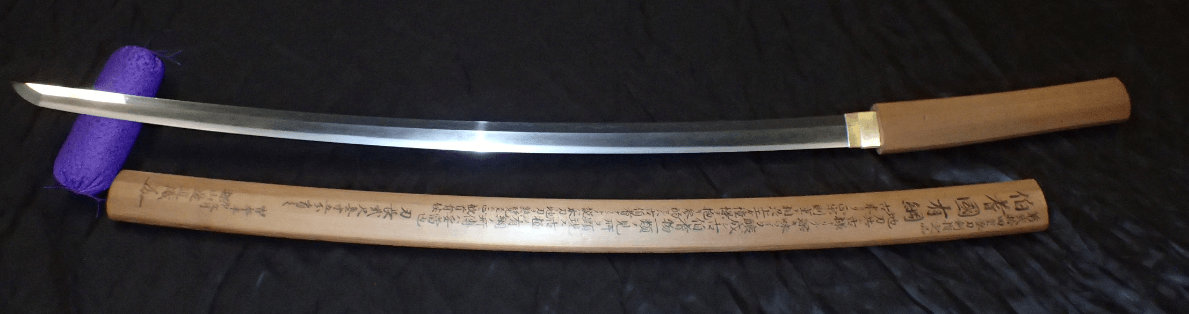
Kunimune of Hōki is one of the standing puzzles of the old Hōki school, a smith of the late to early period whose work is bound up at every turn with the problem of telling him from his far more famous namesake. The published sources are candid about how little is settled. No fixed account of him survives, and no blade among the few that remain records Hōki as his place of residence, so that he is known almost entirely from the workmanship and the cut of his signature. One tradition passes him down as a pupil of the smith Saburō Kunimune who later moved to Hōki, but the published commentary on his extant signed finds this hard to sustain: examined together, the surviving blades show none of Saburō's manner, run more archaic in tone, and may even precede him, so that the reads him not as a offshoot but as a smith who, in their words, 'inherited the line of the Yasutsuna group'. He stands, in other words, beside Sadatsuna and the other early Hōki hands rather than among the -makers, and the constant refrain of his designation entries is that his work is 'distinct from Saburō Kunimune'.
What the judges actually name as his hand is a -laden, archaic temper rather than the bright of . Over the body of his signed and shortened he tempers a -based , broken with and a shallow tone, the entering well and the gathering thickly within the edge, and through it run insistent and , with the clouding to in places. This -rich, restless edge is the tell the published sources lean on to separate him from the calmer, -built of the Kunimune. The answers the : a or straight sweep that brushes into and finishes in a tone, rich in at the point.
The is the other half of the picture, and it is the more rustic for being old Hōki. The forging is with the grain standing, at times flowing, well applied and patches of intermingled, the steel inclining to a dark, iron-like color. It is the kind of the published sources warn can be mistaken for contemporaneous old , told apart by its standing grain, its darkish tone and the soft, clouded edge over it. On the finer pieces, where the forging tightens, a faint rises, and on one shortened the close with a masa tendency takes on a whitish reflection instead. Throughout, the manner is read as archaic and 'of high antiquarian fragrance', no later than the early .
His small record divides into two registers. The mainstream face, carried on most of the signed and , is the rustic Hōki manner just described: standing , darkish steel, a clouded -based full of and . The second face is a small group of finer signed , two of them at the rank, where the forging packs into a dense with , the temper brightens into , and the upper half of the edge breaks into a banded double- and triple-temper, a and sanjūba effect. This banding is the feature the published sources single out as 'reminiscent of Sadatsuna of the lineage', and it is the clearest internal link tying Hōki Kunimune into the Yasutsuna group. Across both registers he cuts a bold, archaic two-character signature near the tip of the tang with a thick chisel; the judges find its strokes 'rounder than the Kunimune's, with a somewhat different movement of the chisel', and note that he never signs the fuller Hōki no Kunimune.
What sets him apart, then, is precisely what the comparison with brings out. His extant signed 'show no manner of Saburō Kunimune and are more archaic', and so are referred back to the Hōki line; his -rich edge, his and , and the and sanjūba of his best pieces are the affirmative evidence, not a borrowed flamboyance. The published sources fold his work into the body of Hōki blades they describe as sharing 'a manner common to old Hōki work', and date the school's reach in his case as late as the Einin era. He is, in short, a quiet, archaic Hōki hand carrying the Yasutsuna inheritance forward, valued as much for what he documents about that line as for any single brilliant trait.
For the collector he is a rare early name with a thin but real record. He has no National Treasures and no Important Cultural Properties; his standing rests instead on the designated tiers, where five of his blades fall in the and ranks, two of them at the higher level. One shortened bears a gold-inlaid Hakushū Kunimune signature, and one prewar was certified an Important Art Object and recorded in the Nihontō Taikan. Provenance, where it is recorded at all, runs through old houses rather than museums: a blade transmitted in the Yamana and Ikeda families, and well-known examples the published sources name as once held at 'Kunōzan Tōshōgū' and in the Ii family. Surviving works are few, and the commentary calls them precious as documentary material for so rare a smith. A signed Hōki Kunimune is not a blade that comes to market often; when one of recorded whereabouts does change hands it is a notable thing for a collector to encounter, a document of how the Yasutsuna line ran on into the period.