NihontoWatch MonNihontoWatchBETA
MarketEncyclopedia
NihontoWatch Mon

NihontoWatchBETA

Market
Encyclopedia
Overview·Kantei·Honors·Designations·Provenance·Blade Forms·Signatures·Lineage·School
OverviewKanteiHonorsDesignationsProvenanceBlade FormsSignaturesLineageSchool
  1. Schools
  2. Gojo/Sanjo
  3. Sanjo
  4. Munechika

Sanjo Munechika

宗近

Jūyō
Vol. 64, No. 1 · Tachi

Sanjo Munechika

宗近

4 ranked works

享保名物帳天下五剣
ProvinceYamashiroEraEien (987–989)PeriodHeianSchoolGojo/Sanjo>SanjoTraditionYamashiro-denFujishiroSai-jo saku(Supreme Work)Toko Taikan2,500(top 1%)TypeSwordsmithCodeMUN29
1Kokuhō
2Jūyō Bunkazai
1Jūyō Tōken

Overview

Munechika worked at in the capital around the Eien era of the late period, at the moment when the curved blade that we now call the Japanese sword was first taking its settled form, and he is counted among the very earliest smiths whose names survive. He is the founder of the school and of the Ko-Kyo-mono, the old Kyoto line from which the whole Yamashiro tradition descends, and in popular lore he is no Kokaji, the Little Smith of , the name by which, in the words of the published sources, he "is widely known in popular lore" (三条小鍛冶の名で人口に膾炙している). His patrimony includes the National Treasure Mikazuki Munechika, counted among the Tenka-Goken, the five greatest swords of the realm. Few names in all of nihonto carry so much weight on so slender a surviving record.

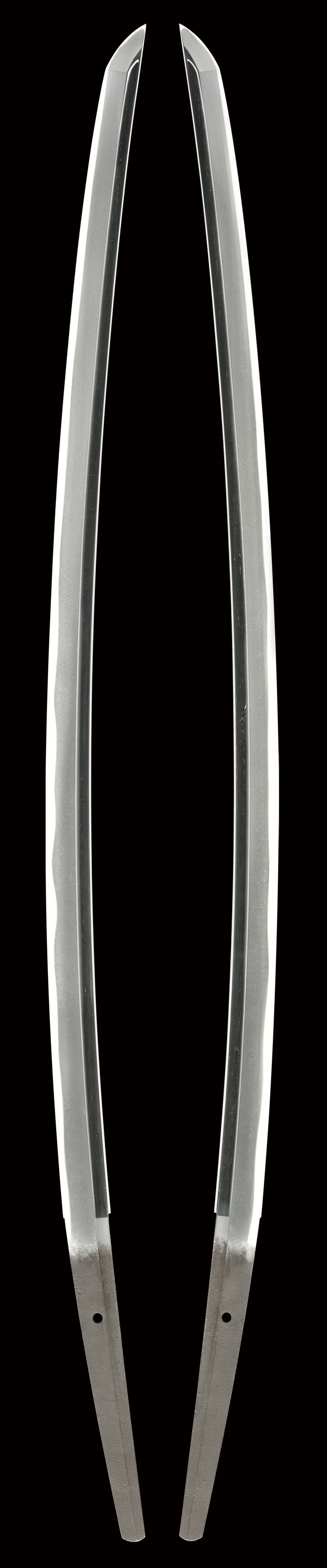
That record is, by the judges' own account, almost vanishingly thin. Works whose signatures can be accepted with certainty "are exceedingly few" (在銘確実なものは極めて少なく), and they come in two practices, the two-character Munechika cut on the or cut on the . The one securely signed on the published record here is an blade, slender, with a clear difference between base and tip widths and a somewhat thin , standing at the base, the running high and settling toward the point, closing into a . It is the elegant, gentle, archaic curve of the late , the bearing the published sources read as older even than early Hoki and early .

The is the refined Kyoto steel of the man who began the Yamashiro line. Over a tightly knit , tending here and there along the to a slightly standing grain, the carries laid as a fine mist, delicate , and a rising softly, a surface the published commentary calls beautiful and a little soft to the eye. Against that quiet the temper is deliberately low. It is a narrow -toned line carrying a small with a feeling, the moist in places and set with , and it is here that the hand becomes personal: and run intermittently from base to point, and around the on the the line doubles and trebles into and sanjuba, the itself taking up the double line and finishing straight with and a feeling of .

This intermittent play of , and double-and-triple temper line is the thread the published sources follow back into deep antiquity, holding that it "connects in one thread to the Shosoin-associated early works" (一脈正倉院物に通じるものであり) and that the blade "may be judged to precede in date even early Hoki and early pieces" (古伯耆物や古備前物などよりも年代がやや遡るように鑑せられる). What separates Munechika from the later Yamashiro and hands is precisely this archaic quiet: not the bright clove-flower of the mature schools but a low, small, classical over a -laden Kyoto , the manner of the tradition at its source rather than in its flowering.

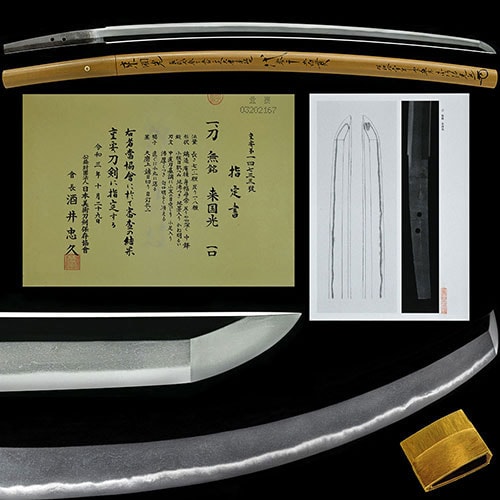
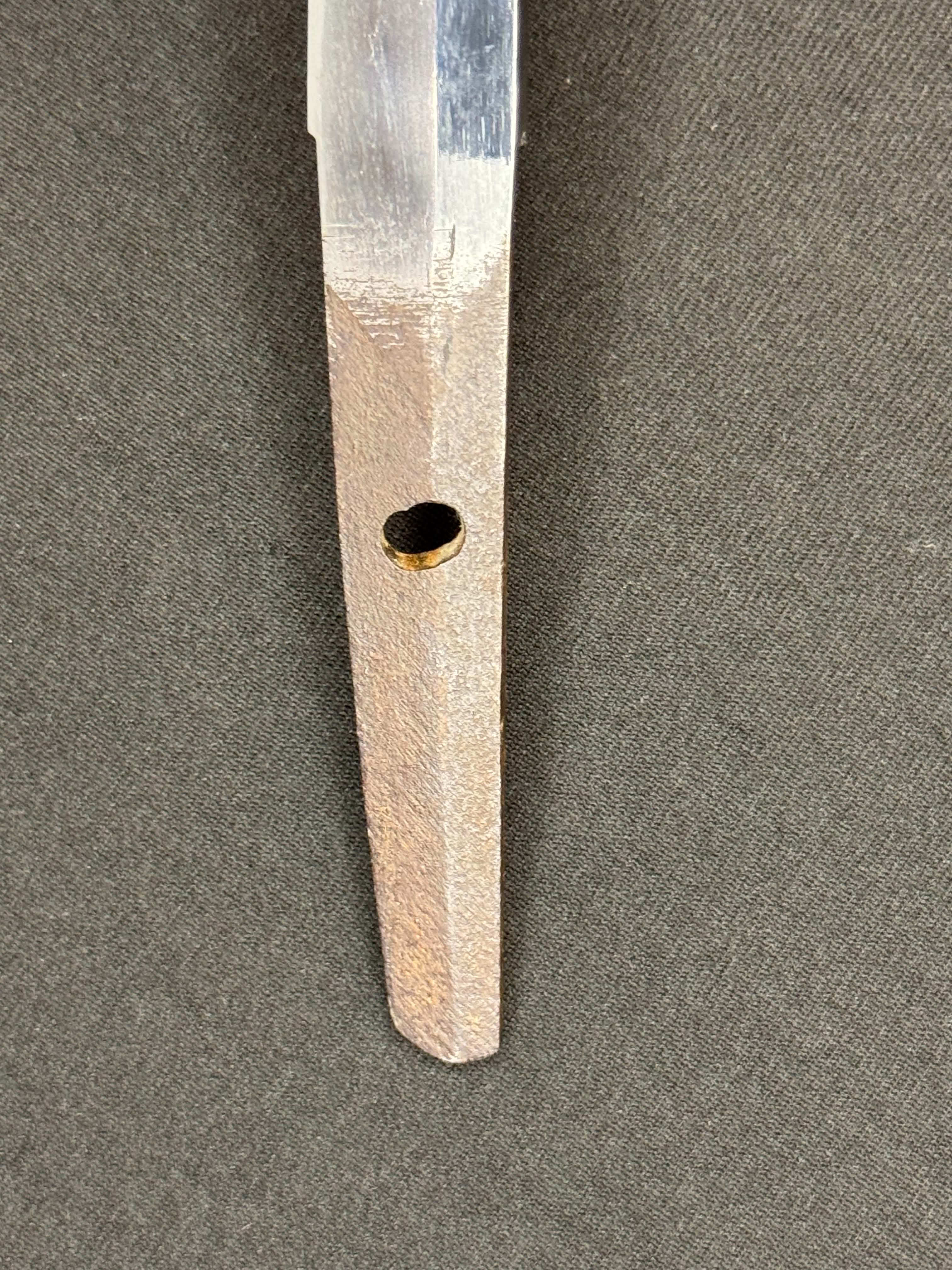
The signature carries its own scholarly question. The two-character of this is cut at the center of the tang in somewhat thick, slightly bold strokes, and the published sources note frankly that its points of commonality with the inscription on the Mikazuki Munechika are not easy to draw. The attribution rests instead on the archaic , the refined , and a documented provenance: the blade is transmitted as having belonged to Kyoto's Atago Shrine, where it is held to have been dedicated by Toyotomi Hideyoshi, and it is recorded in the set of sword drawings Kotoku sent to Ishida Mitsunari, so that its "value as historical source material is extremely high" (歴史的資料性が極めて高く).

The Fujishiro appraisers place Munechika at the Sai-jo grade, their highest rank for the finest smiths, and the Toko Taikan values his work near the very top of its scale. His designated record is among the most rarefied a collector could consider: a National Treasure, the Mikazuki itself, preserved in the Tokyo National Museum, an Important Cultural Property at Wakasahiko Shrine, and the lone securely signed of his own corpus here, carried by Atago Shrine and threaded through Hideyoshi and the Tokugawa shogunal house. These are not blades that come to market; a National Treasure of this antiquity is heritage held in trust, and even an authenticated signed Munechika in private hands would be among the rarest things a collector of early Japanese swords could ever hope to encounter, appearing, if at all, only across the longest span of patience. To hold one would be to hold a document of how the Japanese sword, and the Yamashiro tradition with it, began.
Kantei

a single classical Ko-Kyo-mono Yamashiro hand of the late Heian period, read off one securely signed Juyo tachi: a tightly knit itame with fine ji-nie and nie-utsuri, a low quiet suguha-toned ko-midare with uchinoke, yubashiri and nijuba-sanjuba, the ni-ji signature of the founder of the Sanjo school

Munechika is one of the earliest swordsmiths on record, traditionally placed at in the capital around the Eien era of the late period and known in popular lore as no Kokaji, the Little Smith of . He is the founder of the Ko-Kyo-mono, the old Kyoto line that opens the Yamashiro tradition, and his patrimony includes the National Treasure Mikazuki Munechika, counted among the Tenka-Goken, the Five Great Swords of the realm. Reliably signed work is exceedingly scarce, cut either Munechika on the or on the . The published sources describe a slender of strong and high , the curvature settling toward the tip and closing into a , drawing a gentle archaic curve over a tightly knit with fine , delicate and a . The temper is low and quiet, a narrow -toned line carrying a small with , into which run , and the intermittent and sanjuba that connect his work, in the judges' own thread, to the early Shosoin pieces and place him before even early Hoki and early .

Diagnostic discriminators

100% of his works

100% of his works

100% of his works

Observation by phase

The signed classical hand (Ko-Kyo-mono Yamashiro)

His securely signed record here is a single , slender, with a distinct difference between base and tip widths, a somewhat thin , the slightly high and the rather wide, at the base, a high that settles toward the point, and a , the elegant archaic form of the late . Over it the is a well-packed , tending in places along the to a slightly standing grain, with fine laid as a fine mist, delicate and a rising in the . The temper is low and quiet: a narrow -toned line with a slight small irregularity, mixing in a and a feeling, the moist in places, adhering, with and running well throughout and, around the on the , mixtures of and sanjuba. The runs straight with , incorporates a -like tendency, and finishes with a feeling of toward the point. The published sources read this intermittent , and double-and-triple line as connecting in one thread to the early Shosoin pieces, an archaic fragrance the judges hold to precede even early Hoki and early .

Sugata 姿
Jigane 地鉄
Hamon 刃文
Bōshi 帽子
Scholarship

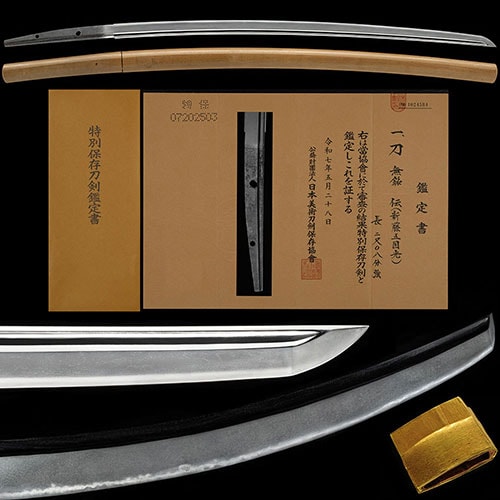
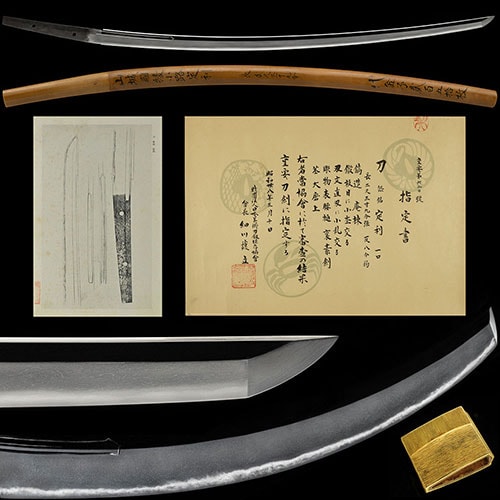
The published sources record that works whose signatures can be accepted with certainty are exceedingly few, that two signature practices are known, Munechika on the omote and Sanjo on the ura, and that the bold thick chisel of this tachi's two-character mei does not make its commonality with the inscription on the Mikazuki Munechika easy to point out, so that the attribution rests on the archaic form, the refined nie-utsuri ground and the documented Atago Shrine provenance.

Honors

享保名物帳Kyōhō Meibutsu Chō (Catalog of Celebrated Blades)

Recorded (meibutsu Mikazuki Munechika)

The family's catalog of celebrated blades (名物) presented to shogun Tokugawa Yoshimune in Kyōhō 4 (1719). Records ~274 blades of – manufacture (168 extant + ~80 burned + ~26 later additions), grouped by smith with valuations and provenance. This honor tags smiths whose work is recorded in the catalog; the detail field carries per-smith counts where the published tally is exact, or 所載 + named blades where only inclusion is verified.

天下五剣Tenka Goken (Five Swords Under Heaven)

Mikazuki Munechika (National Treasure, Tokyo National Museum)

Maker of one of the Five Swords Under Heaven (天下五剣): Dōjigiri Yasutsuna, Kunitsuna, Mikazuki Munechika, Ōdenta Mitsuyo, and Juzumaru Tsunetsugu. All five blades are individually recorded in the Kyōhō Meibutsu Chō; the five-sword set concept is first attested in the 1828 manuscript Shoka Meikenshū (諸家名剣集). The Juzumaru attribution is disputed between Tsunetsugu (traditional/official) and Sakon-no-Shōgen Tsunetsugu (modern scholarship) — both smiths carry this honor with the dispute documented.

Designations

Kokuhō1
Jūyō Bunkazai2
Jūyō Bijutsuhin—
Gyobutsu—
Tokubetsu Jūyō—
Jūyō Tōken1

Elite Standing

0.13 across 4 designated works

Top 15% among smiths

Provenance

7 documented provenances across certified works by Munechika

Provenance Standing

3 works held in elite collections across 7 documented provenances

Top 63% among smiths

Raw score: 1.93 / 10

Blade Forms

Distribution across 4 ranked works

Signatures

Signature types across 4 ranked works

Currently Available

Lineage

Munechika
Students (15)
  1. 1.Yoshiie吉家17designated
  2. 2.Kanenaga兼永12designated
  3. 3.Kuninaga国永9designated
  4. 4.Sanetoshi真利3designated
  5. 5.Arinari有成1designated
  6. 6.Arikuni在國
  7. 7.Arikuni有國
  8. 8.Chikanori近則
  9. 9.Chikamura近村3designated
  10. 10.Kanetsugu兼次
  11. 11.Munenori宗則
  12. 12.Munetoshi宗利
  13. 13.Muneyasu宗安
  14. 14.Sanenori眞則
  15. 15.Tametoshi爲利

Sanjo School

Other artisans of the Sanjo school

  1. 1.Yoshiie吉家17designated
  2. 2.Chikamura近村3designated
  3. 3.Sanetoshi真利3designated
  4. 4.Moriie守家1designated
  5. 5.Chikamura近村3designated
  6. 6.Sukemune助宗1designated
  7. 7.Arinari有成1designated