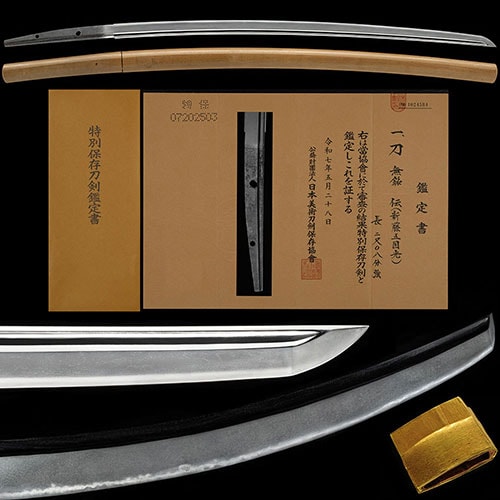
Kuninaga worked at Gojo in Kyoto at the close of the period and into the early , and the published sources count him among the first rank of the old Kyoto makers: "Kuninaga is one of the representative smiths of the ko-Kyomono". He is transmitted as a son or grandson of Munechika, and because he and Kanenaga, given variously as his elder brother or his father, both lived in the Gojo quarter, he is known to the world as Gojo Kuninaga. The most famous blade to carry his name is the Imperial treasure Tsurumaru Kuninaga, and the notes that his signatures are not uniform, yet a whose differs from that treasure and from the Jingu Important Cultural Property can still be acknowledged as the hand. Signed work is exceedingly scarce, only a few and a single , and the published sources say of them all that they "display an archaic elegance and a richly resonant character".
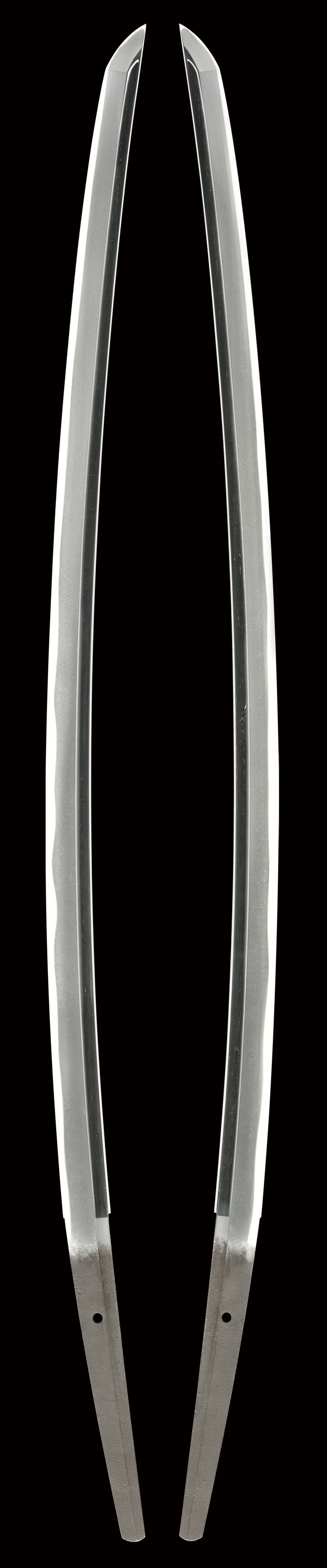
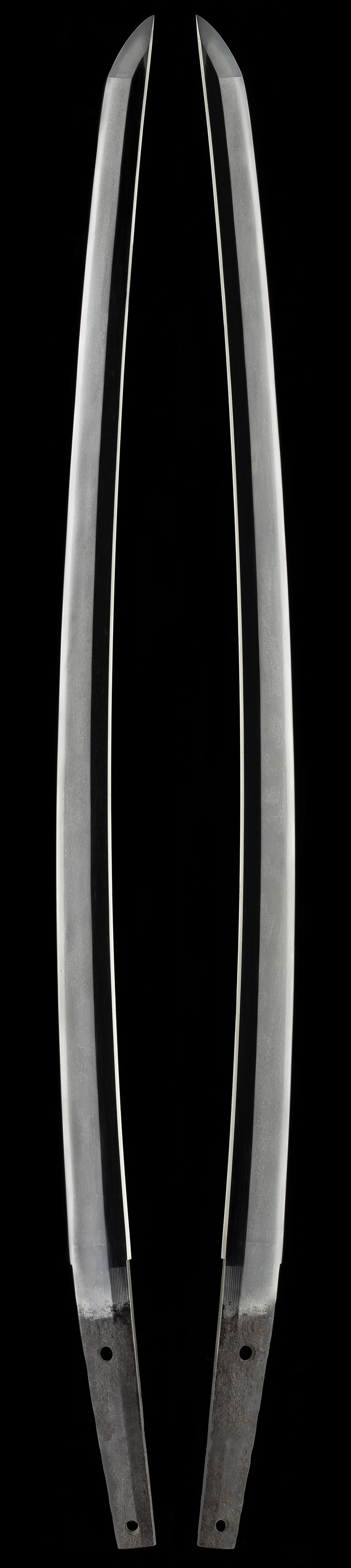
The character of his hand is a quiet one, an old Kyoto temper set over a refined rather than a flamboyant edge. His finest signed keep the slender, graceful -buri form, the curvature high at the waist and easing toward a small , the old shape preserved even where the blade has been shortened. Over a well-packed , standing a little in places and mixed with and , he tempers a soft, bright on a -toned base, drawing in and with and well entered. Where the later schools would raise a towering clove-flower, his line stays small and antique, the soft and the well adhered, with fine and and, along the crests of the temper, and small .
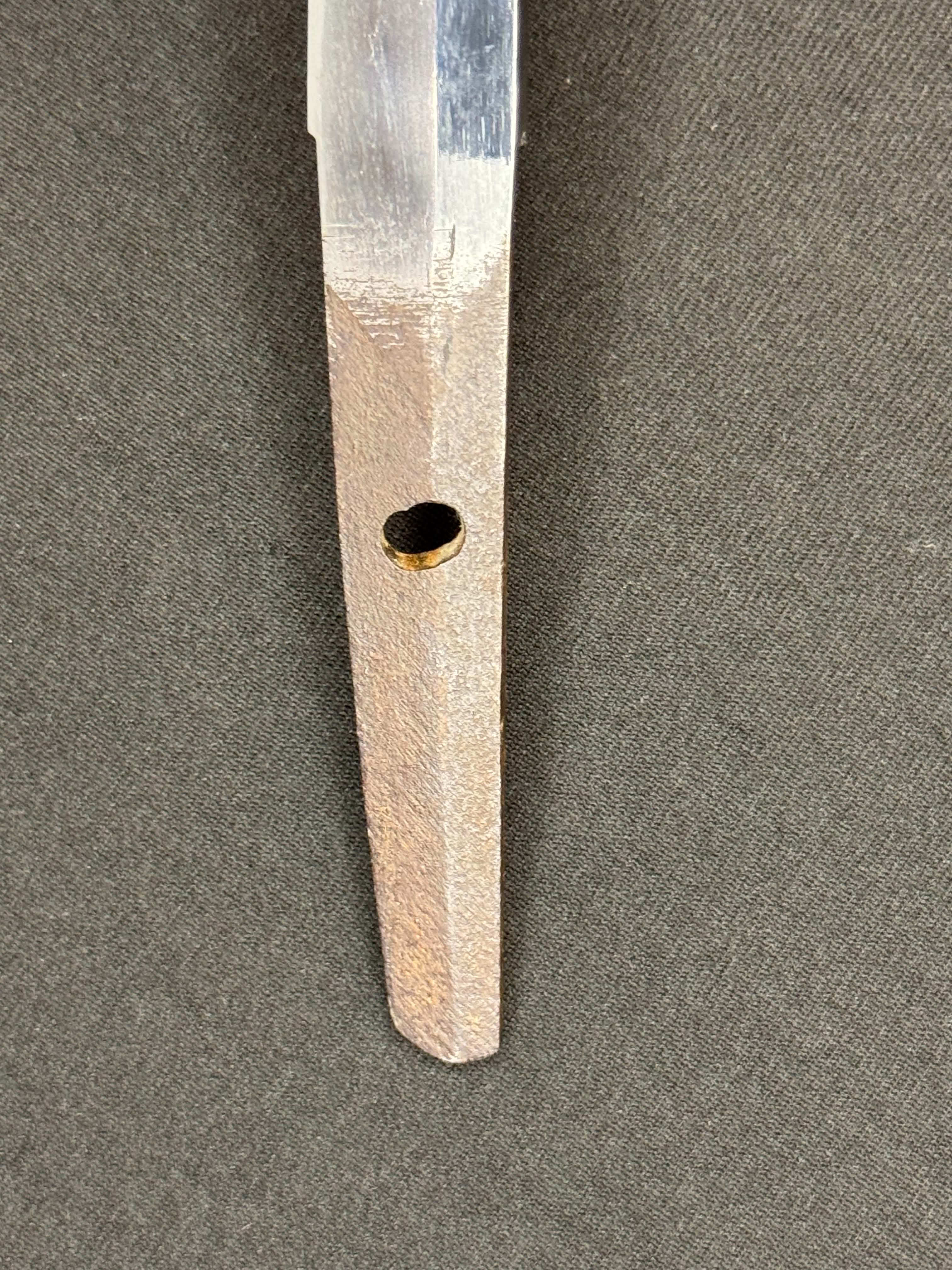
The is the constant. Fine settles in minute, even across the surface, delicate enter, and in places a faint stands, the bright reflection of well-forged Kyoto steel and a Yamashiro feature of his hand. On the most powerful of the attributed the forging flows and stands more openly, the lying thick, and the shows clearly in parts so that the steel reads bright. The runs straight or into a slight , well swept with , the tip pointed and turning back, on one signed a little longer on the face; on the signed it finishes .
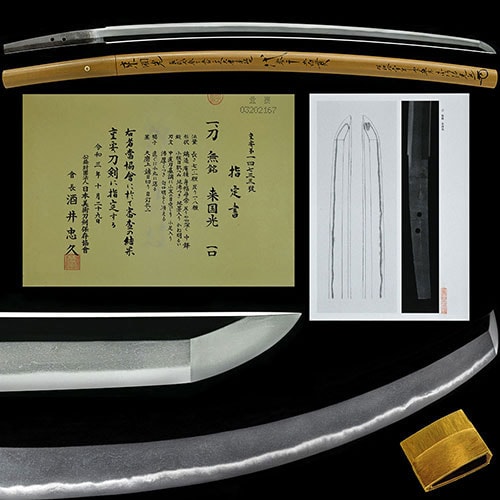
His record divides cleanly into two readings. The signed and are the standard against which he is judged, and the calls one such extremely valuable for understanding the style of a smith "whose signed works are exceedingly rare." The other face is the attributed to him as mainstream old-Kyoto work. On one the published sources read a "strong Yamato character, yet with the lingering manner of Munechika present" and a slightly later period; on another, of standard width and thick and heavy in hand, a base mixes , , and angular , with , and -like and, in parts, a -like edge, of which the sources say it "clearly demonstrates the distinctive traits of Gojo Kuninaga in both and ".
What sets him apart is exactly this old-Kyoto poise. His bright, soft on a base, the faint and the well-ordered Kyoto that predominates on his strongest blade, stand before the elaborate work of the mid- schools rather than within it, his line kept small and antique. The published sources find the highlights of the old Kyoto style conspicuous on his work and the whole "unmistakably graceful", the antique contained within a refined line that has strength without roughness, the skill of a master craftsman. With Kanenaga he stands at the head of the Gojo line, the quiet root of Yamashiro work from which the manner of Munechika is carried forward.
For the collector he is among the rarest of the early Kyoto names. He has no National Treasures on our rolls; his record runs instead through one Important Cultural Property, the signed the published sources call exceptionally sound for a piece of its period, and a small handful of , alongside the prewar Bijutsuhin. His blades are held in long-standing public and private hands grounded in their own provenance: a preserved at Jingu, pieces transmitted through the Date house and once held by Date Muneaki, and provenance reaching to Oda Nobunaga and to the Meiji Emperor. Only a few fall in the tier, so a signed Gojo Kuninaga comes to light only seldom; a privately held example is among the most notable things an early-Kyoto collector could encounter, a document of how Yamashiro work began.