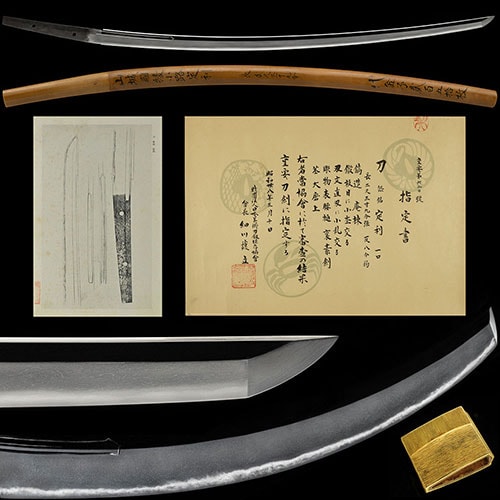
Chikamura was a swordsmith of the group of Kyoto in Yamashiro Province, active from the late period into the early period. According to the and related signature references, he is transmitted as a son of Munechika. A smith of the name is also recorded within the school, and among surviving works it is not always easy to determine at a glance whether a given blade should be assigned to or to . However, the former imperial treasure (kyu-) bearing his signature may safely be regarded as a Kyoto-made piece on the basis of its workmanship, and this attribution has served as the principal reference point for distinguishing his hand.
Chikamura's characteristic work displays the archaic and elegant associated with the lineage: slender, with high , , and . The is mixed with and , with abundant well applied and appearing. The ranges from mixed with small to , with and entering, adhering well, and and appearing — hallmarks of accomplished workmanship. The typically runs straight, turning in , with a tendency toward . Two distinct types of signature survive: one in large, boldly cut characters and another in smaller script, possibly reflecting different periods within the smith's career.
Extant signed works by Chikamura are exceedingly few, rendering every surviving example of considerable documentary value. His blades constitute essential material for the study of the school's transmission beyond its founding generation, and those retaining traces of vermilion writing () reading "" on the reverse of the provide direct evidence of the traditional school attribution. The former imperial collection pieces, in particular, remain the touchstone against which all attributions to this smith are measured.