Gojo Kanenaga of Yamashiro is the central smith of the Gojo group, the second house of the capital's forging after the line of Munechika, and his is the archaic Kyo-mono manner from which the perfected Yamashiro of the and schools would later descend. The published commentary transmits him as a provincial son, grandson or disciple of Munechika who, together with Kuninaga, settled in the Gojo district of Kyoto, the place-name by which the line is known. The smiths drawn from the Munechika line, the published record names as Yoshiie, Kanenaga, Kuninaga and Arinari, of whom only Kanenaga and Kuninaga leave reliably signed work, Kanetsugu and Kaneyasu surviving without confirmed signatures. A late- date is given throughout, and the single fixed point of his oeuvre is the benchmark designated an Important Cultural Property and held by the , against which the attributions are read.
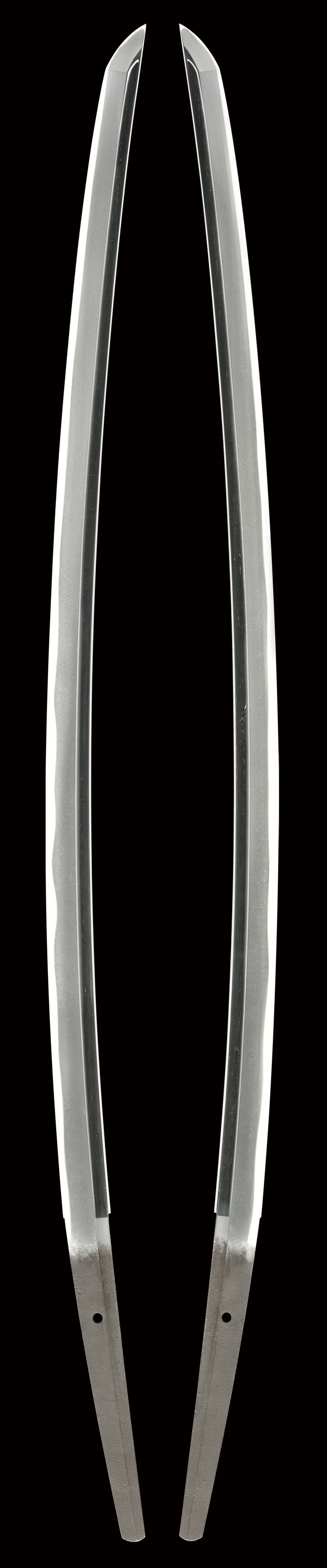
The characteristic hand is a late- Yamashiro : a slender blade in with , deep and pronounced on the pieces, the width narrowing markedly from base to tip to a small , the tip carried with a slightly downturned set. Over this classical stance the temper is laid in a tone into which small clove and small irregularity enter: a mixed with , and , and running in frequently, the deep and attaching, with and sweeping through a bright . It is the laced into the otherwise quiet base that most distinguishes the Gojo work from the plainer of and the pure of that follow, and the published commentary returns to it as the antique signature of the school, describing the signed benchmark in just these terms: "the forging a densely packed with fine , the mixing with in a technically refined and brilliant style".
The is , on the most tightly forged pieces a dense , but it tends to stand somewhat, with a character and flowing grain in places and the occasional o-, fine attaching well across it and, on the better-preserved blades, a rising in the surface. That standing, open grain is itself a point: a grade more archaic than the tightly perfected of the and that succeed him, the mark of the older -Gojo manner. The reads the work as Kyoto rather than Yamato, for the Kanenaga of Nara seldom throws it. The is quiet, running straight or with a slight droop and turning back in a small , sometimes with or a touch of entering the turn. The published sources find an archaic fragrance in this small irregular temper worked in , writing of the signed that its "small irregularities in carry an antique scent", and of an attributed that its small- is likewise old and refined.
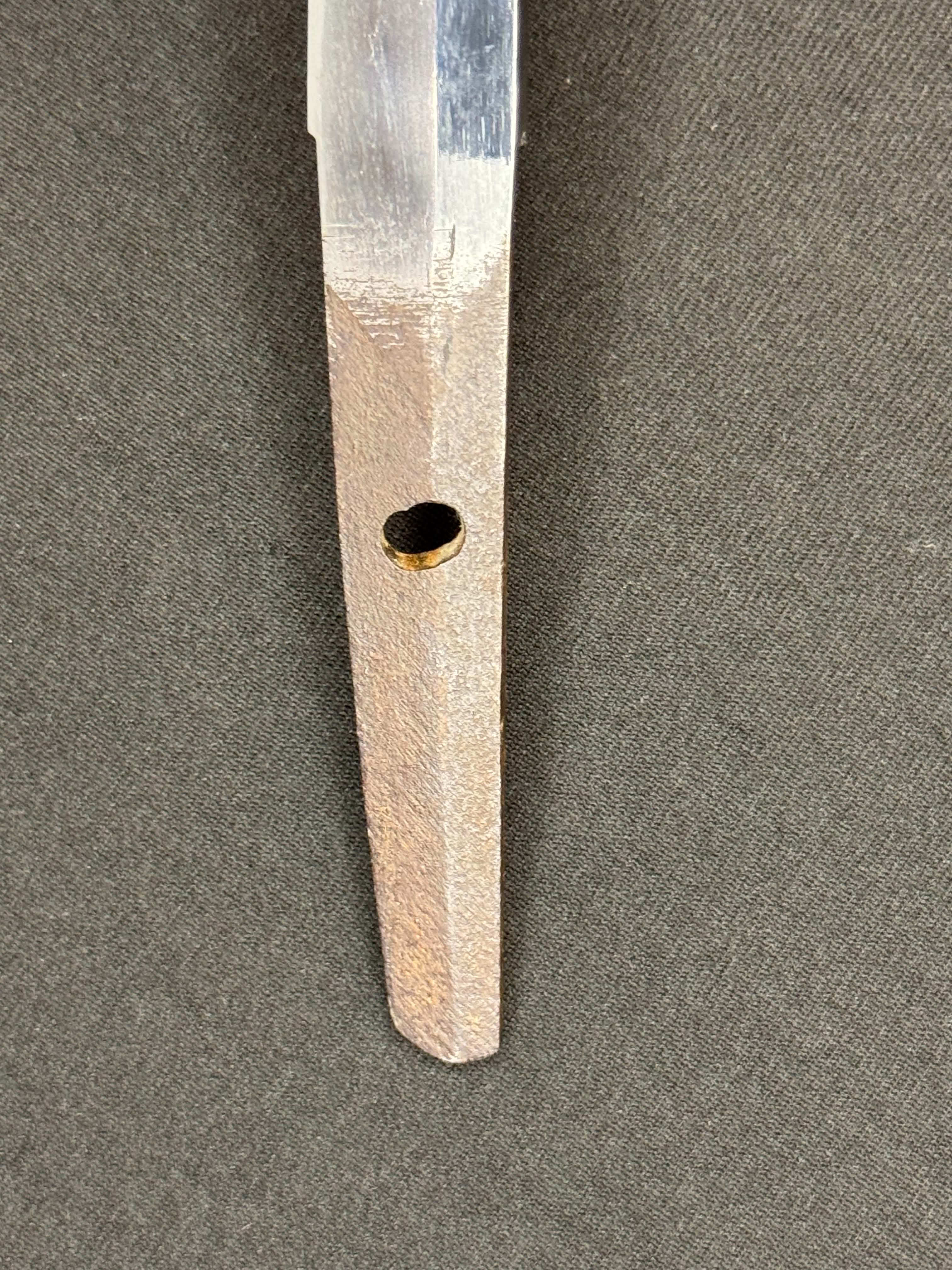
The surviving record stands in two registers joined by one manner. On the one side are the few genuine signed , and deeply , on which the inscription survives only as a single bold character cut with a thick chisel, "" with the lower character lost; on these the chiseling itself becomes the tell, for the published commentary records that "he cuts a two-character signature with the large and the naga somewhat smaller", the 永 habitually compressed and reduced. On the other side, and far the larger body, are the greatly shortened blades reworked from into and appraised as Gojo Kanenaga or ko-Kyo-mono, their attribution resting on the classical form and on points in part of the that connect to the benchmark . A handful carry an inlaid appraisal: one bears a four-character reading Yamashu Kanenaga. The blades range from a quiet -toned to a more flamboyant that becomes especially showy toward the , the appraisal reaching as far as a vivid while holding to the old Kyoto idiom.
Within the early Yamashiro his place is exactly drawn by what separates him from his neighbours and his parent. From Munechika above him the Gojo work is set apart by its order: more controlled than the founder, the published commentary judging one attributed blade "archaic in flavor, yet more orderly than the work of Munechika", so that the very regularity of the temper marks the Gojo hand against its more primitive source. From the and schools below him he is parted by the older , the standing and the against their perfected , and by the that survives in his where theirs runs plainer. So thin and so classical is the signed corpus that the name marks a manner and a standing as much as a single hand: the published sources caution of certain attributed blades that, though appraised as Kyo-mono, they "cannot be conclusively identified as Gojo Kanenaga", held distinct from the signed Kanenaga while admitted to the school.
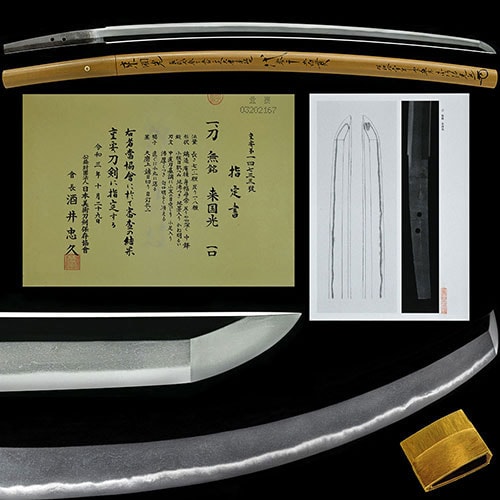
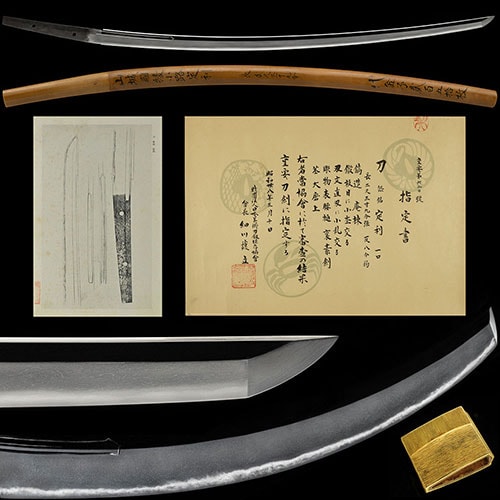
Kanenaga is rated Jo-jo by Fujishiro and carries a Toko Taikan valuation among the upper rank of Yamashiro names. The weight of designation behind him is considerable for so early and so sparely signed a smith: two of his blades are Important Cultural Properties, with two and five beneath them, seven works in the and tiers in all, and three further pieces designated Bijutsuhin in the prewar period; no stands among them. The provenance recorded against his blades runs through houses and the shogunate: one broad and powerfully built was transmitted in the Owari Tokugawa house as his work, said to have come from Tokugawa Ieyasu and carrying a Kochu of Shotoku 4 (1714); the was presented by Rokugo Iga no Kami Masakiyo to Shogun Tsunayoshi and afterward bestowed by the shogunal house upon the Satake. The published commentary appraises the work everywhere as ko-Kyo-mono, "truly elegant in the manner of old Kyoto work", and "clearly expressing the characteristics of old Kyoto work". A signed Kanenaga is among the rarest things in the field, the genuine examples numbering only several ; the attributed ko-Kyo-mono , in the and tiers, are themselves held in long-standing and largely private collections, coming to open hands only rarely and as a landmark of the earliest Yamashiro forging when they do.