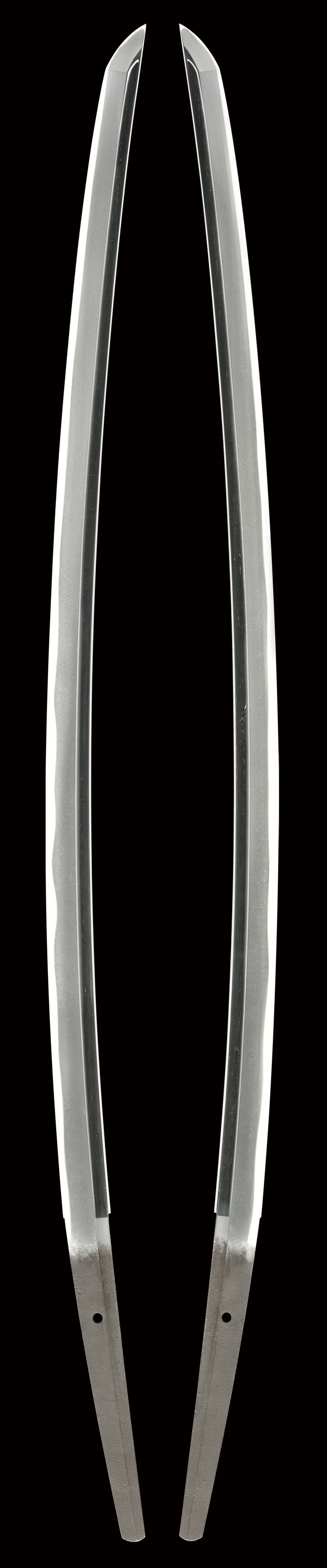
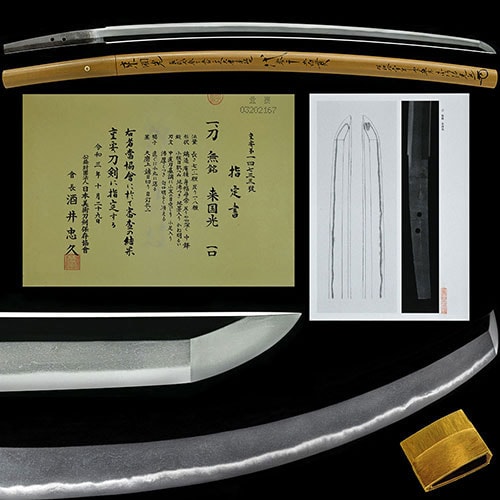
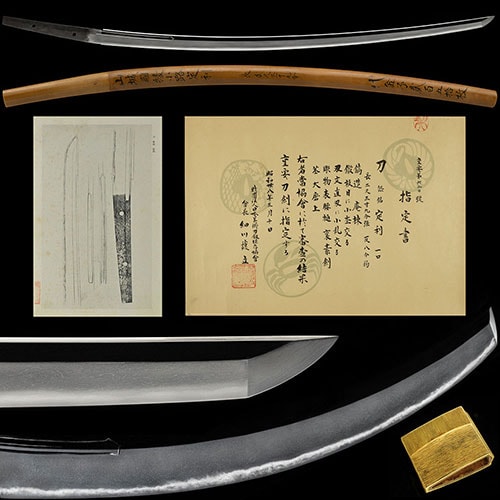
The designated at the 23rd session, a signed two-character Yoshiie (吉家) handed down in the Kajiki Shimazu family, is placed by the published sources at the very end of the period, a work of the Fujiwara to transition (藤末鎌初). Yoshiie belongs to the school of Yamashiro, the line of Munechika and the oldest stratum of Kyoto sword-making; the old registers transmit him as Munechika's son, in some accounts his pupil. The does not accept the link: a considerable number of securely signed works survive, and judging from their style the published sources hold that connecting him directly to Munechika "is untenable", reading him instead as a somewhat later smith of the school, dated across the texts from late into mid .
His keep the old Kyoto build, slender in , the high and deep with on the examples, closing in a small or middle . The is a mixed with ; and enter frequently, sits strongly, and run through the , and the is bright and clear. The feature the published sources name most insistently lies above the , where the small takes on and turns ; even the , with and , carries a doubled feeling. On one signed the writes that the and the -like character of the "are all his points to see"; another commentary calls the small that develops into a viewing point of the school itself.
The is and , well knit, with thick, extremely fine , within it, and a faint , read variously as a soft or a of . On the the steel is called bright, the forging thickly carpeted with and interwoven with , showing "not the slightest looseness". Within this single manner the temper ranges from blades fired quietly on a base with gentle undulation and small to others that widen at mid-blade into a flamboyant . What unifies them is age of flavor: the published sources find in one blade "a deep, archaic elegance" of and say of another that it "possesses a truly archaic fragrance".
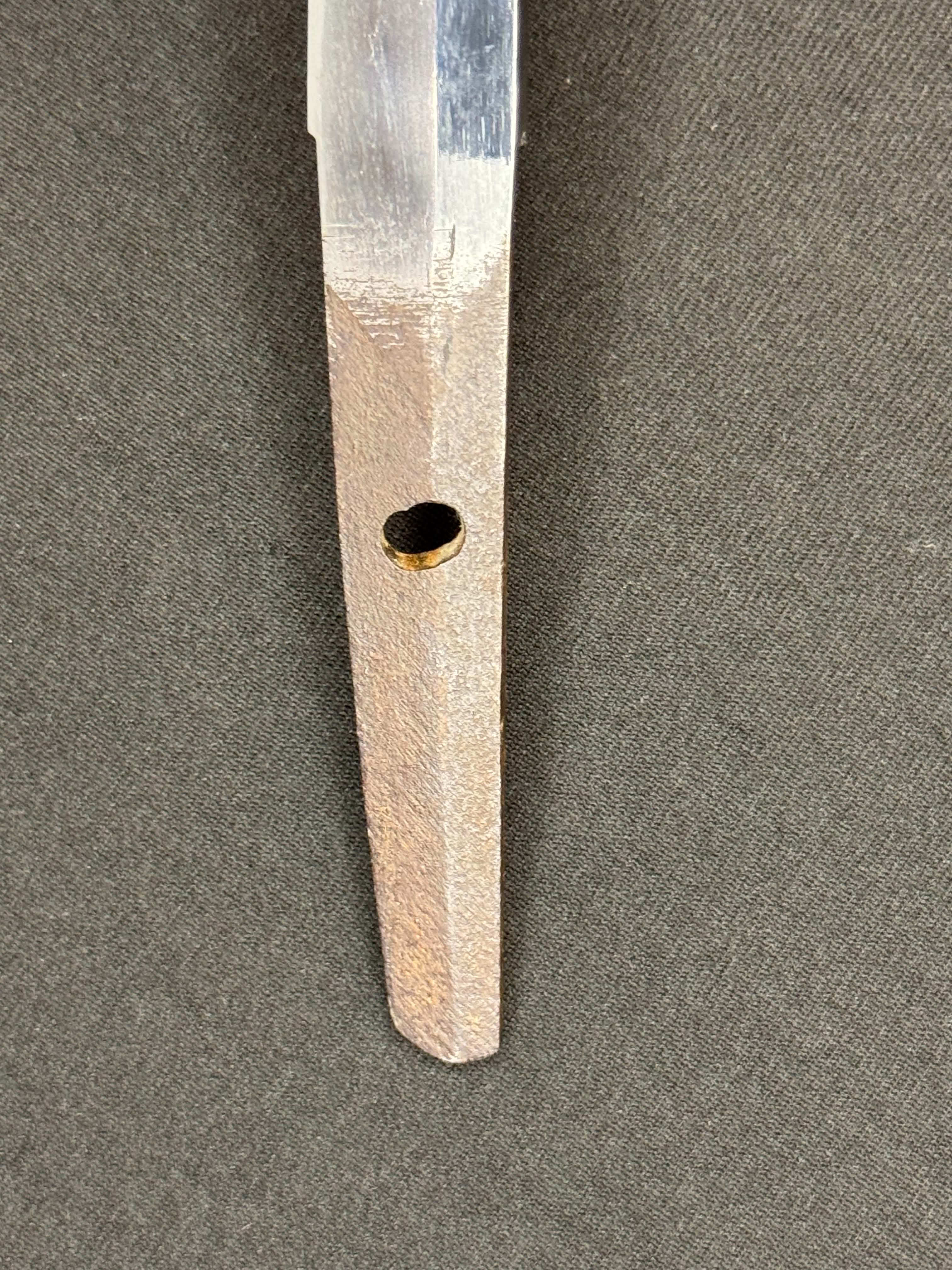
His takes two forms, the two-character Yoshiie (吉家) and the three-character Yoshiie- (吉家作), cut with a bold chisel (太鏨) on the toward the . Signed are comparatively few and the scholarship around them candid: Honma notes that signed blades transmitted as Yoshiie are not uniform in their signature, passed down variously as , or , and only two, formerly in the O-Shimazu and Akaboshi families, are decisively accepted as old Kyoto work. On one signed the characters Yoshiie were later re-chiseled to read Tenza (天座), the name for a sword worn by a retired sovereign (上皇), association rather than forgery, the original reading still legible. Around the signed pieces gathers the register, and passed down as Yoshiie, the attribution resting on the archaic cast of the ; one such carries an of Honami Kojo (光常) dated 8 (1668), valuing it at 350 .
The problem shadowing every Yoshiie blade is the homonym, and the published sources state it without softening: the name exists in both the school and the school, the manner of signing and the workmanship resemble each other, and some blades "cannot be decided offhand". The adjudication rests on his own marks. One was decided for because its is "strong and archaic" and from the manner of its signature, while the namesake of the mid- period, the sources note, "mostly fires a flamboyant ". Within Kyoto the brightness draws the other line: the strong and the bright, clear his texts record blade after blade separate him from Ayanokoji Sadatoshi, the other Kyoto hand working in small , and in the whole of his published record an tendency appears only once, at the of a single . The commentary gathers his identity into a phrase: a blade in which "the Kyoto temperament is pronounced".
Fujishiro grades him Jo-jo , and seventeen designated works stand on record: five Important Cultural Properties, four Bijutsuhin, one and seven . The five Important Cultural Properties are patrimony and will never trade; his recorded holders include the Kyoto National Museum, the Hayashibara Museum of Art, the Kosetsu Museum of Art and the Mori Shusui Museum of Art. The provenance roll is old Kyoto's own: the was presented by the main Shimazu house when Shimazu Tadaro was enfeoffed at Kajiki and stayed with that branch thereafter; a Bijutsuhin came down in the Ikeda family of Okayama; the of the Owari Tokugawa, with the characters Hachiman (八幡) carved from the into the , is kept by the Tokugawa Art Museum; other blades passed through the Hachisuka and Matsudaira families, and one carries an association with Uesugi Kenshin. What a private collector may realistically encounter is the tier of eight blades in the and ranks, and even these are held far more often than traded; a of the early school comes to open hands only rarely, and a signed Yoshiie, of which the published sources accept so few, almost never.