NihontoWatch MonNihontoWatchBETA
MarketEncyclopedia
NihontoWatch Mon

NihontoWatchBETA

Market
Encyclopedia
Overview·Kantei·Designations·Provenance·Blade Forms·Signatures·Lineage·School
OverviewKanteiDesignationsProvenanceBlade FormsSignaturesLineageSchool
  1. Schools
  2. Enju
  3. Kunimura

Enju Kunimura

國村

Tokujū
Vol. 22, No. 18 · Tachi

Enju Kunimura

國村

15 ranked works

ProvinceHigoEraKenji (1275–1278)PeriodKamakuraSchoolEnjuTraditionYamashiro-denFujishiroJo-jo sakuToko Taikan1,000(top 8%)TypeSwordsmithCodeKUN692
1Jūyō Bunkazai
4Jūyō Bijutsuhin
2Tokubetsu Jūyō8Jūyō Tōken

Overview

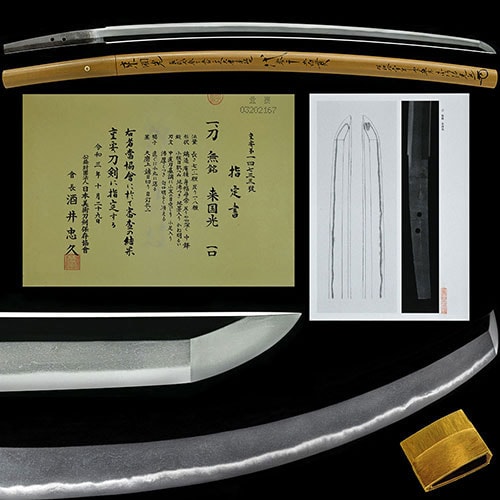
Kunimura is the founder of the school of province, and the published sources set him within the orbit of Yamashiro . According to the prevailing account he was the son of Hiromura of the Yamato Senjuin line, who married a daughter of Kuniyuki, so that Kunimura is transmitted as Kuniyuki's grandson through that daughter and a pupil in the workshop; the school name 延寿, , reads on the characters as the line itself. From him issued the smiths who carried the school, Kuniyoshi, Kunitoki, Kuniyasu, Kunitomo, Kunisuke, Kuninobu and Kunitsuna among them, and from the close of through the period the family flourished at Kumafu in Kikuchi District. His own dated standing falls in the late period, and one of his signed , the blade of 2012, still survives at 87.8 cm with a two-character signature cut in somewhat thick chisel strokes near the center of the tang.

The published descriptions characterize the Enjū hand as the Yamashiro look carried south to the provinces, and they say plainly that the school "in general resembles the school" (概ね来派に類似する). What separates it is a set of provincial accents on that Kyoto manner. The forging shows "a noticeable -tinge together with conspicuous whitish " (鍛えに柾ごころが目立ち白け映りが立ち), the being the surest single tell, the cool reflection of a steel that is not quite the bright . The temper is , either or the narrower , with the drawn somewhat , sunken and quiet, frequently breaking into , the doubled line that recurs across his blades. The completes the signature: where turns back in a tight , the tip is rounded on a larger radius, an with a shallow, short turnback.

The is a well packed and close, mixed with and running into toward the edge, with laid on finely and delicate entering; in places the grain flows strongly and leans to , and over it stands the faint whitish the sources keep returning to. The is laid down in deep with adhering, and at times a small feeling entering, fine drawn through it; the activity within the edge is gentle rather than busy, and the in his better work is bright and clear even where it sinks. On the the published commentary reads this "inherited from the tradition" (来派の伝統をひいた直刃) as producing "a profound, subdued and quiet flavor" (深みのある渋い味わい), the temper restrained, the calm, the whole understated rather than showy.

His work survives only as , the published record noting that "his production is confined to " (その作刀は太刀に限られ), with no or other forms yet seen; the long blades come down either or into , and the surviving signed pieces are all . Two registers can be read in the corpus. The signed - are slender, long, with a marked taper from base to tip, deep with , and a small ; this 細身・幅差顕著・小鋒 form the sources call "distinctive to Kunimura even within the school" (同派の中でも国村独特のもの), and it is precisely this that lets an appraiser narrow a blade down to Kunimura himself, as the 2019 and 2021 commentaries do explicitly. The form the second register, shortened from such and attributed by the reasoning. One even preserves the cut-off, signed tang-tip, inserted back into the shortened as a so the signature would not be lost.

The distinction the sources care about is against , and they draw it from Kunimura's own traits rather than from the blades. One feels "the air of Kyoto work, of the school in particular" (京物とりわけ来派の風情を感じる) in its wheel-like curvature, yet the depth and tightening of its place it with ; another, grounded in workmanship, is said to "reveal a Yamato temperament" (大和気質が窺われて) in its flowing and . The Jūyō Bijutsuhin commentary by Honma puts the kinship and its limit in one phrase: work "resembles yet differs a little" (来に似てやや異なる), carrying some whitishness and a -air, and its shows activity "more sparing than the of the school" (刃中の働きが来一派の直刃よりも淋しい). That quieter, cooler register is the whole point of the school, and Kunimura is the smith who sets it.

In Fujishiro's grading Kunimura is Jō-jō , and the Tōkō Taikan values his work at one million yen, a high standing for a provincial founder. The designated record runs to one Important Cultural Property, two and eight , ten blades in the and tiers, divided about evenly between signed and pieces. The provenance behind them is considerable: the Important Cultural Property descends through the Kuroda family, one through Tokugawa Iesato and the Tokugawa family, others through Nanbu Toshihide, Harumasa and Yamada Fukunosuke; of recorded whereabouts, examples are held by the Hayashibara Museum of Art, the Idemitsu Art Museum and the Okayama Museum of Art. The Important Cultural Property is heritage held in trust and will not trade. The remainder, the and blades, come to market only from time to time and with patience; a signed by the founder of is among the rarer things a collector of work could hope to encounter, and most of what survives is the attribution rather than the signed blade.
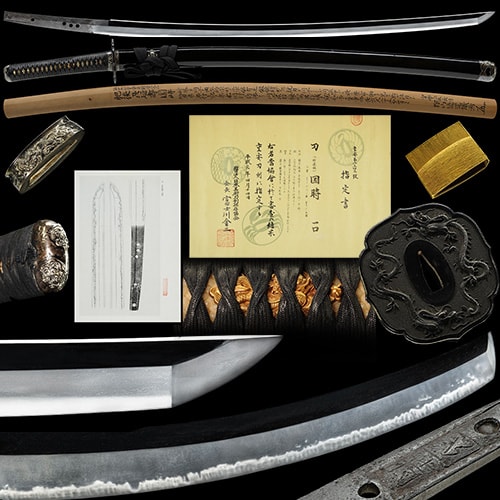
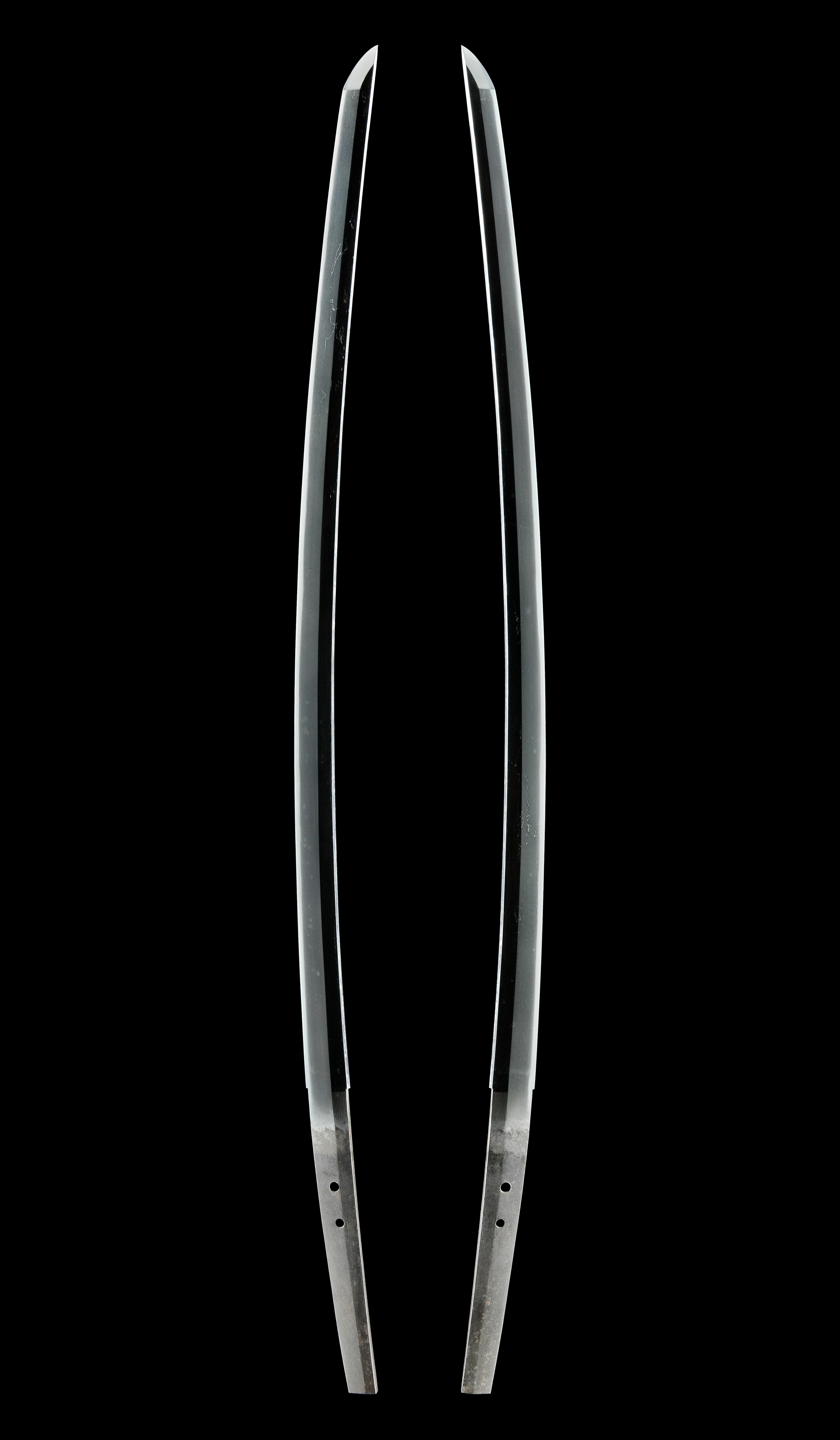
Kantei

One coherent Enju manner (the school shows little individual variation, broadly resembling Rai but for the shirake-utsuri, the masame-lean, the sunk-quiet suguha and the large shallow-turnback boshi) read in two registers: signed ubu tachi, and mumei osuriage katana attributed to Kunimura on his distinctive slender, sharply-tapered, small-kissaki sugata.

Kunimura is the founder of the Enju school of Higo, by tradition the external grandson of Rai Kuniyuki (the son of Hiromura of the Yamato Senjuin line who married Kuniyuki's daughter) and a pupil in the Rai workshop; from him issued Kuniyoshi, Kunitoki, Kuniyasu, Kunitomo, Kunisuke, Kuninobu and Kunitsuna, the school flourishing at Kikuchi-gun Waifu from the end of Kamakura into Nanbokucho. His work survives only as tachi (and osuriage katana from them), all slender, long, with a marked motohaba-sakihaba taper, deep sori and a small kissaki. The hand is the Rai Yamashiro look transplanted to the provinces: a packed itame/ko-itame with thick ji-nie and fine chikei, carrying a whitish shirake-utsuri and a masame-leaning flow, hardened in a chu- or hoso-suguha whose nioiguchi sinks a little and runs quiet, frequently breaking into nijuba, the boshi a large-radius o-maru with a shallow, short turnback.

Diagnostic discriminators

the prime Enju tell: a whitish shirake-utsuri stands in the ji where the Rai parent has essentially none (Rai Kunimitsu 0%, Rai Kunitoshi 1%); the published sources cite it as the first point separating Enju from Rai

the suguha frequently breaks into a nijuba (double habuchi), at roughly four to five times the Rai rate (Rai Kunimitsu 9%, Rai Kunitoshi 12%); recurrent on both the signed tachi and the mumei katana

directly stated as the Enju distinction from Rai: the nioiguchi runs somewhat subdued and the activity in the ha is calm, where the Kyoto parent is brighter and busier; suguha is 100% of his corpus vs 83-84% in Rai

the named bōshi discriminator: the tip's roundness is somewhat larger and the turnback shallow/short, set against Rai's komaru with a fuller turnback

the published sources repeatedly call this sugata 'Kunimura's own' (国村独特) within an otherwise uniform school; it is the basis on which mumei blades are narrowed from Enju to Kunimura himself

Observation by phase

The Enju manner: Rai transplanted to Higo (shirake-utsuri, masame-lean, the quiet suguha)

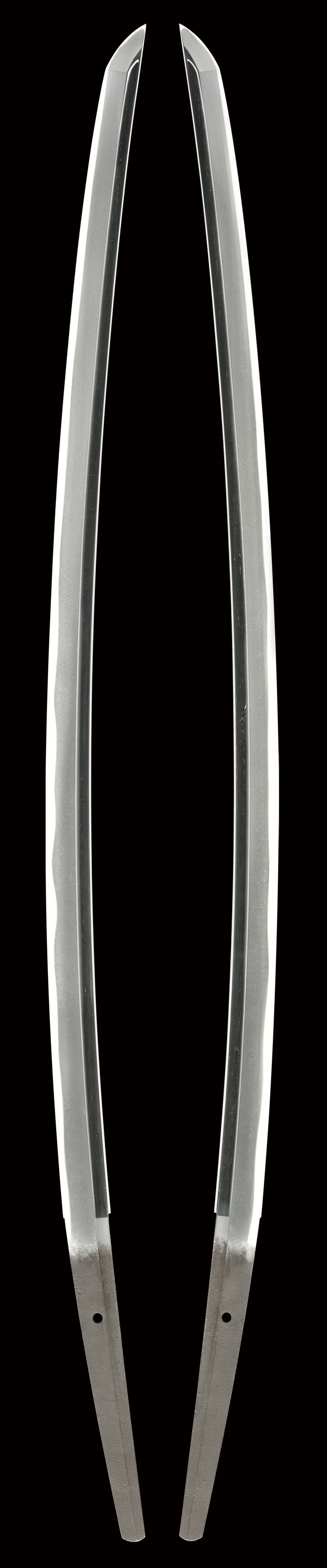
Over a packed itame or ko-itame, sometimes mixed with mokume and flowing toward masame, the ji carries dust-fine ji-nie, fine chikei and the school's whitish shirake-utsuri. The temper is a chu- or hoso-suguha, the nioiguchi tightening and sinking a little, the activity in the ha kept calm, with ko-ashi, ko-nie, and a recurrent nijuba that the judges name as a school feature. The boshi closes sugu into a large-radius o-maru with a shallow, short turnback. Against the parent Rai school the published sources fix the differences precisely: the masame-lean and shirake stand out, the nioiguchi runs subdued where Rai is brighter, and the boshi turns back shallow and round rather than komaru.

Sugata 姿
Jigane 地鉄
Hamon 刃文
Bōshi 帽子

Signed ubu tachi register

ubu tachi carrying a two-character mei (and one gakumei reset into the tang), all long, with a deep koshizori and standing taper; nie-deki appears on this register's lower half

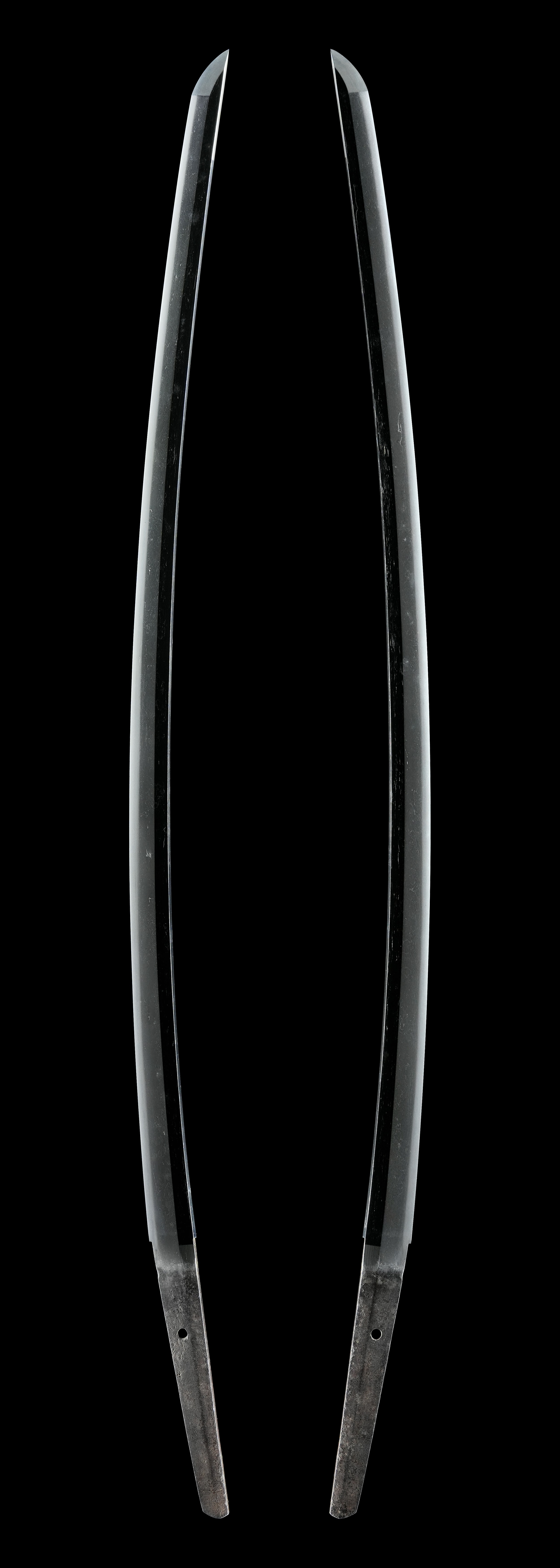
His signed survivals are long ubu tachi, the mei a comparatively small two-character signature set toward the mune, with a deep koshizori and conspicuous taper toward the small kissaki. Several carry a bo-hi with soe-hi, or twin grooves, and gomabashi at the koshimoto. On these the suguha may carry a little nie-deki and small ko-midare or ko-choji ashi in the lower half, the published sources calling the geba the typical work of Kunimura and of the Enju school alike.

Hamon 刃文

Mumei osuriage katana register (attributed on sugata)

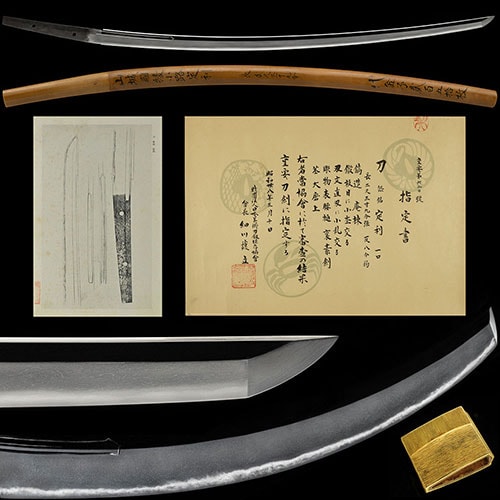
osuriage mumei katana attributed Enju Kunimura on the slender body, marked motohaba-sakihaba taper and small tightened kissaki; the shallow ring-shaped wa-zori recalls Rai but the subdued, tightened nioiguchi and shirake settle the attribution to Enju, narrowed to Kunimura by the sugata

The greater part of the designated record is mumei osuriage katana. The wa-zori and Kyoto air recall Rai at first glance, but the tightened, sinking nioiguchi, the shirake-utsuri and the masame-lean read as Enju, and the slender body with a strong taper and a small, tightened kissaki narrows the attribution to Kunimura himself. The suguha here is fine, breaking into intermittent nijuba and faint hotsure, kinsuji and sunagashi entering fine, the boshi sugu to a large o-maru with a short turnback. One blade preserves the cut-off signed tang-tip from its shortening.

Sugata 姿
Jigane 地鉄
Hamon 刃文
Scholarship

His work survives only as tachi, all slender and long; no tanto or other forms are known, and many carry a bo-hi.

The signed survivals run to a small two-character mei set toward the mune; one long blade preserves, reset as a gakumei, the cut-off signed tang-tip from its shortening.

Designations

Kokuhō—
Jūyō Bunkazai1
Jūyō Bijutsuhin4
Gyobutsu—
Tokubetsu Jūyō2
Jūyō Tōken8

Elite Standing

0.45 across 15 designated works

Top 6% among smiths

Provenance

6 documented provenances across certified works by Kunimura

Provenance Standing

2 works held in elite collections across 6 documented provenances

Top 47% among smiths

Raw score: 2.00 / 10

Blade Forms

Distribution across 15 ranked works

Signatures

Signature types across 15 ranked works

Currently Available

Lineage

Kunimura
Students (6)
  1. 1.Kunitoki國時1 for sale32designated
  2. 2.Kuniyasu國泰17designated
  3. 3.Kunisuke國資3 for sale22designated
  4. 4.Kunitoki國時7designated
  5. 5.Kuniyoshi國吉1 for sale22designated
  6. 6.Kuninobu國信7designated

Enju School

Other artisans of the Enju school

  1. 1.Kuniyasu國泰17designated
  2. 2.Kunitoki國時1 for sale32designated
  3. 3.Kunisuke國資3 for sale22designated
  4. 4.Kunitoki國時7designated
  5. 5.Kuniyoshi國吉1 for sale22designated
  6. 6.Kuninobu國信7designated
  7. 7.Kunishige國重2designated
  8. 8.Kunishige国重1designated
  9. 9.Kuniie國家1designated
  10. 10.Koreyoshi是吉1designated
  11. 11.Kunimoto國元1designated
  12. 12.Kunitsuna國綱2designated