NihontoWatch MonNihontoWatchBETA
MarketEncyclopedia
NihontoWatch Mon

NihontoWatchBETA

Market
Encyclopedia
Overview·Kantei·Honors·Designations·Provenance·Blade Forms·Signatures·Lineage·School
OverviewKanteiHonorsDesignationsProvenanceBlade FormsSignaturesLineageSchool
  1. Schools
  2. Awataguchi
  3. Kuniyasu

Awataguchi Kuniyasu

國安

Tokujū
Vol. 6, No. 2 · Katana

Awataguchi Kuniyasu

國安

23 ranked works

御番鍛冶
ProvinceYamashiroEraShoji (1199–1201)PeriodKamakuraSchoolAwataguchiTraditionYamashiro-denTeacherKuniieFujishiroSai-jo saku(Supreme Work)Toko Taikan1,800(top 3%)TypeSwordsmithCodeKUN1701
3Jūyō Bunkazai
5Jūyō Bijutsuhin
1Gyobutsu
2Tokubetsu Jūyō12Jūyō Tōken

Overview

Kuniyasu worked at in Kyoto in the early period, third of the six brothers, Kunitomo, Hisakuni, Kuniyasu, Kunikiyo, Arikuni and Kunitsuna, who made the school famous, and was called Tosaburo (藤三郎). The published sources count him, with his elder brothers Kunitomo and Hisakuni, among the of the Retired Emperor Go-Toba, and the sword references place his activity around the Jokyu era (1219 to 1222). His surviving signed works are , comparatively numerous for so early a smith; the single signed , recognized at session 31, is for that reason called "extremely precious" (極めて貴重). Fujishiro grades him Sai-jo .

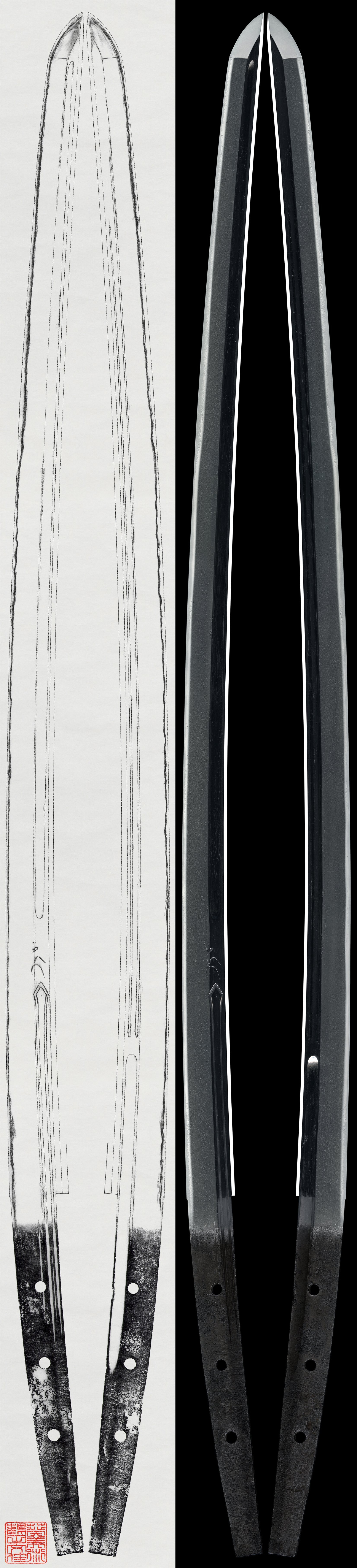
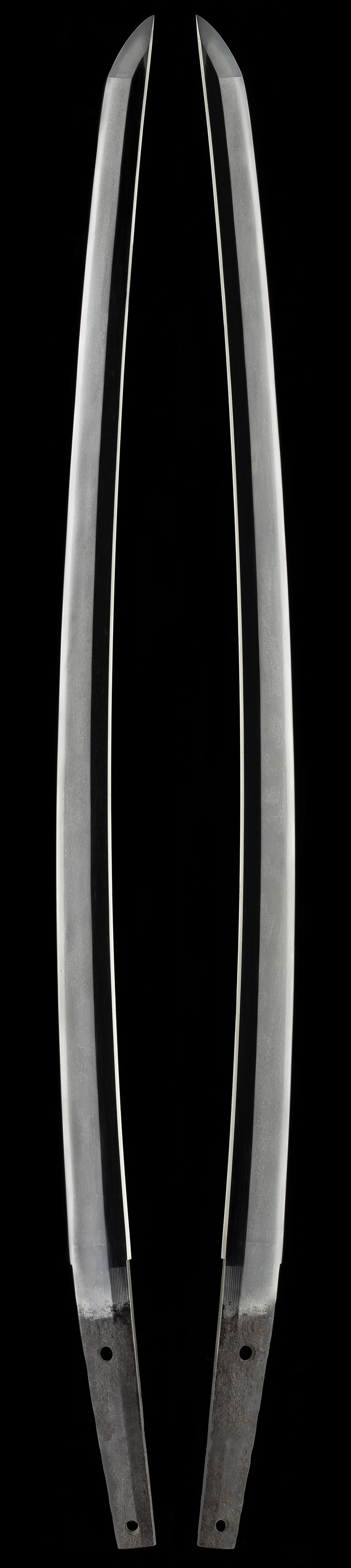
His blades keep the figure of their day, slender, with high and a small , the curve settling faintly toward the point; one source reads the bearing as a gentle grace. On this figure he tempers a small-patterned in , mixing and over a base, with and fine in the . The intervals of the press close, for "many examples show the spacing of the drawn tight" (乱れの間がつまったものが多い), and where the small run linked in series the judges go further, writing of one unsigned that by this linked tendency "even within the school it should be possible to specify Kuniyasu" (一派の中でも国安と特定することが可能). The , "as with Kunitomo, characteristically clouds into " (国友と同様に匂口がうるむ); gathers above the , where one source finds "this smith's habitual hand" (本工の手癖) plainly discernible; on another blade the forked, karimata-like at the reveals the characteristic features. The runs to a small , at times , the tip lightly brushed with .

The divides in two, and the published sources state the split outright: in his forging "there are two kinds, one with standing and one tightly knit" (肌立つものと約むもの二様あり). The tight register is packed , adhering in fine dust, slender woven through, at times a faint rising toward the ; the surface takes on the pear-skin texture the sources call "the school's characteristic " (同派特有の梨子肌), and blades of this kind are read as "the manner closer to Hisakuni" (久国に近い方の作風). The standing register shows with the grain raised, mingled in and conspicuous, and the published record ties it to his signed work: "among this smith's signed pieces those with prominently standing are comparatively many" (本工在銘作には比較的板目の肌立ったものが多い).

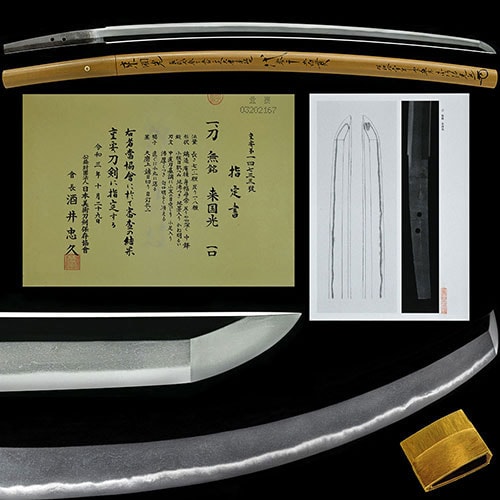
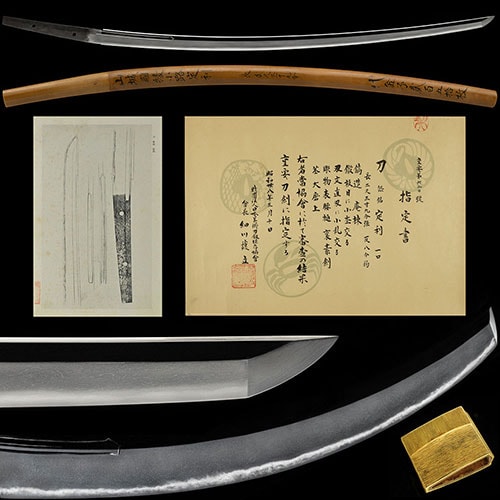
The two registers sort loosely by signature: most unsigned attributions are of the refined type and travel on judgments, a of Koson, a of Mitsutada, an of Koyu dated Genbun 3 (1738). The scholarship is candid about his softest quality: an early text judges of the shadowed dullness that often settles in his edge that "rather than a point of appreciation it is instead a defect" (見どころと云うよりはむしろ欠点である), while later texts call the "one of this smith's notable features" (同工の見どころの一つである). His two-character signature was cut both large and small, and "in either case the character An shows its distinctive features" (いずれも安の字に特徴がある), its cursive abbreviation always the , a major point in judging his . Honma notes of the attributed pieces that "among the there are occasionally wide ones like this sword" (ままこの刀の様に幅広のものがある), robust blades apart from his usual slender build.

Within he is the brother. The school's later course runs through Norikuni to Kuniyoshi and Yoshimitsu and settles into bright , while Kuniyasu holds to the compressed of the founding generation and its clouded . His follows Hisakuni, and his tightest approaches that brother closely; yet the linked picks him out alone within the school, and the pressed intervals and the he shares only with Kunitomo. Against the later generations the judgment entered on his signed is direct: "compared with Norikuni and Kuniyoshi the interior of the works well" (則国や国吉などにくらべると刃中がよく働いて), fully showing, the text concludes, the depth of flavor of work.

Twenty-three designated works stand on record: three Important Cultural Properties, all signed , with five Bijutsuhin, two and twelve , fourteen blades in the and tiers together; nine pieces in the record are signed against eleven unsigned. Eleven blades carry recorded provenance, through the Owari Tokugawa house, one a gift of the shogun Tokugawa Tsunayoshi to Yoshimichi, fourth lord of Owari, and through the Tsugaru, Nanbu, Matsudaira, Mizoguchi and Hosokawa families and the Imperial Family. Of recorded whereabouts his blades rest with the Tokugawa Art Museum, the Tokyo National Museum, the Sano Art Museum and the itself. The three Important Cultural Properties are patrimony, preserved where they stand; some fifteen blades of recorded rank sit in the tiers that may lawfully change hands, and most are held rather than traded. The published record remarks that signed by Kuniyasu are encountered from time to time, and that is the honest measure of him: a of Go-Toba whose work a patient collector may still hope to meet, though each appearance of a example is an occasion.
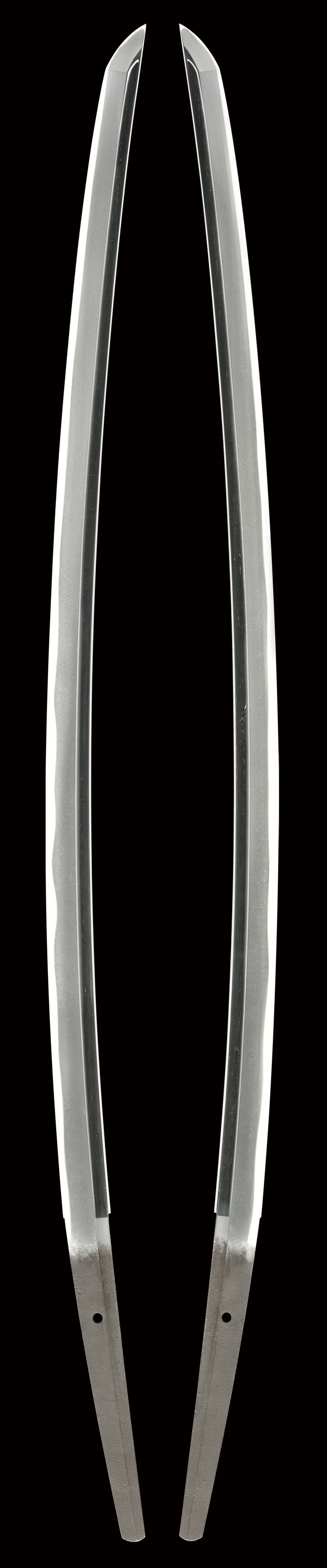
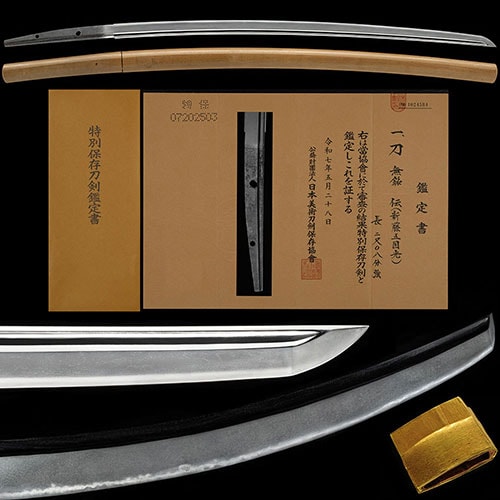
Kantei

one manner, two grounds: ko-nie ko-midare on a suguha base with a clouded (urumi) nioiguchi, over a jigane forged either tight (the nashiji type) or standing (hadatachi)

Awataguchi Kuniyasu, called Tosaburo, is the third of the six Awataguchi brothers of Yamashiro and a goban-kaji of the Retired Emperor Go-Toba alongside his elder brothers Kunitomo and Hisakuni. On a slender, high-koshizori tachi with a small point he tempers a ko-nie ko-midare with ko-choji and small gunome over a suguha base; the midare intervals are compressed, the small gunome run linked in series, and the nioiguchi softens into the clouded urumi that the papers call his and Kunitomo's shared mark, the clearest tell among the brothers.

Diagnostic discriminators

unique vs the profiled Awataguchi kin (Hisakuni, Kuniyoshi, Yoshimitsu)

86% of his works · 1.9× vs his brother Hisakuni

19% of his works

24% of his works

Observation by phase

Ko-nie ko-midare on a suguha base, the nioiguchi clouded (the one manner)

A slender tachi with high koshizori and a small point carries a small-patterned ko-midare with ko-choji and small gunome over a suguha base. The midare intervals are compressed, ko-nie lies thick with ashi and yo, kinsuji and sunagashi run through the ha, yubashiri spots the yakigashira, and the nioiguchi tends to a soft urumi cloudiness. The boshi is sugu with a small ko-maru turnback, at times yakizume or lightly swept.

Sugata 姿
Jigane 地鉄
Hamon 刃文
Bōshi 帽子
The tight ground: nashiji-like ko-itame, the hand near Hisakuni— the judges read the tightly forged works as the manner nearest his brother Hisakuni, and most of the corpus's mumei attributions are of this refined, nashiji-like type
The standing ground: hadatachi itame with jifu— linked to the signed register: the judges note that among his signed works the blades with standing itame are comparatively many
Scholarship

His signed works are tachi; the one signed tanto, recognized at Juyo session 31, is called extremely precious.

He cuts both large and small two-character mei, and the cursive abbreviation of the character An is always the same, a major point in appraising his signature.

Mumei blades carry Hon'ami attributions: kinpun-mei by Koson, kinzogan by Mitsutada, and the Koyu origami of 1738.

Honors

御番鍛冶Goban Kaji (Go-Toba's Imperial Forging Rotation)

April rotation

Master smiths summoned by Retired Emperor Go-Toba (後鳥羽上皇) to serve monthly rotations forging swords at the imperial court, ca. Jōgen–Jōkyū (1208–1221). A cross-school honor: each smith retains his own school (Awataguchi, Fukuoka Ichimonji, Ko-Aoe, etc.). The linked school NS-Gobankaji holds only Go-Toba's own Kiku gyōsaku blades.

View full roster→

Designations

Kokuhō—
Jūyō Bunkazai3
Jūyō Bijutsuhin5
Gyobutsu1
Tokubetsu Jūyō2
Jūyō Tōken12

Elite Standing

0.68 across 23 designated works

Top 4% among smiths

Provenance

15 documented provenances across certified works by Kuniyasu

Provenance Standing

7 works held in elite collections across 15 documented provenances

Top 6% among smiths

Raw score: 2.84 / 10

Blade Forms

Distribution across 23 ranked works

Signatures

Signature types across 23 ranked works

Currently Available

Lineage

TeacherKuniie
Kuniyasu
Student
  1. 1.Hisakuni久國21designated

Awataguchi School

Other artisans of the Awataguchi school

  1. 1.Yoshimitsu吉光50designated
  2. 2.Kuniyoshi國吉1 for sale51designated
  3. 3.Kunitsuna國綱18designated
  4. 4.Hisakuni久國21designated
  5. 5.Norikuni則國15designated
  6. 6.Kunitomo國友4designated
  7. 7.Kunikiyo國清4designated
  8. 8.Arikuni有國2designated
  9. 9.Kunimitsu國光1designated
  10. 10.Kuninobu國延1designated
  11. 11.Kunisada國定2designated
  12. 12.Kunitsuna國綱1designated