NihontoWatch Mon

NihontoWatch

Market
Encyclopedia
Kantei
NihontoWatch Mon

NihontoWatch

Market
Encyclopedia
Kantei

Description

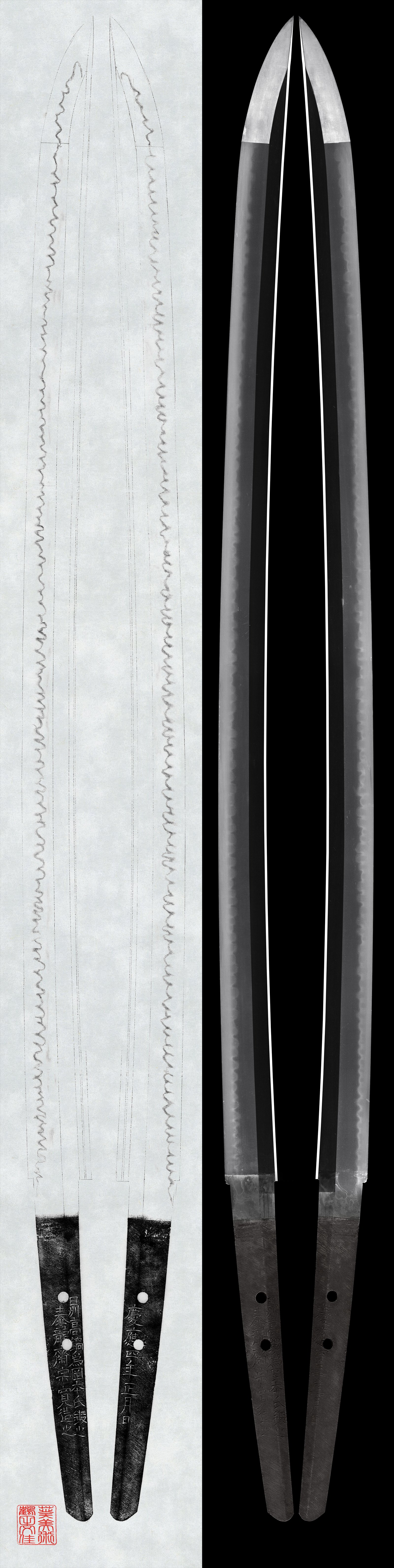
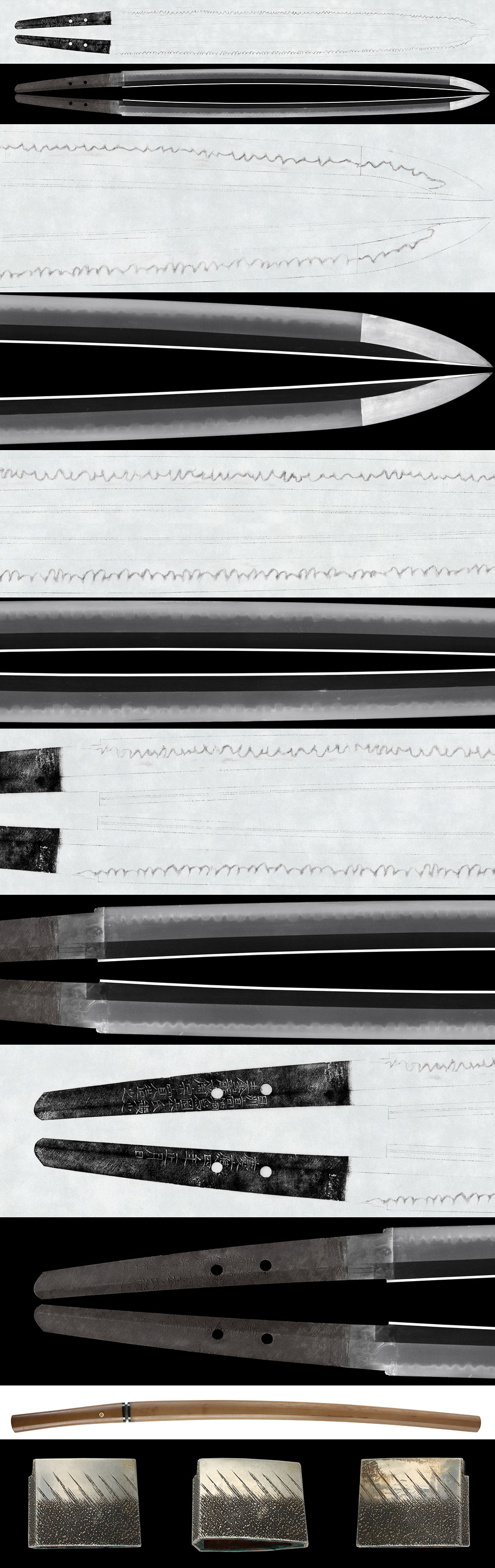
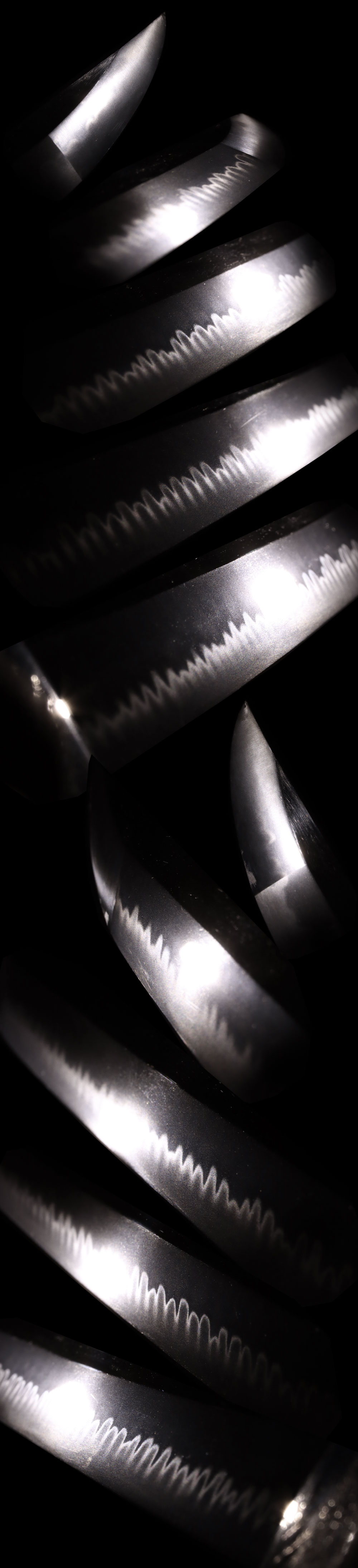
This Katana is made by Tairyusai Sokan, a pupil of Koyama Munetsugu, in Keio 4 (1868). The blade features a broad and thick shape with a very long and large Kissaki, and a beautiful Gunomemidare Hamon. It comes with an NBTHK Tokubetsu Hozon Token paper.

Certificate Reading

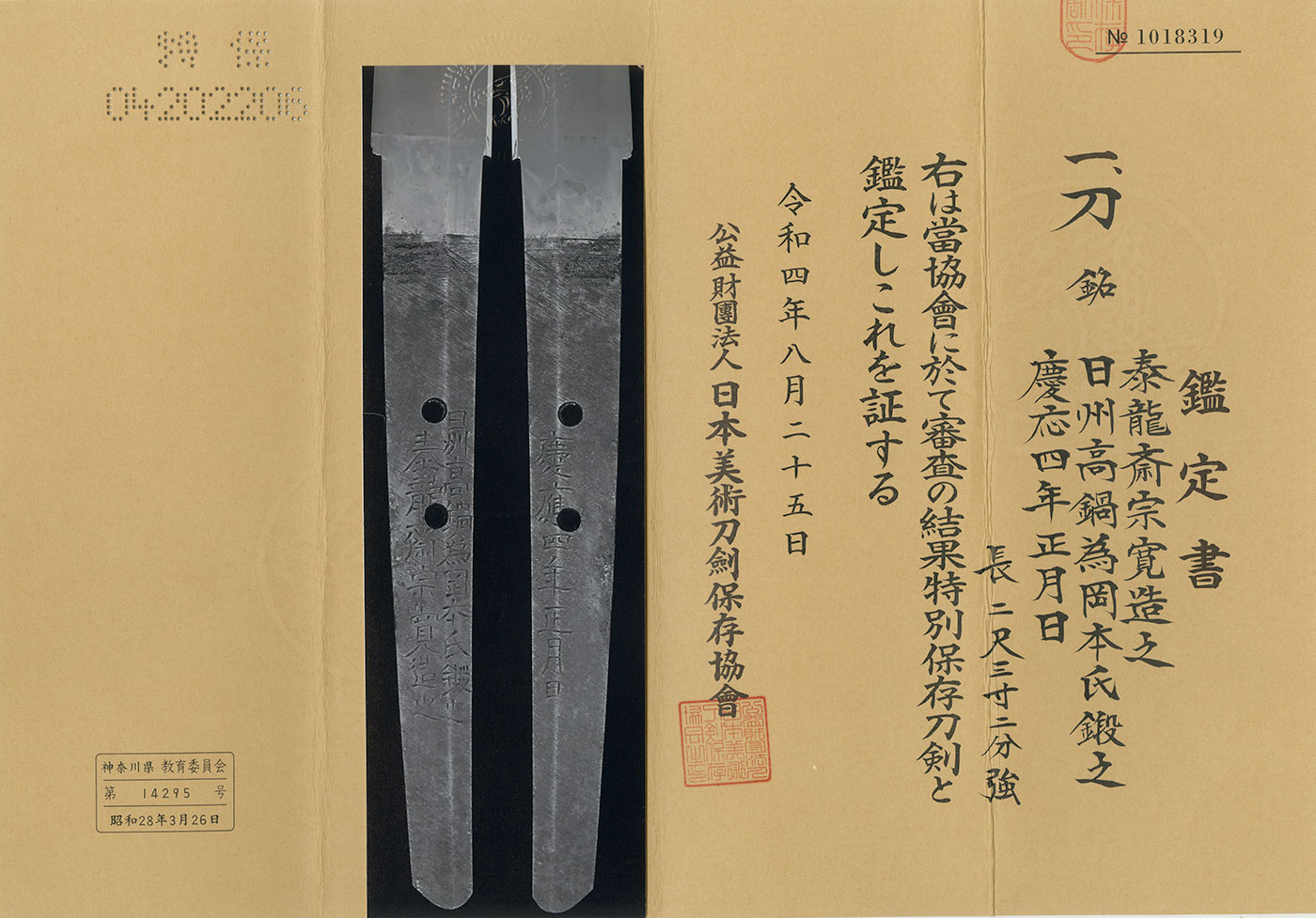
Certificate reading — 銘 泰龍斎宗寛造之 日州高鍋為岡本氏鍛之 慶応四年正月日

NihontoWatch MonNihontoWatch
MarketEncyclopediaKantei
Swords›Koyama Munetsugu›Sokan›Katana: Tairyusai Sokan (NBTHK Tokubetsu Hozon Token)
katanaTokubetsu Hozon
Koyama Munetsugu Sokan

Katana: Tairyusai Sokan (NBTHK Tokubetsu Hozon Token)

mei · Keio (1865-1868) · nagasa 69.7cm · sori 1.06cm

¥1,500,000
Visit seller website →
Koyama Munetsugu Sokan — 1 of 5
Koyama Munetsugu Sokan — 2 of 5
Koyama Munetsugu Sokan — 3 of 5
Koyama Munetsugu Sokan — 4 of 5
Koyama Munetsugu Sokan — 5 of 5
1 / 5
1 / 5
Koyama Munetsugu Sokan — 1 of 5Koyama Munetsugu Sokan — 2 of 5Koyama Munetsugu Sokan — 3 of 5Koyama Munetsugu Sokan — 4 of 5Koyama Munetsugu Sokan — 5 of 5
Measurements & details
Smith
Koyama Munetsugu Sokan
Type
Katana
School
Koyama Munetsugu
Period
Around 1850–1868(Keio)
Province
Musashi
Signature
Signed(100% of this smith's designated works are signed)
Measurements
Nagasa 69.7cmSori 1.06cmMotohaba 3.24cmSakihaba 2.65cmKasane 0.69cmWeight 835g
Description

This Katana is made by Tairyusai Sokan, a pupil of Koyama Munetsugu, in Keio 4 (1868). The blade features a broad and thick shape with a very long and large Kissaki, and a beautiful Gunomemidare Hamon. It comes with an NBTHK Tokubetsu Hozon Token paper.

About the maker

Sokan

宗寛

Shinshinto · Musashi · around 1850-1868

Tōken Taikan top 49%

5 pieces on the market now

›

Sokan was born in the early Bunsei era (1818-1830) as the son of Ono Heizo, in the castle town of Shirakawa in Oshu. His teacher in swordmaking was Koyama Munetsugu, and his forging career appears to have begun around the end of the Tempo era (1830-1844). From around the beginning of the Kaei era he served as a retained smith of the Shimosa Furukawa Domain. Among his later works are examples signed "Abukuma-gawa Sokan," in which he adopted as a surname the Abukuma River of his native region. He began regularly using the art name Tairyusai from around Ansei 1 (1854). His residence in Edo was at Fukagawa Hakozaki. Initially cutting his signatures in kaisho (standard script), from around the eighth month of Ansei 4 (1857) he changed to reisho (clerical script). He was also adept at carving on sword blades and likely served as a capable assistant to his teacher. He continued making swords into the Meiji era, but no works are seen after the Haitorei; he died on January 23, Meiji 16 (1883).

Sokan's blades present the bold, imposing sugata characteristic of the shinshinto period: wide mihaba, thick kasane, shallow sori, and large kissaki, imparting a powerful appearance. The forging shows tightly packed ko-itame with thickly adhering ji-nie and abundant fine chikei; the faintly standing, distinctive midare-utsuri characteristic of this smith also appears. The hamon is based on choji mixed with ko-gunome, gunome, and angular-headed forms, with long ashi entering well; the temper is nioi-dominant with ko-nie and occasional ara-nie, with fine kinsuji and sunagashi, and a bright and clear nioiguchi. In his comparatively early works the choji rises and falls with pronounced variation, producing a more splendid and flamboyant effect, while later works feature a linked succession of somewhat smaller-patterned temper elements. The boshi characteristically runs in midare-komi with ko-maru and a long kaeri.

The NBTHK recognizes Sokan as a smith of high technical ability whose finest works demonstrate that capability to its fullest. His earlier pieces are noted for greater variation within the choji pattern, with the hardened edge displaying noticeable change and a more brilliant effect, while late works show the bright, clear edge standing out strikingly against the robust form. Both ji and ha in his superior examples are described as kenzen (sound and well-preserved), a recurring evaluative commendation. The cutting-test inscriptions that frequently accompany his blades, often by Iga Norishige — counted among the "Four Heavenly Kings" of late-Bakumatsu connoisseurship — are noted as possessing great documentary value, further attesting to the esteem in which Sokan's work was held among warrior patrons of the period.

Historical importance

Where Sokan stands among comparable artisans: across all of nihontō, and within tradition, era, and period. The tiers (Foremost · Leading · Major · Notable) weigh official designations from the NBTHK and Japan's Agency for Cultural Affairs, together with historical honors of lasting repute such as the Sansaku and Meibutsu-chō.

随一
Foremost
屈指
Leading
有数
Major
著名
Notable

Select a lens to see how it's measured.

Designation record
4 designated works
Jūyō
4
5 works by Sokan on the market→
Sokan — full profileShinshinto school

Dated Works

Years he was demonstrably active, proven by signed-and-dated blades

Active period
1850Editorial estimate: 1850–1868
1 of 4 designated works carry a date
About the school

Koyama Munetsugu

固山宗次

Shinshinto · Musashi

16 pieces on the market now

›

Born in Kyōwa 3 (1803) at Shirakawa in Ōshū, Koyama Munetsugu (固山宗次) carried a smith's name read variously in the setsumei as Munobei or Sōbei, working under the art-names Issensai and Seiryōsai. He came up alongside elder brothers Munehira and Munetoshi, and although his teacher is traditionally given as Katō Tsunahide, the NBTHK readers repeatedly note that the hand of Katō Tsunatoshi shows through his work more plainly. He first served the Matsudaira house of Shirakawa as a retained smith; when that domain was transferred to Kuwana in Ise, he settled in Edo at Azabu Nagasaka and forged as a Kuwana domain smith. In Kōka 2 (1845) he received the court title Bizen no Suke, the signature Bizen no Suke Fujiwara Munetsugu recurring on the dated katana from that point. His production runs from the latter half of Bunsei into the early Meiji years, and the program it serves is the Bakumatsu fukko revival of Bizen-den: a deliberate return, from an Edo workshop, to the chōji tempering of the old Bizen masters. The shared idiom is consistent across the line. Construction tends to a wide mihaba, thick kasane, shallow sori and an extended chū-kissaki or ō-kissaki, giving the heavy-in-hand shinshintō bearing the readers call taihai. The ground is a tightly packed ko-itame, sometimes flowing toward nagare or masame, carrying extremely fine mijin-grade ji-nie and frequent chikei; faint utsuri rises on a number of blades.

The temper is the heart of the recognition: a nioi-dominant chōji-midare or gunome-chōji, with ko-chōji, togariba and angular heads mixed in, long ashi and yō entering, fine sunagashi and kinsuji, and a bright, clear nioiguchi. To read his hand, the setsumei flag particular chōji shapes (the kawazuko tadpole-head and the kobushi fist-shaped chōji clustered near Keiō-dated work), a midare-komi bōshi turning in ko-maru with hakikake, and the bold, thick-chiseled signatures with prominent chisel-pillows. Cutting-test inscriptions are common, several tied to the connoisseur Iga Norishige, who is recorded learning swordmaking from Munetsugu. His pupils carry the same vocabulary: Tairyūsai Sōkan (宗寛, also Munekane), son of Ōno Heizō and later a Koga/Furukawa domain smith, whose blades add a faint midare-utsuri and a smaller-pattern late temper; and the likely student Kongōsai Munehiro, who copied the same shrine original his master did. For kantei, the discriminating points are the orderly yet varied chōji arrayed shoulder-to-shoulder, the nie-laden Tenpō-era pieces whose habuchi has not yet settled, and a deliberate allusion to the second-generation Kunisuke when kobushi-like chōji appear. The named works root the line in documented copying: an utsushi of the National Treasure Koryū Kagemitsu, reconstructed to its original ubu state with kurikara and bonji carved by Sōkan; and a Tenpō 11 (1840) wakizashi copying the hōchō-shaped Masamune of Egara Tenmangū in Kamakura, carved by Tōryūsai Seiju and dedicated by Nomura Toshikatsu, a rare pairing of two Edo masters. Provenance inscriptions name patrons such as Miyake Takuma and the Furukawa domain on the Sōkan side. Across the NBTHK register, the work stands as a disciplined Edo restatement of the Bizen chōji tradition, prized for the brightness of its nioiguchi and for the documentary value of its dated, commissioned and trial-cut tangs. Learn more →

3 recorded smiths56 designated works
Leading smiths
SmithEraDesignated
Munetsugu宗次1830-187051
Sokan宗寛1850-18684
Tairyusai泰龍齋1854-18601
Explore the Koyama Munetsugu school →

Historical context

Perry’s arrival in 1853 unraveled the Tokugawa peace and created the first mass demand for working swords in two centuries. Kiyomaro, called the Masamune of Yotsuya, died on its eve; Munetsugu and Yukihide carried the boom to the end.

Bakumatsu: the last war market →

NBTHK Certificate
Tokubetsu Hozon Tōken特別保存刀剣
Sword Especially Worthy of Preservation
›

A Hozon-certified blade judged to show notably superior workmanship and a better state of preservation. The bar is higher: re-tempered blades and most unsigned Muromachi/Edo works are excluded.

Signed: 泰龍斎宗寛造之 日州高鍋為岡本氏鍛之 慶応四年正月日 (Koyama Munetsugu Sokan)
As written on the certificate
About the NBTHK›

The NBTHK (Nihon Bijutsu Tōken Hozon Kyōkai, the Society for the Preservation of Japanese Art Swords) is a public-interest incorporated foundation founded in 1948 and supervised by Japan’s Agency for Cultural Affairs (Bunkachō); it is based at the Japanese Sword Museum in Tokyo. Its expert panels physically examine each submitted work (shinsa) and issue a certificate (kanteishō) ranking it by artistic and historical merit. NBTHK papers are the most widely recognized standard of authentication for Japanese swords and fittings.

NBTHK official site→
Seller
A
Aoi Art
🇯🇵Ships from Japan
›
✓Verified dealeraoijapan.com
Settles in JPY
✓Ships worldwide✓English supportWire transferPayPalCredit card
Return policy

If you wish to return an item, please notify us within 3 days of receipt. After this period we cannot accept cancellations. Please ship the return to us within 5 business days. Cancellation is conditional on the item being kept in the same condition as at the time of sale, so please handle it with care.

View all of Aoi Art’s listings→View this item on the dealer’s site→

More works by Koyama Munetsugu Sokan

View all →
Tsuruginoya
Tokuho
Daisho - Tokuho - by Koyama Munetsugu Sokan - Daisho: Tairyusai SoukanDaisho - Tokuho - by Koyama Munetsugu Sokan - Daisho: Tairyusai Soukan

Daishō

ByKoyama Munetsugu Sokan
¥3,500,000
Tsuruginoya
Tokuho
Katana - Tokuho - by Koyama Munetsugu Sokan - Tairyusai Soukan, Keio 2nd YearKatana - Tokuho - by Koyama Munetsugu Sokan - Tairyusai Soukan, Keio 2nd Year

Katana

ByKoyama Munetsugu Sokan
¥1,700,000
Toyuukai
Tokuho
Katana - Tokuho - by Koyama Munetsugu Sokan - Tairyusai SokanKatana - Tokuho - by Koyama Munetsugu Sokan - Tairyusai Sokan

Katana

ByKoyama Munetsugu Sokan
¥1,800,000
Nipponto
Tokuho
Katana - Tokuho - by Koyama Munetsugu Sokan - Tairyusai Sokan kore o tsukuru, Ansei shichinen shogatsubiKatana - Tokuho - by Koyama Munetsugu Sokan - Tairyusai Sokan kore o tsukuru, Ansei shichinen shogatsubi

Katana

ByKoyama Munetsugu Sokan
Ask

Previously sold by Koyama Munetsugu Sokan

Choshuya
Katana - by Koyama Munetsugu Sokan - Tairyusai Sokan, Keio Gannen Juichigatsu HiKatana - by Koyama Munetsugu Sokan - Tairyusai Sokan, Keio Gannen Juichigatsu Hi
Sold

Katana

ByKoyama Munetsugu Sokan
SOLD
Aoi Art
Katana - by Koyama Munetsugu Sokan - UntitledKatana - by Koyama Munetsugu Sokan - Untitled
Sold

Katana

ByKoyama Munetsugu Sokan
SOLD
Choshuya
Katana - by Koyama Munetsugu Sokan - Japanese Sword for Sale | Ginza Choshuya | Signed Tairyusai Sokan, Keio 2nd Year, 10th MonthKatana - by Koyama Munetsugu Sokan - Japanese Sword for Sale | Ginza Choshuya | Signed Tairyusai Sokan, Keio 2nd Year, 10th Month
Sold

Katana

ByKoyama Munetsugu Sokan
SOLD
Choshuya
Yari - by Koyama Munetsugu Sokan - Kawai Hisayuki Saku, Bunkyu 3rd Year, February, Sokan KitaeYari - by Koyama Munetsugu Sokan - Kawai Hisayuki Saku, Bunkyu 3rd Year, February, Sokan Kitae
Sold

Yari

ByKoyama Munetsugu Sokan
SOLD
Choshuya
Wakizashi - by Koyama Munetsugu Sokan - Tairyusai Sokan made in Tokyo, August, Meiji 2Wakizashi - by Koyama Munetsugu Sokan - Tairyusai Sokan made in Tokyo, August, Meiji 2
Sold

Wakizashi

ByKoyama Munetsugu Sokan
SOLD
Choshuya
Katana - by Koyama Munetsugu Sokan - Tairyusai Sokan made this, August, Genji 1st YearKatana - by Koyama Munetsugu Sokan - Tairyusai Sokan made this, August, Genji 1st Year
Sold

Katana

ByKoyama Munetsugu Sokan
SOLD
Choshuya
Katana - by Koyama Munetsugu Sokan - Tairyusai SokanKatana - by Koyama Munetsugu Sokan - Tairyusai Sokan
Sold

Katana

ByKoyama Munetsugu Sokan
SOLD
Choshuya
Katana - by Koyama Munetsugu Sokan - Tairyusai Sokan, Keio Gannen Juichigatsu HiKatana - by Koyama Munetsugu Sokan - Tairyusai Sokan, Keio Gannen Juichigatsu Hi
Sold

Katana

ByKoyama Munetsugu Sokan
SOLD

More from the Koyama Munetsugu school

View all →
Choshuya
Tokuho
Katana - Tokuho - by Koyama Munetsugu - Bizen no Suke Fujiwara Munetsugu - Ansei 7Katana - Tokuho - by Koyama Munetsugu - Bizen no Suke Fujiwara Munetsugu - Ansei 7

Katana

ByKoyama Munetsugu
¥1,800,000
Toyuukai
Tokuho
Katana - Tokuho - by Koyama Munetsugu - Bizeno-Suke Fujiwara MunetsuguKatana - Tokuho - by Koyama Munetsugu - Bizeno-Suke Fujiwara Munetsugu

Katana

ByKoyama Munetsugu
¥4,000,000
Aoi Art
Tokuho
Tanto - Tokuho - by Koyama Munetsugu School - Sokan SakuTanto - Tokuho - by Koyama Munetsugu School - Sokan Saku

Tantō

ByKoyama Munetsugu School
¥350,000
Aoi Art
Hozon
Tanto - Hozon - by Koyama Munetsugu School - Munetsugu (Province unknown, Shinshinto period)Tanto - Hozon - by Koyama Munetsugu School - Munetsugu (Province unknown, Shinshinto period)

Tantō

ByKoyama Munetsugu School
¥200,000
World Seiyudo
Tokuho
Tanto - Tokuho - by Koyama Munetsugu - Sunnobi Tanto: Bizen-no-suke Munetsugu (Koyama Munetsugu) - NBTHK Tokubetsu Hozon TokenTanto - Tokuho - by Koyama Munetsugu - Sunnobi Tanto: Bizen-no-suke Munetsugu (Koyama Munetsugu) - NBTHK Tokubetsu Hozon Token

Tantō

ByKoyama Munetsugu
¥2,000,000
Tozando
Tanto - by Koyama Munetsugu School - Tanto Mumei (Unsigned) in Shirasaya, Ubu Nakago, Shinshinto EraTanto - by Koyama Munetsugu School - Tanto Mumei (Unsigned) in Shirasaya, Ubu Nakago, Shinshinto Era

Tantō

ByKoyama Munetsugu School
¥250,000
Token-Net
Tokuho
Wakizashi - Tokuho - by Koyama Munetsugu School - Bizen no Suke Fujiwara MunetsuguWakizashi - Tokuho - by Koyama Munetsugu School - Bizen no Suke Fujiwara Munetsugu

Wakizashi

ByKoyama Munetsugu School
¥1,650,000
World Seiyudo
Jūyō
Katana - Jūyō - by Koyama Munetsugu - Koyama Soubei Munetsugu - NBTHK Juyo TokenKatana - Jūyō - by Koyama Munetsugu - Koyama Soubei Munetsugu - NBTHK Juyo Token

Katana

ByKoyama Munetsugu
¥6,800,000

Swords

  • Katana
  • Wakizashi
  • Tantō
  • Tachi
  • Naginata
  • Yari

Fittings

  • Tsuba
  • Fuchi-Kashira
  • Kozuka
  • Menuki

Armor

  • Kabuto
  • Samurai Armor

By Certification

  • Tokujū
  • Jūyō
  • Tokuho
  • Hozon

Resources

  • Dealer Directory
  • Artist Directory
  • The Daily Kantei
  • Glossary
  • Browse All
Nihontowatch© 2026
TermsPrivacyCookiesAbout

Description

This Katana is made by Tairyusai Sokan, a pupil of Koyama Munetsugu, in Keio 4 (1868). The blade features a broad and thick shape with a very long and large Kissaki, and a beautiful Gunomemidare Hamon. It comes with an NBTHK Tokubetsu Hozon Token paper.

Certificate Reading

Certificate reading — 銘 泰龍斎宗寛造之 日州高鍋為岡本氏鍛之 慶応四年正月日

NihontoWatch MonNihontoWatch
MarketEncyclopediaKantei
Swords›Koyama Munetsugu›Sokan›Katana: Tairyusai Sokan (NBTHK Tokubetsu Hozon Token)
katanaTokubetsu Hozon
Koyama Munetsugu Sokan

Katana: Tairyusai Sokan (NBTHK Tokubetsu Hozon Token)

mei · Keio (1865-1868) · nagasa 69.7cm · sori 1.06cm

¥1,500,000
Visit seller website →
Koyama Munetsugu Sokan — 1 of 5
Koyama Munetsugu Sokan — 2 of 5
Koyama Munetsugu Sokan — 3 of 5
Koyama Munetsugu Sokan — 4 of 5
Koyama Munetsugu Sokan — 5 of 5
1 / 5
1 / 5
Koyama Munetsugu Sokan — 1 of 5Koyama Munetsugu Sokan — 2 of 5Koyama Munetsugu Sokan — 3 of 5Koyama Munetsugu Sokan — 4 of 5Koyama Munetsugu Sokan — 5 of 5
Measurements & details
Smith
Koyama Munetsugu Sokan
Type
Katana
School
Koyama Munetsugu
Period
Around 1850–1868(Keio)
Province
Musashi
Signature
Signed(100% of this smith's designated works are signed)
Measurements
Nagasa 69.7cmSori 1.06cmMotohaba 3.24cmSakihaba 2.65cmKasane 0.69cmWeight 835g
Description

This Katana is made by Tairyusai Sokan, a pupil of Koyama Munetsugu, in Keio 4 (1868). The blade features a broad and thick shape with a very long and large Kissaki, and a beautiful Gunomemidare Hamon. It comes with an NBTHK Tokubetsu Hozon Token paper.

About the maker

Sokan

宗寛

Shinshinto · Musashi · around 1850-1868

Tōken Taikan top 49%

5 pieces on the market now

›

Sokan was born in the early Bunsei era (1818-1830) as the son of Ono Heizo, in the castle town of Shirakawa in Oshu. His teacher in swordmaking was Koyama Munetsugu, and his forging career appears to have begun around the end of the Tempo era (1830-1844). From around the beginning of the Kaei era he served as a retained smith of the Shimosa Furukawa Domain. Among his later works are examples signed "Abukuma-gawa Sokan," in which he adopted as a surname the Abukuma River of his native region. He began regularly using the art name Tairyusai from around Ansei 1 (1854). His residence in Edo was at Fukagawa Hakozaki. Initially cutting his signatures in kaisho (standard script), from around the eighth month of Ansei 4 (1857) he changed to reisho (clerical script). He was also adept at carving on sword blades and likely served as a capable assistant to his teacher. He continued making swords into the Meiji era, but no works are seen after the Haitorei; he died on January 23, Meiji 16 (1883).

Sokan's blades present the bold, imposing sugata characteristic of the shinshinto period: wide mihaba, thick kasane, shallow sori, and large kissaki, imparting a powerful appearance. The forging shows tightly packed ko-itame with thickly adhering ji-nie and abundant fine chikei; the faintly standing, distinctive midare-utsuri characteristic of this smith also appears. The hamon is based on choji mixed with ko-gunome, gunome, and angular-headed forms, with long ashi entering well; the temper is nioi-dominant with ko-nie and occasional ara-nie, with fine kinsuji and sunagashi, and a bright and clear nioiguchi. In his comparatively early works the choji rises and falls with pronounced variation, producing a more splendid and flamboyant effect, while later works feature a linked succession of somewhat smaller-patterned temper elements. The boshi characteristically runs in midare-komi with ko-maru and a long kaeri.

The NBTHK recognizes Sokan as a smith of high technical ability whose finest works demonstrate that capability to its fullest. His earlier pieces are noted for greater variation within the choji pattern, with the hardened edge displaying noticeable change and a more brilliant effect, while late works show the bright, clear edge standing out strikingly against the robust form. Both ji and ha in his superior examples are described as kenzen (sound and well-preserved), a recurring evaluative commendation. The cutting-test inscriptions that frequently accompany his blades, often by Iga Norishige — counted among the "Four Heavenly Kings" of late-Bakumatsu connoisseurship — are noted as possessing great documentary value, further attesting to the esteem in which Sokan's work was held among warrior patrons of the period.

Historical importance

Where Sokan stands among comparable artisans: across all of nihontō, and within tradition, era, and period. The tiers (Foremost · Leading · Major · Notable) weigh official designations from the NBTHK and Japan's Agency for Cultural Affairs, together with historical honors of lasting repute such as the Sansaku and Meibutsu-chō.

随一
Foremost
屈指
Leading
有数
Major
著名
Notable

Select a lens to see how it's measured.

Designation record
4 designated works
Jūyō
4
5 works by Sokan on the market→
Sokan — full profileShinshinto school

Dated Works

Years he was demonstrably active, proven by signed-and-dated blades

Active period
1850Editorial estimate: 1850–1868
1 of 4 designated works carry a date
About the school

Koyama Munetsugu

固山宗次

Shinshinto · Musashi

16 pieces on the market now

›

Born in Kyōwa 3 (1803) at Shirakawa in Ōshū, Koyama Munetsugu (固山宗次) carried a smith's name read variously in the setsumei as Munobei or Sōbei, working under the art-names Issensai and Seiryōsai. He came up alongside elder brothers Munehira and Munetoshi, and although his teacher is traditionally given as Katō Tsunahide, the NBTHK readers repeatedly note that the hand of Katō Tsunatoshi shows through his work more plainly. He first served the Matsudaira house of Shirakawa as a retained smith; when that domain was transferred to Kuwana in Ise, he settled in Edo at Azabu Nagasaka and forged as a Kuwana domain smith. In Kōka 2 (1845) he received the court title Bizen no Suke, the signature Bizen no Suke Fujiwara Munetsugu recurring on the dated katana from that point. His production runs from the latter half of Bunsei into the early Meiji years, and the program it serves is the Bakumatsu fukko revival of Bizen-den: a deliberate return, from an Edo workshop, to the chōji tempering of the old Bizen masters. The shared idiom is consistent across the line. Construction tends to a wide mihaba, thick kasane, shallow sori and an extended chū-kissaki or ō-kissaki, giving the heavy-in-hand shinshintō bearing the readers call taihai. The ground is a tightly packed ko-itame, sometimes flowing toward nagare or masame, carrying extremely fine mijin-grade ji-nie and frequent chikei; faint utsuri rises on a number of blades.

The temper is the heart of the recognition: a nioi-dominant chōji-midare or gunome-chōji, with ko-chōji, togariba and angular heads mixed in, long ashi and yō entering, fine sunagashi and kinsuji, and a bright, clear nioiguchi. To read his hand, the setsumei flag particular chōji shapes (the kawazuko tadpole-head and the kobushi fist-shaped chōji clustered near Keiō-dated work), a midare-komi bōshi turning in ko-maru with hakikake, and the bold, thick-chiseled signatures with prominent chisel-pillows. Cutting-test inscriptions are common, several tied to the connoisseur Iga Norishige, who is recorded learning swordmaking from Munetsugu. His pupils carry the same vocabulary: Tairyūsai Sōkan (宗寛, also Munekane), son of Ōno Heizō and later a Koga/Furukawa domain smith, whose blades add a faint midare-utsuri and a smaller-pattern late temper; and the likely student Kongōsai Munehiro, who copied the same shrine original his master did. For kantei, the discriminating points are the orderly yet varied chōji arrayed shoulder-to-shoulder, the nie-laden Tenpō-era pieces whose habuchi has not yet settled, and a deliberate allusion to the second-generation Kunisuke when kobushi-like chōji appear. The named works root the line in documented copying: an utsushi of the National Treasure Koryū Kagemitsu, reconstructed to its original ubu state with kurikara and bonji carved by Sōkan; and a Tenpō 11 (1840) wakizashi copying the hōchō-shaped Masamune of Egara Tenmangū in Kamakura, carved by Tōryūsai Seiju and dedicated by Nomura Toshikatsu, a rare pairing of two Edo masters. Provenance inscriptions name patrons such as Miyake Takuma and the Furukawa domain on the Sōkan side. Across the NBTHK register, the work stands as a disciplined Edo restatement of the Bizen chōji tradition, prized for the brightness of its nioiguchi and for the documentary value of its dated, commissioned and trial-cut tangs. Learn more →

3 recorded smiths56 designated works
Leading smiths
SmithEraDesignated
Munetsugu宗次1830-187051
Sokan宗寛1850-18684
Tairyusai泰龍齋1854-18601
Explore the Koyama Munetsugu school →

Historical context

Perry’s arrival in 1853 unraveled the Tokugawa peace and created the first mass demand for working swords in two centuries. Kiyomaro, called the Masamune of Yotsuya, died on its eve; Munetsugu and Yukihide carried the boom to the end.

Bakumatsu: the last war market →

NBTHK Certificate
Tokubetsu Hozon Tōken特別保存刀剣
Sword Especially Worthy of Preservation
›

A Hozon-certified blade judged to show notably superior workmanship and a better state of preservation. The bar is higher: re-tempered blades and most unsigned Muromachi/Edo works are excluded.

Signed: 泰龍斎宗寛造之 日州高鍋為岡本氏鍛之 慶応四年正月日 (Koyama Munetsugu Sokan)
As written on the certificate
About the NBTHK›

The NBTHK (Nihon Bijutsu Tōken Hozon Kyōkai, the Society for the Preservation of Japanese Art Swords) is a public-interest incorporated foundation founded in 1948 and supervised by Japan’s Agency for Cultural Affairs (Bunkachō); it is based at the Japanese Sword Museum in Tokyo. Its expert panels physically examine each submitted work (shinsa) and issue a certificate (kanteishō) ranking it by artistic and historical merit. NBTHK papers are the most widely recognized standard of authentication for Japanese swords and fittings.

NBTHK official site→
Seller
A
Aoi Art
🇯🇵Ships from Japan
›
✓Verified dealeraoijapan.com
Settles in JPY
✓Ships worldwide✓English supportWire transferPayPalCredit card
Return policy

If you wish to return an item, please notify us within 3 days of receipt. After this period we cannot accept cancellations. Please ship the return to us within 5 business days. Cancellation is conditional on the item being kept in the same condition as at the time of sale, so please handle it with care.

View all of Aoi Art’s listings→View this item on the dealer’s site→

More works by Koyama Munetsugu Sokan

View all →
Tsuruginoya
Tokuho
Daisho - Tokuho - by Koyama Munetsugu Sokan - Daisho: Tairyusai SoukanDaisho - Tokuho - by Koyama Munetsugu Sokan - Daisho: Tairyusai Soukan

Daishō

ByKoyama Munetsugu Sokan
¥3,500,000
Tsuruginoya
Tokuho
Katana - Tokuho - by Koyama Munetsugu Sokan - Tairyusai Soukan, Keio 2nd YearKatana - Tokuho - by Koyama Munetsugu Sokan - Tairyusai Soukan, Keio 2nd Year

Katana

ByKoyama Munetsugu Sokan
¥1,700,000
Toyuukai
Tokuho
Katana - Tokuho - by Koyama Munetsugu Sokan - Tairyusai SokanKatana - Tokuho - by Koyama Munetsugu Sokan - Tairyusai Sokan

Katana

ByKoyama Munetsugu Sokan
¥1,800,000
Nipponto
Tokuho
Katana - Tokuho - by Koyama Munetsugu Sokan - Tairyusai Sokan kore o tsukuru, Ansei shichinen shogatsubiKatana - Tokuho - by Koyama Munetsugu Sokan - Tairyusai Sokan kore o tsukuru, Ansei shichinen shogatsubi

Katana

ByKoyama Munetsugu Sokan
Ask

Previously sold by Koyama Munetsugu Sokan

Choshuya
Katana - by Koyama Munetsugu Sokan - Tairyusai Sokan, Keio Gannen Juichigatsu HiKatana - by Koyama Munetsugu Sokan - Tairyusai Sokan, Keio Gannen Juichigatsu Hi
Sold

Katana

ByKoyama Munetsugu Sokan
SOLD
Aoi Art
Katana - by Koyama Munetsugu Sokan - UntitledKatana - by Koyama Munetsugu Sokan - Untitled
Sold

Katana

ByKoyama Munetsugu Sokan
SOLD
Choshuya
Katana - by Koyama Munetsugu Sokan - Japanese Sword for Sale | Ginza Choshuya | Signed Tairyusai Sokan, Keio 2nd Year, 10th MonthKatana - by Koyama Munetsugu Sokan - Japanese Sword for Sale | Ginza Choshuya | Signed Tairyusai Sokan, Keio 2nd Year, 10th Month
Sold

Katana

ByKoyama Munetsugu Sokan
SOLD
Choshuya
Yari - by Koyama Munetsugu Sokan - Kawai Hisayuki Saku, Bunkyu 3rd Year, February, Sokan KitaeYari - by Koyama Munetsugu Sokan - Kawai Hisayuki Saku, Bunkyu 3rd Year, February, Sokan Kitae
Sold

Yari

ByKoyama Munetsugu Sokan
SOLD
Choshuya
Wakizashi - by Koyama Munetsugu Sokan - Tairyusai Sokan made in Tokyo, August, Meiji 2Wakizashi - by Koyama Munetsugu Sokan - Tairyusai Sokan made in Tokyo, August, Meiji 2
Sold

Wakizashi

ByKoyama Munetsugu Sokan
SOLD
Choshuya
Katana - by Koyama Munetsugu Sokan - Tairyusai Sokan made this, August, Genji 1st YearKatana - by Koyama Munetsugu Sokan - Tairyusai Sokan made this, August, Genji 1st Year
Sold

Katana

ByKoyama Munetsugu Sokan
SOLD
Choshuya
Katana - by Koyama Munetsugu Sokan - Tairyusai SokanKatana - by Koyama Munetsugu Sokan - Tairyusai Sokan
Sold

Katana

ByKoyama Munetsugu Sokan
SOLD
Choshuya
Katana - by Koyama Munetsugu Sokan - Tairyusai Sokan, Keio Gannen Juichigatsu HiKatana - by Koyama Munetsugu Sokan - Tairyusai Sokan, Keio Gannen Juichigatsu Hi
Sold

Katana

ByKoyama Munetsugu Sokan
SOLD

More from the Koyama Munetsugu school

View all →
Choshuya
Tokuho
Katana - Tokuho - by Koyama Munetsugu - Bizen no Suke Fujiwara Munetsugu - Ansei 7Katana - Tokuho - by Koyama Munetsugu - Bizen no Suke Fujiwara Munetsugu - Ansei 7

Katana

ByKoyama Munetsugu
¥1,800,000
Toyuukai
Tokuho
Katana - Tokuho - by Koyama Munetsugu - Bizeno-Suke Fujiwara MunetsuguKatana - Tokuho - by Koyama Munetsugu - Bizeno-Suke Fujiwara Munetsugu

Katana

ByKoyama Munetsugu
¥4,000,000
Aoi Art
Tokuho
Tanto - Tokuho - by Koyama Munetsugu School - Sokan SakuTanto - Tokuho - by Koyama Munetsugu School - Sokan Saku

Tantō

ByKoyama Munetsugu School
¥350,000
Aoi Art
Hozon
Tanto - Hozon - by Koyama Munetsugu School - Munetsugu (Province unknown, Shinshinto period)Tanto - Hozon - by Koyama Munetsugu School - Munetsugu (Province unknown, Shinshinto period)

Tantō

ByKoyama Munetsugu School
¥200,000
World Seiyudo
Tokuho
Tanto - Tokuho - by Koyama Munetsugu - Sunnobi Tanto: Bizen-no-suke Munetsugu (Koyama Munetsugu) - NBTHK Tokubetsu Hozon TokenTanto - Tokuho - by Koyama Munetsugu - Sunnobi Tanto: Bizen-no-suke Munetsugu (Koyama Munetsugu) - NBTHK Tokubetsu Hozon Token

Tantō

ByKoyama Munetsugu
¥2,000,000
Tozando
Tanto - by Koyama Munetsugu School - Tanto Mumei (Unsigned) in Shirasaya, Ubu Nakago, Shinshinto EraTanto - by Koyama Munetsugu School - Tanto Mumei (Unsigned) in Shirasaya, Ubu Nakago, Shinshinto Era

Tantō

ByKoyama Munetsugu School
¥250,000
Token-Net
Tokuho
Wakizashi - Tokuho - by Koyama Munetsugu School - Bizen no Suke Fujiwara MunetsuguWakizashi - Tokuho - by Koyama Munetsugu School - Bizen no Suke Fujiwara Munetsugu

Wakizashi

ByKoyama Munetsugu School
¥1,650,000
World Seiyudo
Jūyō
Katana - Jūyō - by Koyama Munetsugu - Koyama Soubei Munetsugu - NBTHK Juyo TokenKatana - Jūyō - by Koyama Munetsugu - Koyama Soubei Munetsugu - NBTHK Juyo Token

Katana

ByKoyama Munetsugu
¥6,800,000

Swords

  • Katana
  • Wakizashi
  • Tantō
  • Tachi
  • Naginata
  • Yari

Fittings

  • Tsuba
  • Fuchi-Kashira
  • Kozuka
  • Menuki

Armor

  • Kabuto
  • Samurai Armor

By Certification

  • Tokujū
  • Jūyō
  • Tokuho
  • Hozon

Resources

  • Dealer Directory
  • Artist Directory
  • The Daily Kantei
  • Glossary
  • Browse All
Nihontowatch© 2026
TermsPrivacyCookiesAbout
NihontoWatch Mon

NihontoWatch

Market
Encyclopedia
Kantei
NihontoWatch Mon

NihontoWatch

Market
Encyclopedia
Kantei