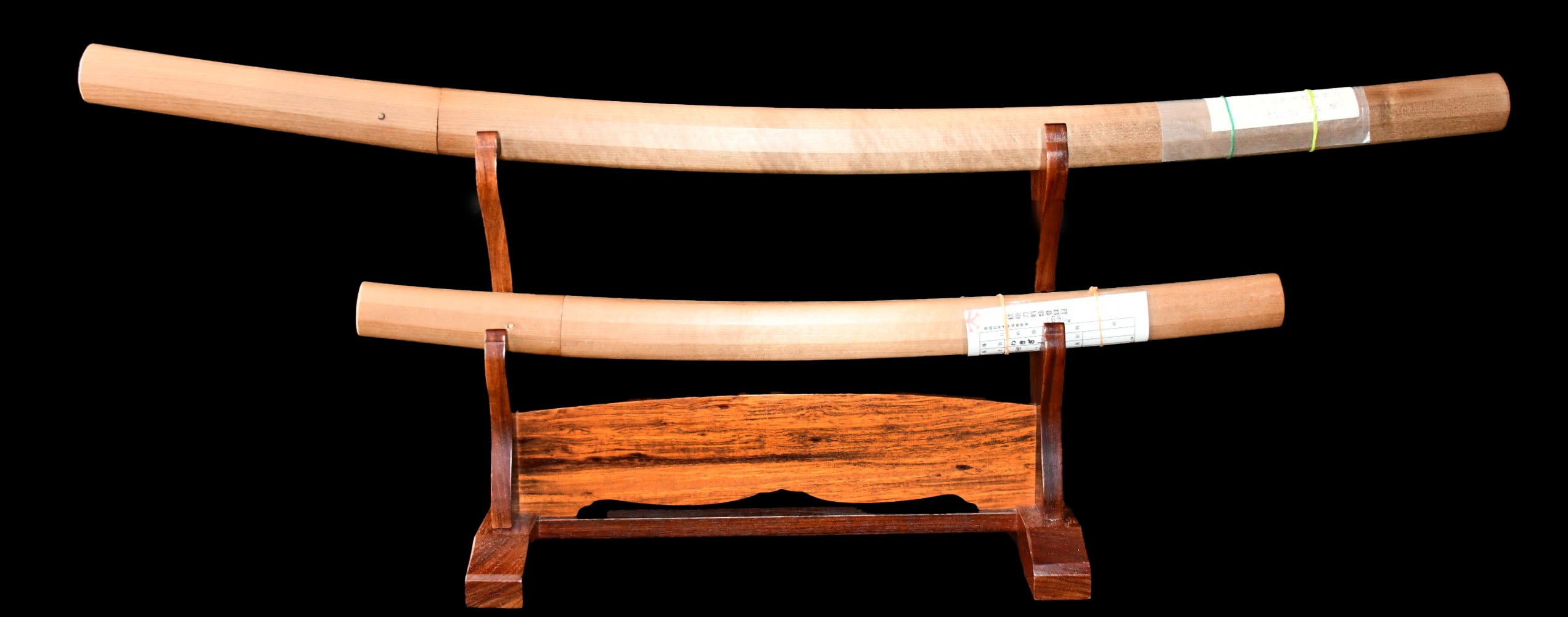
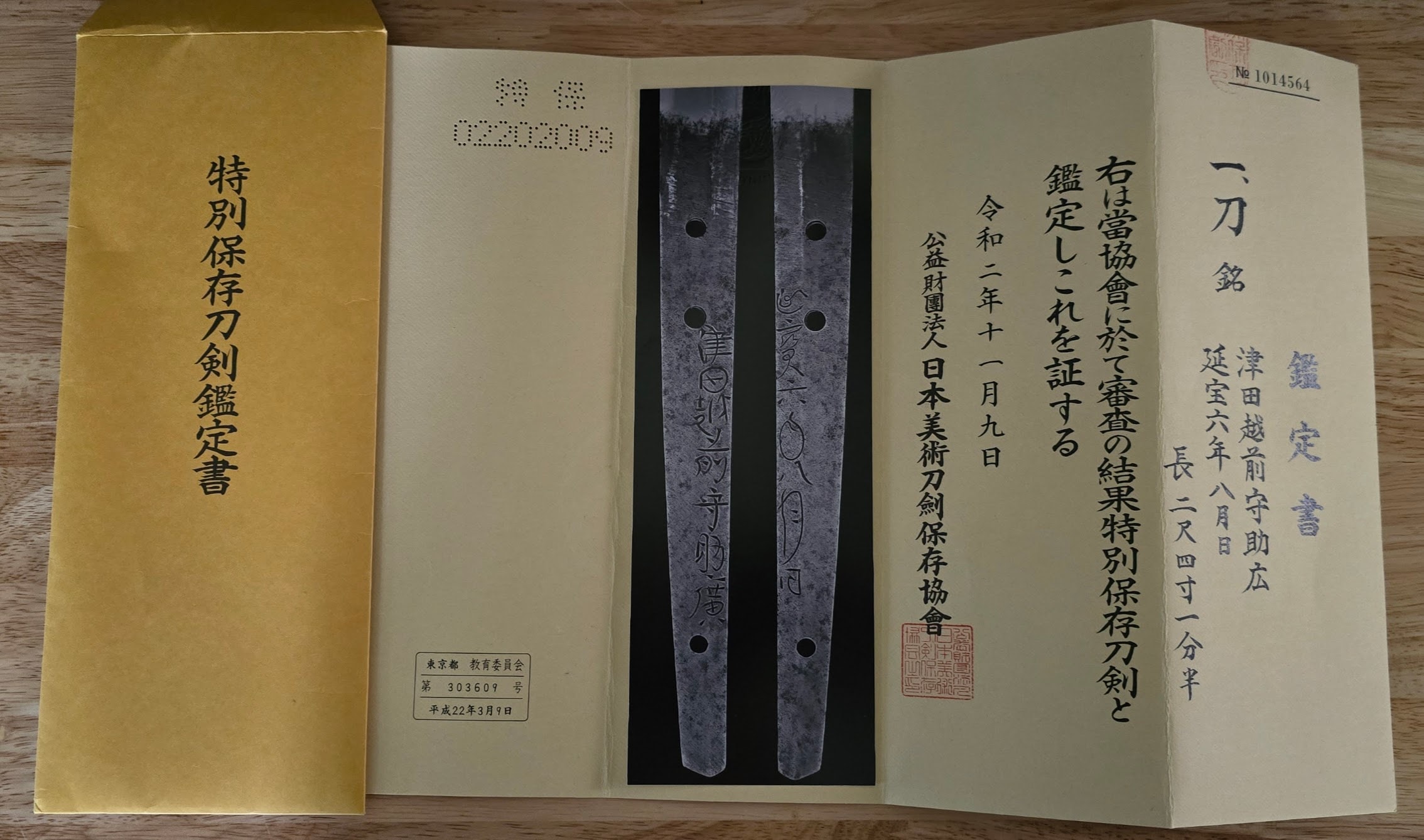
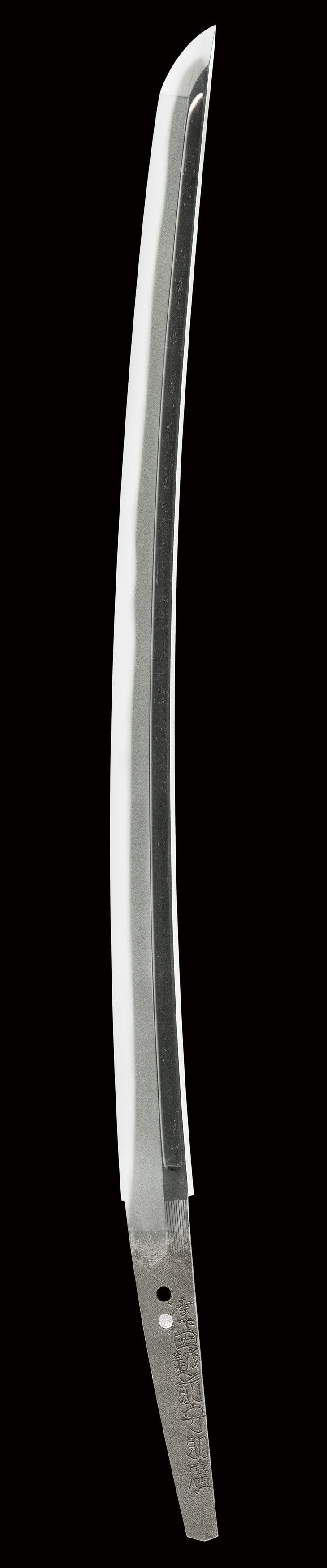
津田越前守助廣 延宝六年八月日 Tsuda Echizennokami Sukehiro
SOLD
Tracked across 81 dealers worldwide · price history · sold archive
Specifications
54.4 cm
1.5 cm
3.37 cm
2.42 cm
About the maker
Sukehiro助廣
The second-generation Sukehiro, the Tsuda Echizen no Kami Sukehiro, was born at Uchide village in Settsu Province, the present Ashiya, in Kan'ei 14 (1637), his common name Jinnojo. He studied under the first-generation smith called the Soboro Sukehiro, and after his teacher's death he became his adopted son and succeeded as the second generation. In Meireki 3 (1657) he received the court title Echizen no Kami, and in Kanbun 7 (1667) he was retained as house smith by Aoyama Inaba no Kami Munetoshi (青山因幡守宗俊), the governor of Osaka Castle; he died in Tenna 2 (1682) at the young age of forty-six. The first generation was a pupil of the first Kawachi no Kami Kunisuke and so stood in the Osaka-Ishido choji tradition, from which the second generation's earliest work descends before he broke away. His name rests on one invention. The published sources state that he came to found the distinctive temper called toran-midare (濤瀾乱), the regular large gunome cresting like ocean swells, and they place him with Inoue Shinkai of Osaka and Nagasone Kotetsu of Edo among the masters of the age. The full and famous manner is the toran-ba. Over a tightly forged ko-itame the published sources record a large gunome-midare that takes a billowing, turbulent-wave appearance, opened at the base by a short straight yakidashi; the nioi runs deep, ko-nie adheres thickly, ashi enter, sunagashi and kinsuji run through, and tobiyaki-like jewels are at times tempered along the upper half. The nioiguchi, the sources return to again and again, is bright and clear. The published record names this manner his own creation outright and describes its sweep: that he founded the toran and won universal acclaim, a development that exerted great influence not only in his own time but on later generations and on the swordsmiths of the Shinshinto age. The texts read his development as a single arc, stated almost verbatim across his blades: in the early period a choji-midare in the Ishido manner, then a turn to gunome-midare, and at last the founding of the toran that is uniquely his. The forging beneath the temper is the second pillar of his hand. The published sources describe a ko-itame that is most tightly packed, the steel clear, with ji-nie applied thickly in a fine, dustlike manner and fine chikei entering well. It is a bright and well-ordered jigane, and the sources find in it, with the temper above, the source of his renown: the precise clarity of the jigane and the deep, bright character of the nioiguchi. Alongside the celebrated toran runs a suguha he handled with equal mastery. The published sources, having named the toran, add that apart from it his suguha is also exceedingly skilled, and they describe it as a chu-suguha carrying a shallow notare, often a five-fold undulation that the judges treat as a point of appreciation peculiar to him. There too the nioi is deep, ko-nie thick and finely even, with kinsuji and sunagashi within, and the boshi runs straight and turns in ko-maru, the point often showing hakikake and a somewhat deeper temper that the sources read as his habitual hand. The chronology of his work turns on a single date, read straight off the nakago. The published sources record that from the second month of Enpo 2 (1674) he changed the earlier angular kaku-Tsuda signature, cut in gyosho, to the cursive maru-Tsuda in sosho, a change that followed a Konoe-style calligraphy bestowed through his domain; the world calls the earlier form kaku-Tsuda (角津田) and the later maru-Tsuda (丸津田), so the form of the signature alone dates a blade before or after that line. The dense dated inscriptions of the Enpo years give his toran a tight year-by-year chronology, from the youthful, vigorous toran of the Kanbun thirties to the fully realized pieces of the late Enpo and Tenna years. Of the manner of these two registers the sources are candid about the standing of his suguha: while the brilliant toran is his fame, there are those who praise the suguha the more, the published sources writing that some hold his straight temper above the showier wave (華麗な濤瀾よりも直刃の方をより称讃するむきもある). The two-character signature, the sources note, belongs only to his late work and is exceedingly rare; carved blades are rarer still, his oeuvre carrying horimono only seldom and then by a specialist carver, the Osaka carver Nagasaka Yuhoken named in connection with his and Sukenao's blades. Within the school he is the founder of the toran and one of the twin masters of Osaka Shinto. The published sources set his suguha repeatedly beside that of Inoue Shinkai of the same province and call the two a twin peak, the discriminator named outright: the nie of Sukehiro's straight temper is finer in particle and more evenly arranged, and from the edge toward the ji there appears a minute activity the sources liken to the look of finely torn hosho paper, 「奉書紙を裂いたような細かな働きが顕著に看取される」. They measure him against his own teacher as well: handling the Soboro Sukehiro's rare suguha in his own bright, clear nioiguchi, he is judged the master who surpassed his teacher, 「師父にまさる名工である」. And they place him against Edo: with Nagasone Kotetsu he is 「古来、新刀中の東西の両横綱とも称せられている」. His foremost pupil was Tsuda Sukenao, who carried the toran forward, and the manner he founded shaped the Osaka swords of his day and after. In Fujishiro's grading he is Sai-jo saku, the highest rank, and in the Toko Taikan his valuation stands among the very highest of the Shinto smiths. The weight of designation behind his name is heavy: among the blades on record one is an Important Cultural Property, with six in the Tokubetsu Juyo tier and the great body of his work, some eighty-nine pieces, in the Juyo tier; he has no National Treasure on record. The richest provenance gathers, as one would expect, around his patron: many of his finest pieces descend in the Aoyama house of the Osaka castle governors, among them the great tachi dated Enpo 6 named Murasame (村雨), forged at Munetoshi's order and long secretly held in the family, said to have been brought out only at the prayers for rain, its blade bearing the Sanskrit characters for Daiitoku Myo-o (大威徳明王) and Marishiten (摩利支天). Through the same house passed the celebrated collaborative katana of Enpo 3 by Sukehiro and Inoue Shinkai, which Kamata Gyomyo later praised in his Shinto Bengi (新刀弁疑). His provenance otherwise rests largely with long-private collections rather than named institutions. Of his designated works on record, almost all sit in the Tokubetsu Juyo and Juyo tiers and so are held more than traded; a Sukehiro of the first quality, and above all an Aoyama piece, comes to a private collector only rarely, a landmark when it does.