The twentieth century nearly killed the craft twice: wartime distortion, then the occupation ban. The NBTHK’s founding in 1948 and licensed forging from 1953 rebuilt the sword as an art, crowned by Living National Treasures and the mukansa rank.
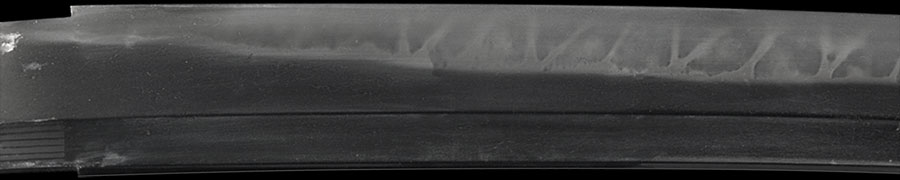
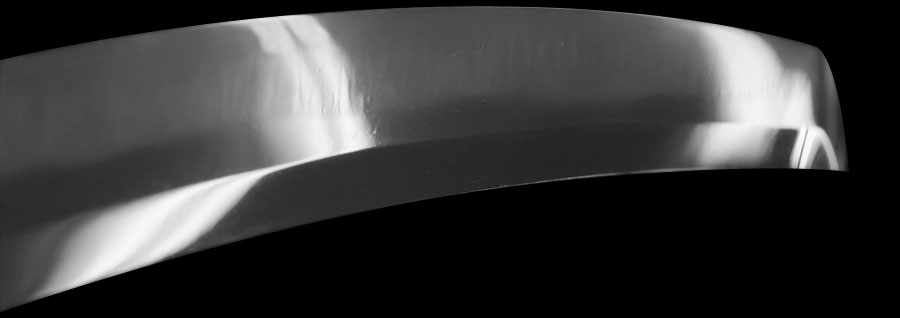
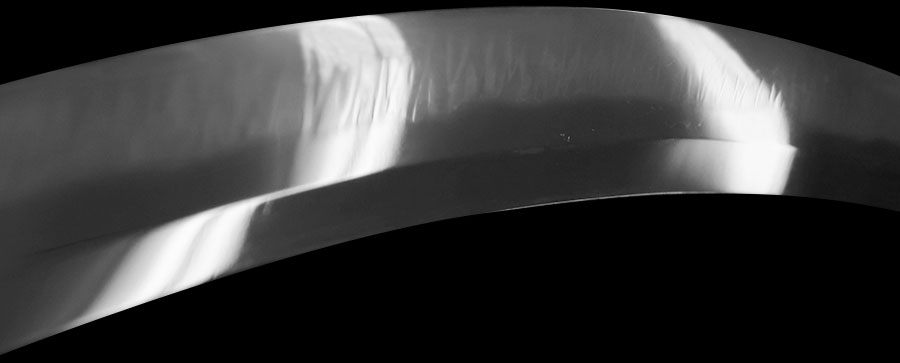
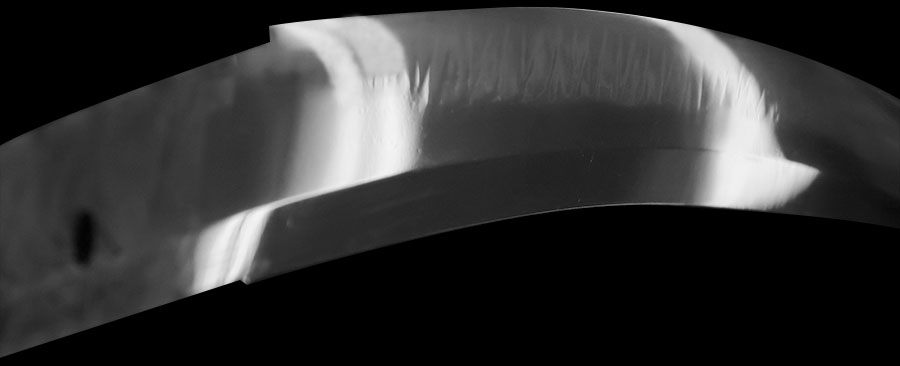
It has appeared, it has appeared; it was said to exist, and now the sword said to have been made by the swordsmith Yoshimitsu to celebrate the marriage of His Majesty the Emperor Emeritus and Ms. Shoda Michiko has appeared. The swordsmith Yoshimitsu was a smith with a great desire for learning who studied under both the Ningen Kokuho Miyairi Akihira and the Ningen Kokuho Amada Akitsugu; his real name was Tanaka Shokichi, born in Meiji 34. He crafted swords in the famous Ina-dani of Nagano Prefecture. Ina-dani is located in the southern part of Nagano Prefecture, the largest valley in Japan sandwiched between the Central Alps and the Southern Alps, a wonderful, quiet place with rich nature and scenic beauty. This sword is a work that copies Ichimonji Norimune, who is also famous in Touken Ranbu, showing a grand tachi sugata with a wide moto-mihaba and a wide saki-mihaba; the jigane is forged in ko-itame hada, and the hamon is a masterfully hardened dai-choji ba in nioi-deki with ko-nie in the style of Norimune. The date of April 10, Showa 34, when this sword was presented, remains in the memory of people around the world even now for the parade in front of the Imperial Palace in a luxurious horse-drawn carriage commemorating the marriage of His Highness the Crown Prince and Her Highness Princess Michiko. This sword was made to commemorate the marriage, but as we, the couple, have grown old, we have been entrusted with it to pass it on cheaply to someone who will cherish it; therefore, through this kindness, we are offering it at a special bargain price, so please enjoy it.
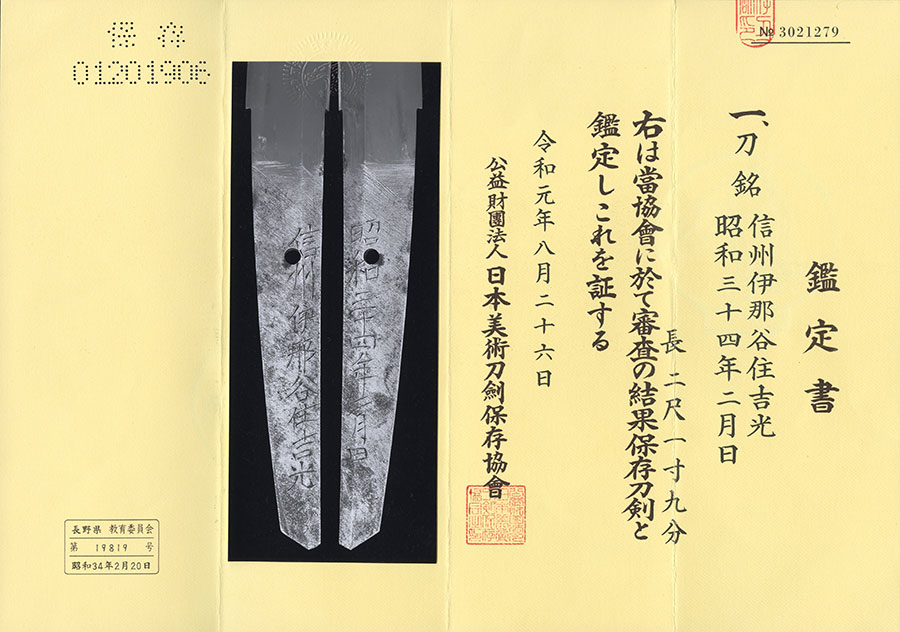
Certificate reading — 銘 信州伊那谷住吉光 昭和三十四年二月日
信州伊那谷住吉光 三十四年二月日 Shinshu Inadaniju Yoshimitsu
Offered by Nipponto


As written by the shop
Machine translation from the shop's Japanese · may contain errors ·
Shōwa to the present: destruction and revival
The twentieth century nearly killed the craft twice: wartime distortion, then the occupation ban. The NBTHK’s founding in 1948 and licensed forging from 1953 rebuilt the sword as an art, crowned by Living National Treasures and the mukansa rank.
Certifies a genuine blade worth preserving: a signature confirmed correct, or, if unsigned, an era, province, and school that the NBTHK can reliably identify.
The NBTHK (Nihon Bijutsu Tōken Hozon Kyōkai, the Society for the Preservation of Japanese Art Swords) is a public-interest incorporated foundation founded in 1948 and supervised by Japan’s Agency for Cultural Affairs (Bunkachō); it is based at the Japanese Sword Museum in Tokyo. Its expert panels physically examine each submitted work (shinsa) and issue a certificate (kanteishō) ranking it by artistic and historical merit. NBTHK papers are the most widely recognized standard of authentication for Japanese swords and fittings.
NBTHK official siteFor returns due to customer circumstances, the cost is the customer's responsibility. For returns due to our mis-shipment or a defective item, we bear the cost.
¥550,000