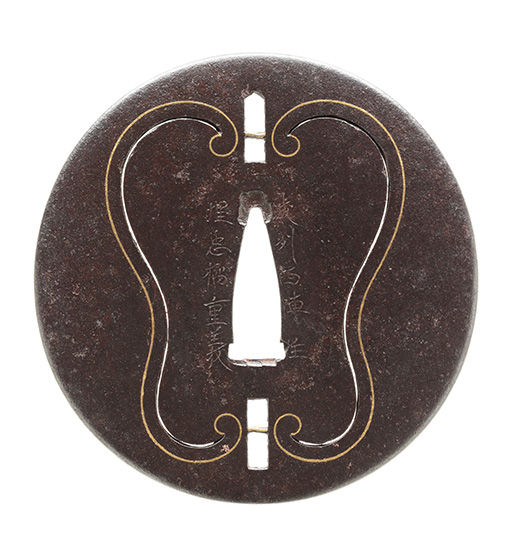
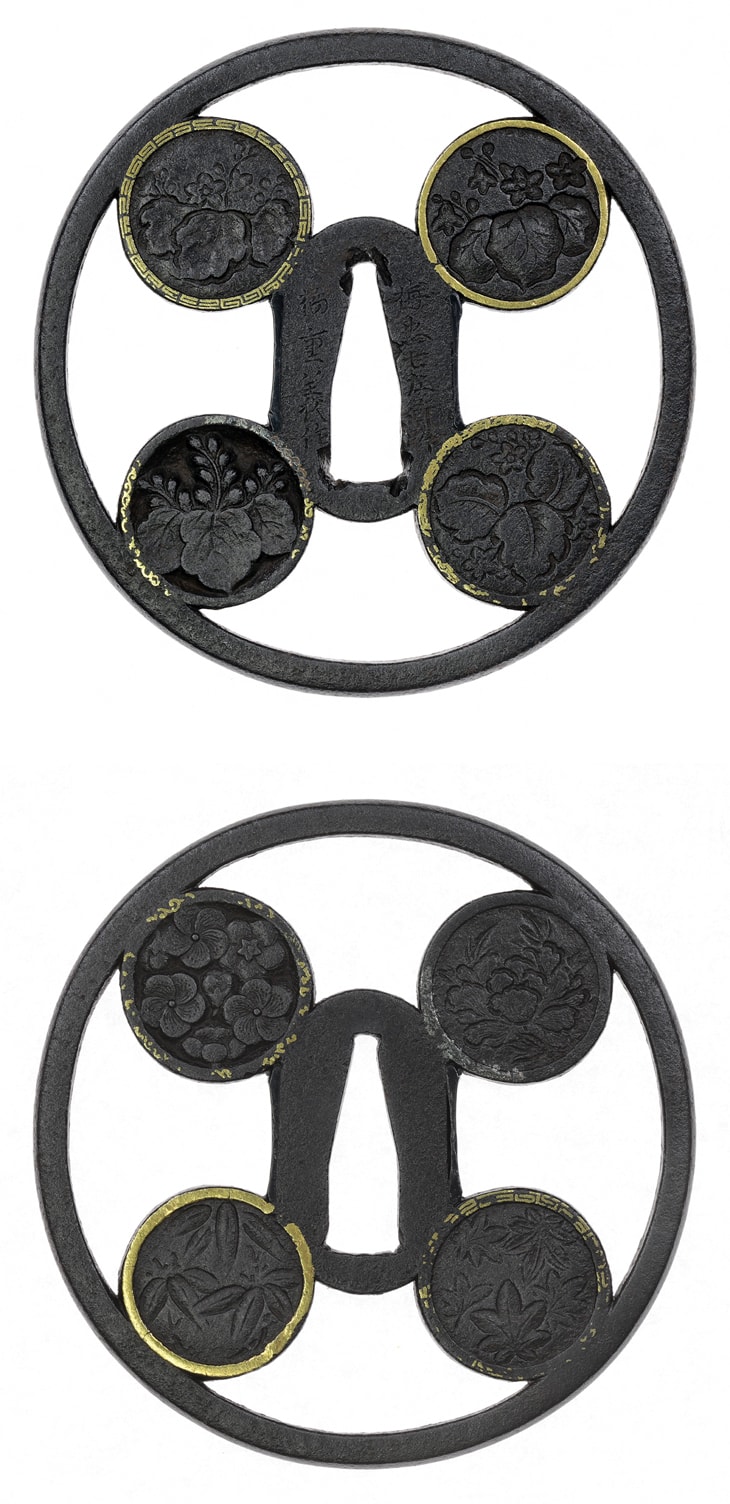
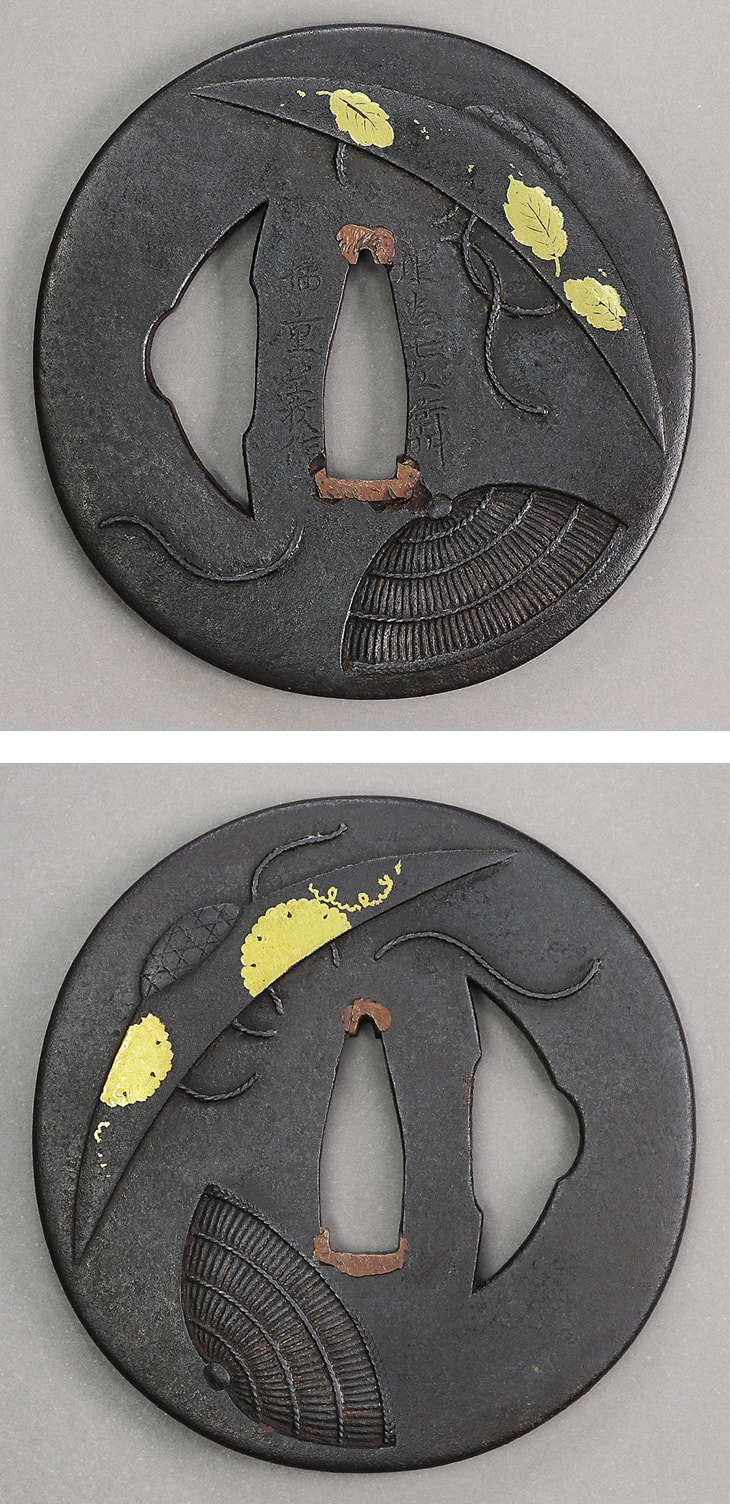
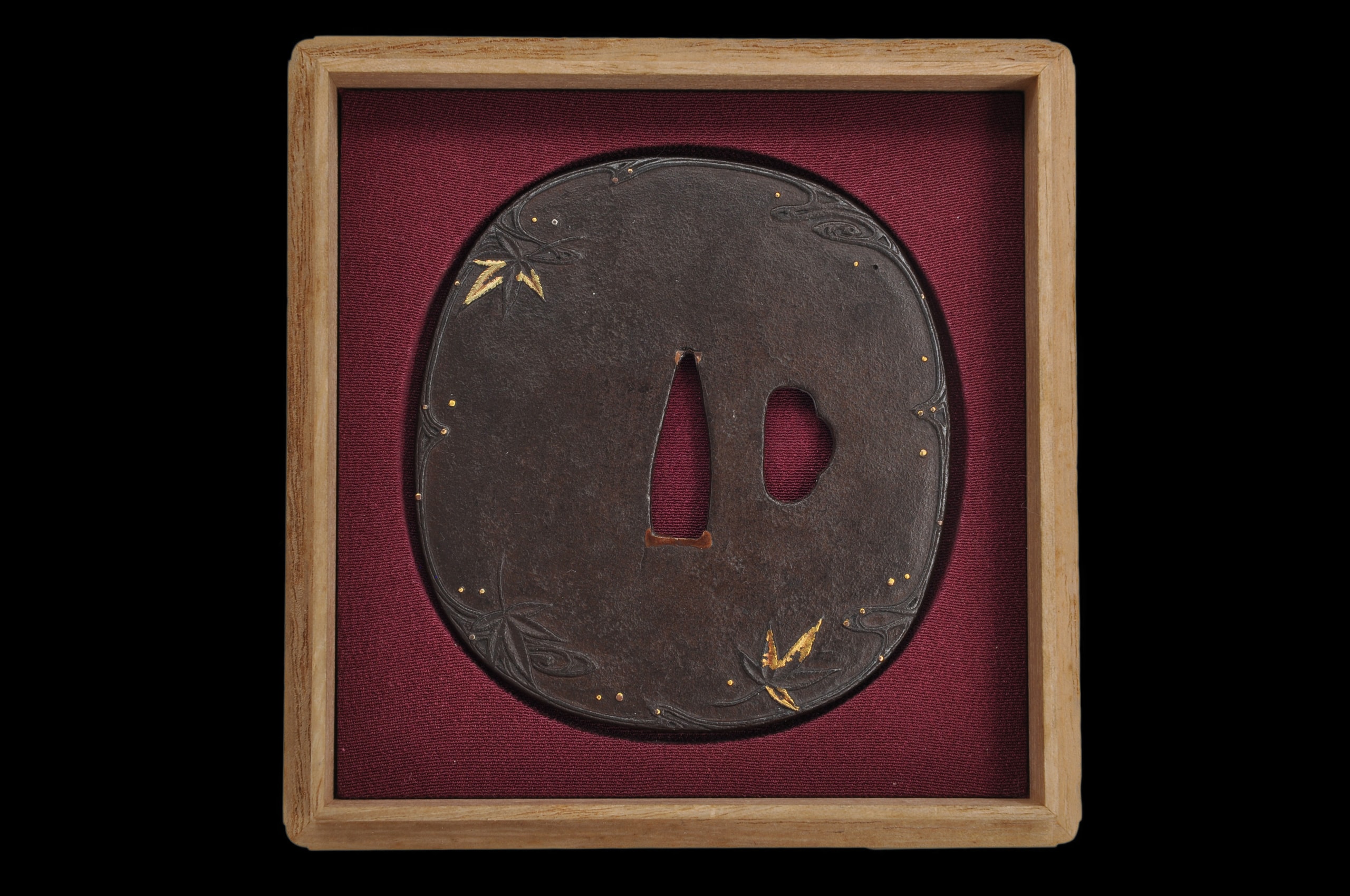
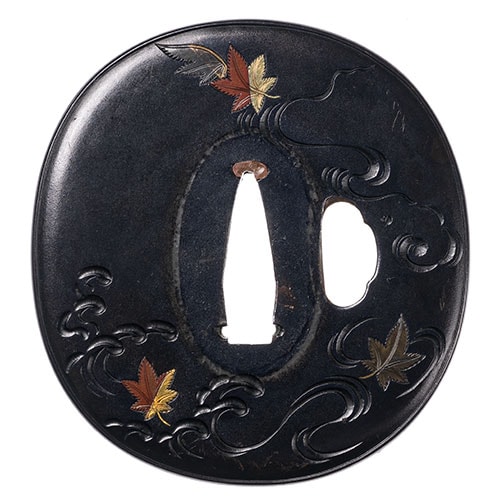
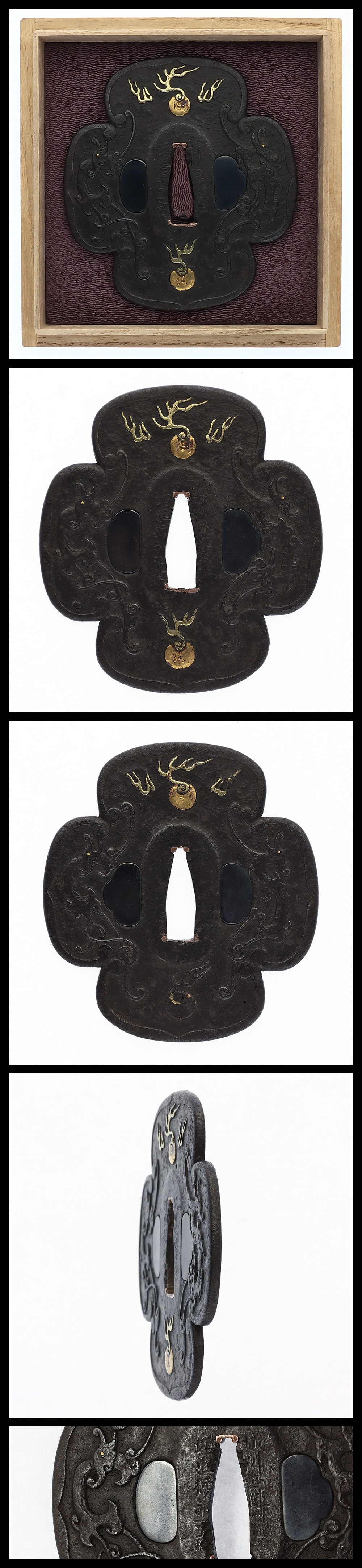
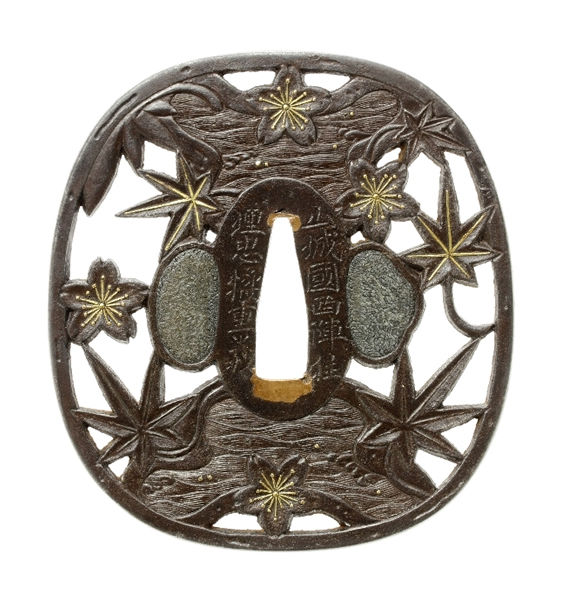
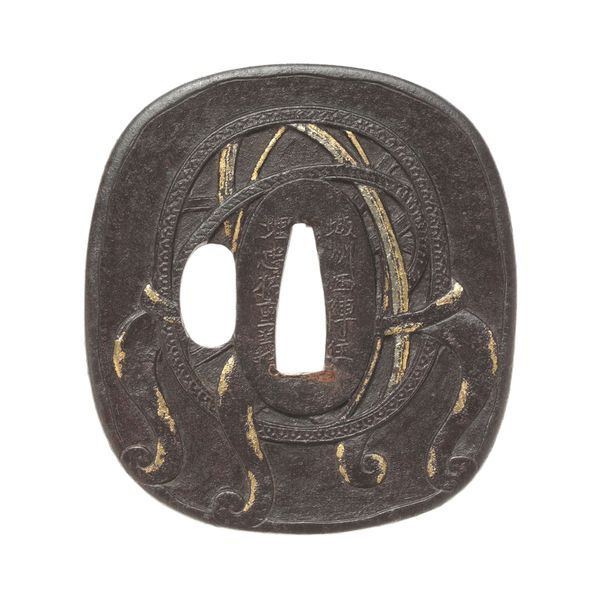
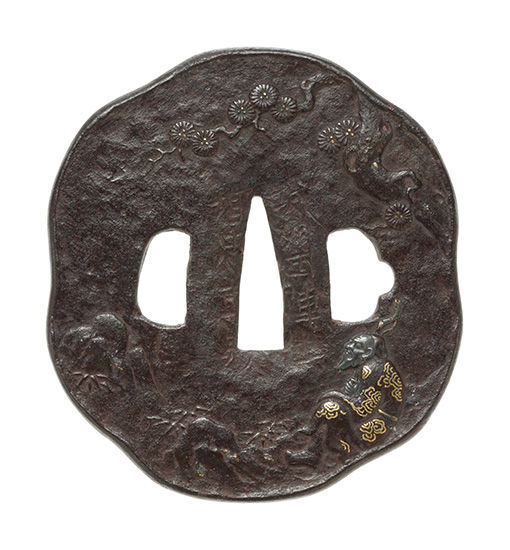
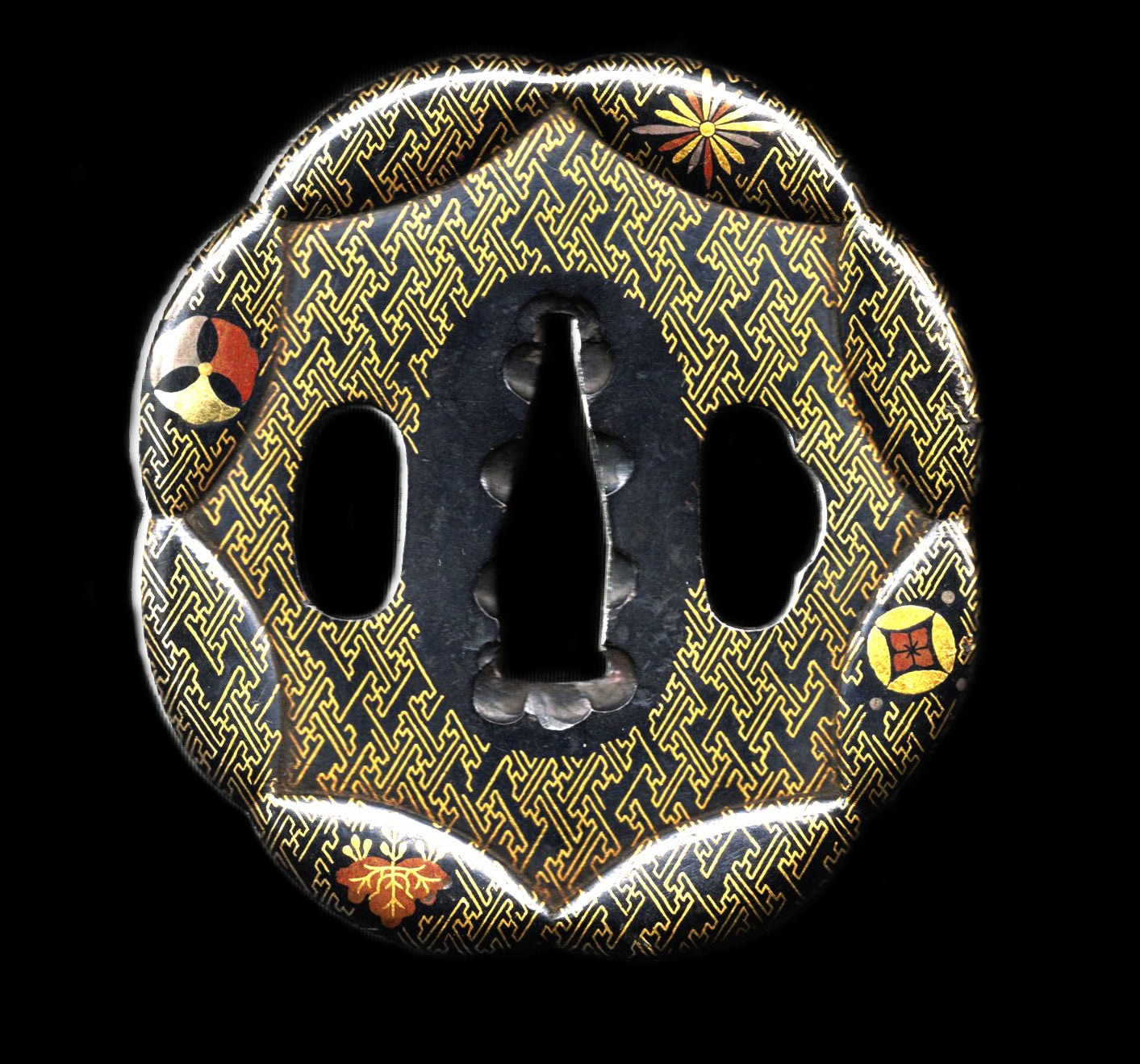
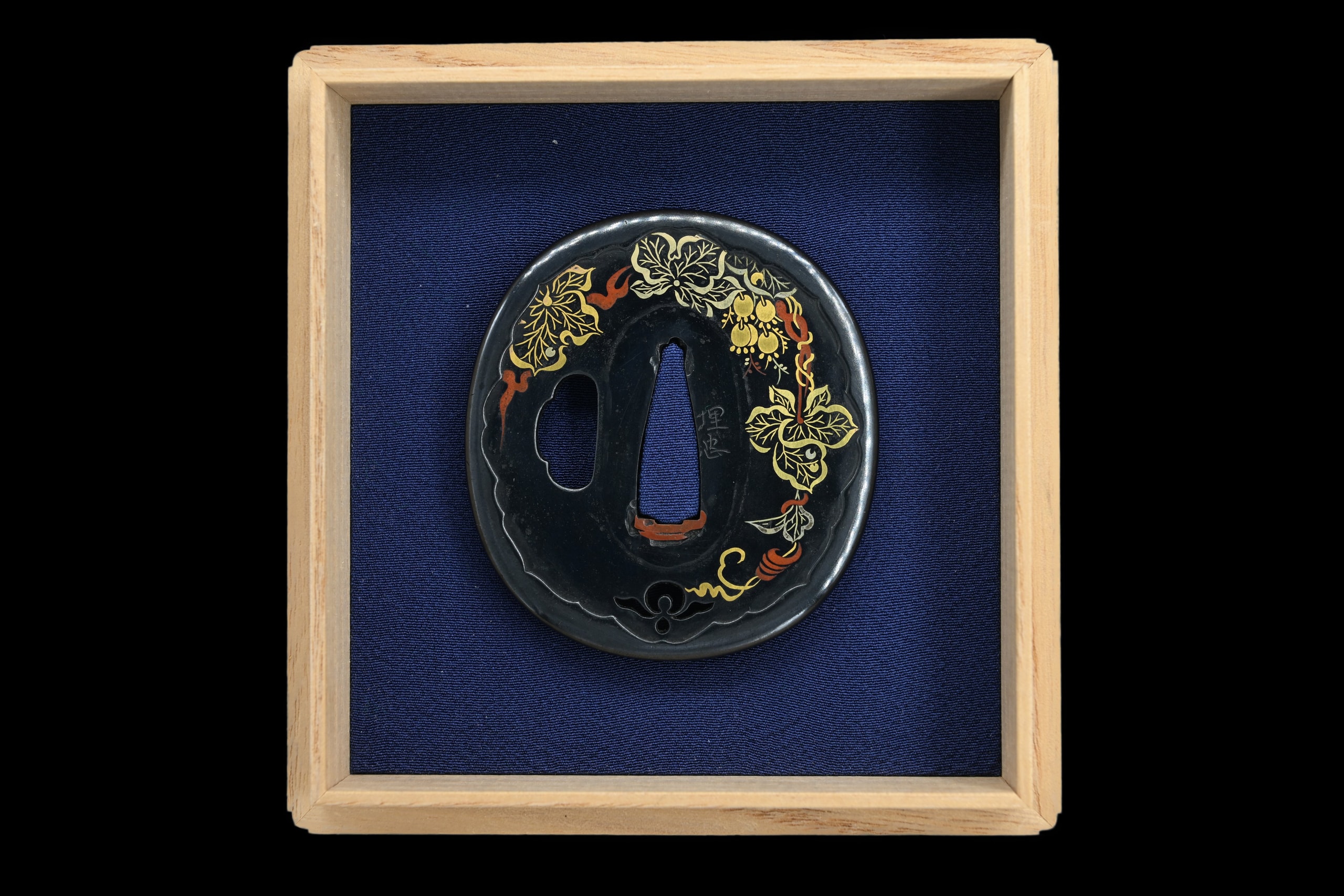
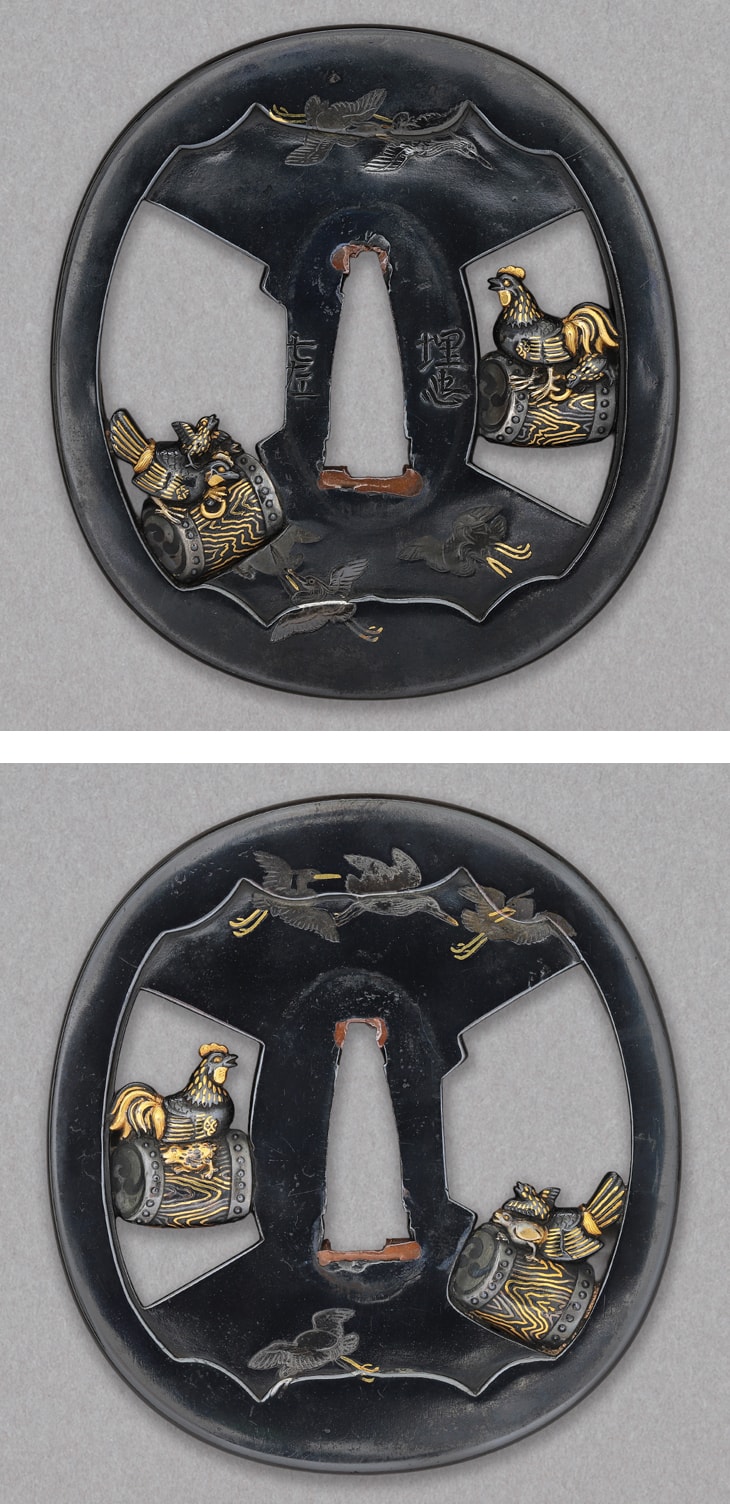
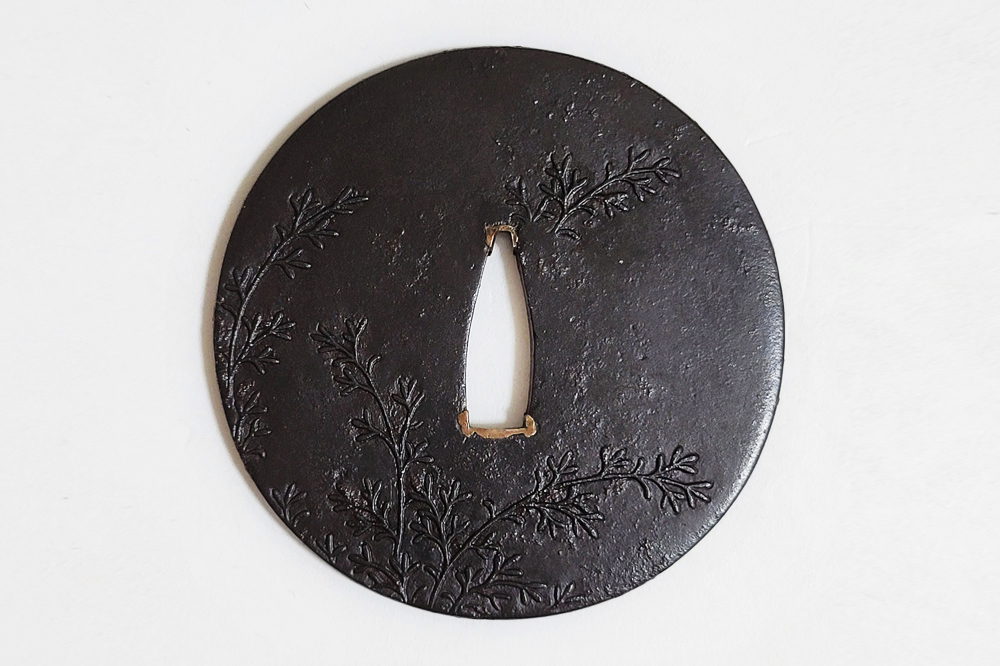
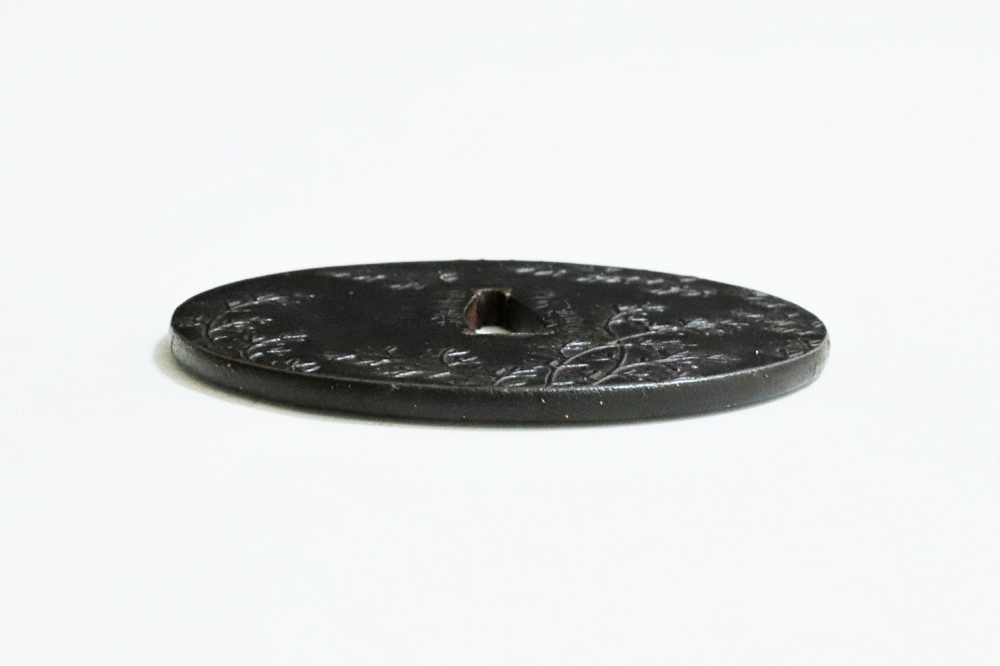
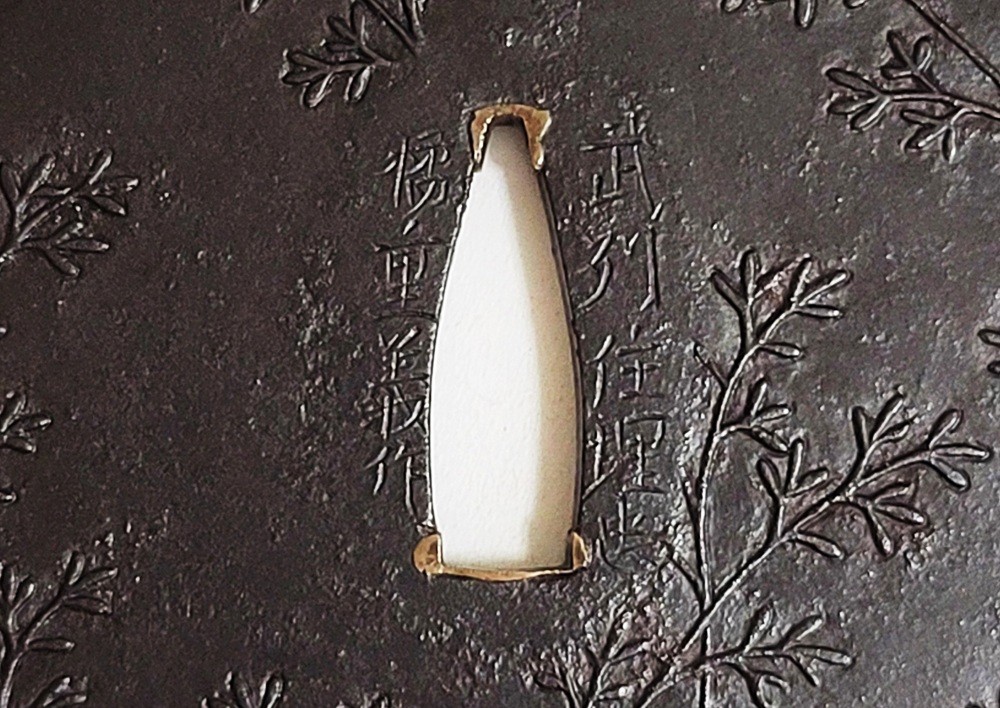
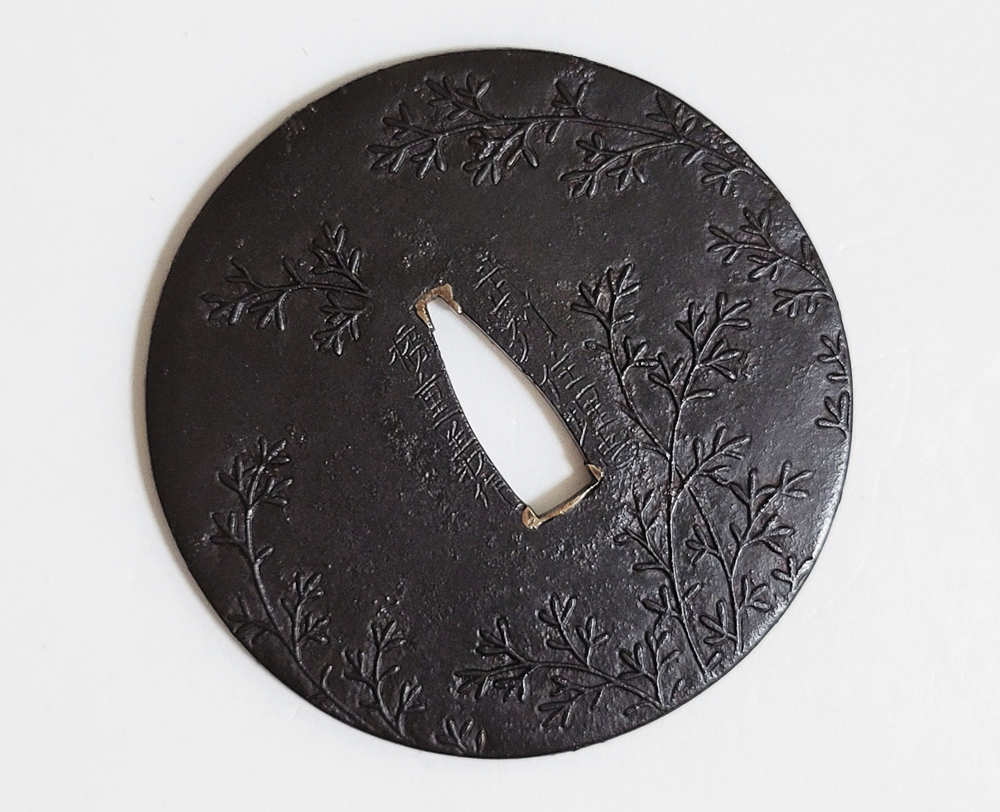
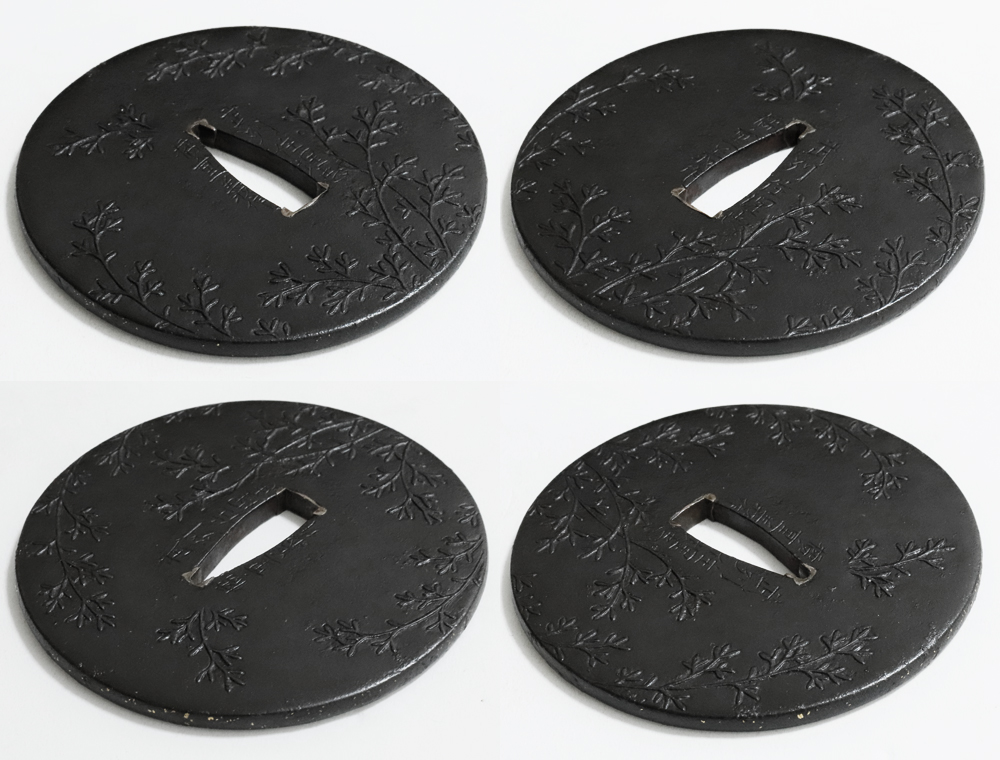
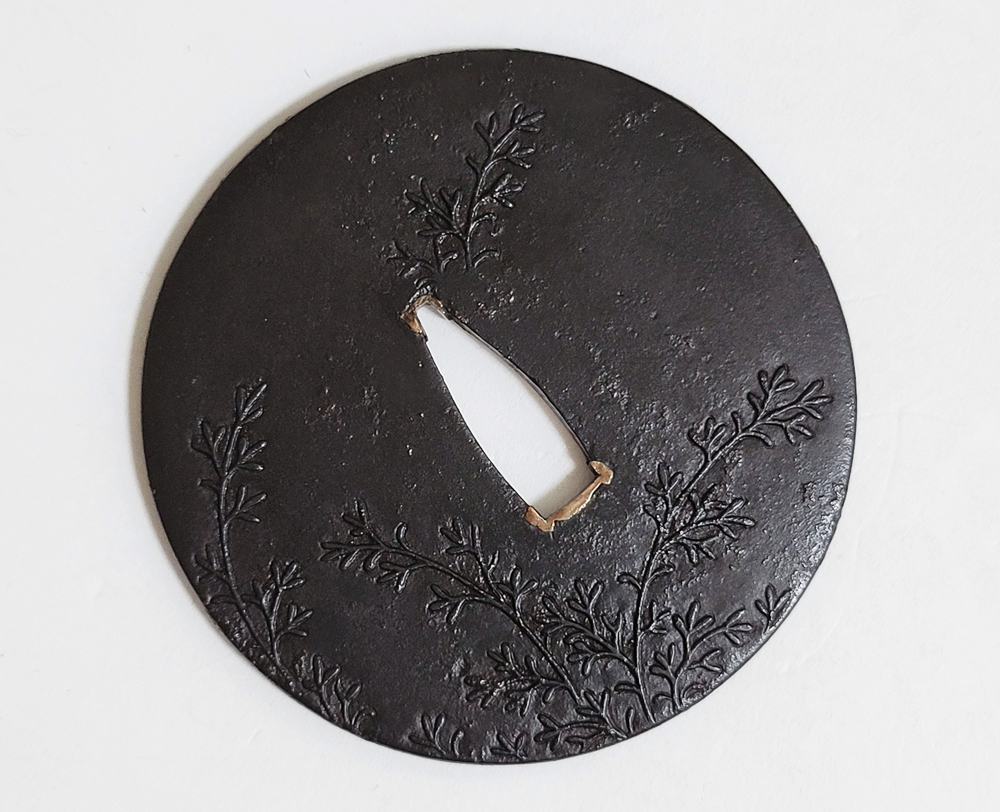
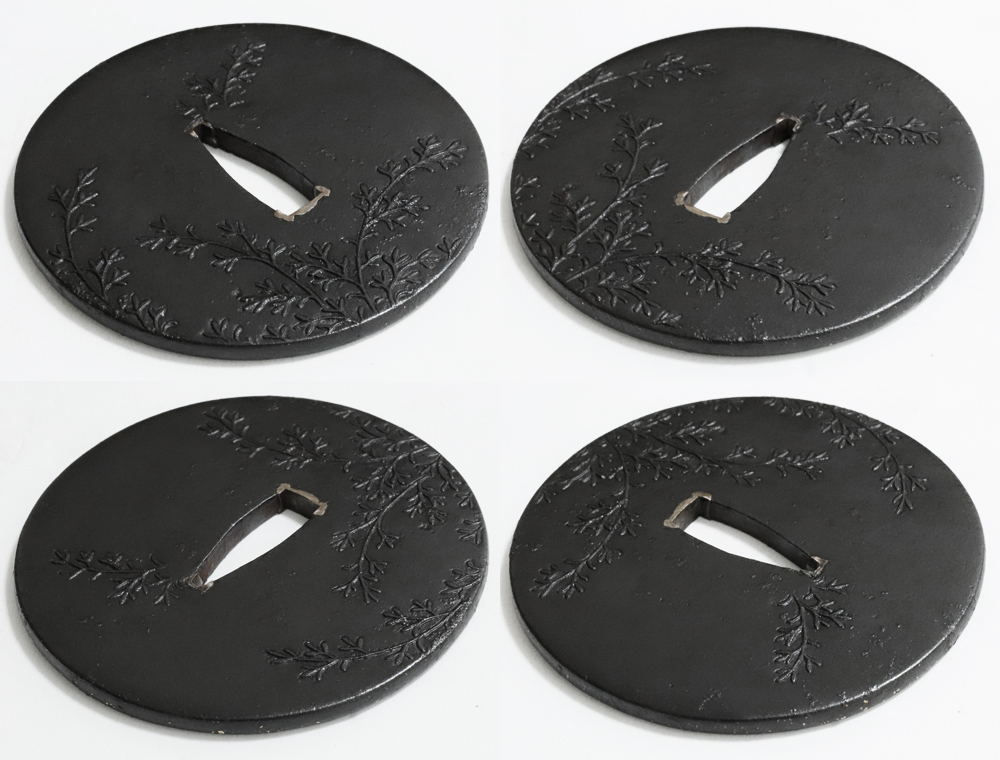
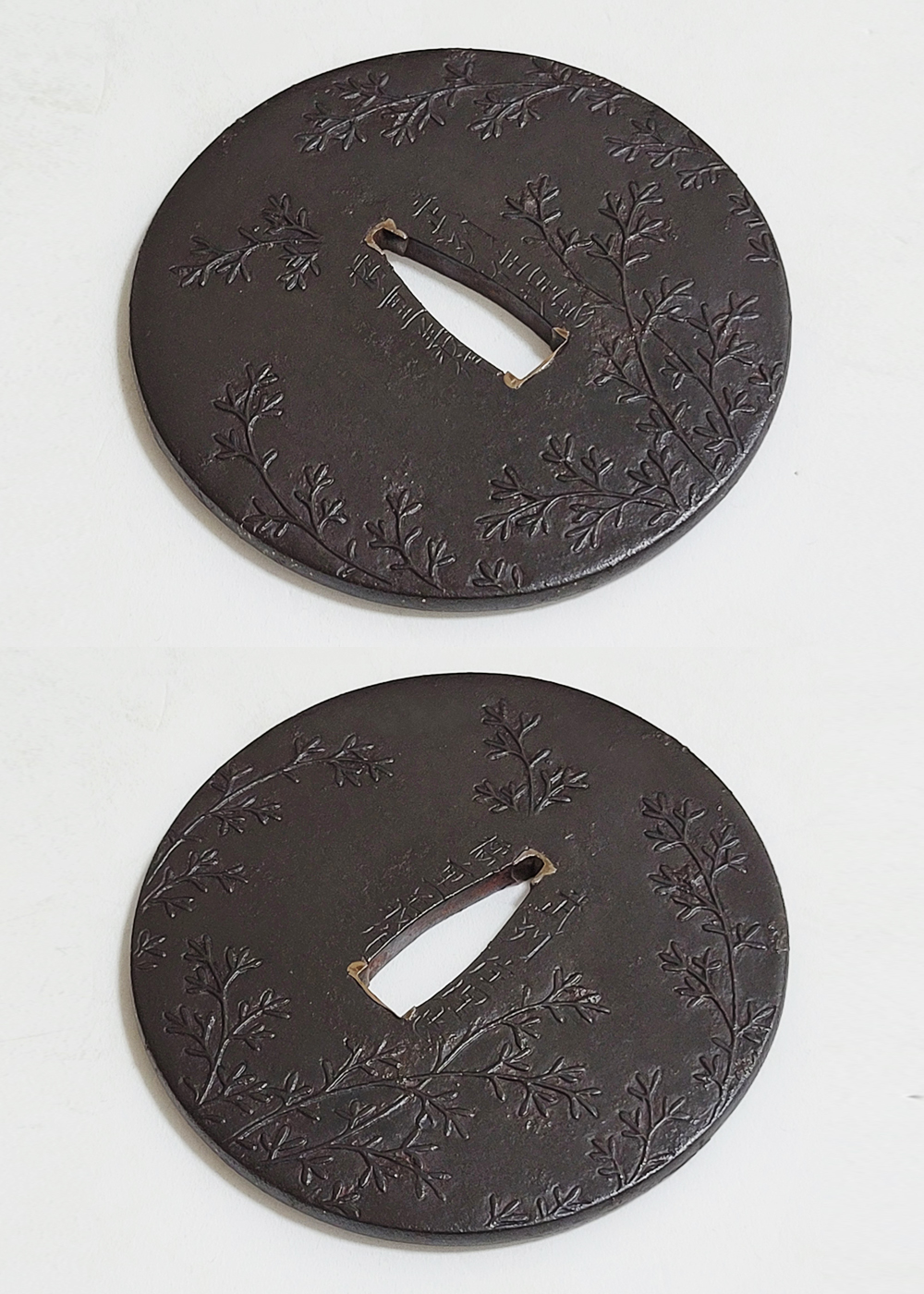
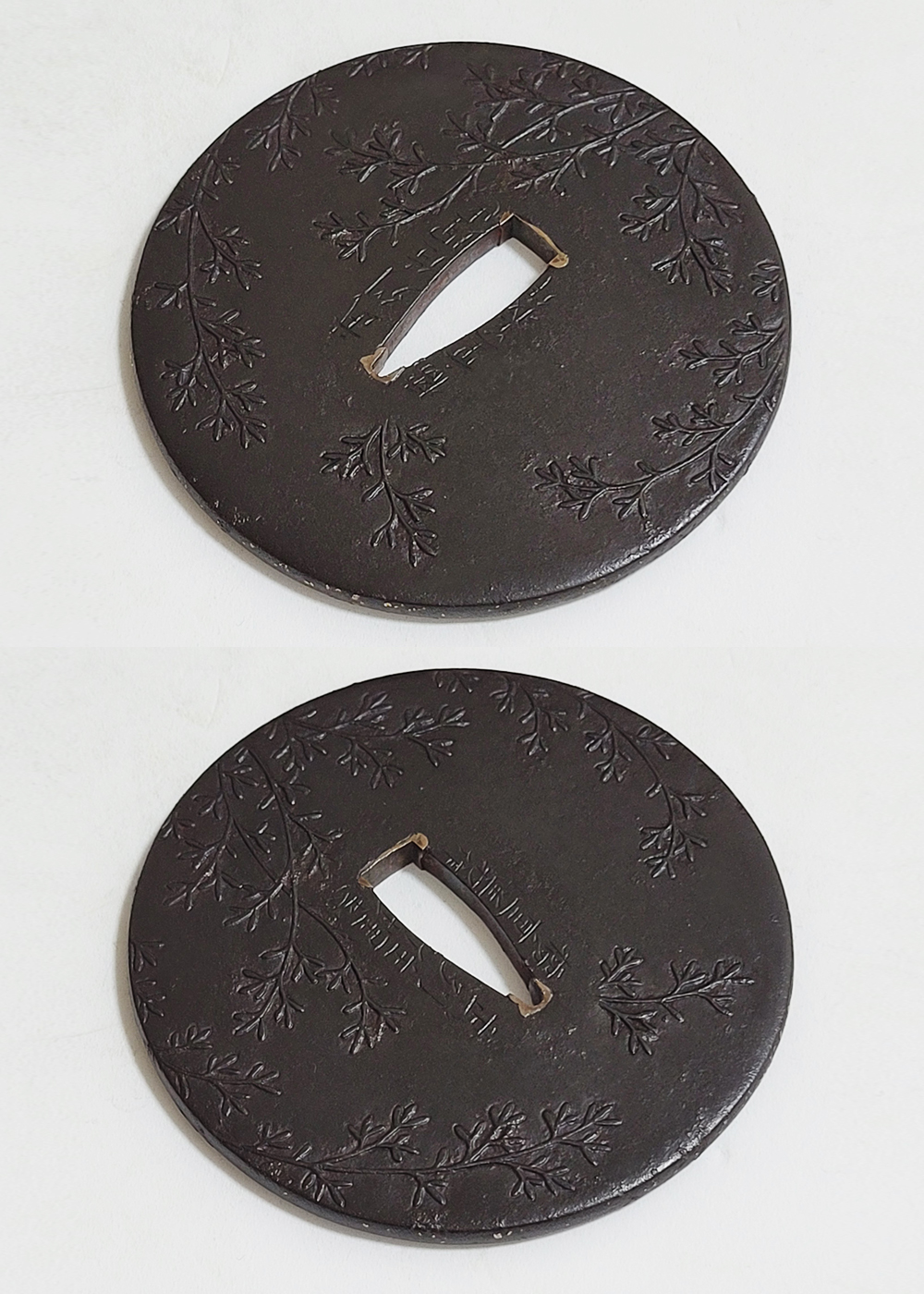
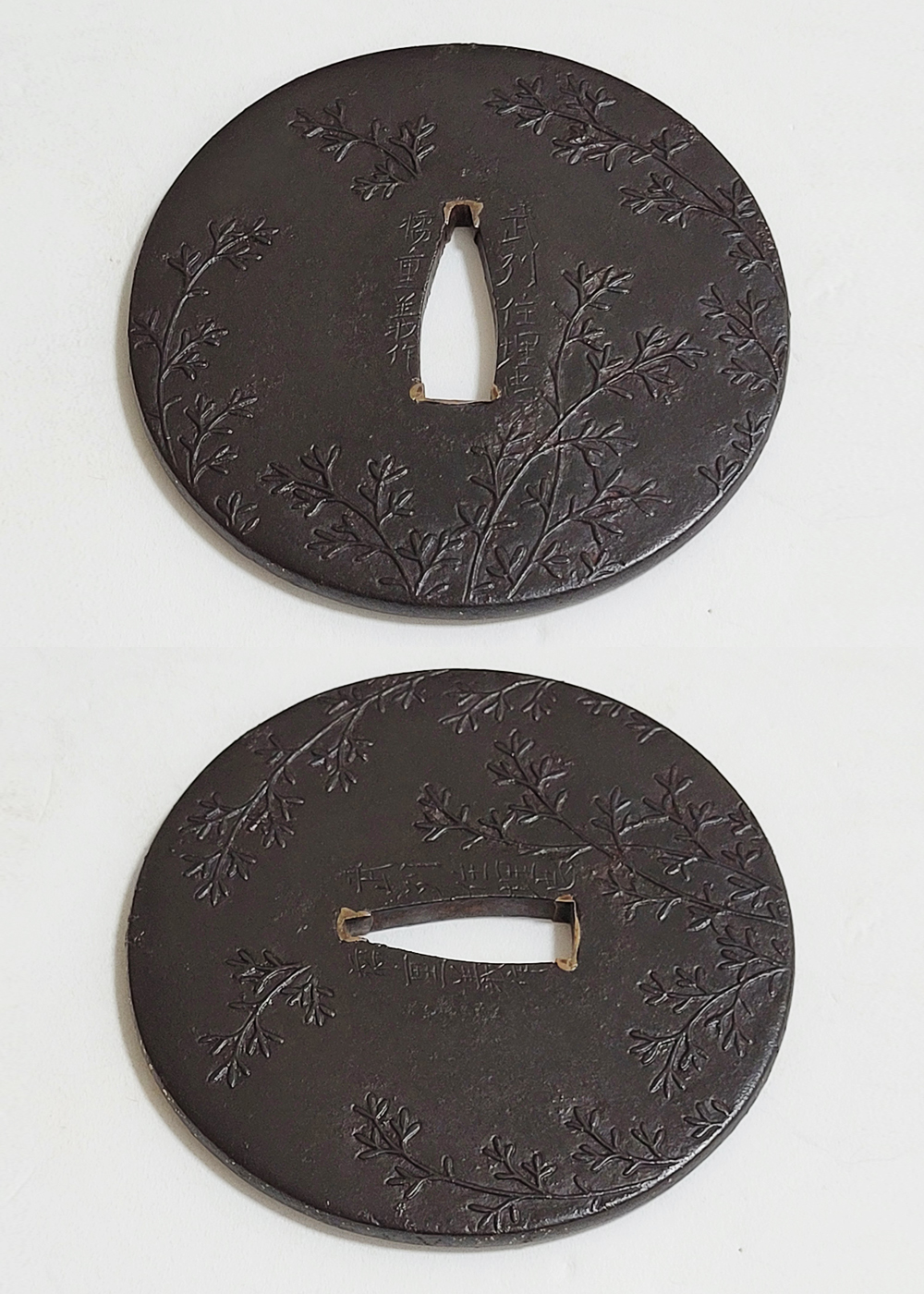
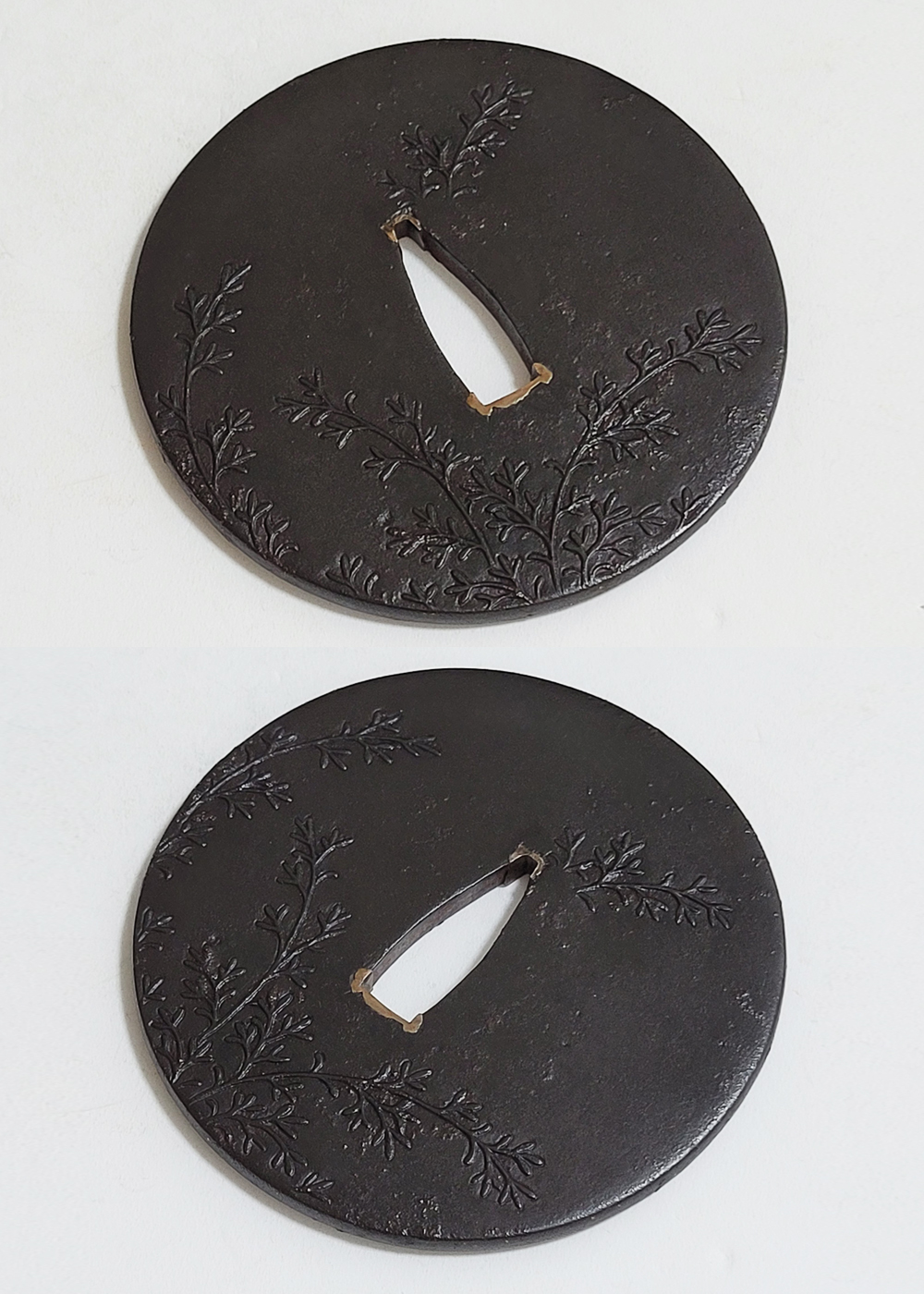
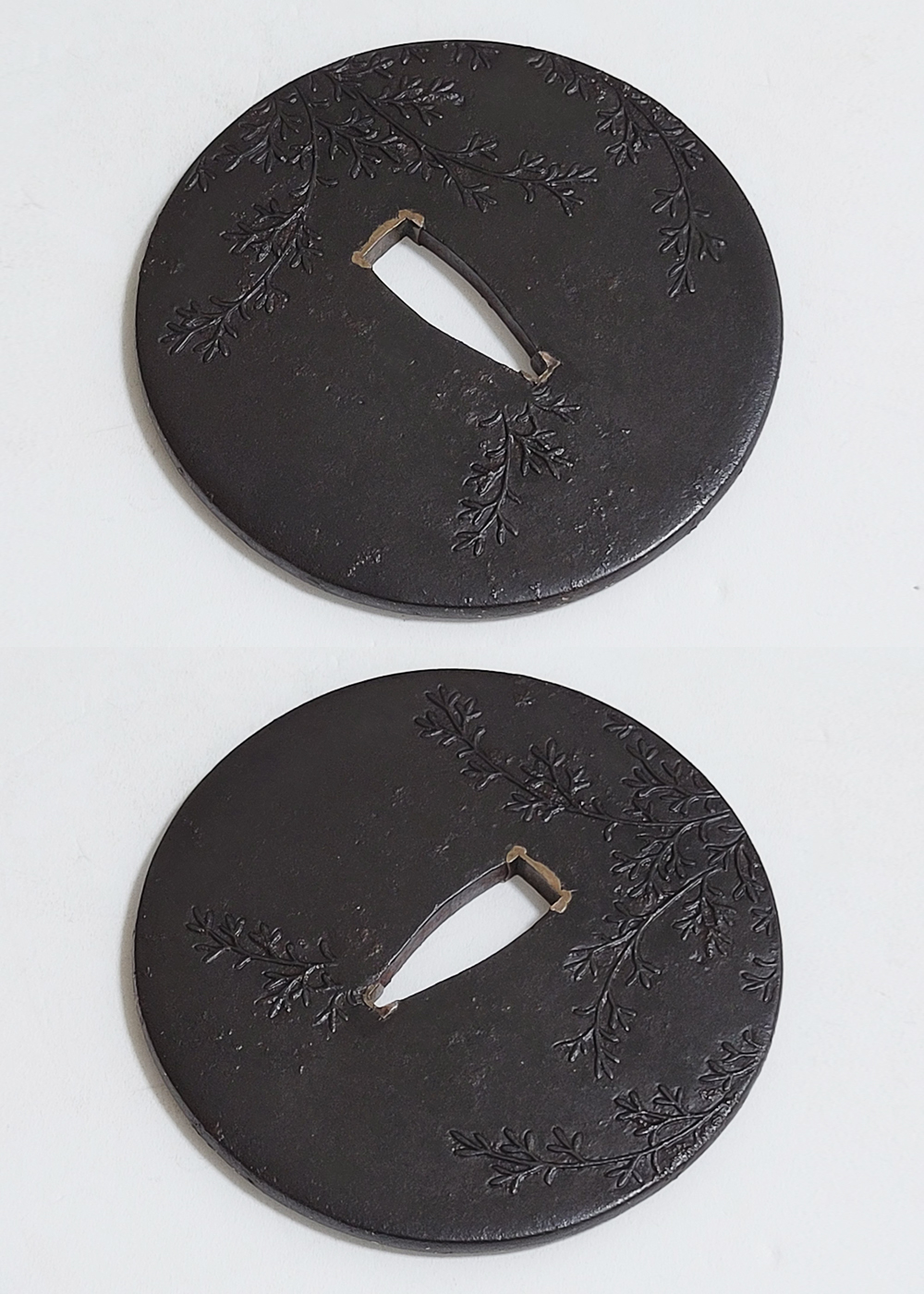
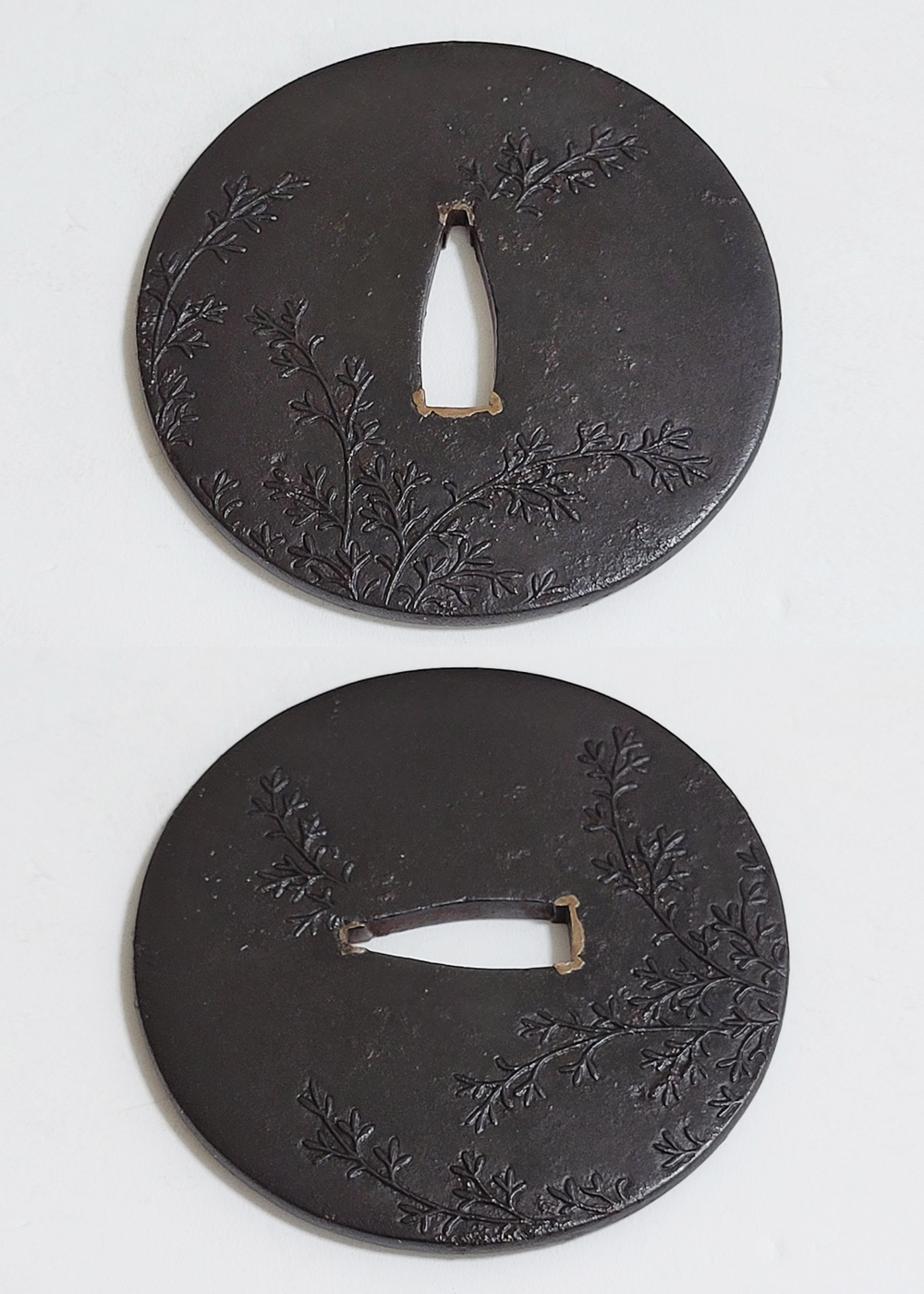
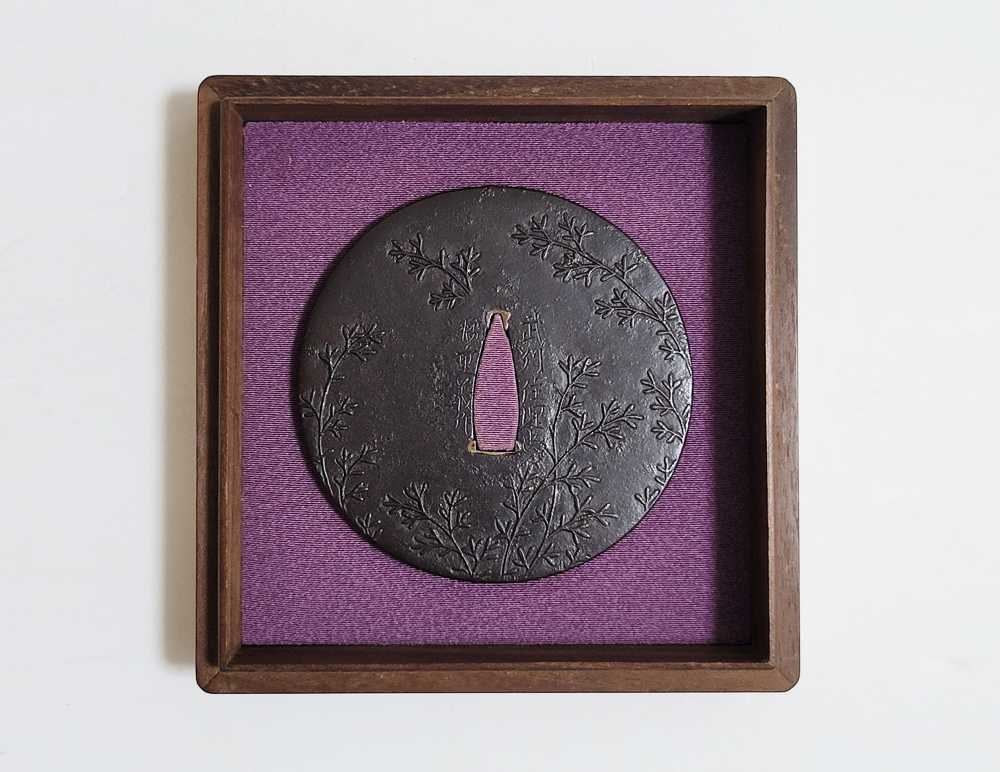
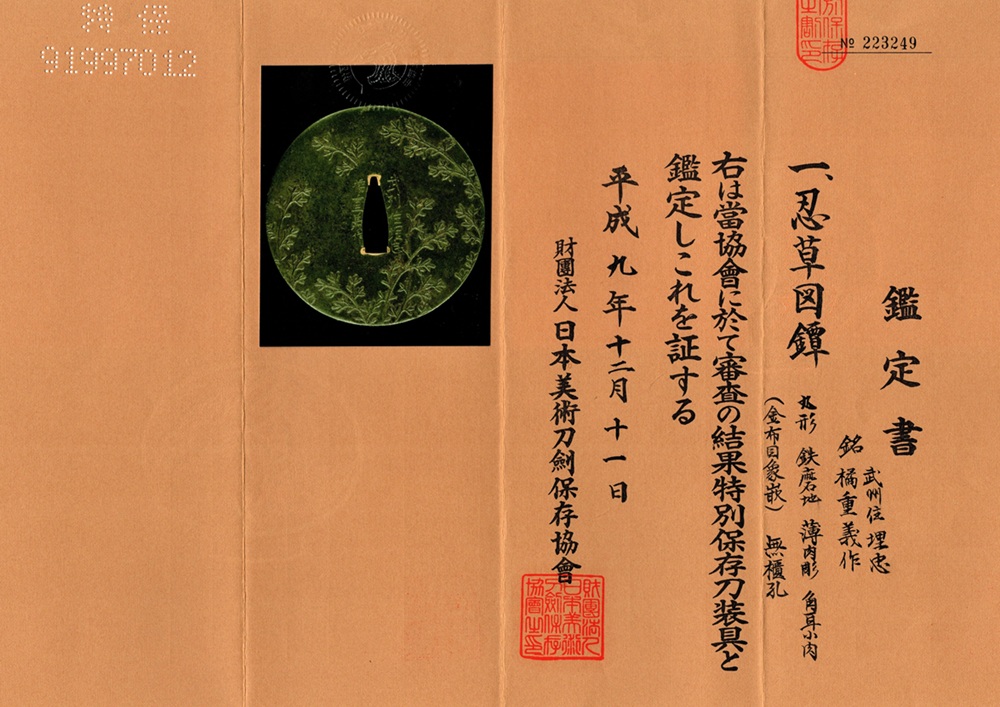
This round, mumei iron tsuba features a delicate design of gracefully extending branches and finely divided leaves, depicting the 'Shinobugusa' (fern) motif in usunikubori (thin-relief carving). The signature 'Bushu ju Umetada Tachibana Shigeyoshi saku' is attributed to Umetada Tadashige, who resided in Nishijin, Kyoto, though there are various theories regarding this. Traces of gold nunome-zogan (overlay inlay) on the rim hint at its original splendor. It passed the Tokubetsu Hozon Tosogu examination in 1997.
 NihontoWatch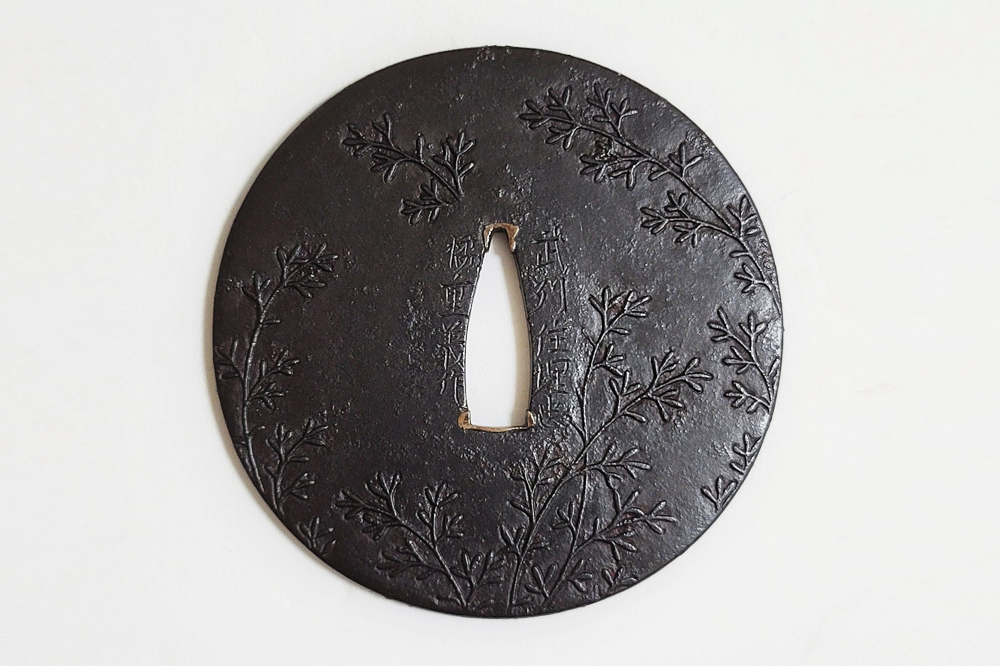
Shinto · around 1670
6 pieces on the market now
Umetada Shigeyoshi was a metalsmith of the Umetada school active from the Kan'ei through Genroku eras, residing in Nishijin, Yamashiro Province. He signed his works as Umetada Shichizaemon Tachibana Shigeyoshi, with the family name alternatively rendered as Umechū. Inheriting the carving methods of the school founder Myoju, Shigeyoshi carried forward and refined the distinctive pictorial idiom of the Umetada lineage. Multiple craftsmen appear to have worked under the name Shigeyoshi across Kyoto, Edo, and Akashi, and their precise identities and interrelationships remain incompletely resolved, though the core figure is firmly associated with the Nishijin workshop and high-ranking daimyo patronage.
Shigeyoshi commanded a formidable range of metalworking techniques. His tsuba employ shakudo grounds finished in both polished (migaki-ji) and stone-textured (ishime-ji) surfaces, ornamented through suemon-zogan (applied inlay), hira-zogan (flat inlay), sukidashi-bori (undercut relief), and kin-iroe (gold color application). He worked fluently in multiple metals including gold, silver, suaka, and brass, often combining them within a single composition to achieve the chuya (day-and-night) two-tone effect characteristic of his output. His complete daisho koshirae demonstrate mastery of the full suite of fitting types, from fuchi-kashira and menuki to kozuka, kurikata, and kojiri, unified by consistent ground treatment and decorative vocabulary.
Shigeyoshi's surviving works reveal an artist of refined sensibility who synthesized the Umetada tradition of sophisticated inlay with an elegant decorative vision suited to the tastes of powerful warrior houses. His textile-derived designs of linked shippo, karakusa arabesque, and sayagata patterns reflect his Nishijin milieu, the heart of Kyoto's silk-weaving district, while his heraldic compositions bearing the kuyo-mon and other family crests served the Hosokawa and Asano clans. His output represents a high point of the urbane, pictorial manner within the Umetada school and constitutes important material for the study of early-to-mid Edo period daimyo accoutrements.
Where Shigeyoshi stands among comparable artisans: across all of nihontō, and within tradition, era, and period. The tiers (Foremost · Leading · Major · Notable) weigh official designations from the NBTHK and Japan's Agency for Cultural Affairs, together with historical honors of lasting repute such as the Sansaku and Meibutsu-chō.
Select a lens to see how it's measured.
Shinto · Kyoto
51 pieces on the market now
The Umetada school is one of the most distinguished metalworking lineages of the Momoyama period, rooted in Nishijin, Kyoto, and claiming descent from the legendary Sanjo Munechika. The house served the Ashikaga shogunal family over successive generations, establishing deep foundations in the full range of sword-related arts -- swordmaking, blade carving (toshin-bori), the production of steel and fittings, the shortening of blades, the insertion of inlaid signature attributions (zogan-mei), and the making of mountings. " Myoju taught both Hizen Tadayoshi and Higo no Kami Teruhiro, and accepted commissions from the Toyotomi and Tokugawa houses as well as many daimyo families. An earlier stratum of production, appraised as Ko-Umetada, dates from the close of the Muromachi period and demonstrates that the group's technical foundations were firmly established before Myoju's maturity. The near-contemporary Mitsutada, though absent from formal genealogies, is conjectured to have been of senior standing within the circle; his works, executed on brass with an archaic dekoboko-ji ground, display "an even more classically archaic elegance" than Myoju's. Shigeyoshi, active from the Kan'ei through Genroku eras, carried the tradition forward into the mid-Edo period. The Umetada school's collective technical identity divides into two principal modes: iron works and soft-metal (irogane) works. In the iron mode, Myoju expressed geometric patterns -- sayagata, raimon, kasumi-kaminari-mon, and rinzu-mon -- by means of gold nunome-zogan, complemented by celebrated openwork including wheel and double-tomoe sukashi tsuba.
The nejikaeshi-mimi (twisted turned-back rim) and gold rim inlay are techniques "at which he particularly excelled," while the iron itself is invariably "carefully selected" and displays excellent quality. In the irogane mode -- employing shakudo, suaka, brass, and other alloys as ground material -- the school developed a distinctive form of hira-zogan (flat inlay) that retains only slight relief, deploying colored metals in novel combinations. " Ground textures including hammered tsuchime-ji, polished migaki-ji, and file-finished surfaces are deployed with meticulous care to heighten the pictorial effect. Mitsutada's work on brass with its uneven, raised-and-recessed ground and enrichment through gold and silver nunome-zogan represents a more archaic variant of this aesthetic. Shigeyoshi synthesized the inherited hira-zogan tradition with textile-derived designs of linked shippo, karakusa arabesque, and sayagata patterns -- reflecting his Nishijin milieu, the heart of Kyoto's silk-weaving district -- while deploying suemon-zogan, sukidashi-bori, and kin-iroe across shakudo grounds in both polished and stone-textured finishes. The Umetada school's historical significance is singular: the pictorial manner of design, the hira-zogan technique, and the use of non-iron metals as the ground material "all find their earliest beginning with Myoju" -- he stands as the originator of an entire aesthetic vocabulary in kinko. The NBTHK consistently describes Myoju's work as possessing "the vitality that preserves the very momentum of brushwork," with a "strong connection with Hon'ami Koetsu and Tawaraya Sotatsu" that places him among the foremost artistic figures of the Momoyama age. " Solid-gold tsuba, frequently melted down during periods of upheaval, are recognized as extremely rare survivals of exceptional documentary and artistic value. Learn more →
| Smith | Era | Designated |
|---|---|---|
| Myoju明寿 | 1590-1631 | 45 |
| Muneyoshi宗吉 | 1596-1615 | 4 |
| Kunai宮内 | — | 0 |
| Kaji’emon加治右衛門 | — | 0 |
| Naritsugu就次 | — | 0 |
A Hozon-certified fitting of notably superior craftsmanship and condition, often with signature or workmanship of high reference value.
The NBTHK (Nihon Bijutsu Tōken Hozon Kyōkai, the Society for the Preservation of Japanese Art Swords) is a public-interest incorporated foundation founded in 1948 and supervised by Japan’s Agency for Cultural Affairs (Bunkachō); it is based at the Japanese Sword Museum in Tokyo. Its expert panels physically examine each submitted work (shinsa) and issue a certificate (kanteishō) ranking it by artistic and historical merit. NBTHK papers are the most widely recognized standard of authentication for Japanese swords and fittings.
NBTHK official siteDomestic: items may be returned within 7 days in original condition for a full refund (buyer covers transport). Overseas orders: no-refunds, no-returns.