 NihontoWatchNihontoWatch
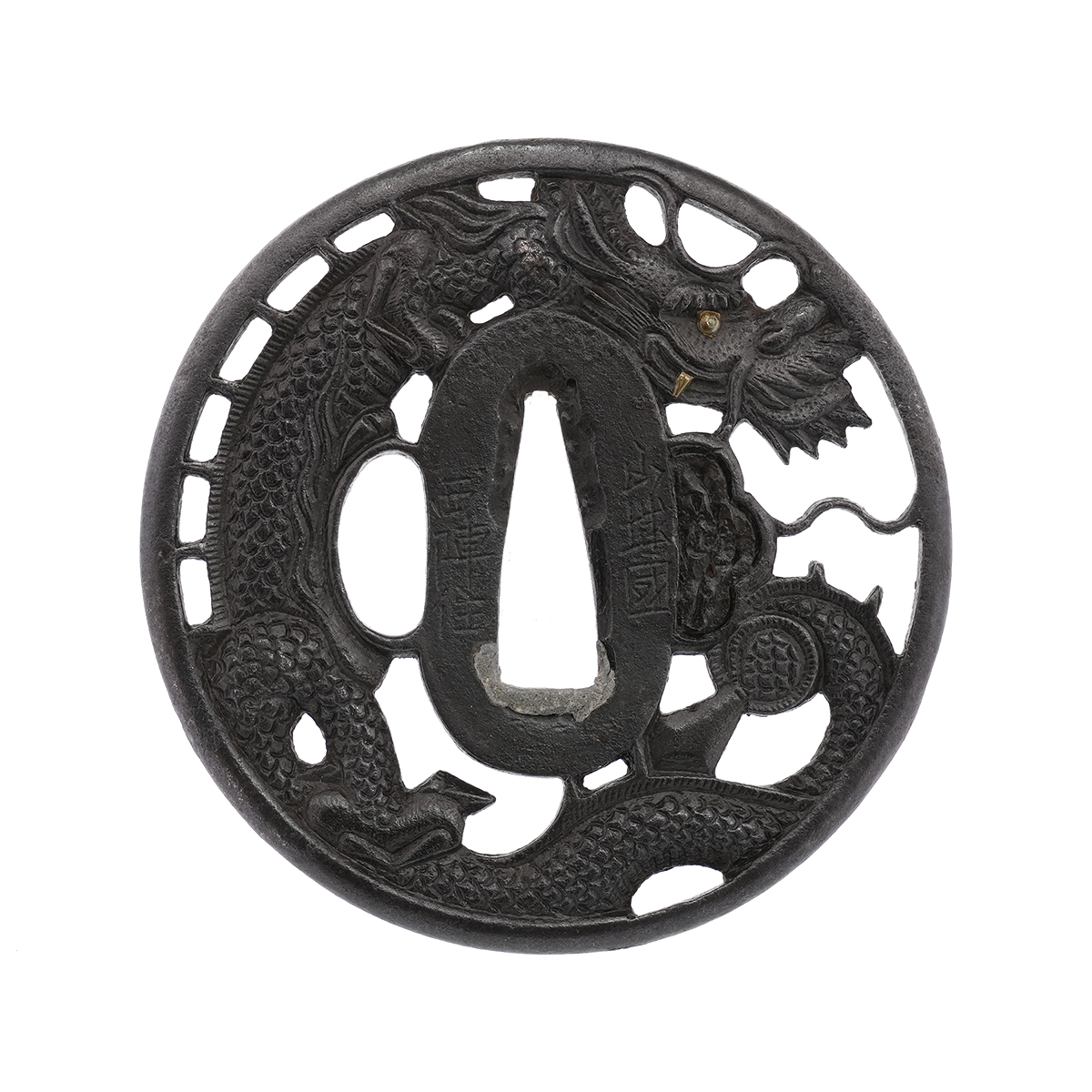
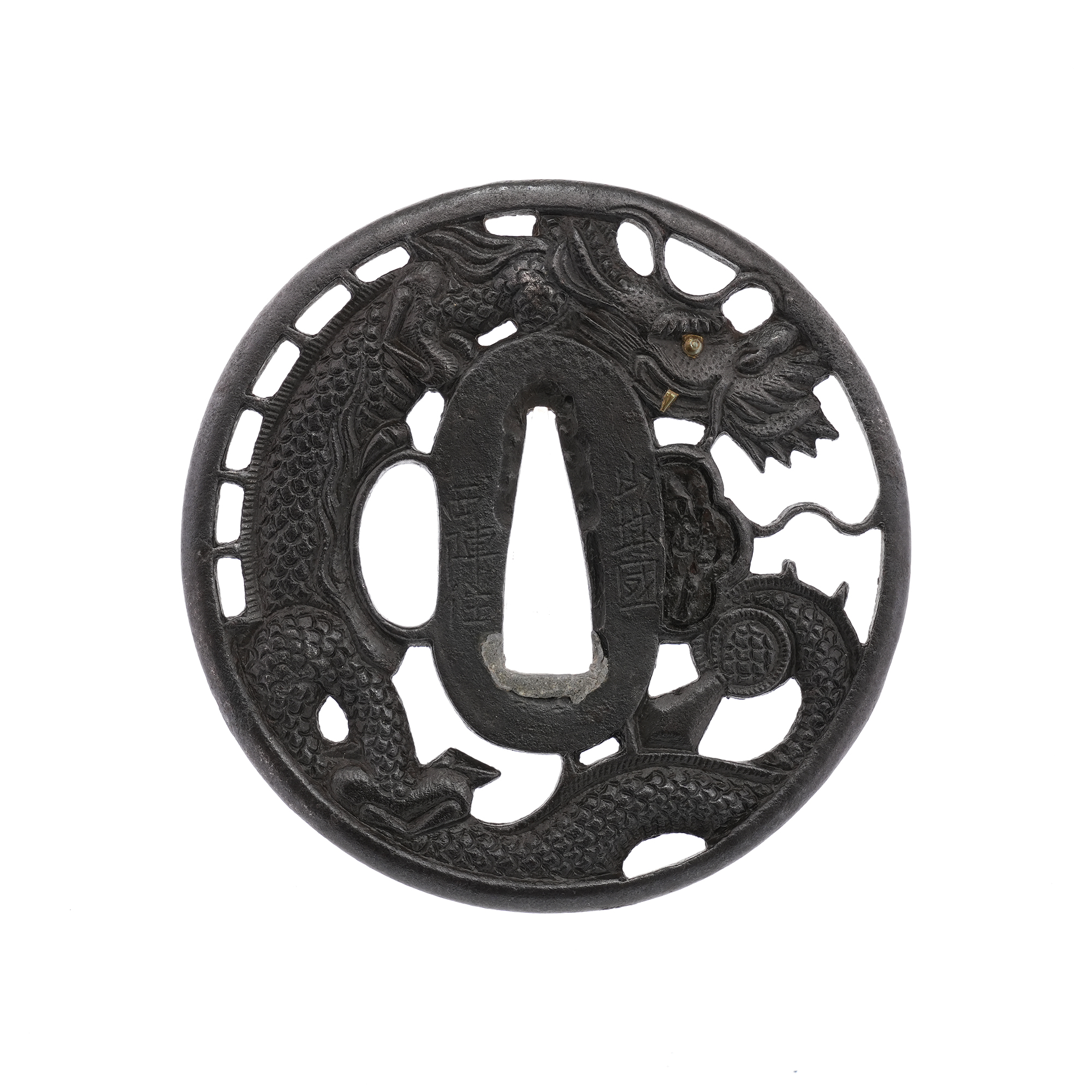
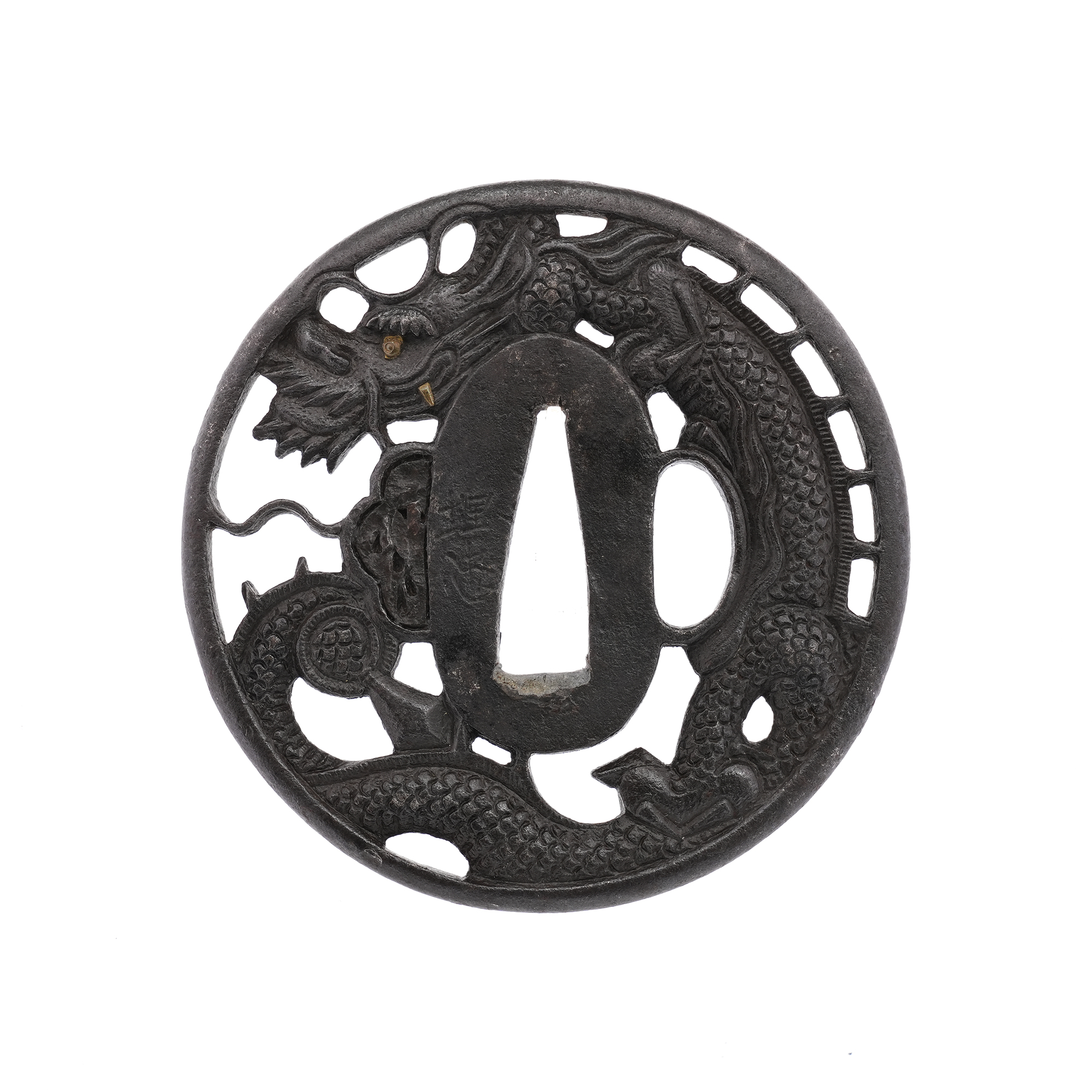
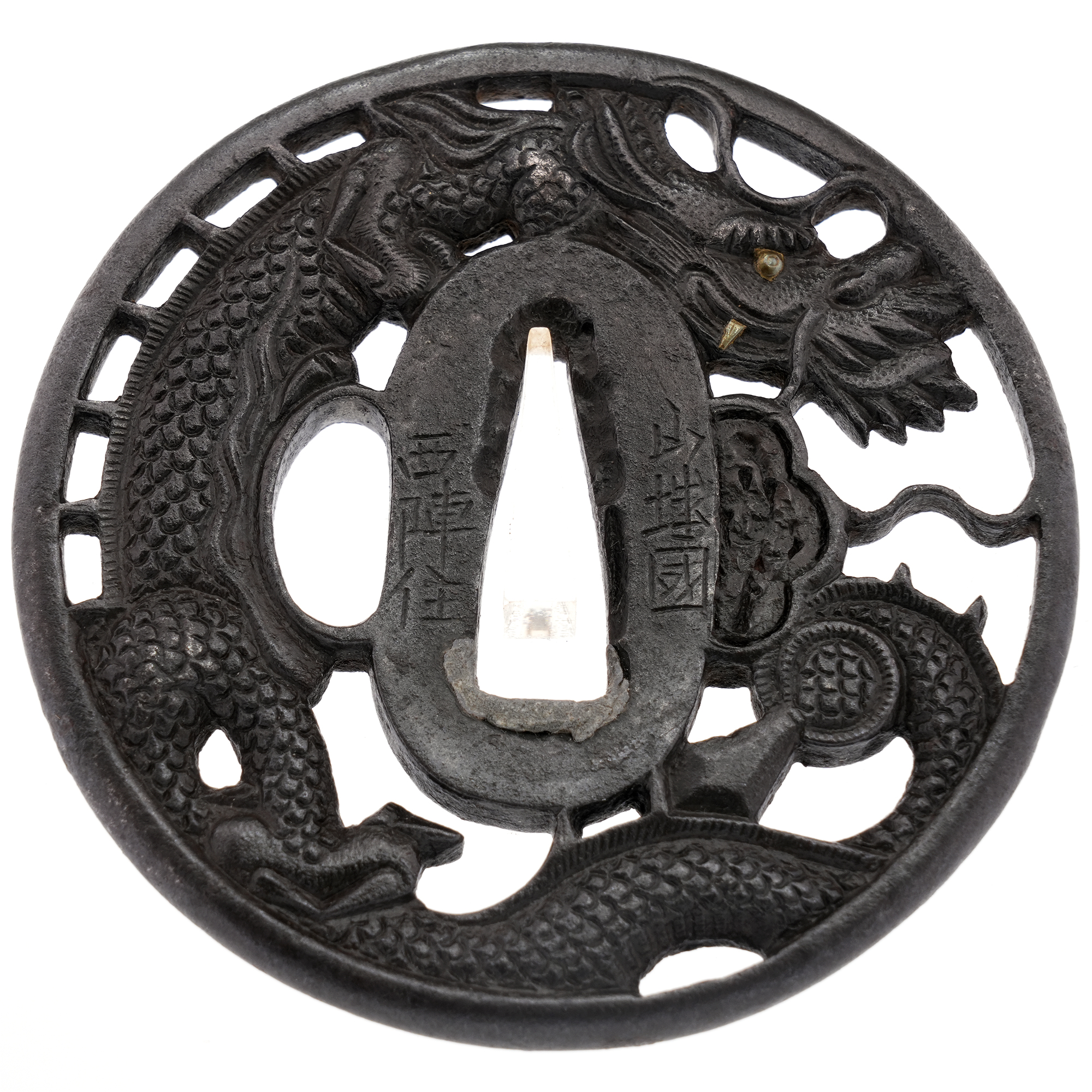
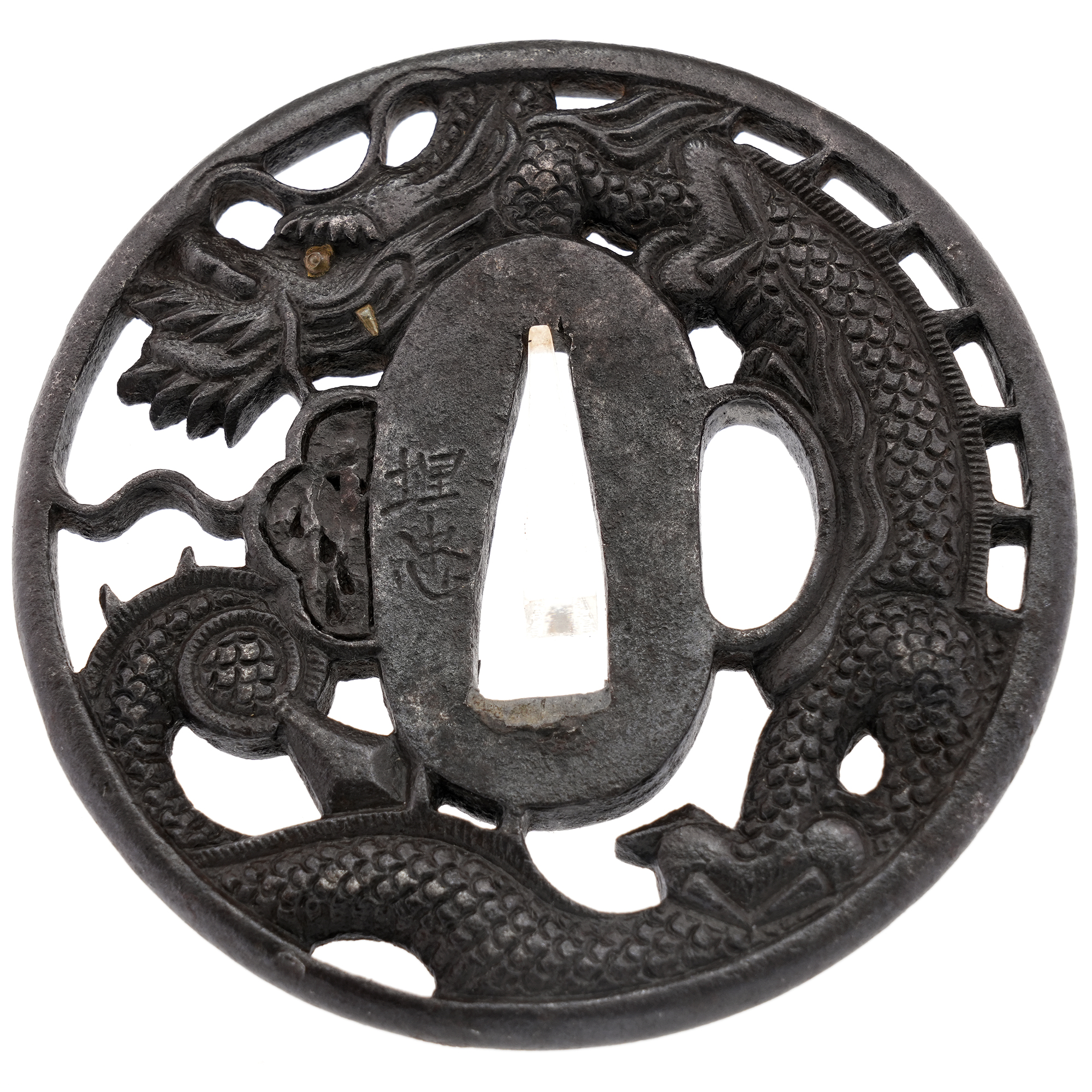
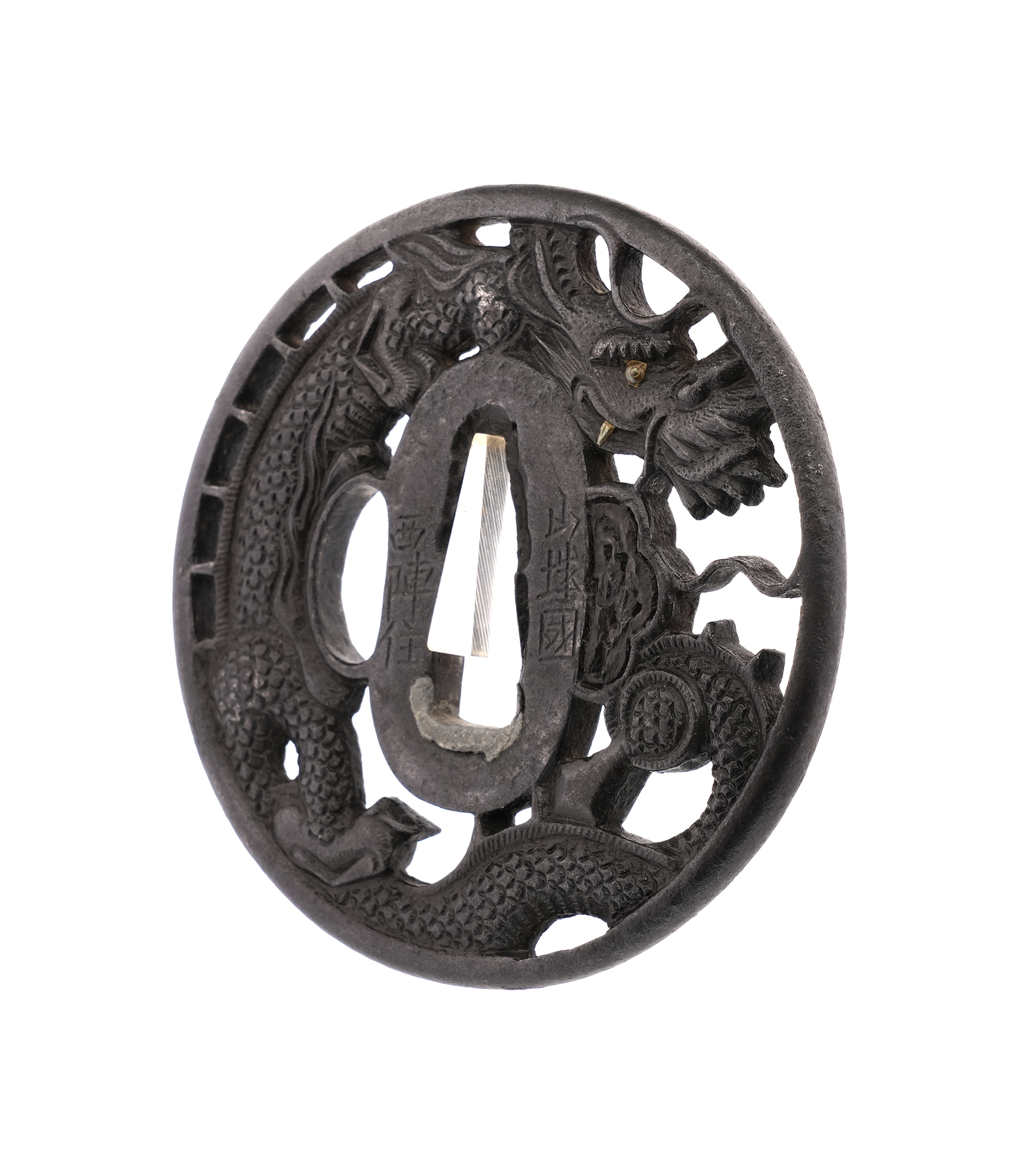
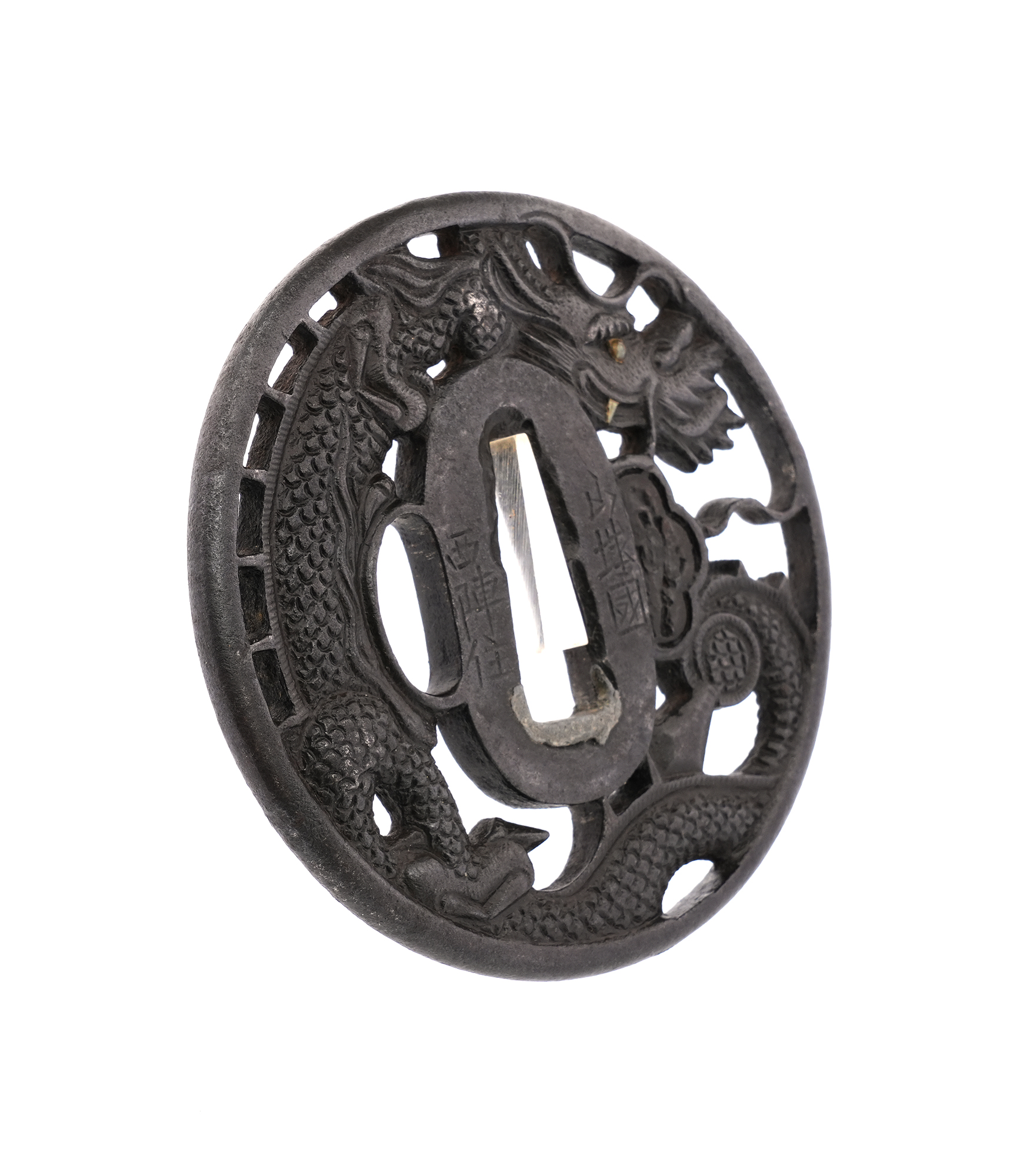
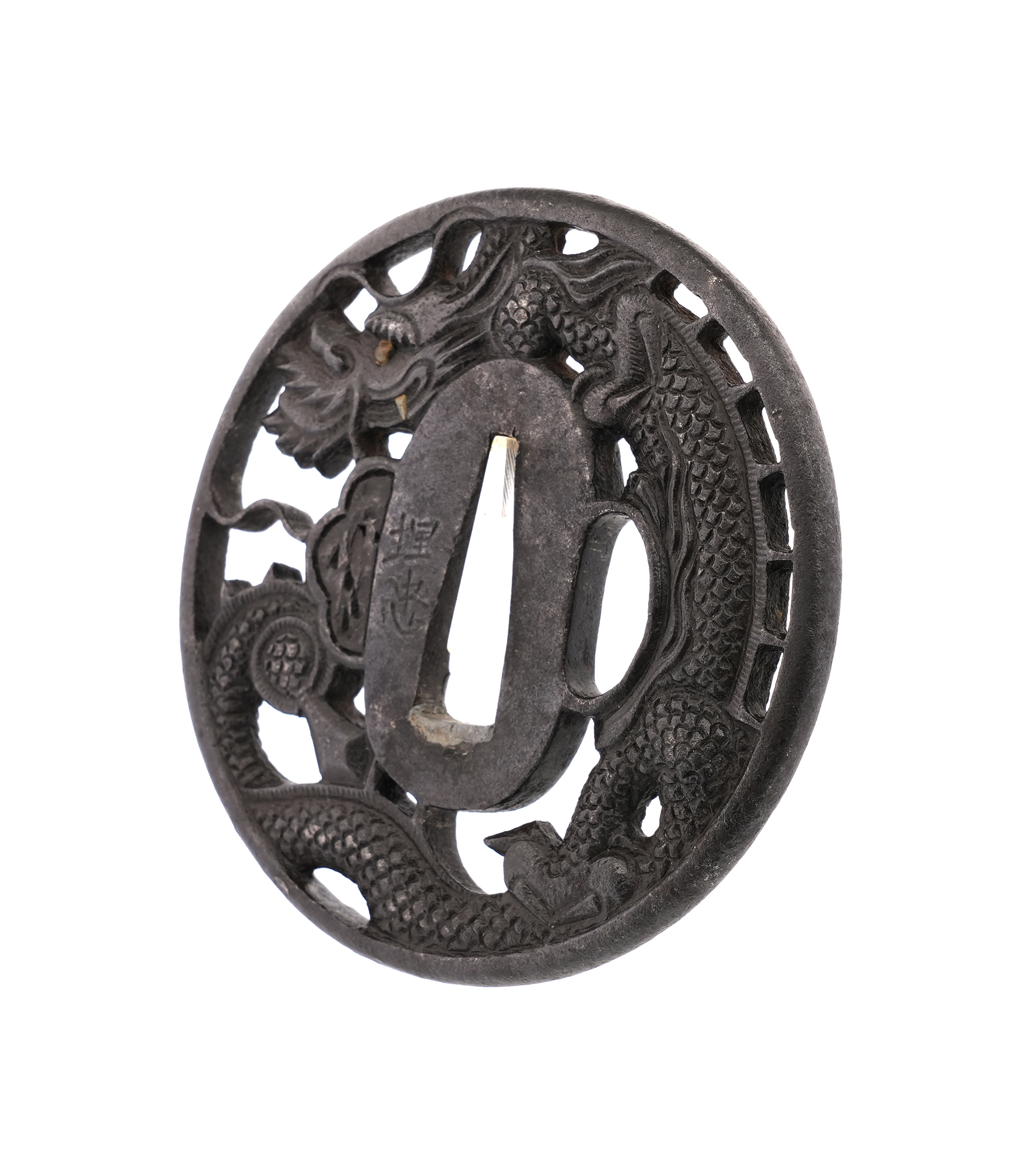
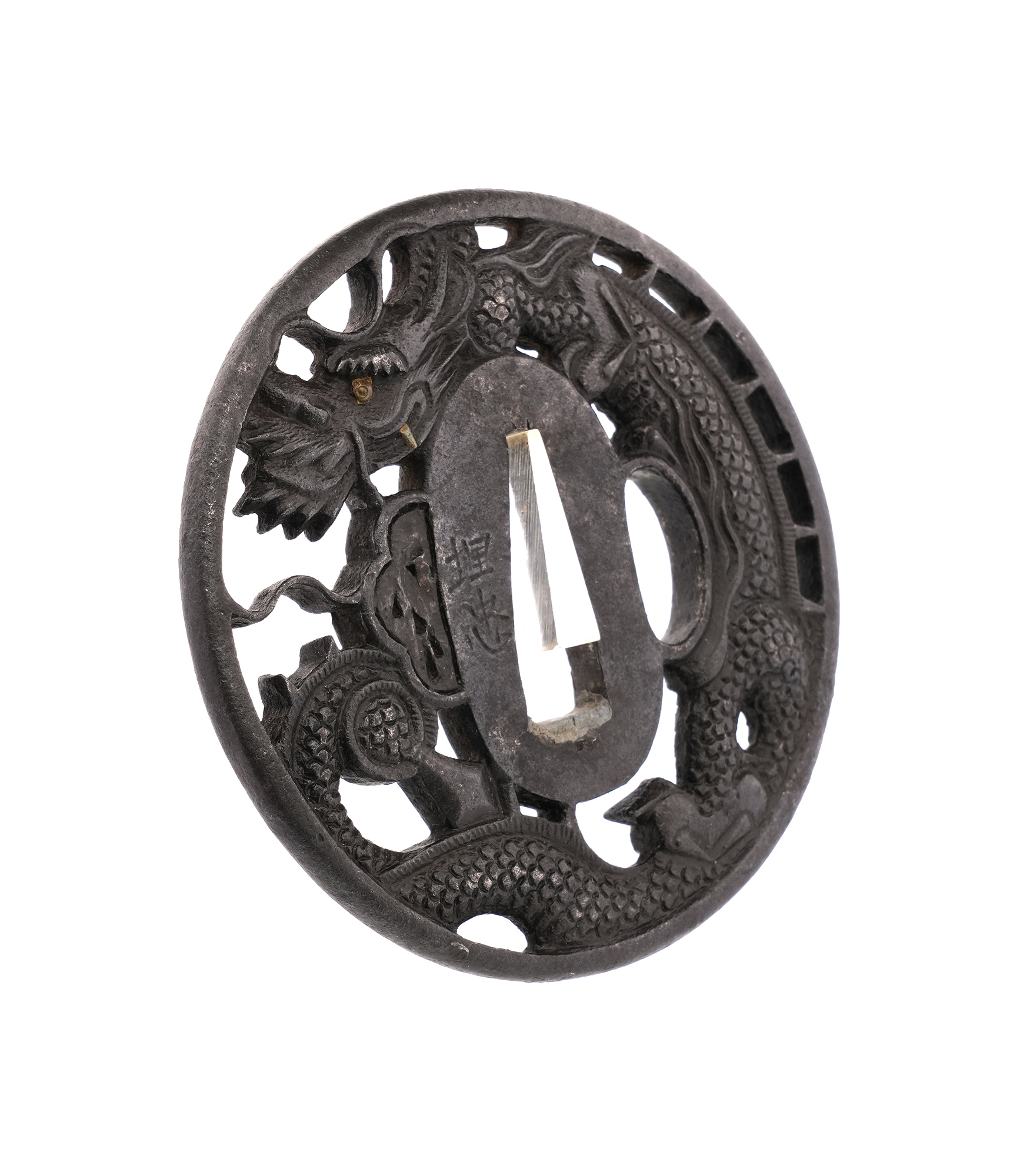
The Umetada family was a lineage of swordsmiths and tosogu masters based in Kyoto from the Momoyama period through the early Edo period, and the first generation Umetada Myoju is known as a master craftsman who demonstrated excellent skills in various fields such as sword making, polishing, and horimono. In tosogu as well, they produced many masterpieces such as sukashi tsuba and hori tsuba using tetsu-ji and shakudo-ji, and their refined style exerted a great influence on later Kyoto kinko. Among works inscribed with the Umetada mei, there are not a few that include later kiwame or ato-mei, and it is considered important to examine each work individually. This work features a powerful sukashi in tetsu-ji, showing a grand composition with a single dragon arranged to fill the entire circle. The head of the dragon is full of intensity, the scales carved across the entire body are carefully expressed down to each individual scale, and sure carving techniques can be seen in the limbs and claws. Brass-gan is applied to the eyes and fangs, skillfully enhancing the dragon's sense of life through the contrast with the calm color of the tetsu-aji. The thick niku-oki and well-balanced sukashi are worth seeing, and the high skill of the creator can be felt from the composition, which is brought together without flaw even to the mimi. This work has a history of being held in the examination by the Nihon Bijutsu Token Hozon Kyokai, with the mei being labeled as "room for research," but this means that no conclusion was presented regarding the authenticity of the mei. On the other hand, the work itself is an excellent piece that can be evaluated as a single plate possessing a high degree of perfection worthy of the Umetada name, excelling in tetsu-aji, carving technique, and composition.
NihontoWatchOffered by Toushin

We couldn’t find current papers for this piece. Ask the dealer whether it has been, or can be, submitted to shinsa. — Hoshi

Machine translation of the shop's Japanese ·
Machine translation from the shop's Japanese · may contain errors ·
Shinto · Kyoto
45 pieces on the market now
The Umetada school is one of the most distinguished metalworking lineages of the Momoyama period, rooted in Nishijin, Kyoto, and claiming descent from the legendary Sanjo Munechika. The house served the Ashikaga shogunal family over successive generations, establishing deep foundations in the full range of sword-related arts -- swordmaking, blade carving (toshin-bori), the production of steel and fittings, the shortening of blades, the insertion of inlaid signature attributions (zogan-mei), and the making of mountings. " Myoju taught both Hizen Tadayoshi and Higo no Kami Teruhiro, and accepted commissions from the Toyotomi and Tokugawa houses as well as many daimyo families. An earlier stratum of production, appraised as Ko-Umetada, dates from the close of the Muromachi period and demonstrates that the group's technical foundations were firmly established before Myoju's maturity. The near-contemporary Mitsutada, though absent from formal genealogies, is conjectured to have been of senior standing within the circle; his works, executed on brass with an archaic dekoboko-ji ground, display "an even more classically archaic elegance" than Myoju's. Shigeyoshi, active from the Kan'ei through Genroku eras, carried the tradition forward into the mid-Edo period. The Umetada school's collective technical identity divides into two principal modes: iron works and soft-metal (irogane) works. In the iron mode, Myoju expressed geometric patterns -- sayagata, raimon, kasumi-kaminari-mon, and rinzu-mon -- by means of gold nunome-zogan, complemented by celebrated openwork including wheel and double-tomoe sukashi tsuba.
The nejikaeshi-mimi (twisted turned-back rim) and gold rim inlay are techniques "at which he particularly excelled," while the iron itself is invariably "carefully selected" and displays excellent quality. In the irogane mode -- employing shakudo, suaka, brass, and other alloys as ground material -- the school developed a distinctive form of hira-zogan (flat inlay) that retains only slight relief, deploying colored metals in novel combinations. " Ground textures including hammered tsuchime-ji, polished migaki-ji, and file-finished surfaces are deployed with meticulous care to heighten the pictorial effect. Mitsutada's work on brass with its uneven, raised-and-recessed ground and enrichment through gold and silver nunome-zogan represents a more archaic variant of this aesthetic. Shigeyoshi synthesized the inherited hira-zogan tradition with textile-derived designs of linked shippo, karakusa arabesque, and sayagata patterns -- reflecting his Nishijin milieu, the heart of Kyoto's silk-weaving district -- while deploying suemon-zogan, sukidashi-bori, and kin-iroe across shakudo grounds in both polished and stone-textured finishes. The Umetada school's historical significance is singular: the pictorial manner of design, the hira-zogan technique, and the use of non-iron metals as the ground material "all find their earliest beginning with Myoju" -- he stands as the originator of an entire aesthetic vocabulary in kinko. The NBTHK consistently describes Myoju's work as possessing "the vitality that preserves the very momentum of brushwork," with a "strong connection with Hon'ami Koetsu and Tawaraya Sotatsu" that places him among the foremost artistic figures of the Momoyama age. " Solid-gold tsuba, frequently melted down during periods of upheaval, are recognized as extremely rare survivals of exceptional documentary and artistic value. Learn more →
| Smith | Era | Designated |
|---|---|---|
| Myoju明寿 | 1590-1631 | 45 |
| Muneyoshi宗吉 | 1596-1615 | 4 |
| Naritsugu就次 | — | 0 |
| Umetada Mitsushige光重 | 1700-1750 | 0 |
| Kaji’emon加治右衛門 | — | 0 |
We could not find an authenticity certificate on the seller’s listing. Japanese swords and fittings are normally papered by the NBTHK (or the NTHK). Without one, the attribution is the seller’s own assessment and has not been independently verified — treat it with caution and ask the dealer about certification before buying.
As a rule we do not accept returns, except when we have sent a different item from the one ordered or when there is a significant discrepancy between the description and the item. If you wish to return an item, please contact us within 3 days of its arrival and then send it back.
¥220,000