 NihontoWatchNihontoWatch
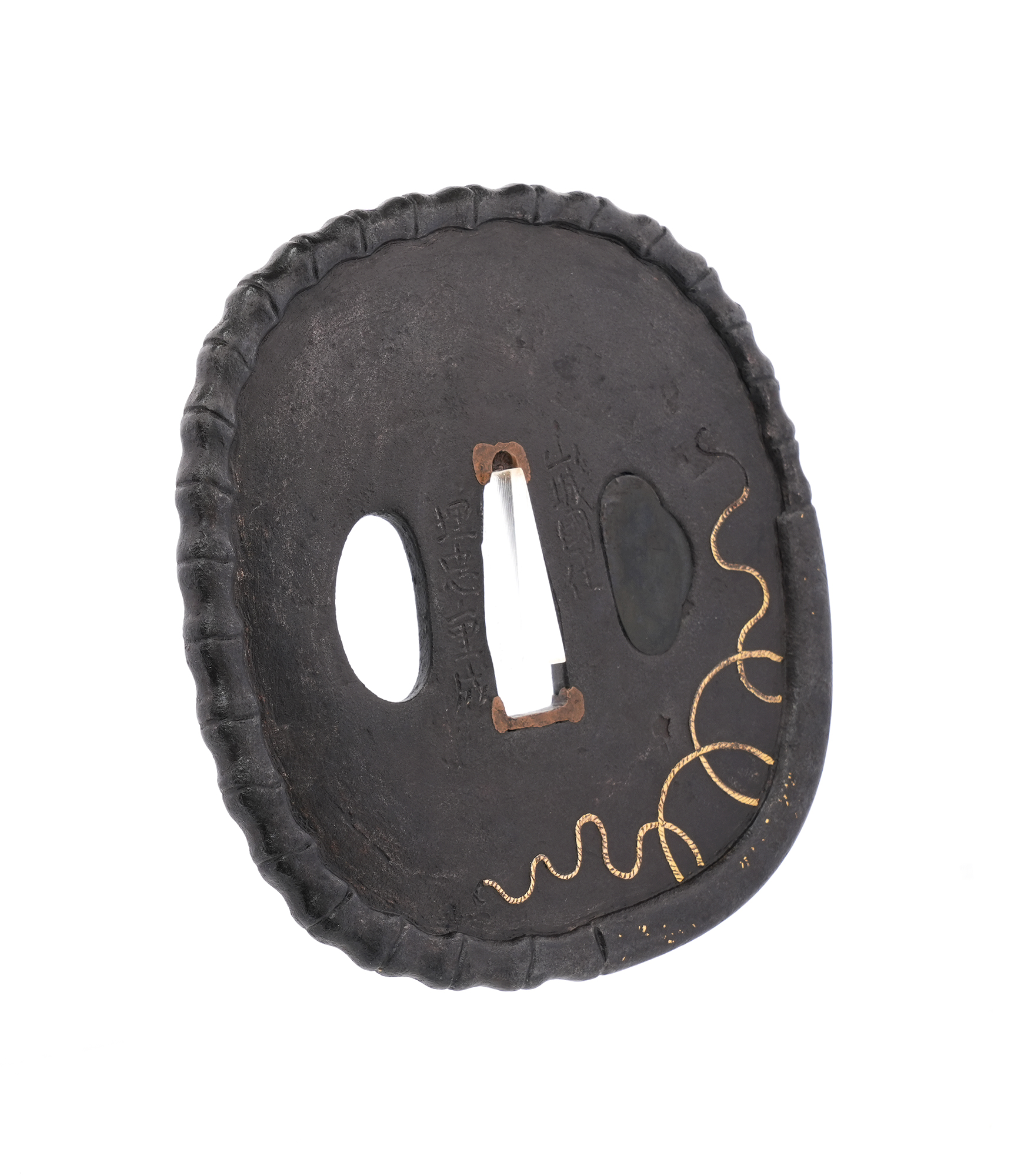
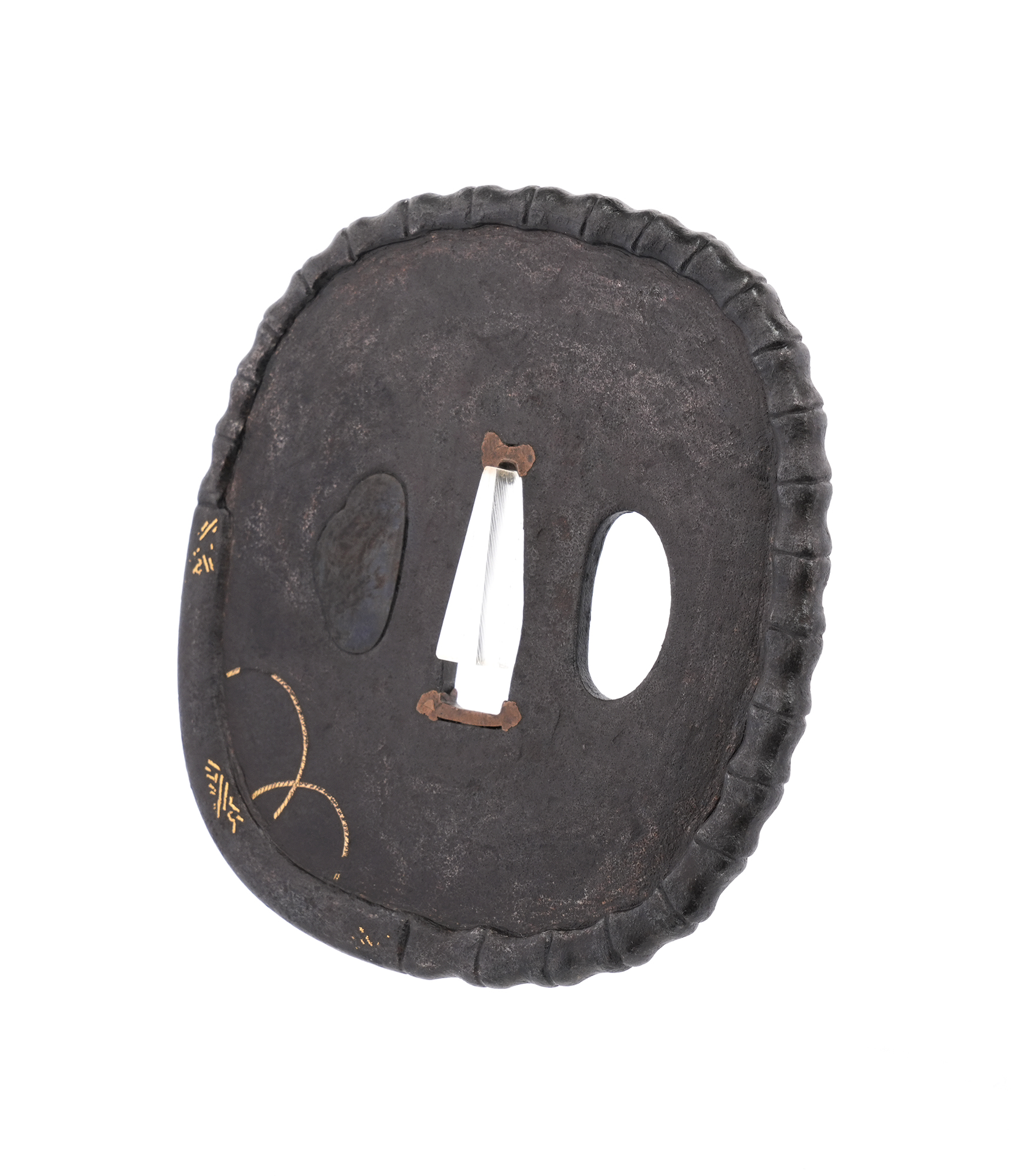
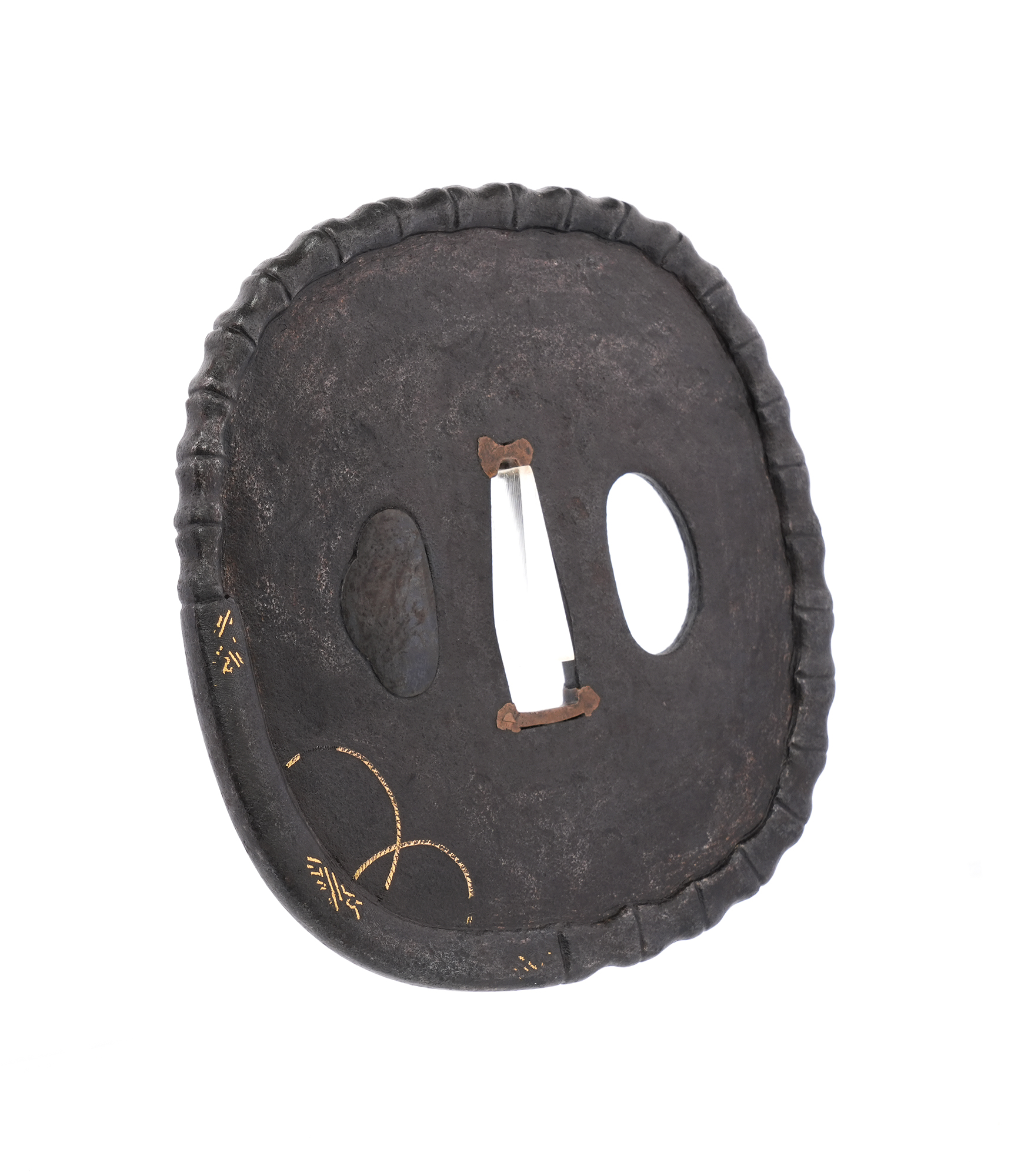
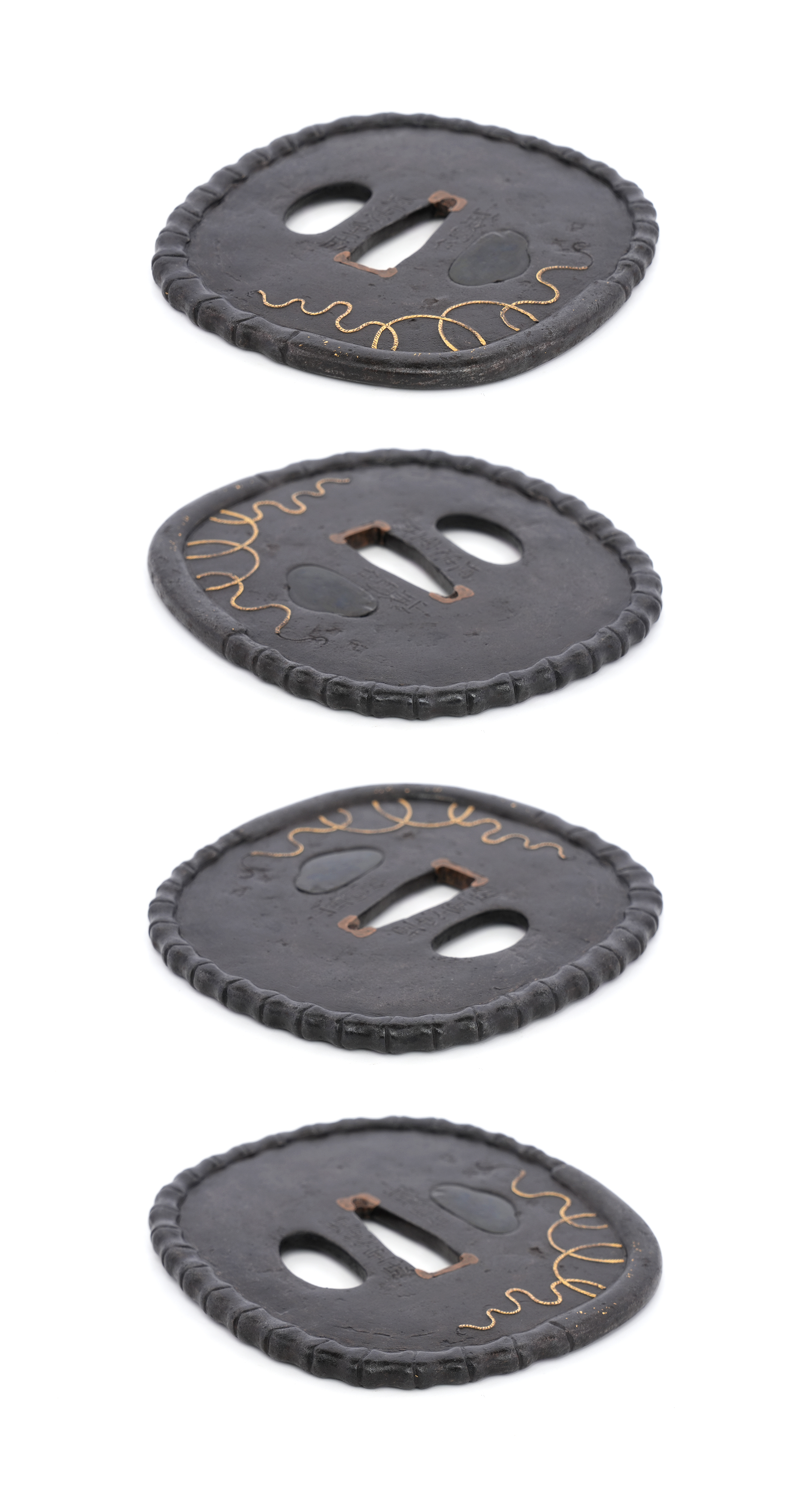
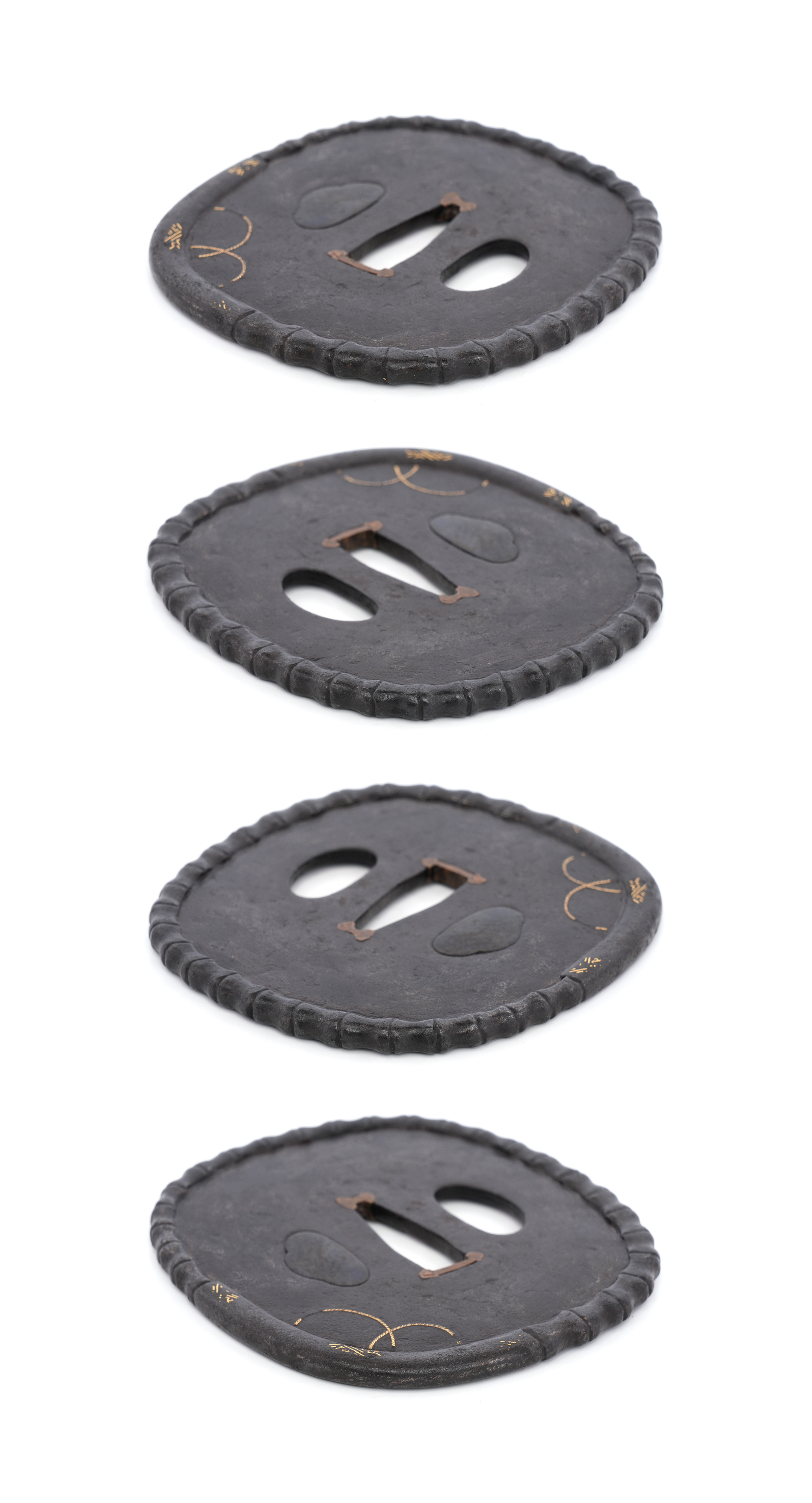
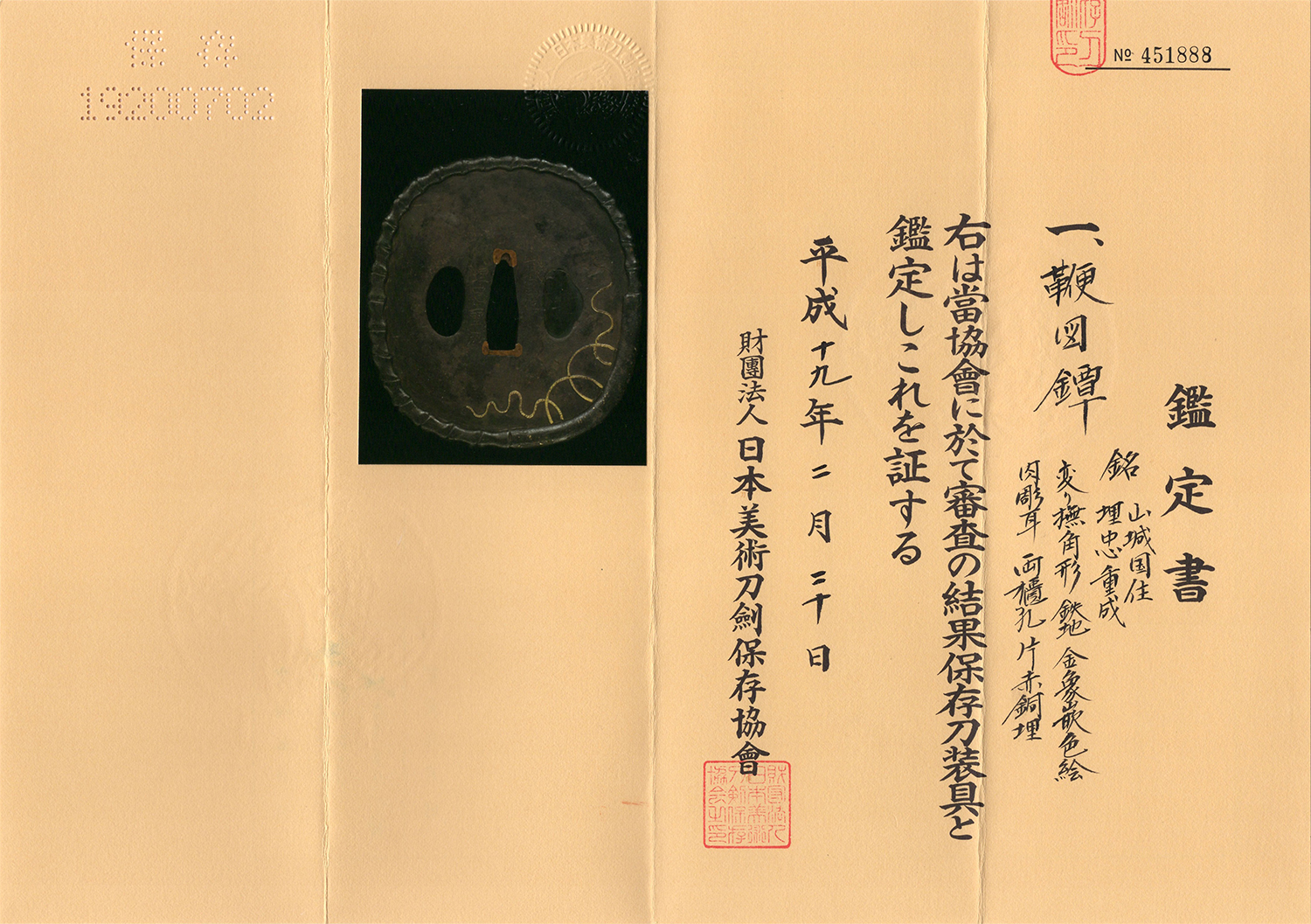
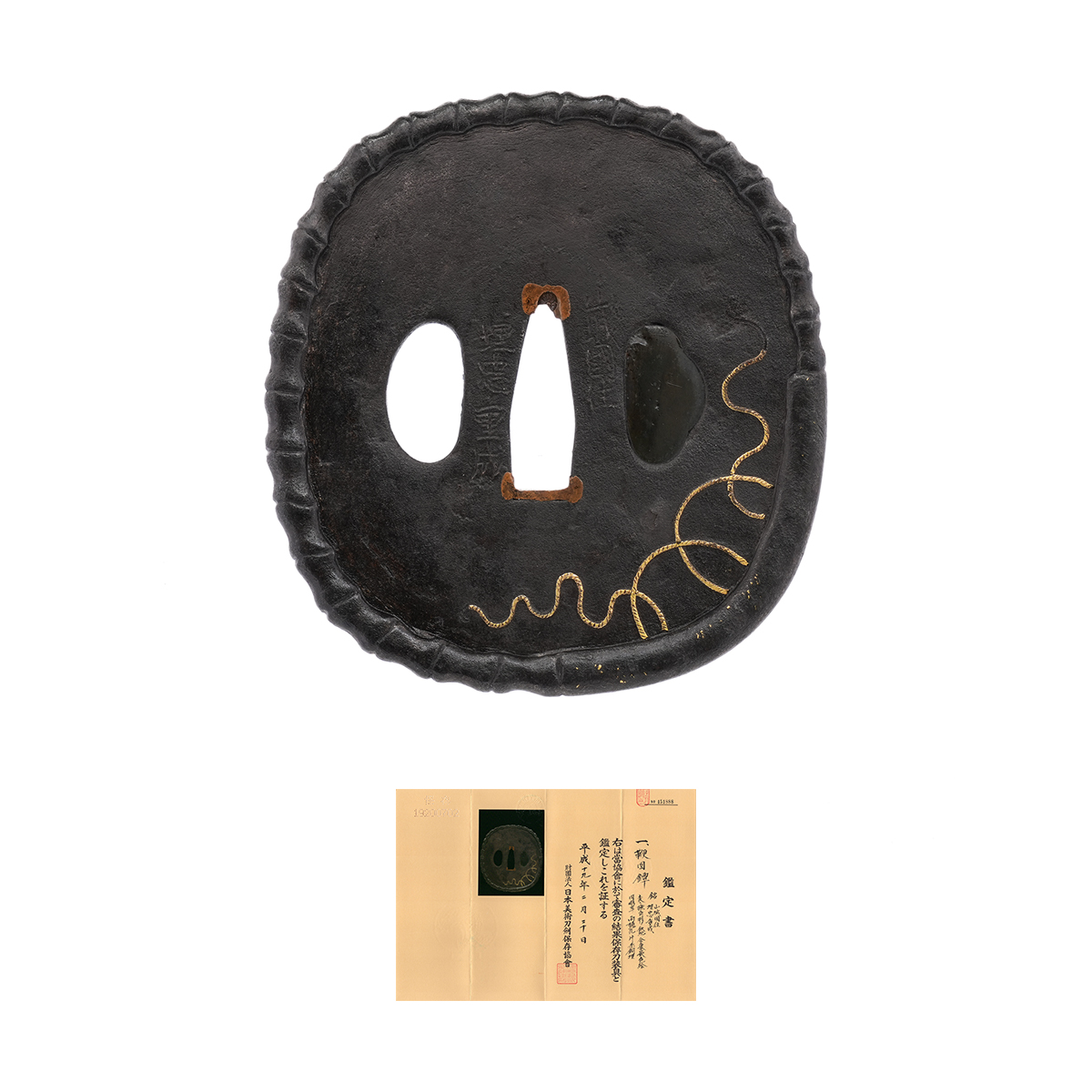
Umedada Shigenari, known as Shichizaemon, was a metalworker of the Umedada school who used the Tachibana surname. Living in Nishijin, Yamashiro no Kuni, he was active primarily around the Enpo and Tenna eras; it is said he was summoned by the Shogunate to travel to Edo and also resided in Shiba Katamonzen-cho. Known as a skilled hand of the Umedada school, he left behind tsuba featuring carvings and zogan on various base metals, starting with tetsu-ji. Among extant works, mei such as "Yamashiro no Kuni ju Umedada Shigenari" and "Yamashiro no Kuni Nishijin ju Umedada Tachibana Shigenari" have been confirmed, and the Cultural Heritage Database also includes a work by Shigenari featuring sukibori and kin-gin zogan on tetsu-ji. A whip is a practical tool for controlling a horse, and at the same time, it is a motif that evokes the equestrian culture of the samurai class. In this work, rather than simply depicting a whip on the tsuba surface, the knotted form of the whip wraps entirely around the mimi, incorporating that three-dimensional contour into the very outer shape of the tsuba; the outstanding inspiration of Umedada Shigenari, which integrates design and modeling, stands out. The thickness of the mimi is maintained at 4.8 mm, and because each continuous knot is expressed with thick niku, it tightens the composition as a powerful border from the front, while from an angle, the volume and shadows of the whip rising from the tetsu-ji appear clearly. On the omote surface, a rope is performed with suakado zogan followed by kin-iroe, depicting a form that stretches with varying rhythm as it broadly crosses the tsuba surface from the bottom right. The golden lines float vividly atop the tetsu-ji which exhibits a deep black color, and while the lines expressed finely down to the twists of the rope create light movement, kin-nunome zogan is added to the handle of the whip to provide variation in technique and brilliance, skillfully combining the different works of suakado zogan, kin-iroe, and kin-nunome zogan within a concise composition. Precisely because it is a composition that boldly leaves wide yohaku, the undulation of the rope and the whip encircling the mimi respond to one another, allowing one to enjoy a modest yet deeply impressive keshiki where the fine gold lines appear and recede depending on the viewing angle. On the ura surface, the rope is expressed in a wachi-gai shape at the bottom left, changing the mood from the relaxed composition of the omote and condensing the motif into the form of intertwined rings. In this composition, which maintains a sense of overall unity through the whip encircling the mimi while changing the presentation of the rope between omote and ura, one can see the author's excellent sense of design that makes full use of the limited tsuba surface; the kogai-hitsu-ana is carefully filled with shakudo, and suakado sekigane are applied to the top and bottom of the nakago-ana, leaving behind a certain provenance as a sword fitting that was practically used even in the finishing of details. The large-scale tetsu-ji, the whip-shaped mimi showing rich niku-oki, the gold rope striking against the black ground, and the composition with different themes on the omote and ura come together as one; the charm of this piece lies in how it leaves a strong impression through only the color tones of the materials and the movement of lines, without relying on gaudy takabori. Accompanied by a Hozon Tosogu Kanteisho, this is a tsuba rich in design quality even among the works of this smith, allowing one to fully appreciate the certain skill and playfulness of Umedada Shigenari, as well as the beauty of the tetsu-aji and zogan.
Offered by Toushin
2 on the market

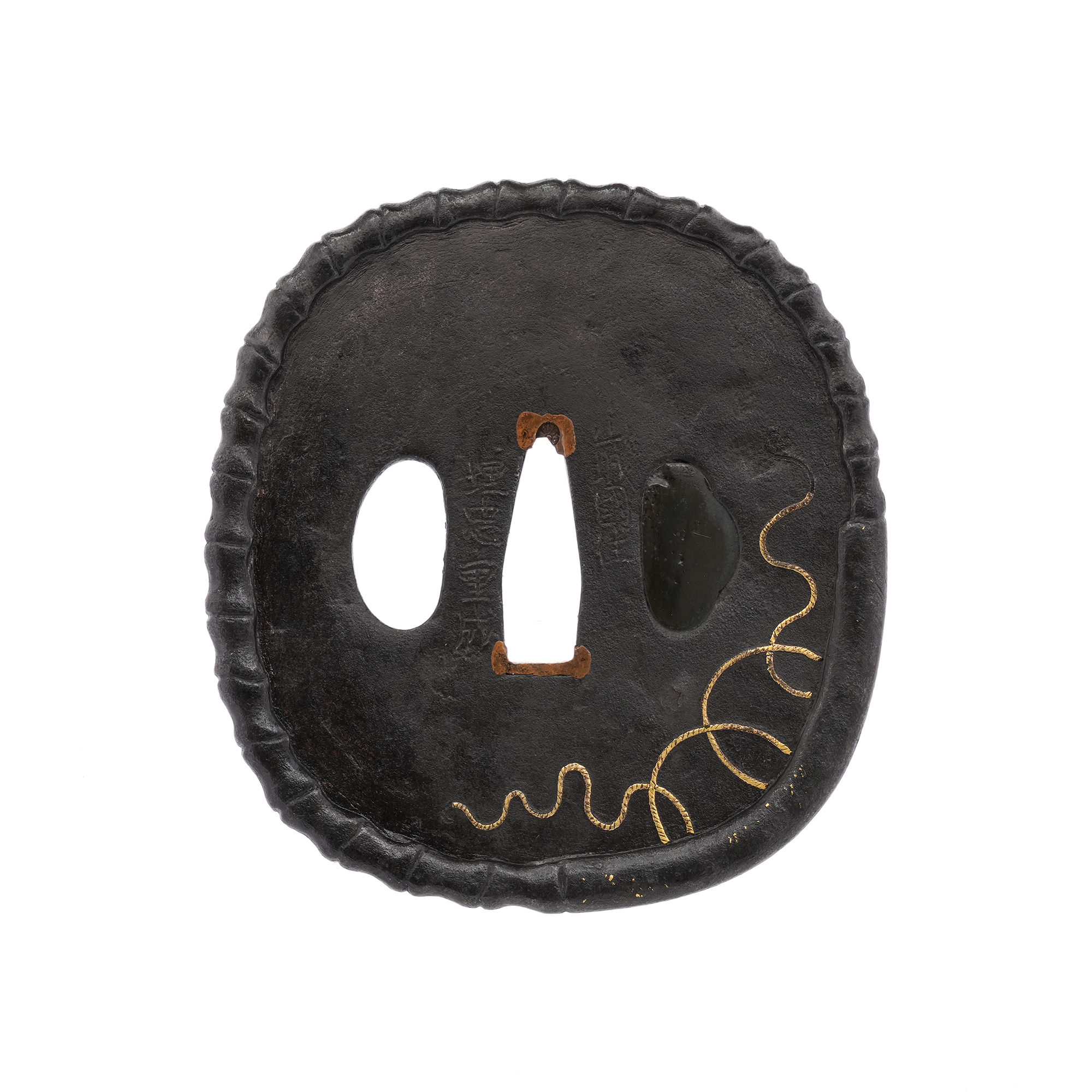
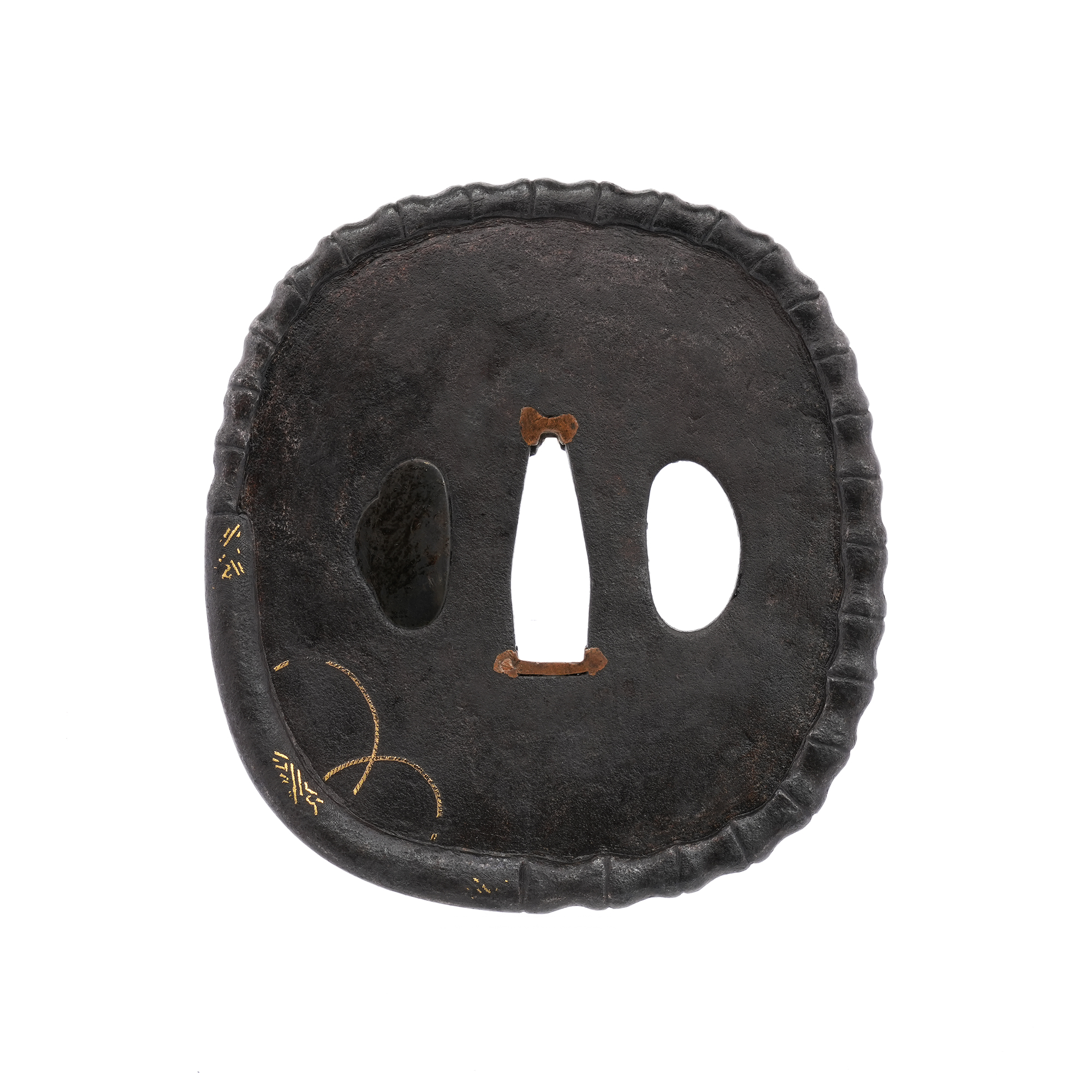
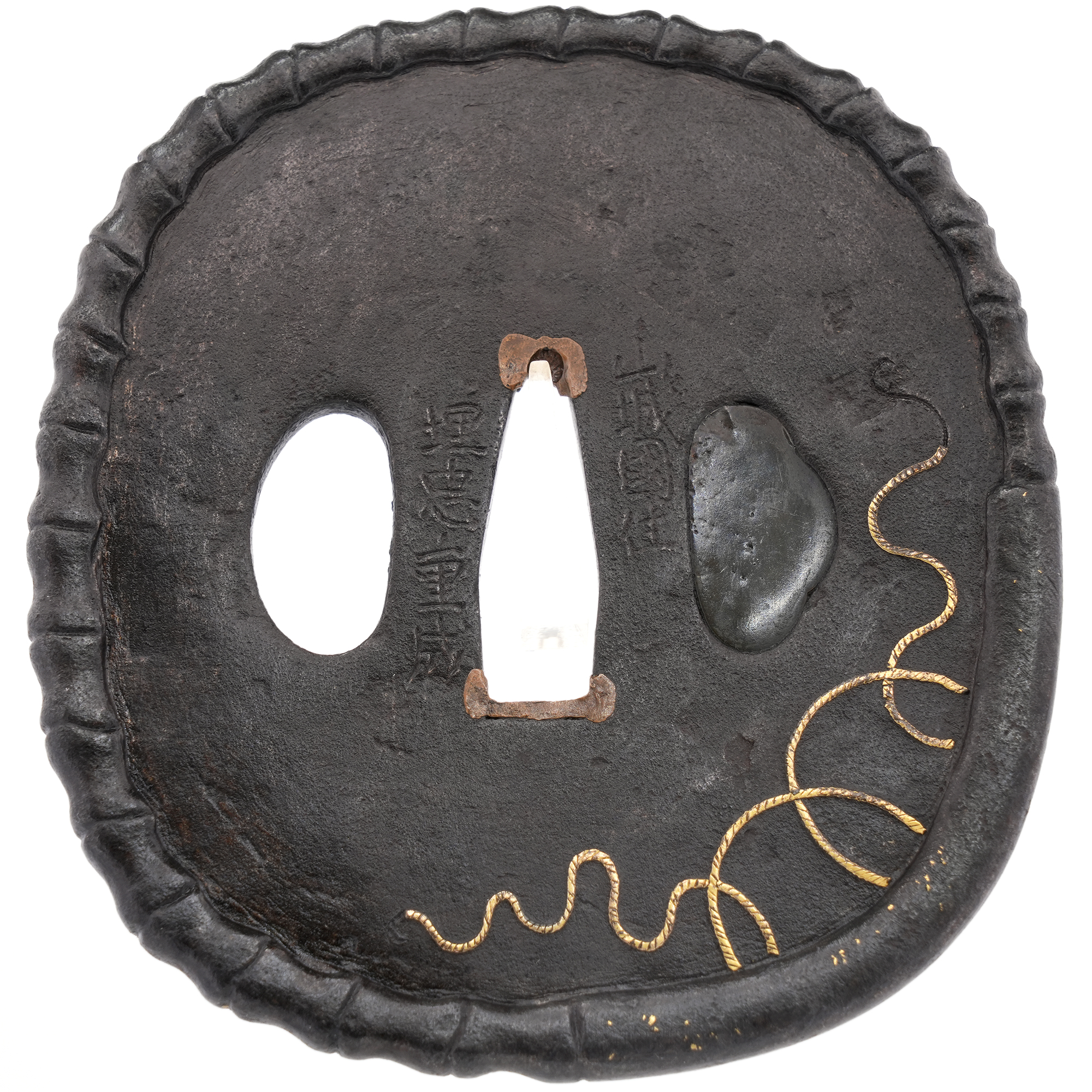
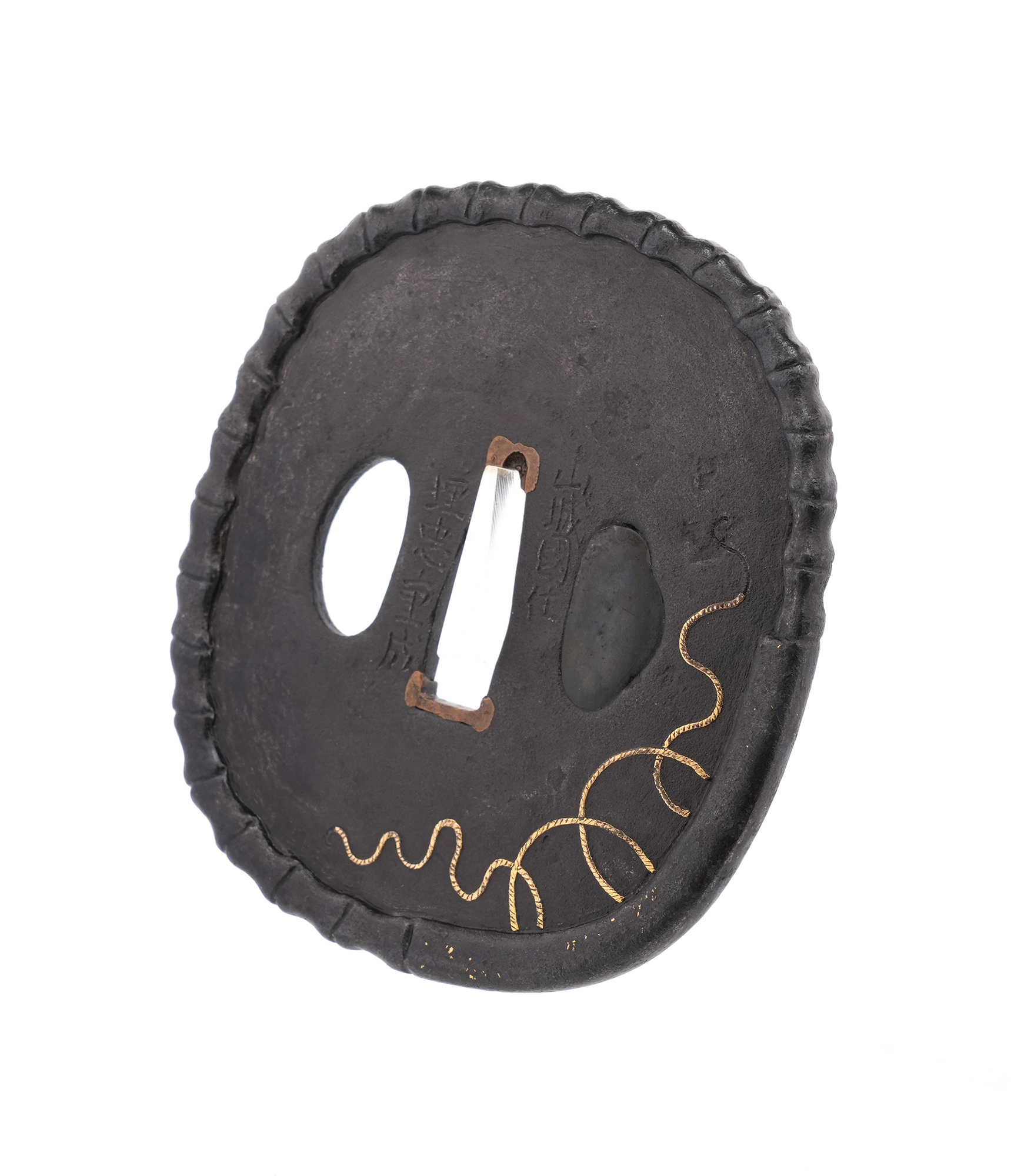
As written by the shop
Machine translation from the shop's Japanese · may contain errors ·
Shinto
2 pieces on the market now
Shinto · Kyoto
45 pieces on the market now
The Umetada school is one of the most distinguished metalworking lineages of the Momoyama period, rooted in Nishijin, Kyoto, and claiming descent from the legendary Sanjo Munechika. The house served the Ashikaga shogunal family over successive generations, establishing deep foundations in the full range of sword-related arts -- swordmaking, blade carving (toshin-bori), the production of steel and fittings, the shortening of blades, the insertion of inlaid signature attributions (zogan-mei), and the making of mountings. " Myoju taught both Hizen Tadayoshi and Higo no Kami Teruhiro, and accepted commissions from the Toyotomi and Tokugawa houses as well as many daimyo families. An earlier stratum of production, appraised as Ko-Umetada, dates from the close of the Muromachi period and demonstrates that the group's technical foundations were firmly established before Myoju's maturity. The near-contemporary Mitsutada, though absent from formal genealogies, is conjectured to have been of senior standing within the circle; his works, executed on brass with an archaic dekoboko-ji ground, display "an even more classically archaic elegance" than Myoju's. Shigeyoshi, active from the Kan'ei through Genroku eras, carried the tradition forward into the mid-Edo period. The Umetada school's collective technical identity divides into two principal modes: iron works and soft-metal (irogane) works. In the iron mode, Myoju expressed geometric patterns -- sayagata, raimon, kasumi-kaminari-mon, and rinzu-mon -- by means of gold nunome-zogan, complemented by celebrated openwork including wheel and double-tomoe sukashi tsuba.
The nejikaeshi-mimi (twisted turned-back rim) and gold rim inlay are techniques "at which he particularly excelled," while the iron itself is invariably "carefully selected" and displays excellent quality. In the irogane mode -- employing shakudo, suaka, brass, and other alloys as ground material -- the school developed a distinctive form of hira-zogan (flat inlay) that retains only slight relief, deploying colored metals in novel combinations. " Ground textures including hammered tsuchime-ji, polished migaki-ji, and file-finished surfaces are deployed with meticulous care to heighten the pictorial effect. Mitsutada's work on brass with its uneven, raised-and-recessed ground and enrichment through gold and silver nunome-zogan represents a more archaic variant of this aesthetic. Shigeyoshi synthesized the inherited hira-zogan tradition with textile-derived designs of linked shippo, karakusa arabesque, and sayagata patterns -- reflecting his Nishijin milieu, the heart of Kyoto's silk-weaving district -- while deploying suemon-zogan, sukidashi-bori, and kin-iroe across shakudo grounds in both polished and stone-textured finishes. The Umetada school's historical significance is singular: the pictorial manner of design, the hira-zogan technique, and the use of non-iron metals as the ground material "all find their earliest beginning with Myoju" -- he stands as the originator of an entire aesthetic vocabulary in kinko. The NBTHK consistently describes Myoju's work as possessing "the vitality that preserves the very momentum of brushwork," with a "strong connection with Hon'ami Koetsu and Tawaraya Sotatsu" that places him among the foremost artistic figures of the Momoyama age. " Solid-gold tsuba, frequently melted down during periods of upheaval, are recognized as extremely rare survivals of exceptional documentary and artistic value. Learn more →
| Smith | Era | Designated |
|---|---|---|
| Myoju明寿 | 1590-1631 | 45 |
| Muneyoshi宗吉 | 1596-1615 | 4 |
| Naritsugu就次 | — | 0 |
| Umetada Mitsushige光重 | 1700-1750 | 0 |
| Kaji’emon加治右衛門 | — | 0 |
Certifies a genuine fitting worth preserving: a correct signature, or, if unsigned, an identifiable era and school, with recognized artistic and craft value.
The NBTHK (Nihon Bijutsu Tōken Hozon Kyōkai, the Society for the Preservation of Japanese Art Swords) is a public-interest incorporated foundation founded in 1948 and supervised by Japan’s Agency for Cultural Affairs (Bunkachō); it is based at the Japanese Sword Museum in Tokyo. Its expert panels physically examine each submitted work (shinsa) and issue a certificate (kanteishō) ranking it by artistic and historical merit. NBTHK papers are the most widely recognized standard of authentication for Japanese swords and fittings.
NBTHK official siteAs a rule we do not accept returns, except when we have sent a different item from the one ordered or when there is a significant discrepancy between the description and the item. If you wish to return an item, please contact us within 3 days of its arrival and then send it back.
¥605,000