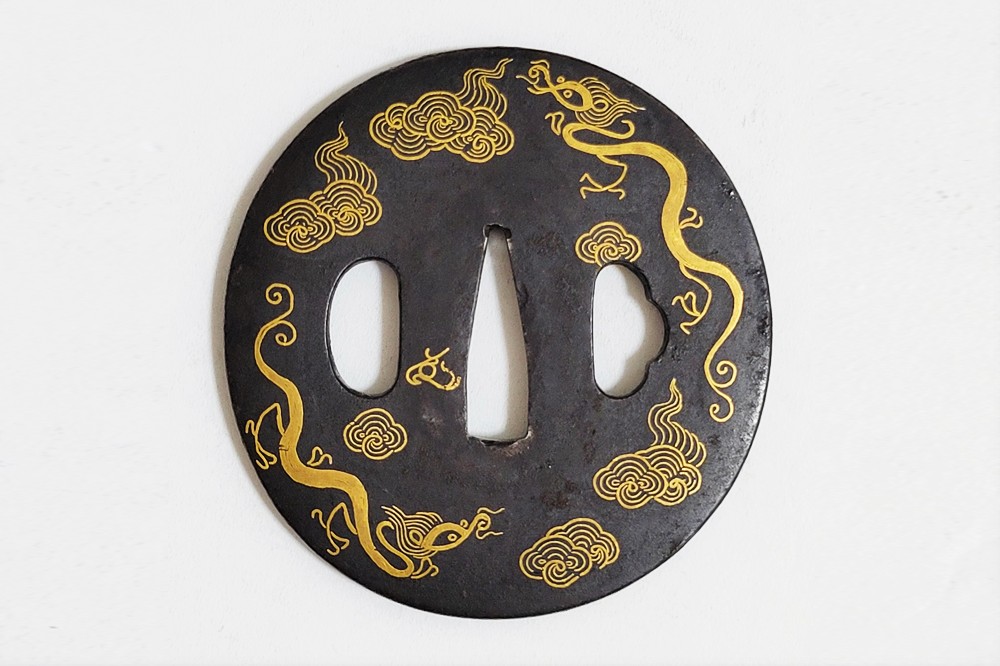
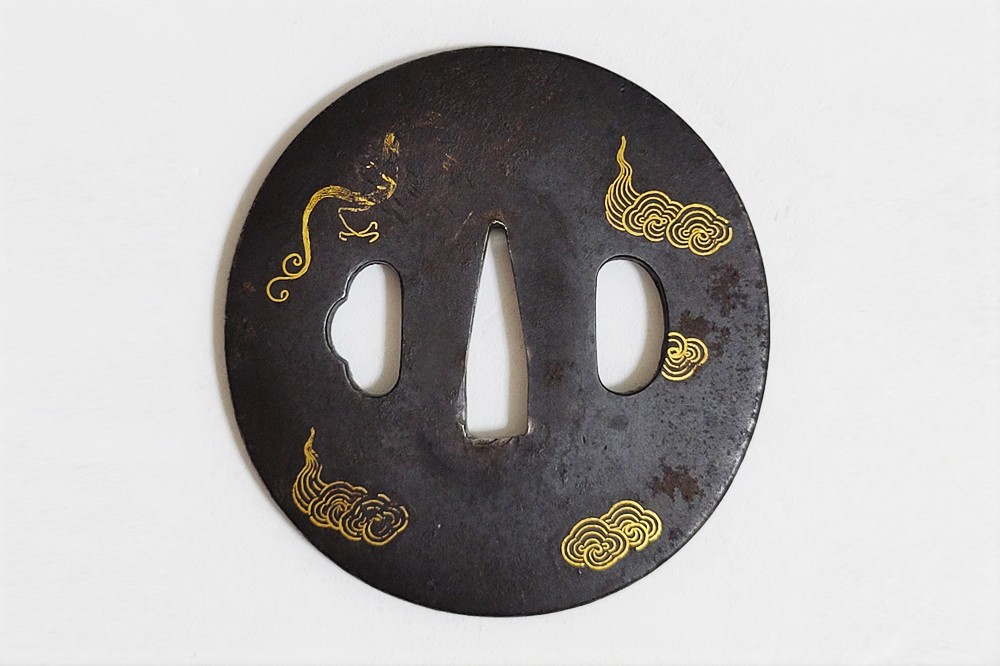
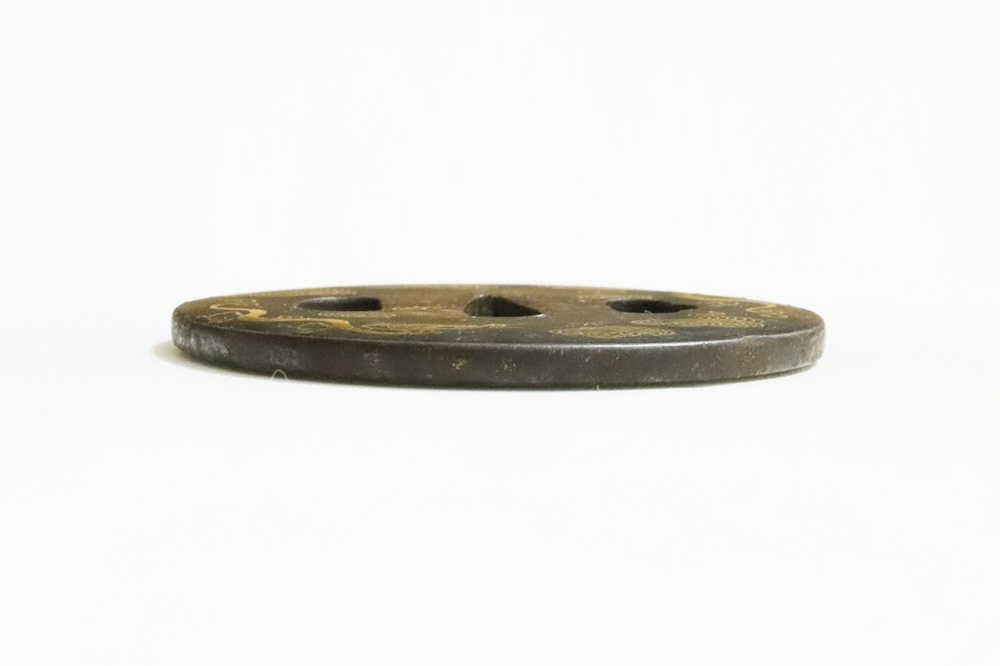
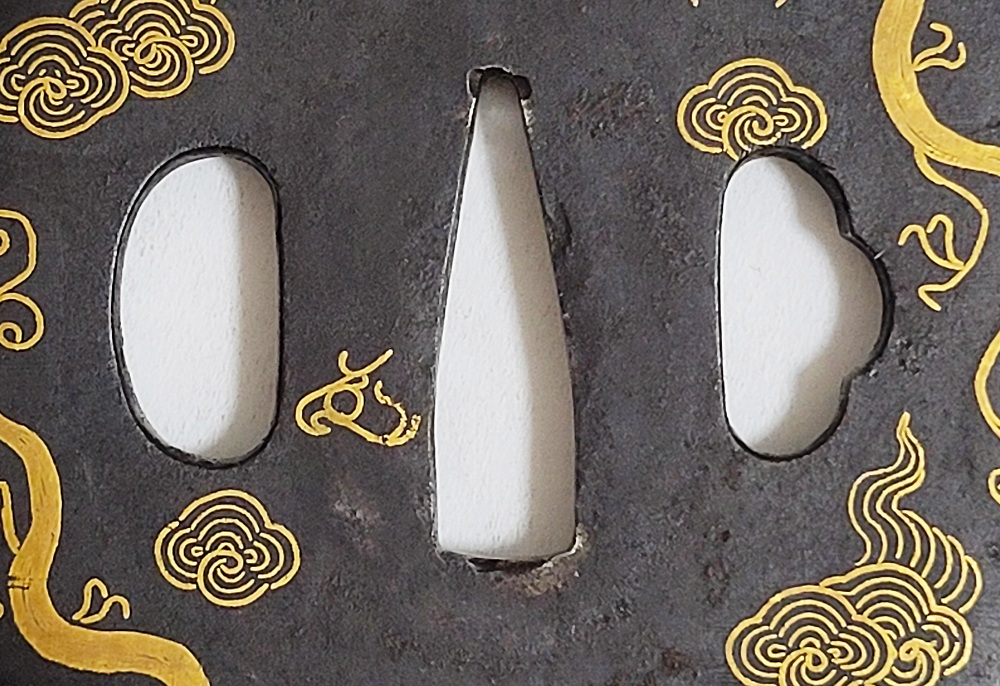
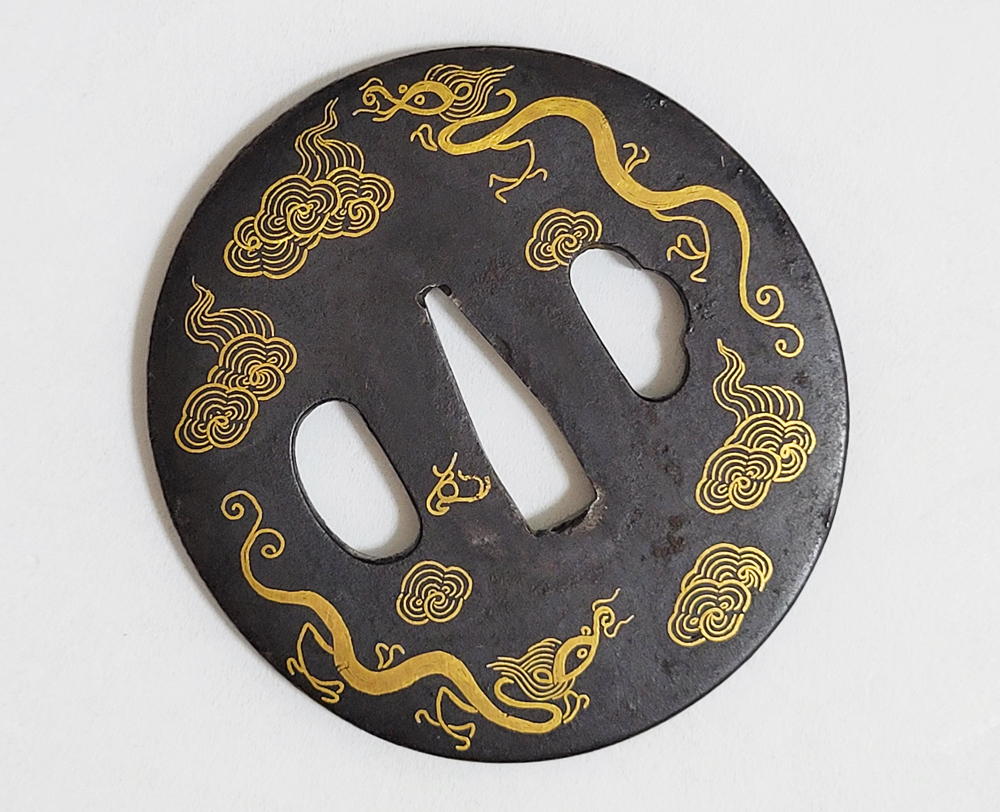
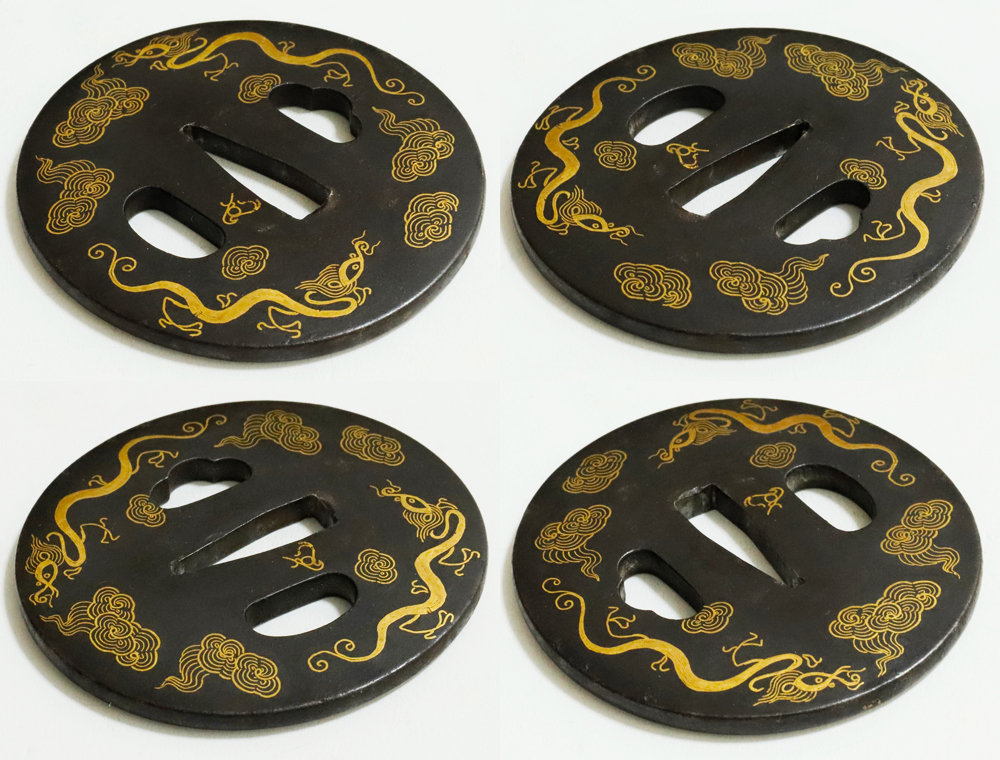
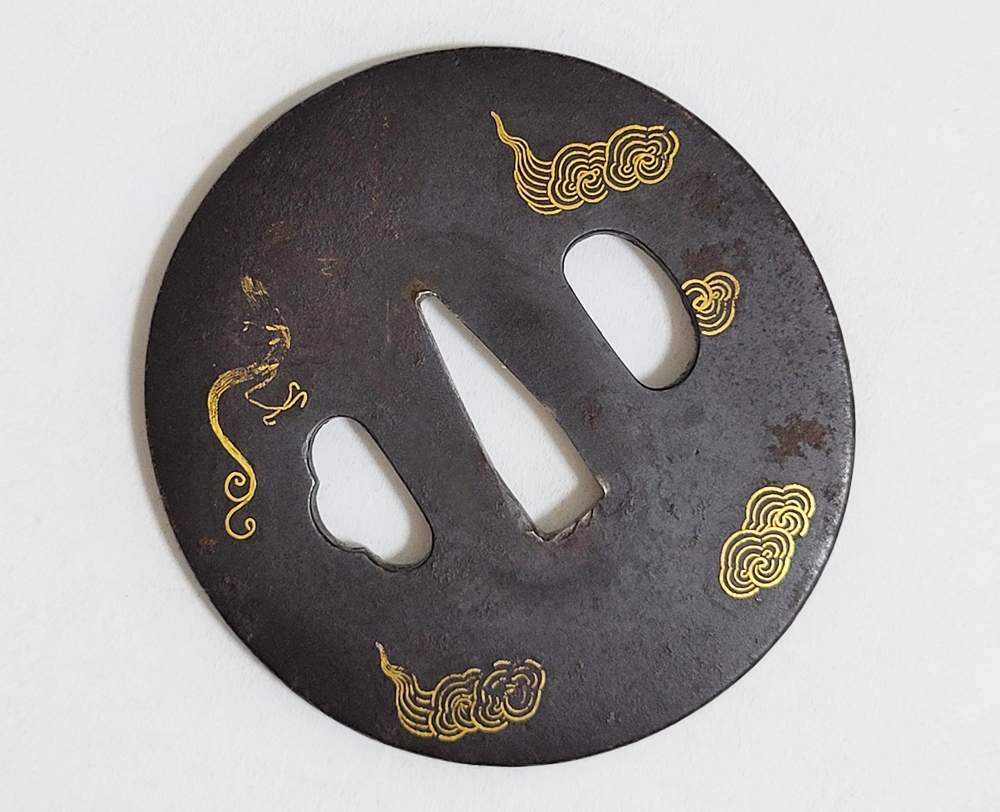
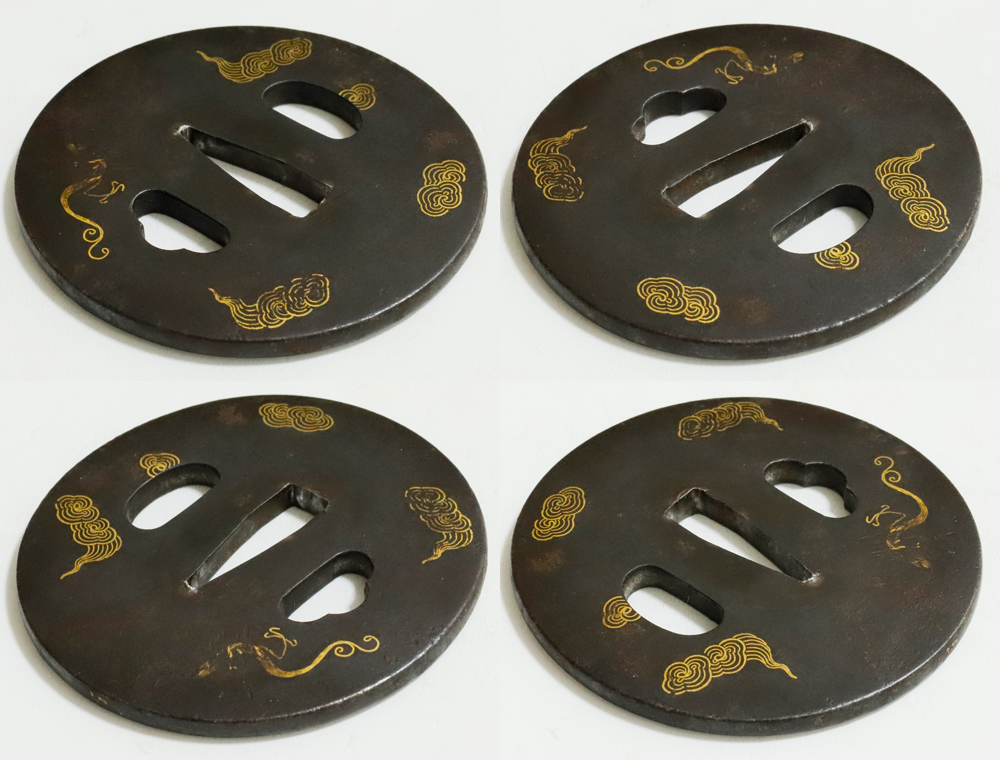
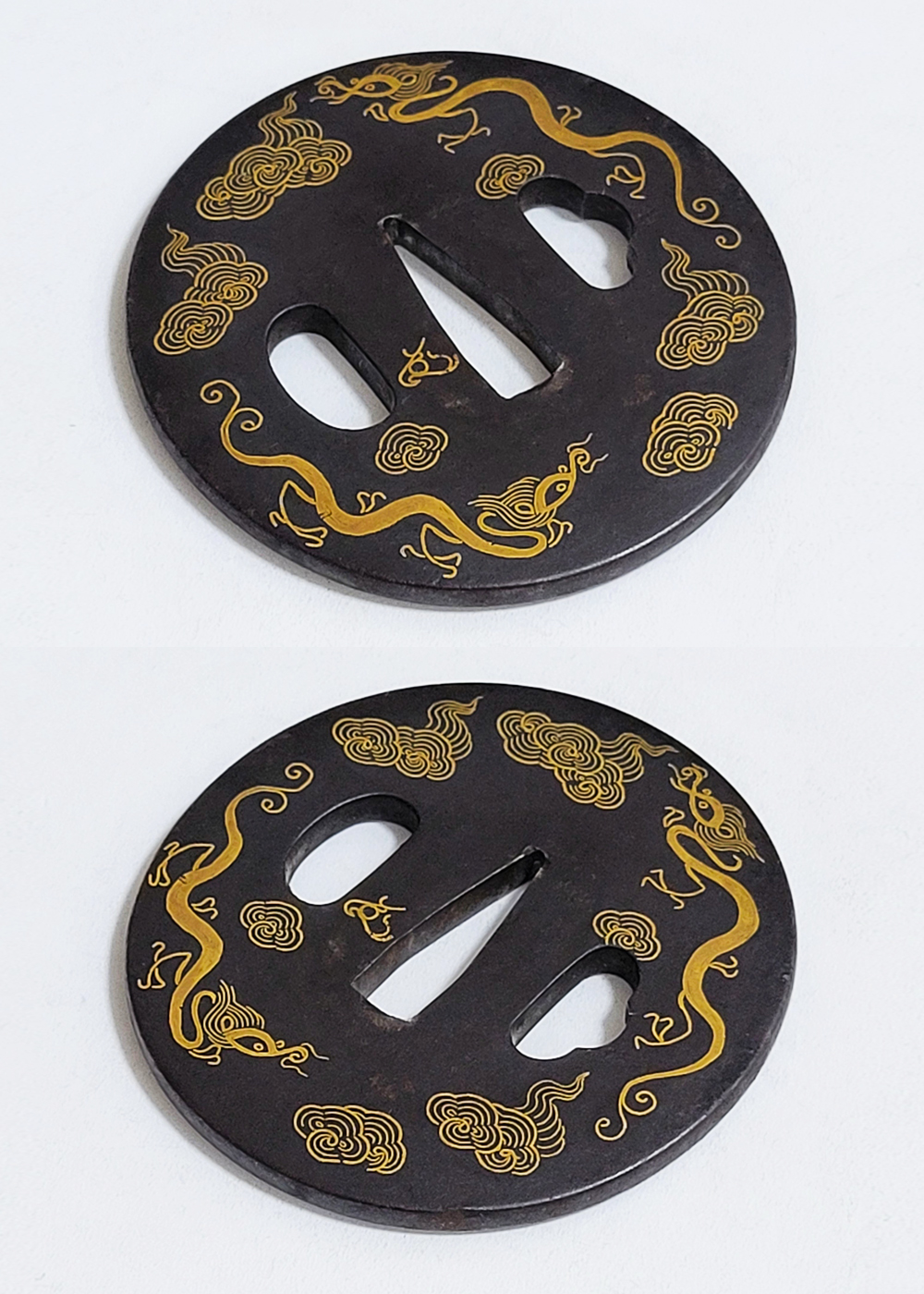
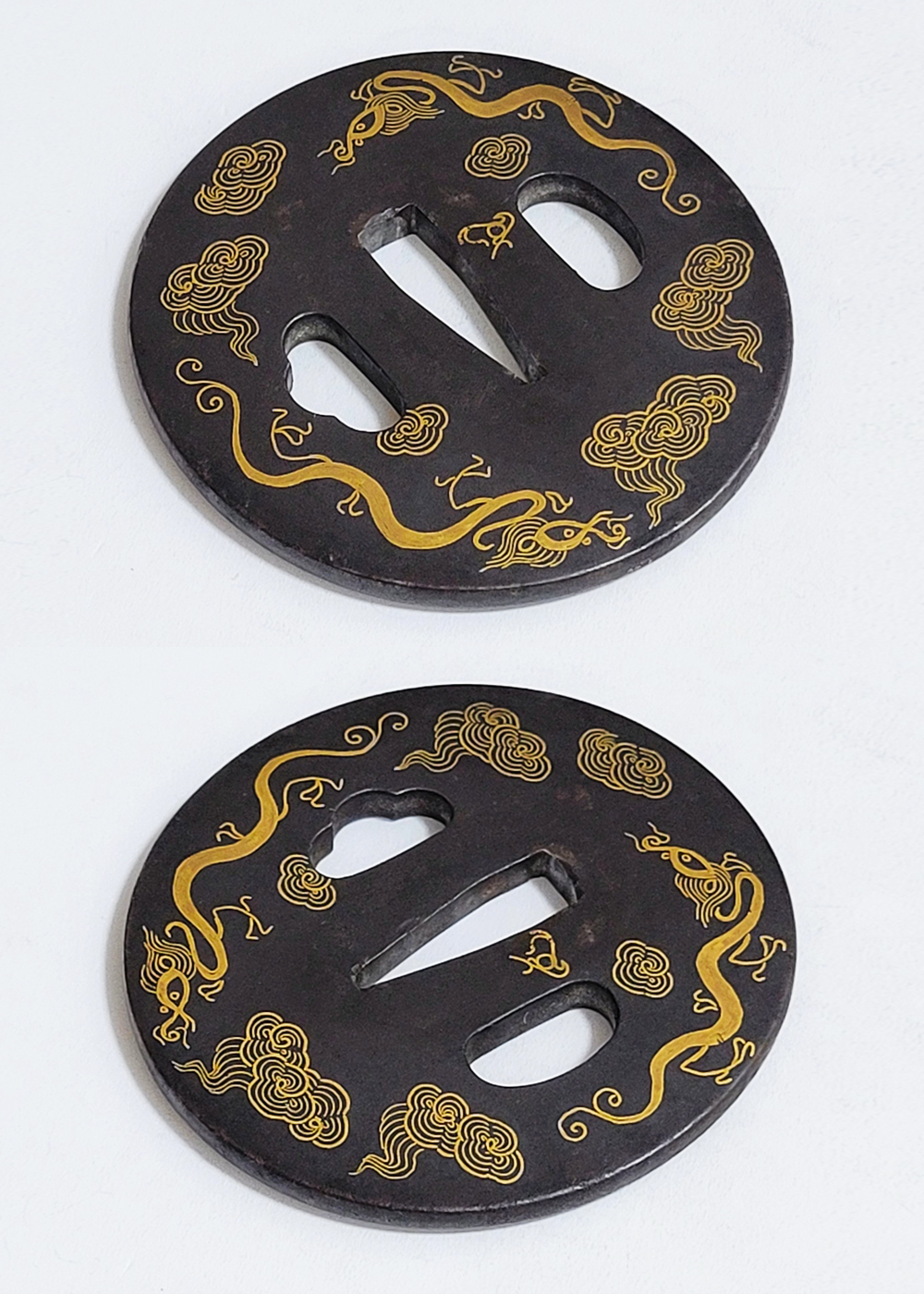
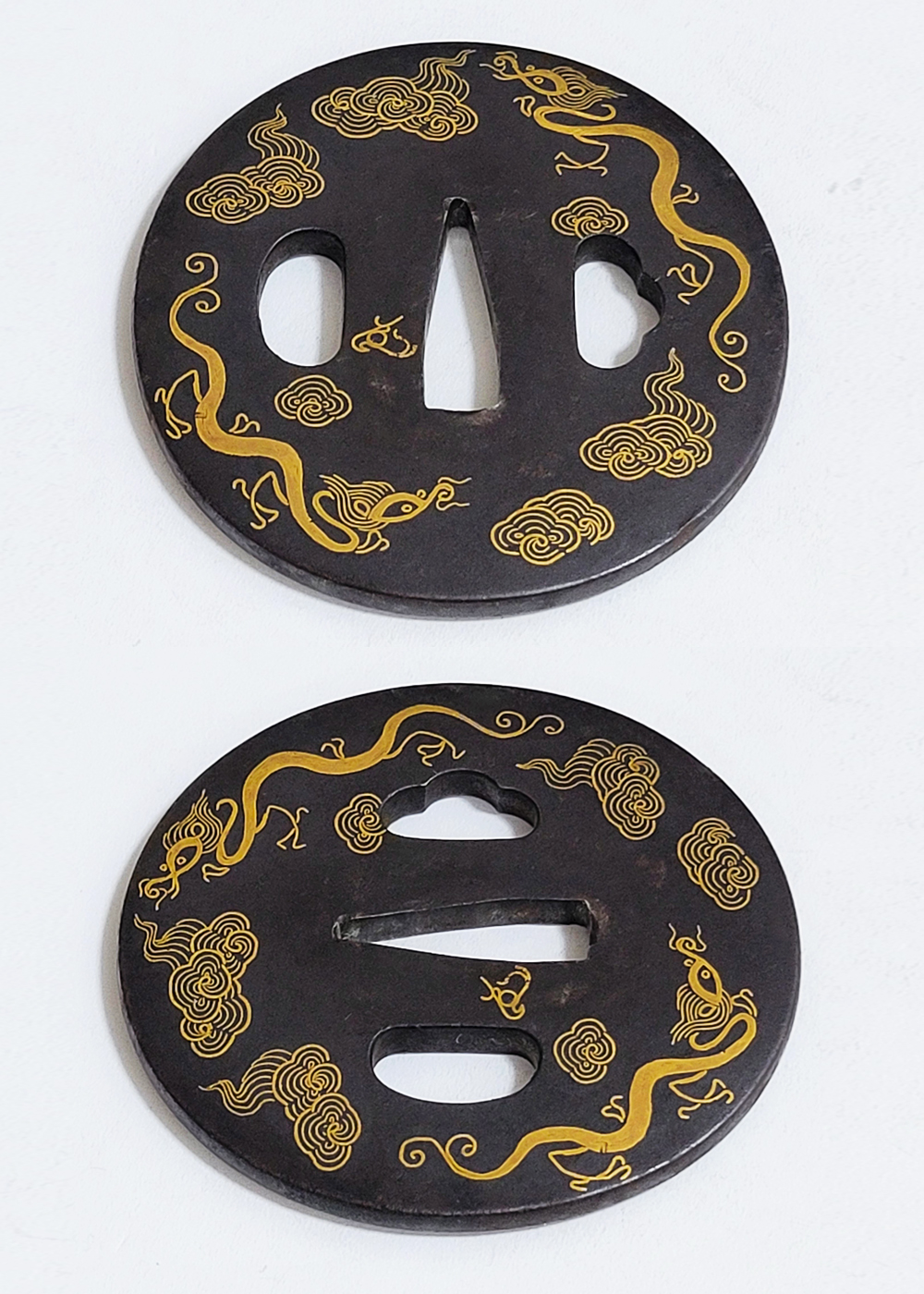
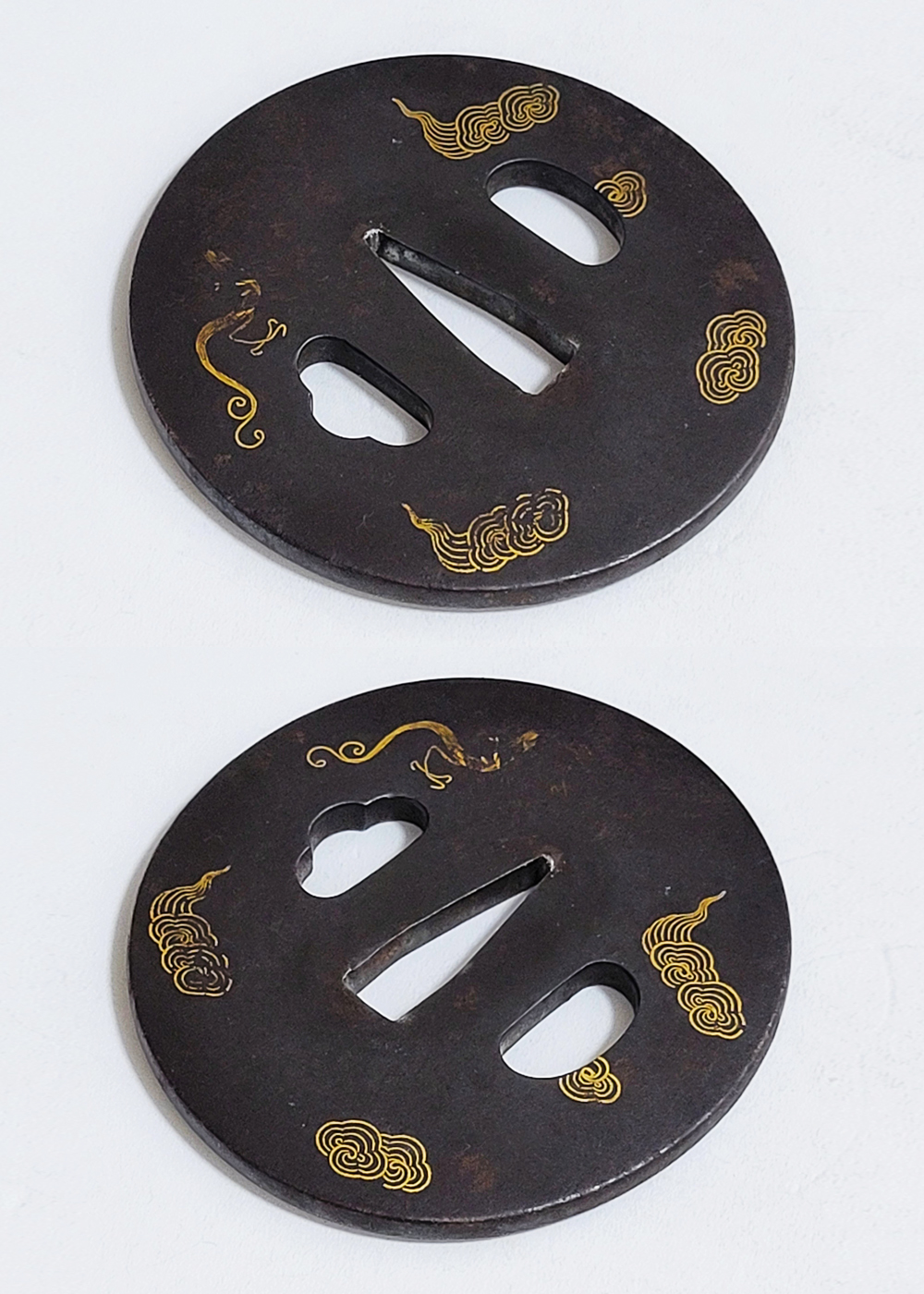
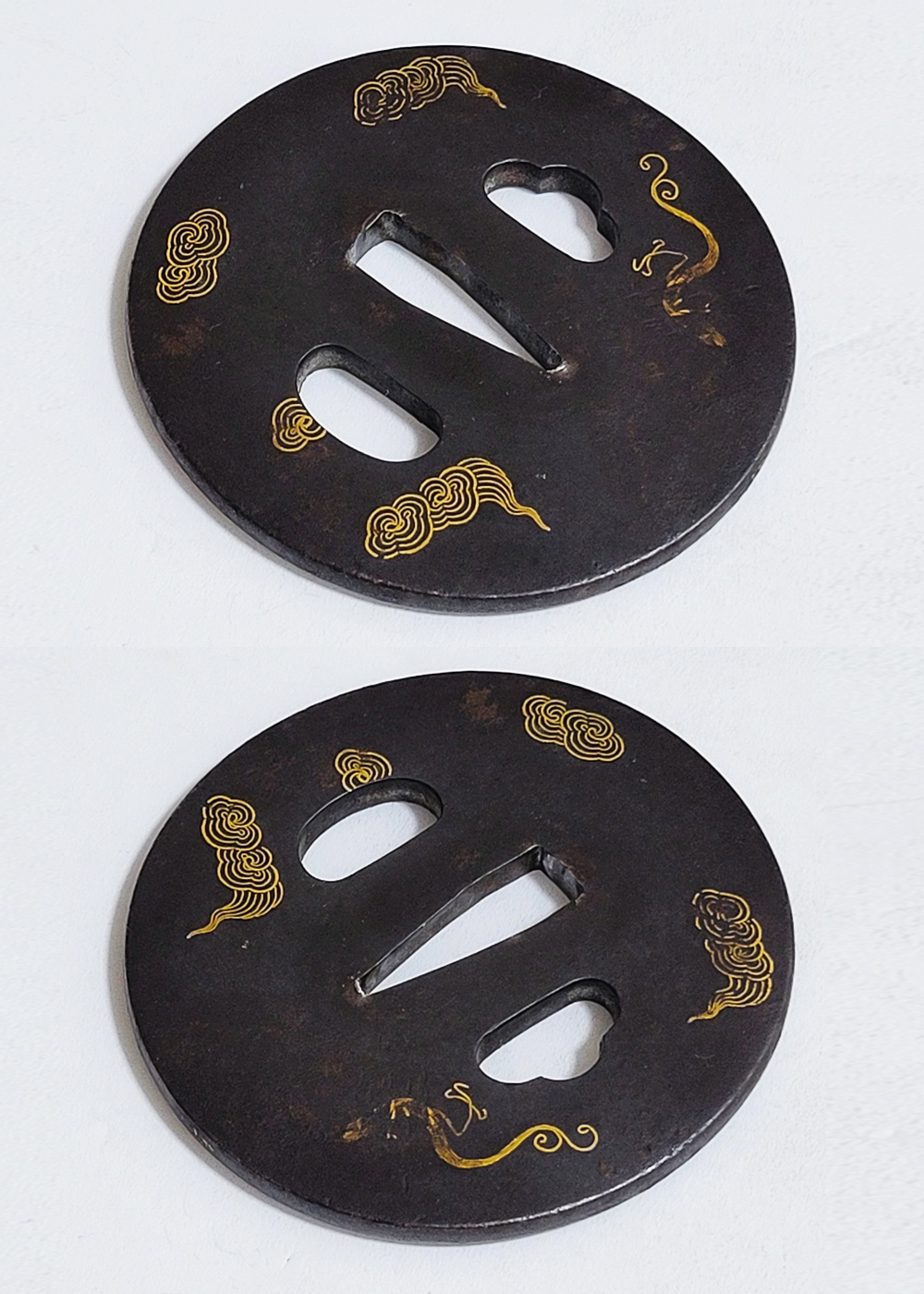
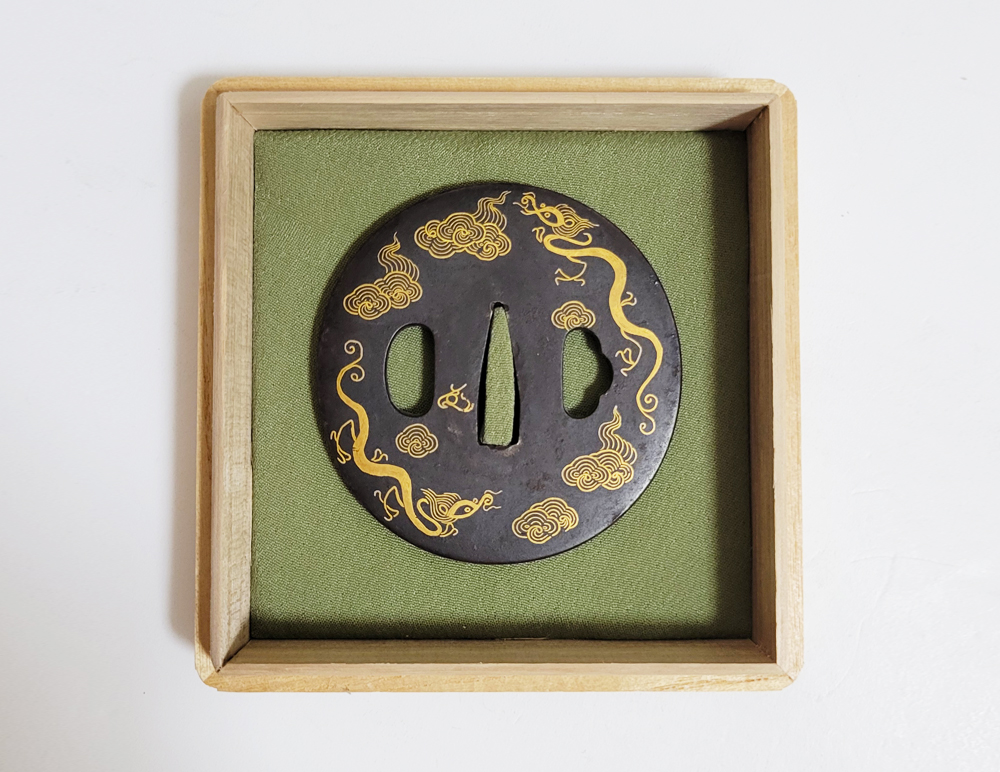
This tsuba features a simple yet elegant design of a rain dragon and auspicious clouds in gold hirazogan on an iron ground. A slender, scaleless rain dragon gracefully dances in the sky, creating a quiet sense of dynamism in harmony with the swirling auspicious clouds. The signature is only a kao (stylized monogram), so the maker is unknown. Based on the delicate gold hirazogan technique used for the rain dragon and auspicious clouds, it is believed to be a work of the Sendai Kusakari school from the late Edo period.
mei · Sendai Kusakari · Edo (c. 1680)


Kusakari School
Edo
Mutsu
Signed
Kinko · Mutsu (Sendai)
5 pieces on the market now
The Kusakari school (草苅) was one of several distinguished kinko lineages retained as official domain craftsmen (kakae-ko) by the Date family of Sendai, one of the great han of Mutsu Province. Alongside the Shibuya, Oguma, Saito, Masamura, and Sukegawa houses, the Kusakari artisans served as han-ko to the Date throughout the middle and late Edo period. "[[c:1]] The founding master, Kiyosada (清定, first generation), used Kusakariya as his house name. He apprenticed under Masamura Shichiemon, a craftsman in service to the Sendai domain, then travelled to Edo to study under the Omori family before returning to Sendai during the Tenmei era (1781-1789) to assume his position as domain artisan to the Date house. The Kusakari school's collective style is defined by a highly distinctive inlay method practiced on shakudo grounds. The canonical technique, described with near-formulaic consistency across the corpus, proceeds as follows: on an ishime-ji (stone-textured) ground, the outlines of the design are carved in high relief and inlaid with gold wire (kinsen-zogan); the interior is then polished out (togidashi) to lie nearly level with the ground plane, and filled with geometric patterns executed in hira-zogan.
The repertoire of interior patterns is itself a hallmark: kikko (tortoiseshell), sayagata (linked swastika fret), masugata (square diaper), asanoha (hemp leaf), ajiro (woven mat), shippo-tsunagi (linked seven-jewel), nami-chidori (waves with plovers), and soryu (paired dragons) recur across nearly every designated work. "[[c:2]] The standard ground is ishime-ji, though at least one rare example employs nanako-ji, suggesting a specially commissioned piece of exceptional care[[c:3]]. Gold fukurin rims, sometimes bearing flowing-water (ryusui) designs, and gold-lined hitsu-ana complete the refined presentation. The Kusakari school's significance rests in its mastery of a technically demanding inlay method that became synonymous with Sendai kinko craftsmanship. Kiyosada's works are praised across the setsumei for their "splendid command of technique"[[c:5]] and the "strong professional pride" they convey, with designated examples ranging from characteristic gunbai tsuba to rarer departures such as a raptor-and-cypress composition that combines katakiribori and kebori with the school's signature inlay manner[[c:4]]. The consistency of the NBTHK's assessments — describing the works as displaying "the maker's distinctive character together with his accurate and advanced technical skill"[[c:6]] — affirms the Kusakari tradition as a defining expression of domain metalwork in the service of one of Edo-period Japan's most powerful daimyo houses. Learn more →
| Smith | Era | Designated |
|---|---|---|
| Kiyosada清定 | mid Edo | 6 |
We could not find an authenticity certificate on the seller’s listing. Japanese swords and fittings are normally papered by the NBTHK (or the NTHK). Without one, the attribution is the seller’s own assessment and has not been independently verified — treat it with caution and ask the dealer about certification before buying.
Domestic: items may be returned within 7 days in original condition for a full refund (buyer covers transport). Overseas orders: no-refunds, no-returns.
This tsuba features a simple yet elegant design of a rain dragon and auspicious clouds in gold hirazogan on an iron ground. A slender, scaleless rain dragon gracefully dances in the sky, creating a quiet sense of dynamism in harmony with the swirling auspicious clouds. The signature is only a kao (stylized monogram), so the maker is unknown. Based on the delicate gold hirazogan technique used for the rain dragon and auspicious clouds, it is believed to be a work of the Sendai Kusakari school from the late Edo period.
mei · Sendai Kusakari · Edo (c. 1680)


Kusakari School
Edo
Mutsu
Signed
Kinko · Mutsu (Sendai)
5 pieces on the market now
The Kusakari school (草苅) was one of several distinguished kinko lineages retained as official domain craftsmen (kakae-ko) by the Date family of Sendai, one of the great han of Mutsu Province. Alongside the Shibuya, Oguma, Saito, Masamura, and Sukegawa houses, the Kusakari artisans served as han-ko to the Date throughout the middle and late Edo period. "[[c:1]] The founding master, Kiyosada (清定, first generation), used Kusakariya as his house name. He apprenticed under Masamura Shichiemon, a craftsman in service to the Sendai domain, then travelled to Edo to study under the Omori family before returning to Sendai during the Tenmei era (1781-1789) to assume his position as domain artisan to the Date house. The Kusakari school's collective style is defined by a highly distinctive inlay method practiced on shakudo grounds. The canonical technique, described with near-formulaic consistency across the corpus, proceeds as follows: on an ishime-ji (stone-textured) ground, the outlines of the design are carved in high relief and inlaid with gold wire (kinsen-zogan); the interior is then polished out (togidashi) to lie nearly level with the ground plane, and filled with geometric patterns executed in hira-zogan.
The repertoire of interior patterns is itself a hallmark: kikko (tortoiseshell), sayagata (linked swastika fret), masugata (square diaper), asanoha (hemp leaf), ajiro (woven mat), shippo-tsunagi (linked seven-jewel), nami-chidori (waves with plovers), and soryu (paired dragons) recur across nearly every designated work. "[[c:2]] The standard ground is ishime-ji, though at least one rare example employs nanako-ji, suggesting a specially commissioned piece of exceptional care[[c:3]]. Gold fukurin rims, sometimes bearing flowing-water (ryusui) designs, and gold-lined hitsu-ana complete the refined presentation. The Kusakari school's significance rests in its mastery of a technically demanding inlay method that became synonymous with Sendai kinko craftsmanship. Kiyosada's works are praised across the setsumei for their "splendid command of technique"[[c:5]] and the "strong professional pride" they convey, with designated examples ranging from characteristic gunbai tsuba to rarer departures such as a raptor-and-cypress composition that combines katakiribori and kebori with the school's signature inlay manner[[c:4]]. The consistency of the NBTHK's assessments — describing the works as displaying "the maker's distinctive character together with his accurate and advanced technical skill"[[c:6]] — affirms the Kusakari tradition as a defining expression of domain metalwork in the service of one of Edo-period Japan's most powerful daimyo houses. Learn more →
| Smith | Era | Designated |
|---|---|---|
| Kiyosada清定 | mid Edo | 6 |
We could not find an authenticity certificate on the seller’s listing. Japanese swords and fittings are normally papered by the NBTHK (or the NTHK). Without one, the attribution is the seller’s own assessment and has not been independently verified — treat it with caution and ask the dealer about certification before buying.
Domestic: items may be returned within 7 days in original condition for a full refund (buyer covers transport). Overseas orders: no-refunds, no-returns.