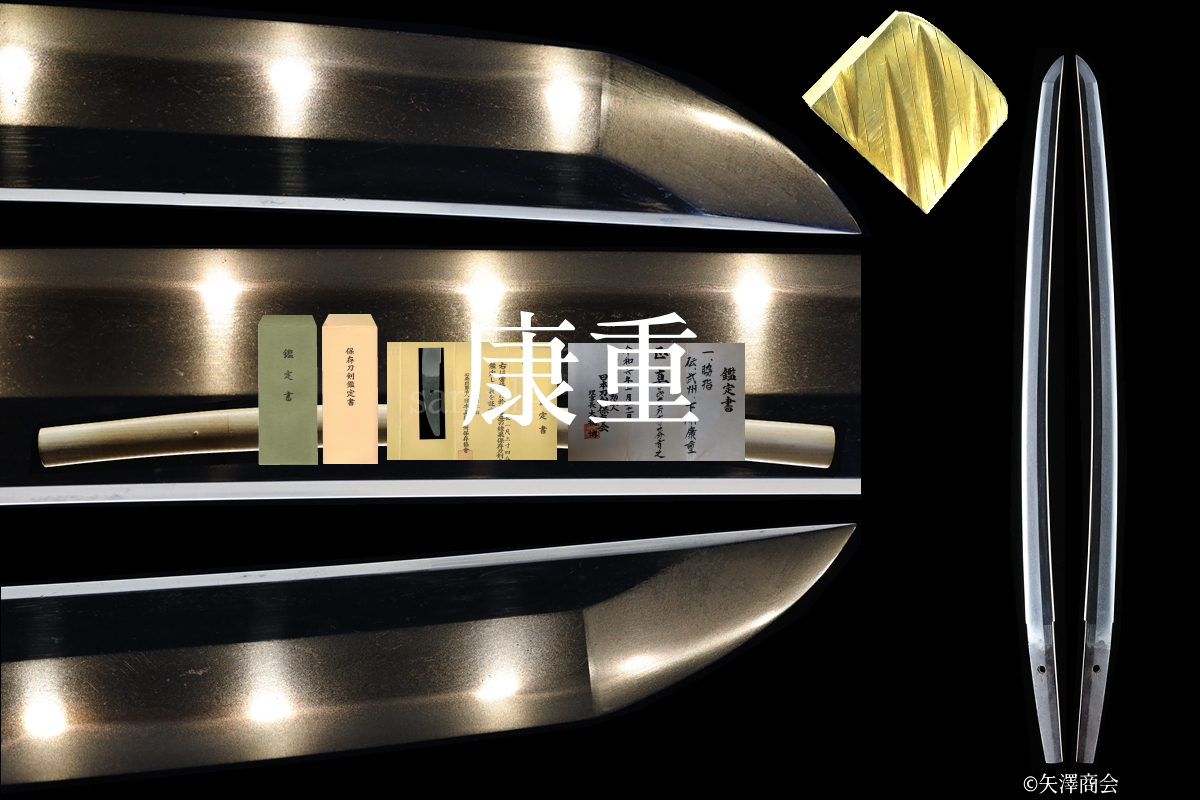
Daimyo Registration Koto Tensho Yasushige (Yamamoto Yogoro Yasushige)
(Regarding Daimyo Registration)
This sword was registered in Showa 26, the first year that sword registration began; it is said that many famous swords are found among these because registration was requested in order of former Kazoku, former Daimyo, and former Shizoku. This sword is a rare 4-digit Daimyo registration from the first year, Showa 26.
(Regarding Shitahara Yasushige)
Chu-jo saku swordsmith
Yasushige was born in Eiroku 6, his name was Yamamoto Tozaemon, and he is attributed as the head of the Bushu Shitahara smiths.
The Bushu Shitahara school was a group of swordsmiths active around present-day Hachioji, Tokyo; the common theory is that in the late Muromachi period, the legitimate son of the Shitahara founder Tajima Chikashige, the second generation Takumi Chikashige, received the character "Yasu" from Hojo Ujiyasu and changed his name to Yasushige.
It is also commonly said that his younger brother Nagato Chikashige received the character "Teru" from Hojo Ujiteru and changed his name to Terushige.
Regarding Yasushige, there is Yamamoto Toemon-no-jo, the son of Chikashige, around Tenbun, and Yamamoto Yogoro, the son of Toemon-no-jo, around Tensho.
They resided and forged swords in the land of Shitahara, Shimo-onkata, Tama District, Bushu. The lords who patronized them were the Oishi clan, who were the Musashi Shugodai for the Kanrei Yamanouchi Uesugi family; then the Odawara Hojo family who defeated the Uesugi family and seized control of the Kanto region; and furthermore, after the fall of Odawara Castle by Toyotomi Hideyoshi and the destruction of the Hojo clan (Tensho 18), their former lands were guaranteed by the Tokugawa family, and they continued forging as official smiths for the Shogunate until the end of the Edo period.
From this school emerged swordsmiths such as Terushige, Hiroshige, Masashige, Munekuni, Yasukuni, and Toshinaga, and at its peak, it flourished to the extent of being called the "Ten Families of Shitahara."
They are the only group of swordsmiths in Musashi Province that continued from the Muromachi period until the end of the Edo period.
Machine translation from the shop's Japanese · may contain errors ·
Daimyo Registration Koto Tensho Yasushige (Yamamoto Yogoro Yasushige)
(Regarding Daimyo Registration)
This sword was registered in Showa 26, the first year that sword registration began; it is said that many famous swords are found among these because registration was requested in order of former Kazoku, former Daimyo, and former Shizoku. This sword is a rare 4-digit Daimyo registration from the first year, Showa 26.
(Regarding Shitahara Yasushige)
Chu-jo saku swordsmith
Yasushige was born in Eiroku 6, his name was Yamamoto Tozaemon, and he is attributed as the head of the Bushu Shitahara smiths.
The Bushu Shitahara school was a group of swordsmiths active around present-day Hachioji, Tokyo; the common theory is that in the late Muromachi period, the legitimate son of the Shitahara founder Tajima Chikashige, the second generation Takumi Chikashige, received the character "Yasu" from Hojo Ujiyasu and changed his name to Yasushige.
It is also commonly said that his younger brother Nagato Chikashige received the character "Teru" from Hojo Ujiteru and changed his name to Terushige.
Regarding Yasushige, there is Yamamoto Toemon-no-jo, the son of Chikashige, around Tenbun, and Yamamoto Yogoro, the son of Toemon-no-jo, around Tensho.
They resided and forged swords in the land of Shitahara, Shimo-onkata, Tama District, Bushu. The lords who patronized them were the Oishi clan, who were the Musashi Shugodai for the Kanrei Yamanouchi Uesugi family; then the Odawara Hojo family who defeated the Uesugi family and seized control of the Kanto region; and furthermore, after the fall of Odawara Castle by Toyotomi Hideyoshi and the destruction of the Hojo clan (Tensho 18), their former lands were guaranteed by the Tokugawa family, and they continued forging as official smiths for the Shogunate until the end of the Edo period.
From this school emerged swordsmiths such as Terushige, Hiroshige, Masashige, Munekuni, Yasukuni, and Toshinaga, and at its peak, it flourished to the extent of being called the "Ten Families of Shitahara."
They are the only group of swordsmiths in Musashi Province that continued from the Muromachi period until the end of the Edo period.
Three unifiers ended the century of war, and the sword became an instrument of the new order: the 1588 sword hunt made it the warrior’s badge, famous blades passed between houses like treaties, and appraisal ever after divides the craft here, kotō from shintō.
Certifies a genuine blade worth preserving: a signature confirmed correct, or, if unsigned, an era, province, and school that the NBTHK can reliably identify.
About the NBTHK›
The NBTHK (Nihon Bijutsu Tōken Hozon Kyōkai, the Society for the Preservation of Japanese Art Swords) is a public-interest incorporated foundation founded in 1948 and supervised by Japan’s Agency for Cultural Affairs (Bunkachō); it is based at the Japanese Sword Museum in Tokyo. Its expert panels physically examine each submitted work (shinsa) and issue a certificate (kanteishō) ranking it by artistic and historical merit. NBTHK papers are the most widely recognized standard of authentication for Japanese swords and fittings.



 NihontoWatch