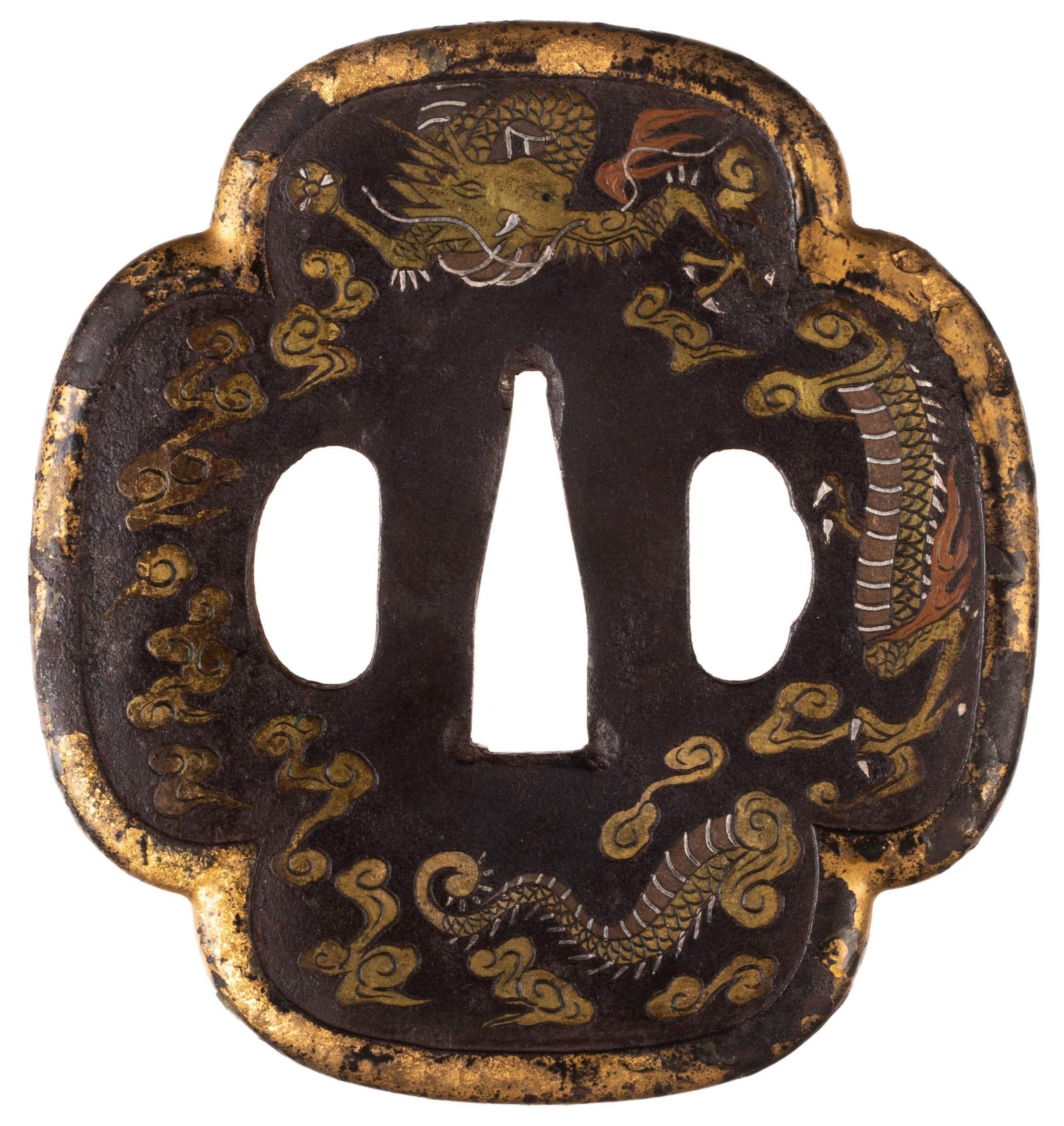
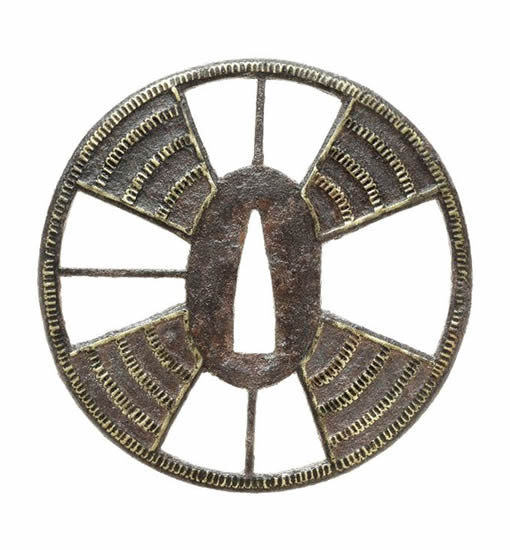
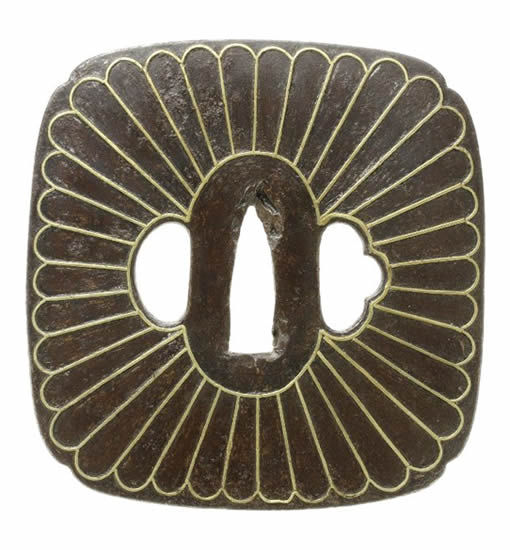
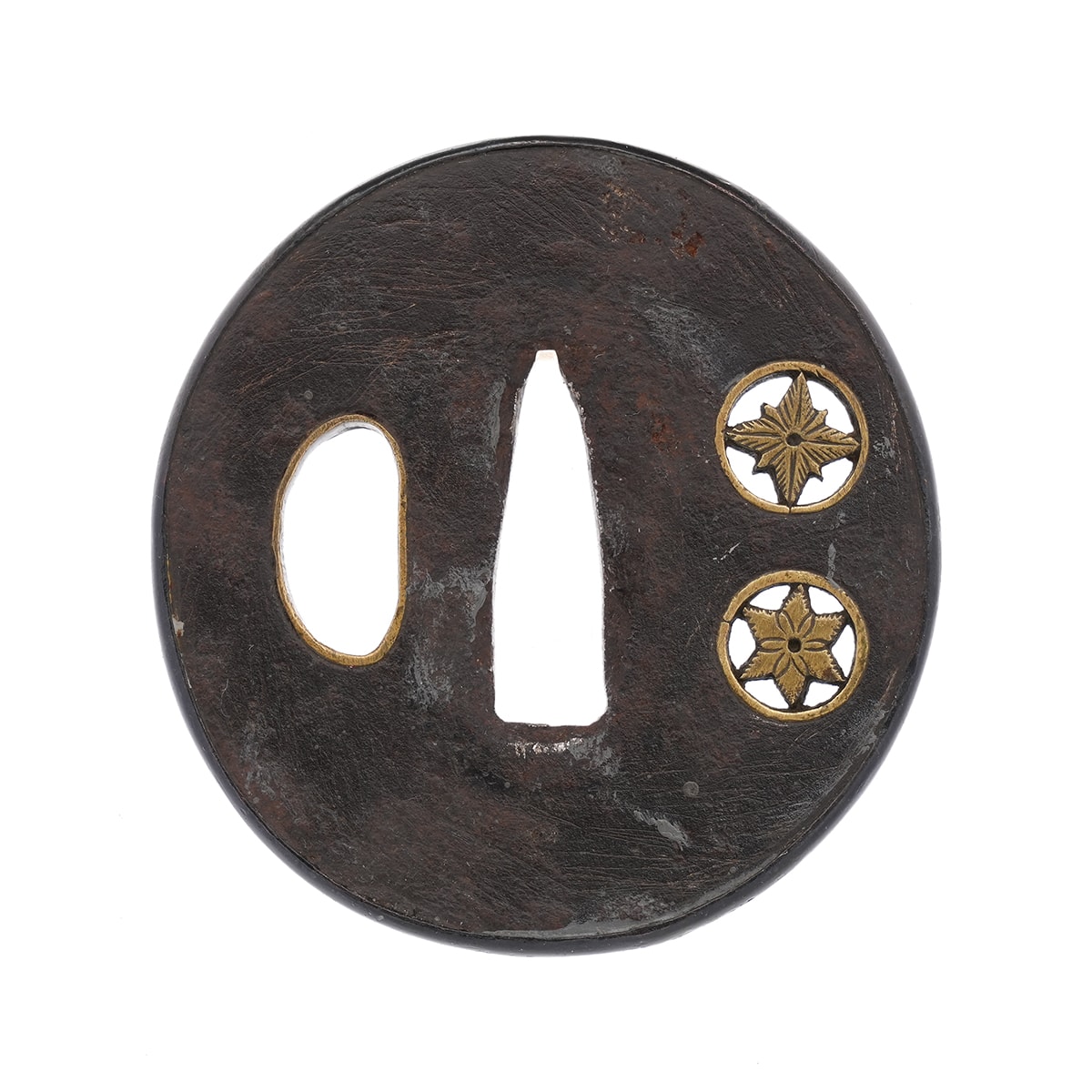
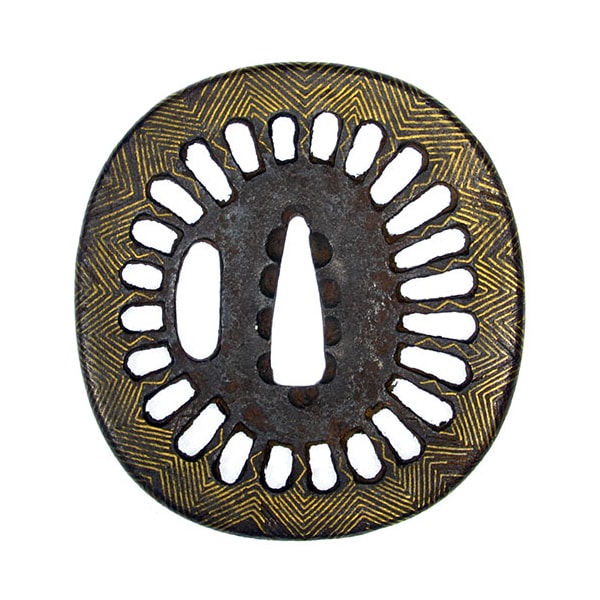
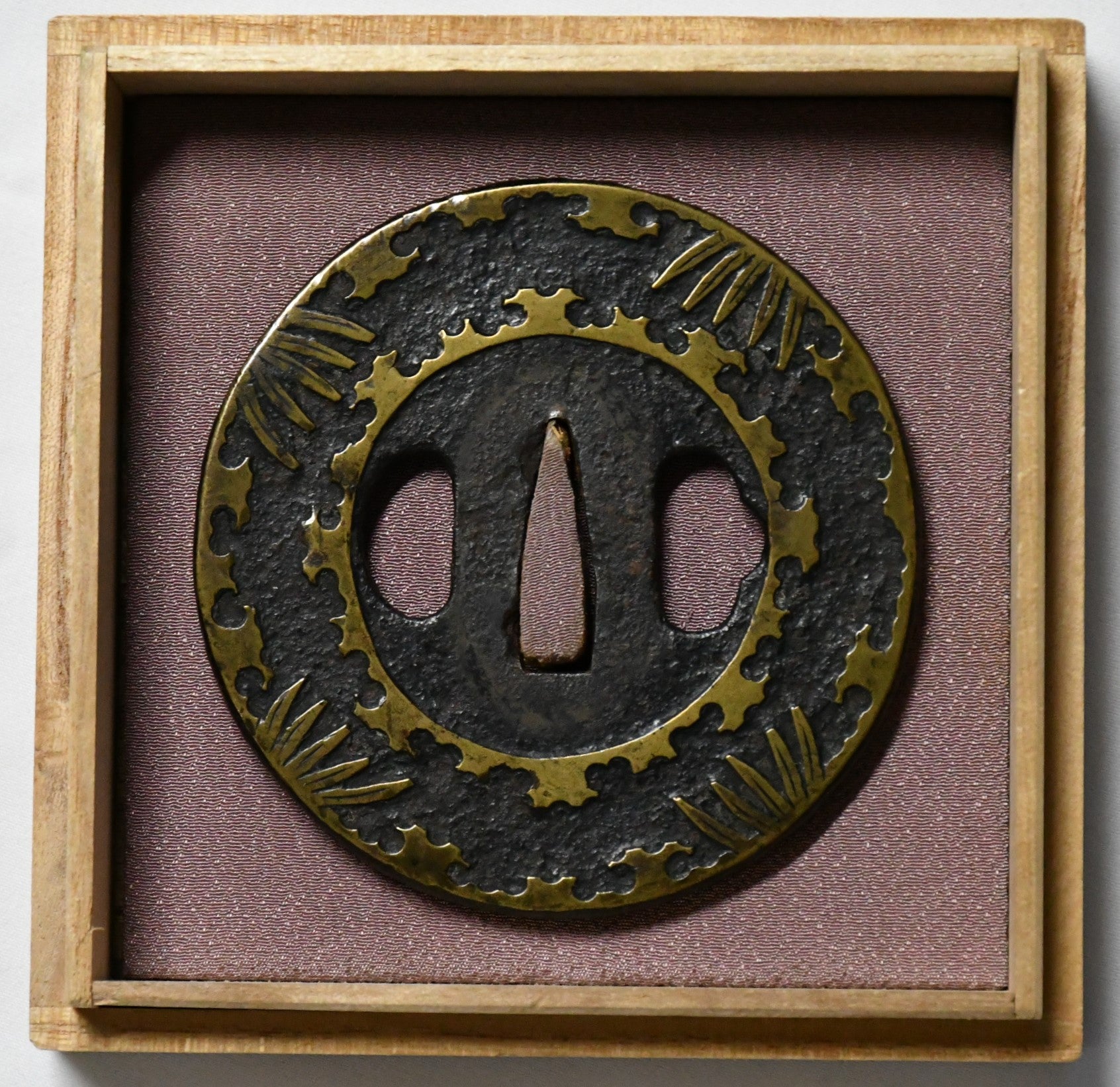
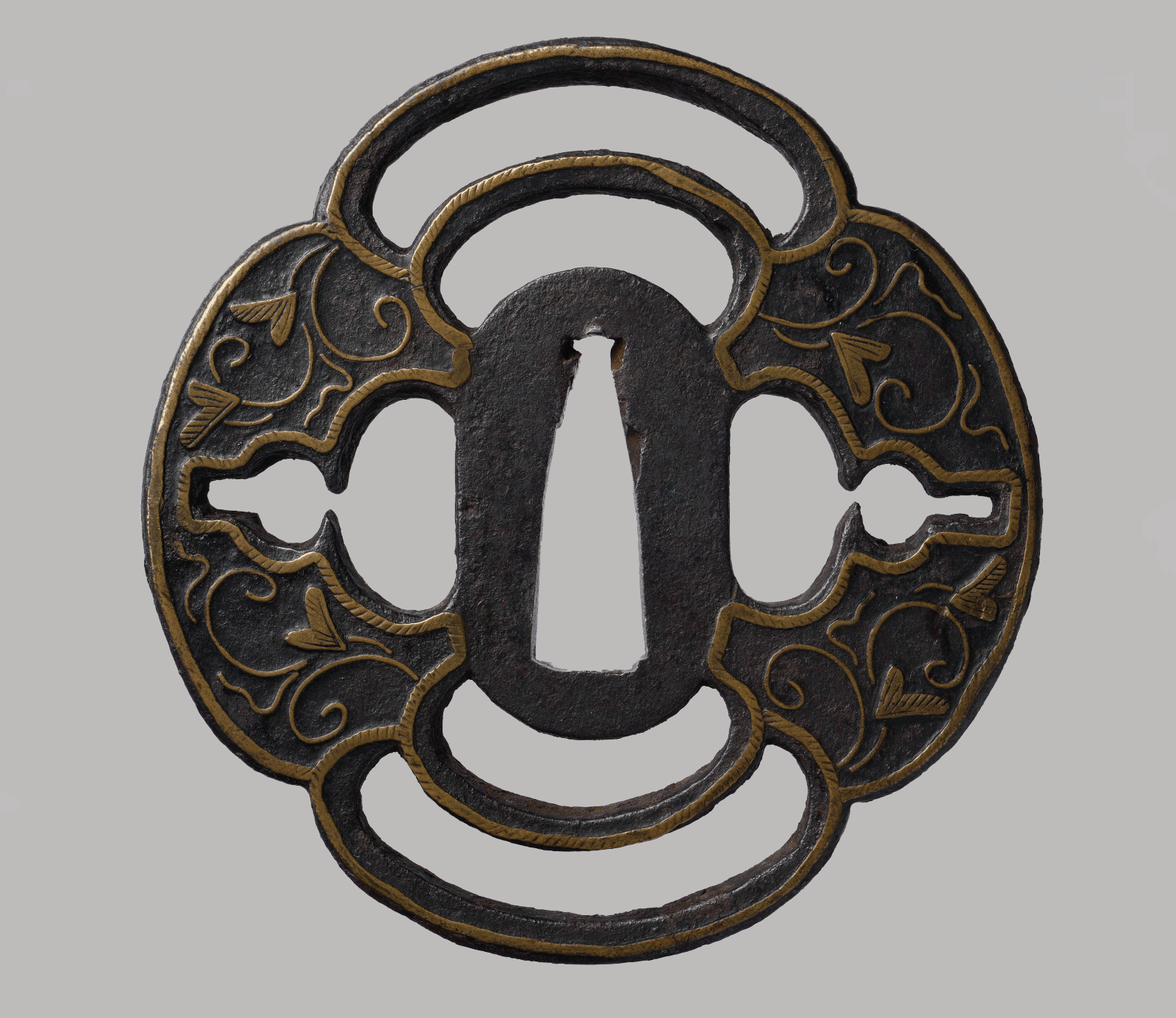
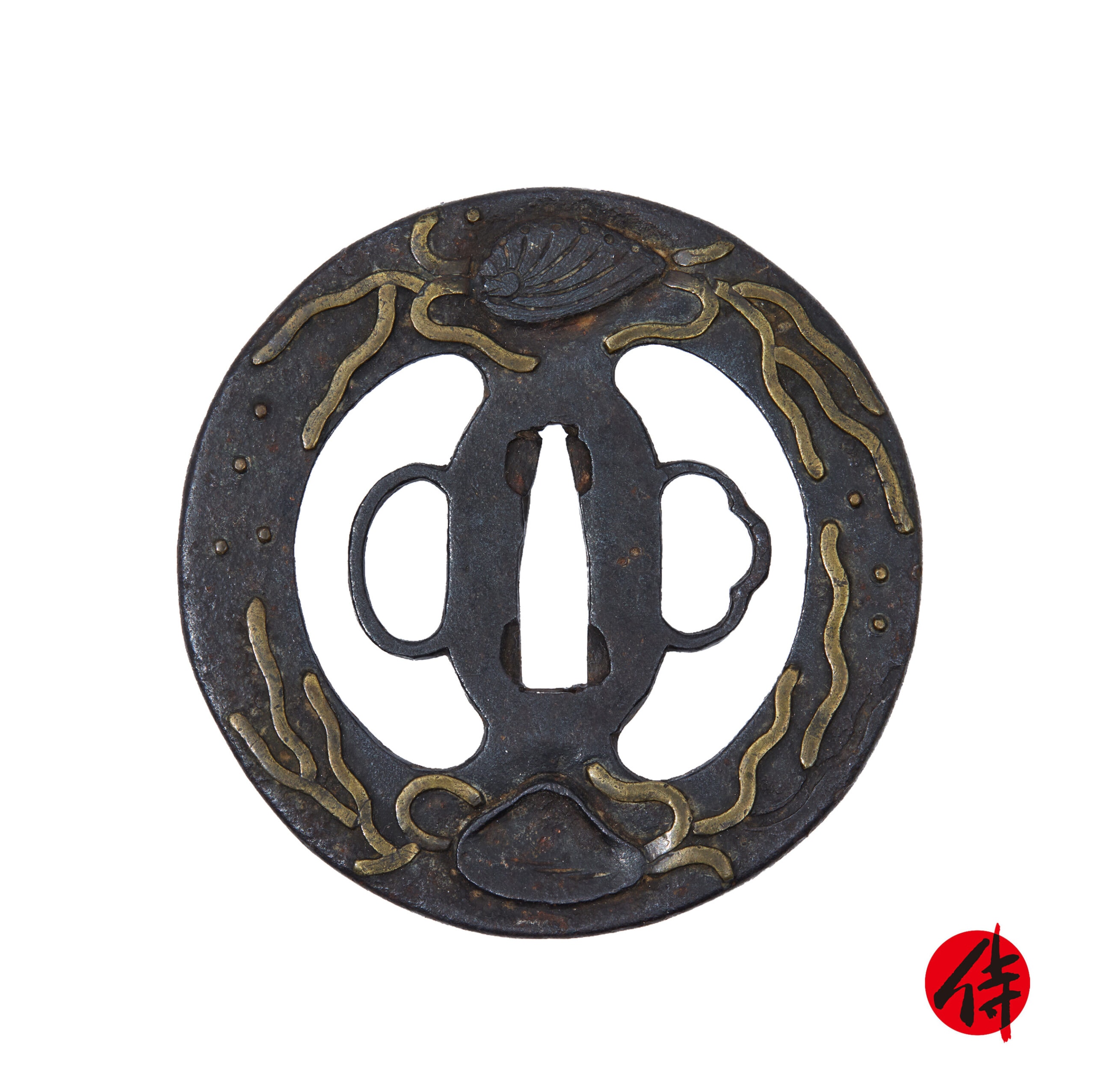
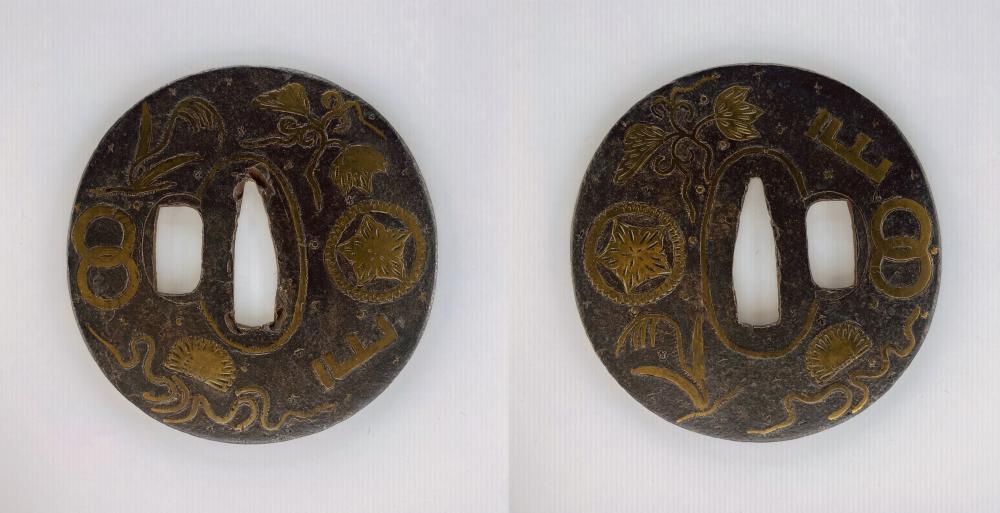
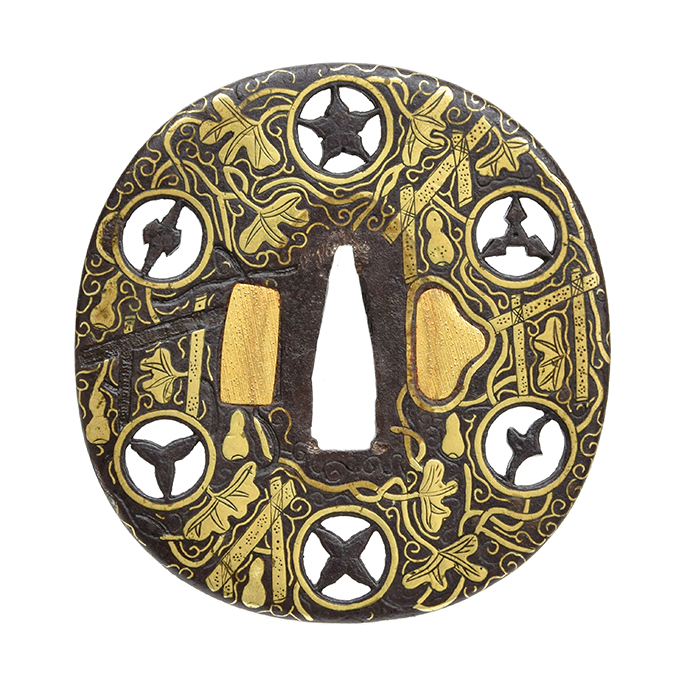
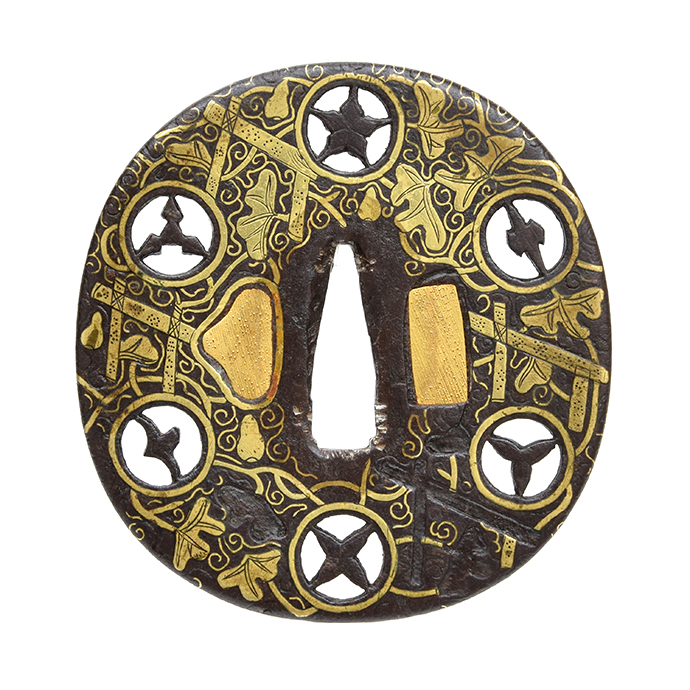
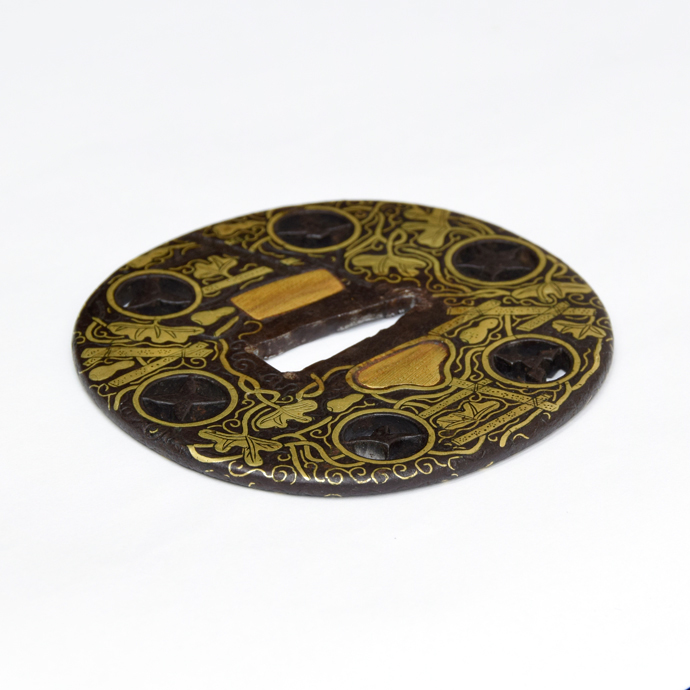
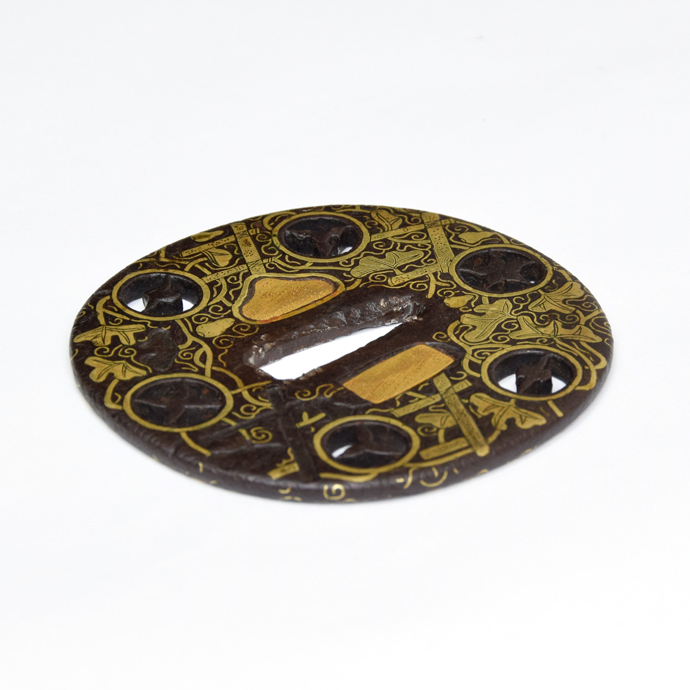
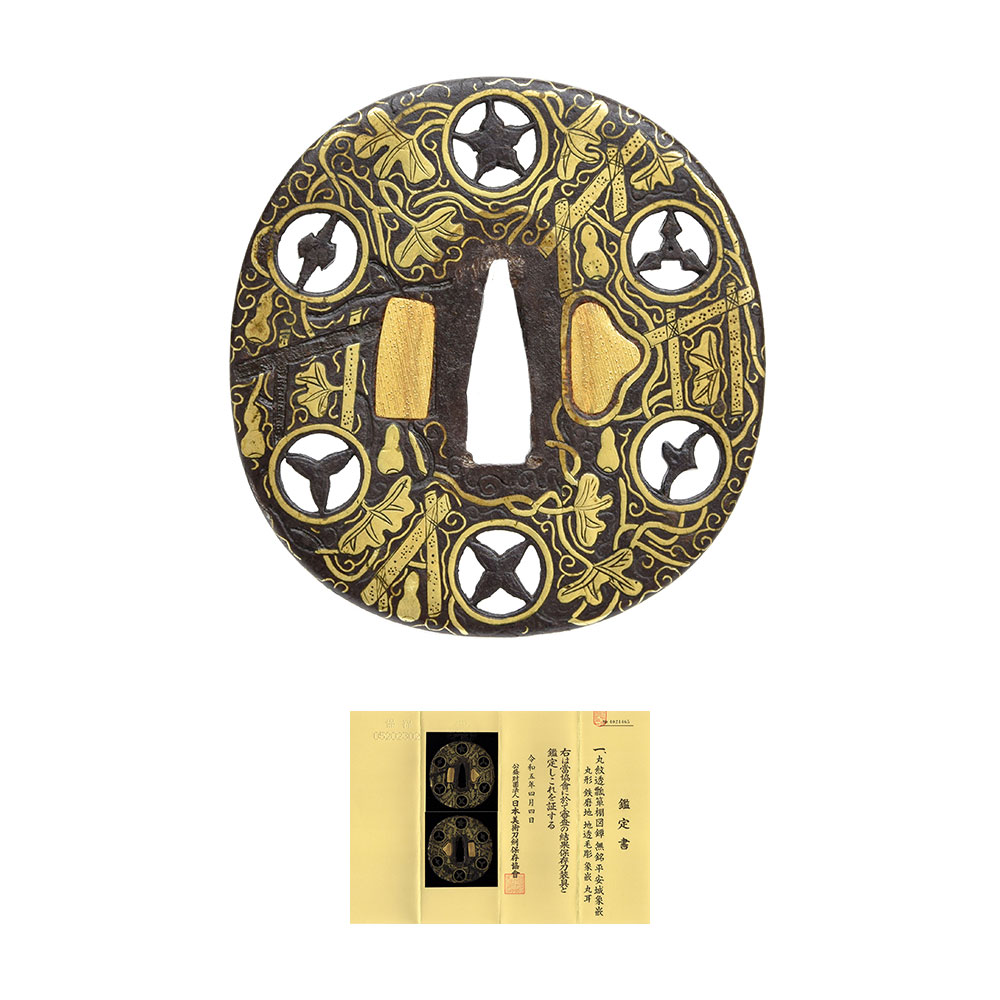
This is a beautiful Heianjo Zogan tsuba featuring a round crest openwork design with gourds. It is crafted from iron with brass inlay, showcasing the characteristic technique inherited from Ounin tsuba. Despite some minor loss of inlay due to age, the overall composition remains well-balanced and aesthetically pleasing, making it a desirable collector's piece.
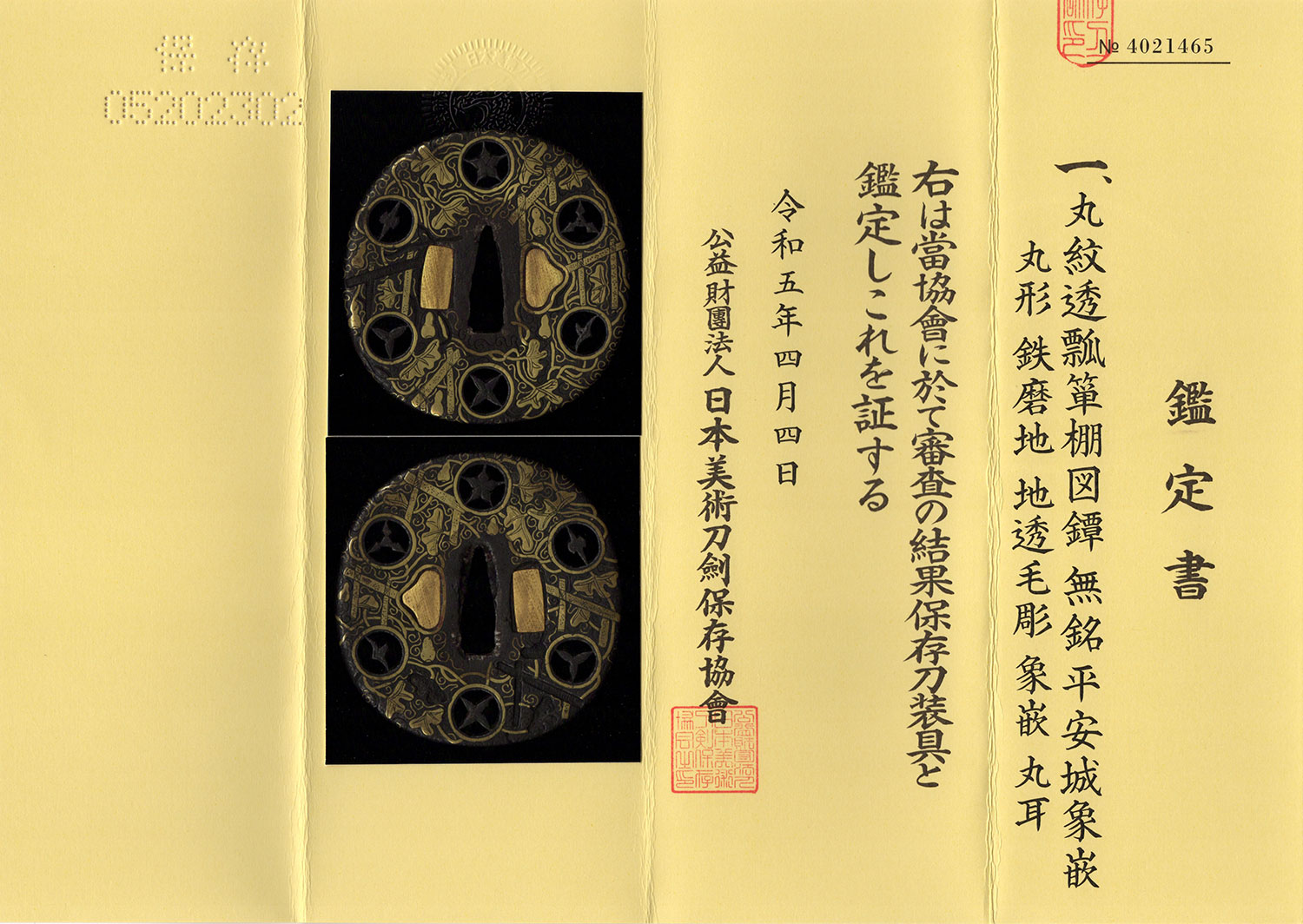
Certificate reading — 無銘(平安城象嵌)
 NihontoWatch
mumei · Heianjo · Edo
Iron-tsuba
25 pieces on the market now
Heianjo zogan tsuba constitute a technique-defined regional tradition rooted in Yamashiro Province, centered on the capital city of Kyoto. The NBTHK setsumei consistently describe the tradition as one that "draws upon the lineage of Onin tsuba,"[[c:1]] though the relationship is understood as broadly contemporaneous rather than strictly sequential; the earliest Heianjo inlay works are, in terms of period, close to Onin tsuba. The tradition flourished from the closing years of the Muromachi period through the Momoyama era and into the early Edo period. Connections to other iron-tsuba lineages such as Kamakura tsuba have also been contemplated. From within this milieu emerged Koike Yoshiro, who received the court title Izumi no Kami and took the name Naomasa; originally of Kyoto, he later relocated to Kaga Province and is said to have pioneered the tradition known as Kaga inlay (Kaga zogan). " The collective idiom of the tradition divides broadly into two technical approaches: suemon-zogan (flush raised inlay) and hira-zogan (flat inlay). A defining characteristic shared by both is the extensive use of brass (shinchu / 真鍮).
In terms of design, the suemon-zogan manner frequently employs crests and scrolling karakusa (唐草) arabesques developed in an ornamental, pattern-like fashion, while the hira-zogan manner often depicts grasses and flowers -- chrysanthemum, dianthus (nadeshiko), and bellflower (kikyo) motifs among them. As time progressed, the palette expanded beyond brass to include gold, silver, refined copper (suaka), shakudo, and yamagane, used in combination; pictorial designs were introduced, and some works mix suemon-zogan with hira-zogan or incorporate sukidashi-bori takabori (raised carving in scooped-out relief). The iron plates are typically of generous proportion, and the Koike Yoshiro sub-line is further distinguished by thin iron plates with successive crest openwork at the rim edge, dense karakusa hira-zogan across the ground enhanced with fine line engraving (kebori), and a subtle niku-otoshi ("set-down flesh") treatment at the rim. Across the NBTHK setsumei the tradition is repeatedly praised for an unmistakably Kyoto sensibility. "[[c:4]] The pictorial ambition of later masters such as Nagayoshi, whose sukidashi-takabori landscape compositions "successfully unfold the world of pictorial tsuba," demonstrates the breadth of the tradition beyond pure inlay ornament. Taken together, the Heianjo zogan corpus attests to a sustained metropolitan workshop culture in which brass inlay on iron plate was elevated -- through distinctive technique, refined design[[c:5]], and an abiding courtly elegance -- into one of the recognized pillars of the Kyoto tsuba canon. Learn more →
| Smith | Era | Designated |
|---|---|---|
| Shigemitsu重光 | — | 0 |
| Hidesada英貞 | — | 0 |
| Tadatsugu忠次 | — | 0 |
| Yoshihisa吉久 | — | 0 |
| Yoshinaga吉長 | — | 0 |
Certifies a genuine fitting worth preserving: a correct signature, or, if unsigned, an identifiable era and school, with recognized artistic and craft value.
The NBTHK (Nihon Bijutsu Tōken Hozon Kyōkai, the Society for the Preservation of Japanese Art Swords) is a public-interest incorporated foundation founded in 1948 and supervised by Japan’s Agency for Cultural Affairs (Bunkachō); it is based at the Japanese Sword Museum in Tokyo. Its expert panels physically examine each submitted work (shinsa) and issue a certificate (kanteishō) ranking it by artistic and historical merit. NBTHK papers are the most widely recognized standard of authentication for Japanese swords and fittings.
NBTHK official siteReturns accepted within 3 days of delivery for defective items or significant discrepancies; customer bears return shipping and bank fees.
¥143,000
This is a beautiful Heianjo Zogan tsuba featuring a round crest openwork design with gourds. It is crafted from iron with brass inlay, showcasing the characteristic technique inherited from Ounin tsuba. Despite some minor loss of inlay due to age, the overall composition remains well-balanced and aesthetically pleasing, making it a desirable collector's piece.
Certificate reading — 無銘(平安城象嵌)
NihontoWatchmumei · Heianjo · Edo
Iron-tsuba
25 pieces on the market now
Heianjo zogan tsuba constitute a technique-defined regional tradition rooted in Yamashiro Province, centered on the capital city of Kyoto. The NBTHK setsumei consistently describe the tradition as one that "draws upon the lineage of Onin tsuba,"[[c:1]] though the relationship is understood as broadly contemporaneous rather than strictly sequential; the earliest Heianjo inlay works are, in terms of period, close to Onin tsuba. The tradition flourished from the closing years of the Muromachi period through the Momoyama era and into the early Edo period. Connections to other iron-tsuba lineages such as Kamakura tsuba have also been contemplated. From within this milieu emerged Koike Yoshiro, who received the court title Izumi no Kami and took the name Naomasa; originally of Kyoto, he later relocated to Kaga Province and is said to have pioneered the tradition known as Kaga inlay (Kaga zogan). " The collective idiom of the tradition divides broadly into two technical approaches: suemon-zogan (flush raised inlay) and hira-zogan (flat inlay). A defining characteristic shared by both is the extensive use of brass (shinchu / 真鍮).
In terms of design, the suemon-zogan manner frequently employs crests and scrolling karakusa (唐草) arabesques developed in an ornamental, pattern-like fashion, while the hira-zogan manner often depicts grasses and flowers -- chrysanthemum, dianthus (nadeshiko), and bellflower (kikyo) motifs among them. As time progressed, the palette expanded beyond brass to include gold, silver, refined copper (suaka), shakudo, and yamagane, used in combination; pictorial designs were introduced, and some works mix suemon-zogan with hira-zogan or incorporate sukidashi-bori takabori (raised carving in scooped-out relief). The iron plates are typically of generous proportion, and the Koike Yoshiro sub-line is further distinguished by thin iron plates with successive crest openwork at the rim edge, dense karakusa hira-zogan across the ground enhanced with fine line engraving (kebori), and a subtle niku-otoshi ("set-down flesh") treatment at the rim. Across the NBTHK setsumei the tradition is repeatedly praised for an unmistakably Kyoto sensibility. "[[c:4]] The pictorial ambition of later masters such as Nagayoshi, whose sukidashi-takabori landscape compositions "successfully unfold the world of pictorial tsuba," demonstrates the breadth of the tradition beyond pure inlay ornament. Taken together, the Heianjo zogan corpus attests to a sustained metropolitan workshop culture in which brass inlay on iron plate was elevated -- through distinctive technique, refined design[[c:5]], and an abiding courtly elegance -- into one of the recognized pillars of the Kyoto tsuba canon. Learn more →
| Smith | Era | Designated |
|---|---|---|
| Shigemitsu重光 | — | 0 |
| Hidesada英貞 | — | 0 |
| Tadatsugu忠次 | — | 0 |
| Yoshihisa吉久 | — | 0 |
| Yoshinaga吉長 | — | 0 |
Certifies a genuine fitting worth preserving: a correct signature, or, if unsigned, an identifiable era and school, with recognized artistic and craft value.
The NBTHK (Nihon Bijutsu Tōken Hozon Kyōkai, the Society for the Preservation of Japanese Art Swords) is a public-interest incorporated foundation founded in 1948 and supervised by Japan’s Agency for Cultural Affairs (Bunkachō); it is based at the Japanese Sword Museum in Tokyo. Its expert panels physically examine each submitted work (shinsa) and issue a certificate (kanteishō) ranking it by artistic and historical merit. NBTHK papers are the most widely recognized standard of authentication for Japanese swords and fittings.
NBTHK official siteReturns accepted within 3 days of delivery for defective items or significant discrepancies; customer bears return shipping and bank fees.
¥143,000