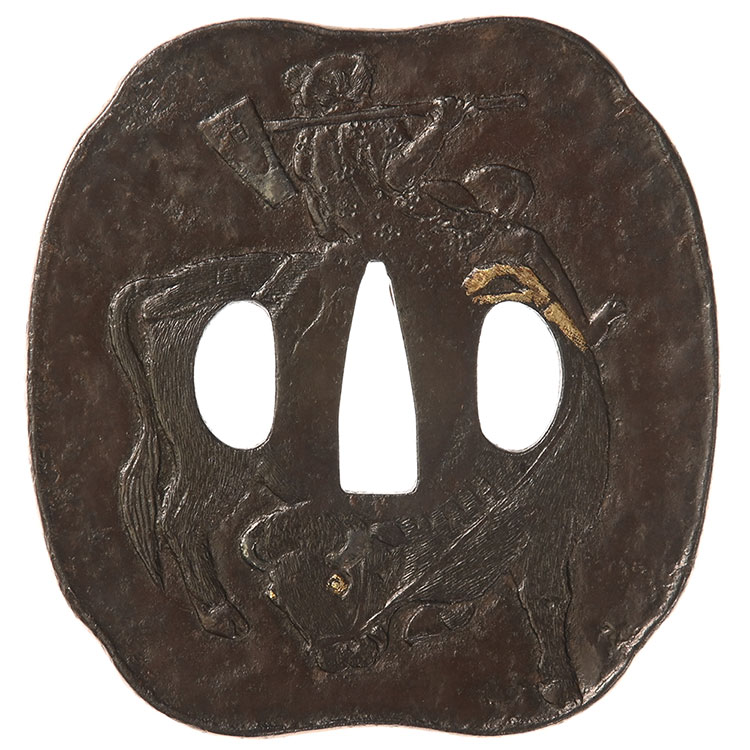
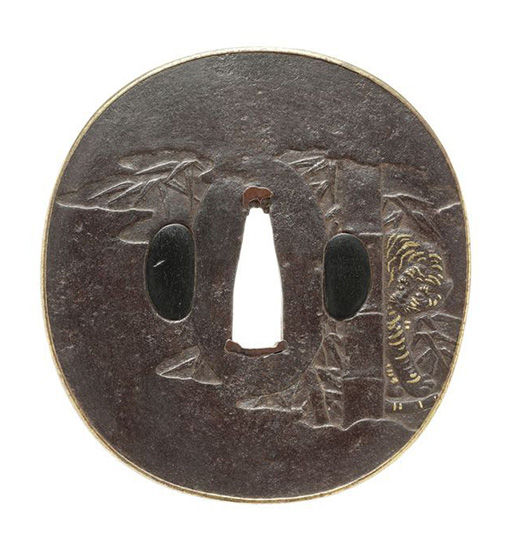
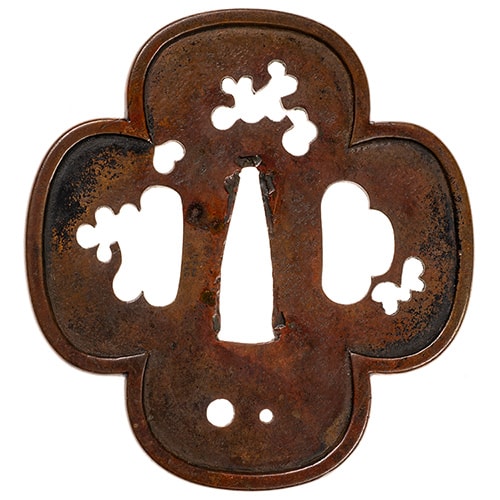
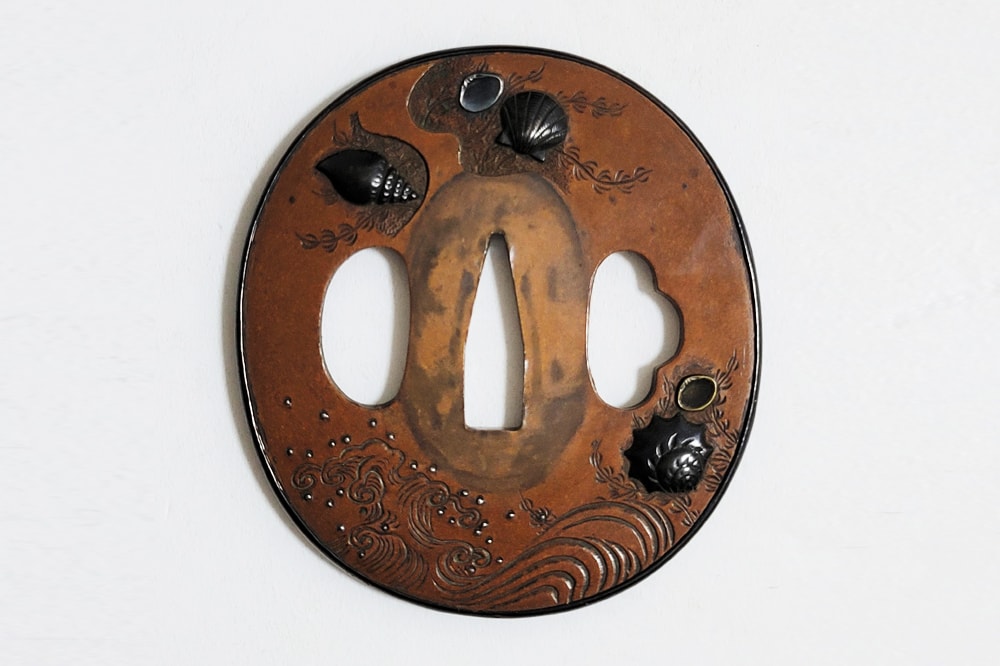
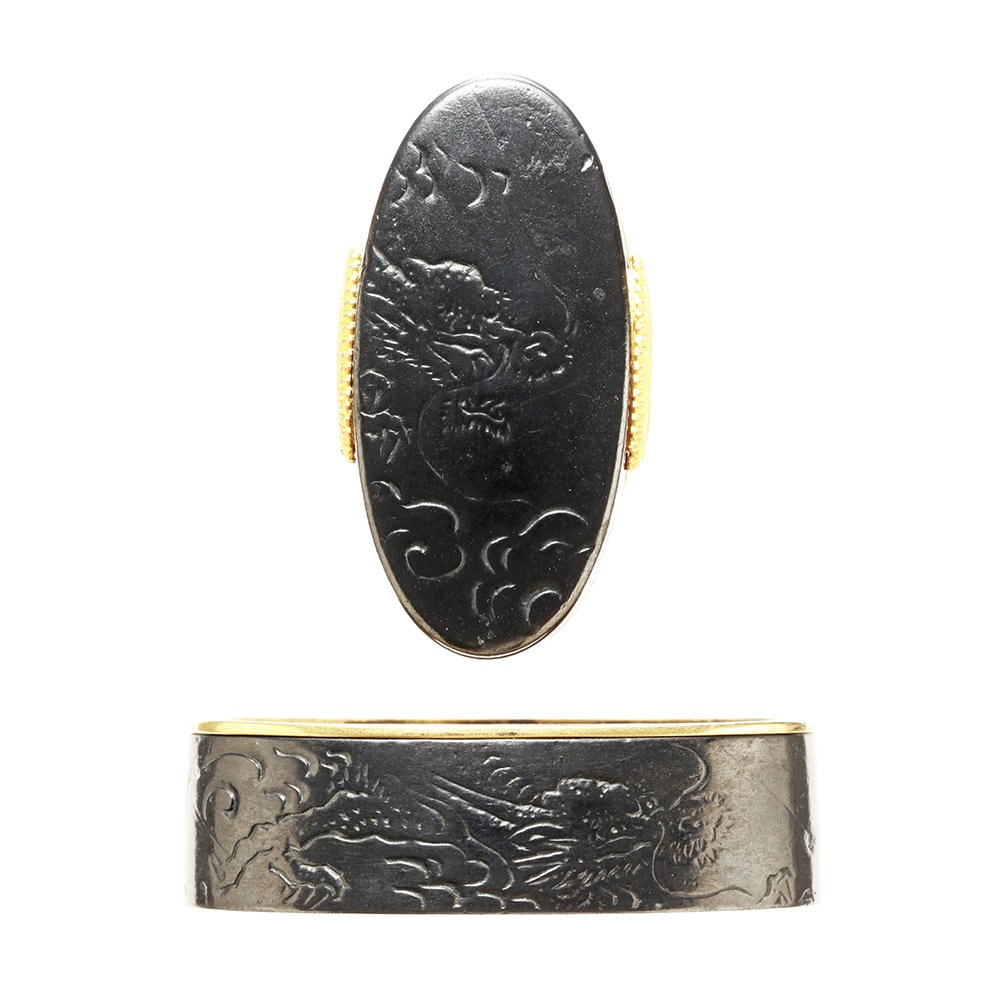
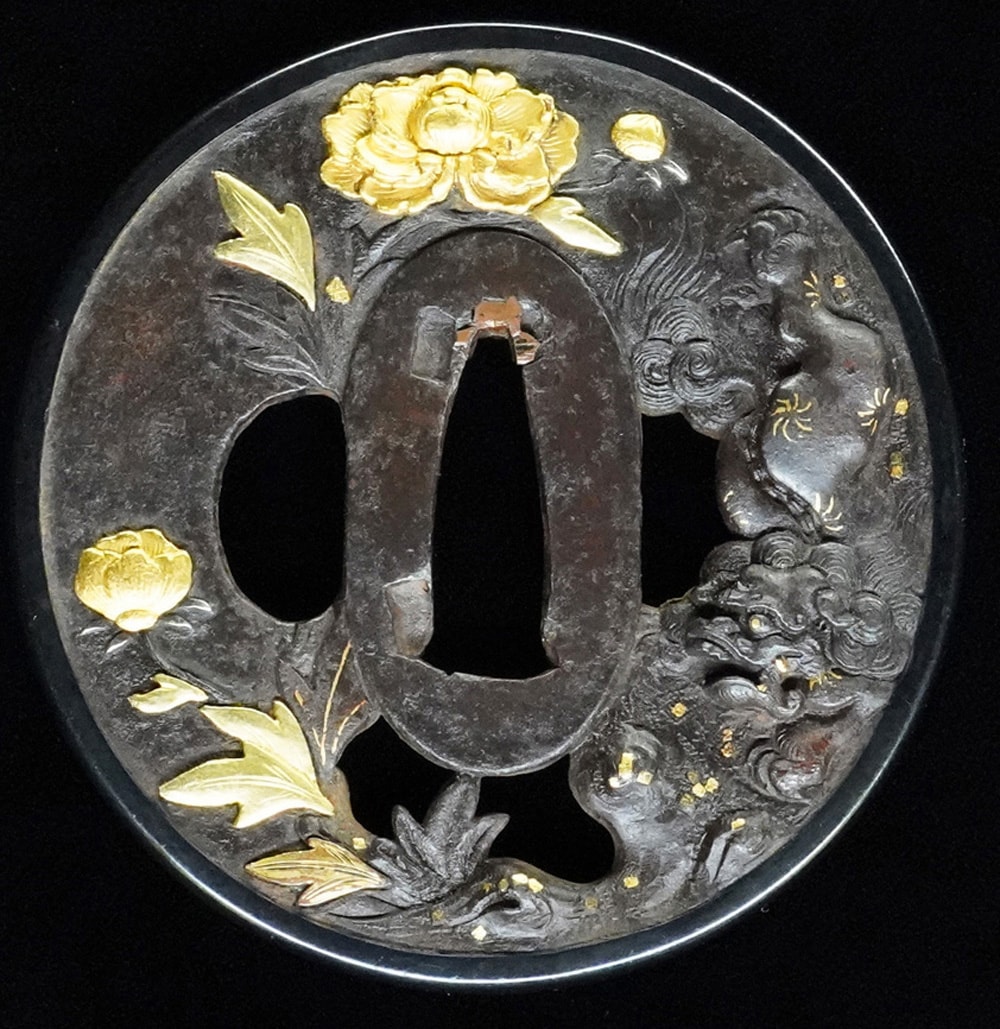
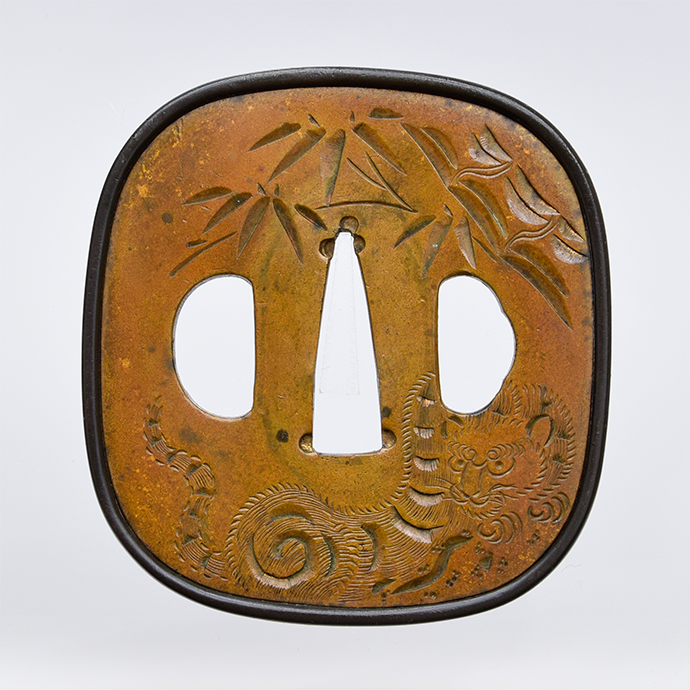
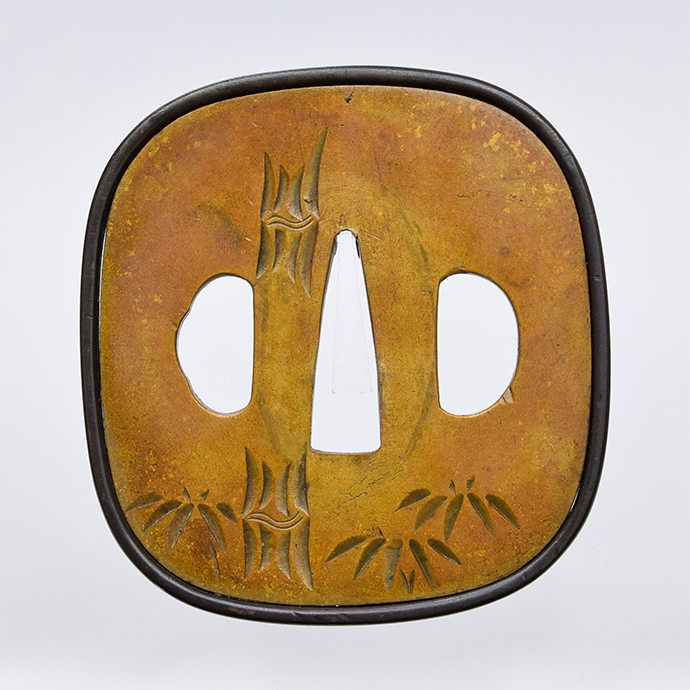
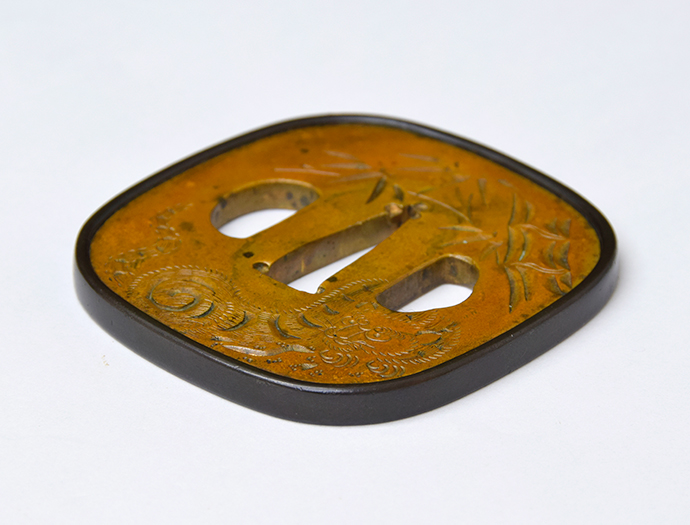
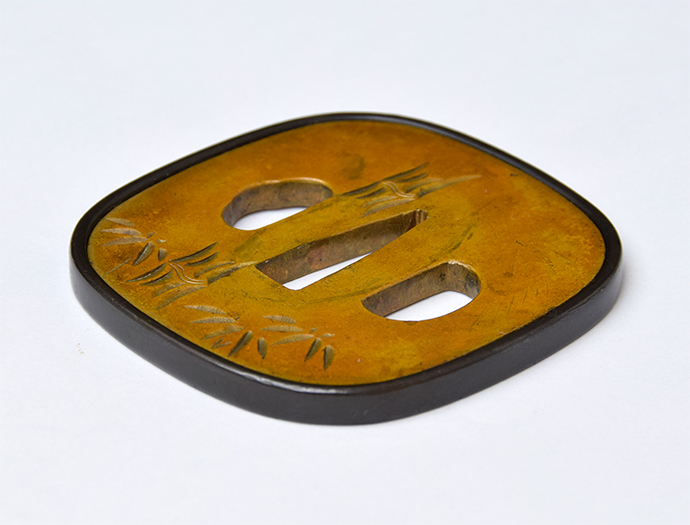
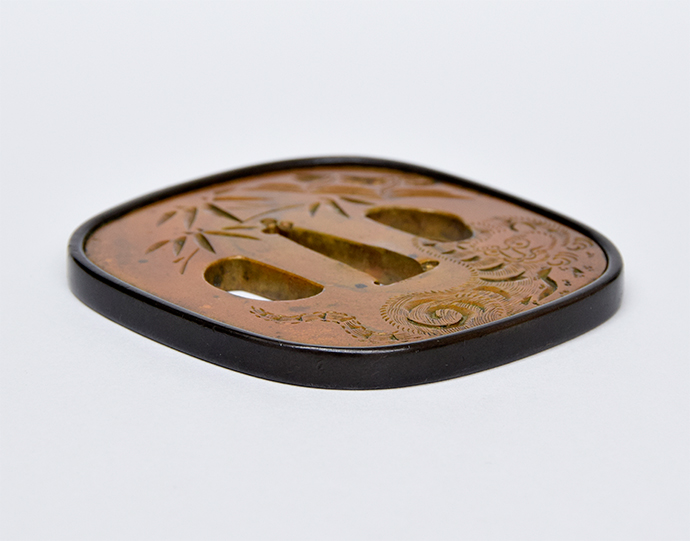
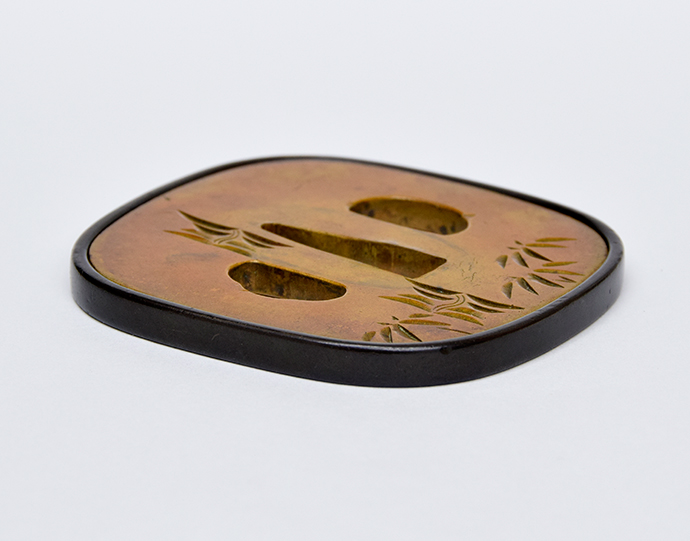
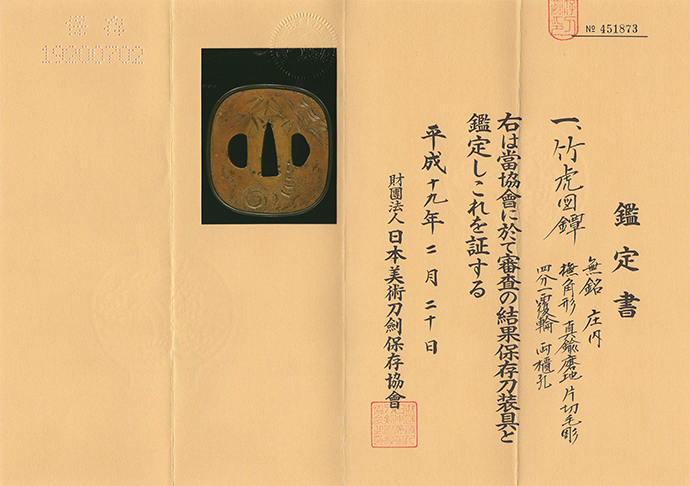
This is an unsigned (mumei) tsuba from the Shonai school, featuring a powerful katakiribori carving of bamboo and a tiger on a sentoku ground. The rim is adorned with shakudo fukurin. It comes with an NBTHK Hozon Tosogu certificate.
Certificate reading — 無銘(庄内)
 NihontoWatch
mumei · Shonai · 1801-1868
Shonai School
1801-1868
Unsigned
Hozon (NBTHK)
Kinko · Dewa
19 pieces on the market now
The Shonai metalworking tradition arose in the castle town of the Sakai lords in Dewa Province, where geographic remoteness from the great urban ateliers fostered a distinctive regional idiom sustained across multiple generations of domain-retained craftsmen (kakae-ko). The earliest master attested in the designation corpus is Zaoya (1661--1742), who studied under Sato Chinkyu -- the same teacher who trained Nara Yasuchika -- yet remained throughout his life in Shonai and never traveled to Edo[[c:1]]. The dominant Washida lineage, by contrast, maintained a pattern of successive generations journeying to Edo to study under the Yanagawa school before returning to serve the Sakai house: the main line ran from the first head, Shinkodo Mitsutoki, through Kokodo Tokitaka, Kyukodo Mitsutoki, and the fourth head Shokodo Mitsuchika, with the latter's younger brother Kyozan Mitsunaka (1830--1889) bringing the school to its brilliant culmination. Other artisans drawn into this milieu include Horyusai Kosei, who fulfilled official commissions for the Sakai family, and Okada Tokio, originally of Sendai, who studied under Kono Shunmei before becoming a pupil of Washida Mitsutoki in Dewa. The collective technical vocabulary of the Shonai corpus centers on hira-zogan (flat inlay) executed in multiple varieties of colored metals -- gold, silver, shakudo, shibuichi, oborogin, and suaka -- applied over polished shakudo grounds (migaki-ji).
" Alongside the Washida manner, the corpus documents shakudo nanako-ji grounds bearing heraldic crests in gold iroe, as in Kosei's unified fittings for the Sakai house, and sukidashi-bori relief carving enriched with gold and silver iroe, as in Zaoya's tsuba with its interweaving of butterfly and ivy. The recurring guncho (swarm of butterflies) motif across multiple designated works exemplifies a design sensibility the examiners characterize as sharing affinities with the aesthetic consciousness of maki-e lacquer and yuzen dyeing -- a distinctly wayo (Japanese-style) decorative grammar[[c:4]]. The NBTHK examinations situate Shonai metalwork as a tradition in which "plain sincerity, graceful beauty, and unpretentious simplicity coexist[[c:7]]," and from which "many distinguished artisans" were produced[[c:5]]. The corpus attests both the formation of a regional school capable of absorbing Edo-derived technique and transforming it into a locally inflected vocabulary, and the achievement of individual masters -- above all Washida Mitsunaka, whose daishō tsuba pair received Tokubetsu-Juyo designation as "a masterpiece ... " From Zaoya's mid-Edo works channeling the manner of Chinkyu[[c:6]], through the Washida school's systematic absorption of Yanagawa and Kaga methods, to the formal heraldic programs executed for daimyo use, the Shonai tradition represents a sustained and coherent regional contribution to the late-Edo metalworking canon. Learn more →
| Smith | Era | Designated |
|---|---|---|
| Arichika在哉 | 1670 | 1 |
| Mitsunaka光中 | 1670 | 3 |
| Tokio時雄 | 1670 | 1 |
| Horyusai Mitsuakira鳳龍斎光精 | — | 1 |
Certifies a genuine fitting worth preserving: a correct signature, or, if unsigned, an identifiable era and school, with recognized artistic and craft value.
The NBTHK (Nihon Bijutsu Tōken Hozon Kyōkai, the Society for the Preservation of Japanese Art Swords) is a public-interest incorporated foundation founded in 1948 and supervised by Japan’s Agency for Cultural Affairs (Bunkachō); it is based at the Japanese Sword Museum in Tokyo. Its expert panels physically examine each submitted work (shinsa) and issue a certificate (kanteishō) ranking it by artistic and historical merit. NBTHK papers are the most widely recognized standard of authentication for Japanese swords and fittings.
NBTHK official siteReturns accepted within 3 days of delivery for defective items or significant discrepancies; customer bears return shipping and bank fees.