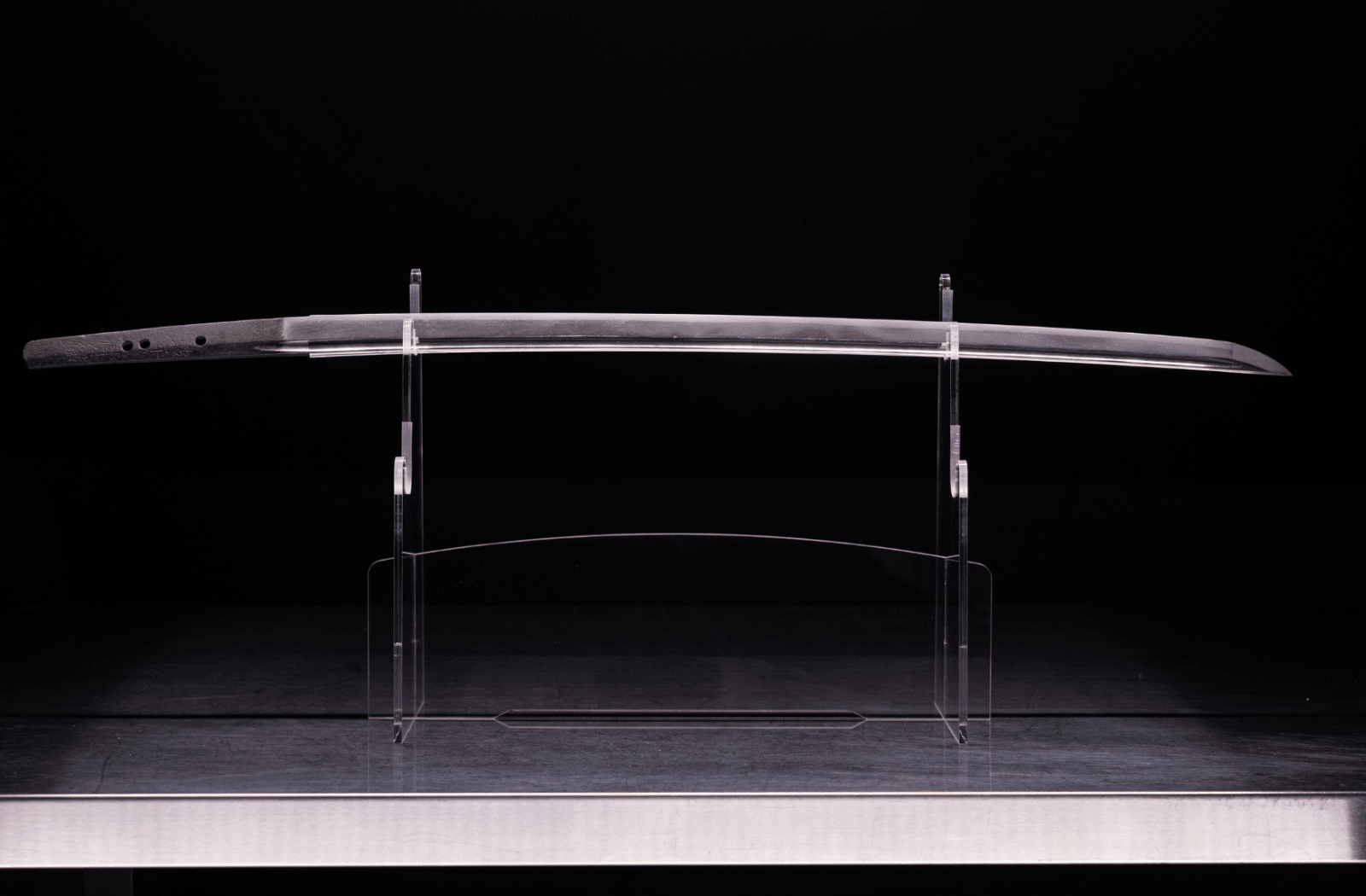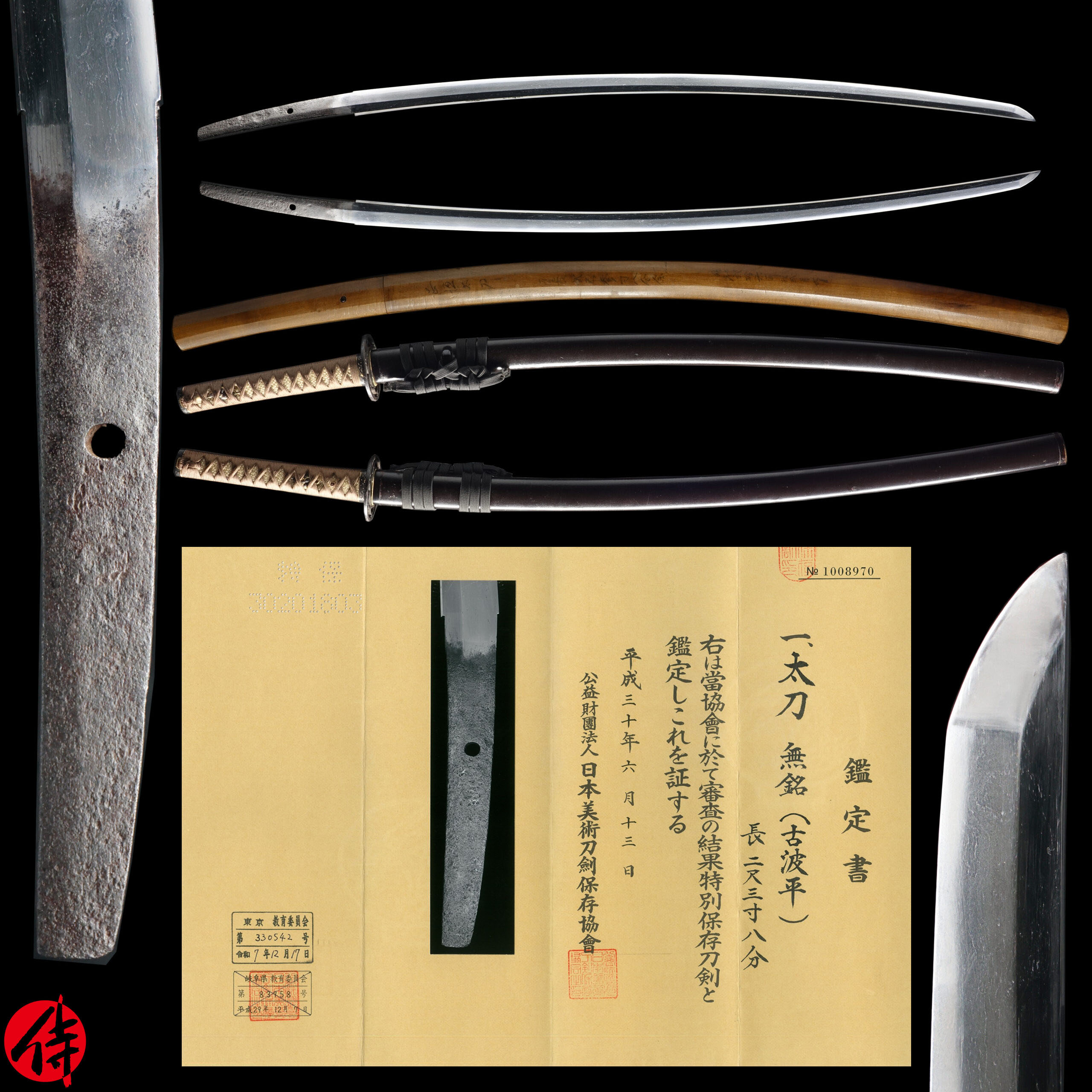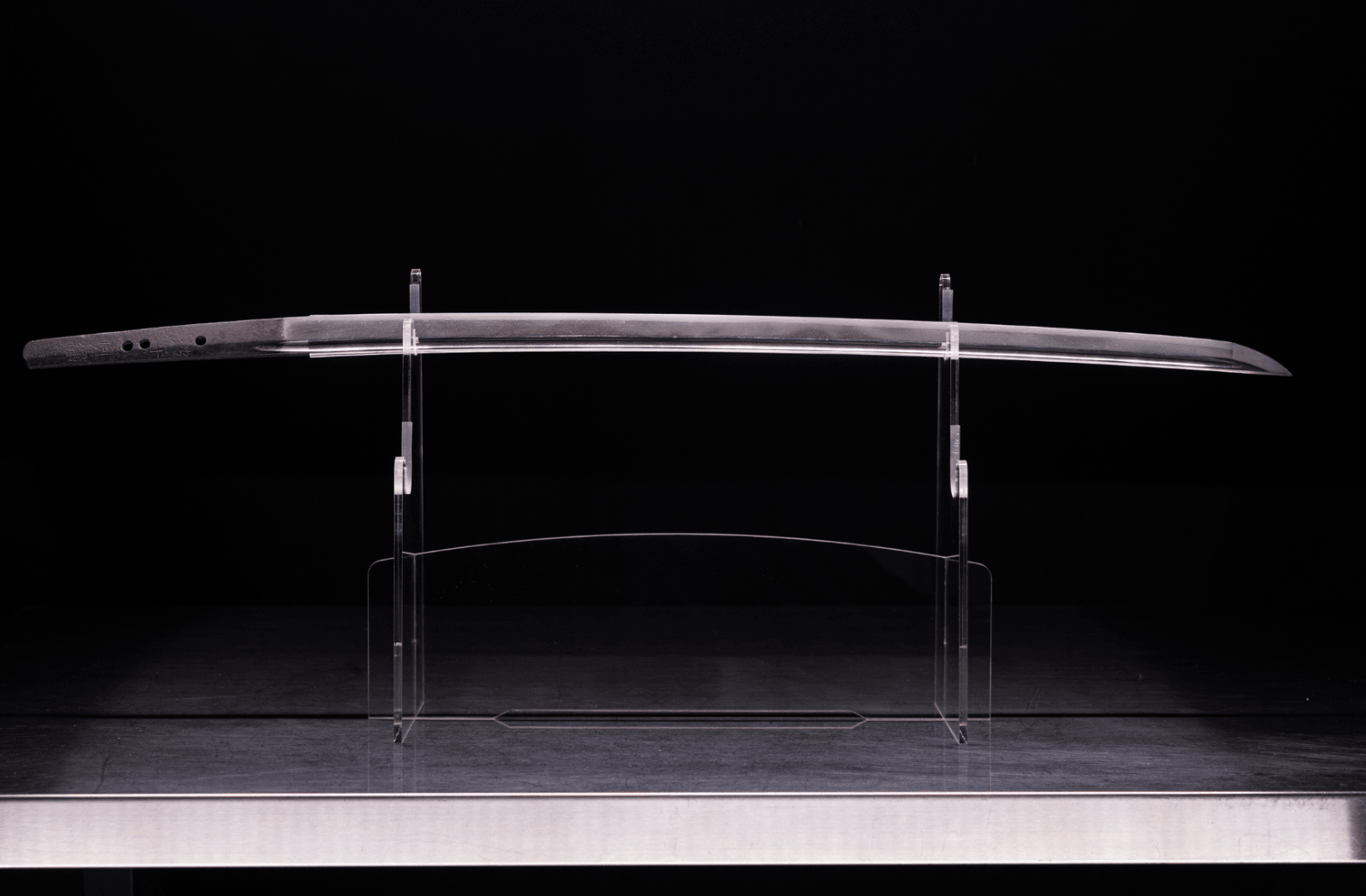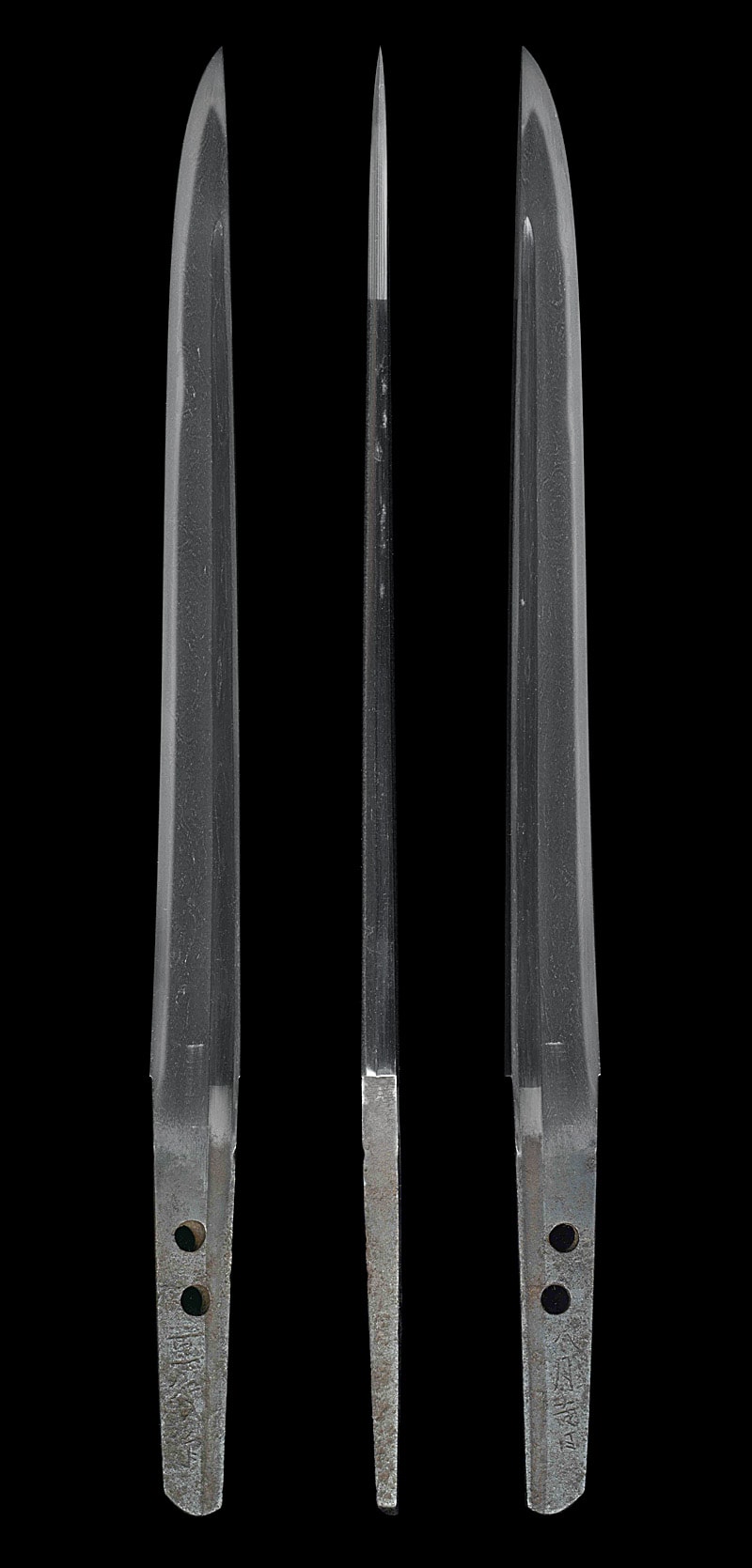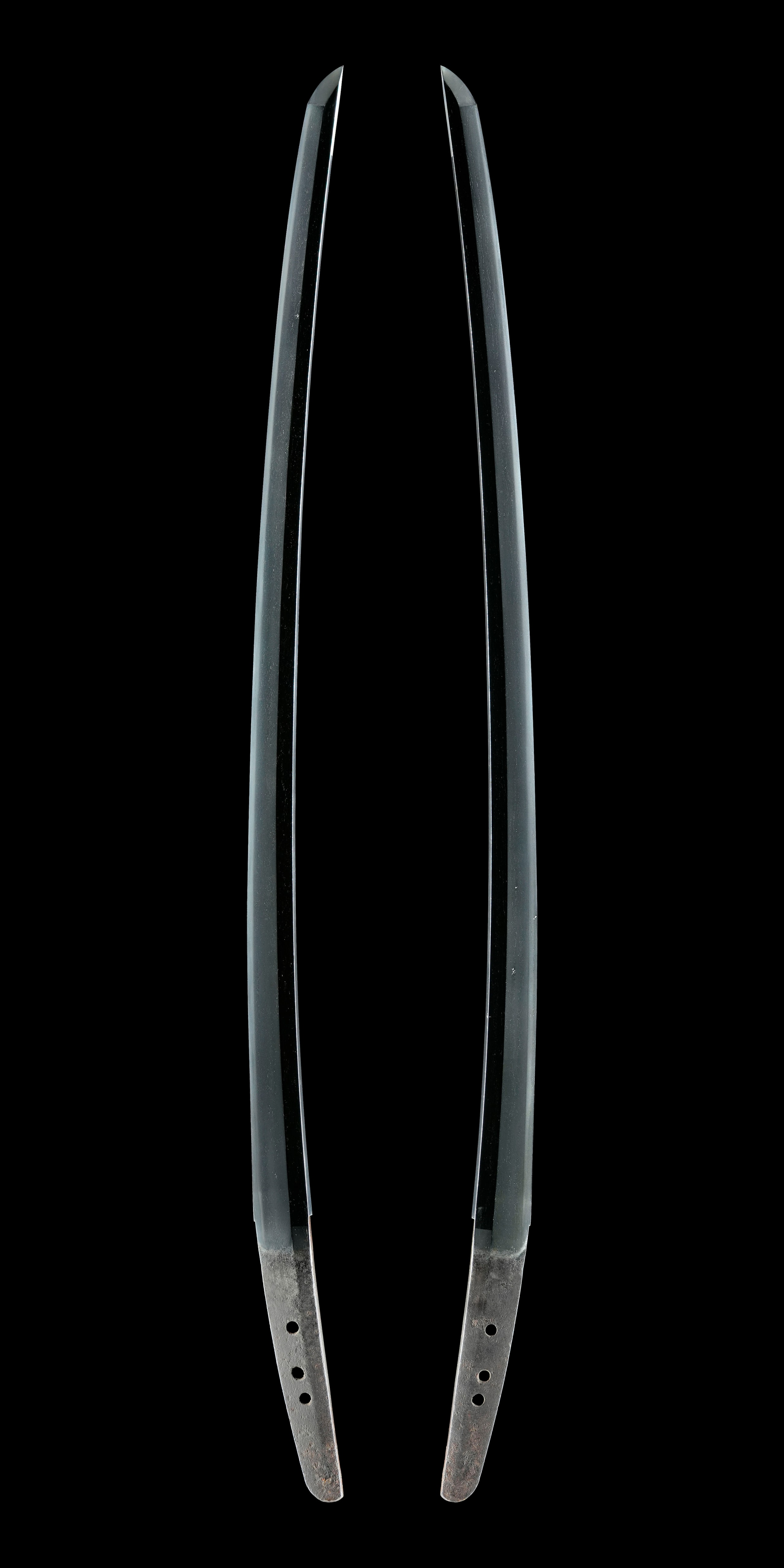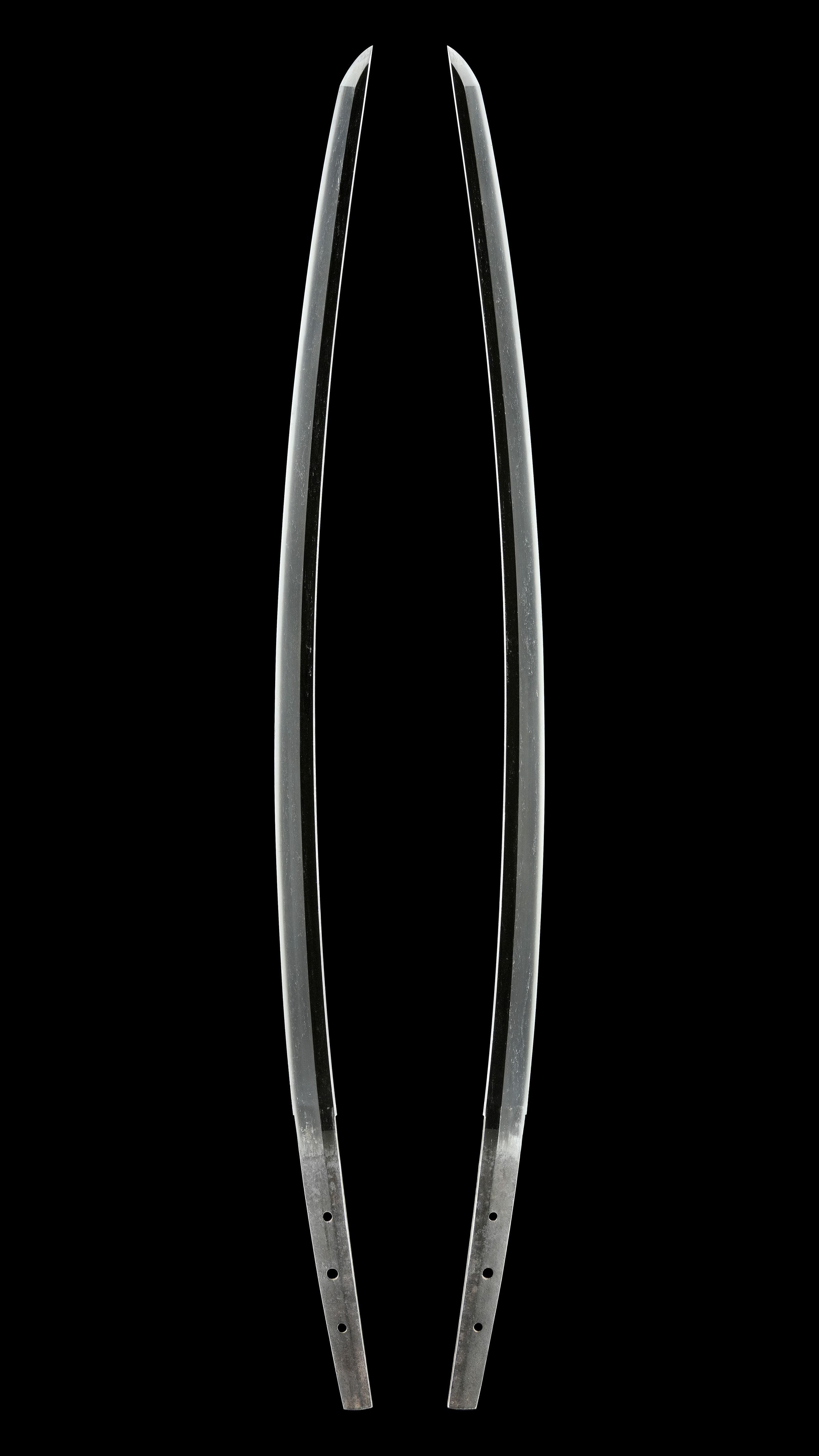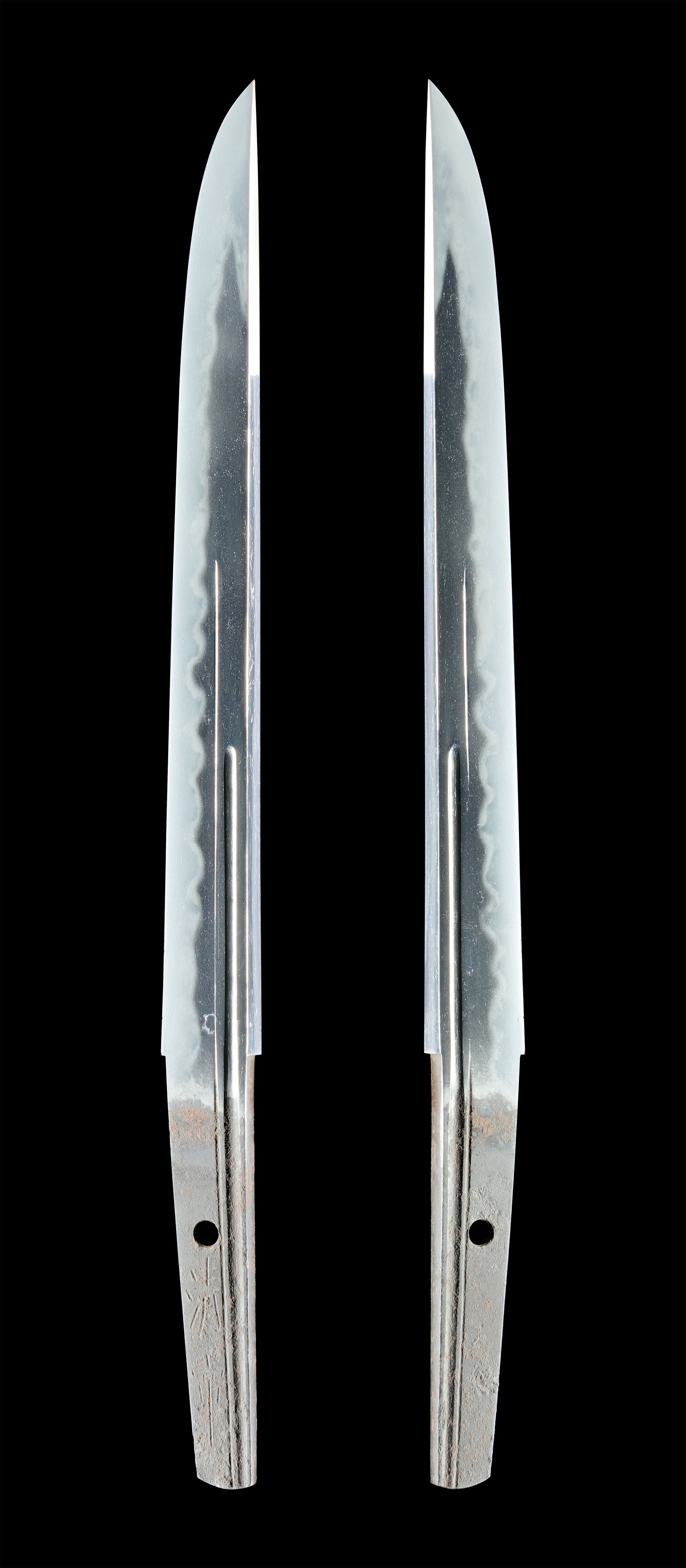
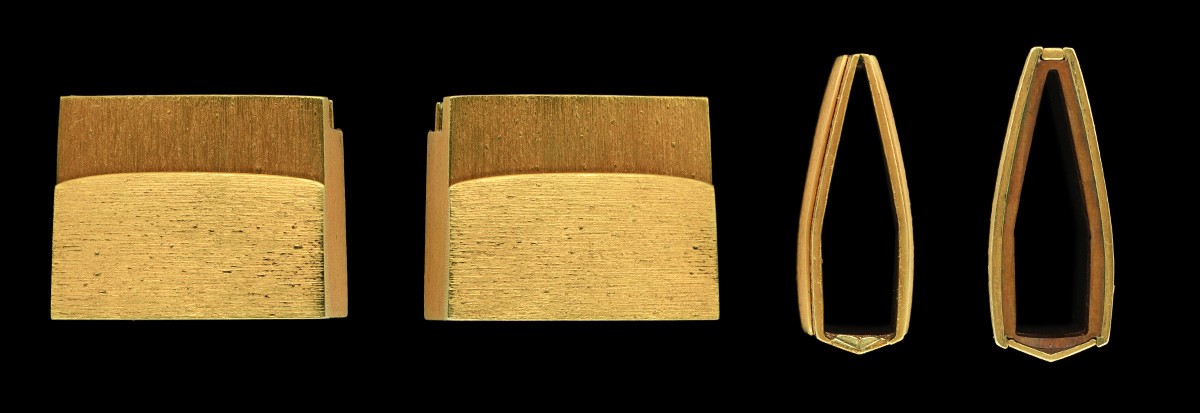
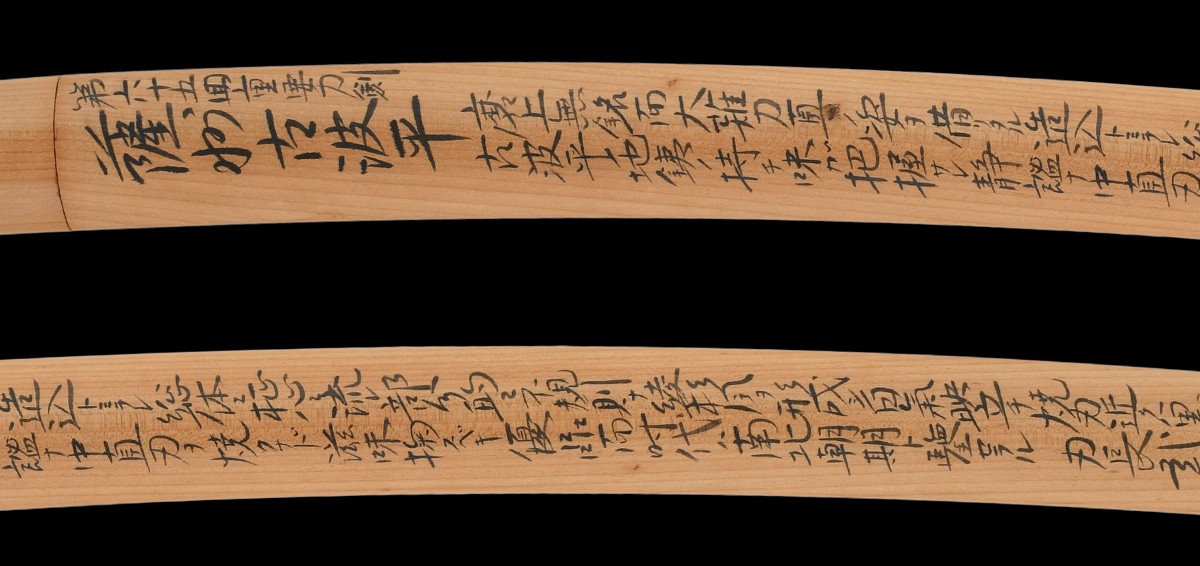
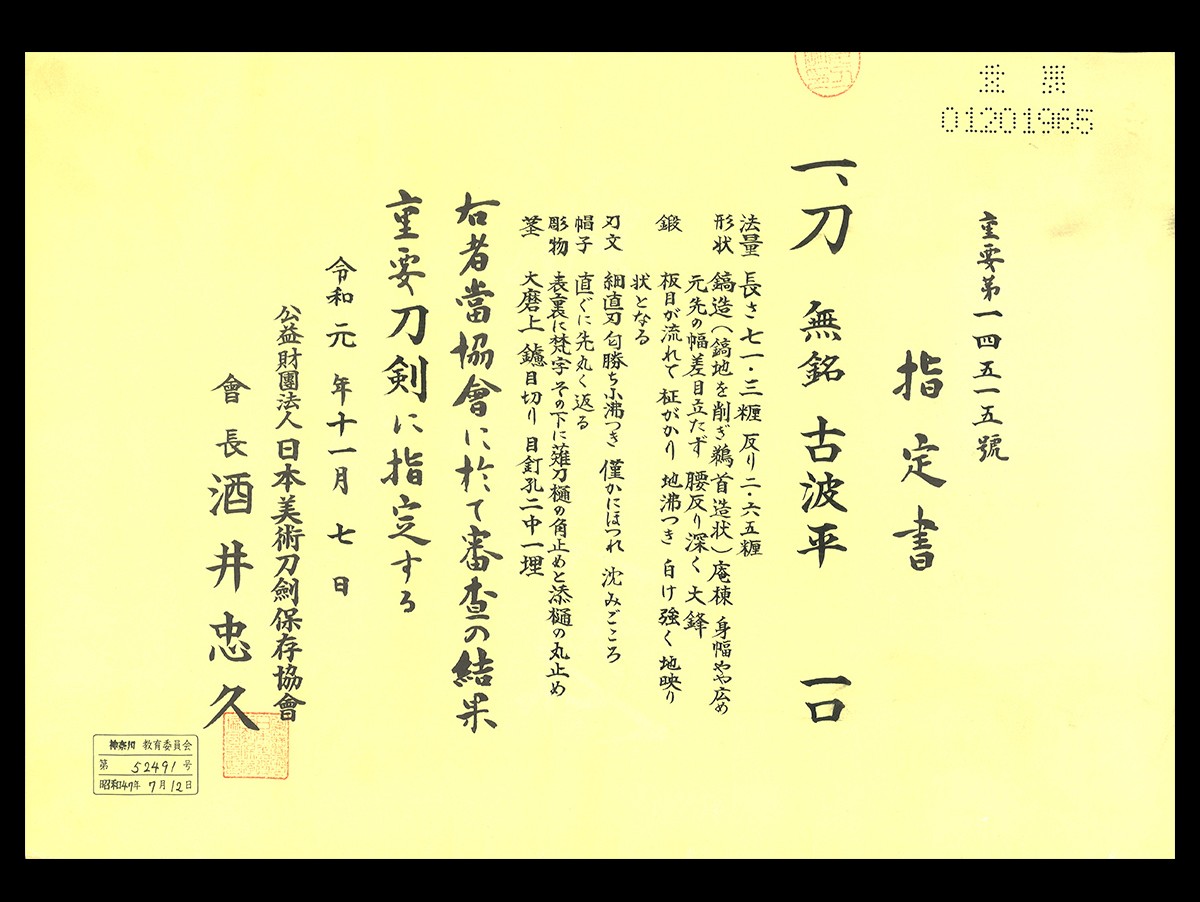
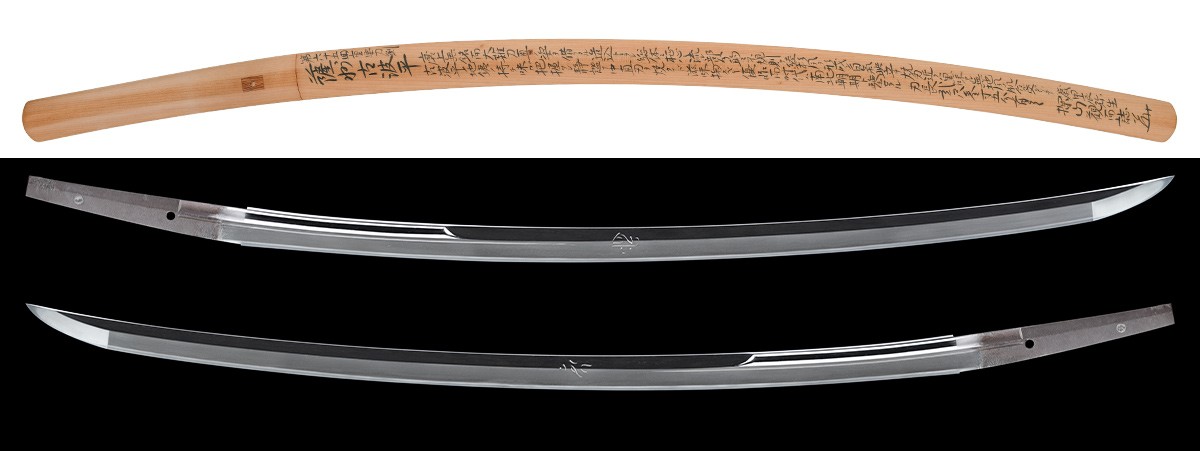
-, 65th Session — Designated November 7, 2019
, : Ko-Naminohira (古波平)
Measurements 71.3 cm, 2.65 cm, 2.9 cm, 2.25 cm, 6.6 cm, 17.0 cm, 0.1 cm
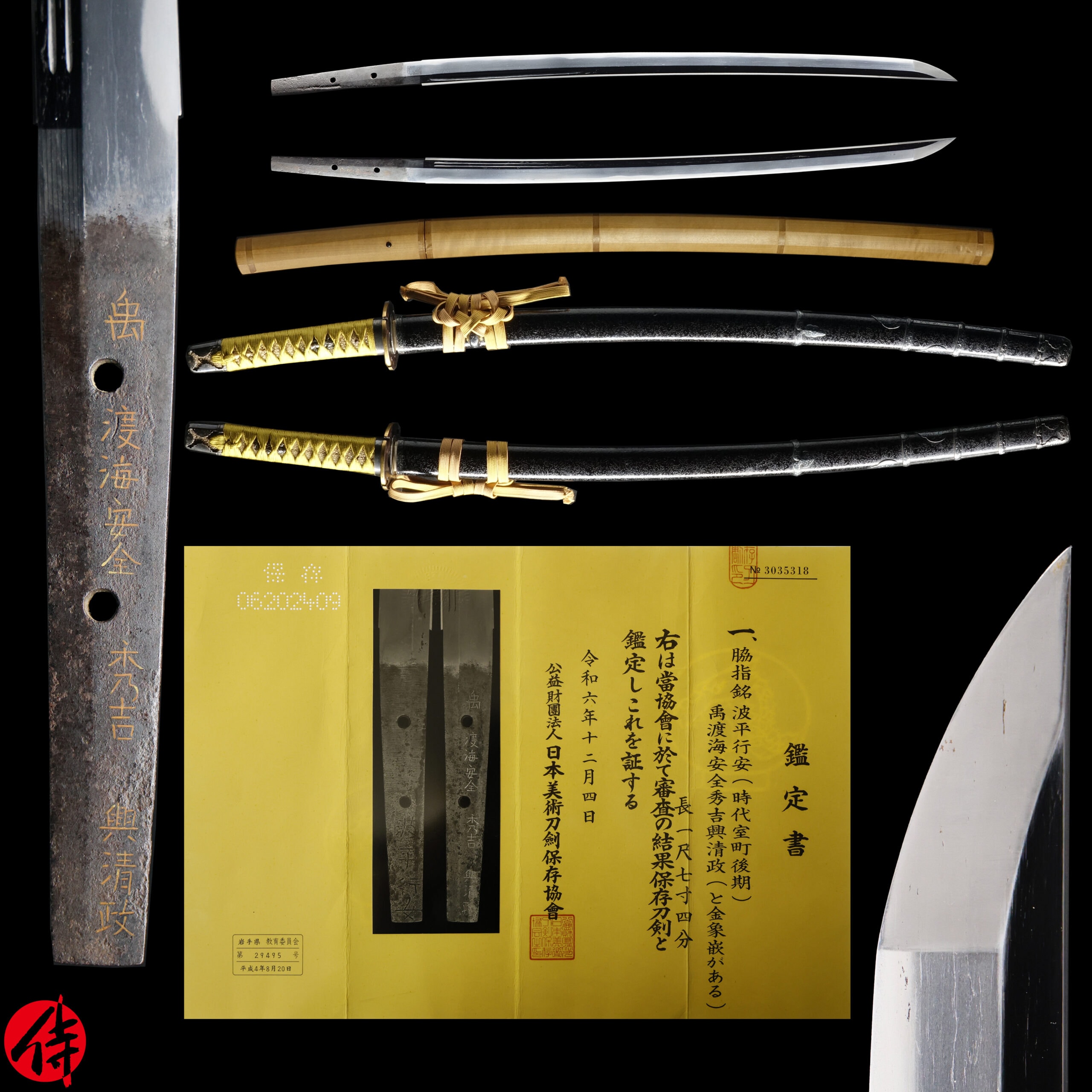
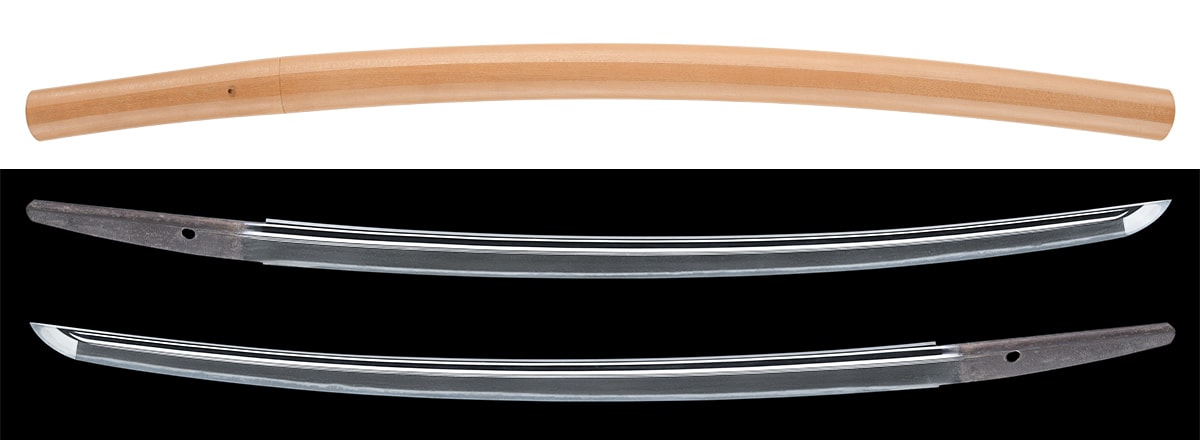
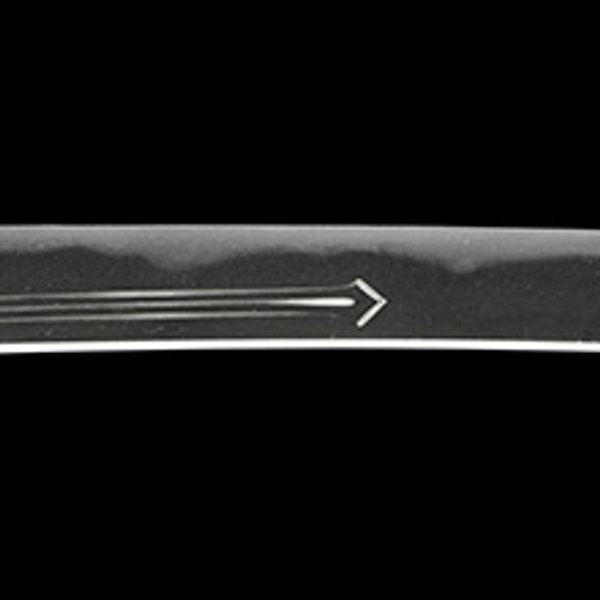
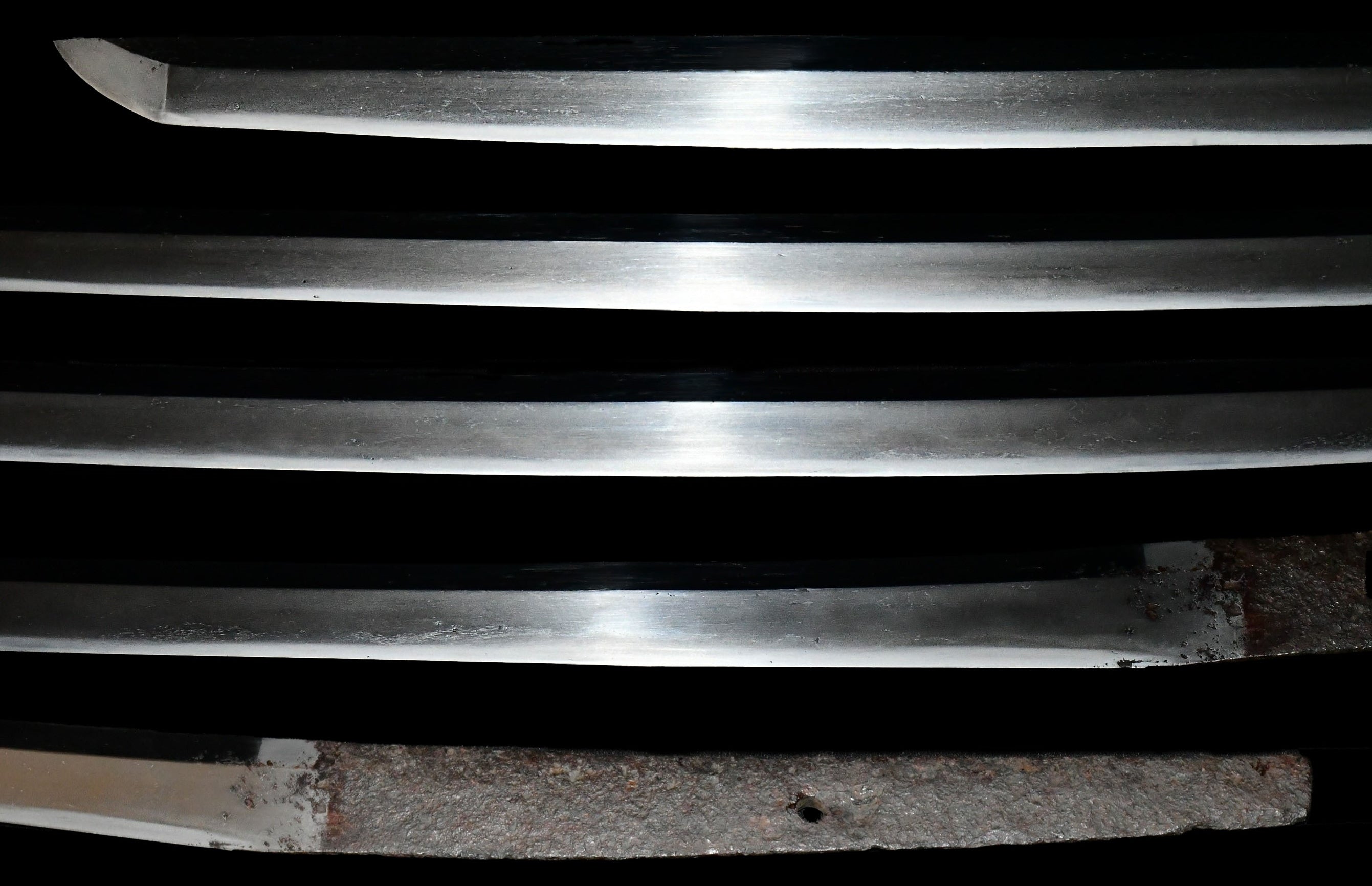
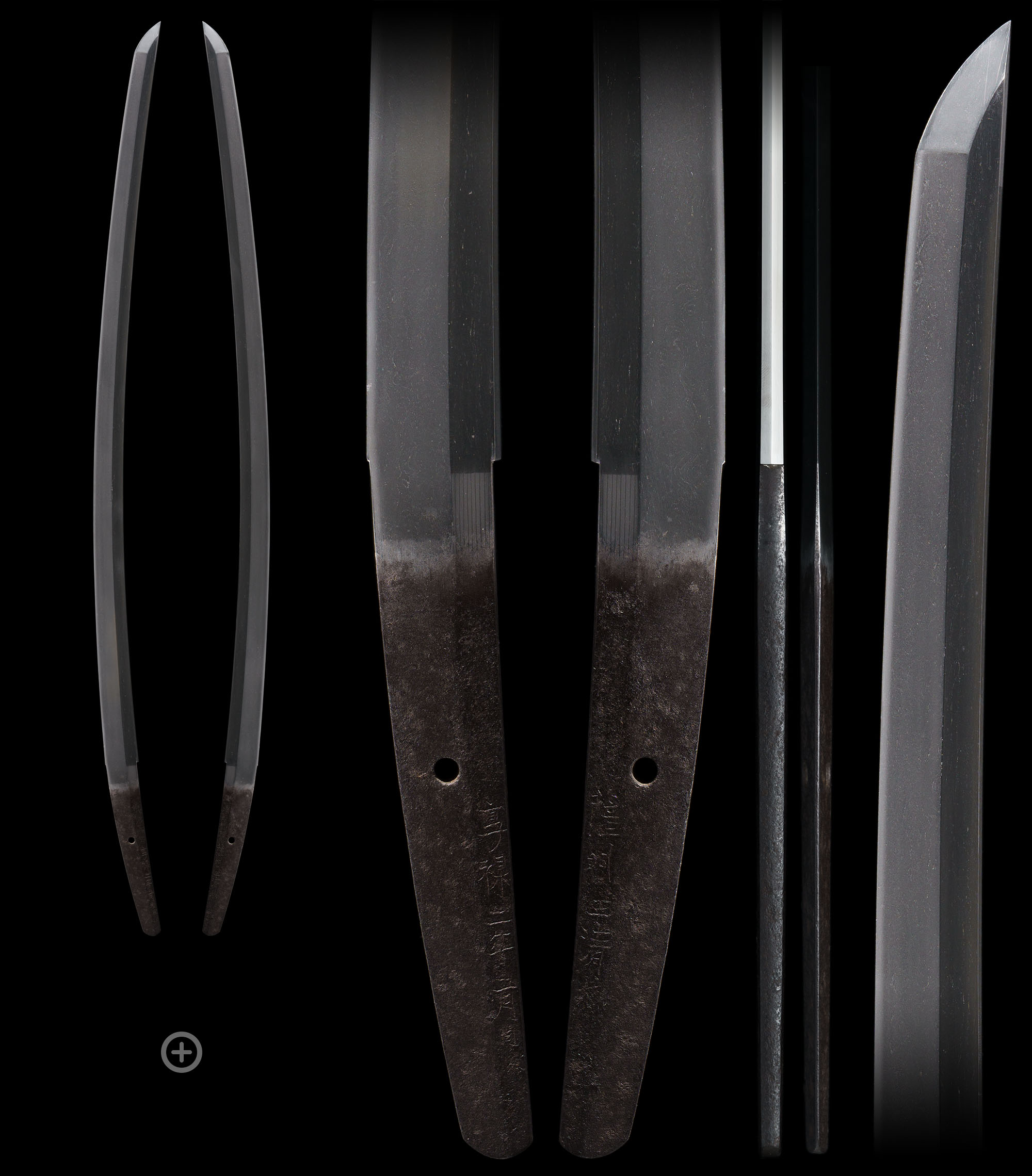
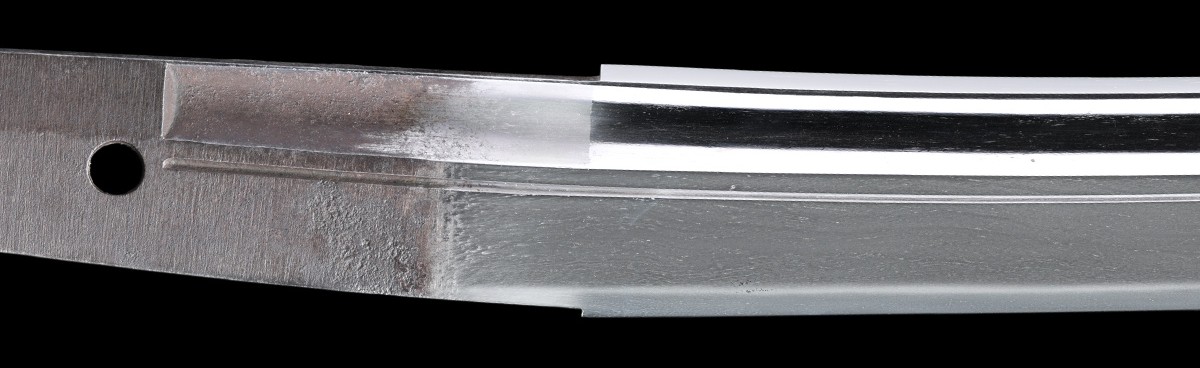
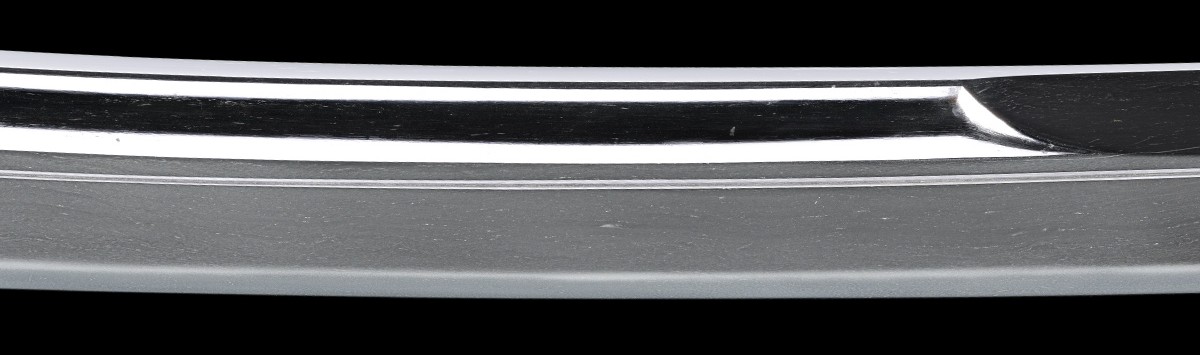
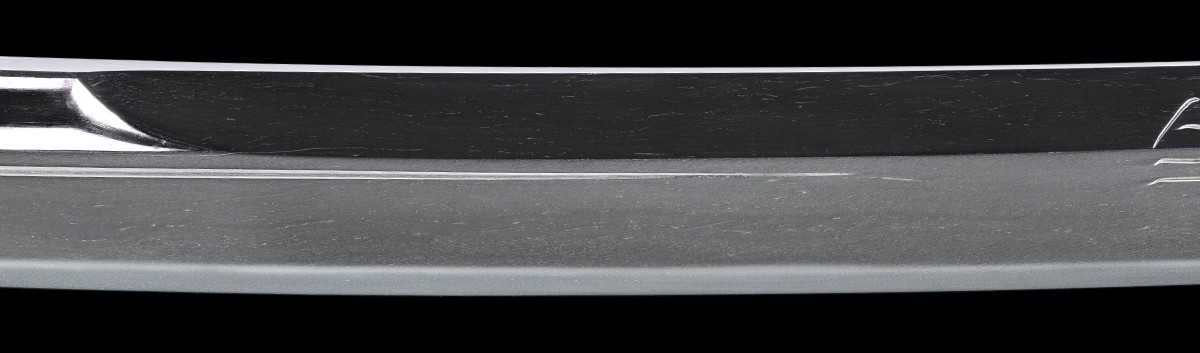
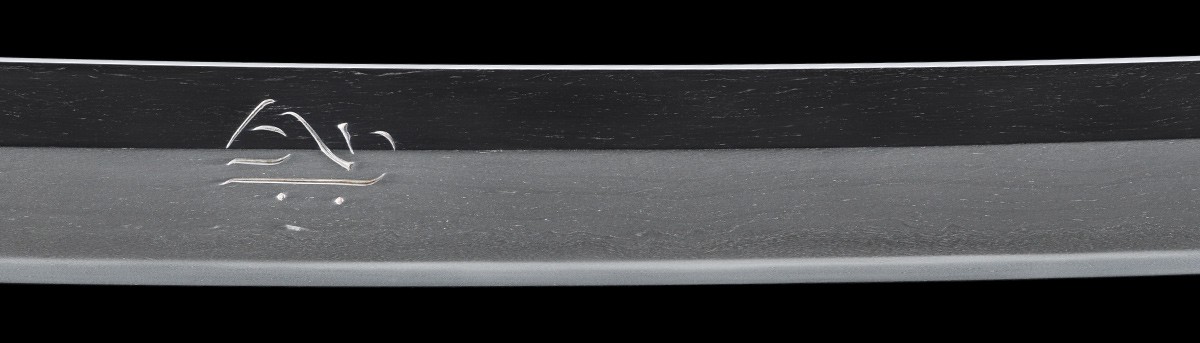
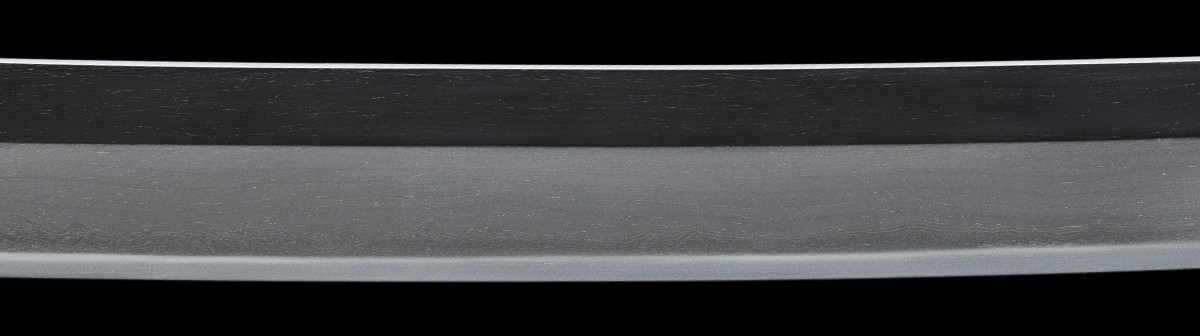
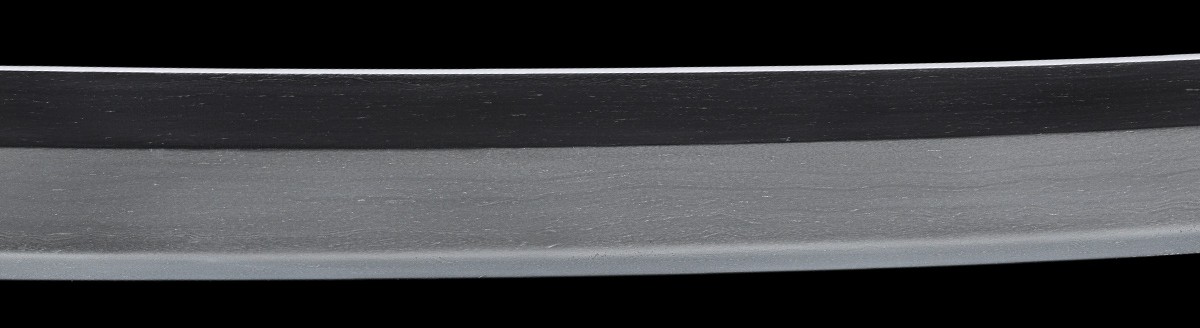
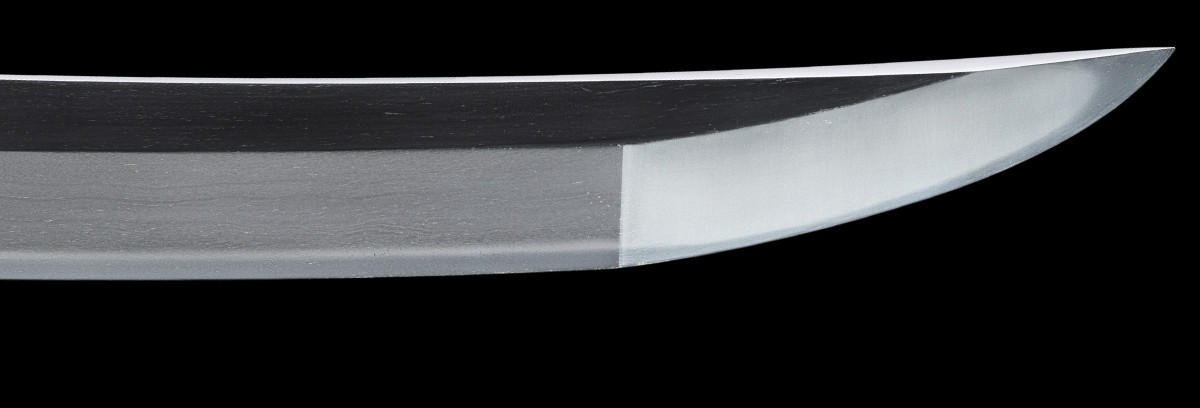
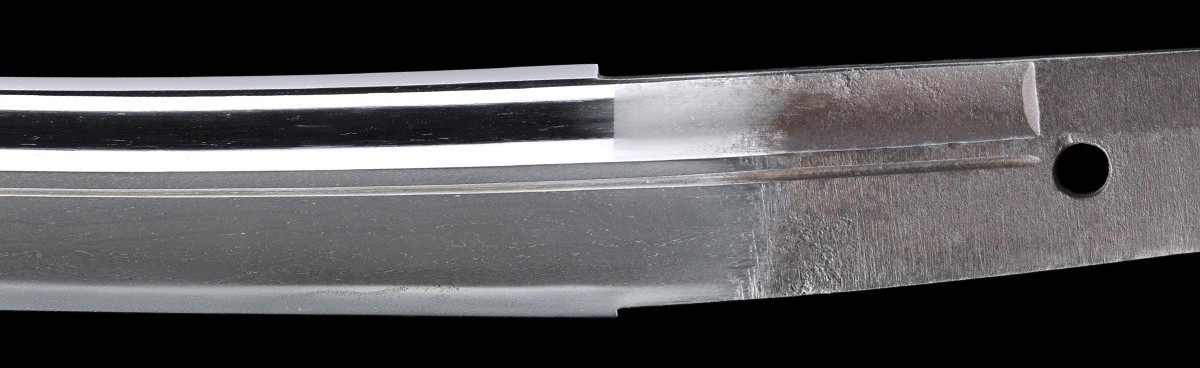
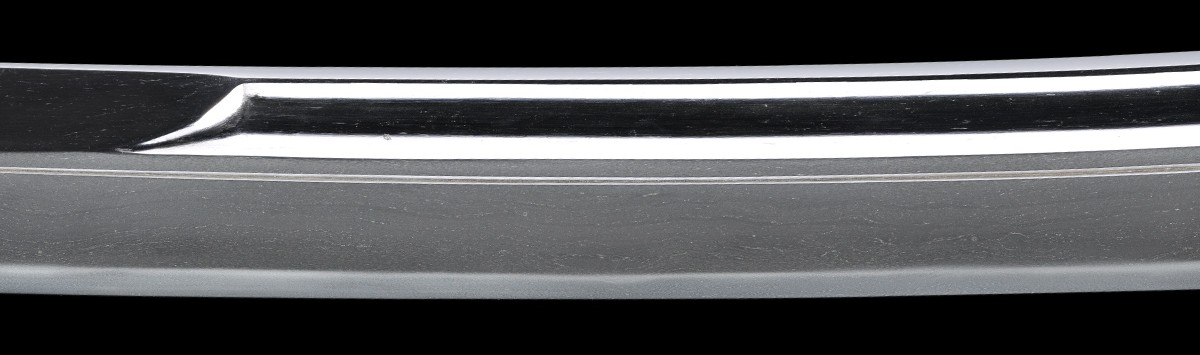
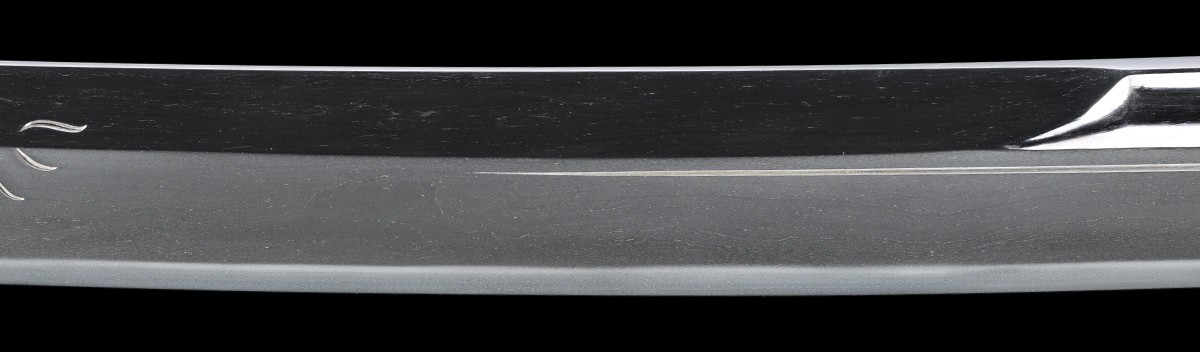
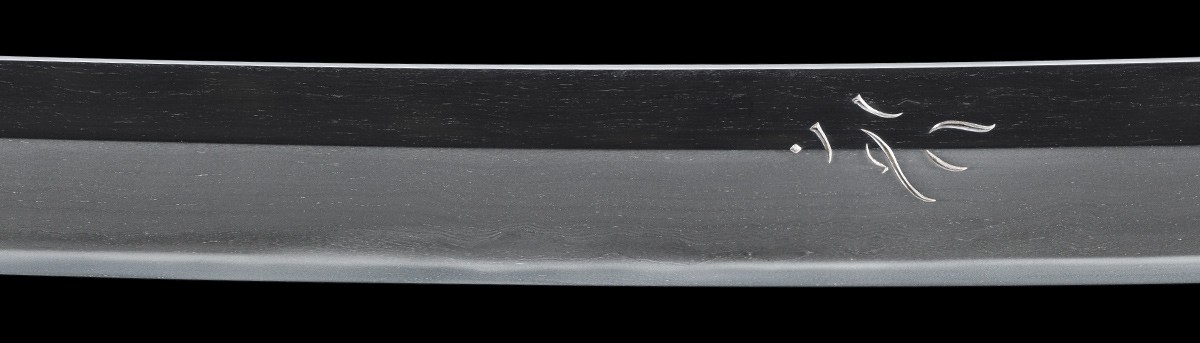
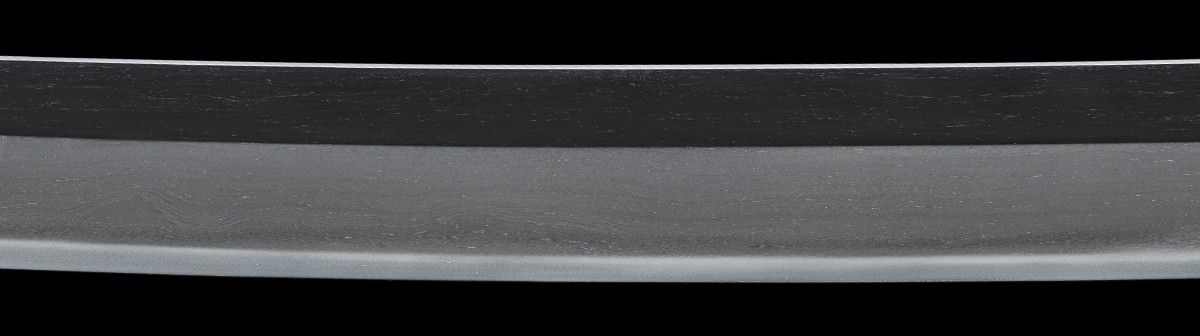
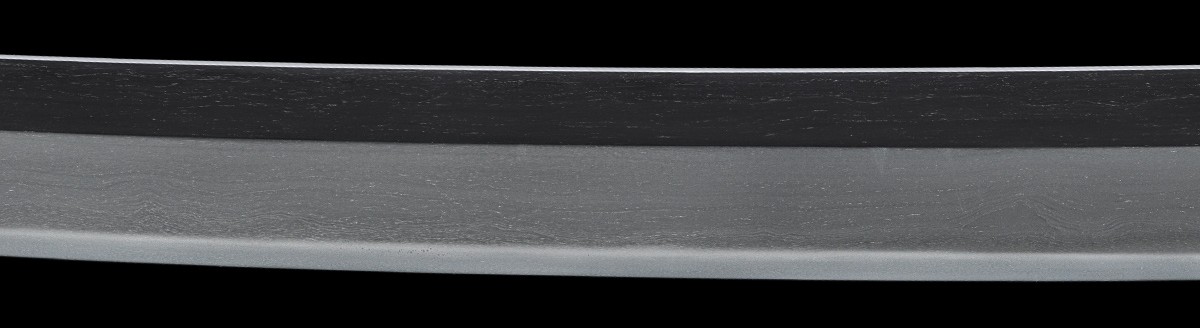
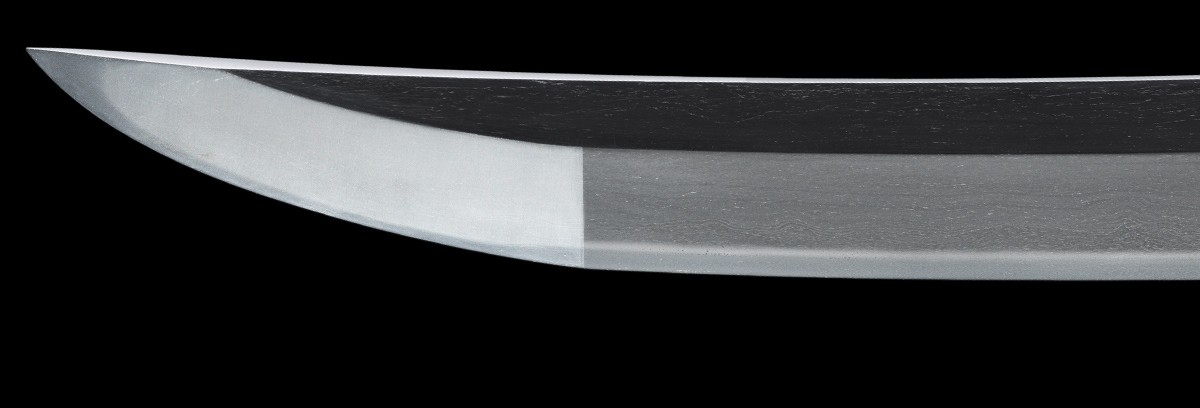
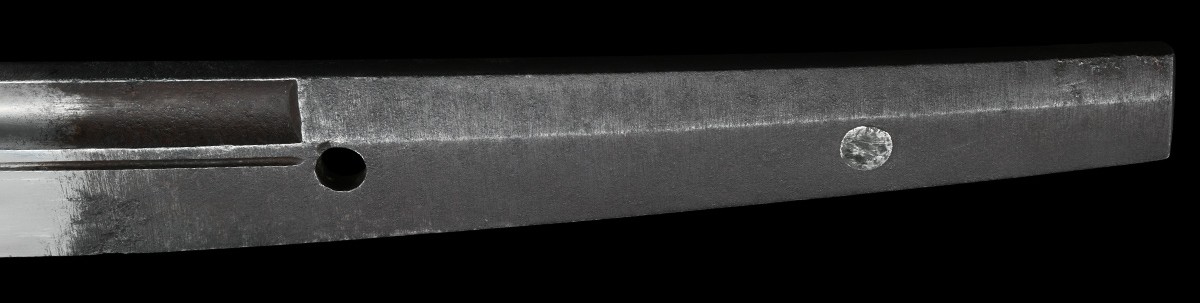
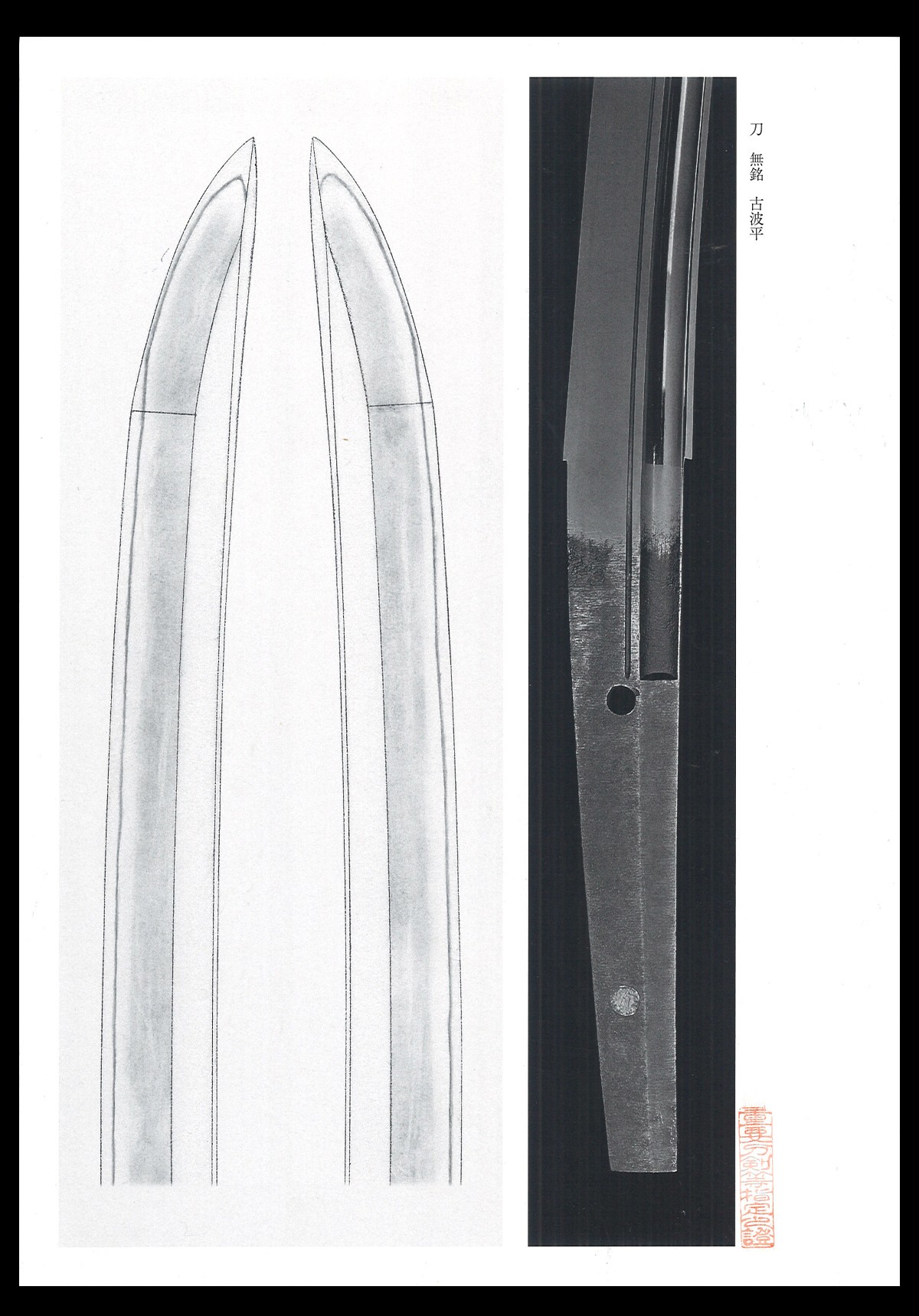
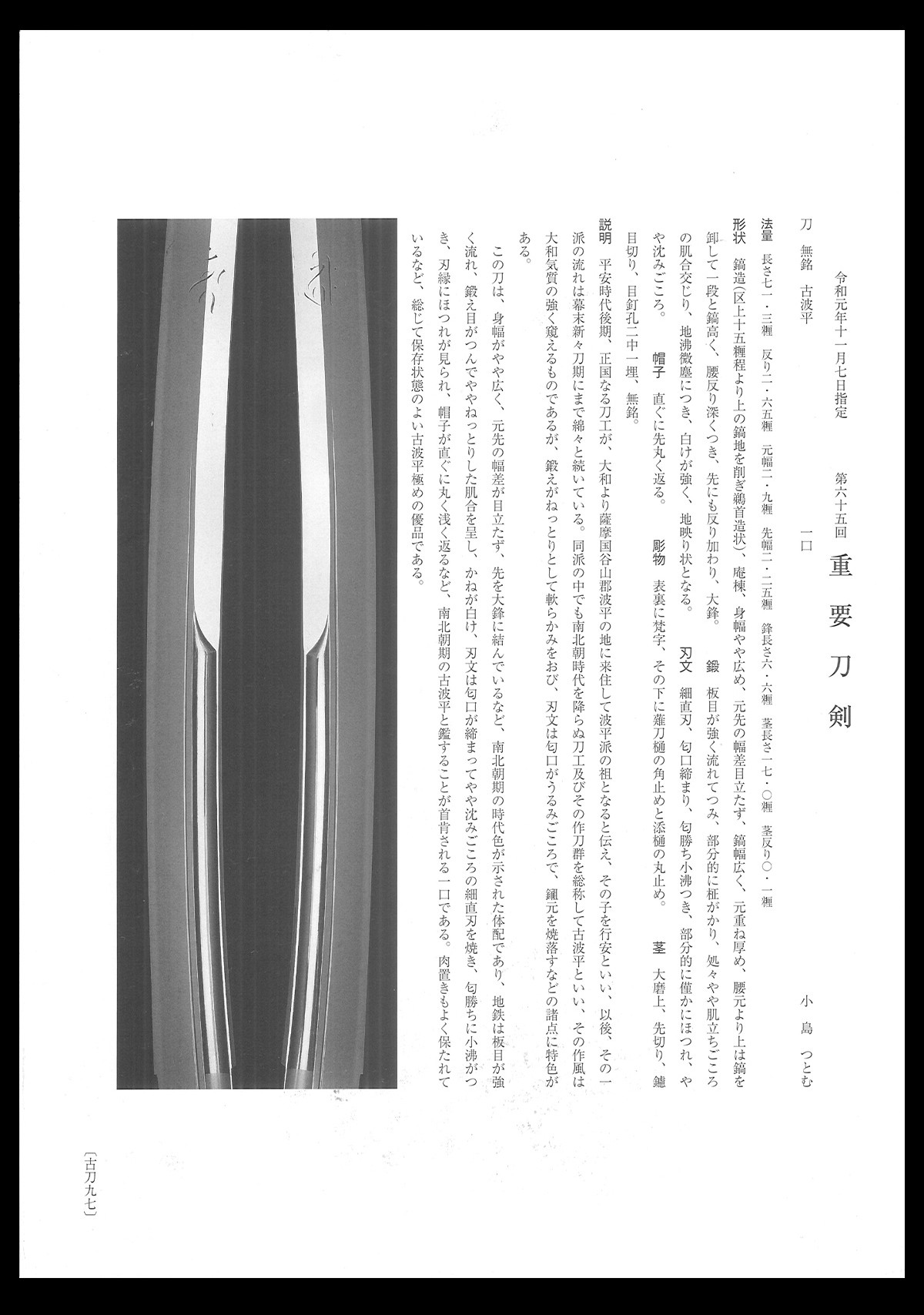
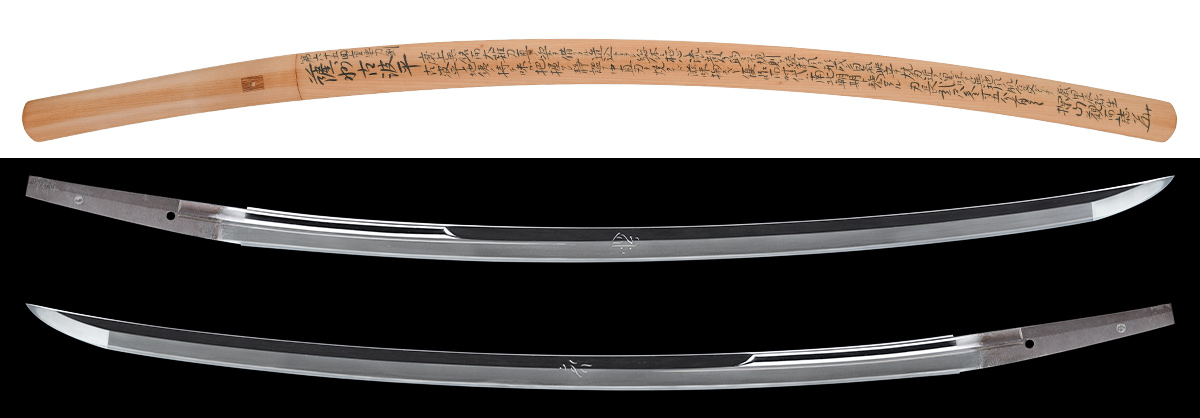
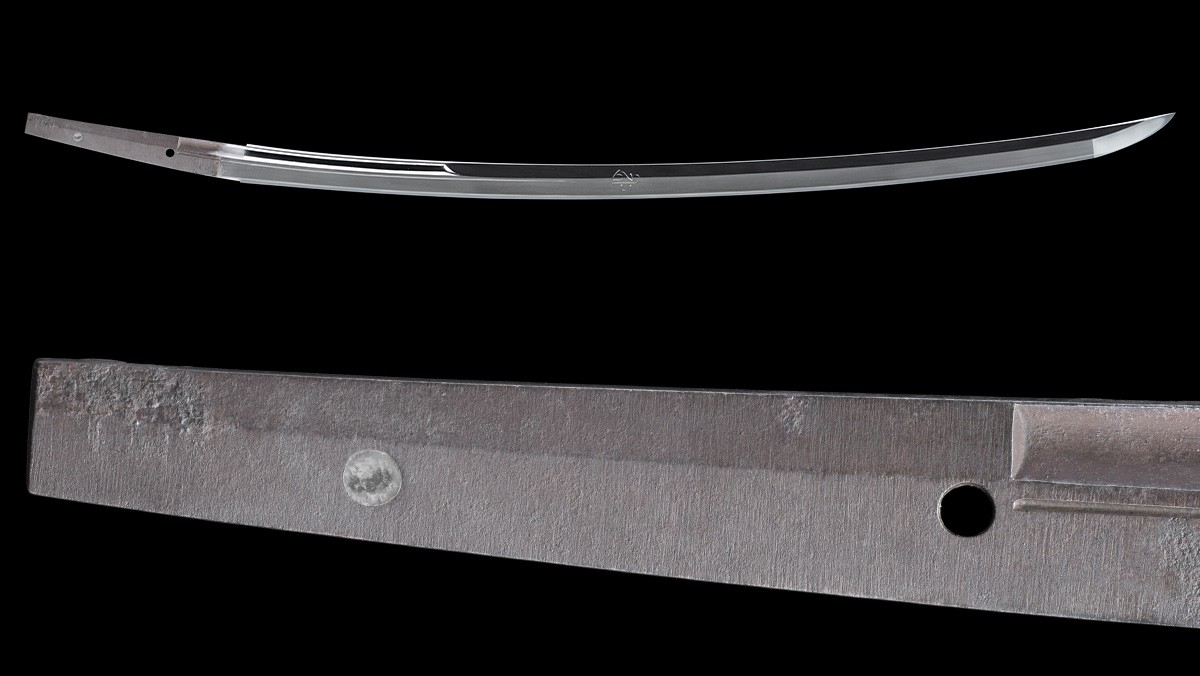
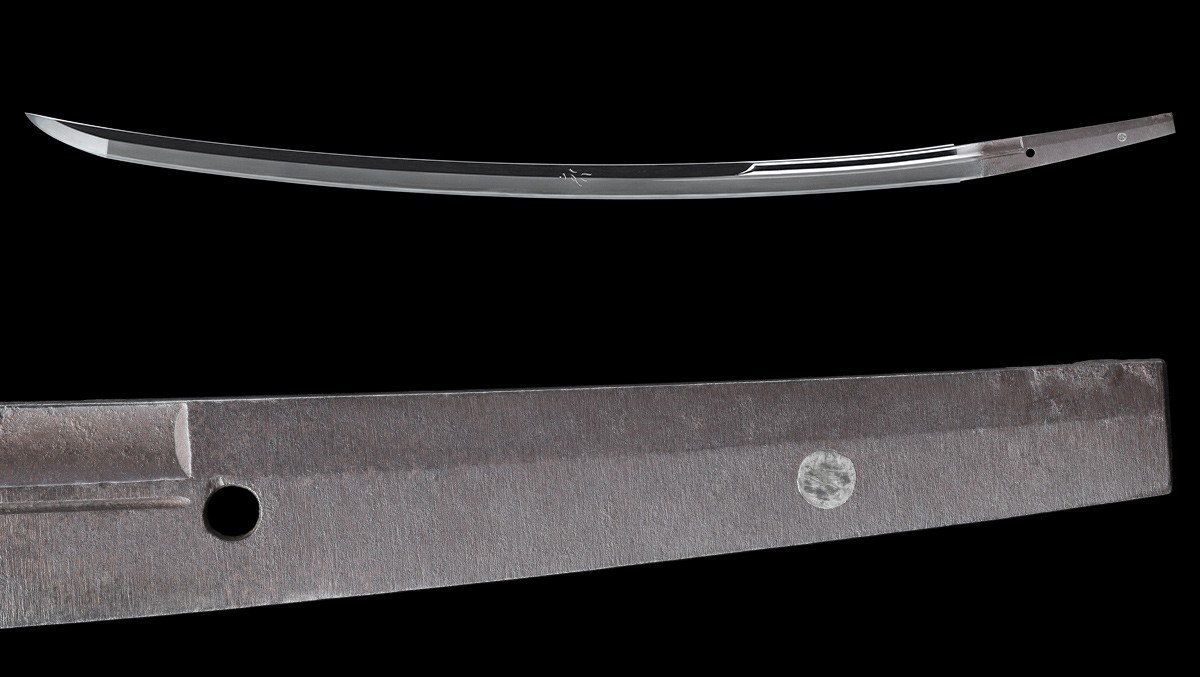
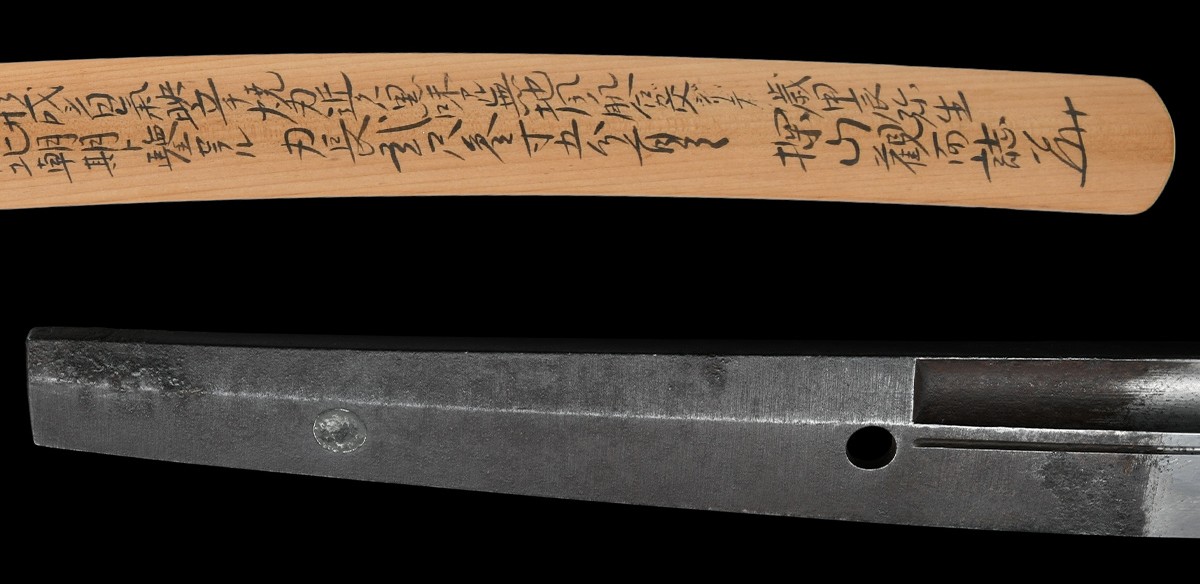
Description Keijō: (from about 15 cm above the the is cut down, giving an -like appearance), ; somewhat wide; little difference between base and tip width; wide ; thick ; from the lower section upward the is lowered and the stands correspondingly higher; deep with additional curvature toward the tip; . : Strong flows markedly and forges in a compact manner; partly tending to ; in places a slightly -inclined texture is mixed in; extremely fine adheres; a strong whitish tone appears, becoming an -like effect in the ground. : Fine ; the is tight; -dominant with ; in places slight ; with a slight tendency toward (subdued) in the . : Straight, turning back in a round form. : on both sides; below, a with and an accompanying with . : Greatly shortened (); tip cut ; file marks ; two , one plugged; unsigned.
Artisan Ko-Naminohira
Era period
Explanation Tradition holds that in the late period a smith named Masakuni came from Yamato and settled at Naminohira in Taniyama District, Satsuma Province, thereby becoming the founder of the Naminohira line. His son is said to have been Yukiyasu, and thereafter the lineage continued unbroken down to the late era. Within this group, the collective designation “Ko-Naminohira” refers broadly to the smiths and their works dating no later than the period. Their workmanship reveals a strongly Yamato-influenced character; however, the forging tends to have a dense, slightly soft and “sticky” feel, and the temper often shows a with an -inclined (moist/soft) character, together with distinctive points such as at the base.
This blade has a somewhat wide build, shows little taper from base to tip, and closes in an —features that clearly present the period character of the era. The shows strongly flowing with a compactly forged, slightly tenacious texture, and the steel takes on a whitish cast; the is a fine with a tight and a slight -tendency, with in -dominant fashion, while appears along the edge. The runs straight and turns back shallowly and round. Taken together, these points make the appraisal as -period Ko-Naminohira entirely convincing. Moreover, the blade’s (flesh) is well preserved; overall, it is a fine, well-preserved example worthy of a Ko-Naminohira attribution.
[ 97]