 NihontoWatchNihontoWatch
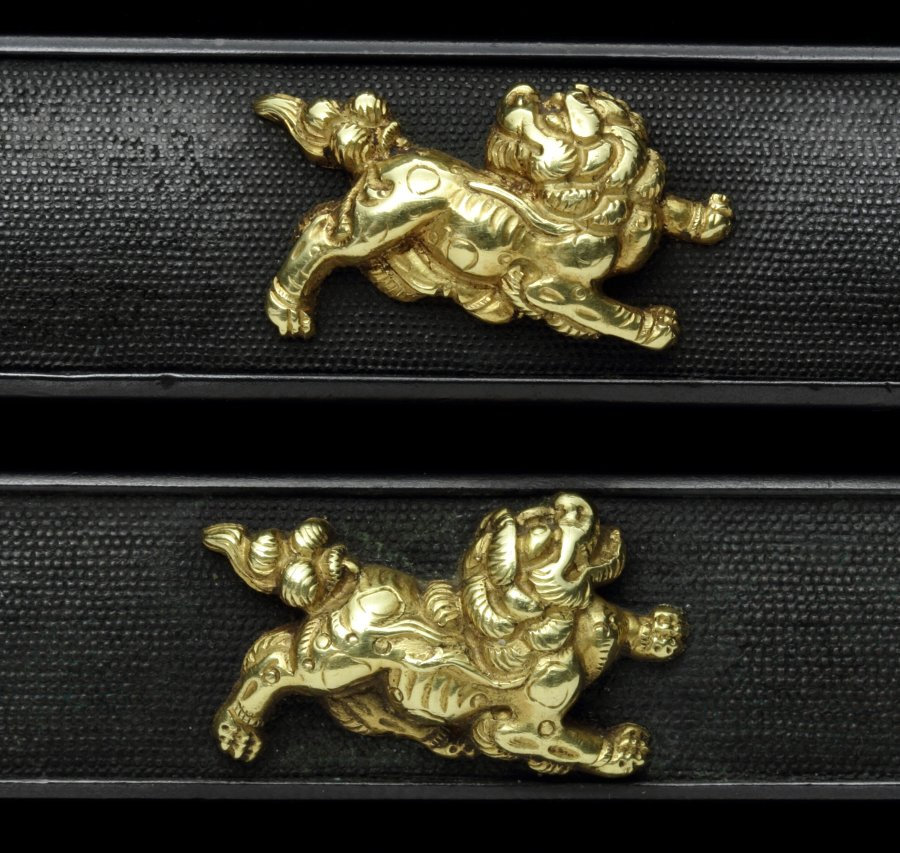
金一疋獅子据紋の彫が見事なのは言うまでもないことだが、仕立が実に洒落ているのである。耳かきと蕨手の周囲のみに金色絵を施した笄、初めから袖小柄の造り込みとした小柄、いずれも赤銅地と金のバランスが絶妙。阿吽の吉相を表す金一疋獅子は、拵に装着した時、互いに目線をかわすように配置され、紋高く引き締まった造形で、大きすぎず、小さすぎず、全体と調和して、後藤家の品格、洗練を表している。悦乗は、後藤宗家九代程乗の次男で、加賀前田家から百五十石を支給され、演乗と隔年で金沢へ赴き、加州金工の発展に尽力した。後年は江戸下谷に屋敷を賜り、徳川幕府の用達も行った。悦乗の正真作は世に稀なものである。
NihontoWatchOffered by Choshuya
This piece has sold
Get an email when a new Goto Etsujo piece hits the market.
Goto Etsujo
Edo
Yamashiro
Signed
Hozon (NBTHK)
As written by the shop
Iebori · Kaga / Edo
2 pieces on the market now
Goto Etsujo Mitsukuni was the second son of Teijo, ninth head of the main Goto house, and succeeded as the third master of the Rihei house, the branch line that anchored the Goto tradition in Kaga Province. Born in Kyoto in Kan'ei 19 (1642), he received a stipend of 150 koku from the Maeda of Kaga and alternated yearly with Enjo of the Kanbei house in residence at Kanazawa, where he entered the service of the Maeda, trained many disciples, and devoted himself to the development of Kaga metalwork. In his later years he was granted a residence in Shitaya, Edo, and together with the main house served the Tokugawa shogunate. He died in Hoei 5 (1708) at the age of sixty-seven.
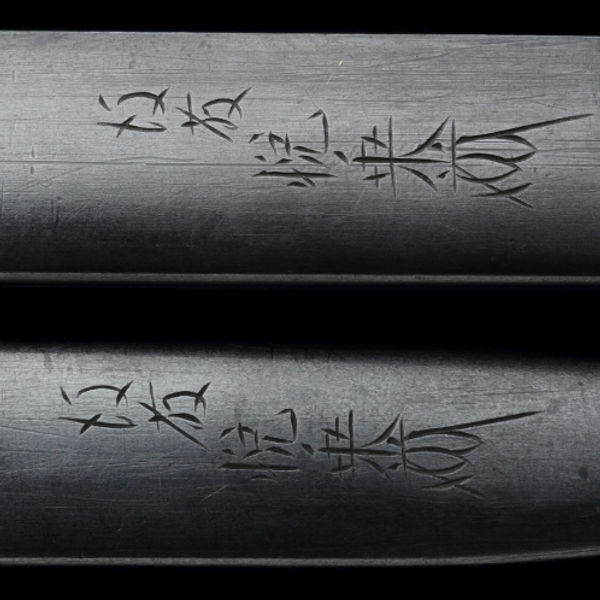
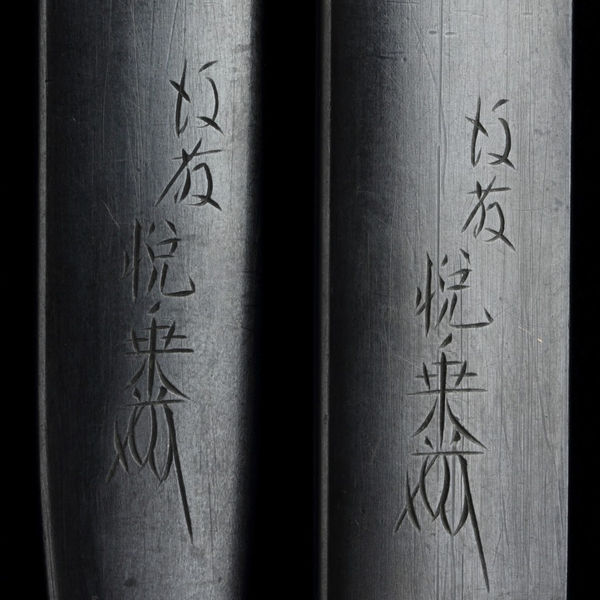
Etsujo's manner of work adheres entirely to the orthodox Goto house style, the o-ie-ryu, and his skill is described as in no way inferior to that of his father Teijo. He worked principally in shakudo nanako-ji enriched by high-relief carving (sukidashi takabori) and gold iroe, as well as gold suemon-zogan and solid gold nikubori. His handling of nikuoki closely matches that of Teijo. Even in boldly scaled compositions his meticulous chiselwork is alive in the smallest details, and gold crests stand out brilliantly against the ground. He signed both "Goto Mitsukuni" and "Goto Etsujo," each accompanied by kao; signed mitokoromono bearing his name are noted as extremely few.
The NBTHK has recognized Etsujo's finest work as both a model example of the artist's output and an outstanding peak achievement, while his contributions to the flourishing of Kaga metalwork are consistently acknowledged. His scabbard lacquer ensembles display refinement and dignity, and his signed pieces are praised for their high documentary value, providing valuable material for the study of the Goto family. Etsujo stands as a pivotal figure in the transmission of the mainline Goto aesthetic into the provincial workshops of Kaga.
Where Etsujo stands among comparable artisans: across all of nihontō, and within tradition, era, and period. The tiers (Foremost · Leading · Major · Notable) weigh official designations from the NBTHK and Japan's Agency for Cultural Affairs, together with historical honors of lasting repute such as the Sansaku and Meibutsu-chō.
Select a lens to see how it's measured.
Iebori · Kaga
16 pieces on the market now
The Kaga Goto (加賀後藤) school arose when the Maeda lords of Kaga Province drew masters of the Goto house from Kyoto into their direct service. The founding figure was Goto Kakujo Mitsunobu (覚乗光信), born in Kyoto in Tensho 17 (1589) as the second son of Chojo. By the directive of Tokugawa Ieyasu, the Goto family's closely guarded techniques, transmitted as an exclusive isshi soden (一子相伝) lineage, were conferred in full upon Kakujo of the Kanbei house, although it was not the main line. Retained by the Maeda at the extraordinary stipend of 150 koku, he was held in particular favour by Lord Maeda Toshitsune. The school's second principal figure was Goto Etsujo Mitsukuni (悦乗光邦), second son of Teijo, who strengthened the Rihei branch. Together with Enjo (演乗) of the Kanbei house, Etsujo alternated yearly between Kyoto and Kanazawa, training many disciples and devoting himself to the development of Kaga metalwork. The designated corpus reveals a body of work executed entirely in the orthodox Goto house manner (o-ie-ryu).
The prevailing ground is shakudo nanako-ji[[c:1]], upon which designs are rendered in takabori with gold iroe (金色絵) and, in polychrome compositions, gold, silver, and shakudo suemon. Gold nanako-ji grounds also appear, as in Kakujo's Kurikara futokoro-mono set upon a gold plate with polychrome accents. " In complete ito-maki tachi koshirae ensembles, the full suite of fittings is worked in shakudo nanako-ji scattered with the family crest in gold sukidashi takabori with kin-iroe, yielding mountings of courtly splendour. " The setsumei attest to the Kaga Goto's significance within the broader Goto tradition. Etsujo's workmanship adheres "exclusively to the orthodox Goto house style," with skill "in no way inferior to that of his father Teijo," and the construction and nikuoki of Mitsukuni's signed mitokoromono match Teijo's own work. " Their rarity, combined with the exceptional technical standard the corpus documents, underscores the Kaga Goto school's place within the Goto legacy and the Edo-period tosogu canon. Learn more →
Certifies a genuine fitting worth preserving: a correct signature, or, if unsigned, an identifiable era and school, with recognized artistic and craft value.
The NBTHK (Nihon Bijutsu Tōken Hozon Kyōkai, the Society for the Preservation of Japanese Art Swords) is a public-interest incorporated foundation founded in 1948 and supervised by Japan’s Agency for Cultural Affairs (Bunkachō); it is based at the Japanese Sword Museum in Tokyo. Its expert panels physically examine each submitted work (shinsa) and issue a certificate (kanteishō) ranking it by artistic and historical merit. NBTHK papers are the most widely recognized standard of authentication for Japanese swords and fittings.
NBTHK official siteIf, due to our fault, the item differs significantly from its proper condition, the item may be returned. Cooling-off is within one week of the item's arrival.