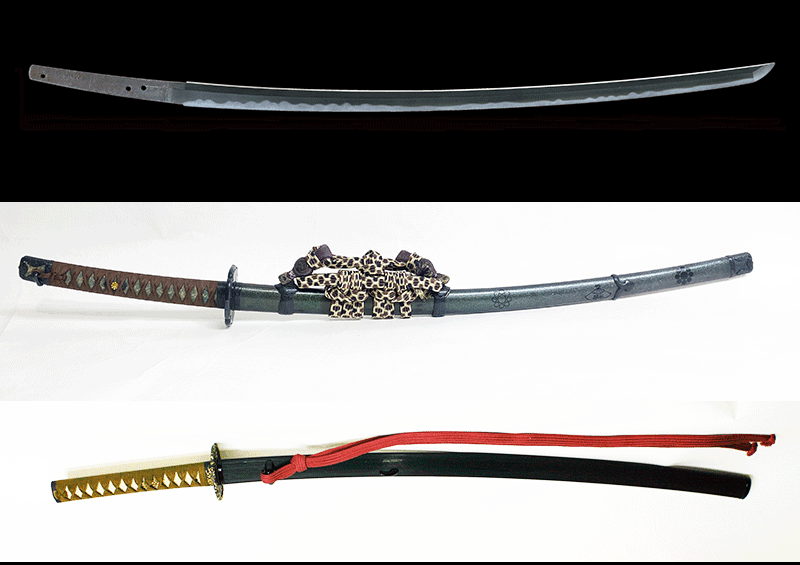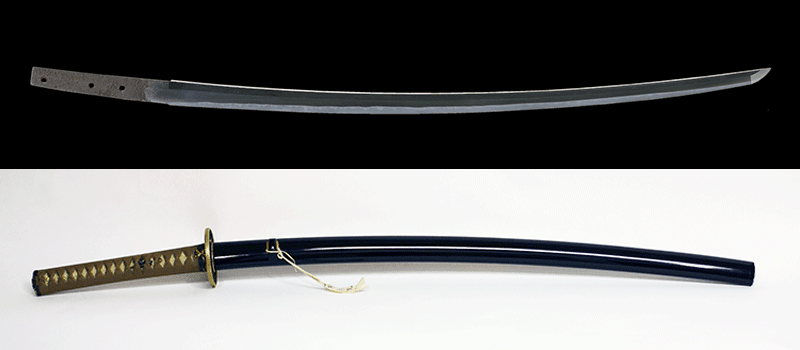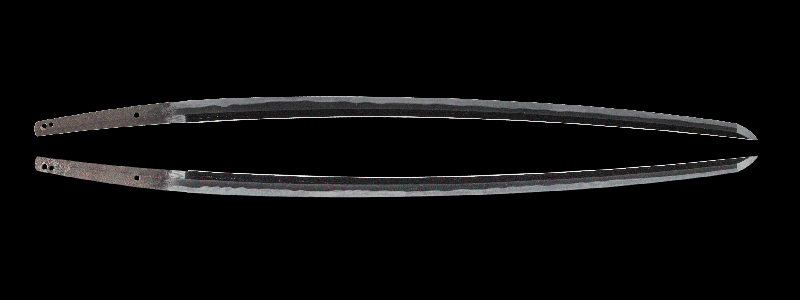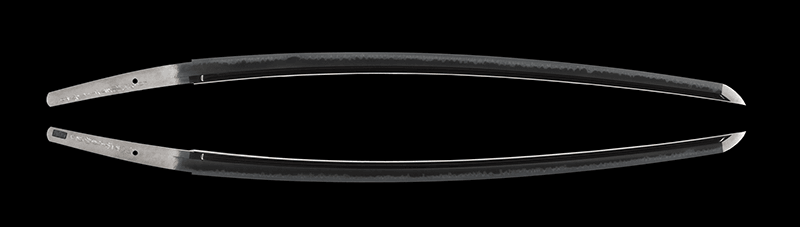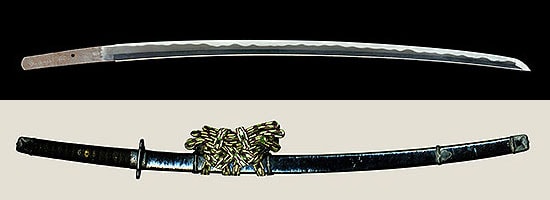
宇多国久
SOLD
Tracked across 81 dealers worldwide · price history · sold archive
Specifications
62.8 cm
1.6 cm
2.7 cm
1.7 cm
About the maker
Uda Kunihisa國久
Uda Kunihisa is the Ōei-era hand of the Etchū Uda school, the line the reference registers carry from Ko-Nyūdō Kunimitsu, the monk-smith who migrated from Uda District in Yamato to Etchū at the close of the Kamakura period and whose name flourished into the late Muromachi. The *Meikan* records Kunihisa as the son of Kunifusa, in another reading the son of Kunimune, gives him the studio name Uemon Saburō, and dates the first generation to Ōei, the same name then continuing for several generations through the Hōtoku and Bunmei eras toward the end of Muromachi. Of that long line he is the one hand the published sources treat as typical of the school and read against its founder. His work survives signed, a thing rare among Uda smiths, and the body of it is the long early-Muromachi *tantō*, broad for its length and with little or no curvature, that the school favored over the *tachi* and *uchigatana* it seldom made, joined by a few *wakizashi*, a *tachi*, and even a great spear. One of his blades carries a date of Ōei 7, which the judges hold to predate even the recorded examples of the line, calling it the earliest of all and "a valuable document, and besides of fine make" (資料的にも貴重であり、かつ出来が優れている). Kunihisa is read first off the steel, for his temper is the school idiom and it is the *jigane* that carries him. On the calmer blades he forges an *itame* that runs and stands, flowing slightly toward *masame*, the steel turning whitish so that a *shirake-utsuri* or a faint *bō-utsuri* stands in the *ji*, with *ji-nie* throughout. Over it he tempers a *chū-suguha* or a *suguha*-toned line, opening shallowly into *notare* with pointed *gunome* and *ko-gunome* mixed in, *ashi* entering, the *nioiguchi* drawn tight, *ko-nie* well adhered, and along the *habuchi* the Yamato activity of *kuichigai-ba* and *hotsure* that names the school's old province. The published sources call exactly this combination, a whitish standing *itame* under a tight *chū-suguha*, the very type of the Uda hand, and on one signed *tantō* of just this make they write that "this is precisely that type, and the make is good" (まさにその典型であり、出来がよい). Through the *ha* run *sunagashi*, which lie on nearly every surviving blade, and *kinsuji* through most, the *nie-deki* activity that holds steady whether the temper is calm or roused. The second manner the sources draw from him is the Sōshū-leaning one, which they trace to Kunifusa's study under Etchū Norishige, granting that much Uda work of this period calls the Sōshū tradition to mind while holding that none is of pure Sōshū construction. On the dated Ōei 7 *tantō* the *jigane* is an *itame* with *moku* and *chikei* entering, the temper a shallow *notare* mixed with *gunome*, *ko-nie* applied and *kinsuji* running, and the judges read it plainly as Sōshū-leaning. In this register the body broadens, the *nie* thickens and grows at times coarse, *yubashiri*, *kinsuji* and *sunagashi* run more freely, and on the finest blades a round, luminous *nie* scatters through the *yakiba*. The *bōshi* turns *midare-komi*, the tip pointed or pushed up, the turnback long and at times deep. A nie-laden Kunihisa blade reads as Sōshū at first glance, and the published sources return it to Uda by the steel, the dark, whitish *jigane* and the *nioiguchi* that holds rather than glows. Beyond the school formulas the sources name what is Kunihisa's own, and it is a quality of *jigane* rather than a new shape. His finest *tantō* and *wakizashi* are a *ko-itame* so well forged and compacted that the steel turns refined and bright, *ji-nie* laid on densely and at times dust-fine as *ji-nie mijin*, a *jigane* darkish and whitish with a faint *utsuri*. Through the *yakiba* runs the round, luminous *nie* the school calls its own, the *ha* and *ji* alike clear, and on one such blade the judges find "in the well-forged, refined surface, Kunihisa's individuality can be seen" (国久の個性が着て取れる), naming the same piece "an outstanding work among the finest" (屈指の優品である). The Uda *jigane*, they note in passing, runs to two kinds, one that stands and one that compacts and gathers abundant *ji-nie*; Kunihisa is read on the side that gathers and refines. His blades are otherwise plain in their fittings, a *bō-hi* or *koshi-hi* run out on the spear and the *tantō*, *gomabashi* and a *suken* carved on others, the carving kept simple beneath the working of the steel. What distinguishes Kunihisa within the late Uda line is the brightness of that refined steel, which the sources read toward Yamashiro rather than toward his own school's duller hands. On a *tachi* whose construction stands high in the *shinogi* and runs to a *ko-gunome midare* with *hotsure* and *sunagashi* and a *yakizume bōshi*, they call the manner Yamato in temperament and "a work showing the characteristics of Uda" (宇多物の特色を示した一口である). On his best *wakizashi* and *tantō*, where the *ko-itame* tightens and the bright round *nie* gathers, they go further, writing that the blade "calls Rai Kunimitsu and Kunitsugu to mind at a glance, a fine work of Kunihisa" (一見来国光・国次らを髣髴とさせる、国久の秀作である), and of another that it is "of a make all but mistakable for Rai Kunimitsu or Kunitsugu" (来国光や国次に紛れんばかりの出来映え). His own *shirake-utsuri* and standing *itame* set him apart from the Yamashiro hands he approaches, and his refinement sets him apart from the plainer Uda smiths around him; the verdict in every case rests on the steel, not on the temper. For the collector Kunihisa is a soundly recorded provincial name rather than a famous one. He has no National Treasures and no Important Cultural Properties; his record runs entirely through the Juyo rank, where ten of his blades are held, the *Tōkō Taikan* rating him at four hundred and the *Fujishiro* registers placing him at *chū-jō saku*, a competent middle-upper hand. Of his blades whose present whereabouts are recorded, several rest with shrines and a museum, among them Yasukuni Jinja, the Kunōzan Tōshōgū and the Suiboku Museum, the kind of long, settled holding that keeps most designated work off the market. With ten Juyo blades on record and most of them held rather than traded, a signed Uda Kunihisa comes to a private collector only from time to time, and with patience; when one does, it is a clear window onto how the northern Uda forged at its Ōei height, the moment the school's steel ran bright enough to be taken, for an instant, for Rai.