Gassan Sadakazu (1836-1918) was the defining swordsmith of the Meiji era and is widely regarded as one of the greatest sword makers in Japanese history. Adopted by Gassan Sadayoshi of Osaka, he mastered all five major traditions – Bizen, Sôshû, Yamashiro, Yamato and Omi – a feat unequalled by any other artist of his generation. In 1906, the Imperial Household appointed him a Teishitsu-gigei’in (Imperial Household Artisan), the highest honour bestowed upon a craftsman in Meiji Japan. This katana, dated to January 1915, was forged when Sadakazu was 80 years old – placing it among the last swords ever to leave his hands, and making it an extraordinary document of his lifelong mastery.
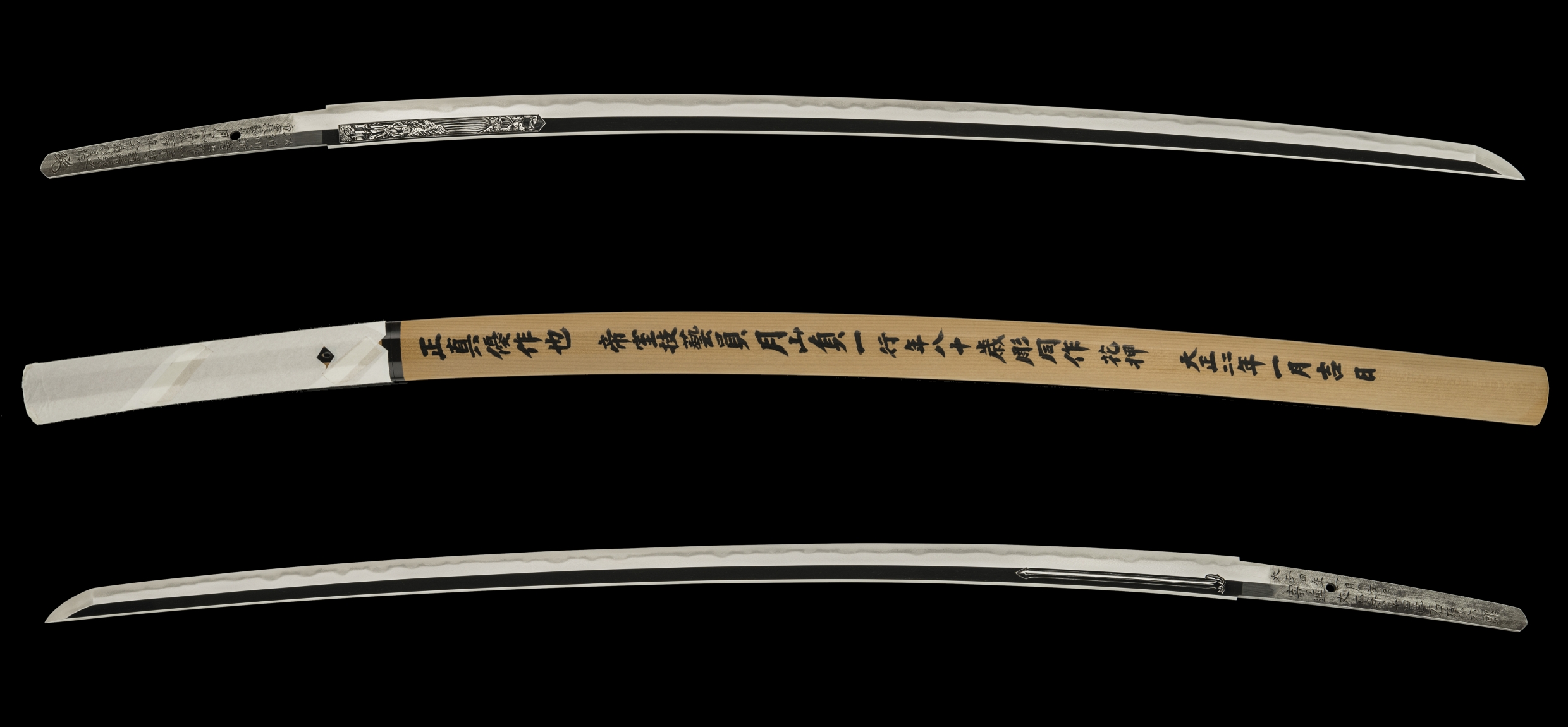
Forged in respectful emulation of Gorô Masamune Den – the Sôshû tradition founded by Japan’s most celebrated swordsmith – the blade carries every hallmark of that supreme lineage. The jihada is a dense ko-itame rich with ji-nie and magnificent swirling chikei, the dark lines flowing seamlessly from the body into the yakiba where they transform into glittering kinsuji. The hamon is an exuberant gunome-midare in nie-deki, alive with ashi, brushed sunagashi, and long kinsuji running close to the temper line. The boshi is hakikake – sweeping – and the overall impression is one of barely-contained energy held in perfect control. The horimono, carved entirely by Sadakazu himself (hori dôsaku), seals the work: on the omote, Taki-Fudô – the fierce Buddhist guardian Fudô Myô-ô standing amid waterfalls – carved in extraordinary relief; on the ura, the guardian suken with tsume (dragon claw), reinforcing the spiritual power of the composition.
The sword was commissioned by Ishihara Rokurô (1873-1932), the 14th chief of the Ishihara clan and one of the most prominent philanthropists in Tokushima Prefecture, in commemoration of the enthronement of Emperor Taishô. It was donated to Jôrokuji, the oldest and most prestigious Zen temple in Tokushima, founded in 650 AD, in prayer for happiness, prosperity and peace. The sayagaki by Gassan Sadatoshi, great-grandson of Sadakazu and current head of the Gassan family, declares the blade shôshin yûsaku nari – a genuine masterpiece. This is a once-in-a-lifetime piece: a late, dated, signed work by Japan’s greatest Meiji swordsmith, with a documented commission history, temple provenance, and family authentication.


 NihontoWatch