Muromachi turned sword making into an industry: the uchigatana rose with massed infantry warfare, Osafune and Seki produced bundle swords beside custom orders, and the Ming trade carried Japanese blades abroad by the tens of thousands.
 NihontoWatchNihontoWatch
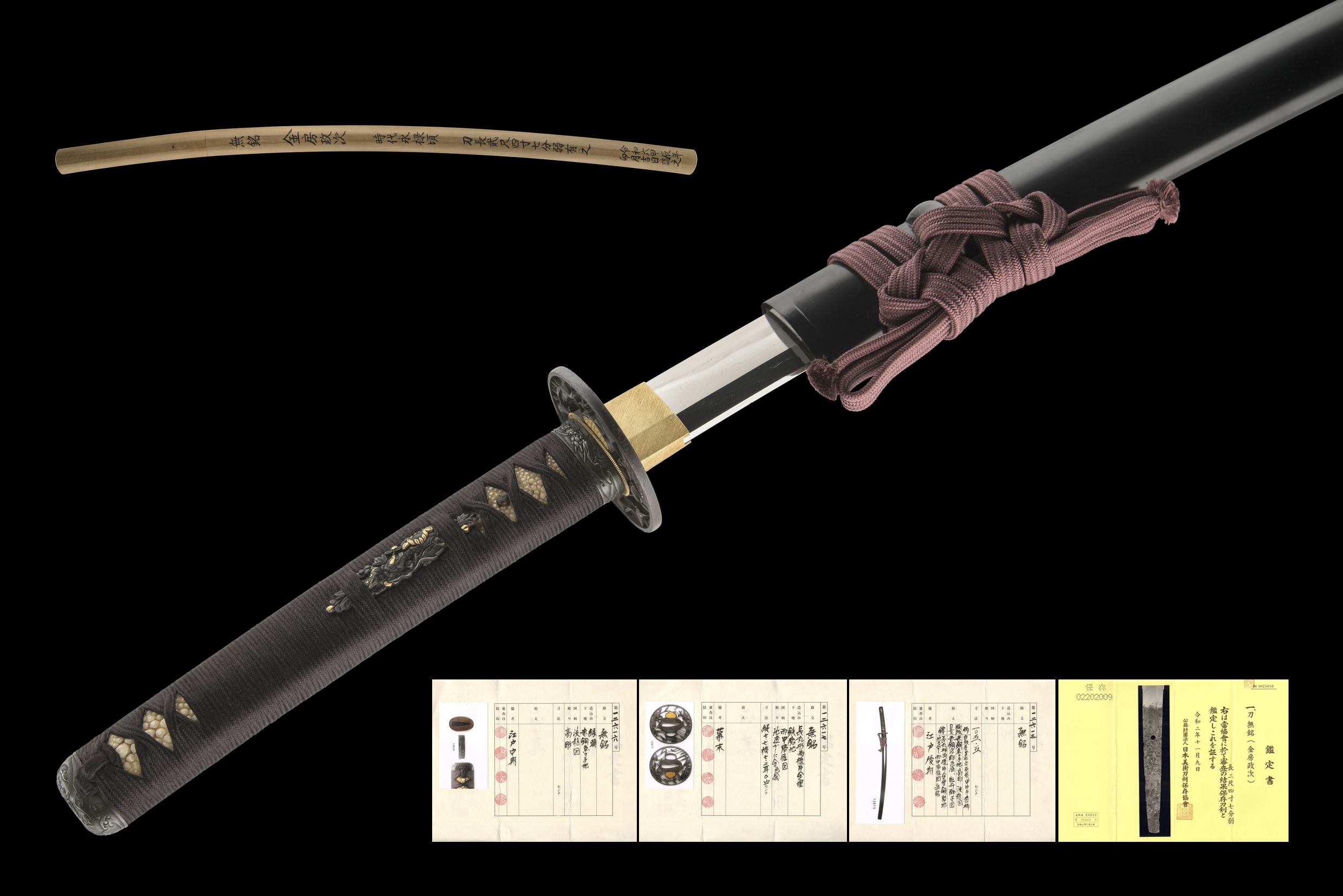
The Kanabô school is said to have begun producing swords in the Daiei era (1521-1528), with its roots in the Yamato Sue-Tegai tradition. Founding influences trace back to Shinya Masanaga and Fujiwara Masanaga, and the school’s leading smiths included Masashige, Masasada, Masakiyo and Masatsugu. The Kanabô smiths built a strong reputation as expert makers of spears, particularly the jumonji-yari, and their swords were equally valued by samurai warriors as dependable battle-tested blades. This long, powerful katana attributed to Kanabô Masatsugu is a textbook example of why Kanabô swords were prized on the battlefield. Strong and stout in shape, shallow in curvature, with a wide mihaba, thick kasane, and a massive ô-kissaki just shy of 10cm in length – this blade means business. The steel shows wonderful straight-grain masame-hada with pools of rounded mokume-hada and striking streams of sunagashi running throughout. The hamon is a wild mix of styles closest to Sue-Bizen and Mino in flavour, with characteristic spiking togari-ba peaks that reflect the turbulence of the late Muromachi period. The sword comes with a fine set of late Edo period koshirae centred on a splendid polished iron sukashi tsuba attributed to Sunagawa Masachika of Edo province, depicting a flock of geese flying in the rain with one hitsu-ana filled in gold with an exquisite floral design. The fuchi-kashira is a superb shakudô piece attributed to the Bizen Shôami school, featuring a dragon swimming in waves. Oversized menuki depict protective shishi lions enveloped with peonies – symbols of wealth, prosperity, and spiritual guardianship – wrapped in katate-maki so they can be fully appreciated. This is a sword that will stand tall in any nihonto collection.
Offered by Unique Japan
This piece has sold
9 on the market
Get an email when new Kanabo School work hits the market.
Wakimono · Yamato
9 pieces on the market now
The Kanabō (金房) smiths worked in Nanto, the old name for Nara in Yamato province, from the end of the Muromachi period into the early Shintō era. Their relationship to any of the five established Yamato schools is not clearly fixed in the record, and the NBTHK setsumei treat the group as one that rose and flourished in Nara during the late Muromachi decades, with dated examples encountered from the Eishō era onward. The blades here name several hands. Masatsugu (政次), who signed as Kanabō Hyōe no Jō Masatsugu and as Kanefusa Hyōe no Jō Masatsugu, is described as the representative and best-known smith of the line. Masasada (政定), signing Kanefusa Saemon-no-jō Masasada, left an uchigatana dated Eiroku 2 (1559). " Rather than the classical Yamato-den manner of the earlier five schools, the Kanabō hand reads as a Muromachi uchigatana idiom that shares points with the Sue-Bizen and Sue-Seki spheres. The kitae is itame that flows into nagare and tends toward masame, with the grain often standing and growing large, and a whitish utsuri appearing in places. The hamon divides between two registers the setsumei repeatedly cite: a large gunome-based midare, the "hips" of the gunome opening out and mixed at times with togari-ba, chōji, or ko-notare; and a suguha carried on a tight nioiguchi.
Across both, ashi and yō enter well and stand out, ko-nie and ji-nie adhere, and sunagashi with kinsuji run through; the nioiguchi frequently takes a shizumi, subdued cast. The bōshi runs midare-komi, often with hakikake and a pointed or ko-maru return. The build tends to broad mihaba with sakizori on the swords, while naginata are conspicuously common, a production read as answering the demands of the warrior monks (sōhei) of Kōfukuji and the great Nanto temples. For kantei, the line is held by the flowing masame-tending itame, the broad gunome-midare with prominent ashi and yō over a tight or subdued nioiguchi, and the marked presence of naginata and long polearm blades among extant work. The setsumei single out Masatsugu's polearms as typical of his hand, several preserved with their vermilion-lacquer nagamaki mounts (shunuri nagamaki koshirae) and one black-lacquer naginata mounting, the fittings inferred to have been made together with the blade. The records grant that true masterworks within the group are rare, yet they describe individual blades by Masatsugu and Masasada with fine jigane, skillfully cut horimono, and workmanship judged excellent and dignified. Within the wider Yamato sphere the Kanabō stand as a late, utilitarian offshoot whose polearms and serviceable swords carry the group's name into the NBTHK register. Learn more →
| Smith | Era | Designated |
|---|---|---|
| Masatsugu政次 | 1492-1570 | 4 |
| Masazane正眞 | 1532-1555 | 0 |
| Masasada政定 | 1521-1559 | 1 |
The Muromachi period (1392 to 1573)
Muromachi turned sword making into an industry: the uchigatana rose with massed infantry warfare, Osafune and Seki produced bundle swords beside custom orders, and the Ming trade carried Japanese blades abroad by the tens of thousands.
Certifies a genuine blade worth preserving: a signature confirmed correct, or, if unsigned, an era, province, and school that the NBTHK can reliably identify.
The NBTHK (Nihon Bijutsu Tōken Hozon Kyōkai, the Society for the Preservation of Japanese Art Swords) is a public-interest incorporated foundation founded in 1948 and supervised by Japan’s Agency for Cultural Affairs (Bunkachō); it is based at the Japanese Sword Museum in Tokyo. Its expert panels physically examine each submitted work (shinsa) and issue a certificate (kanteishō) ranking it by artistic and historical merit. NBTHK papers are the most widely recognized standard of authentication for Japanese swords and fittings.
NBTHK official siteAll swords come with a three-day inspection period beginning from the date of delivery. If not satisfied, the sword may be returned within this period for a full refund of the purchase price. Outside of this period, all sales are final. Swords purchased on a layaway payment plan are not eligible for the three-day inspection period.