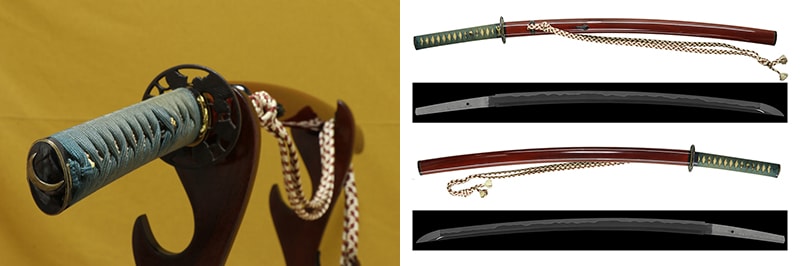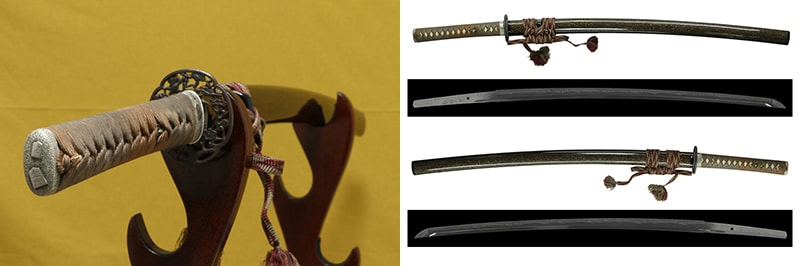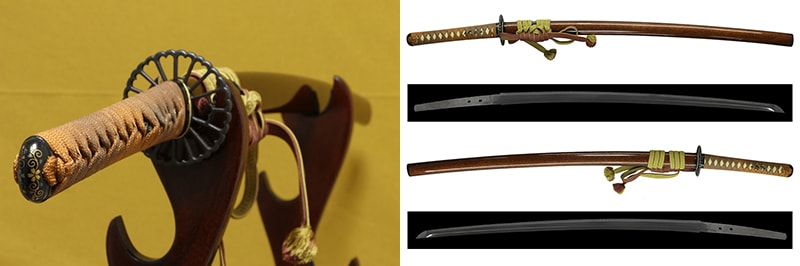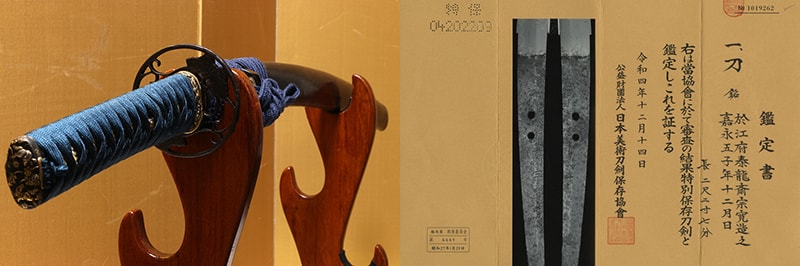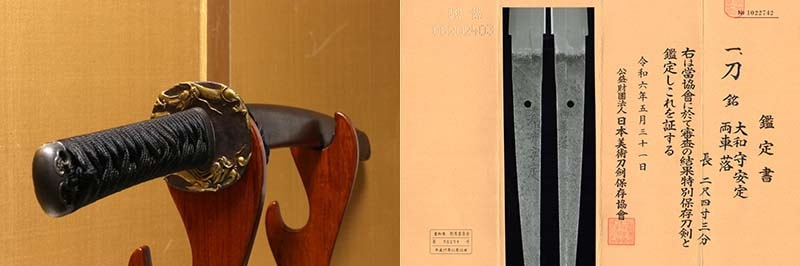
大和守安定 二尺四寸三分 打刀拵、白鞘付
SOLD
Tracked across 76 dealers worldwide · price history · sold archive
Enpo (1673-1681)
Specifications
76.3 cm
0.7 cm
3.23 cm
1.98 cm
About the maker
Ishido Yasusada安定
Yamato no Kami Yasusada is a Kanbun-shintō master of Edo, by common name Tomita, sometimes written Tobita, Sōbei, born in Genna 4 (1618) and at work from the Keian years into Enpō. A surviving katana inscribed as made at the age of fifty-three in Kanbun 10 fixes that birth date, and a Keian-dated blade signed as made in Musashi shows that he had already reached Edo by Keian 1 (1648). The published sources long held him a smith of Echizen and a pupil of Yasutsugu, but recent research and the swordbook Shintō Ben'gi place him instead within the Kishū Ishidō group, recording him as a resident of Edo who belonged to the Ishidō house and signed the surname Tomita, and noting elsewhere "Yasusada, of Kishū." An extant wakizashi signed at Wakayama in Kishū, and the shared Tomita surname of the Kishū smiths Tameyasu and Yasuhiro, make the attribution persuasive. On the same evidence, together with the tapering long nakago and the Yamano-family cutting-test inscriptions his blades so often carry, the prevailing view makes his teacher Izumi no Kami Kaneshige rather than Yasutsugu. The tell of his hand is the temper. Over a tight ko-itame he works a notare base into which gunome is mixed, and the feature the judges grasp as his own is the way that line turns angular: the notare boxes at its peaks and the gunome squares at peak and valley, what the published sources describe as the hardened edge taking on an angular, boxed configuration. A notare base carries the larger part of his record, at times widening into a broad notare, with ashi entering, the nioi deep, the nie thick and in places gathering coarse. Fine sunagashi run through the temper and small kinsuji enter, the activity of a nie-based hand rather than a nioi one. The bōshi runs notare-komi to a ko-maru, sometimes shallow and wet-looking, sometimes with a slightly long turnback. The blades are robust ubu katana of the Kanbun form, wide at the base with a marked taper to the tip, thick in kasane, shallow in sori, the chū-kissaki compact, and the conspicuously high iori-mune of his construction is itself one of his marks. The jigane is the constant beneath that varied edge. His ko-itame is densely forged, at times mixed with mokume and flowing in places, the ji-nie adhering thickly and at its finest laid dust-fine, with delicate chikei entering well and the steel clear. The published sources single one blade out for a jigane "truly of excellent quality," the fineness of its ji-nie and chikei revealing a high level of forging skill. Over it the deep, bright nioi and the well-adhered nie give the temper its clarity, and where the hardening rises high the gunome mixes with pointed elements and some height variation, the nioiguchi at times keenly clear and at times, on the wider-tempered pieces, tending toward a subdued shizumi. It is a single hand worked in clear, vigorous steel. The published sources divide his work into two manners, and they say which is the more numerous. The first is the notare mixed with gunome that turns angular, the larger part of his record; the second is a gunome-dominant midareba, tempered high and wide with pointed elements, fewer in number but distinct. His full maturity is placed in the Manji years: the commentary states plainly that his works span Keian through Enpō but that "the Manji era is regarded as his fully matured period, when many of his most spirited pieces were produced." His blades carry dates from Meireki and Manji into Kanbun, and the run of Yamano cutting-test inscriptions, by Yamano Ka'emon Nagahisa and by Kanjūrō Yasuhisa among them, ties his record to the testing of a sharp-cutting hand. What the judges return to, again and again, is his standing beside Kotetsu. They read his work as approaching Kotetsu and as resembling yet distinct from him, calling one blade an appearance that resembles yet differs from Kotetsu in his so-called Hanetora phase. The distinction is drawn not by borrowing Kotetsu's traits but by naming Yasusada's own: where Kotetsu's hand is read as the brighter and clearer, the published sources find that beside Kotetsu "the conspicuous prominence of the notare is a point of appreciation" in Yasusada, and that the boxy angular gunome, the steeply raised iori-mune, and the way the temper near the monouchi grows calmer than elsewhere are where his individual character is caught. He stands among the leading Kanbun-shintō Edo smiths, beside Kotetsu and the Hōjōji line, his Sōshū-leaning nie temper inherited from Kaneshige and worked into a form that is his own. Yasusada is graded Jō saku, and his signed and dated katana survive in comparatively good numbers, well represented at the Jūyō rank, the present record running to a dozen Jūyō blades from the fourteenth session through the sixty-second. The published sources call his finest the typical and representative work of this smith, one Kanbun katana "a superior piece with much to appreciate," both ji and ha bright and clear, robust and of considerable length, another "a textbook-typical and representative work" displaying his favored manner. He has no works in the National Treasure or higher modern designation tiers; his standing rests on this body of Jūyō katana and wakizashi, several bearing the prized Yamano gold-inlaid cutting-test inscriptions that make them valued reference material as well as fine swords. Recorded ownership of his blades is sparse, scattered private holdings rather than great institutions, so a signed Yasusada is not beyond reach in the way a Kamakura master is. It comes to a private collector from time to time, a robust Kanbun katana of the capital whose angular notare and Yamano cutting-test inscription set it apart from the Kotetsu it is so often measured against.