 NihontoWatchNihontoWatch
The scene of small aoi leaves and flowers growing in profusion has been arranged into the shape of menuki, and its truly old-fashioned, Japanese-style form is wonderful. It is not an eccentric combination, but rather charming, as if a piece of nature has been captured exactly as it is. Incidentally, due to the heart-shaped leaves and the shape of the flowers, this aoi is the futaba-aoi, the same as the aoi of the Tokugawa family. Even though it is the crest of the Tokugawa family, these menuki were made before the rise of the Tokugawa family and have no relation to them (though one is free to indulge in the delusion that they might have originated from the Tokugawa family...). The carving on the surface is quite skillful, and to ensure each leaf is recognized three-dimensionally, the edges of the leaves are raised and carved like a rounded border. The leaf veins are also carefully depicted down to the fine details. The flowers are all treated with gold fukuro-gise, creating a brilliance that is not too overbearing. It has a sober yet graceful image. While the form is good, the lack of height and the flatness are concerning, but looking at the urayuki blows those worries away. No menuki enthusiast who sees the dashidashi of this urayuki would say it is a work of the Edo period. It is undeniably magnificent dashidashi. Furthermore, the thinness of the jinita is considerable, to the point that another strike might have opened a hole. There are spots where the traces of tsuyu-zogan pierced from the front appear as convex shapes on the back, making for an urayuki packed with highlights, and to top it off, there are no ashi from the start... this looks old. As far as the inspection of the urayuki is concerned, the workmanship is reminiscent of the late Muromachi period. However, our shop has designated it as Momoyama period. This judgment was made considering the gold fukuro-gise applied to the flowers and the silver tsuyu-zogan. If it were uttori instead of fukuro-gise, I might have moved it up to late Muromachi without hesitation. Front is Momoyama period, back is Muromachi period... there is no way such a kiwame for menuki exists. Regarding the kiwame, based on the style and quality of the carving, our shop's opinion is Ko-Goto. However, the design of the motif is subtle, and if submitted for shinsa, it might be attributed to Ko-Kinko. If, contrary to expectations, it were attributed to something like Kyo-Kinko, I could only curse... on the other hand, there might even be a kiwame for Sojo (when delusions reach this point, I even amaze myself).
Offered by Asahi Token

We couldn’t find current papers for this piece. Ask the dealer whether it has been, or can be, submitted to shinsa. — Hoshi

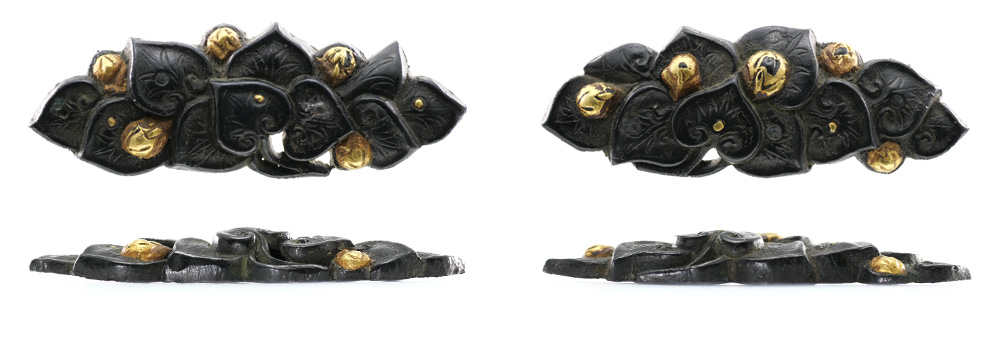
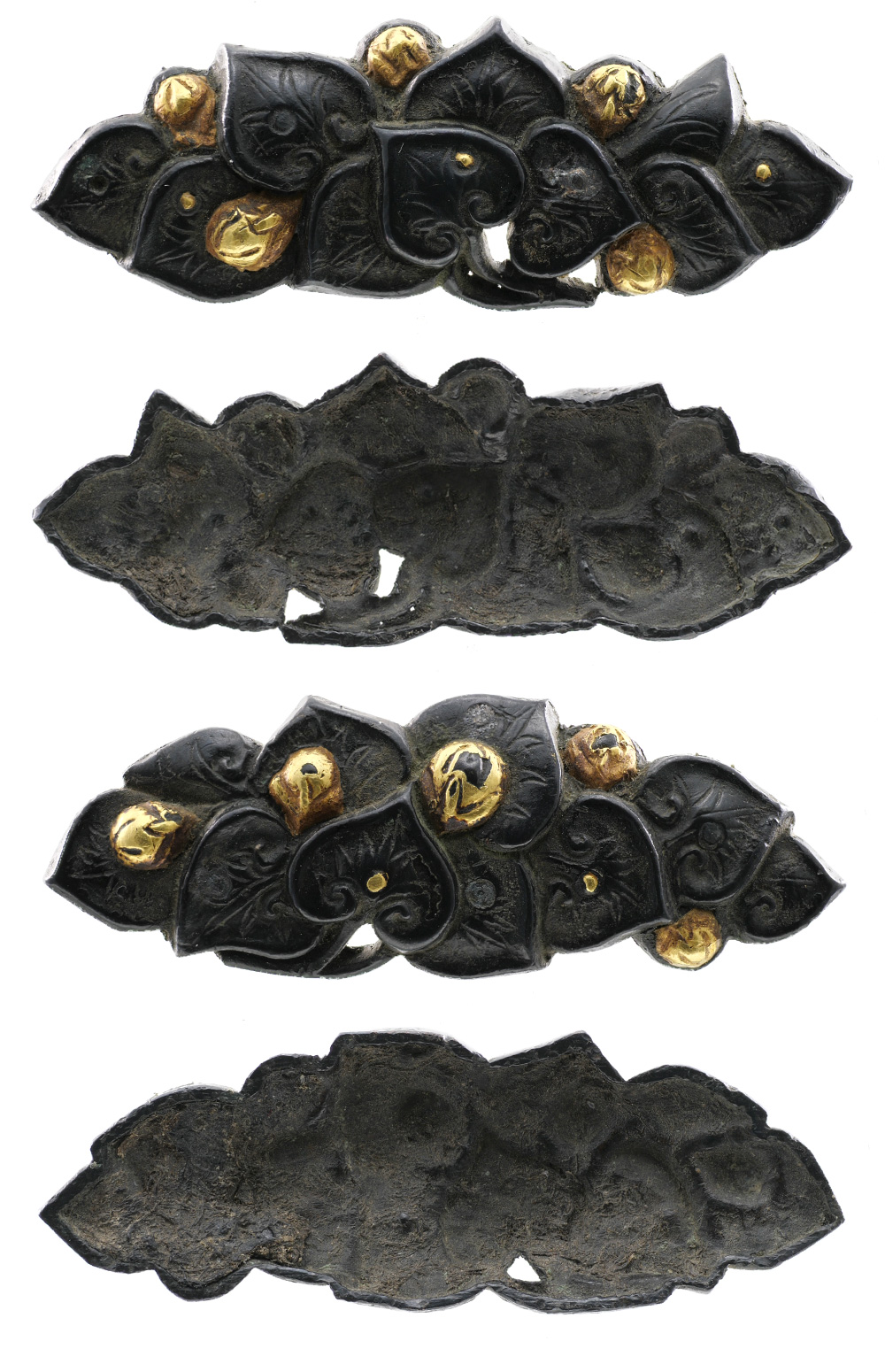
Pre-Edo
Unsigned
Machine translation of the shop's Japanese ·
Machine translation from the shop's Japanese · may contain errors ·
We could not find an authenticity certificate on the seller’s listing. Japanese swords and fittings are normally papered by the NBTHK (or the NTHK). Without one, the attribution is the seller’s own assessment and has not been independently verified — treat it with caution and ask the dealer about certification before buying.
Returns are accepted within 7 days of the item's arrival, provided its condition has not changed since the time of sale. Once the return is confirmed, the payment is promptly refunded to your designated account.
¥160,000