Edo was the sword’s age of connoisseurship: the Hon’ami appraisers, the shogunal register of famous blades of 1719, and a thriving literature turned the sword into an object of study even as it ceased to be drawn in war.
 NihontoWatchNihontoWatch
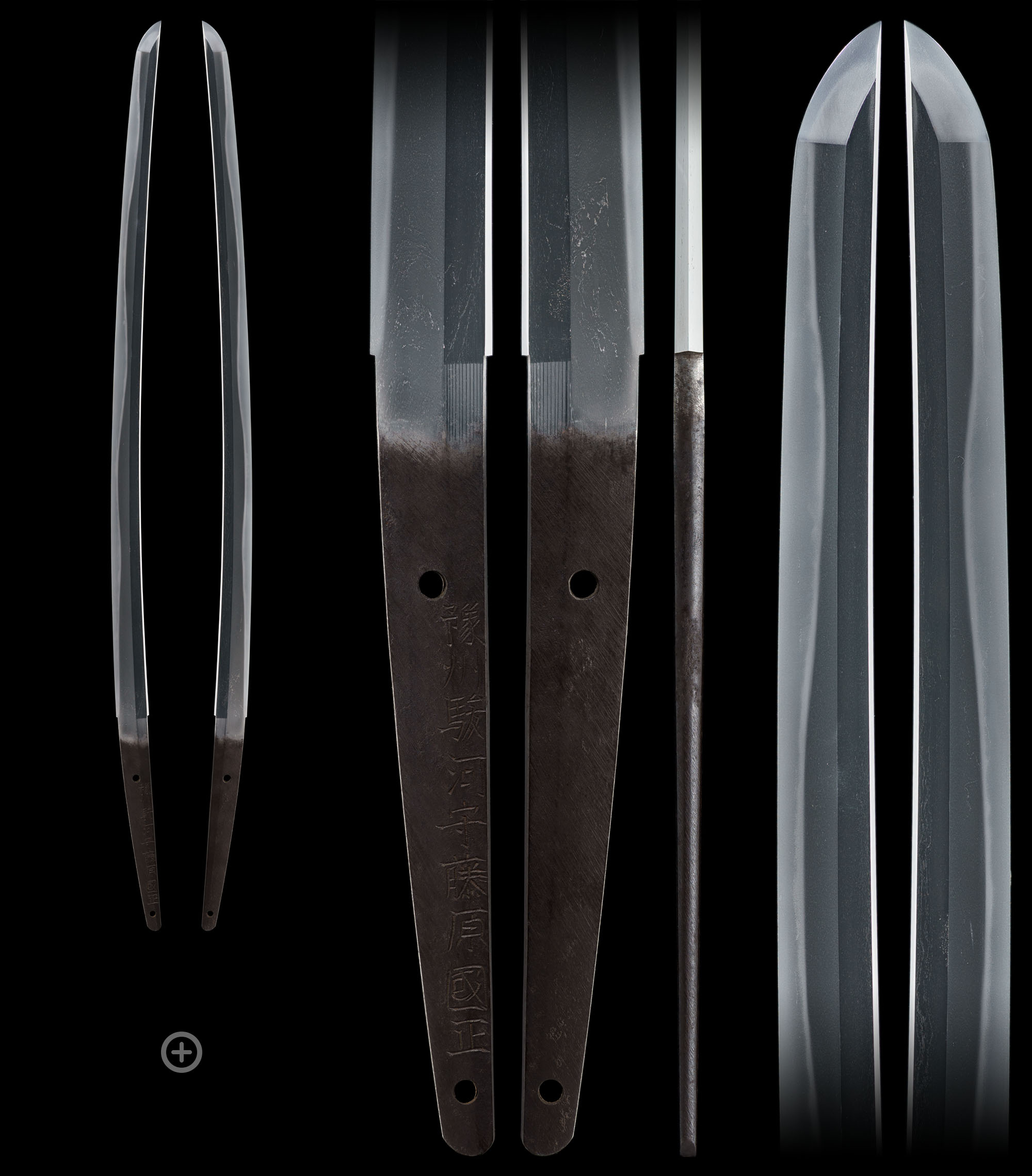
With a thick kasane and relatively wide mihaba, this sword is a sturdy Kanbun Shinto in terms of its measurements, yet its neat and smart sugata leaves a striking impression. After all, it must be this oh-notare hamon that makes it appear so. Within the span of just under 2 shaku 3 sun, there are three large mountains at almost equal intervals; the plump, deep nioiguchi undulates in a relaxed notare with a calm feeling, leading one to imagine that the owner who wore this must have had a very gentle personality. Contrary to the curves of the notare, the ha-saki side of the nioiguchi is unexpectedly busy, with ko-ashi appearing frequently from the moto to the saki, providing plenty of highlights to enjoy. One must not overlook the fact that ko-nie is attached within the ha, where kinsuji and sunagashi-style activity appear in several places on both the omote and ura. The activity of the kinsuji, which moves at an angle from the nioiguchi, could, depending on how one looks at it, be called a modest kuichigai-ba. It is likely activity along the masame-inclined ko-itame hada, feeling as though it inevitably emerged at the points where the hamon undulates and meanders. Given this jihada and an abundance of nie, it seems a natural highlight to appear. Regarding this notare hamon, while it is by no means a new form, this sword was made around Kanbun, a time when the hamon styles shown in Shinto Tokuden were emerging. Whether the notare of this sword is a "notare for show" following those examples, or a "traditional notare" modeled after Koto, what do you all think? And one hidden highlight... the niku-oki of the nakago. It has ko-niku and is plump; when gripped, the goodness of that sensation can be felt in the palm. The yasurime are carefully carved not only on the omote and ura but also on the mune, ha-saki, and nakago-jiri, making for truly excellent tsukurikomi (though the yasurime at the habaki-moto feel a little careless). Based on the above hamon and tsukurikomi, I am easily indulging in the delusion and concluding that this sword might be a carefully crafted chuumon-uchi... I would not be ashamed even if I am wrong. Our shop believes this sword is a blade worthy of that evaluation. The first generation Suruga no Kami Masakuni was a retained smith of Date Hidemune of Iyo. He was a student of Yasusada in Edo, and is said to be the son or student of Hojo-ji Masahiro. Although he is a student of Yamato no Kami Yasusada, this sword, with its abundant ko-ashi in notare, feels closer to the Hojo-ji style if anything. Since it is Hojo-ji, if I said it was a blade in the Kotetsu style to put it nicely... everyone would look away, wouldn't they? That is too much of a leap, my apologies.
Offered by Asahi Token

That’s real money, and we couldn’t find current papers for this piece. Before you buy, ask the dealer whether it has been, or can be, submitted to shinsa. — Hoshi Ask me first
As written by the shop
Machine translation from the shop's Japanese · may contain errors ·
Iyo · around 1661-1673
Tōken Taikan top 63%
The Edo period (1615 to 1868)
Edo was the sword’s age of connoisseurship: the Hon’ami appraisers, the shogunal register of famous blades of 1719, and a thriving literature turned the sword into an object of study even as it ceased to be drawn in war.
We could not find an authenticity certificate on the seller’s listing. Japanese swords and fittings are normally papered by the NBTHK (or the NTHK). Without one, the attribution is the seller’s own assessment and has not been independently verified — treat it with caution and ask the dealer about certification before buying.
Returns are accepted within 7 days of the item's arrival, provided its condition has not changed since the time of sale. Once the return is confirmed, the payment is promptly refunded to your designated account.
¥1,000,000