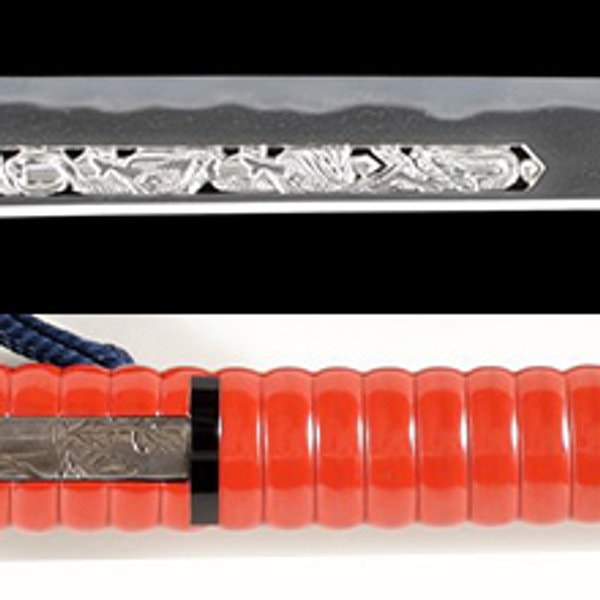
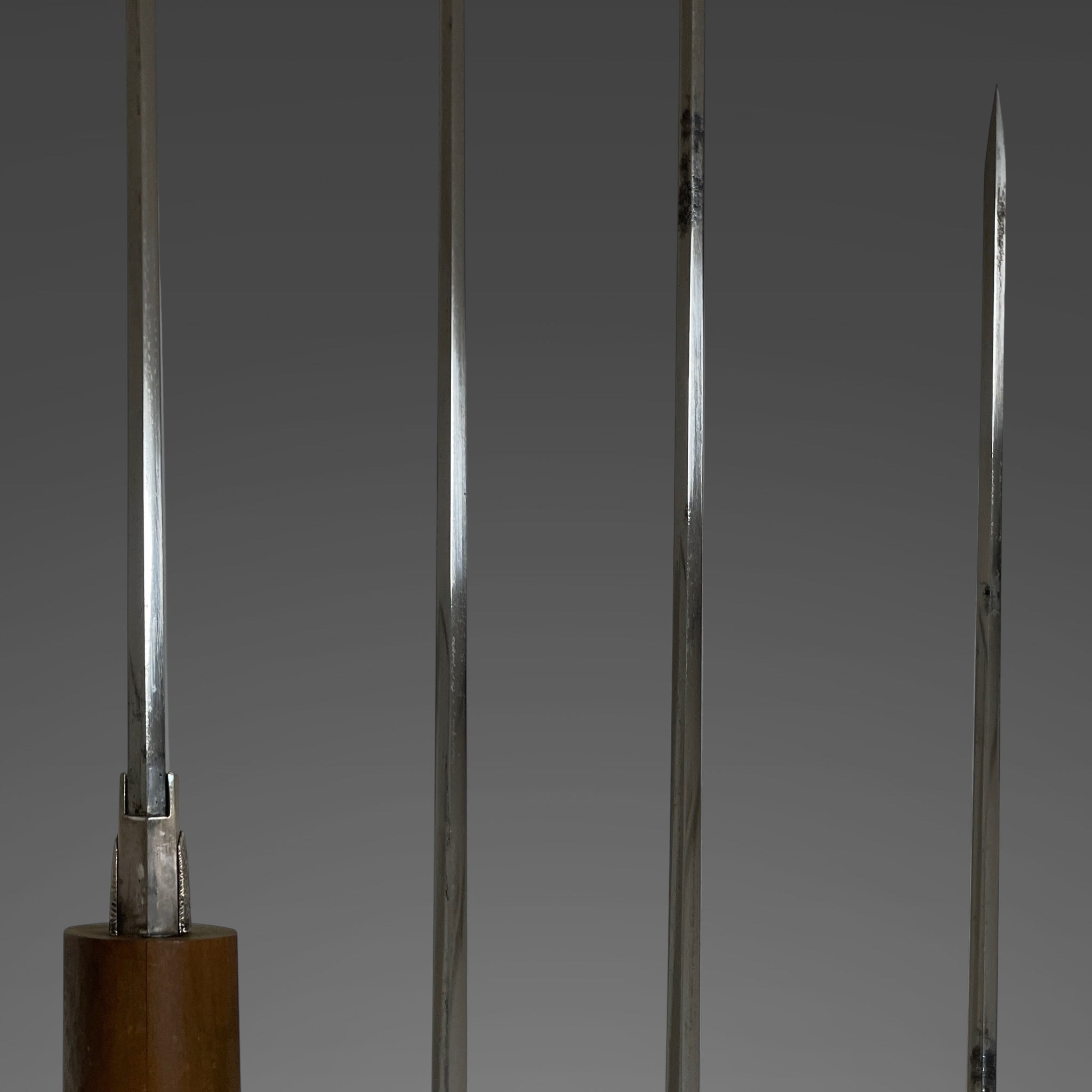
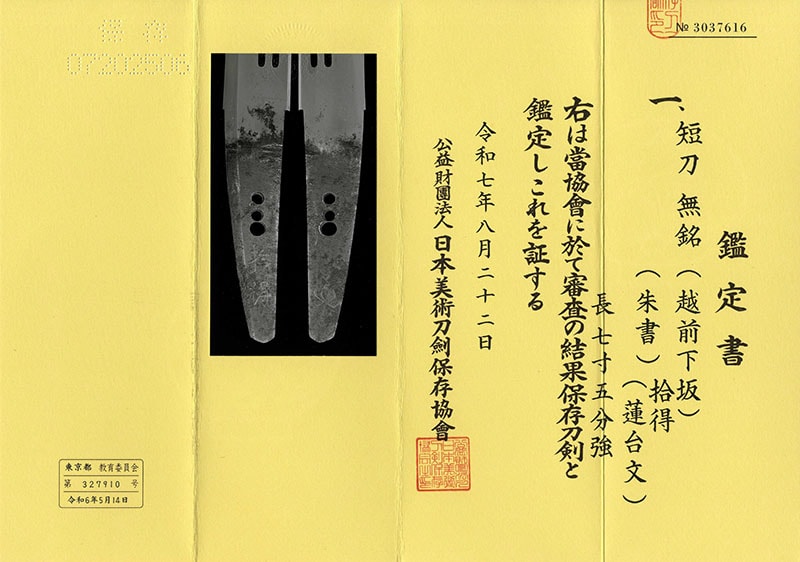
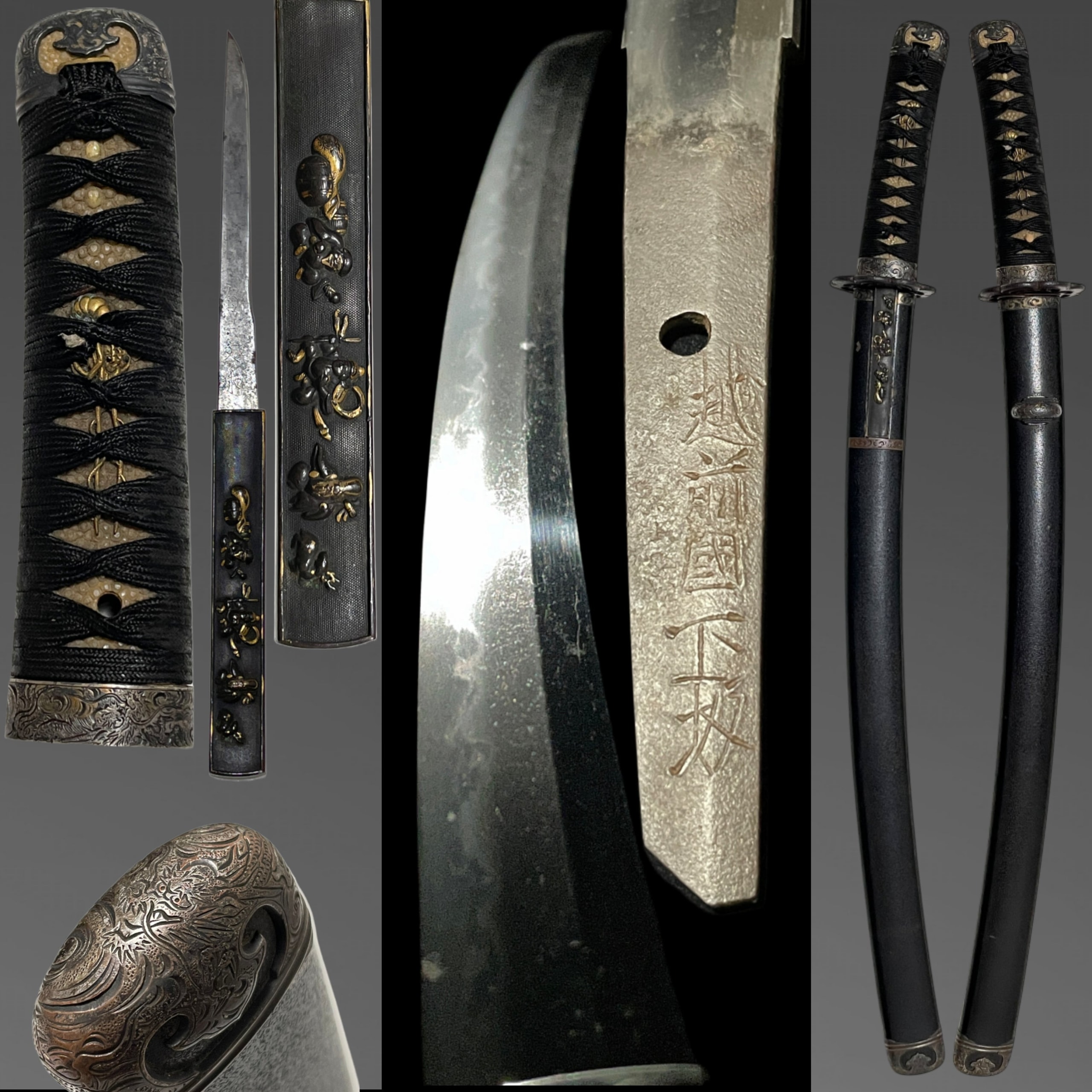
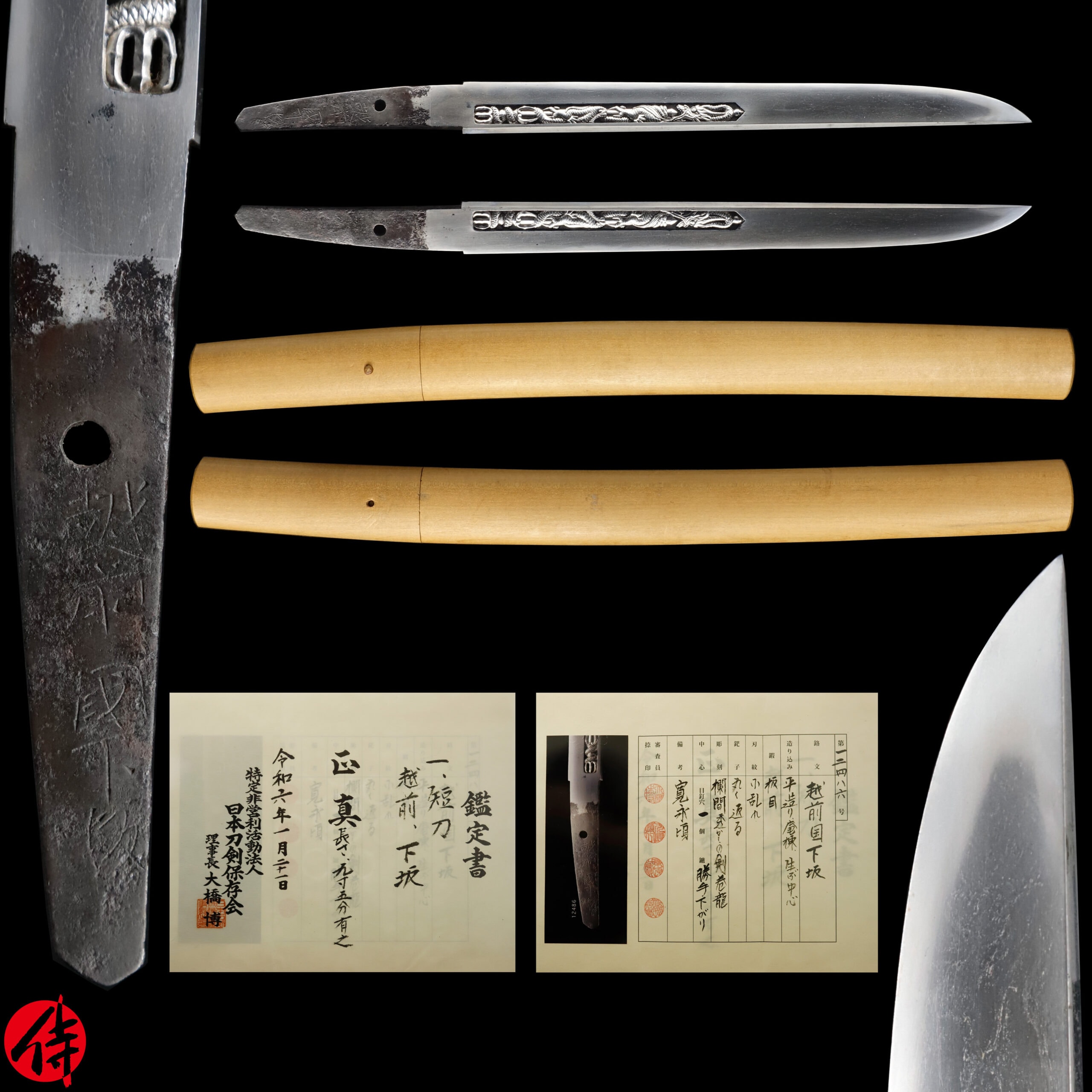
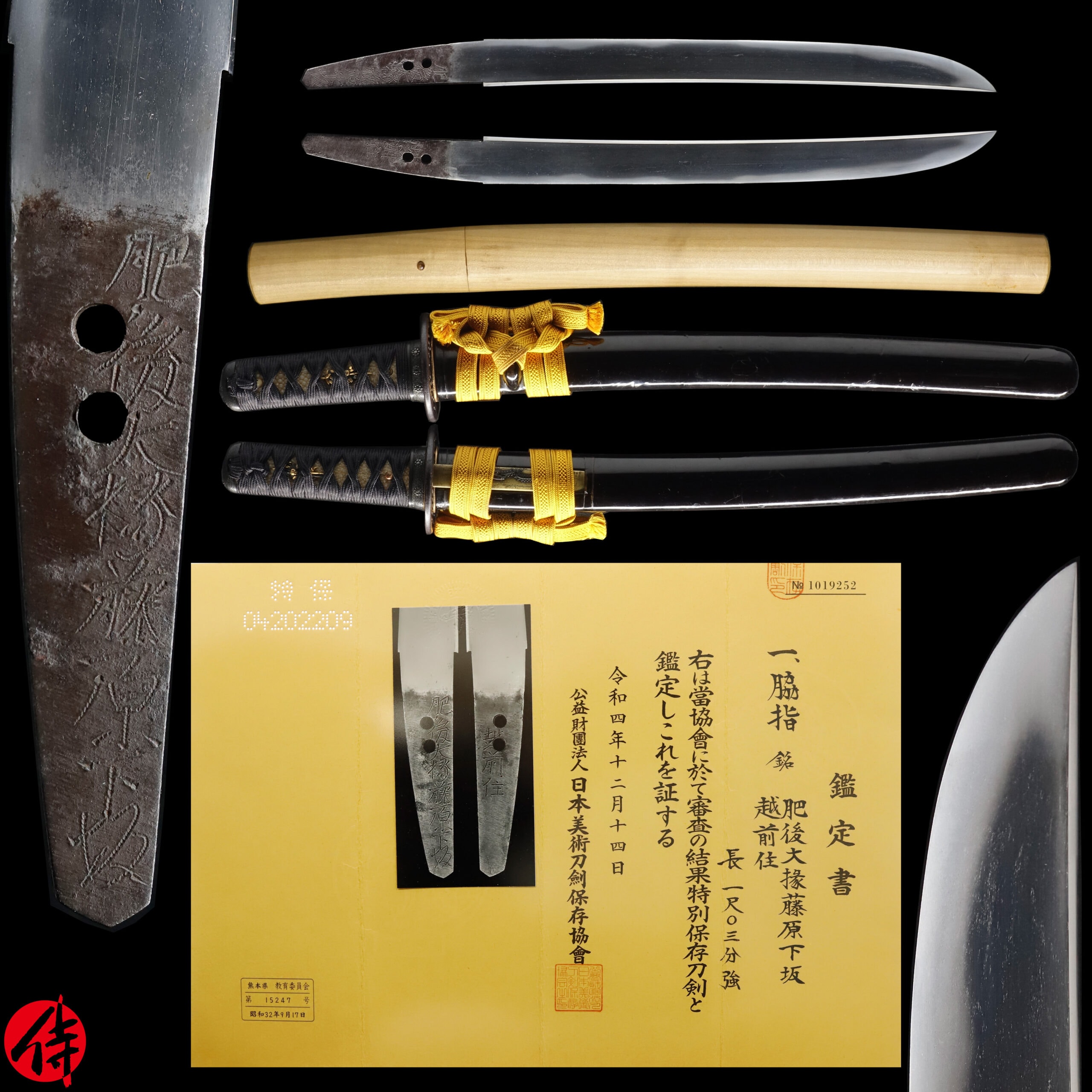
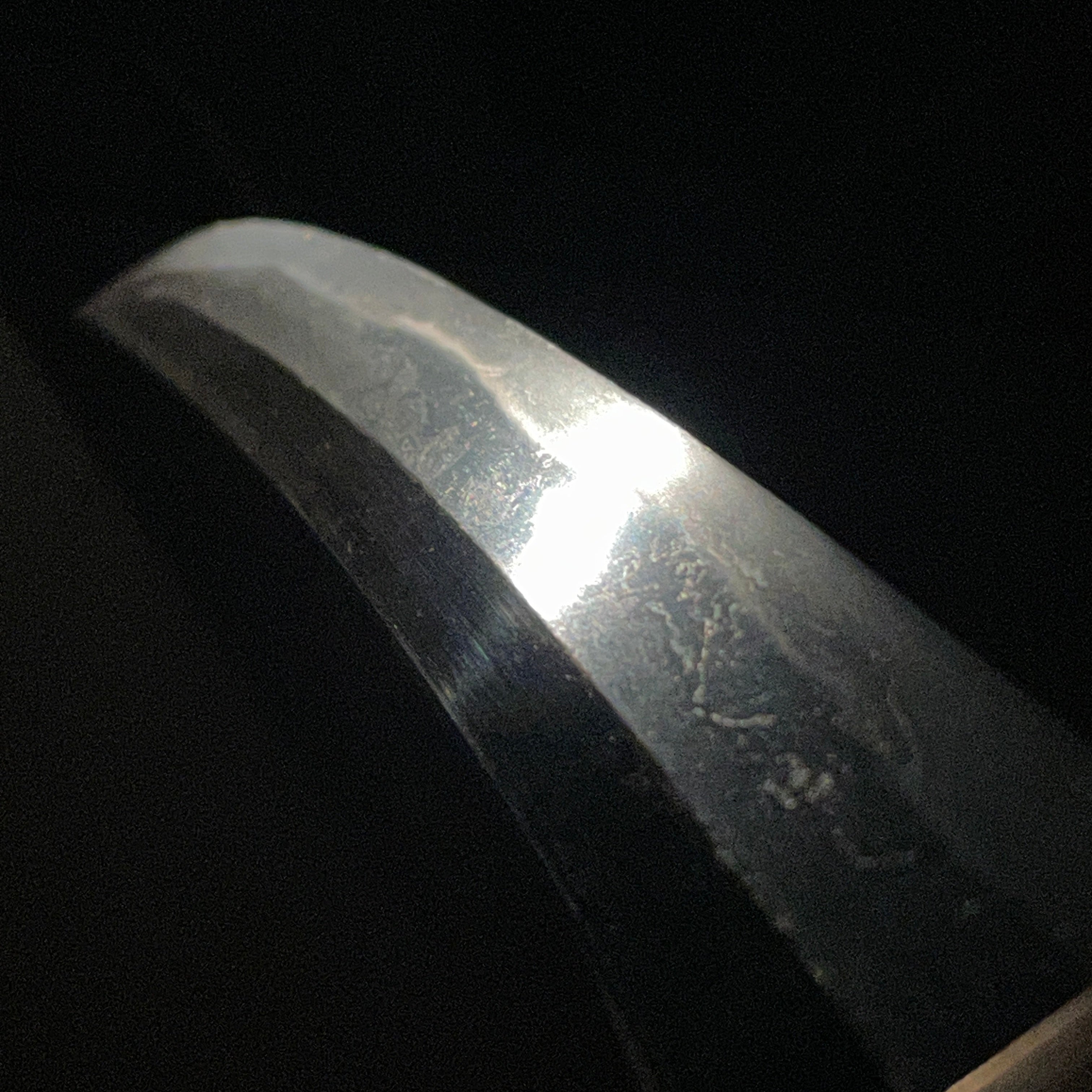
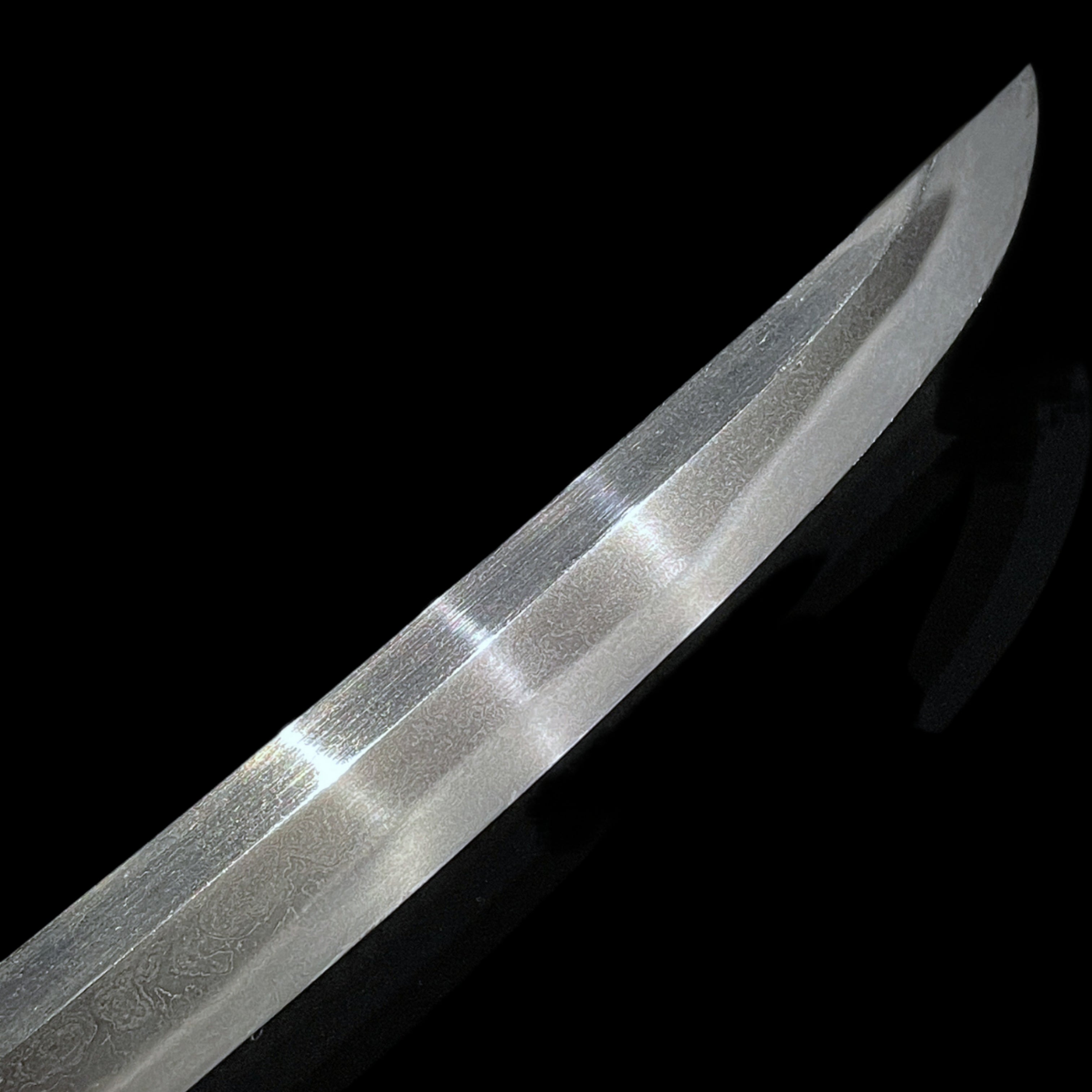
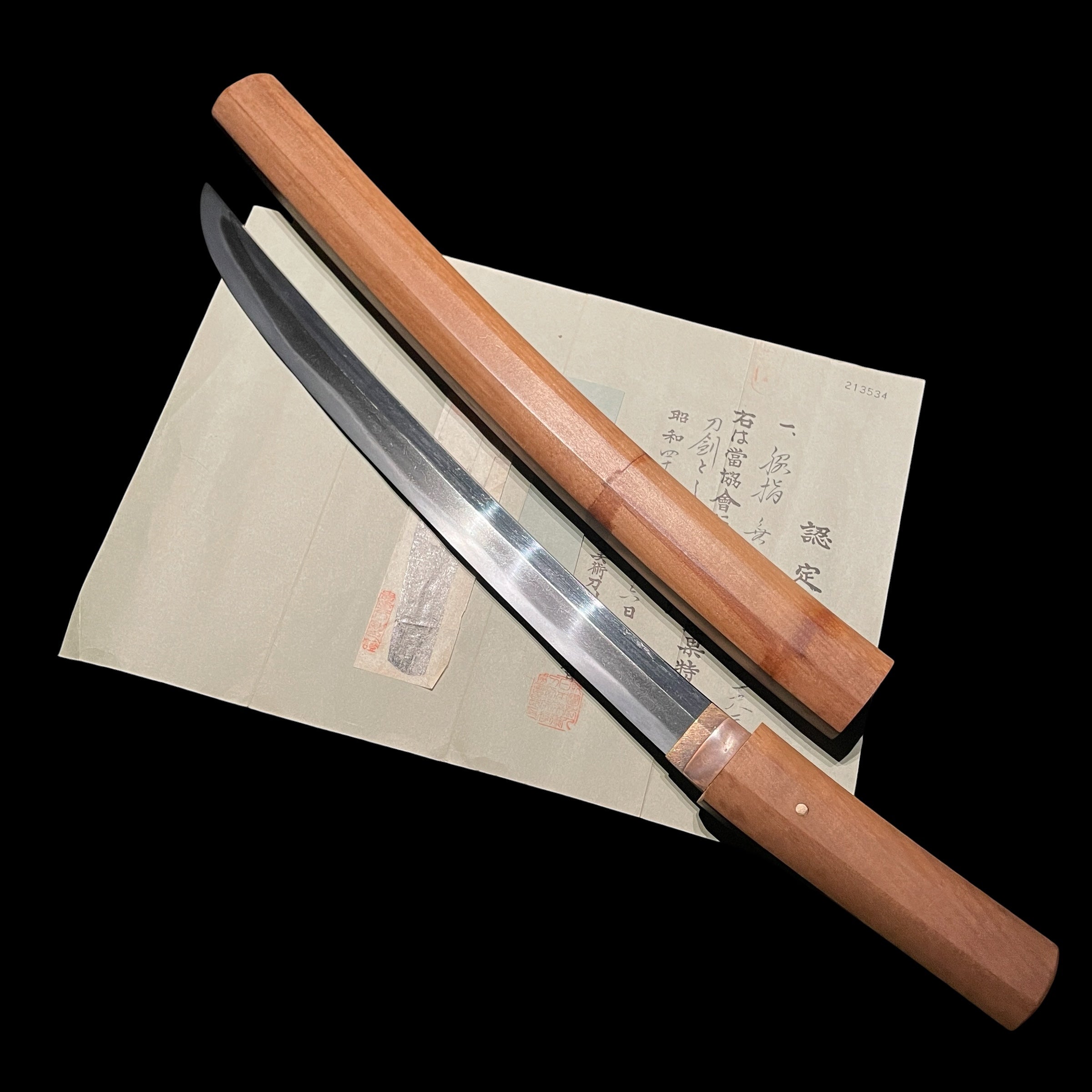
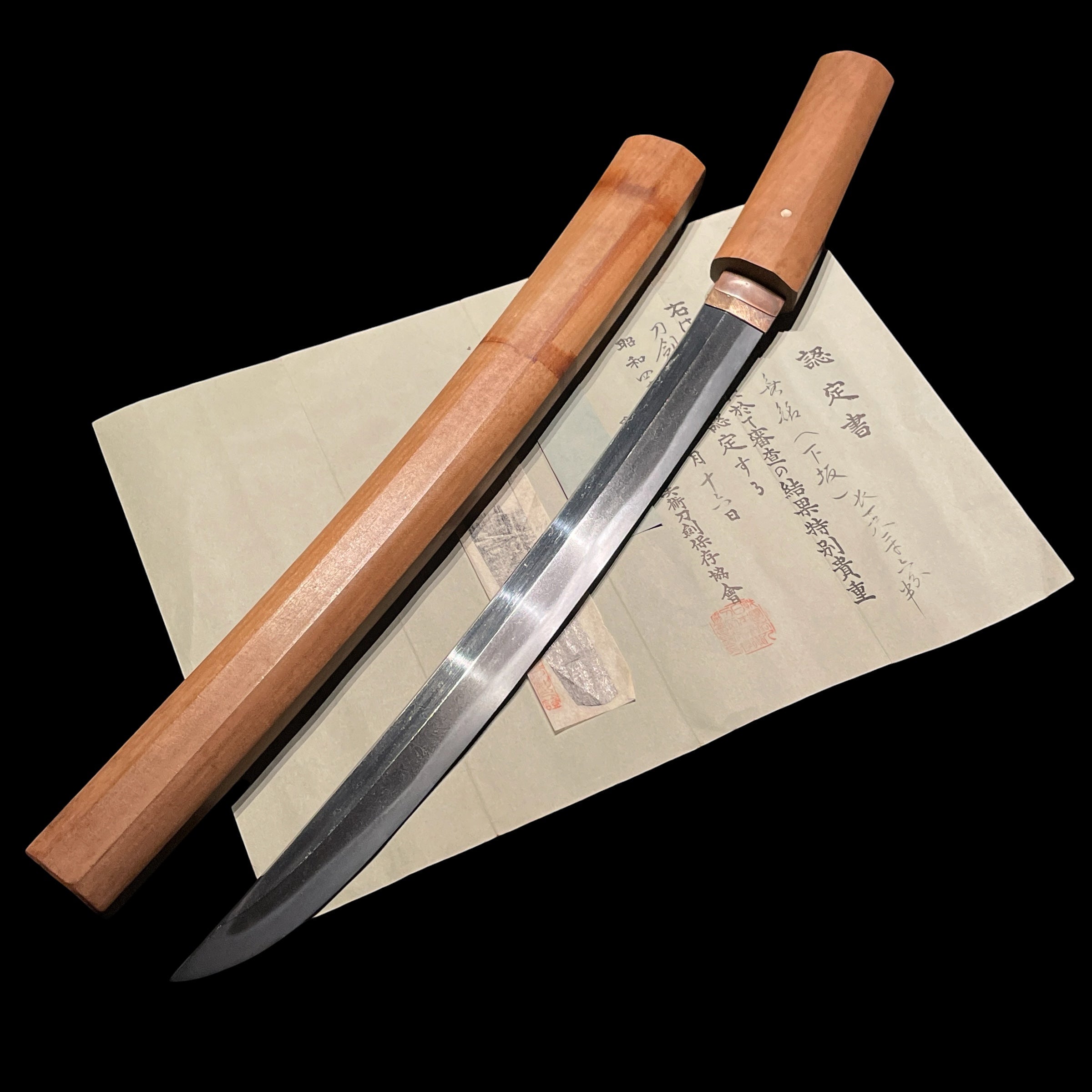
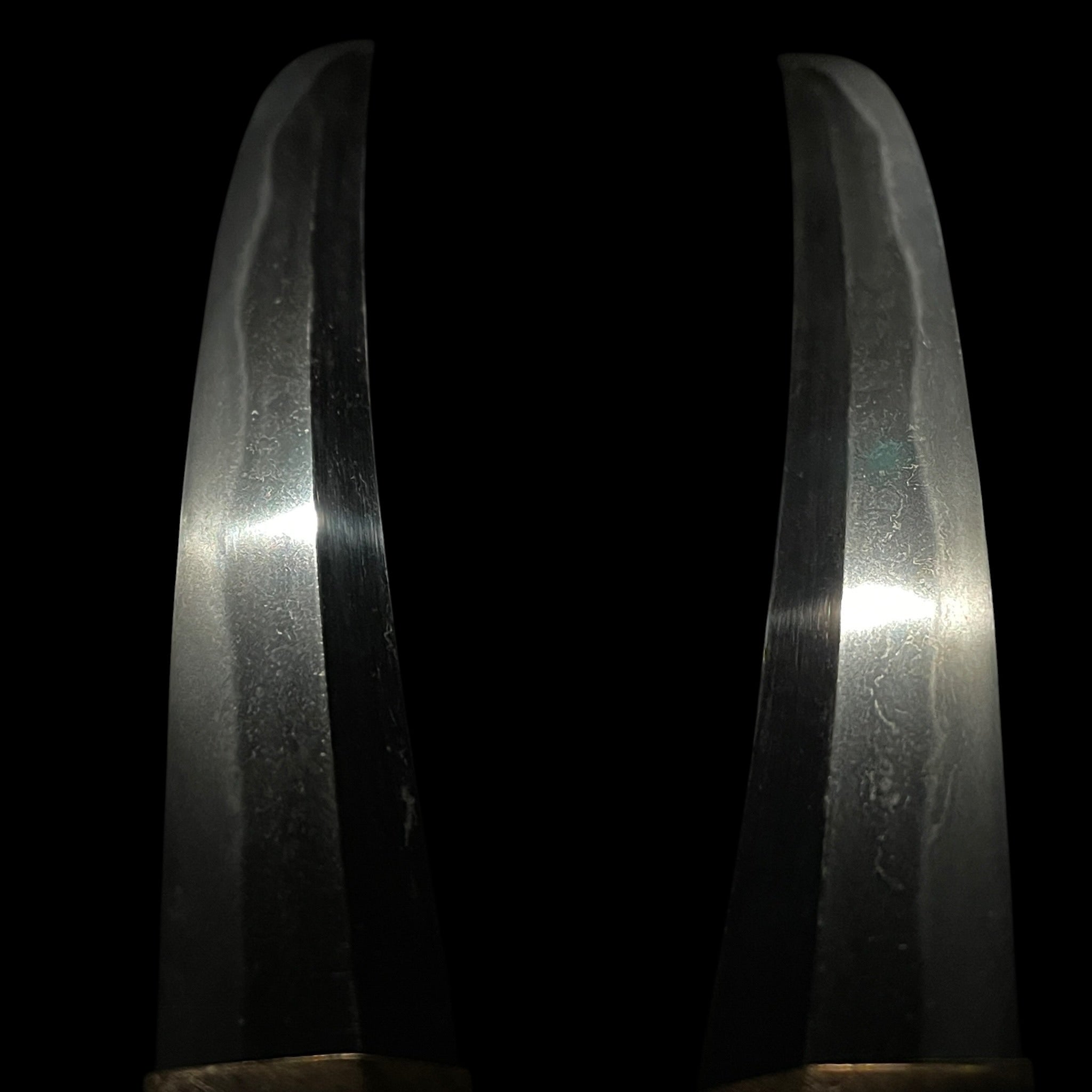
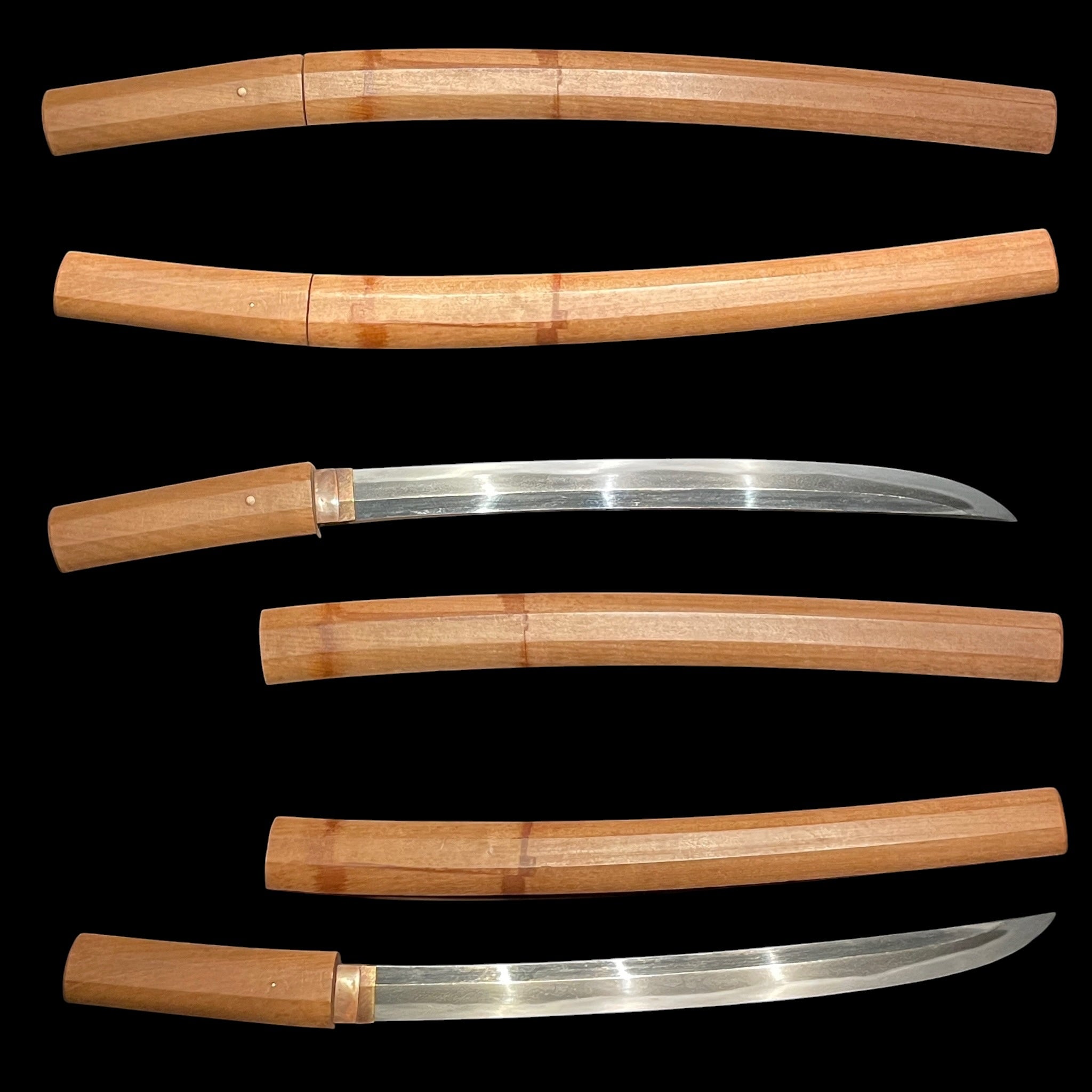
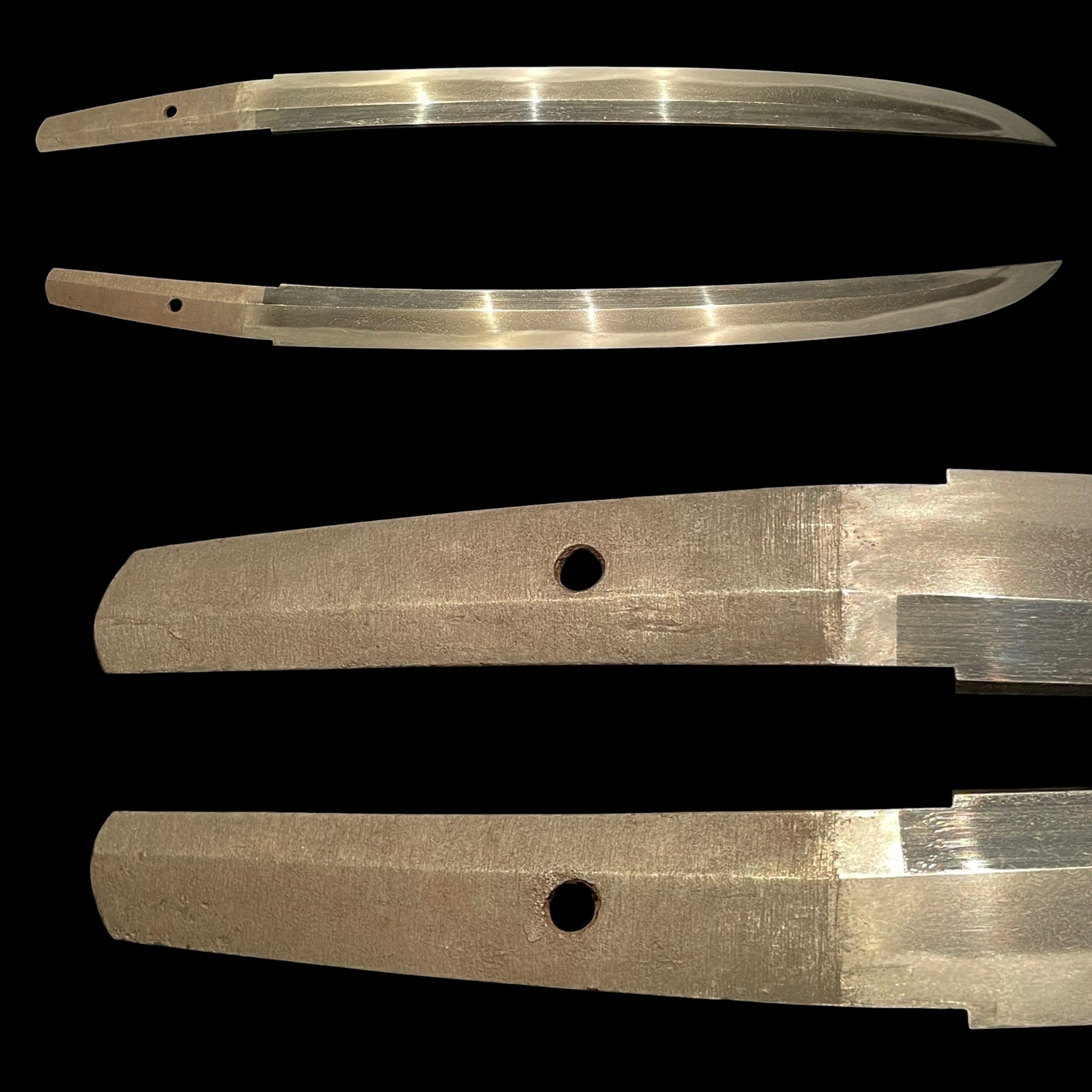
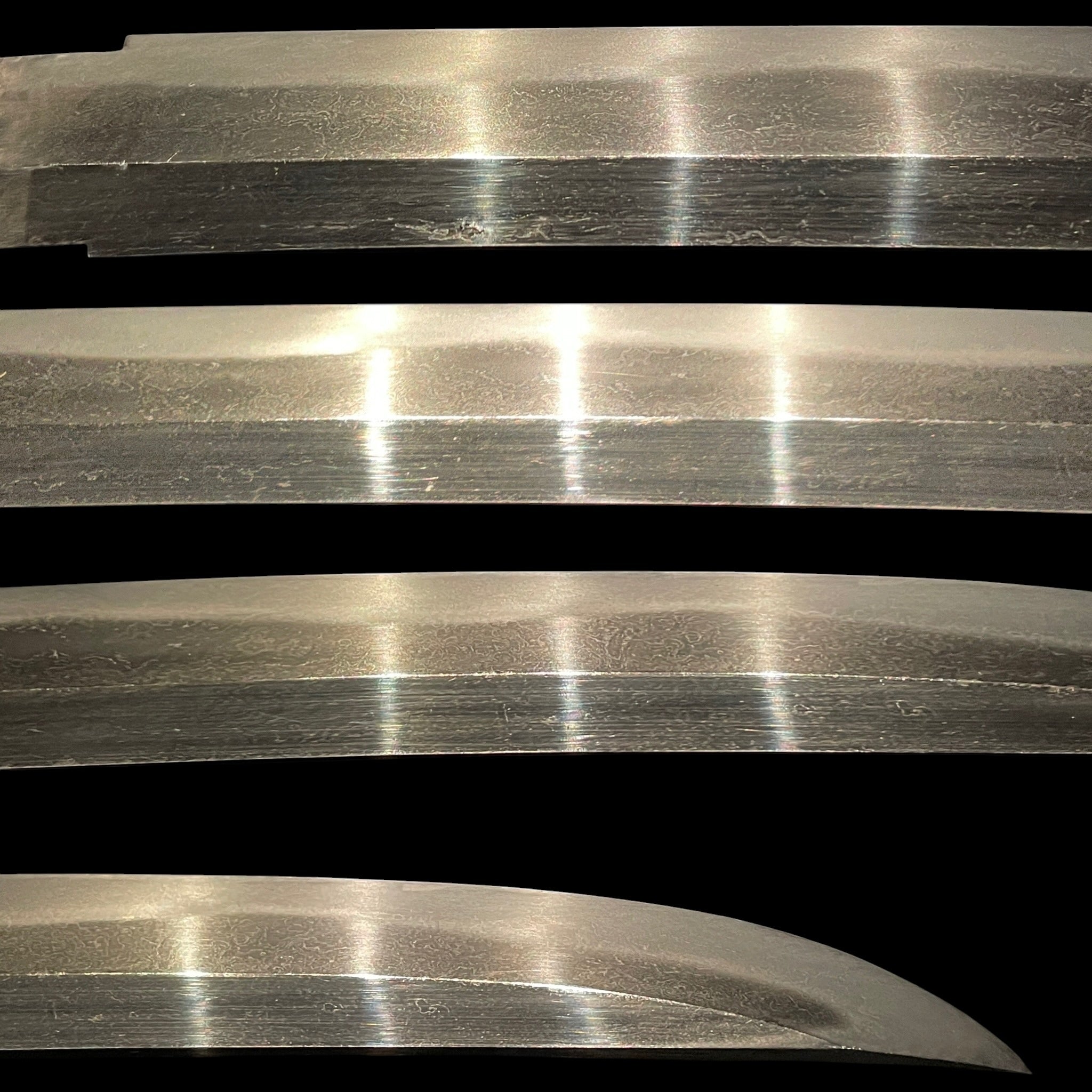
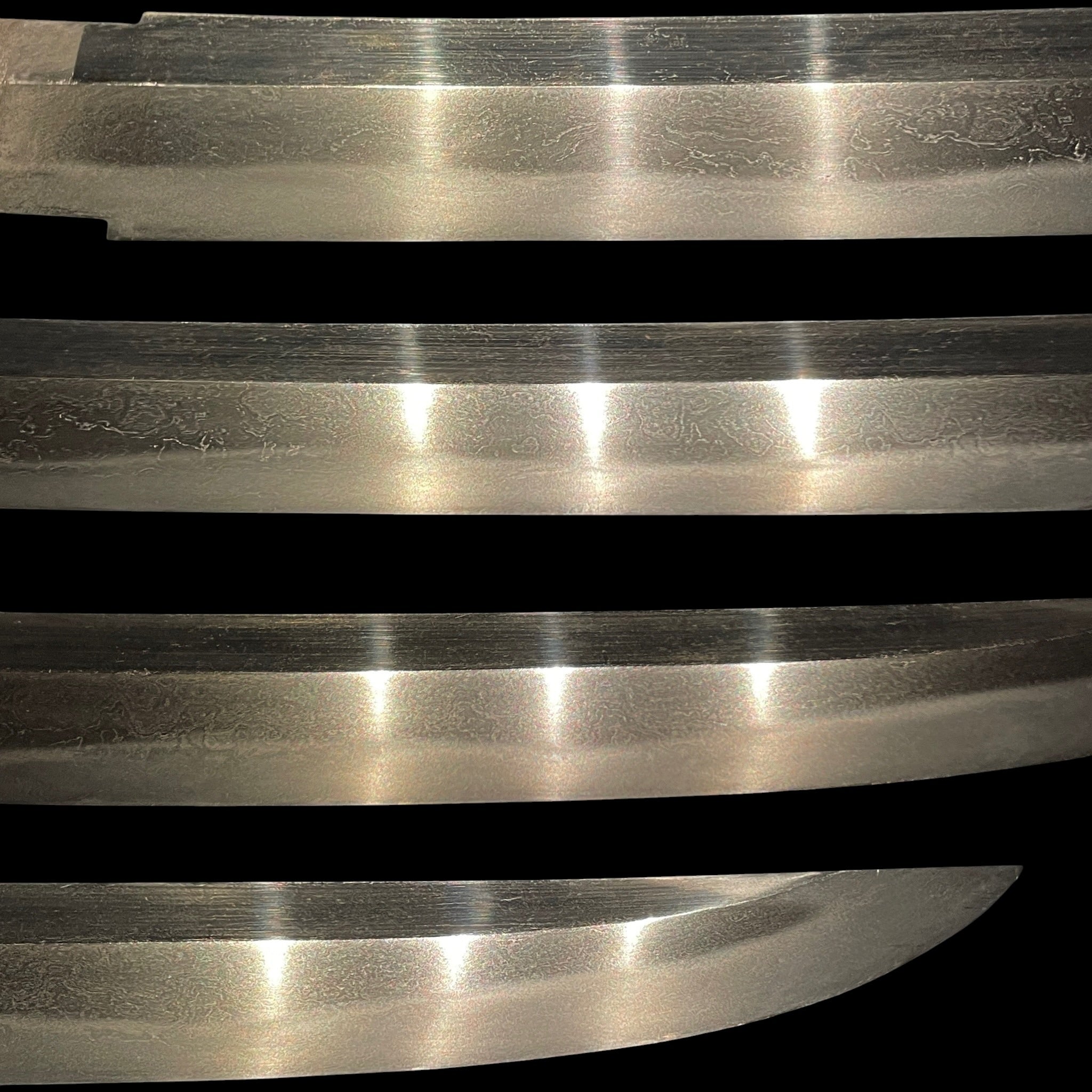
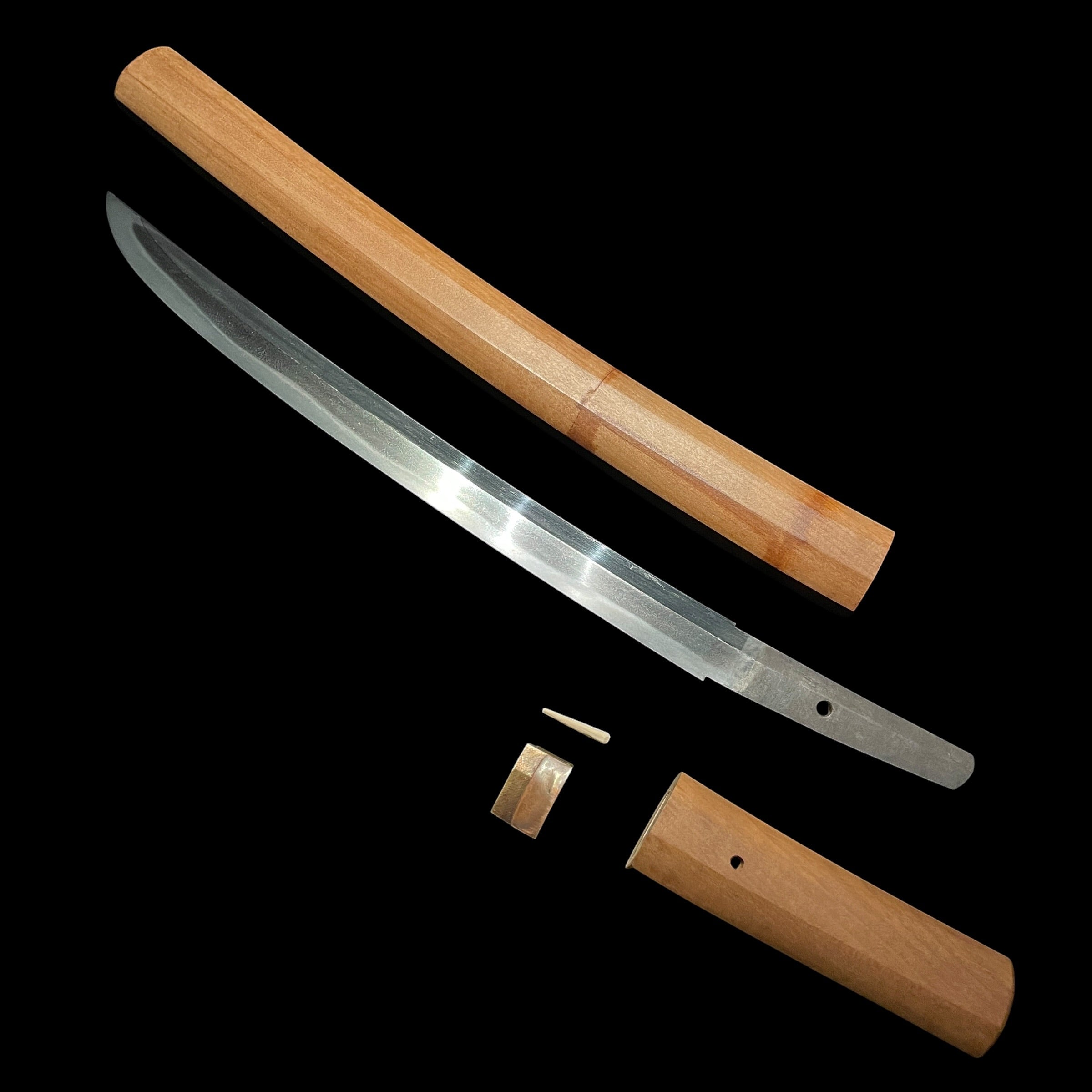
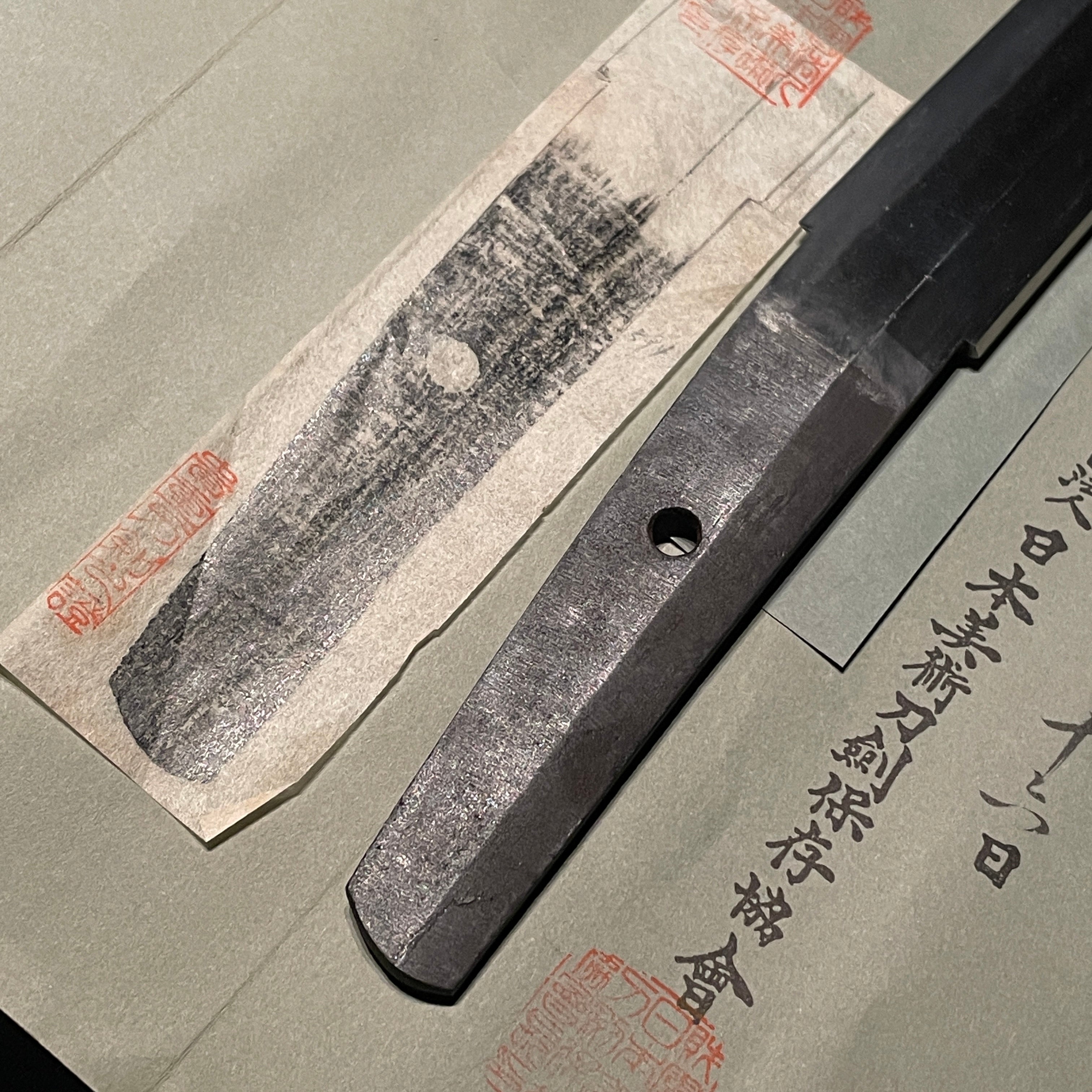
This is a wide wakizashi with beautiful jigane. It is signed Mumei (Shimosaka) and dates to the Edo period. The blade has a nagasa of 38.4cm, sori of 0.8cm, motohaba of 3.24cm, sakihaba of 2.26cm, motokasane of 0.7cm, and sakikasane of 0.56cm, with a blade weight of 420g.
 NihontoWatchBETA
mumei · Edo · nagasa 38.4cm · sori 0.8cm
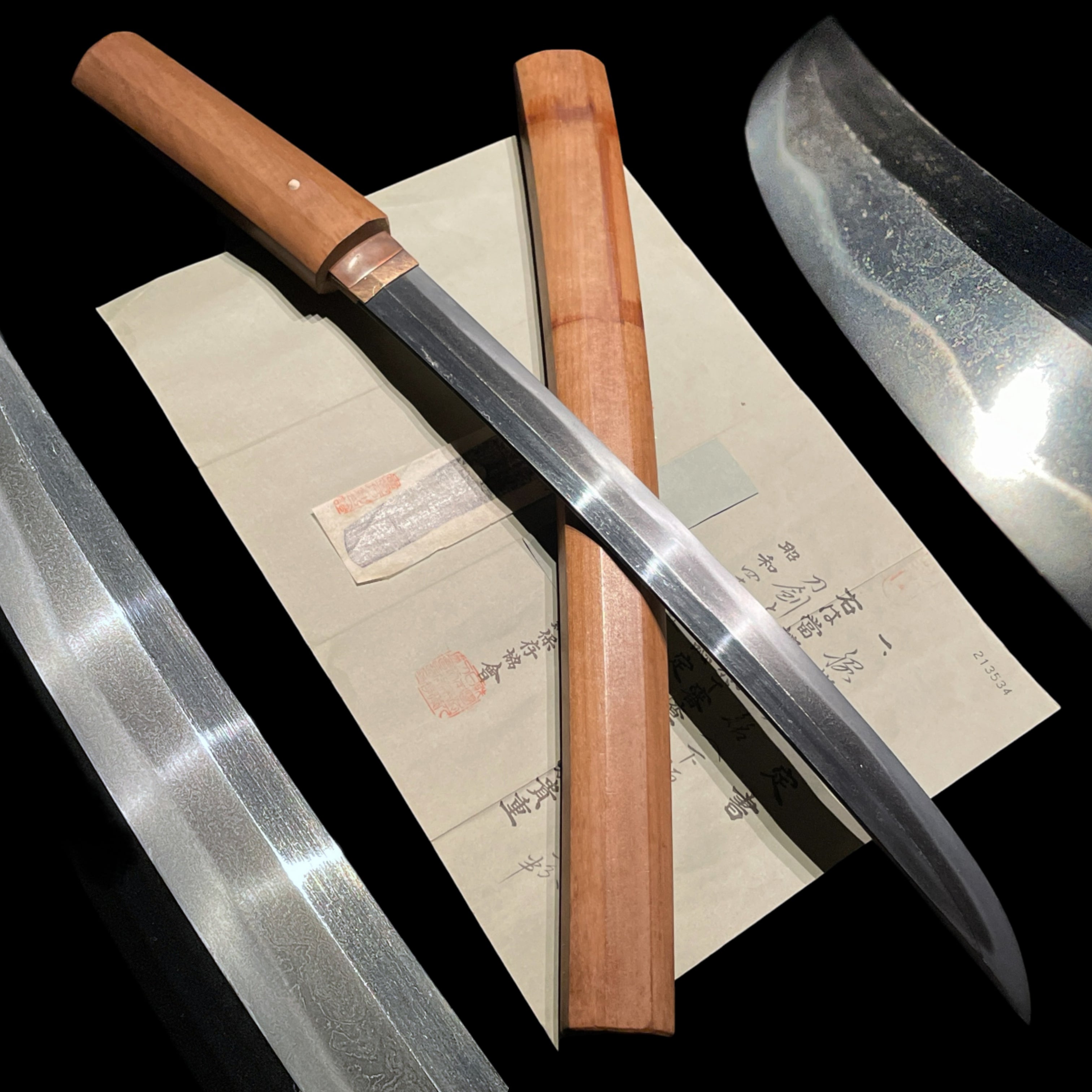
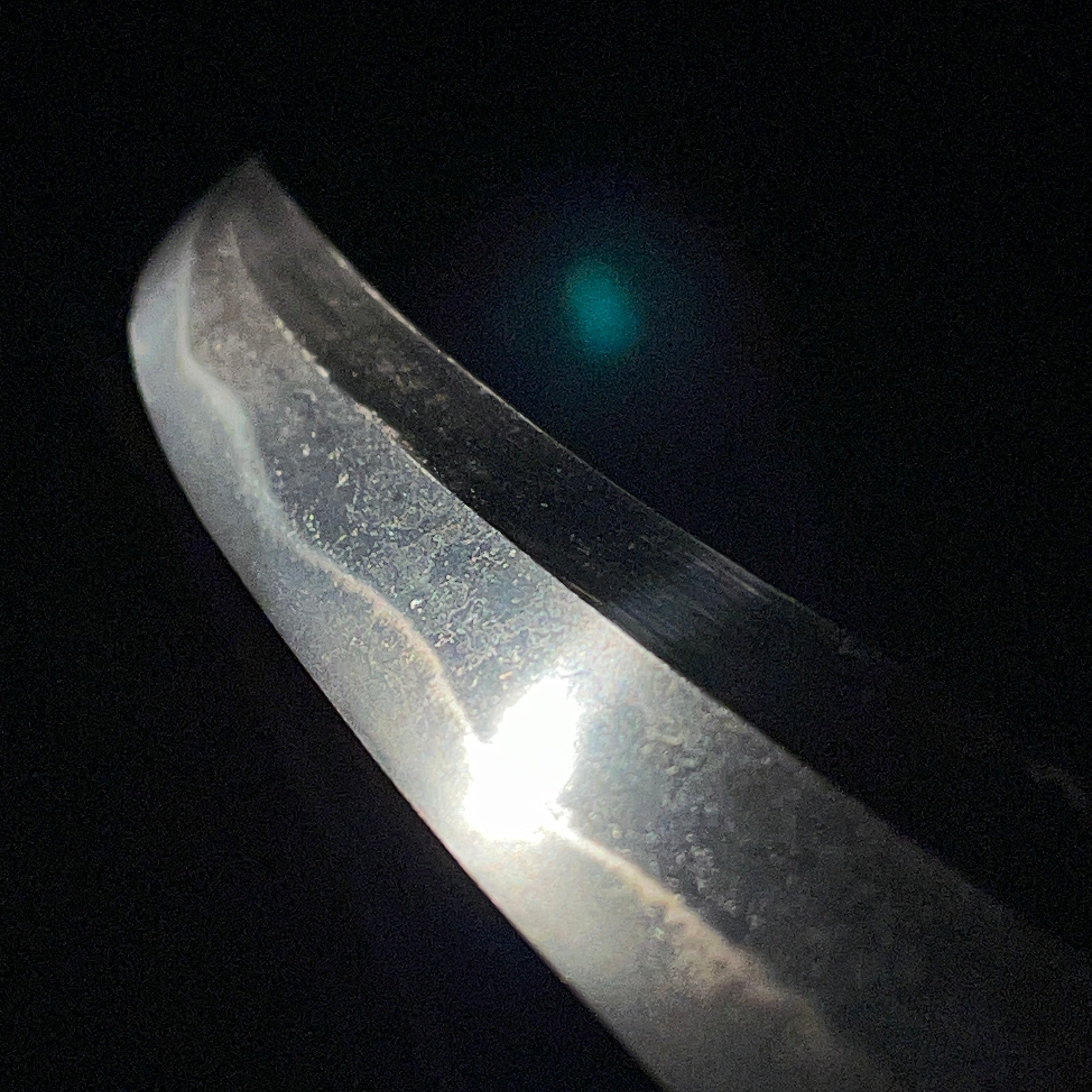
Echizen Shimosaka (Shintō; the group from which the Echizen Yasutsugu line arose) · Echizen · around 1596-1615
Fujishiro Jo-jo saku · Tōken Taikan top 14%
2 pieces on the market now
A katana of the fourteenth Juyo session, signed Higo Daijo Fujiwara Shimosaka, Echizen-ju, is read by the published sources as a pre-Yasutsugu signature, a blade made before the smith began to inscribe Yasutsugu in Keicho 11 or 12, and it opens onto the central fact about this name. Shimosaka is not one swordsmith. It is a trademark signature shared by a band of Echizen smiths at the dawn of the Shinto era, and the designated record gathers their work under the single name. The published sources state the case plainly. Rather than reading these inscriptions as the work of one man, it is more reasonable to take them as 「同人とみるよりは幾人かの鍛冶者の一団であり」, a group of several smiths who forged under Shimosaka 「下坂を商標として鍛刀していたと解することが妥当であろう」, and in the earliest phase of that group it was the first-generation Yasutsugu who served as 「康継がその代表者」. The name is the wellspring of the Echizen Yasutsugu line and of the deep relief carving the province made its own.
The hand that runs through the group is a quiet one, set against the flamboyance of much contemporary Shinto work. Every blade on the record is forged in itame, in most cases mixed with mokume and tending to flow toward both edge and back and to stand open, the jigane carrying ji-nie throughout and at times a blackish cast to the steel with chikei entering. Over that jigane the temper runs from a medium suguha to a shallow notare mixed with gunome, small ashi entering, the nie attaching, often unevenly, and sunagashi streaming through the tempered area, with kinsuji and a frequently frayed habuchi on the finer pieces. The boshi is the steadiest tell of all, running straight into a small round ko-maru turnback and most often brushing into hakikake at the point. It is a working manner read by activity within the ha rather than by a bold outline of the temper, the sand-streaming sunagashi the most consistent of the group's recognition points.
The carving is the other constant, and the one the published sources name most readily as a regional mark. Deep relief and openwork horimono recur across the corpus: a true-form Kurikara dragon cut in relief within the groove, a Bishamonten and bonji in the hi of one katana, a dragon and tiger powerfully rendered on a tanto, a Marishiten on the koshi-moto of a naginata. The published sources call these the distinctive Echizen carving, 「越前彫」, and, on the later pieces, the Echizen Kinai-style carving, 「記内彫」, noting the somewhat roughened chisel finish that marks the school's hand. The Higo Daijo Fujiwara register adds a narrow suguha with a tightening nioiguchi that tends toward shizumi and a shirake-utsuri standing in the ji, the early manner the texts read as sharing points in common with Yasutsugu's own work.
Because the name is a trademark, the corpus is best read by the registers the published sources themselves draw rather than by a single style. The earliest is the Higo Daijo Fujiwara Shimosaka signature, traditionally taken as Yasutsugu's own first mark and called by the texts 「康継前銘」; but the title Higo Daijo was carried by several Echizen smiths at once, and the published sources hold that it 「肥後大掾下坂銘は, 従来初代康継の初銘とされてきた」 yet 「康継一人とは限らない」, listing Yasutsugu I, Sadakuni, Kanenori, Kuniyasu and Masakatsu among the hands whose chisel movement, brush intent and workmanship are too alike to part on present evidence. Beside that register stand the generic Echizen no Kuni Shimosaka blades, by hands the texts judge 「康継とは全くの別人の作」 and call 「個名を明らかにし得ないが一門の上手」, skilled but unnamed, their period not descending past the Keicho and Genna years. Two hands the published sources do venture to name. A katakiriba tanto whose construction runs through to the tang they read as Kanesaki, on the strength of a dated Keicho 11 piece of the type and an inscription matching the Shimosaka Kanesaki form, with a deep-curved naginata likewise read as probably his.
The second named hand carries the trademark out of Echizen altogether and shows how the group should be placed. Shimosaka Hachirozaemon the published sources give as 「下坂八郎左衛門は本国が近江であり」, an Omi-born smith taken into the service of Tanaka Yoshimasa of Kurume domain, who shared his native province, and so removed to Chikugo; his long-signed naginata, forged in Chikugo and dated Keicho 8, carries forward an earlier sugata in its widened head and deep curvature, and the texts prize its tang inscription as 「下坂鍛冶研究の貴重な好資料である」, precious reference material for the study of Shimosaka smiths. The distinction the published sources draw is therefore not one of style alone but of name and biography, the individual hand told off the signature and the documented life where it can be told at all, and on every blade where it cannot, the verdict is the same: 「下坂一門の作として優品であることには異論はない」, a superior work of the Shimosaka lineage whatever the personal name.
The name is held in nine Juyo blades on the record, four tanto, two naginata, two katana and a wakizashi, all signed and none unsigned, the workmanship rated Jo-jo saku in Fujishiro. There are no National Treasures and no Important Cultural Properties among them, so the group is encountered through its designated Juyo blades rather than through any famous holding; of recorded whereabouts one is in the Tokyo National Museum, and one naginata survives in a kin-nashiji koshirae bearing the Mitsuba-Aoi crest in maki-e, taken by the published sources for one of the personal arms of a daimyo. Provenance is otherwise unrecorded, the more so because the blades are valued less as the work of a single celebrated smith than as documents of an early Shinto workshop, several among them praised by the texts as reference material for fixing the group's hands. A signed Echizen Shimosaka comes to the collector only from time to time, a Juyo tanto or naginata being the realistic encounter; the rarer prize is the Higo Daijo Fujiwara pre-Yasutsugu register, or a named piece by Kanesaki or Hachirozaemon whose inscription places it within the band from which the Echizen Yasutsugu line arose.
Shinto · Echizen
50 pieces on the market now
The Shimosaka name began not as a single hand but as a trademark shared by a band of Echizen smiths at the dawn of the shinto era, and the designated record gathers their work under that one signature rather than parsing it into individuals. The published sources read the early inscriptions, the generic Echizen no Kuni Shimosaka and the titled Higo Daijo Fujiwara Shimosaka, as the product of a group, of which the first-generation Yasutsugu served as the representative. Learn more →
| Smith | Era | Designated |
|---|---|---|
| Yasutsugu康繼 | 1596-1615 | 74 |
| Yasutsugu康繼 | 1624-1644 | 27 |
| Yasutsugu康繼 | 1661-1673 | 8 |
| Sadakuni貞國 | 1596-1615 | 11 |
| Shigetaka重高 | 1596-1615 | 6 |
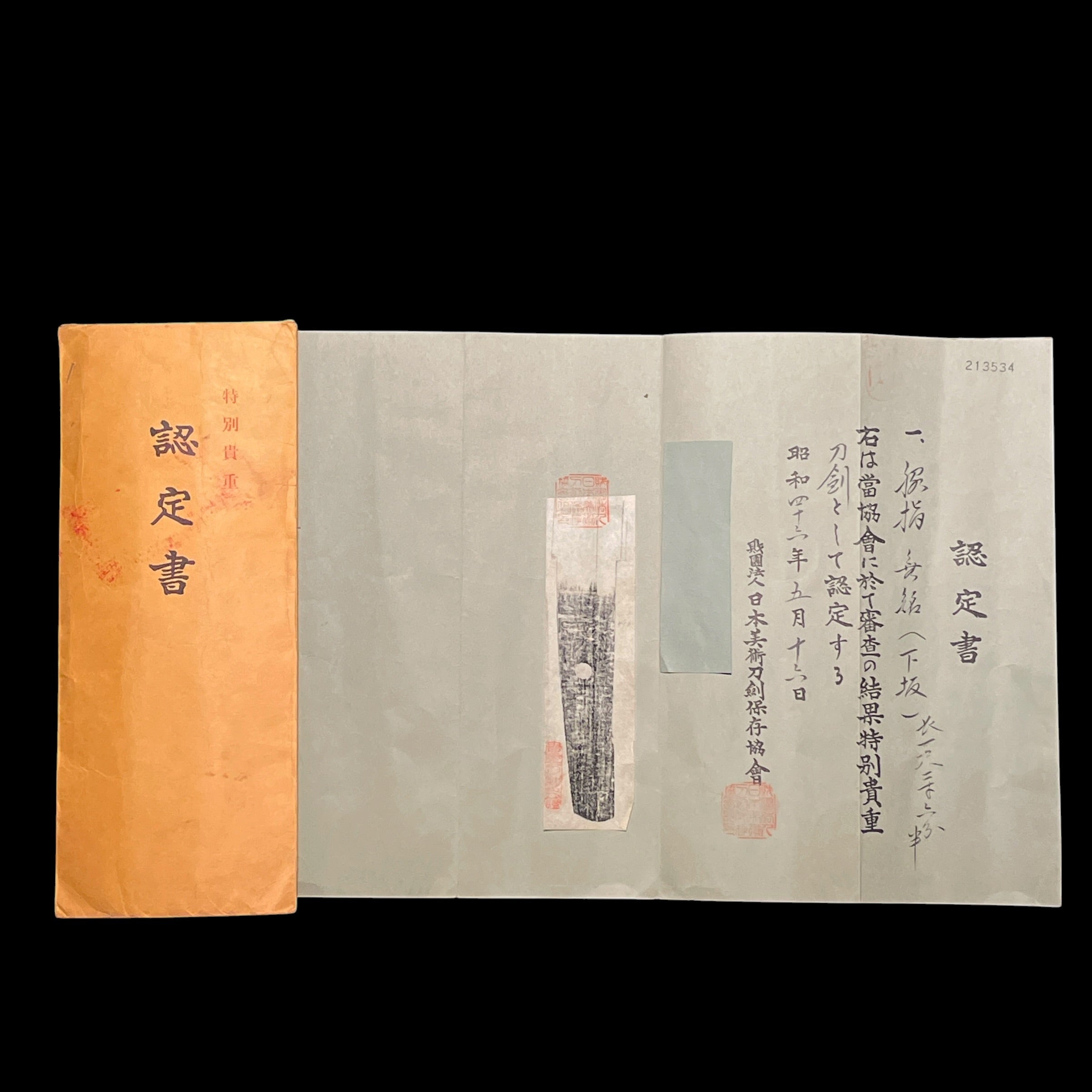
We could not find an authenticity certificate on the seller’s listing. Japanese swords and fittings are normally papered by the NBTHK (or the NTHK). Without one, the attribution is the seller’s own assessment and has not been independently verified — treat it with caution and ask the dealer about certification before buying.
Swords are non-returnable (blades cannot be re-imported to Japan). Insured shipping; damage/loss claims reported within 5 days of receipt. Cancellation fee 10% before shipment; not possible after shipment.
This is a wide wakizashi with beautiful jigane. It is signed Mumei (Shimosaka) and dates to the Edo period. The blade has a nagasa of 38.4cm, sori of 0.8cm, motohaba of 3.24cm, sakihaba of 2.26cm, motokasane of 0.7cm, and sakikasane of 0.56cm, with a blade weight of 420g.
NihontoWatchBETAmumei · Edo · nagasa 38.4cm · sori 0.8cm
Echizen Shimosaka (Shintō; the group from which the Echizen Yasutsugu line arose) · Echizen · around 1596-1615
Fujishiro Jo-jo saku · Tōken Taikan top 14%
2 pieces on the market now
A katana of the fourteenth Juyo session, signed Higo Daijo Fujiwara Shimosaka, Echizen-ju, is read by the published sources as a pre-Yasutsugu signature, a blade made before the smith began to inscribe Yasutsugu in Keicho 11 or 12, and it opens onto the central fact about this name. Shimosaka is not one swordsmith. It is a trademark signature shared by a band of Echizen smiths at the dawn of the Shinto era, and the designated record gathers their work under the single name. The published sources state the case plainly. Rather than reading these inscriptions as the work of one man, it is more reasonable to take them as 「同人とみるよりは幾人かの鍛冶者の一団であり」, a group of several smiths who forged under Shimosaka 「下坂を商標として鍛刀していたと解することが妥当であろう」, and in the earliest phase of that group it was the first-generation Yasutsugu who served as 「康継がその代表者」. The name is the wellspring of the Echizen Yasutsugu line and of the deep relief carving the province made its own.
The hand that runs through the group is a quiet one, set against the flamboyance of much contemporary Shinto work. Every blade on the record is forged in itame, in most cases mixed with mokume and tending to flow toward both edge and back and to stand open, the jigane carrying ji-nie throughout and at times a blackish cast to the steel with chikei entering. Over that jigane the temper runs from a medium suguha to a shallow notare mixed with gunome, small ashi entering, the nie attaching, often unevenly, and sunagashi streaming through the tempered area, with kinsuji and a frequently frayed habuchi on the finer pieces. The boshi is the steadiest tell of all, running straight into a small round ko-maru turnback and most often brushing into hakikake at the point. It is a working manner read by activity within the ha rather than by a bold outline of the temper, the sand-streaming sunagashi the most consistent of the group's recognition points.
The carving is the other constant, and the one the published sources name most readily as a regional mark. Deep relief and openwork horimono recur across the corpus: a true-form Kurikara dragon cut in relief within the groove, a Bishamonten and bonji in the hi of one katana, a dragon and tiger powerfully rendered on a tanto, a Marishiten on the koshi-moto of a naginata. The published sources call these the distinctive Echizen carving, 「越前彫」, and, on the later pieces, the Echizen Kinai-style carving, 「記内彫」, noting the somewhat roughened chisel finish that marks the school's hand. The Higo Daijo Fujiwara register adds a narrow suguha with a tightening nioiguchi that tends toward shizumi and a shirake-utsuri standing in the ji, the early manner the texts read as sharing points in common with Yasutsugu's own work.
Because the name is a trademark, the corpus is best read by the registers the published sources themselves draw rather than by a single style. The earliest is the Higo Daijo Fujiwara Shimosaka signature, traditionally taken as Yasutsugu's own first mark and called by the texts 「康継前銘」; but the title Higo Daijo was carried by several Echizen smiths at once, and the published sources hold that it 「肥後大掾下坂銘は, 従来初代康継の初銘とされてきた」 yet 「康継一人とは限らない」, listing Yasutsugu I, Sadakuni, Kanenori, Kuniyasu and Masakatsu among the hands whose chisel movement, brush intent and workmanship are too alike to part on present evidence. Beside that register stand the generic Echizen no Kuni Shimosaka blades, by hands the texts judge 「康継とは全くの別人の作」 and call 「個名を明らかにし得ないが一門の上手」, skilled but unnamed, their period not descending past the Keicho and Genna years. Two hands the published sources do venture to name. A katakiriba tanto whose construction runs through to the tang they read as Kanesaki, on the strength of a dated Keicho 11 piece of the type and an inscription matching the Shimosaka Kanesaki form, with a deep-curved naginata likewise read as probably his.
The second named hand carries the trademark out of Echizen altogether and shows how the group should be placed. Shimosaka Hachirozaemon the published sources give as 「下坂八郎左衛門は本国が近江であり」, an Omi-born smith taken into the service of Tanaka Yoshimasa of Kurume domain, who shared his native province, and so removed to Chikugo; his long-signed naginata, forged in Chikugo and dated Keicho 8, carries forward an earlier sugata in its widened head and deep curvature, and the texts prize its tang inscription as 「下坂鍛冶研究の貴重な好資料である」, precious reference material for the study of Shimosaka smiths. The distinction the published sources draw is therefore not one of style alone but of name and biography, the individual hand told off the signature and the documented life where it can be told at all, and on every blade where it cannot, the verdict is the same: 「下坂一門の作として優品であることには異論はない」, a superior work of the Shimosaka lineage whatever the personal name.
The name is held in nine Juyo blades on the record, four tanto, two naginata, two katana and a wakizashi, all signed and none unsigned, the workmanship rated Jo-jo saku in Fujishiro. There are no National Treasures and no Important Cultural Properties among them, so the group is encountered through its designated Juyo blades rather than through any famous holding; of recorded whereabouts one is in the Tokyo National Museum, and one naginata survives in a kin-nashiji koshirae bearing the Mitsuba-Aoi crest in maki-e, taken by the published sources for one of the personal arms of a daimyo. Provenance is otherwise unrecorded, the more so because the blades are valued less as the work of a single celebrated smith than as documents of an early Shinto workshop, several among them praised by the texts as reference material for fixing the group's hands. A signed Echizen Shimosaka comes to the collector only from time to time, a Juyo tanto or naginata being the realistic encounter; the rarer prize is the Higo Daijo Fujiwara pre-Yasutsugu register, or a named piece by Kanesaki or Hachirozaemon whose inscription places it within the band from which the Echizen Yasutsugu line arose.
Shinto · Echizen
50 pieces on the market now
The Shimosaka name began not as a single hand but as a trademark shared by a band of Echizen smiths at the dawn of the shinto era, and the designated record gathers their work under that one signature rather than parsing it into individuals. The published sources read the early inscriptions, the generic Echizen no Kuni Shimosaka and the titled Higo Daijo Fujiwara Shimosaka, as the product of a group, of which the first-generation Yasutsugu served as the representative. Learn more →
| Smith | Era | Designated |
|---|---|---|
| Yasutsugu康繼 | 1596-1615 | 74 |
| Yasutsugu康繼 | 1624-1644 | 27 |
| Yasutsugu康繼 | 1661-1673 | 8 |
| Sadakuni貞國 | 1596-1615 | 11 |
| Shigetaka重高 | 1596-1615 | 6 |
We could not find an authenticity certificate on the seller’s listing. Japanese swords and fittings are normally papered by the NBTHK (or the NTHK). Without one, the attribution is the seller’s own assessment and has not been independently verified — treat it with caution and ask the dealer about certification before buying.
Swords are non-returnable (blades cannot be re-imported to Japan). Insured shipping; damage/loss claims reported within 5 days of receipt. Cancellation fee 10% before shipment; not possible after shipment.