 NihontoWatchNihontoWatch
This is a tsuba made by Houan, a swordsmith from Owari province during the Momoyama period. The tsuba features a design of heaven and earth with a suhama (sandbar) motif, created using openwork carving on an iron base. The surface has a unique texture achieved through a combination of burning and corrosion techniques.
NihontoWatchOffered by Choshuya

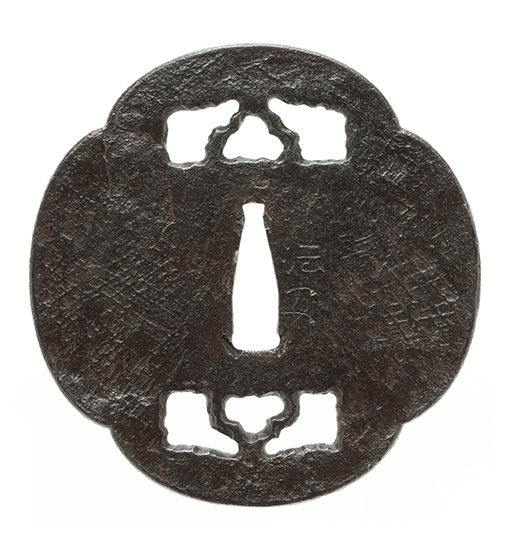
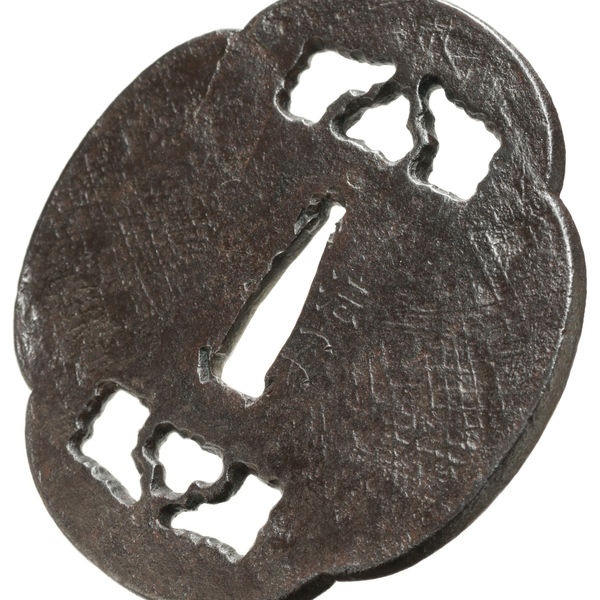
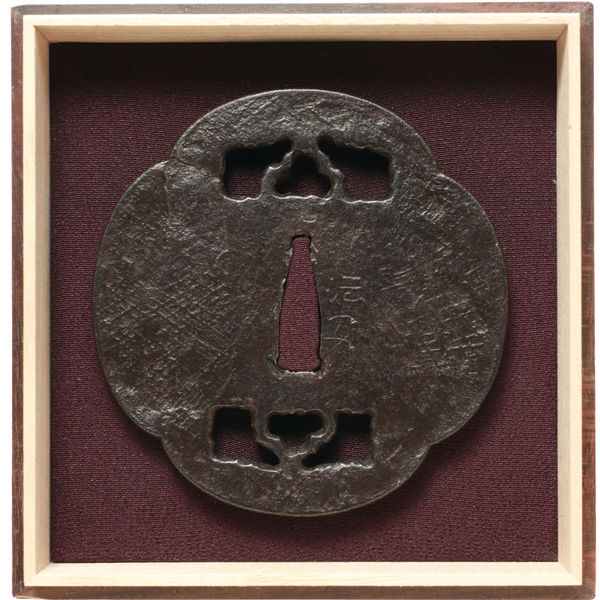
Iron-tsuba · Owari
Hōan (法安) signed his iron tsuba with the two characters of his name alone, and the published sources give him a full biography. He was an armour and weapon smith (bugu-kaji) of Kiyosu in Owari, whose personal name was Kawaguchi Saburōemon. Retained as a craftsman by the Asano family, he lived first at Fuchū in Kai and then at Wakayama in Kii, and he died on the twentieth day of the fifth month of Keichō 18 (1613), with the posthumous name Honpōin Sōan Nisshin Koji. His son-in-law Hisatsugu and others moved to Hiroshima in Aki with the Asano transfer in the Genna years, and the family graves are therefore at Kokuzen-ji in Hiroshima. The five designated guards under his name date from the end of the Muromachi period into the Momoyama age.
The published sources place him with Yamakichi and Nobuie among the Owari tsuba makers who left signed work and whose manners have much in common. Of the three they write that his work is somewhat more technical than Nobuie's and a step more polished than Yamakichi's[[c:1]]. Wheel openwork (kuruma-sukashi) is often seen in both Hōan and Yamakichi, and in both the iron bones (tekkotsu) are revealed with a bold, vigorous effect[[c:2]]. The commentary adds that his name stands high because of his fine wheel-openwork guards.
His art begins in the plate itself. His iron is so famed for its toughness that it carries the nickname uwabami-tetsu, giant-serpent iron (「うわばみ鉄」と異称されるほど手強さに定評がある). On the designated guards it is described as viscous and dense, with the forging texture coming up here and there with a lively movement. A round wheel-openwork guard of twelve openings has a thick rim in the manner of a dote-mimi and shows the beauty and strength of well-forged iron, with tekkotsu appearing at many points. The published sources note that the openwork is cut by an unforced, straightforward carving method.
His particular technique is yakite-kusarashi, a fired and deliberately corroded finish that sets the design in a living texture. On a vertical-round guard the Six-Character Invocation is raised on one face and the Seven-Character Daimoku on the other, in what the published sources call the kusarashi-te manner, while the hammered surface and small openings deepen its elegance. On a wheel-openwork guard he uses the same method to show a long-eared rabbit at the rim, with a touch of gold inlay. Elsewhere it brings shifting effects across the flat of the plate.
Amida-yasuri, file marks radiating from the centre, is his other device. On one round guard the parts not pierced with the wheel are filed in Amida-yasuri. The published sources find the balance between the two delightful, call both composition and carving outstanding, and note the gloss and moist lustre particular to Hōan[[c:3]], together with a large, solid seppa-dai. A variant eight-lobed guard with the Daimoku is filed in Amida-yasuri overall, and its richly varied rim becomes a landscape in its own right. Of it they write that within one tsuba a world particular to Hōan is brought into being[[c:4]].
All five of his designated works are Juyo tsuba, signed with the bare name. The published record gives no provenance for them and names no institution that holds them. They were designated from private collections, and an example comes to market only occasionally. The published sources recite the same Kiyosu biography for every signed piece and do not divide the name into generations. A collector meets him in the wheel-openwork guards on which his reputation rests and in the corroded, Amida-filed plates that show his technique.
Where Hoan stands among comparable artisans: across all of nihontō, and within tradition, era, and period. The tiers (Foremost · Leading · Major · Notable) weigh official designations from the NBTHK and Japan's Agency for Cultural Affairs, together with historical honors of lasting repute such as the Sansaku and Meibutsu-chō.
Select a lens to see how it's measured.
Iron-tsuba · Owari
3 pieces on the market now
The Hoan school takes its name from its founder Hoan (法安), whose personal name was Kawaguchi Saburuemon, an arms-smith (bugu-kaji) active in Kiyosu, Owari Province, from the late Muromachi into the Momoyama period. Originally an armorer by trade, Hoan entered the service of the Asano family as a retained craftsman, residing successively at Kofu in Kai Province and at Wakayama in Kii Province before his death on the twentieth day of the fifth month of Keicho 18 (1613). His posthumous Buddhist name was Honpoin Soan Nisshin Koji. " Within this triad, Hoan is distinguished as "somewhat more technical in execution" than Nobuie and "a step more polished and sophisticated" than Yamakichi[[c:2]]. Following Hoan's death, his son-in-law Hisatsugu relocated to Hiroshima in Aki Province during the Genna era in connection with the Asano family's transfer of fief, establishing the Hiroshima branch of the lineage; the family cemetery remains at Kokuzen-ji Temple in that city. Hoan's plate iron was celebrated for its extraordinary toughness, "to the extent that it was also known by the epithet uwabami-tetsu" ("great-serpent iron").
Across the designated corpus, this iron is described as possessing a distinctive "viscous" (nettori) and tenacious character, with the forged texture (kitae-hada) emerging "here and there with lively animation" and tekkotsu (iron bones) appearing prominently at the surface. " This technique was deployed both for surface treatment across the ji and for the depiction of figural subjects, as in the long-eared rabbit rendered at the rim of one designated tsuba. Hoan's repertoire further embraced kuruma-sukashi (wheel openwork), amida-yasuri file-mark patterning employed as a deliberate design element, tsuchime-ji (hammered ground), and sukidashi-bori (raised carving). " The Hoan school occupies a position of high regard within the Owari iron-tsuba tradition. The NBTHK observes that "because there exist fine examples of kuruma-sukashi, the name Hoan is held in high regard[[c:4]]," and the designated works consistently display what the examiners characterize as a unique artistic world realized within a single tsuba. Learn more →
| Smith | Era | Designated |
|---|---|---|
| Hoan法安 | — | 5 |
| Hoan法安 | — | 0 |
| Kanenobu兼信 | — | 0 |
| Hisatsugu久次 | — | 0 |
A Hozon-certified fitting of notably superior craftsmanship and condition, often with signature or workmanship of high reference value.
The NBTHK (Nihon Bijutsu Tōken Hozon Kyōkai, the Society for the Preservation of Japanese Art Swords) is a public-interest incorporated foundation founded in 1948 and supervised by Japan’s Agency for Cultural Affairs (Bunkachō); it is based at the Japanese Sword Museum in Tokyo. Its expert panels physically examine each submitted work (shinsa) and issue a certificate (kanteishō) ranking it by artistic and historical merit. NBTHK papers are the most widely recognized standard of authentication for Japanese swords and fittings.
NBTHK official siteIf, due to our fault, the item differs significantly from its proper condition, the item may be returned. Cooling-off is within one week of the item's arrival.