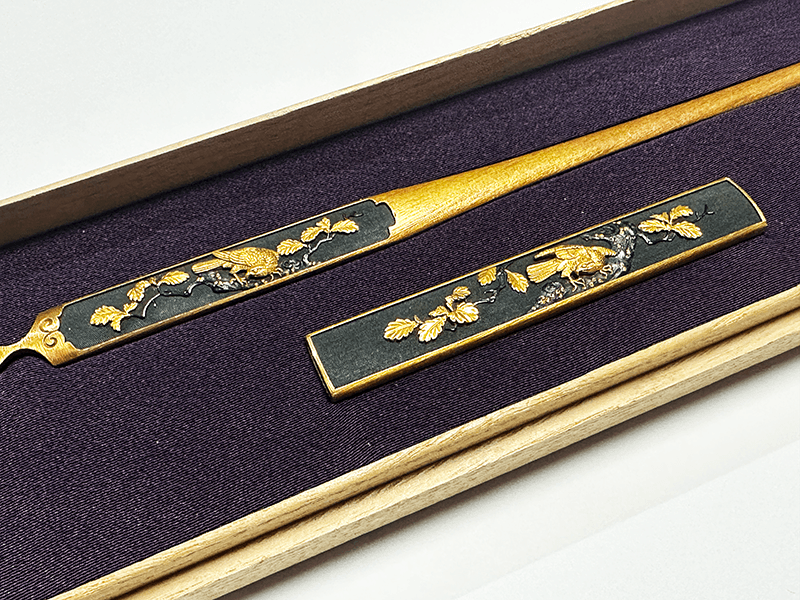
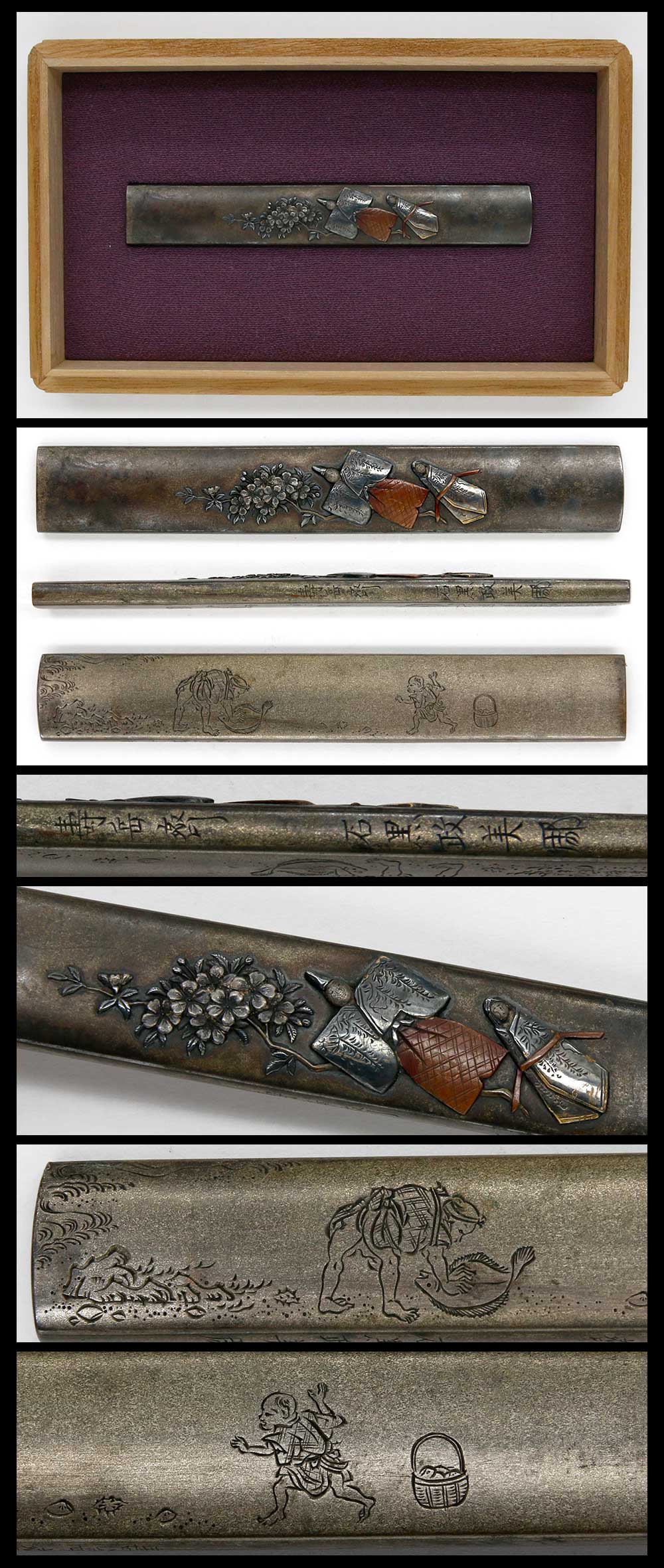
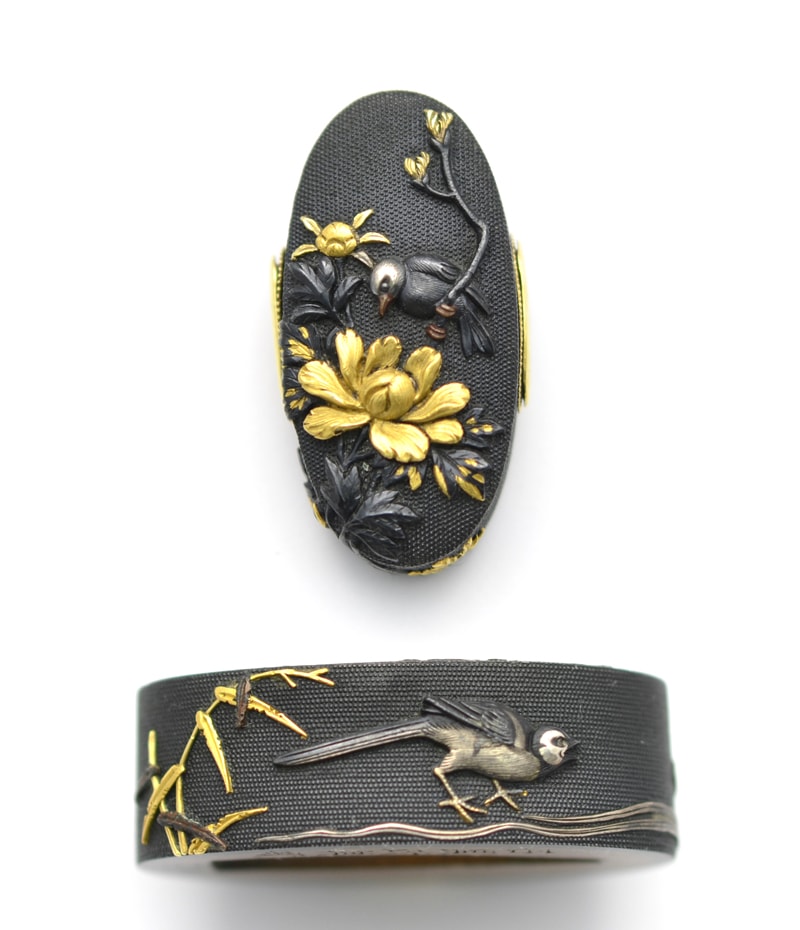
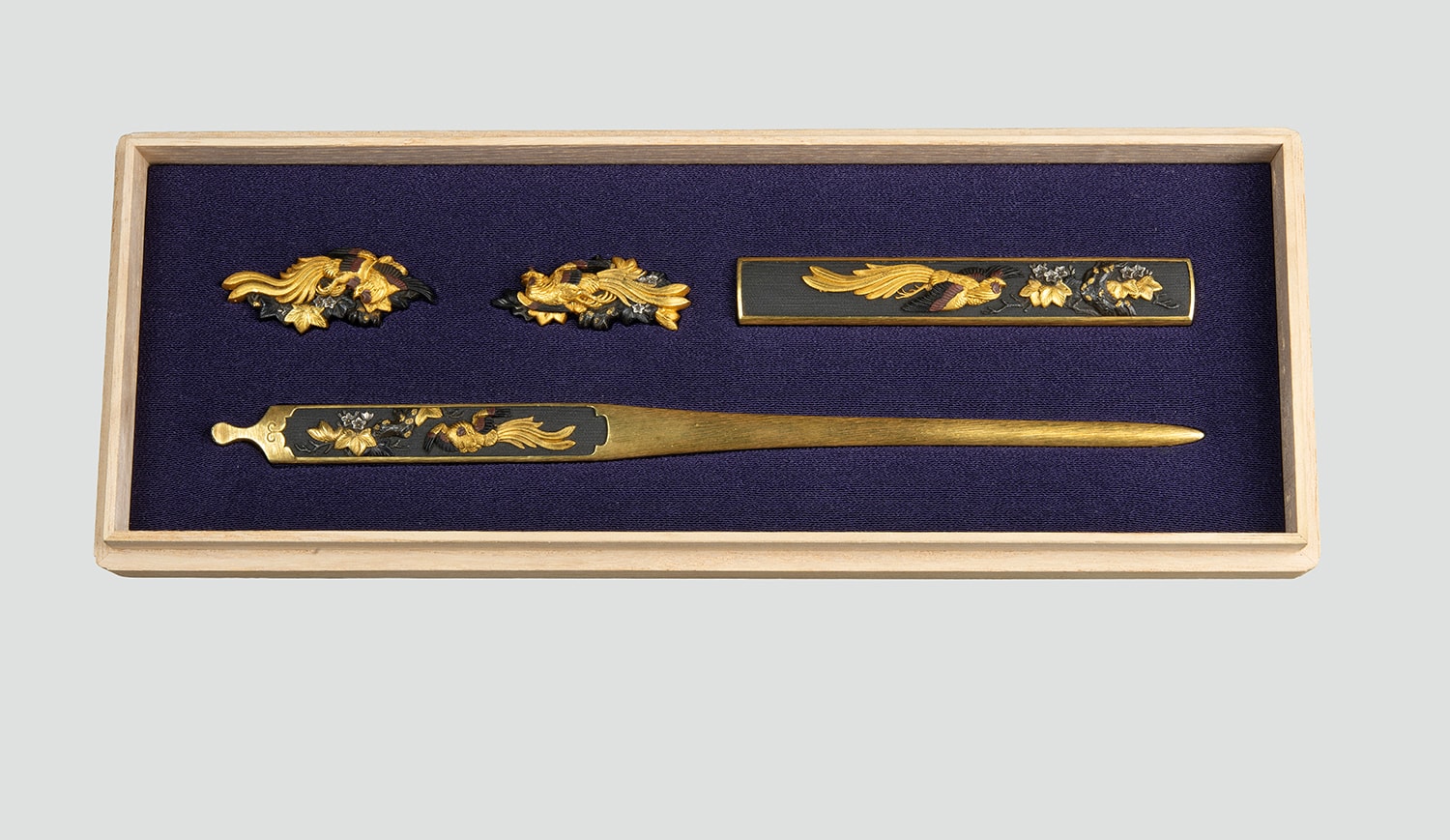
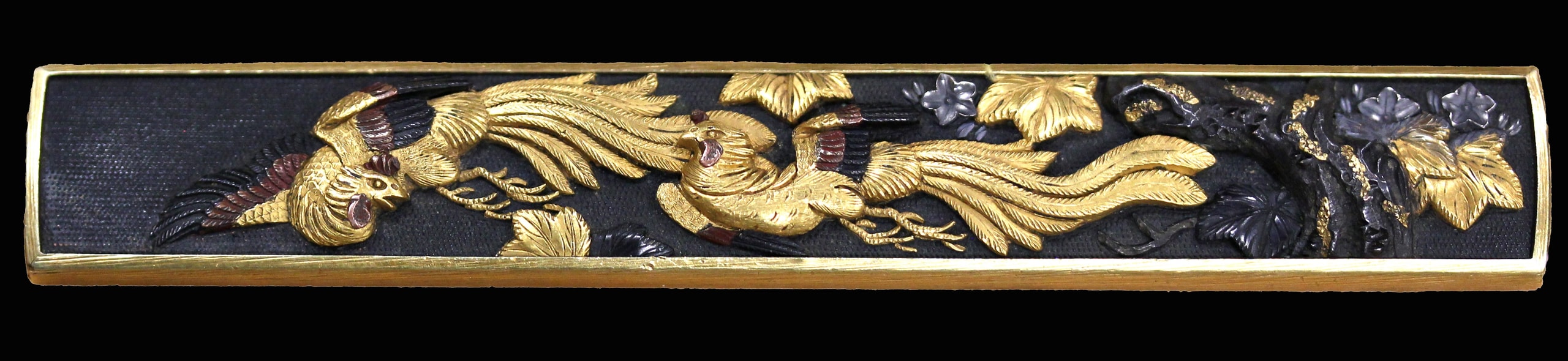
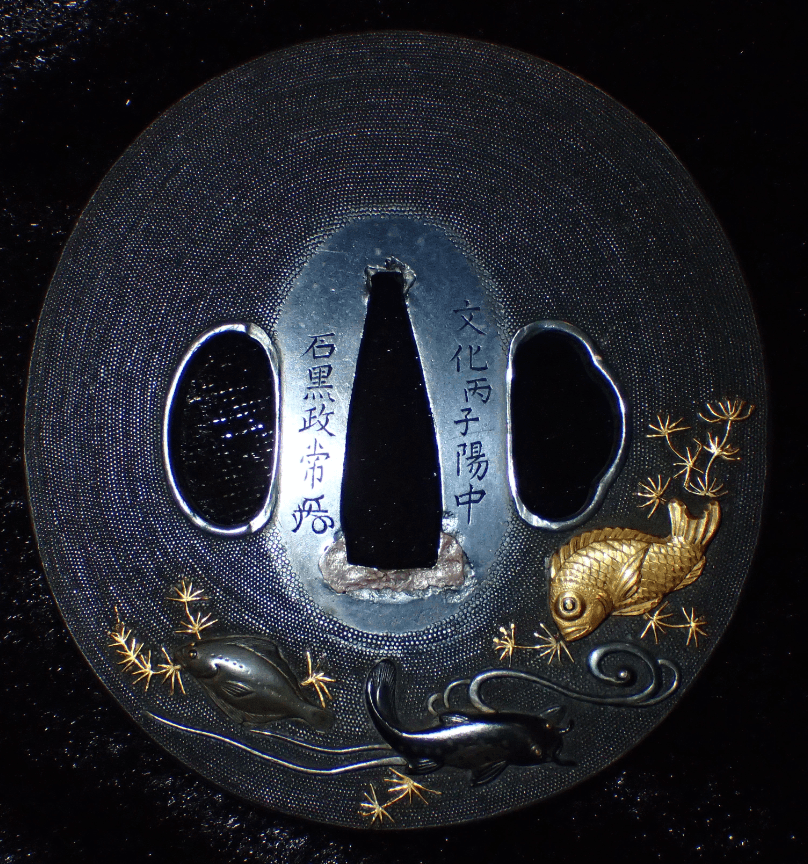
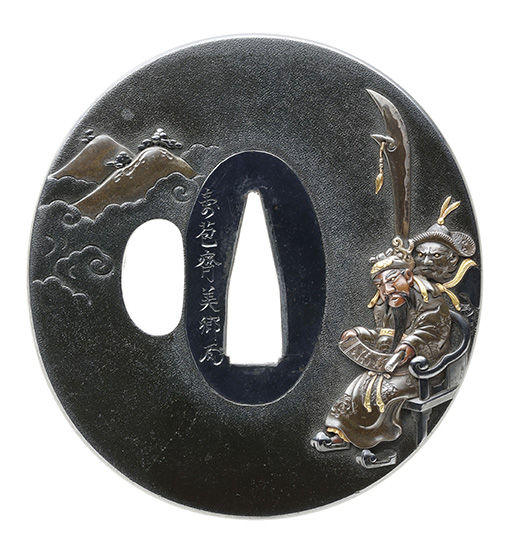
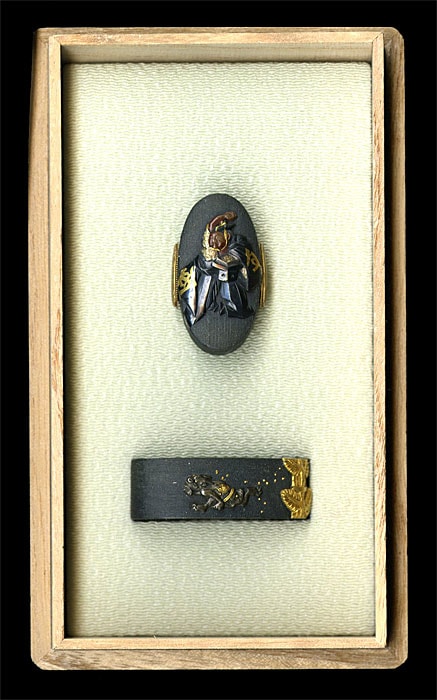
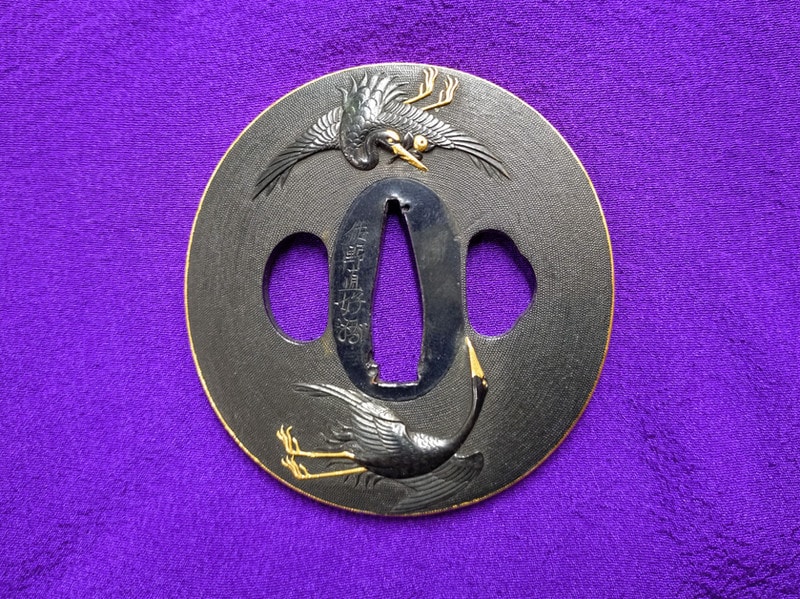
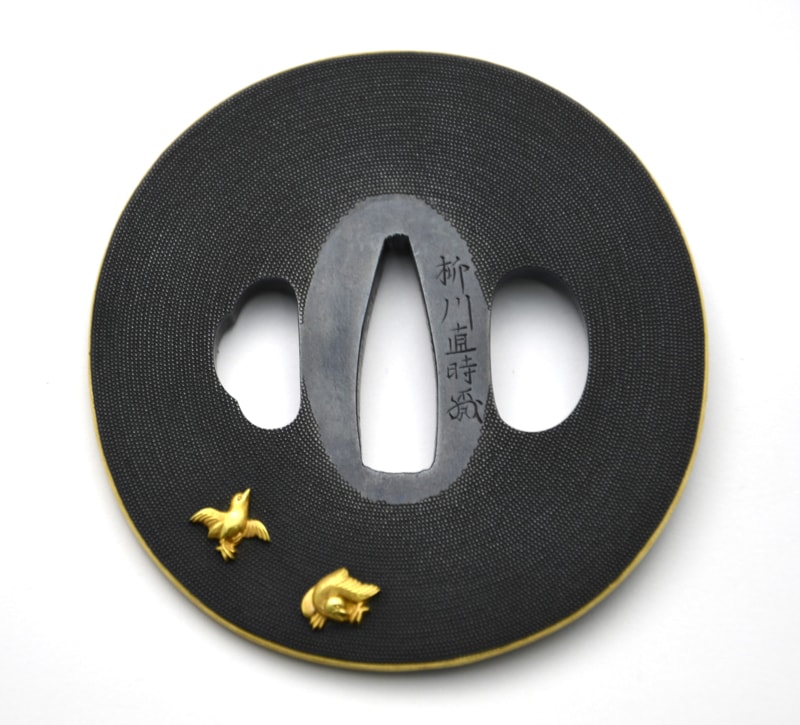
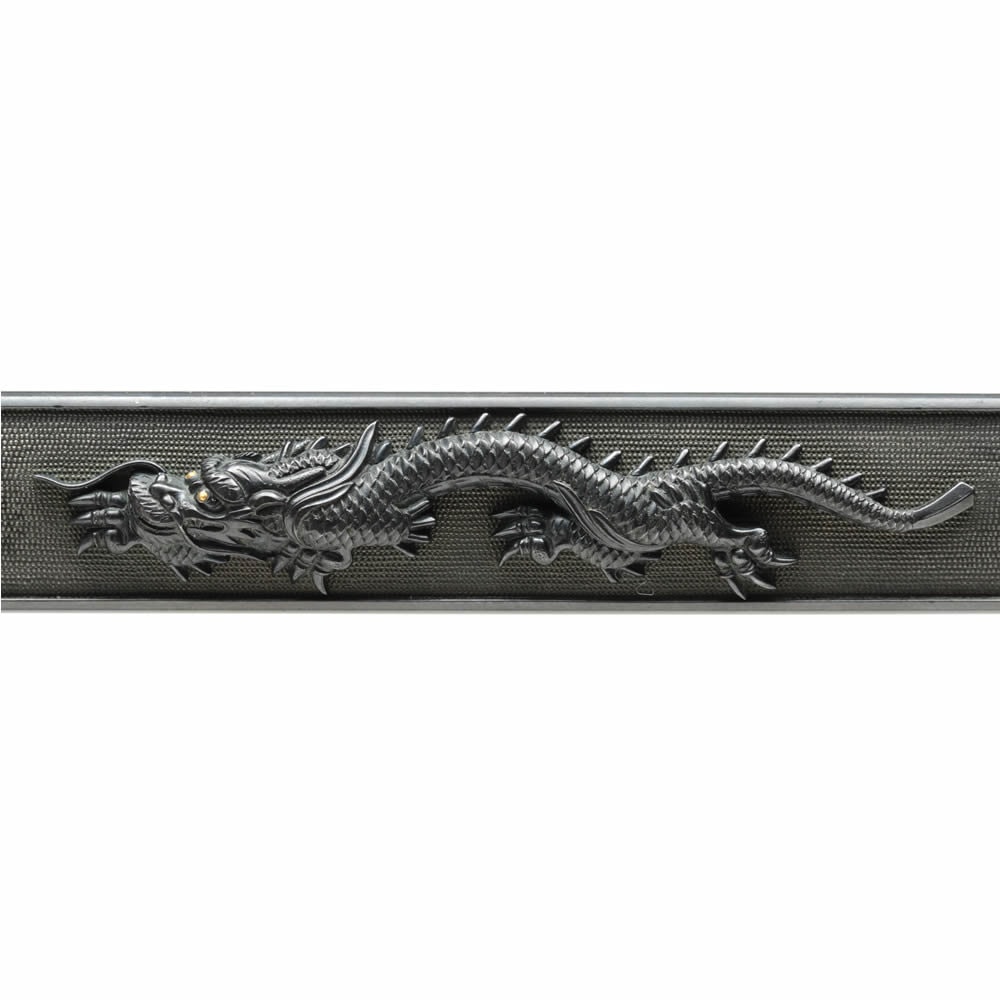
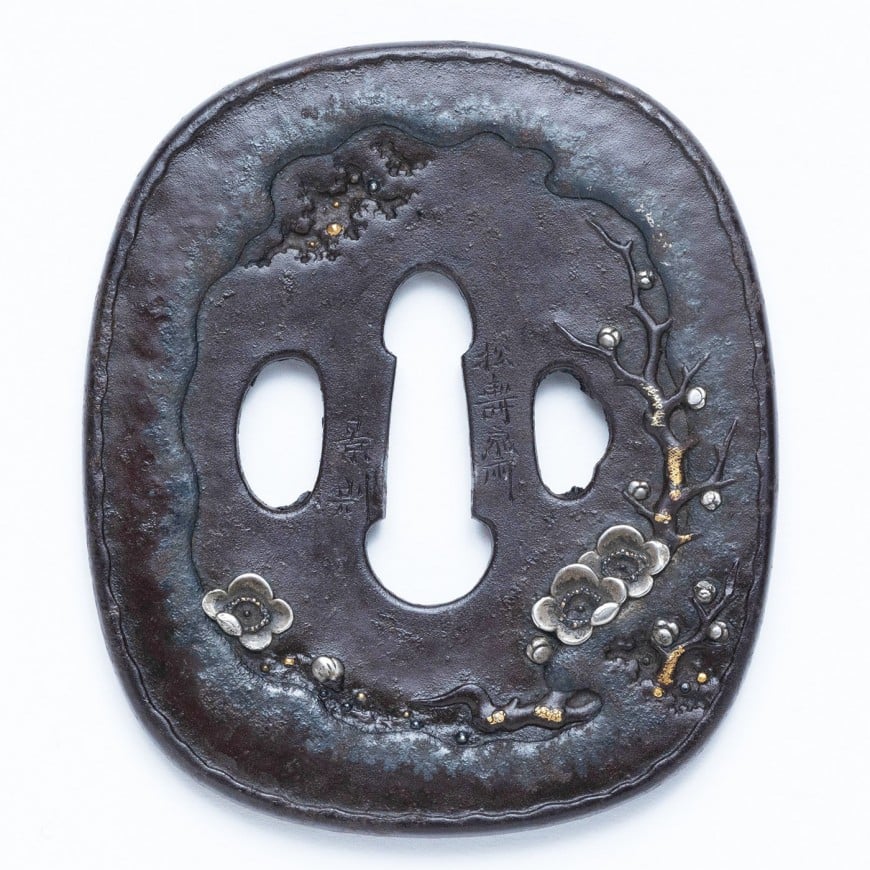
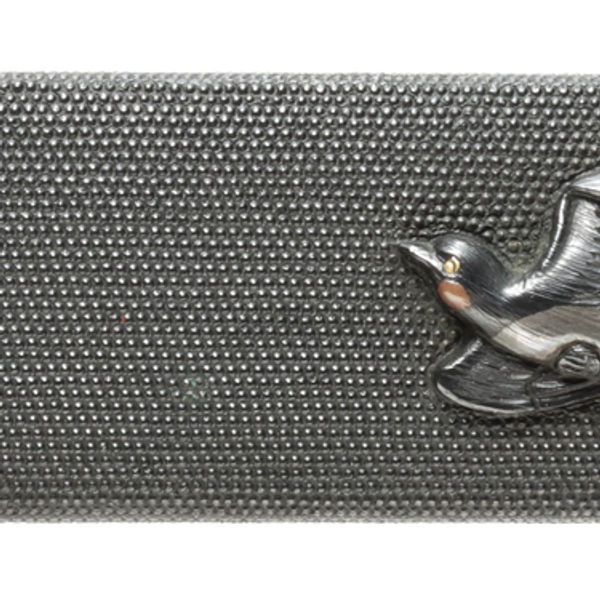
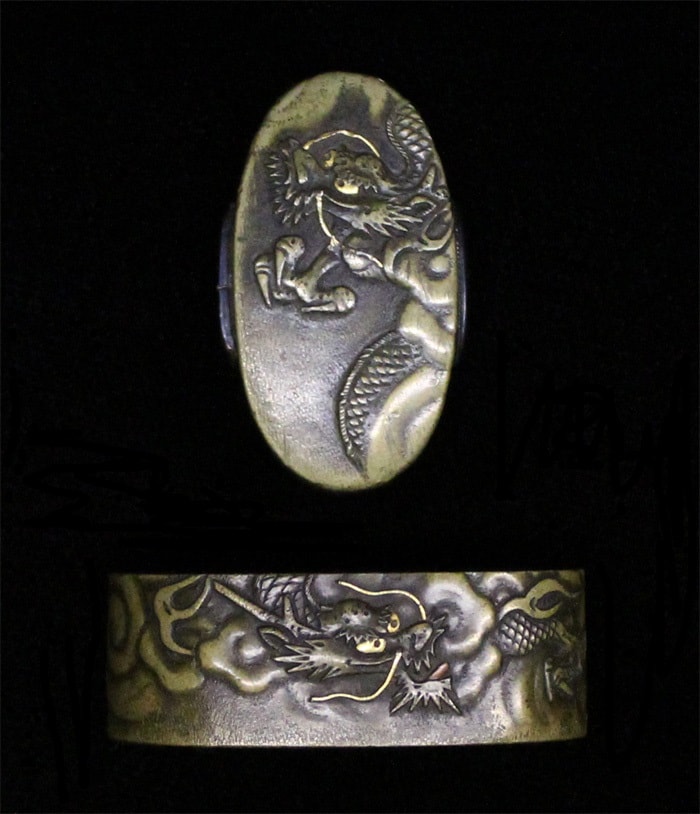
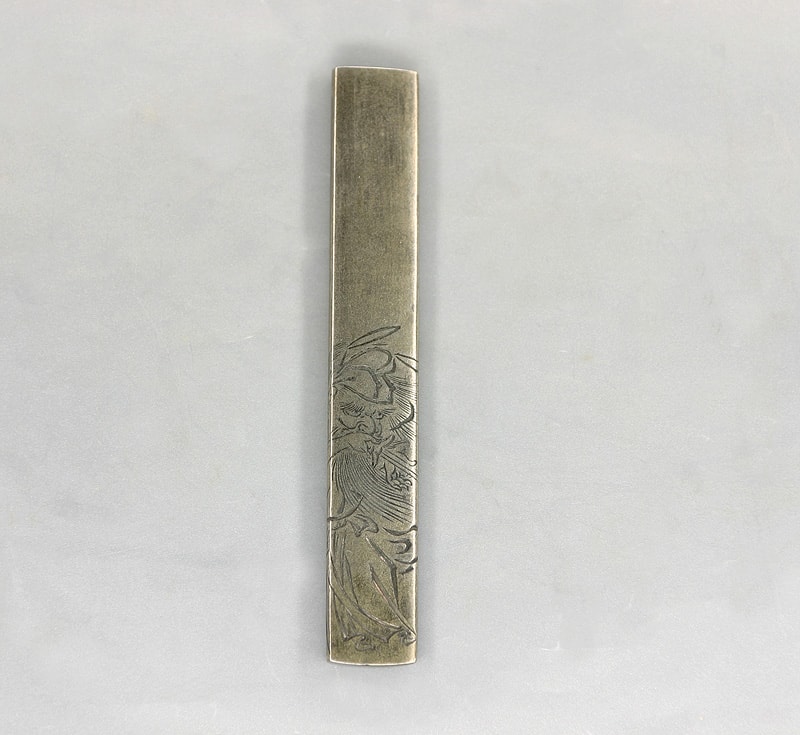
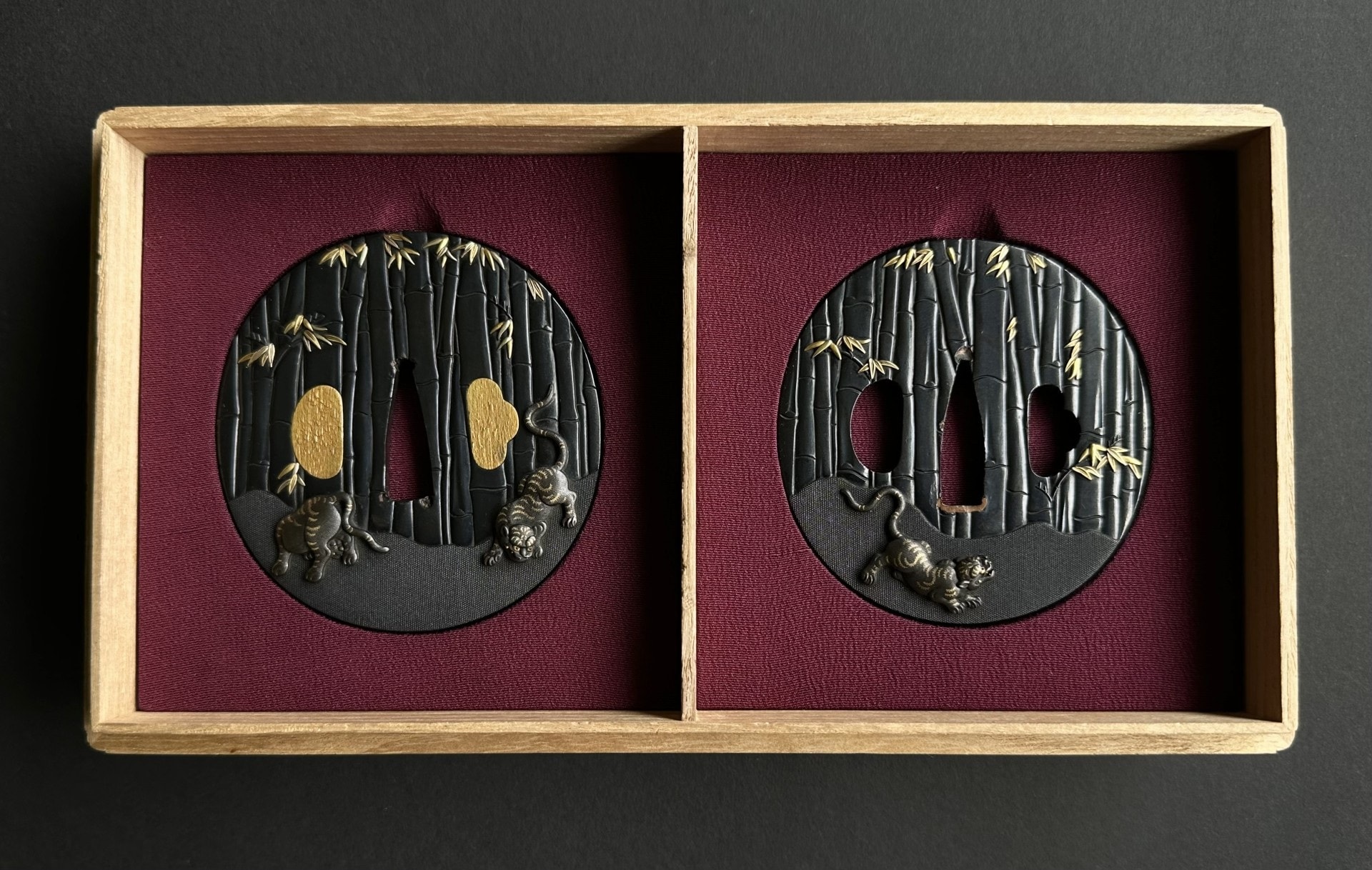
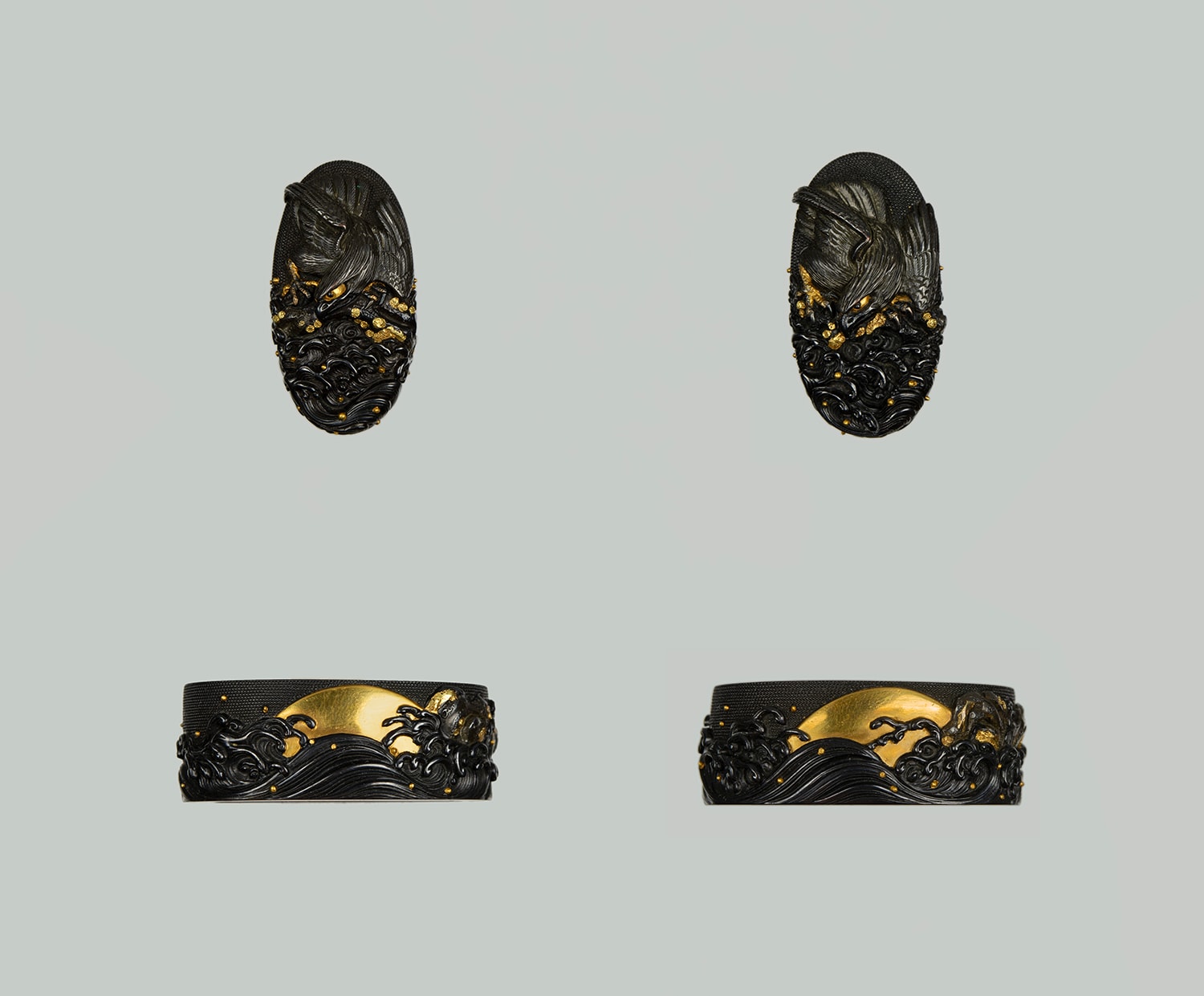
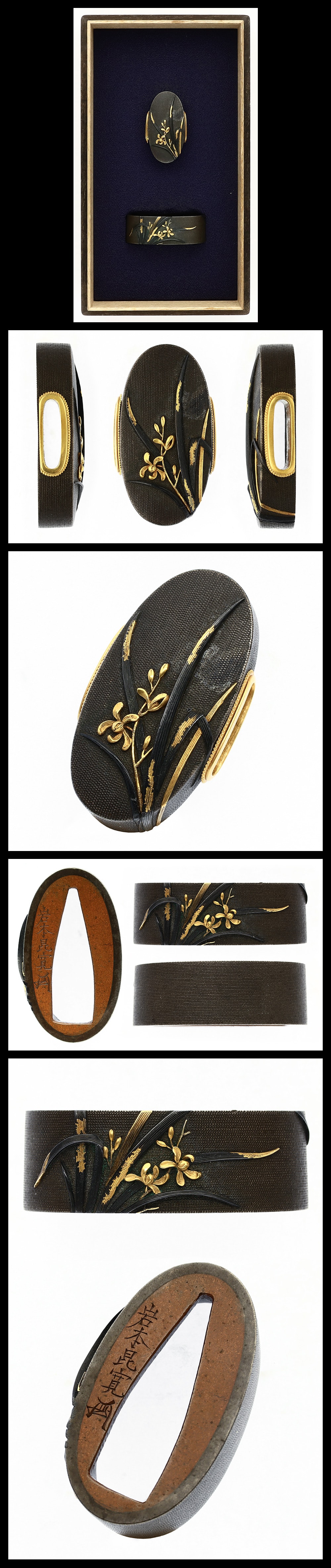
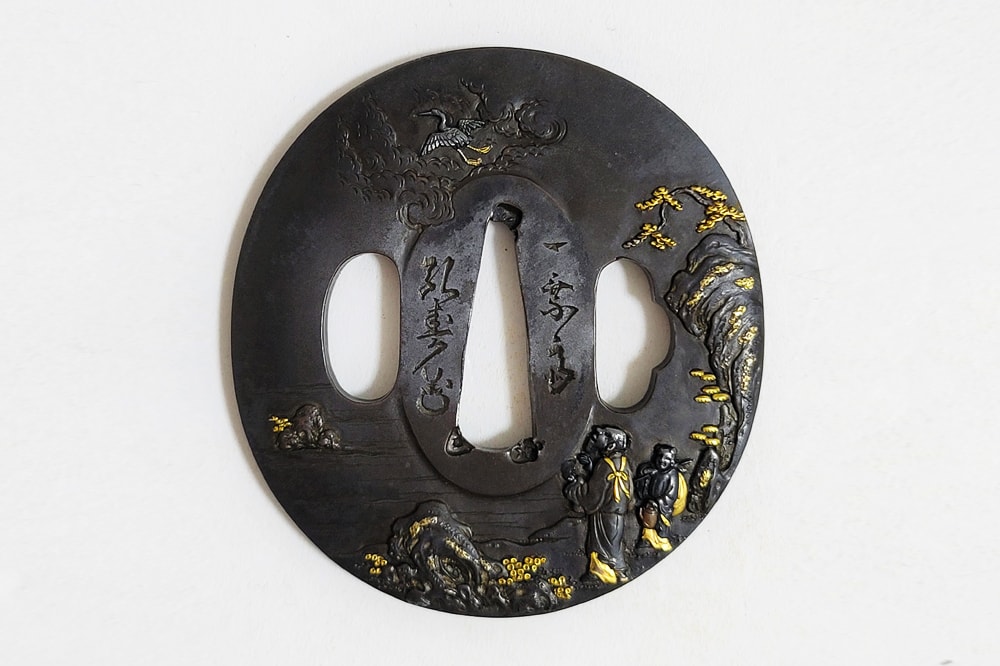
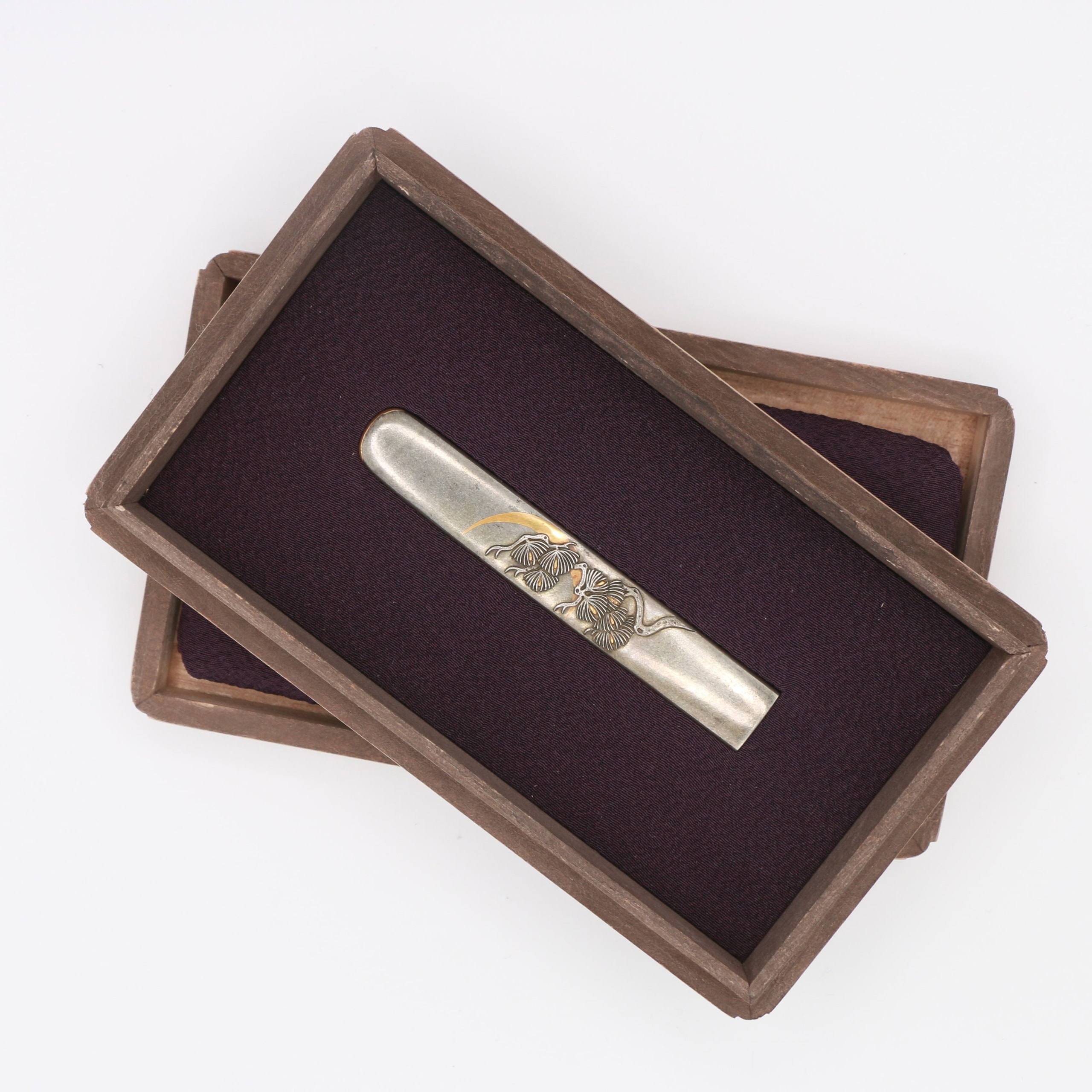
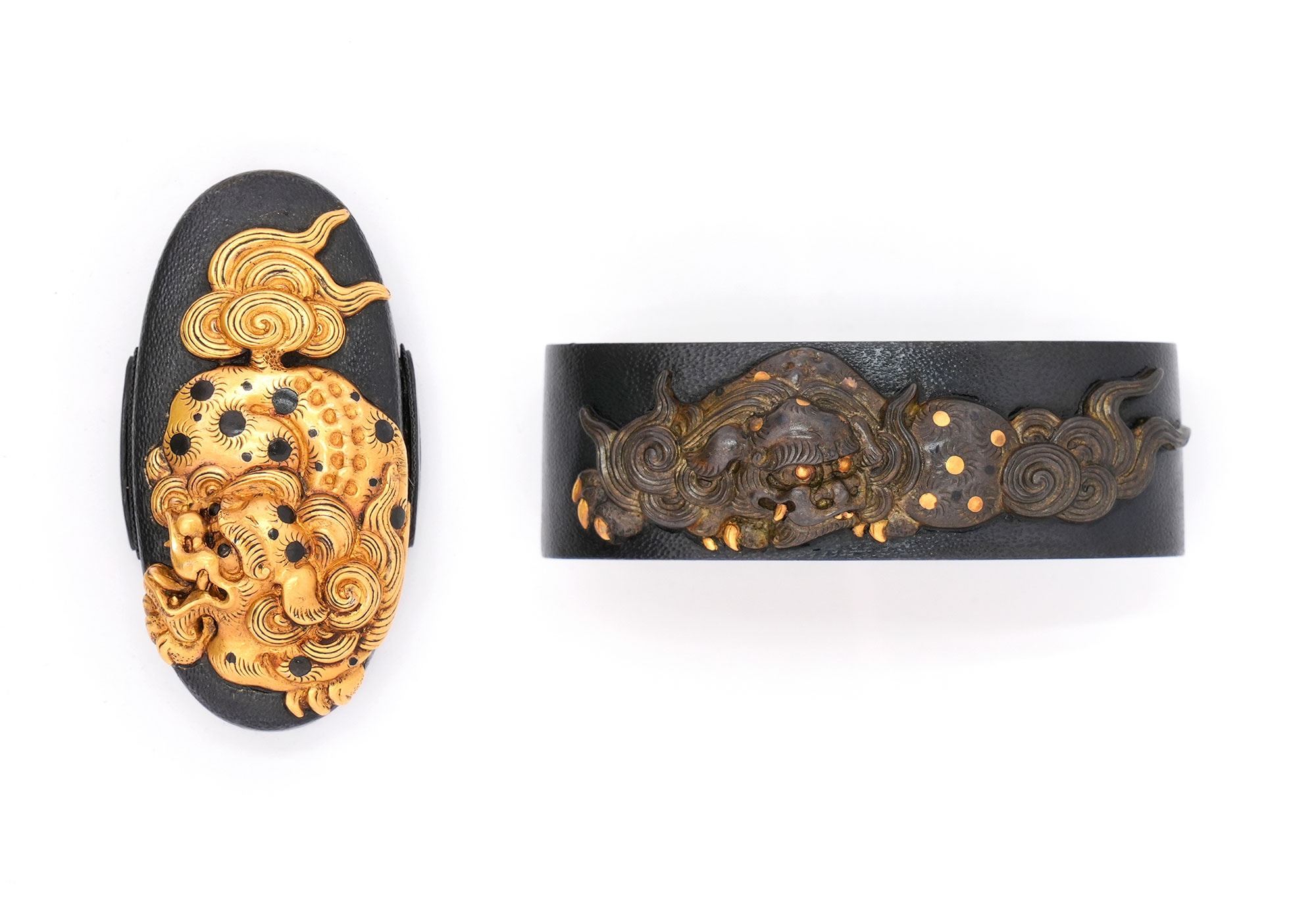
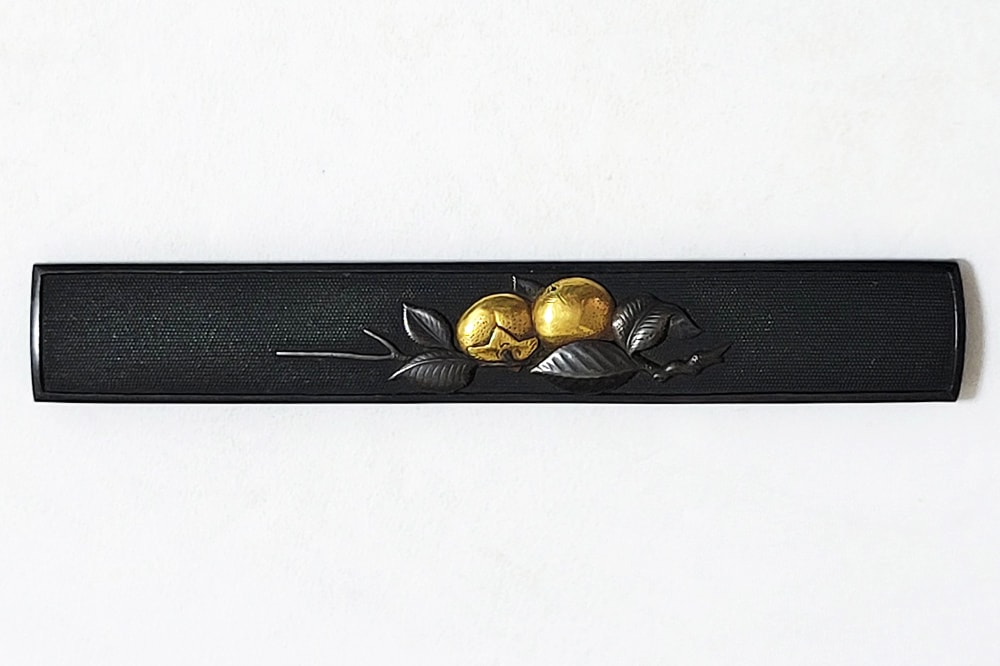
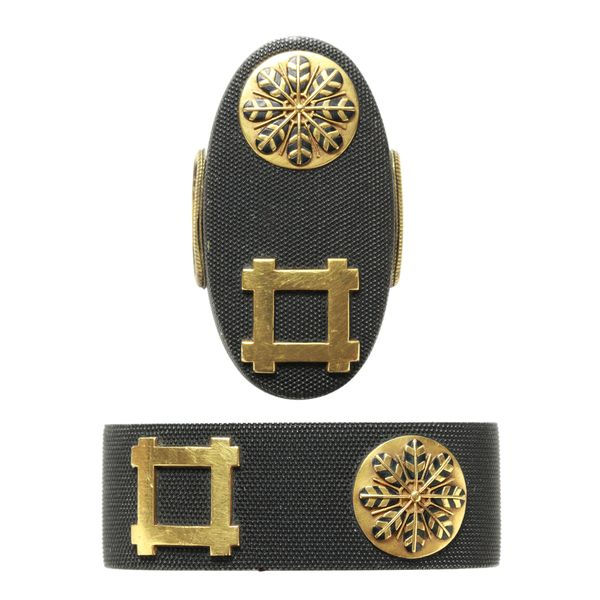
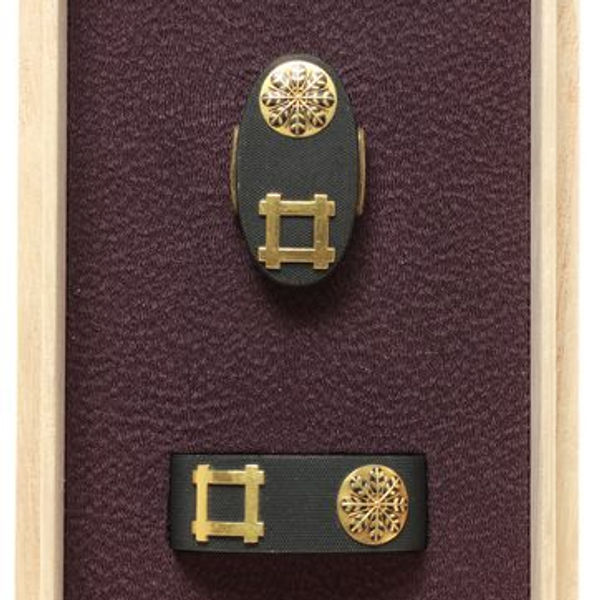
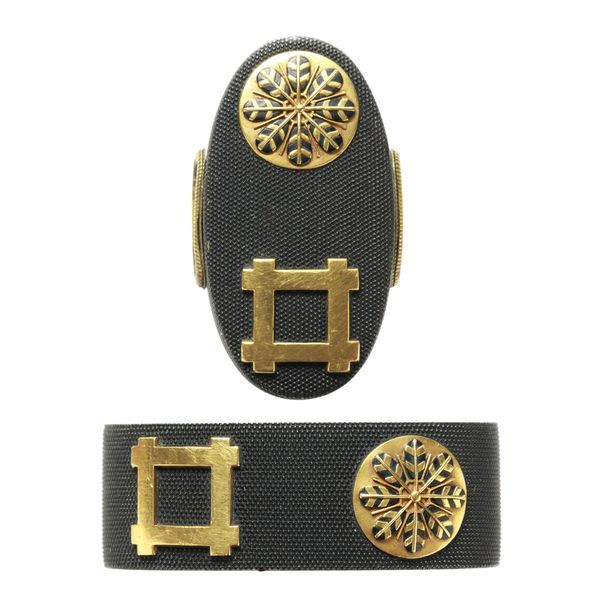
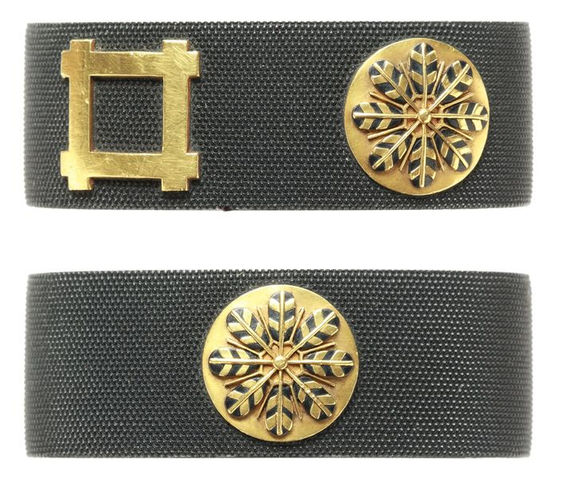
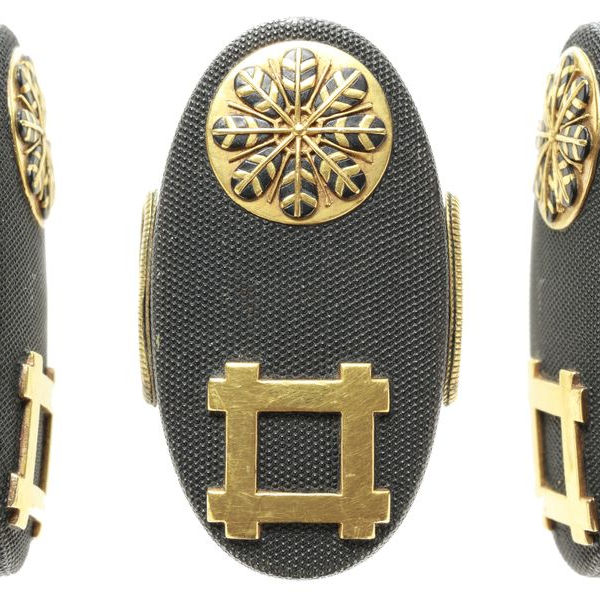
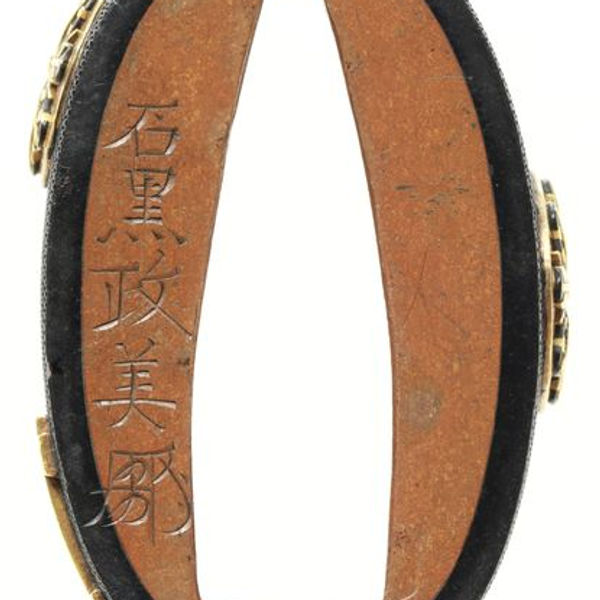
This fuchi-kashira features the family crests (Inoue Takanoha-mon and Hira Izutsu-mon) of the Inoue family of Takaoka Domain. Crafted by the master Ishiguro Masayoshi, it showcases finely executed takabori kin-iroe (high-relief gold coloring) crests on a shakudo nanako ground, creating a beautiful contrast between the jet black and gold. It comes with a Tokubetsu Hozon certificate.
 NihontoWatch
mei · Ishiguro · Edo
Ishiguro
Edo
Musashi
Signed
Tokuho (NBTHK)
Machibori · Musashi
4 pieces on the market now
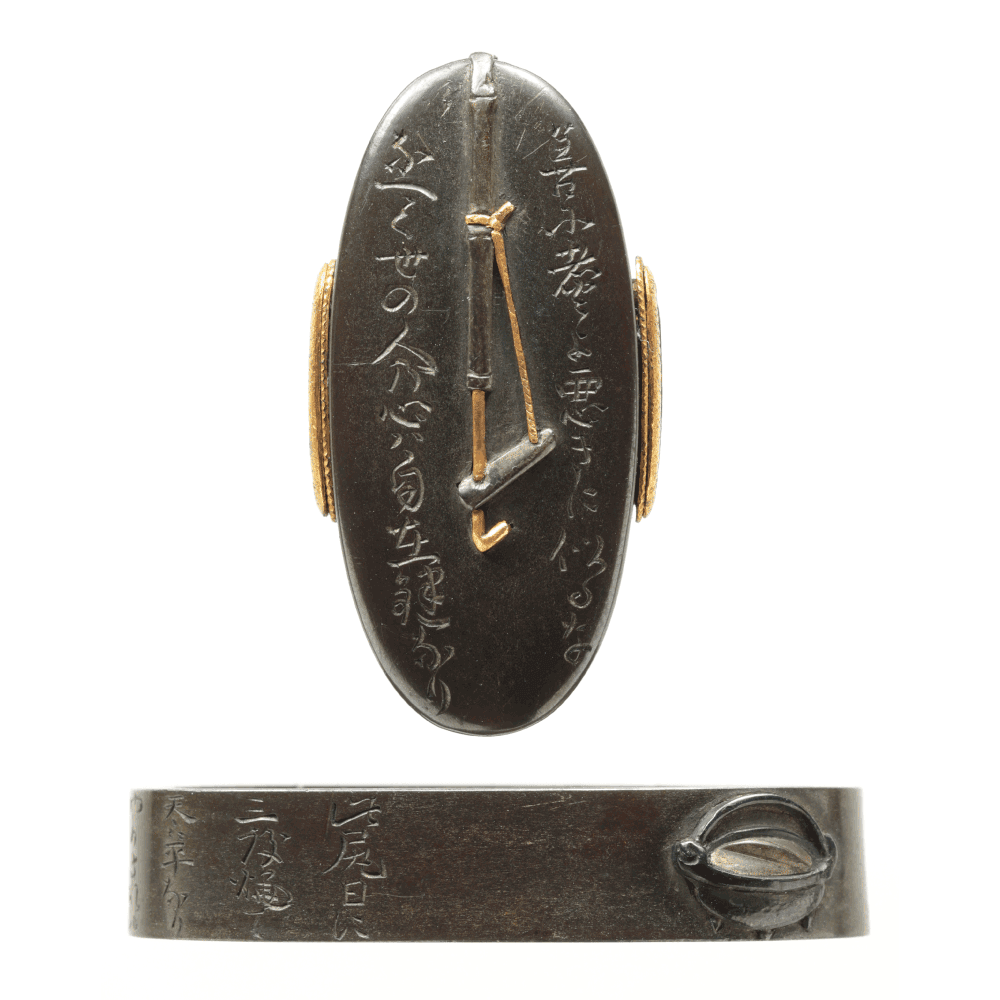
Ishiguro Masayoshi (石黒政美), also read Masami, was a preeminent master of the Ishiguro school, a distinguished lineage of Edo-period metalworkers descended from the Yokoya tradition. Born in An'ei 3 (1774), his common name was Shōzō, and he employed a succession of art names including Jugakusai, Jukakusai, Juōsai, and Juō. He first trained under Sano Naoyoshi of the Yanagawa school before entering the atelier of Ishiguro Masatsune, the founder of the Ishiguro house. In tribute to both teachers, he derived his art name by taking one character from each master's name and substituting the character mi (美) for yoshi (好), thus arriving at Masayoshi (政美). Extant works bearing the inscription "Third-generation Ishiguro Masayoshi"[[c:1]] confirm that he succeeded as the third head of the family following the second Masatsune. Within the school he was celebrated alongside his fellow pupil Masaaki as forming a "matched pair" of supreme ability, and he trained numerous disciples who carried the Ishiguro manner into the late Edo period.
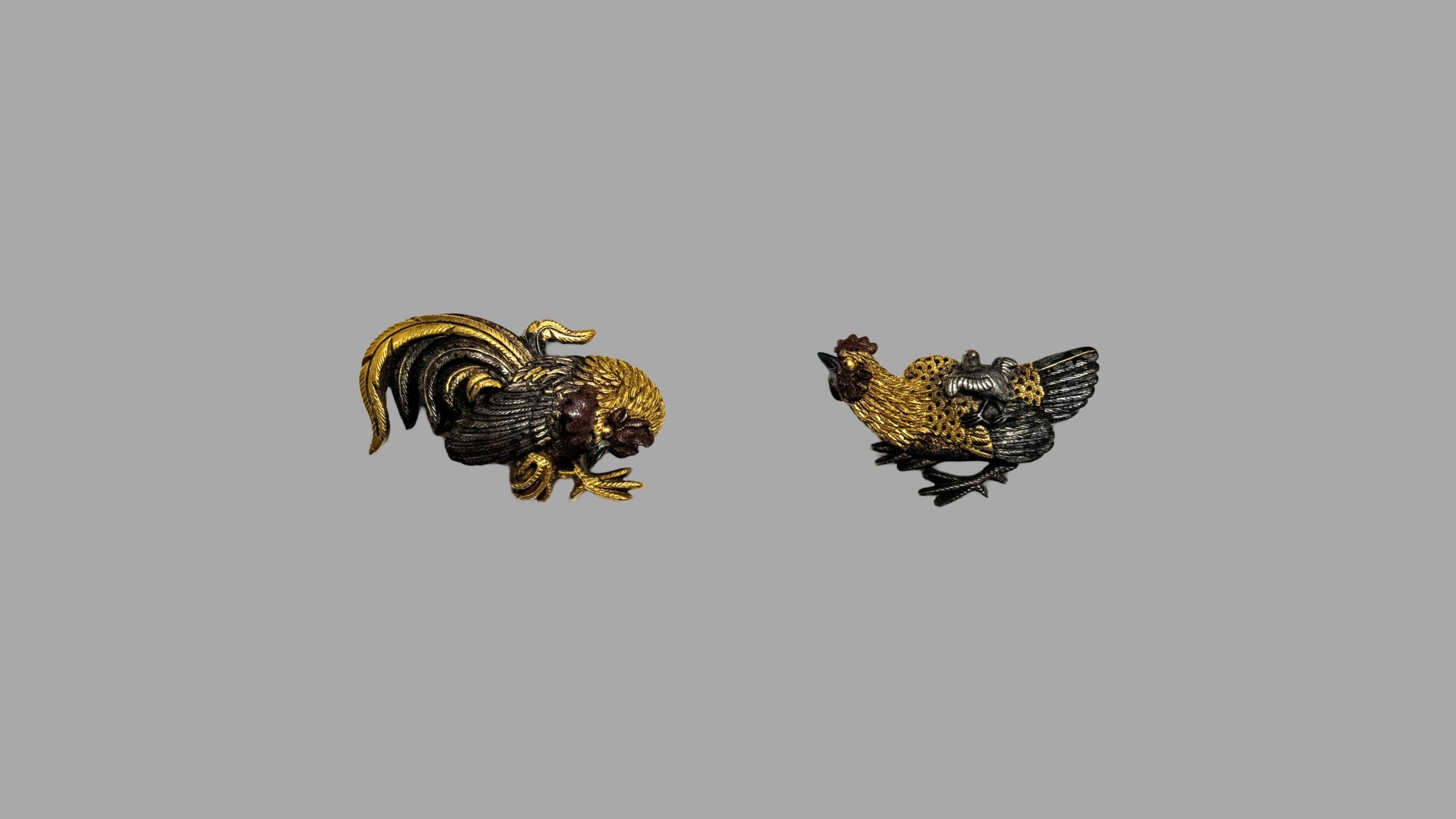
Masayoshi's technical command encompassed the full repertoire of the Ishiguro school's metalworking vocabulary. His preferred format was a shakudō ground finished in dense nanako-ji upon which elaborate pictorial compositions were built through takabori executed as applied motifs in the suemon technique, enriched with lavish polychrome iroe employing gold, silver, shibuichi, and scarlet copper (hiirōdō). His tsuba, fuchi-kashira, kozuka, kōgai, and menuki frequently formed unified suites—soroi kanagu or complete issaku sets—demonstrating rigorous thematic coherence across every fitting. While the school's signature kachō-zu (flowers-and-birds) subjects predominated, Masayoshi proved equally commanding in martial themes: hawks poised on rocks above raging torrents, raptors fixed upon prey amid aged pines, and dragon-and-tiger compositions rendered through varied relief techniques from sukidashi-bori through rounded modeling to full high relief. He also worked with distinction on shibuichi migaki-ji and ishime-ji grounds, and produced refined katakiribori and kebori line-engraving on solid-gold fittings, as seen in his celebrated "Four Gentlemen" aikuchi suite. His works inscribed at the age of seventy-seven and seventy-eight confirm an undiminished creative intensity sustained across decades.
Masayoshi occupies a central place in the history of late Edo metalwork as the artist who brought the Ishiguro school's painterly idiom to its fullest expression. His compositions reveal a pictorial intelligence that extends beyond virtuoso carving: front and reverse surfaces are linked through continuous branches and contrasting water motifs, male and female birds are paired with deliberate compositional care, and the interplay of a-un expression lends narrative depth to each scene. The NBTHK examiners have repeatedly noted that his finest pieces represent works in which "Masayoshi's full capabilities are brought to fruition,"[[c:2]] praising both the steadfast precision of his chisel work at the smallest scale and the monumental presence of his high-relief compositions. Whether rendering the opulent splendor of peacocks with peonies or the austere nobility of a solitary hawk upon iron, Masayoshi demonstrated a range and mastery that secured his standing as one of the foremost tōsōgu artists of the late Tokugawa period.
Where Masayoshi stands among comparable artisans: across all of nihontō, and within tradition, era, and period. The tiers (Foremost · Leading · Major · Notable) weigh official designations from the NBTHK and Japan's Agency for Cultural Affairs, together with historical honors of lasting repute such as the Sansaku and Meibutsu-chō.
Select a lens to see how it's measured.
Machibori · Edo
21 pieces on the market now
The Ishiguro school was founded by Ishiguro Masatsune, born in Horeki 10 (1760), who trained under Kato Naotsune and Yanagawa Naomasa within the broader Yokoya lineage before establishing an independent atelier that would become one of the most celebrated machibori ("town carving") workshops of the late Edo period. Masatsune combined one character from each teacher's name to form his professional identity, and under the art name Togakushi he attracted a succession of gifted pupils -- Masayoshi, Masaaki, Koretsune (his eldest son), Koreyoshi, Masahide, and Masahiro -- who carried the school's distinctive manner through the final decades of the Tokugawa period and into the Meiji era. Centered in Edo, the Ishiguro lineage operated within the machibori sphere, producing fittings for discerning warrior-class and merchant patrons rather than under the hereditary commissions of the Goto iebori tradition, a commercial independence that fostered pictorial ambition and technical innovation. The collective technical identity of the Ishiguro school is defined by a painterly naturalism executed through takabori upon shakudo nanako-ji grounds, enriched by lavish polychrome iroe employing an unusually wide palette of colored metals -- gold, silver, shibuichi, suaka (scarlet copper), oborogin, and hi-irodo. The school's signature subjects are kacho-zu (flowers and birds), rendered with a naturalistic, sketch-like fidelity grounded in close observation from life. Masatsune established this direction, transforming the Yanagawa manner into a personal idiom centered on birds of prey and bird-and-flower compositions that became the hallmarks of the house. His works are characterized by an "honest, finely detailed manner" and a "clear and limpid spirit" achieved through masterful use of open space. Masayoshi, who succeeded as third head, brought the school's painterly idiom to its fullest expression: front and reverse surfaces are linked through continuous branches and contrasting water motifs, male and female birds are paired with deliberate compositional care, and the interplay of a-un expression lends narrative depth to each scene.
His compositions on iron migaki-ji grounds demonstrate equal command, with kin-sunago zogan evoking atmospheric haze. " Koretsune served as vital link between the founder and the school's later flourishing, with takabori described as "dignified and sumptuous, yet steadfast and reliable," and a command of perspective achieved by subtly modulating surface depth. Koreyoshi, credited with ability "surpassing that of his father" Masayoshi, brought the school's character to its fullest late-period expression, producing work likened to the nishiki-e color woodblock prints of the age. The Ishiguro school's significance within the tosogu canon rests upon its transformation of the Yokoya-Yanagawa classical discipline into a pictorial art of extraordinary chromatic richness and compositional sophistication. Where earlier metalworking traditions relied predominantly on monochrome shakudo or gold tonalities, the Ishiguro masters deployed polychrome iroe with a sumptuousness "that never lapses into vulgarity" -- a balance of brilliance and restraint that defines the school's aesthetic. Masatsune's founding generation retained a martial vigor suited to warrior taste that distinguished his work from the "more purely ornamental output of later Ishiguro artists," while the successive generations of Masayoshi, Masaaki, and Koreyoshi progressively refined the school's decorative vocabulary toward an opulence that mirrored the cultural efflorescence of the Bunka-Bunsei era. Complete soroe-kanagu sets and unified issaku suites represent the school's highest achievement, demonstrating rigorous thematic coherence across every component of a mounting. The NBTHK has consistently praised the school's finest works as pieces in which "the Ishiguro school's distinctive character" is left "nothing unexpressed," and the tradition's enduring legacy is that of a workshop which, across four generations, brought the art of polychrome metalwork to its most accomplished and visually resplendent expression in Edo-period Japan. Learn more →
| Smith | Era | Designated |
|---|---|---|
| Masayoshi政美 | — | 29 |
| Masatsune政常 | — | 17 |
| Masaaki政明 | — | 19 |
| Koretsune是常 | — | 4 |
| Koreyoshi是美 | — | 4 |
A Hozon-certified fitting of notably superior craftsmanship and condition, often with signature or workmanship of high reference value.
The NBTHK (Nihon Bijutsu Tōken Hozon Kyōkai, the Society for the Preservation of Japanese Art Swords) is a public-interest incorporated foundation founded in 1948 and supervised by Japan’s Agency for Cultural Affairs (Bunkachō); it is based at the Japanese Sword Museum in Tokyo. Its expert panels physically examine each submitted work (shinsa) and issue a certificate (kanteishō) ranking it by artistic and historical merit. NBTHK papers are the most widely recognized standard of authentication for Japanese swords and fittings.
NBTHK official siteIf, due to our fault, the item differs significantly from its proper condition, the item may be returned. Cooling-off is within one week of the item's arrival.
This fuchi-kashira features the family crests (Inoue Takanoha-mon and Hira Izutsu-mon) of the Inoue family of Takaoka Domain. Crafted by the master Ishiguro Masayoshi, it showcases finely executed takabori kin-iroe (high-relief gold coloring) crests on a shakudo nanako ground, creating a beautiful contrast between the jet black and gold. It comes with a Tokubetsu Hozon certificate.
NihontoWatchmei · Ishiguro · Edo
Ishiguro
Edo
Musashi
Signed
Tokuho (NBTHK)
Machibori · Musashi
4 pieces on the market now
Ishiguro Masayoshi (石黒政美), also read Masami, was a preeminent master of the Ishiguro school, a distinguished lineage of Edo-period metalworkers descended from the Yokoya tradition. Born in An'ei 3 (1774), his common name was Shōzō, and he employed a succession of art names including Jugakusai, Jukakusai, Juōsai, and Juō. He first trained under Sano Naoyoshi of the Yanagawa school before entering the atelier of Ishiguro Masatsune, the founder of the Ishiguro house. In tribute to both teachers, he derived his art name by taking one character from each master's name and substituting the character mi (美) for yoshi (好), thus arriving at Masayoshi (政美). Extant works bearing the inscription "Third-generation Ishiguro Masayoshi"[[c:1]] confirm that he succeeded as the third head of the family following the second Masatsune. Within the school he was celebrated alongside his fellow pupil Masaaki as forming a "matched pair" of supreme ability, and he trained numerous disciples who carried the Ishiguro manner into the late Edo period.
Masayoshi's technical command encompassed the full repertoire of the Ishiguro school's metalworking vocabulary. His preferred format was a shakudō ground finished in dense nanako-ji upon which elaborate pictorial compositions were built through takabori executed as applied motifs in the suemon technique, enriched with lavish polychrome iroe employing gold, silver, shibuichi, and scarlet copper (hiirōdō). His tsuba, fuchi-kashira, kozuka, kōgai, and menuki frequently formed unified suites—soroi kanagu or complete issaku sets—demonstrating rigorous thematic coherence across every fitting. While the school's signature kachō-zu (flowers-and-birds) subjects predominated, Masayoshi proved equally commanding in martial themes: hawks poised on rocks above raging torrents, raptors fixed upon prey amid aged pines, and dragon-and-tiger compositions rendered through varied relief techniques from sukidashi-bori through rounded modeling to full high relief. He also worked with distinction on shibuichi migaki-ji and ishime-ji grounds, and produced refined katakiribori and kebori line-engraving on solid-gold fittings, as seen in his celebrated "Four Gentlemen" aikuchi suite. His works inscribed at the age of seventy-seven and seventy-eight confirm an undiminished creative intensity sustained across decades.
Masayoshi occupies a central place in the history of late Edo metalwork as the artist who brought the Ishiguro school's painterly idiom to its fullest expression. His compositions reveal a pictorial intelligence that extends beyond virtuoso carving: front and reverse surfaces are linked through continuous branches and contrasting water motifs, male and female birds are paired with deliberate compositional care, and the interplay of a-un expression lends narrative depth to each scene. The NBTHK examiners have repeatedly noted that his finest pieces represent works in which "Masayoshi's full capabilities are brought to fruition,"[[c:2]] praising both the steadfast precision of his chisel work at the smallest scale and the monumental presence of his high-relief compositions. Whether rendering the opulent splendor of peacocks with peonies or the austere nobility of a solitary hawk upon iron, Masayoshi demonstrated a range and mastery that secured his standing as one of the foremost tōsōgu artists of the late Tokugawa period.
Where Masayoshi stands among comparable artisans: across all of nihontō, and within tradition, era, and period. The tiers (Foremost · Leading · Major · Notable) weigh official designations from the NBTHK and Japan's Agency for Cultural Affairs, together with historical honors of lasting repute such as the Sansaku and Meibutsu-chō.
Select a lens to see how it's measured.
Machibori · Edo
21 pieces on the market now
The Ishiguro school was founded by Ishiguro Masatsune, born in Horeki 10 (1760), who trained under Kato Naotsune and Yanagawa Naomasa within the broader Yokoya lineage before establishing an independent atelier that would become one of the most celebrated machibori ("town carving") workshops of the late Edo period. Masatsune combined one character from each teacher's name to form his professional identity, and under the art name Togakushi he attracted a succession of gifted pupils -- Masayoshi, Masaaki, Koretsune (his eldest son), Koreyoshi, Masahide, and Masahiro -- who carried the school's distinctive manner through the final decades of the Tokugawa period and into the Meiji era. Centered in Edo, the Ishiguro lineage operated within the machibori sphere, producing fittings for discerning warrior-class and merchant patrons rather than under the hereditary commissions of the Goto iebori tradition, a commercial independence that fostered pictorial ambition and technical innovation. The collective technical identity of the Ishiguro school is defined by a painterly naturalism executed through takabori upon shakudo nanako-ji grounds, enriched by lavish polychrome iroe employing an unusually wide palette of colored metals -- gold, silver, shibuichi, suaka (scarlet copper), oborogin, and hi-irodo. The school's signature subjects are kacho-zu (flowers and birds), rendered with a naturalistic, sketch-like fidelity grounded in close observation from life. Masatsune established this direction, transforming the Yanagawa manner into a personal idiom centered on birds of prey and bird-and-flower compositions that became the hallmarks of the house. His works are characterized by an "honest, finely detailed manner" and a "clear and limpid spirit" achieved through masterful use of open space. Masayoshi, who succeeded as third head, brought the school's painterly idiom to its fullest expression: front and reverse surfaces are linked through continuous branches and contrasting water motifs, male and female birds are paired with deliberate compositional care, and the interplay of a-un expression lends narrative depth to each scene.
His compositions on iron migaki-ji grounds demonstrate equal command, with kin-sunago zogan evoking atmospheric haze. " Koretsune served as vital link between the founder and the school's later flourishing, with takabori described as "dignified and sumptuous, yet steadfast and reliable," and a command of perspective achieved by subtly modulating surface depth. Koreyoshi, credited with ability "surpassing that of his father" Masayoshi, brought the school's character to its fullest late-period expression, producing work likened to the nishiki-e color woodblock prints of the age. The Ishiguro school's significance within the tosogu canon rests upon its transformation of the Yokoya-Yanagawa classical discipline into a pictorial art of extraordinary chromatic richness and compositional sophistication. Where earlier metalworking traditions relied predominantly on monochrome shakudo or gold tonalities, the Ishiguro masters deployed polychrome iroe with a sumptuousness "that never lapses into vulgarity" -- a balance of brilliance and restraint that defines the school's aesthetic. Masatsune's founding generation retained a martial vigor suited to warrior taste that distinguished his work from the "more purely ornamental output of later Ishiguro artists," while the successive generations of Masayoshi, Masaaki, and Koreyoshi progressively refined the school's decorative vocabulary toward an opulence that mirrored the cultural efflorescence of the Bunka-Bunsei era. Complete soroe-kanagu sets and unified issaku suites represent the school's highest achievement, demonstrating rigorous thematic coherence across every component of a mounting. The NBTHK has consistently praised the school's finest works as pieces in which "the Ishiguro school's distinctive character" is left "nothing unexpressed," and the tradition's enduring legacy is that of a workshop which, across four generations, brought the art of polychrome metalwork to its most accomplished and visually resplendent expression in Edo-period Japan. Learn more →
| Smith | Era | Designated |
|---|---|---|
| Masayoshi政美 | — | 29 |
| Masatsune政常 | — | 17 |
| Masaaki政明 | — | 19 |
| Koretsune是常 | — | 4 |
| Koreyoshi是美 | — | 4 |
A Hozon-certified fitting of notably superior craftsmanship and condition, often with signature or workmanship of high reference value.
The NBTHK (Nihon Bijutsu Tōken Hozon Kyōkai, the Society for the Preservation of Japanese Art Swords) is a public-interest incorporated foundation founded in 1948 and supervised by Japan’s Agency for Cultural Affairs (Bunkachō); it is based at the Japanese Sword Museum in Tokyo. Its expert panels physically examine each submitted work (shinsa) and issue a certificate (kanteishō) ranking it by artistic and historical merit. NBTHK papers are the most widely recognized standard of authentication for Japanese swords and fittings.
NBTHK official siteIf, due to our fault, the item differs significantly from its proper condition, the item may be returned. Cooling-off is within one week of the item's arrival.