 NihontoWatchNihontoWatch
(Note) There are many sansui-zu among Choshu tsuba. Their origin lies with the Muromachi period master painter Sesshu. Sesshu studied ink wash painting in Ming China under the patronage of the Ouchi clan, shugo daimyo who held Suo, Nagato, Chikuzen, Buzen, and Hizen. After returning to Japan, he settled at Unkoku-an in Tenka, Yamaguchi, where he painted masterpieces including the "Sansui Chokan". That painting style was inherited by Hara Jihei Naoharu (later Unkoku Togan), who was ordered to revive the Sesshu school by the preeminent daimyo of western Japan, Mori Terumoto, and continued as the Unkoku school until the end of the Edo period. Tsuba gained popularity for matching any koshirae and were a specialty product that supported the economy of the Choshu han. While most are made of iron and characterized by well-forged tetsu-aji and a lustrous, deep rust color, there are rare, elaborate works made of shakudo-ji like this piece. Unfolding across a high-quality, bluish shakudo migaki-ji is a sansui-zu (note) depicting the lives of people by the water's edge against a backdrop of strange rock formations. Although large for a tsuba, it is a size that fits within the palm. What a rich world exists within it. I want you to become a person within the work and explore this world. A firm sense of depth is felt in the space, and the depiction of the shore is particularly magnificent. What draws interest is the strange rock beside the hitsu-ana. There is a large hollow, through which the ripples on the lake surface can be seen. While not quite this clear or large, this is also depicted in Sesshu's "Sansui Chokan". As an aside, it brings to mind that there were philosophies and religions in China, Ryukyu, and even among the Celts that considered caves, holes in rocks, or hollows in trees to be entrances to sacred worlds or the afterlife. The influence of Sesshu can be seen here and there on the surface. Strength and weakness, light and dark, scratching, and bleeding. This is a special, lifelong masterpiece by Tomohisa, who exhausted every skill to express the effects of the brush with a tagane.
NihontoWatchOffered by Choshuya
This piece has sold
Get an email when a new Tomohisa piece hits the market.

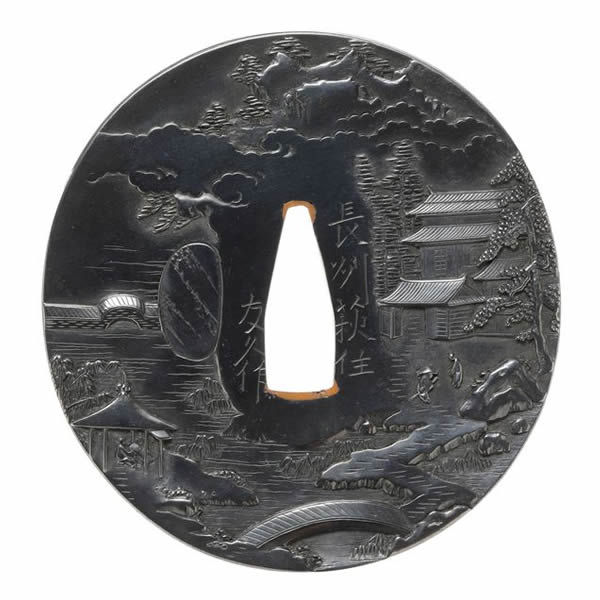
As written by the shop
Machine translation from the shop's Japanese · may contain errors ·
Nagato
5 pieces on the market now
A Hozon-certified fitting of notably superior craftsmanship and condition, often with signature or workmanship of high reference value.
The NBTHK (Nihon Bijutsu Tōken Hozon Kyōkai, the Society for the Preservation of Japanese Art Swords) is a public-interest incorporated foundation founded in 1948 and supervised by Japan’s Agency for Cultural Affairs (Bunkachō); it is based at the Japanese Sword Museum in Tokyo. Its expert panels physically examine each submitted work (shinsa) and issue a certificate (kanteishō) ranking it by artistic and historical merit. NBTHK papers are the most widely recognized standard of authentication for Japanese swords and fittings.
NBTHK official siteIf, due to our fault, the item differs significantly from its proper condition, the item may be returned. Cooling-off is within one week of the item's arrival.