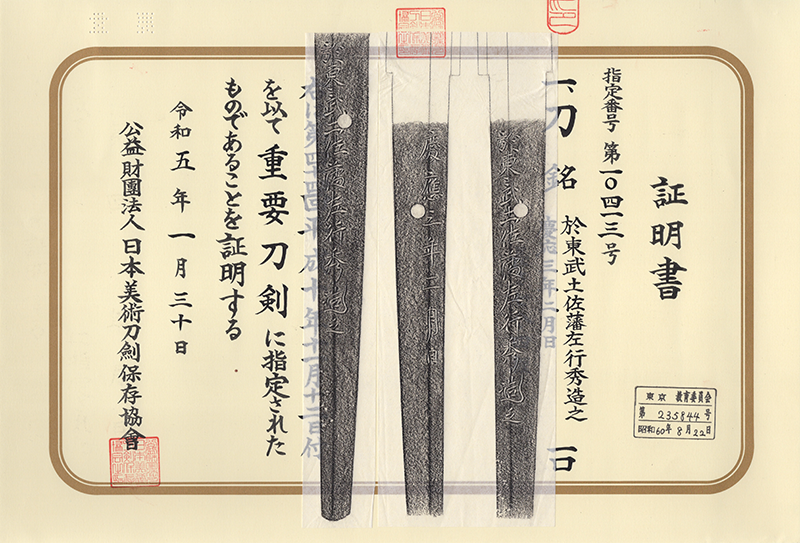
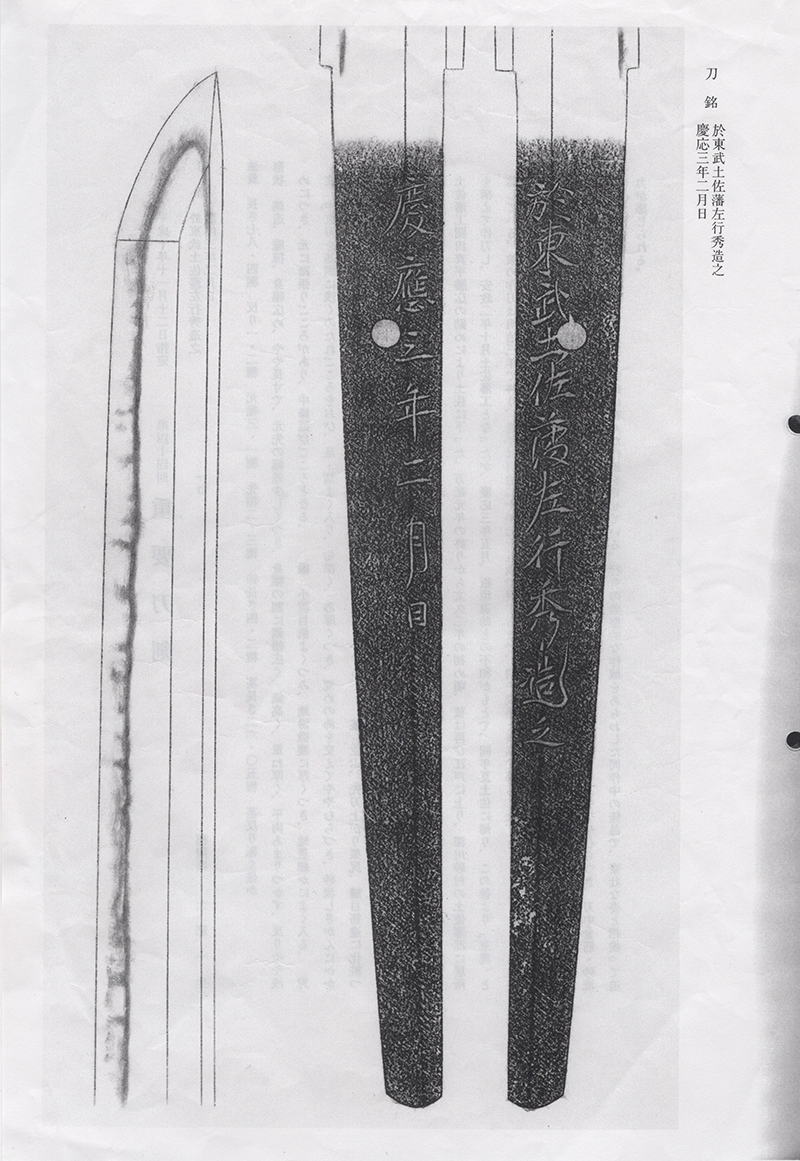
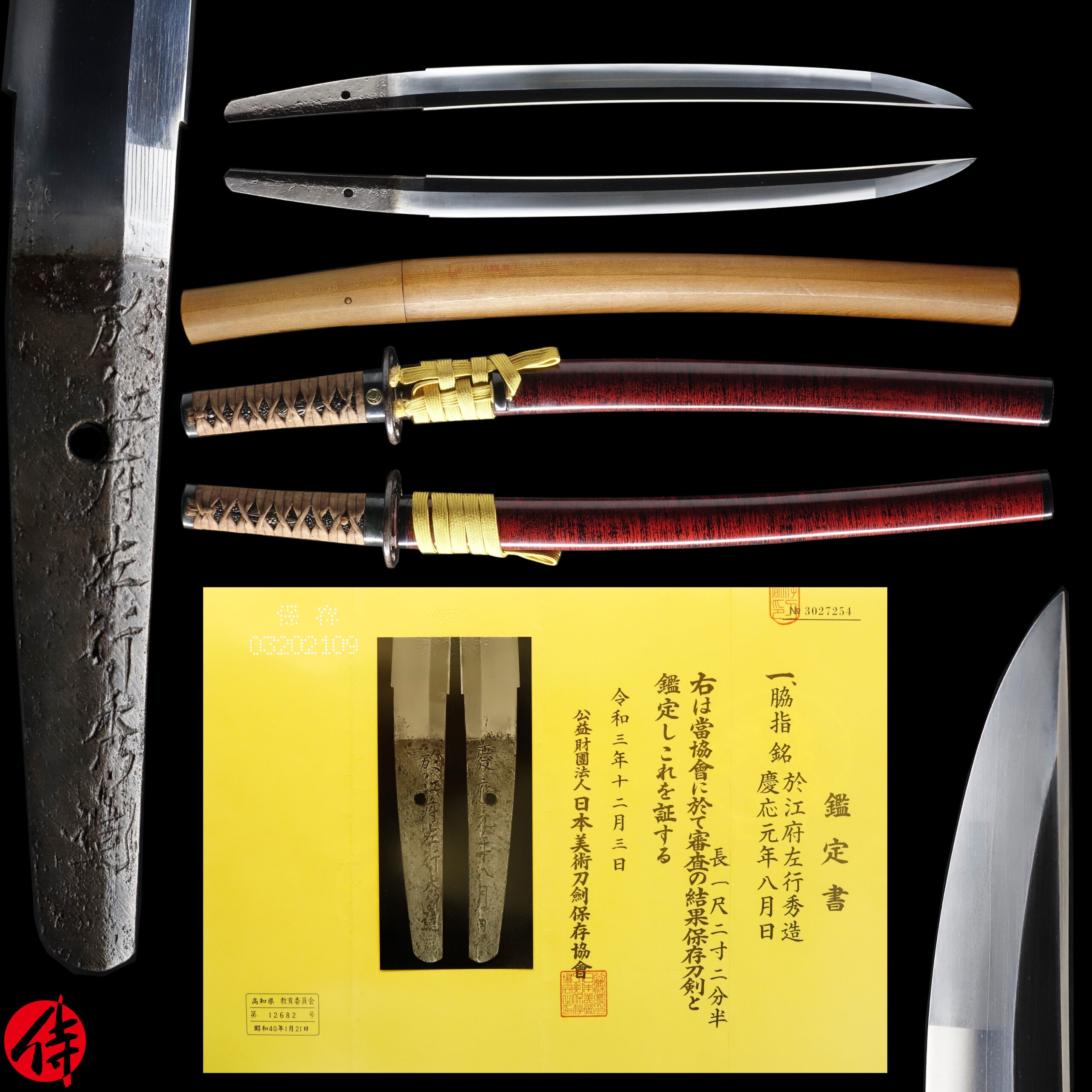
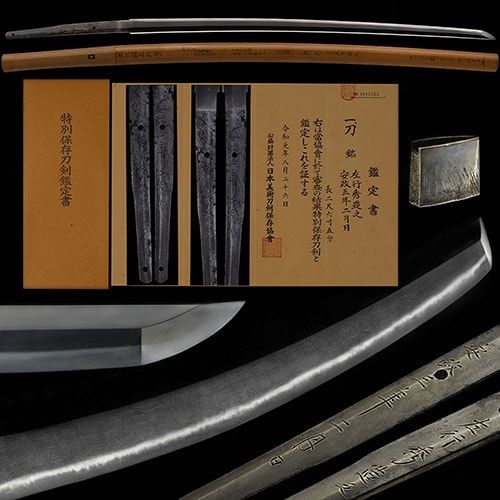
Sa Yukihide was born in Bunka 10 (1813) at Hoshimaru in Asakura, Kamiza District of Chikuzen Province, the heir of Itō Matabei Morishige, and took the name Toyonaga Kyūbei, later the art-name Tōko. He set the character Sa (左) at the head of his signature and styled himself a descendant of the Chikuzen Samonji line, in some inscriptions its thirty-ninth generation, a genealogical claim the published sources flatly reject: of one dated katana the commentary states that he "styled himself the thirty-ninth-generation grandson of Samonji, but this is not correct"[[c:1]]. What is documented instead is a career of the bakumatsu. In the early Tenpō era he went up to Edo and studied sword-forging under Shimizu Hisayoshi, a disciple of Hosokawa Masayoshi, winning a name for surpassing his teacher; in Kōka 3 (1846), at thirty-four, he went down to Tosa at the recommendation of the domain smith Sekita Shinpei Katsuhiro, and in Ansei 2 (1855) he became a retained smith of the Yamauchi house, working in both Tosa and the domain's Edo residence at Sunamura in Fukagawa until his swordmaking ended in Meiji 3 (1870). The published sources count him "one of the noted masters of the shinshintō"[[c:2]].
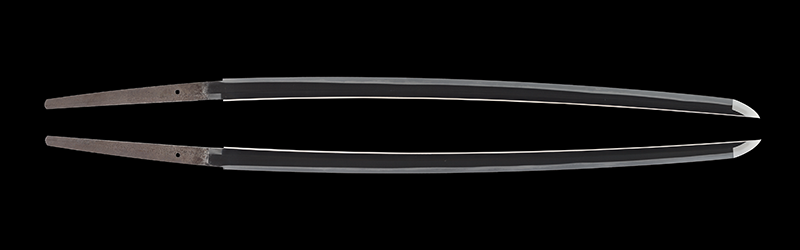
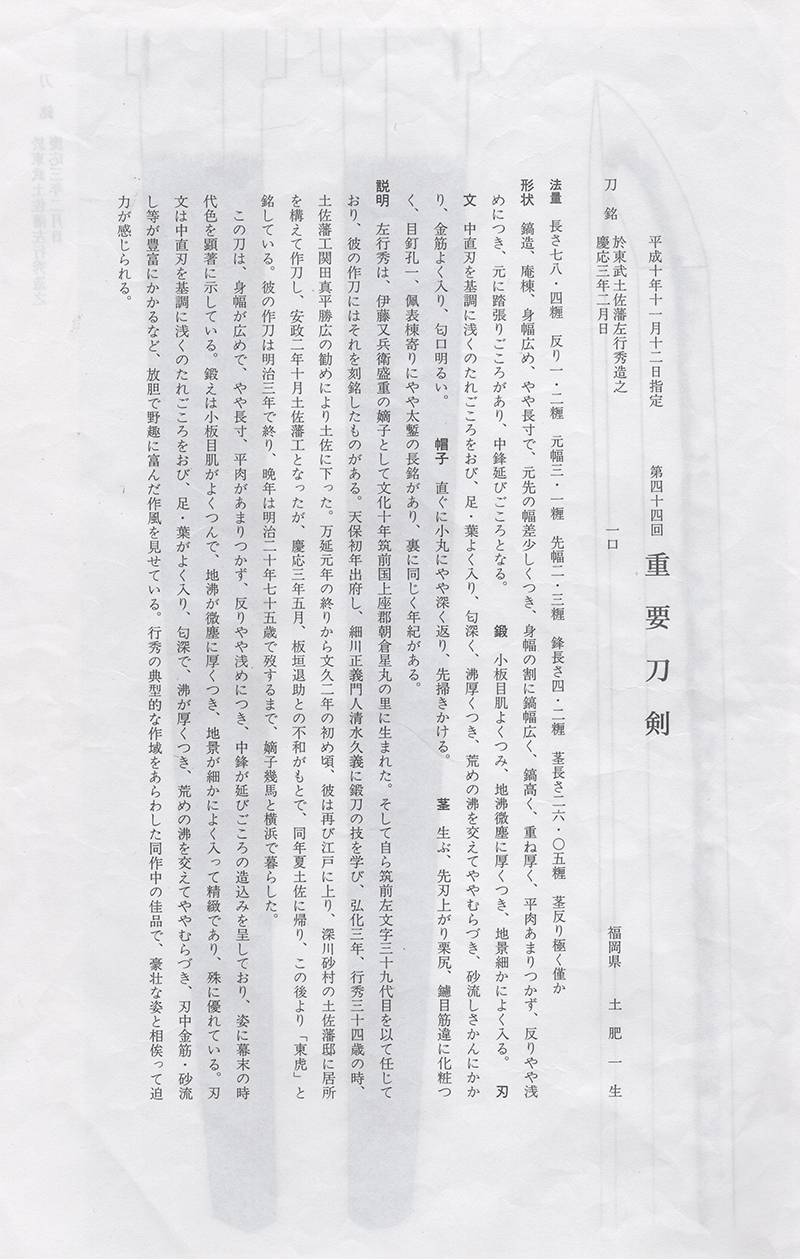
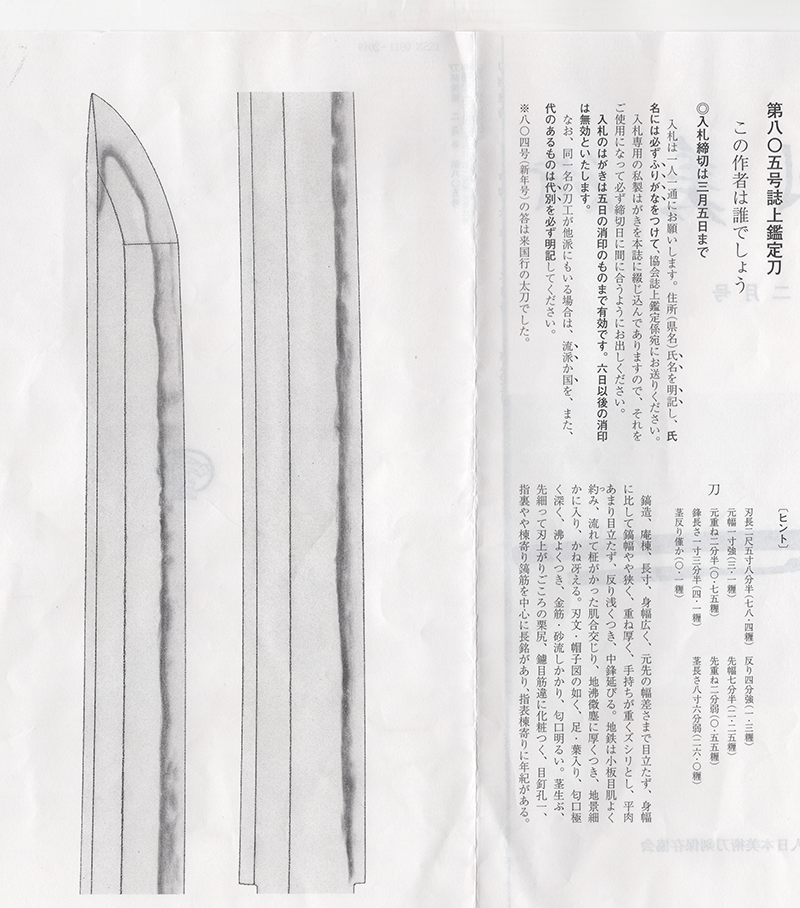
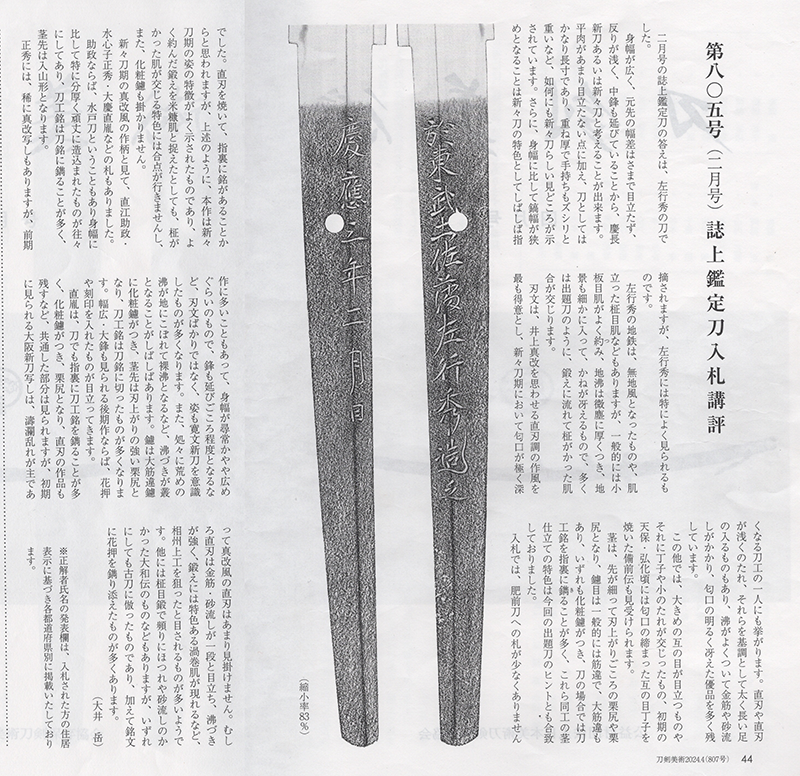
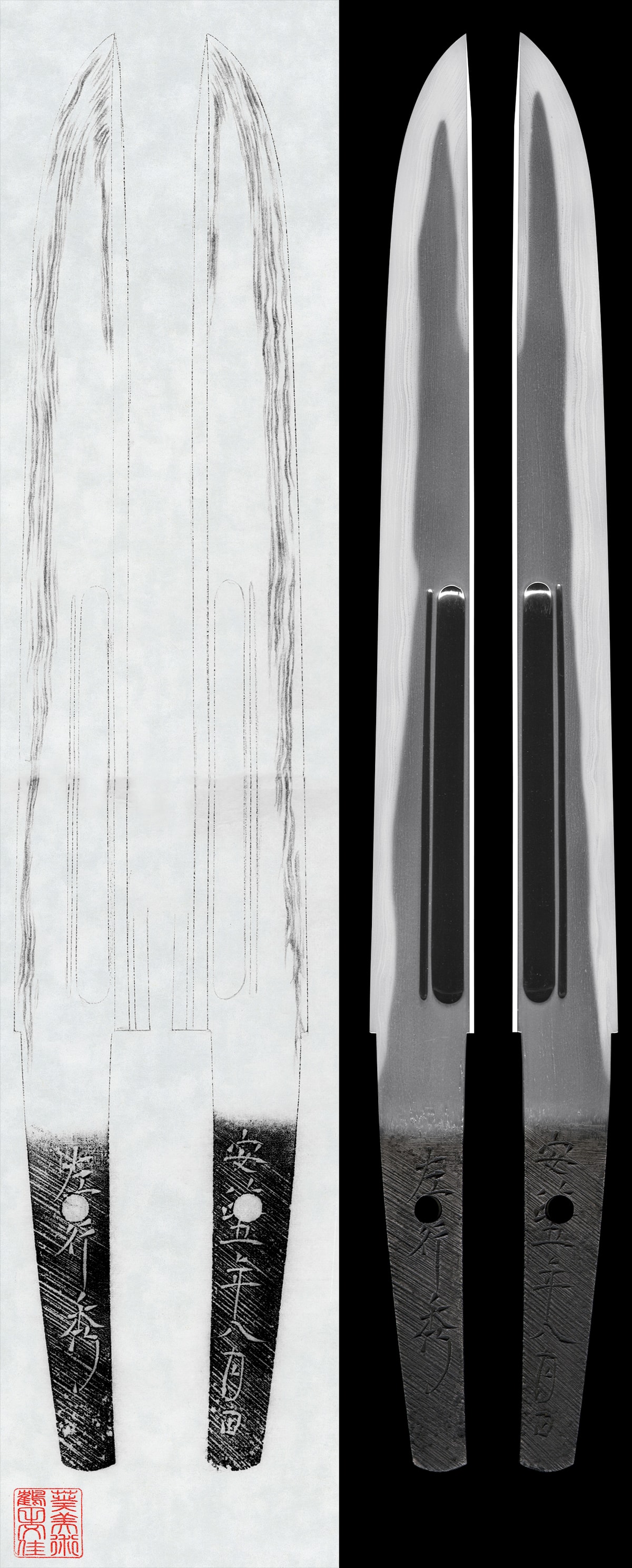
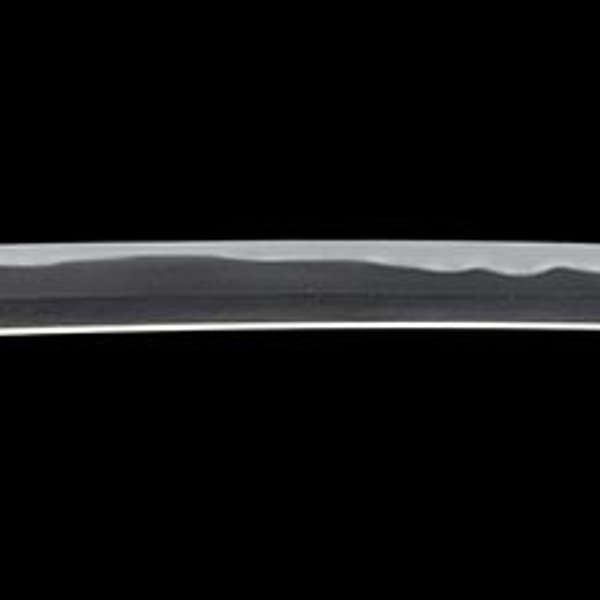
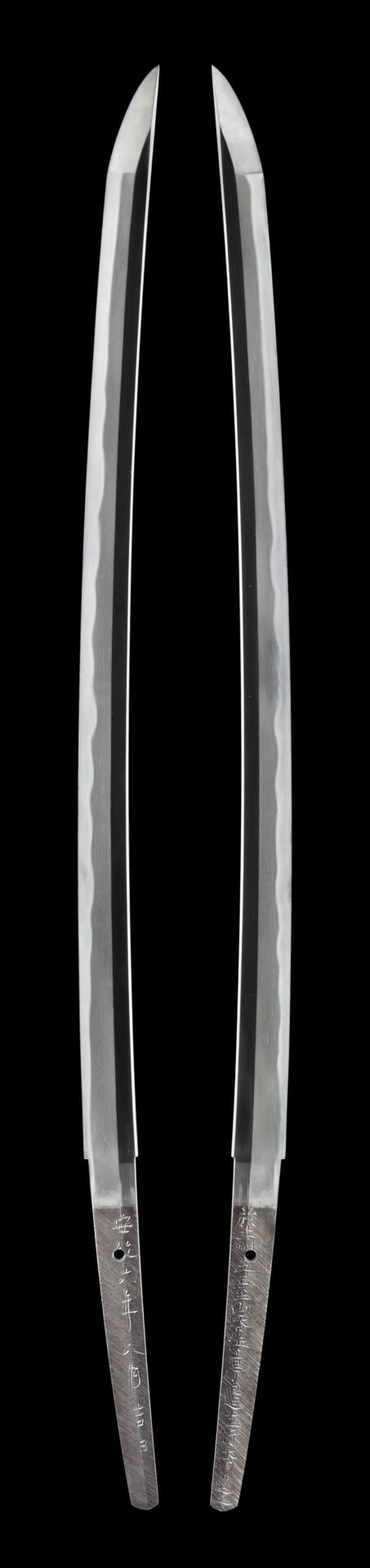
His recognized work is a broad suguha made in conscious emulation of Inoue Shinkai, the manner the published sources call his true forte. He carries it on a grand shinshintō body, wide in mihaba with little taper from base to tip, thick in kasane and heavy in the hand, shallow in sori with a large or elongated point, the tang ubu and cut with a long, boldly chiseled signature. Over a tightly forged ko-itame the temper runs a wide suguha bearing a shallow notare and vigorously mixed with gunome, the nioiguchi exceptionally deep, the ko-nie thick and well adhered, nie-hotsure frequent along the habuchi, ashi entering, with sunagashi and kinsuji running through and the whole bright and clear. The bōshi runs straight to a ko-maru with hakikake and a long, sometimes deep, turnback. The Tokubetsu Jūyō katana dated Kaei 2 (1849) shows the type at its height, its broad straight temper with intermingled gunome the most deeply nioi-laden of his hand.
The jigane is the constant beneath both his manners. It is a closely packed ko-itame, at times an itame flowing toward masame, with thick ji-nie, frequent chikei, and a steel the commentary repeatedly calls bright and clear, occasionally tightening to a near-plain jigane. This is the Sōshū-derived forging of his stated ideal rather than any Bizen reflection, and the published sources hold that whatever the temper his nie is well attached, his nioiguchi the deepest, and his ji and ha keenly clear. On one Kaei 6 (1853) katana the activity is described with his jigane and hamon both luminous; on another the nioiguchi is "the deepest, bright and clear."
Alongside the suguha the published sources name a second manner, a gunome-midare at times led by notare and mixing in chōji and large gunome, more flamboyant than the straight temper. Over the same shinshintō build the edge enters long thick ashi, the nioi deep, the nie thick and at times coarse, with sunagashi and kinsuji, and the bōshi runs midare-komi and points or turns back in ko-maru with hakikake. The forging beneath it ranges from the tight ko-itame to a well-ordered masame. Some of these the commentary reads as utsushi after Sōshū models, with a Shizu emulation among them and others recalling Nanki Shigekuni; his earliest manner is recorded as a Hosokawa-school Bizen-den, a chōji-midare with a tightened nioiguchi, before he turned, in his own words and the judges', to the Sōshū tradition. He also signed in several hands, sometimes adding a kaō, and on a few late blades the seven-character Toyonaga Tōko signature.
What sets Yukihide apart from the wider shinshintō revival is the object of his emulation and the clarity he drew from it. Where many of his contemporaries rebuilt the flamboyant Bizen chōji of the middle ages, his ideal, as the published sources put it, was "to take the Sōshū tradition as his ideal"[[c:3]], realized above all in works "after the manner of Inoue Shinkai, in conscious admiration of him"[[c:4]]. His bright deep-nioi suguha over a chikei-laden jigane is read as the Ōsaka Shinkai line carried into the bakumatsu, and the judges go further still: of one Kaei 6 katana the commentary declares outright that "the brilliance of his ji and ha is foremost among the shinshintō"[[c:5]]. That clarity, more than any single shape of temper, is the mark of his hand.
For the collector Yukihide is a securely knowable name, signed and dated almost without exception. Fujishiro grades him Jō-jō saku, and his record runs through two works at the Tokubetsu Jūyō rank, two prewar Jūyō Bijutsuhin, and many at the Jūyō rank, sixty-three in the Tokubetsu Jūyō and Jūyō tiers together; he has no National Treasures or Important Cultural Properties. Because, as the commentary warns, forgeries in his name are extremely numerous, a securely dated signature is prized as a reference specimen, and the supplementary inscriptions some of his blades carry, recording the place of forging and even the mochitetsu iron used, are valued as documentary material in their own right. His blades pass through long-held collections anchored in their own provenance, among them the Yamauchi lords of Tosa, in whose villa at Godaizan he forged what one entry calls a once-in-a-lifetime work, alongside the Inada, Ogura, Ochi and Takagaki families of recorded whereabouts. Most are held rather than traded, but he is not beyond reach as the great Kamakura names are: a signed, dated Yukihide of good workmanship comes to market from time to time, a sound and bright record of the last age of the Japanese sword.