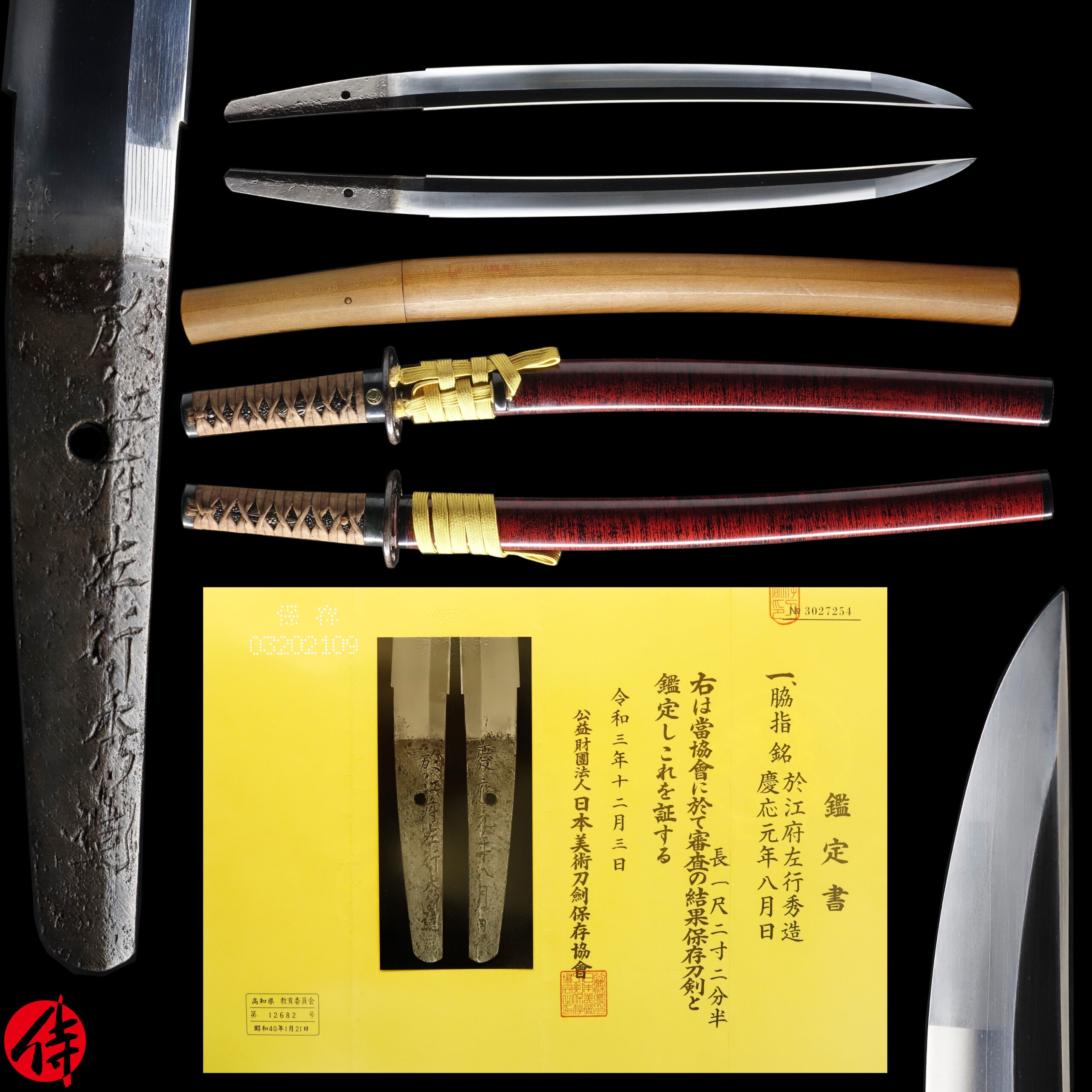
Perry’s arrival in 1853 unraveled the Tokugawa peace and created the first mass demand for working swords in two centuries. Kiyomaro, called the Masamune of Yotsuya, died on its eve; Munetsugu and Yukihide carried the boom to the end.
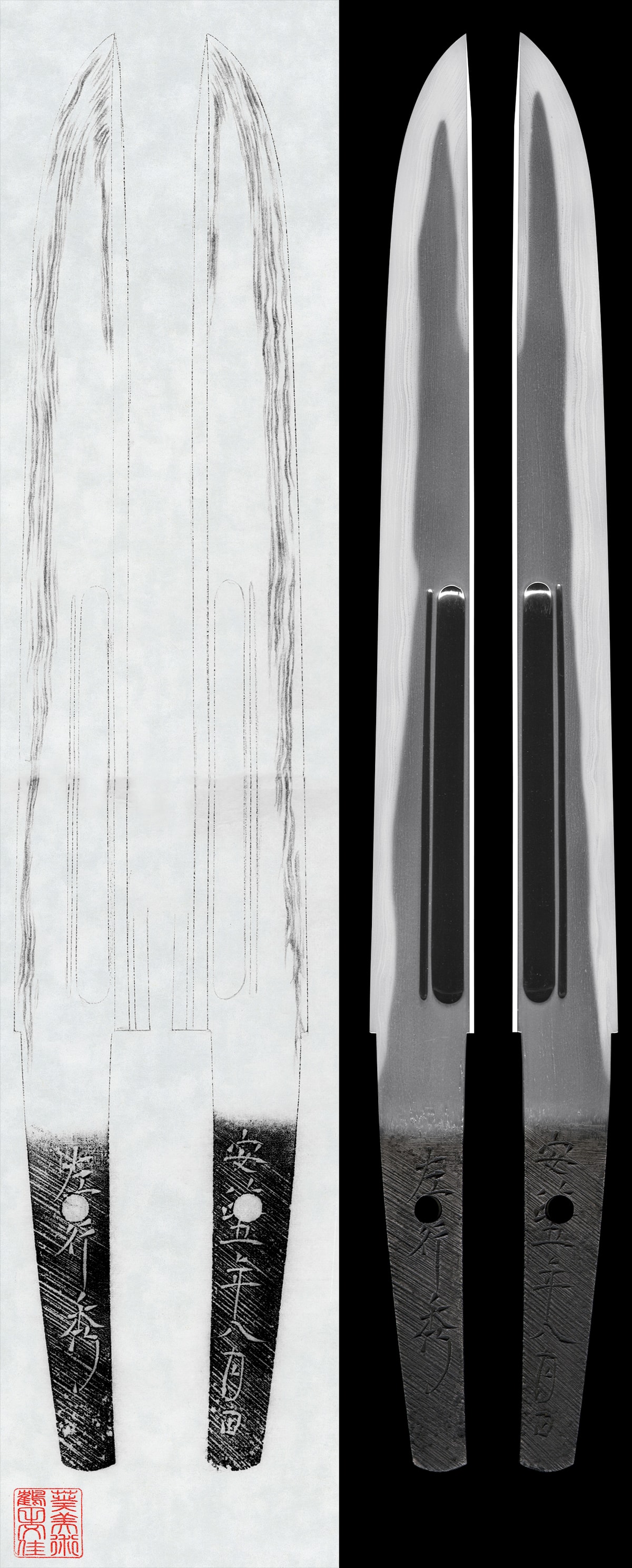
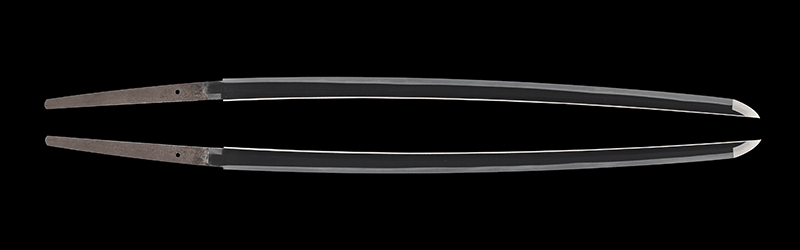
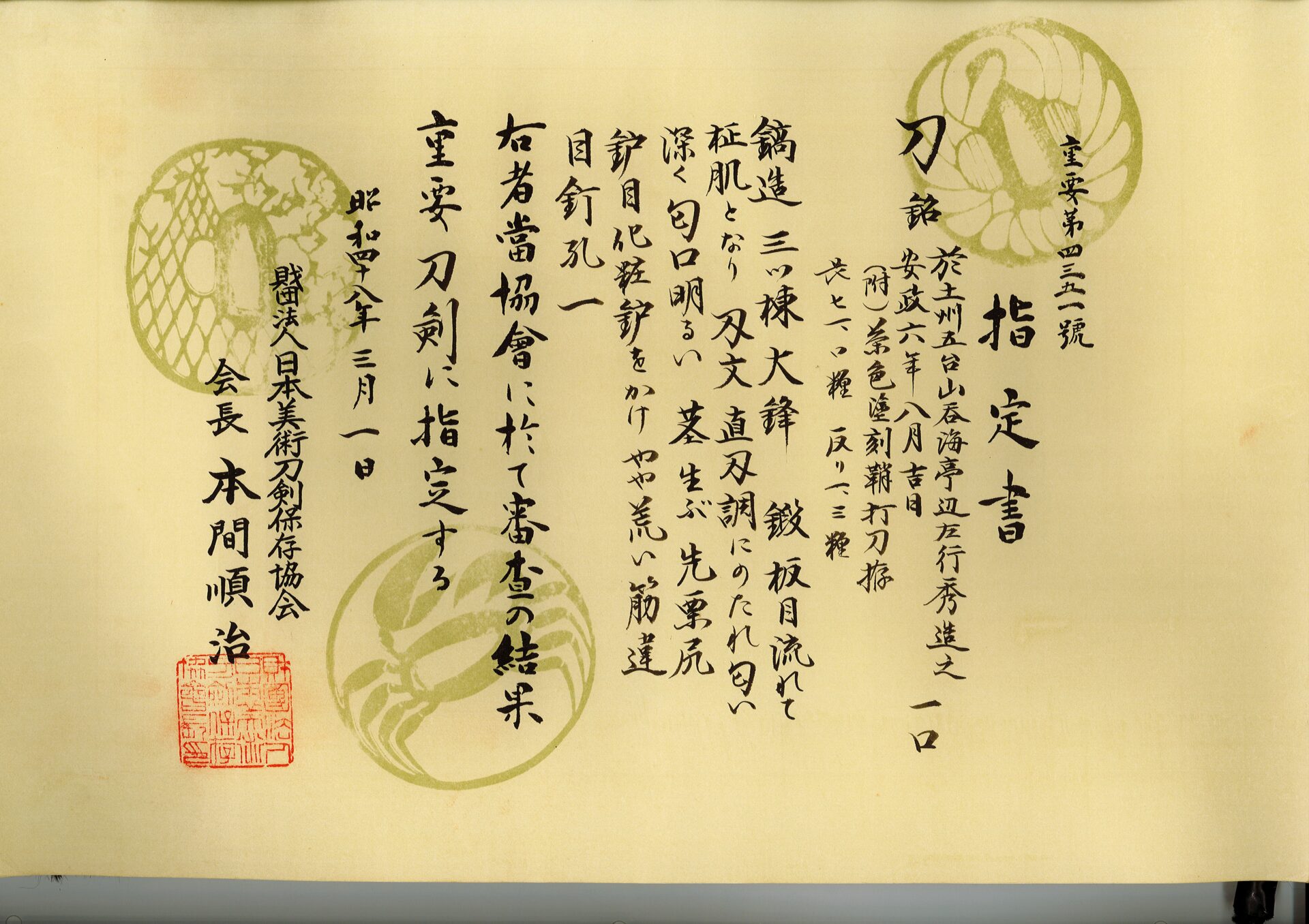
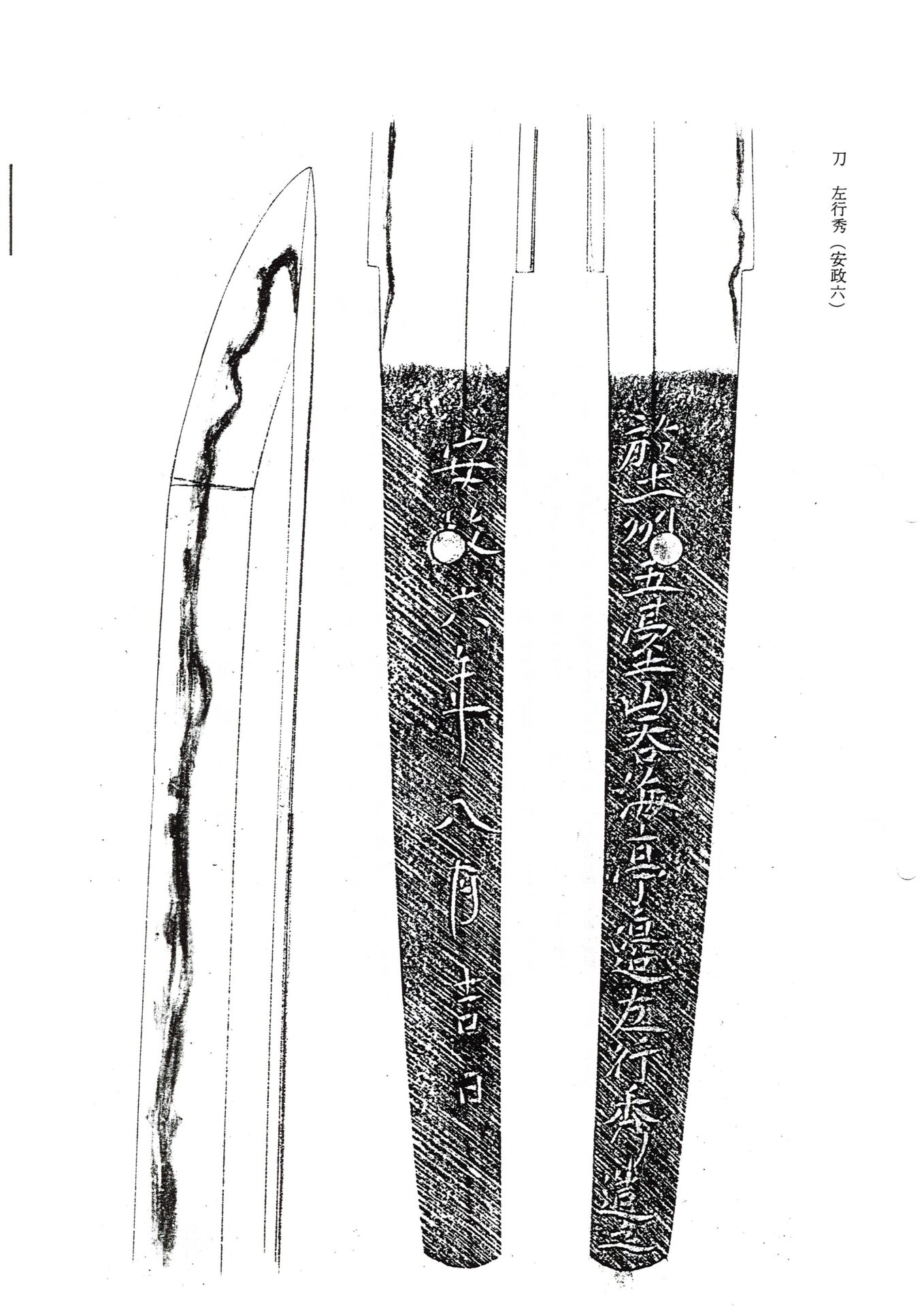
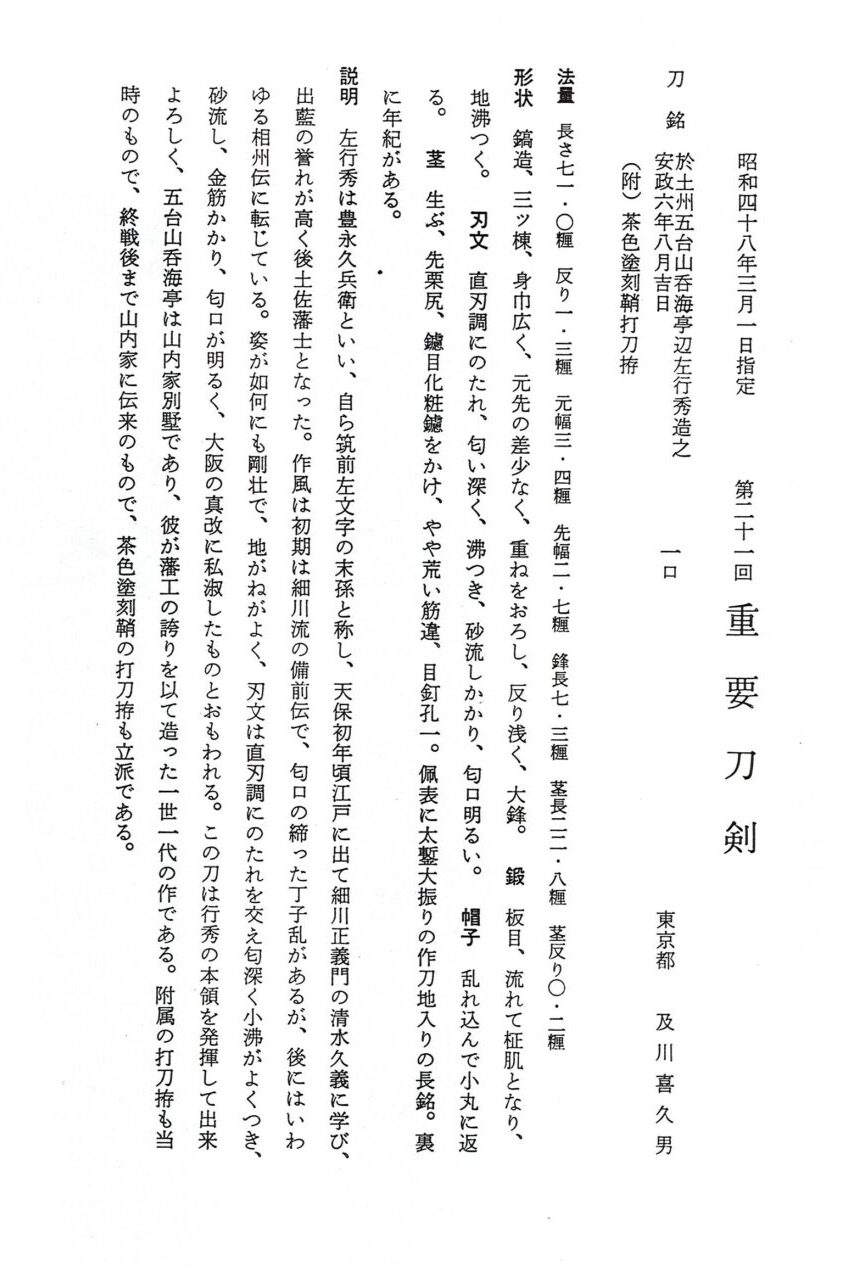
This is a katana by Sa Yukihide, dating to the late Edo period. It has been designated as a Juyo Token (Important Sword). The blade features a straight temper line with deep nioi and abundant nie, and comes with a koshirae.
左行秀は豊永久兵衛といい、自ら筑前左文字の末孫と称し、天保初年頃江戸に出て細川正義門の清水久義に学び、出藍の誉れが高く後土佐藩士となった。作風は初期は細川流の備前伝で、匂口の締った丁子乱があるが、後にはいわゆる相州伝に転じている。姿が如何にも剛壮で、地がねがよく、刃文は直刃調にのたれを交え匂深く小沸がよくつき、砂流し、金筋かかり、匂口が明るく、大阪の真改に私淑したものとおもわれる。この刀は行秀の本領を発揮して出来よろしく、五台山海亭は山内家別墅であり、彼が藩工の誇りを以て造った一世一代の作である。附属の打刀拵も当時のもので、終戦後まで山内家に伝来のもので、茶色塗刻鞘の打刀拵も立派である。
 NihontoWatch
Bunka–Meiji (1813-1887) · nagasa 71cm · sori 1.3cm
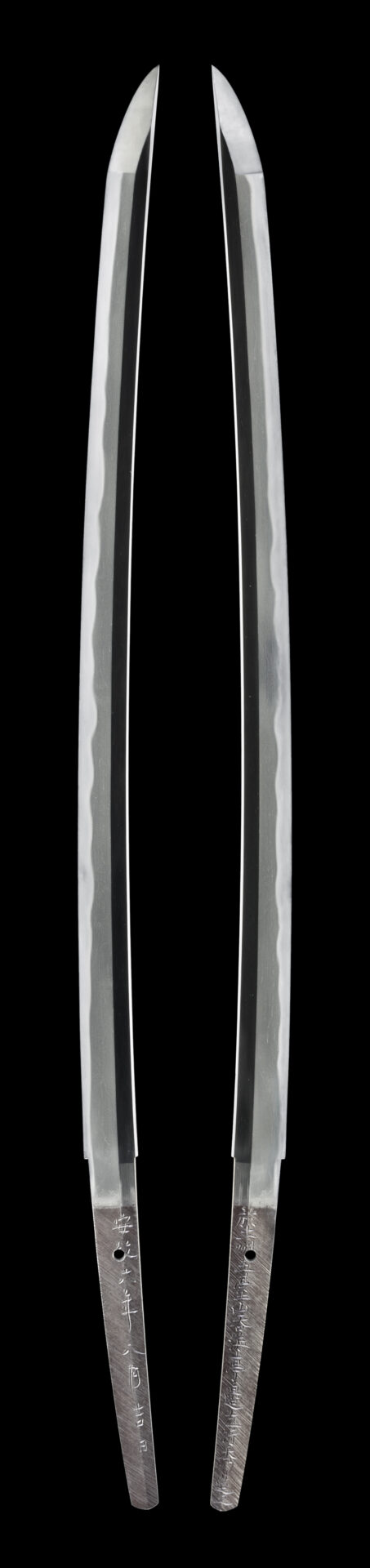
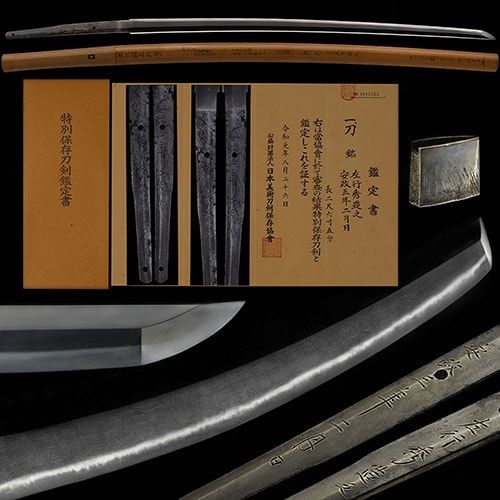
Sa Yukihide (self-styled Chikuzen Samonji), Tosa-domain shinshinto · Chikuzen · around 1813-1887
Fujishiro Jo-jo saku
3 pieces on the market now
Sa Yukihide was born in Bunka 10 (1813) at Hoshimaru in Asakura, Kamiza District of Chikuzen Province, the heir of Itō Matabei Morishige, and took the name Toyonaga Kyūbei, later the art-name Tōko. He set the character Sa (左) at the head of his signature and styled himself a descendant of the Chikuzen Samonji line, in some inscriptions its thirty-ninth generation, a genealogical claim the published sources flatly reject: of one dated katana the commentary states that he "styled himself the thirty-ninth-generation grandson of Samonji, but this is not correct"[[c:1]]. What is documented instead is a career of the bakumatsu. In the early Tenpō era he went up to Edo and studied sword-forging under Shimizu Hisayoshi, a disciple of Hosokawa Masayoshi, winning a name for surpassing his teacher; in Kōka 3 (1846), at thirty-four, he went down to Tosa at the recommendation of the domain smith Sekita Shinpei Katsuhiro, and in Ansei 2 (1855) he became a retained smith of the Yamauchi house, working in both Tosa and the domain's Edo residence at Sunamura in Fukagawa until his swordmaking ended in Meiji 3 (1870). The published sources count him "one of the noted masters of the shinshintō"[[c:2]].
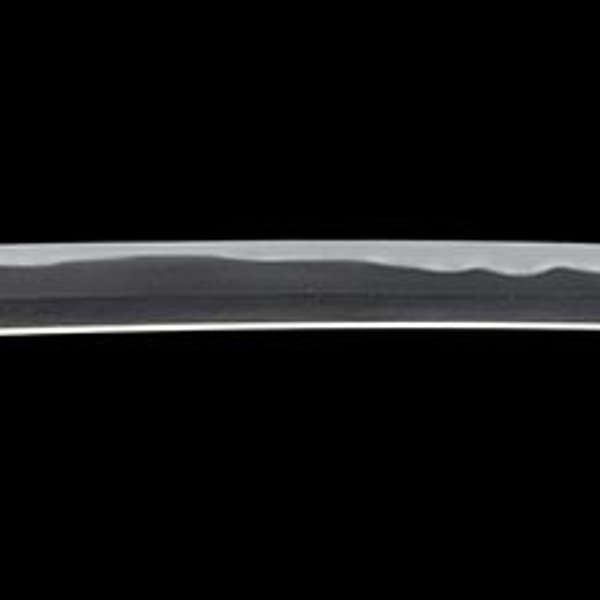
His recognized work is a broad suguha made in conscious emulation of Inoue Shinkai, the manner the published sources call his true forte. He carries it on a grand shinshintō body, wide in mihaba with little taper from base to tip, thick in kasane and heavy in the hand, shallow in sori with a large or elongated point, the tang ubu and cut with a long, boldly chiseled signature. Over a tightly forged ko-itame the temper runs a wide suguha bearing a shallow notare and vigorously mixed with gunome, the nioiguchi exceptionally deep, the ko-nie thick and well adhered, nie-hotsure frequent along the habuchi, ashi entering, with sunagashi and kinsuji running through and the whole bright and clear. The bōshi runs straight to a ko-maru with hakikake and a long, sometimes deep, turnback. The Tokubetsu Jūyō katana dated Kaei 2 (1849) shows the type at its height, its broad straight temper with intermingled gunome the most deeply nioi-laden of his hand.
The jigane is the constant beneath both his manners. It is a closely packed ko-itame, at times an itame flowing toward masame, with thick ji-nie, frequent chikei, and a steel the commentary repeatedly calls bright and clear, occasionally tightening to a near-plain jigane. This is the Sōshū-derived forging of his stated ideal rather than any Bizen reflection, and the published sources hold that whatever the temper his nie is well attached, his nioiguchi the deepest, and his ji and ha keenly clear. On one Kaei 6 (1853) katana the activity is described with his jigane and hamon both luminous; on another the nioiguchi is "the deepest, bright and clear."
Alongside the suguha the published sources name a second manner, a gunome-midare at times led by notare and mixing in chōji and large gunome, more flamboyant than the straight temper. Over the same shinshintō build the edge enters long thick ashi, the nioi deep, the nie thick and at times coarse, with sunagashi and kinsuji, and the bōshi runs midare-komi and points or turns back in ko-maru with hakikake. The forging beneath it ranges from the tight ko-itame to a well-ordered masame. Some of these the commentary reads as utsushi after Sōshū models, with a Shizu emulation among them and others recalling Nanki Shigekuni; his earliest manner is recorded as a Hosokawa-school Bizen-den, a chōji-midare with a tightened nioiguchi, before he turned, in his own words and the judges', to the Sōshū tradition. He also signed in several hands, sometimes adding a kaō, and on a few late blades the seven-character Toyonaga Tōko signature.
What sets Yukihide apart from the wider shinshintō revival is the object of his emulation and the clarity he drew from it. Where many of his contemporaries rebuilt the flamboyant Bizen chōji of the middle ages, his ideal, as the published sources put it, was "to take the Sōshū tradition as his ideal"[[c:3]], realized above all in works "after the manner of Inoue Shinkai, in conscious admiration of him"[[c:4]]. His bright deep-nioi suguha over a chikei-laden jigane is read as the Ōsaka Shinkai line carried into the bakumatsu, and the judges go further still: of one Kaei 6 katana the commentary declares outright that "the brilliance of his ji and ha is foremost among the shinshintō"[[c:5]]. That clarity, more than any single shape of temper, is the mark of his hand.
For the collector Yukihide is a securely knowable name, signed and dated almost without exception. Fujishiro grades him Jō-jō saku, and his record runs through two works at the Tokubetsu Jūyō rank, two prewar Jūyō Bijutsuhin, and many at the Jūyō rank, sixty-three in the Tokubetsu Jūyō and Jūyō tiers together; he has no National Treasures or Important Cultural Properties. Because, as the commentary warns, forgeries in his name are extremely numerous, a securely dated signature is prized as a reference specimen, and the supplementary inscriptions some of his blades carry, recording the place of forging and even the mochitetsu iron used, are valued as documentary material in their own right. His blades pass through long-held collections anchored in their own provenance, among them the Yamauchi lords of Tosa, in whose villa at Godaizan he forged what one entry calls a once-in-a-lifetime work, alongside the Inada, Ogura, Ochi and Takagaki families of recorded whereabouts. Most are held rather than traded, but he is not beyond reach as the great Kamakura names are: a signed, dated Yukihide of good workmanship comes to market from time to time, a sound and bright record of the last age of the Japanese sword.
Where Yukihide stands among comparable artisans: across all of nihontō, and within tradition, era, and period. The tiers (Foremost · Leading · Major · Notable) weigh official designations from the NBTHK and Japan's Agency for Cultural Affairs, together with historical honors of lasting repute such as the Sansaku and Meibutsu-chō.
Select a lens to see how it's measured.
Years he was demonstrably active, proven by signed-and-dated blades
Shinshinto · Chikuzen
3 pieces on the market now
Sa Yukihide (左行秀) was born in Bunka 10 (1813) in the Hoshimaru area of Asakura, Kamiza District, Chikuzen Province, the legitimate son of Itō Matabei Morishige. The setsumei record that he styled himself the thirty-ninth-generation successor to the Chikuzen Sa (Samonji) line, and that he carved this claim into the inscriptions of certain blades, which is the source of the Sa name borne by his work. In the early Tenpō era he went up to Edo and studied forging under Shimizu Hisayoshi, a disciple of Hosokawa Masayoshi. In Kōka 3 (1846), at the age of thirty-four, he went down to Tosa on the recommendation of Sekita Shinpei Katsuhiro, a swordsmith in the service of the Tosa domain, and in the tenth month of Ansei 2 (1855) he became an official Tosa domain smith. From the close of Man'en 1 (1860) into the early part of Bunkyū 2 (1862) he again went up to Edo, establishing a residence and forging at the Tosa domain estate at Sunamura in Fukagawa. " His swordmaking concluded in Meiji 3 (1870), and he spent his later years in Yokohama with his heir Ikuma until his death in Meiji 20 (1887), placing the school's production squarely in the mid-nineteenth century shinshintō revival of the Sōshū-den. Across the register, the shared vocabulary is consistent enough to function as a recognition key. The sugata is bold and weighty: a wide mihaba with little taper, thick kasane, frequent funbari, and an ō-kissaki (a slightly more slender, sun-nobi form with an extended chū-kissaki appears in the Tosa and Edo-residence pieces). The kitae is a densely forged ko-itame that often flows toward masame, sometimes predominantly masame, carrying thick fine ji-nie and abundant chikei over notably clear steel. His favored hamon, named repeatedly as the manner he most excelled in, is a chū-suguha or suguha-chō base bearing a shallow notare tendency intermixed with gunome and ko-gunome, with ashi and yō; the nioiguchi is conspicuously deep, nie adheres thickly with occasional coarse grains, and kinsuji, nie-suji, and sunagashi run through a bright, clear edge.
The bōshi is midare-komi or sugu turning back in ko-maru with hakikake. A vigorous gunome-midare in Sōshū-den coloration, understood as aiming toward the manner of Gō Yoshihiro, appears in a daishō katana and in a rare hira-zukuri wakizashi. The nakago is ubu with sujikai kesho-yasuri and bold, deeply cut signatures, frequently raising the place characters "Chikushū" or "Doshū" and recording the forging site or iron used. Beyond the school itself, no pupils are named in these blades; the carver Isogai Yoshitatsu, a disciple of Masayoshi, executed the horimono on the daishō, a fact noted on its tang by Myōchin Ki Muneteru. For kantei, the deep nioiguchi with thick, brilliantly bursting nie over a clear masame-tending ground is the firmest discriminator, with localized tightening of the nioiguchi noted as an appealing departure from his usual breadth. The setsumei single out documentary inscriptions: the place-name "Ōshima-sanroku" recording the forging locale, and his repeated use of Nambu mochi-tetsu iron from the Kamaishi area, a material also employed by Unju Korekazu, Tairyūsai Munenobu, Iwai Masatoshi, and Gassan Sadakazu. The Meiji 3 katana carries the latest confirmed date and shows the shorter, period-marked form of his closing years, distinct from the grand Ka'ei and Ansei works. A fully matched daishō is recorded as exceptionally uncommon. Jūyō-Bijutsuhin pieces in the register were published in Meitō Shūbi, Edo Shintō Meisakushū, Nihontō Taikan, and Kanzan Tōwa. The NBTHK setsumei present Yukihide as a leading hand of the Bakumatsu Sōshū revival, his strongest blades carrying the school's claim to the medieval Sa name into a forceful late-Edo idiom. Learn more →
| Smith | Era | Designated |
|---|---|---|
| Yukihide行秀 | 1813-1887 | 64 |
| Toko東虎 | 1868-1912 | 1 |
Bakumatsu: the last war market
Perry’s arrival in 1853 unraveled the Tokugawa peace and created the first mass demand for working swords in two centuries. Kiyomaro, called the Masamune of Yotsuya, died on its eve; Munetsugu and Yukihide carried the boom to the end.
A blade of top-grade workmanship and condition, formally judged to rank with a nationally recognized Important Art Object (Jūyō Bijutsuhin). Awarded only at the NBTHK’s competitive annual examination.
Of Japan’s roughly 2.5 million registered swords, only 12,307 (about 1 in 203) have ever attained Jūyō.
The NBTHK (Nihon Bijutsu Tōken Hozon Kyōkai, the Society for the Preservation of Japanese Art Swords) is a public-interest incorporated foundation founded in 1948 and supervised by Japan’s Agency for Cultural Affairs (Bunkachō); it is based at the Japanese Sword Museum in Tokyo. Its expert panels physically examine each submitted work (shinsa) and issue a certificate (kanteishō) ranking it by artistic and historical merit. NBTHK papers are the most widely recognized standard of authentication for Japanese swords and fittings.
NBTHK official siteThis is a katana by Sa Yukihide, dating to the late Edo period. It has been designated as a Juyo Token (Important Sword). The blade features a straight temper line with deep nioi and abundant nie, and comes with a koshirae.
左行秀は豊永久兵衛といい、自ら筑前左文字の末孫と称し、天保初年頃江戸に出て細川正義門の清水久義に学び、出藍の誉れが高く後土佐藩士となった。作風は初期は細川流の備前伝で、匂口の締った丁子乱があるが、後にはいわゆる相州伝に転じている。姿が如何にも剛壮で、地がねがよく、刃文は直刃調にのたれを交え匂深く小沸がよくつき、砂流し、金筋かかり、匂口が明るく、大阪の真改に私淑したものとおもわれる。この刀は行秀の本領を発揮して出来よろしく、五台山海亭は山内家別墅であり、彼が藩工の誇りを以て造った一世一代の作である。附属の打刀拵も当時のもので、終戦後まで山内家に伝来のもので、茶色塗刻鞘の打刀拵も立派である。
NihontoWatchBunka–Meiji (1813-1887) · nagasa 71cm · sori 1.3cm
Sa Yukihide (self-styled Chikuzen Samonji), Tosa-domain shinshinto · Chikuzen · around 1813-1887
Fujishiro Jo-jo saku
3 pieces on the market now
Sa Yukihide was born in Bunka 10 (1813) at Hoshimaru in Asakura, Kamiza District of Chikuzen Province, the heir of Itō Matabei Morishige, and took the name Toyonaga Kyūbei, later the art-name Tōko. He set the character Sa (左) at the head of his signature and styled himself a descendant of the Chikuzen Samonji line, in some inscriptions its thirty-ninth generation, a genealogical claim the published sources flatly reject: of one dated katana the commentary states that he "styled himself the thirty-ninth-generation grandson of Samonji, but this is not correct"[[c:1]]. What is documented instead is a career of the bakumatsu. In the early Tenpō era he went up to Edo and studied sword-forging under Shimizu Hisayoshi, a disciple of Hosokawa Masayoshi, winning a name for surpassing his teacher; in Kōka 3 (1846), at thirty-four, he went down to Tosa at the recommendation of the domain smith Sekita Shinpei Katsuhiro, and in Ansei 2 (1855) he became a retained smith of the Yamauchi house, working in both Tosa and the domain's Edo residence at Sunamura in Fukagawa until his swordmaking ended in Meiji 3 (1870). The published sources count him "one of the noted masters of the shinshintō"[[c:2]].
His recognized work is a broad suguha made in conscious emulation of Inoue Shinkai, the manner the published sources call his true forte. He carries it on a grand shinshintō body, wide in mihaba with little taper from base to tip, thick in kasane and heavy in the hand, shallow in sori with a large or elongated point, the tang ubu and cut with a long, boldly chiseled signature. Over a tightly forged ko-itame the temper runs a wide suguha bearing a shallow notare and vigorously mixed with gunome, the nioiguchi exceptionally deep, the ko-nie thick and well adhered, nie-hotsure frequent along the habuchi, ashi entering, with sunagashi and kinsuji running through and the whole bright and clear. The bōshi runs straight to a ko-maru with hakikake and a long, sometimes deep, turnback. The Tokubetsu Jūyō katana dated Kaei 2 (1849) shows the type at its height, its broad straight temper with intermingled gunome the most deeply nioi-laden of his hand.
The jigane is the constant beneath both his manners. It is a closely packed ko-itame, at times an itame flowing toward masame, with thick ji-nie, frequent chikei, and a steel the commentary repeatedly calls bright and clear, occasionally tightening to a near-plain jigane. This is the Sōshū-derived forging of his stated ideal rather than any Bizen reflection, and the published sources hold that whatever the temper his nie is well attached, his nioiguchi the deepest, and his ji and ha keenly clear. On one Kaei 6 (1853) katana the activity is described with his jigane and hamon both luminous; on another the nioiguchi is "the deepest, bright and clear."
Alongside the suguha the published sources name a second manner, a gunome-midare at times led by notare and mixing in chōji and large gunome, more flamboyant than the straight temper. Over the same shinshintō build the edge enters long thick ashi, the nioi deep, the nie thick and at times coarse, with sunagashi and kinsuji, and the bōshi runs midare-komi and points or turns back in ko-maru with hakikake. The forging beneath it ranges from the tight ko-itame to a well-ordered masame. Some of these the commentary reads as utsushi after Sōshū models, with a Shizu emulation among them and others recalling Nanki Shigekuni; his earliest manner is recorded as a Hosokawa-school Bizen-den, a chōji-midare with a tightened nioiguchi, before he turned, in his own words and the judges', to the Sōshū tradition. He also signed in several hands, sometimes adding a kaō, and on a few late blades the seven-character Toyonaga Tōko signature.
What sets Yukihide apart from the wider shinshintō revival is the object of his emulation and the clarity he drew from it. Where many of his contemporaries rebuilt the flamboyant Bizen chōji of the middle ages, his ideal, as the published sources put it, was "to take the Sōshū tradition as his ideal"[[c:3]], realized above all in works "after the manner of Inoue Shinkai, in conscious admiration of him"[[c:4]]. His bright deep-nioi suguha over a chikei-laden jigane is read as the Ōsaka Shinkai line carried into the bakumatsu, and the judges go further still: of one Kaei 6 katana the commentary declares outright that "the brilliance of his ji and ha is foremost among the shinshintō"[[c:5]]. That clarity, more than any single shape of temper, is the mark of his hand.
For the collector Yukihide is a securely knowable name, signed and dated almost without exception. Fujishiro grades him Jō-jō saku, and his record runs through two works at the Tokubetsu Jūyō rank, two prewar Jūyō Bijutsuhin, and many at the Jūyō rank, sixty-three in the Tokubetsu Jūyō and Jūyō tiers together; he has no National Treasures or Important Cultural Properties. Because, as the commentary warns, forgeries in his name are extremely numerous, a securely dated signature is prized as a reference specimen, and the supplementary inscriptions some of his blades carry, recording the place of forging and even the mochitetsu iron used, are valued as documentary material in their own right. His blades pass through long-held collections anchored in their own provenance, among them the Yamauchi lords of Tosa, in whose villa at Godaizan he forged what one entry calls a once-in-a-lifetime work, alongside the Inada, Ogura, Ochi and Takagaki families of recorded whereabouts. Most are held rather than traded, but he is not beyond reach as the great Kamakura names are: a signed, dated Yukihide of good workmanship comes to market from time to time, a sound and bright record of the last age of the Japanese sword.
Where Yukihide stands among comparable artisans: across all of nihontō, and within tradition, era, and period. The tiers (Foremost · Leading · Major · Notable) weigh official designations from the NBTHK and Japan's Agency for Cultural Affairs, together with historical honors of lasting repute such as the Sansaku and Meibutsu-chō.
Select a lens to see how it's measured.
Years he was demonstrably active, proven by signed-and-dated blades
Shinshinto · Chikuzen
3 pieces on the market now
Sa Yukihide (左行秀) was born in Bunka 10 (1813) in the Hoshimaru area of Asakura, Kamiza District, Chikuzen Province, the legitimate son of Itō Matabei Morishige. The setsumei record that he styled himself the thirty-ninth-generation successor to the Chikuzen Sa (Samonji) line, and that he carved this claim into the inscriptions of certain blades, which is the source of the Sa name borne by his work. In the early Tenpō era he went up to Edo and studied forging under Shimizu Hisayoshi, a disciple of Hosokawa Masayoshi. In Kōka 3 (1846), at the age of thirty-four, he went down to Tosa on the recommendation of Sekita Shinpei Katsuhiro, a swordsmith in the service of the Tosa domain, and in the tenth month of Ansei 2 (1855) he became an official Tosa domain smith. From the close of Man'en 1 (1860) into the early part of Bunkyū 2 (1862) he again went up to Edo, establishing a residence and forging at the Tosa domain estate at Sunamura in Fukagawa. " His swordmaking concluded in Meiji 3 (1870), and he spent his later years in Yokohama with his heir Ikuma until his death in Meiji 20 (1887), placing the school's production squarely in the mid-nineteenth century shinshintō revival of the Sōshū-den. Across the register, the shared vocabulary is consistent enough to function as a recognition key. The sugata is bold and weighty: a wide mihaba with little taper, thick kasane, frequent funbari, and an ō-kissaki (a slightly more slender, sun-nobi form with an extended chū-kissaki appears in the Tosa and Edo-residence pieces). The kitae is a densely forged ko-itame that often flows toward masame, sometimes predominantly masame, carrying thick fine ji-nie and abundant chikei over notably clear steel. His favored hamon, named repeatedly as the manner he most excelled in, is a chū-suguha or suguha-chō base bearing a shallow notare tendency intermixed with gunome and ko-gunome, with ashi and yō; the nioiguchi is conspicuously deep, nie adheres thickly with occasional coarse grains, and kinsuji, nie-suji, and sunagashi run through a bright, clear edge.
The bōshi is midare-komi or sugu turning back in ko-maru with hakikake. A vigorous gunome-midare in Sōshū-den coloration, understood as aiming toward the manner of Gō Yoshihiro, appears in a daishō katana and in a rare hira-zukuri wakizashi. The nakago is ubu with sujikai kesho-yasuri and bold, deeply cut signatures, frequently raising the place characters "Chikushū" or "Doshū" and recording the forging site or iron used. Beyond the school itself, no pupils are named in these blades; the carver Isogai Yoshitatsu, a disciple of Masayoshi, executed the horimono on the daishō, a fact noted on its tang by Myōchin Ki Muneteru. For kantei, the deep nioiguchi with thick, brilliantly bursting nie over a clear masame-tending ground is the firmest discriminator, with localized tightening of the nioiguchi noted as an appealing departure from his usual breadth. The setsumei single out documentary inscriptions: the place-name "Ōshima-sanroku" recording the forging locale, and his repeated use of Nambu mochi-tetsu iron from the Kamaishi area, a material also employed by Unju Korekazu, Tairyūsai Munenobu, Iwai Masatoshi, and Gassan Sadakazu. The Meiji 3 katana carries the latest confirmed date and shows the shorter, period-marked form of his closing years, distinct from the grand Ka'ei and Ansei works. A fully matched daishō is recorded as exceptionally uncommon. Jūyō-Bijutsuhin pieces in the register were published in Meitō Shūbi, Edo Shintō Meisakushū, Nihontō Taikan, and Kanzan Tōwa. The NBTHK setsumei present Yukihide as a leading hand of the Bakumatsu Sōshū revival, his strongest blades carrying the school's claim to the medieval Sa name into a forceful late-Edo idiom. Learn more →
| Smith | Era | Designated |
|---|---|---|
| Yukihide行秀 | 1813-1887 | 64 |
| Toko東虎 | 1868-1912 | 1 |
Bakumatsu: the last war market
Perry’s arrival in 1853 unraveled the Tokugawa peace and created the first mass demand for working swords in two centuries. Kiyomaro, called the Masamune of Yotsuya, died on its eve; Munetsugu and Yukihide carried the boom to the end.
A blade of top-grade workmanship and condition, formally judged to rank with a nationally recognized Important Art Object (Jūyō Bijutsuhin). Awarded only at the NBTHK’s competitive annual examination.
Of Japan’s roughly 2.5 million registered swords, only 12,307 (about 1 in 203) have ever attained Jūyō.
The NBTHK (Nihon Bijutsu Tōken Hozon Kyōkai, the Society for the Preservation of Japanese Art Swords) is a public-interest incorporated foundation founded in 1948 and supervised by Japan’s Agency for Cultural Affairs (Bunkachō); it is based at the Japanese Sword Museum in Tokyo. Its expert panels physically examine each submitted work (shinsa) and issue a certificate (kanteishō) ranking it by artistic and historical merit. NBTHK papers are the most widely recognized standard of authentication for Japanese swords and fittings.
NBTHK official site