The twentieth century nearly killed the craft twice: wartime distortion, then the occupation ban. The NBTHK’s founding in 1948 and licensed forging from 1953 rebuilt the sword as an art, crowned by Living National Treasures and the mukansa rank.
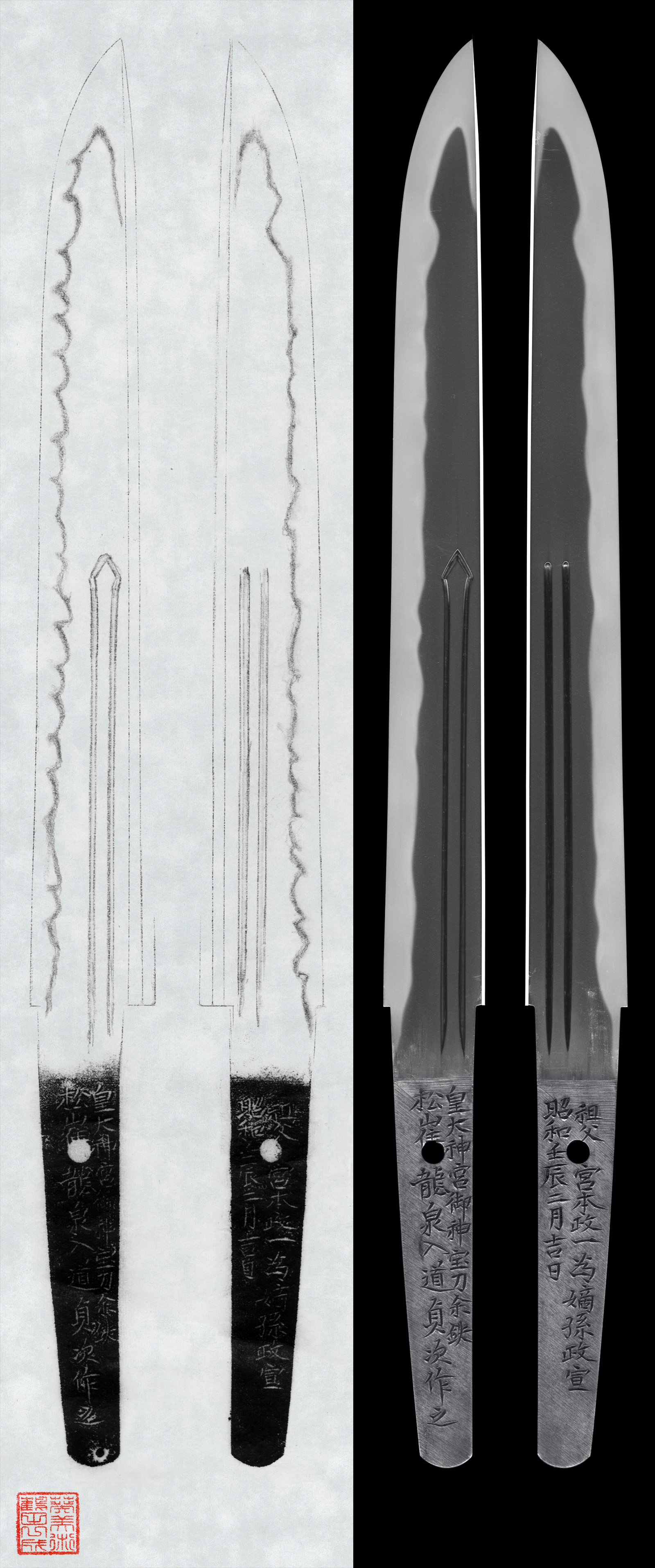
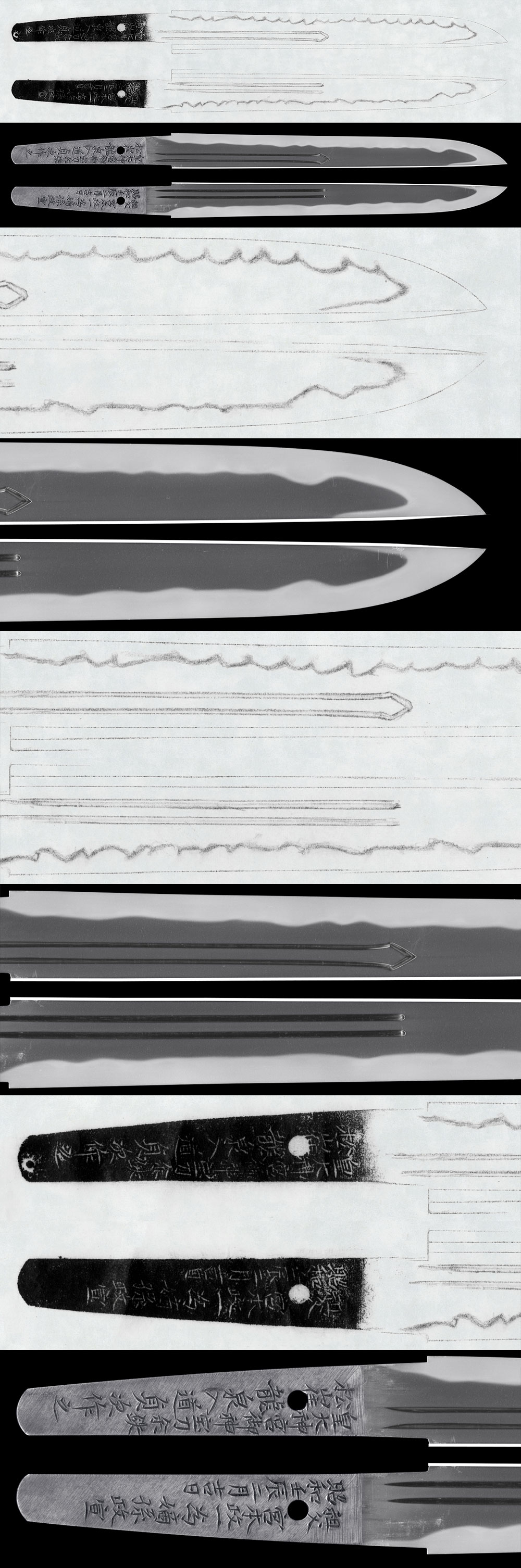
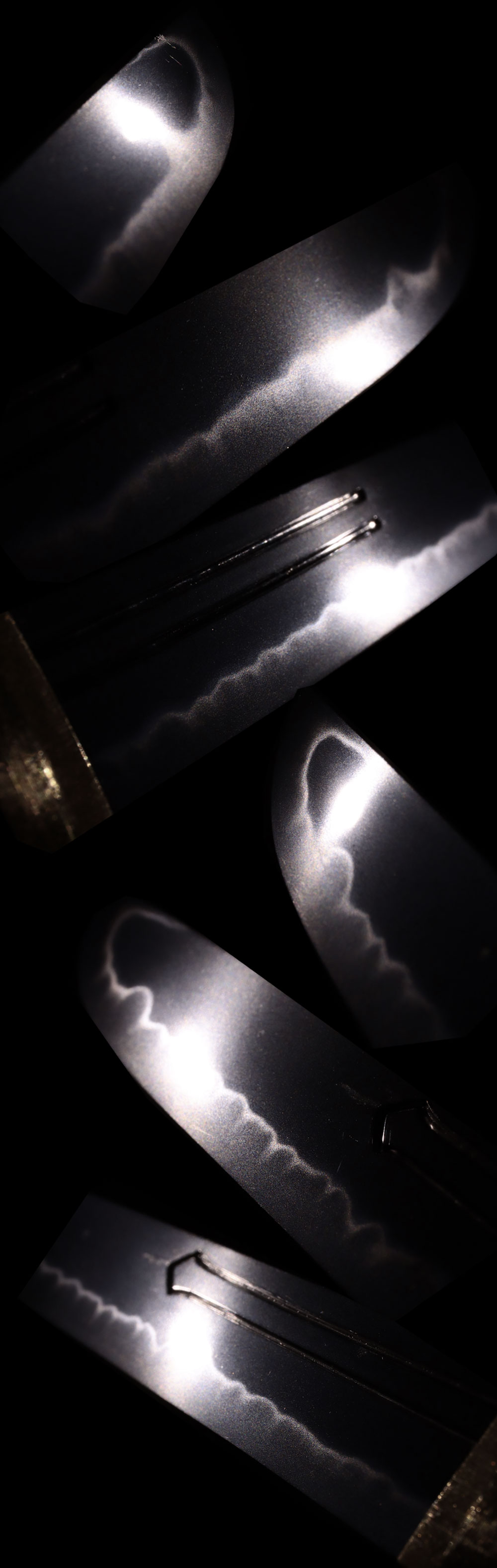
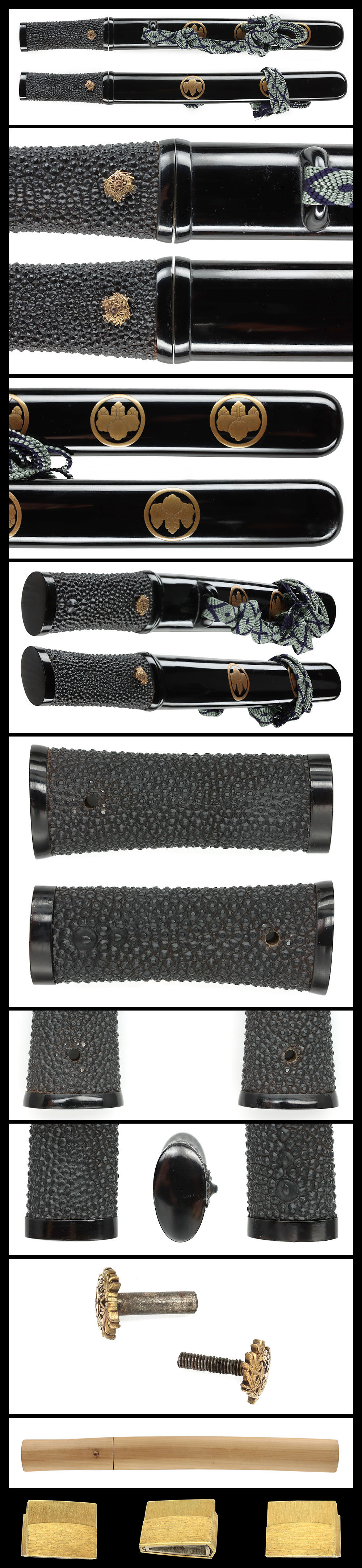
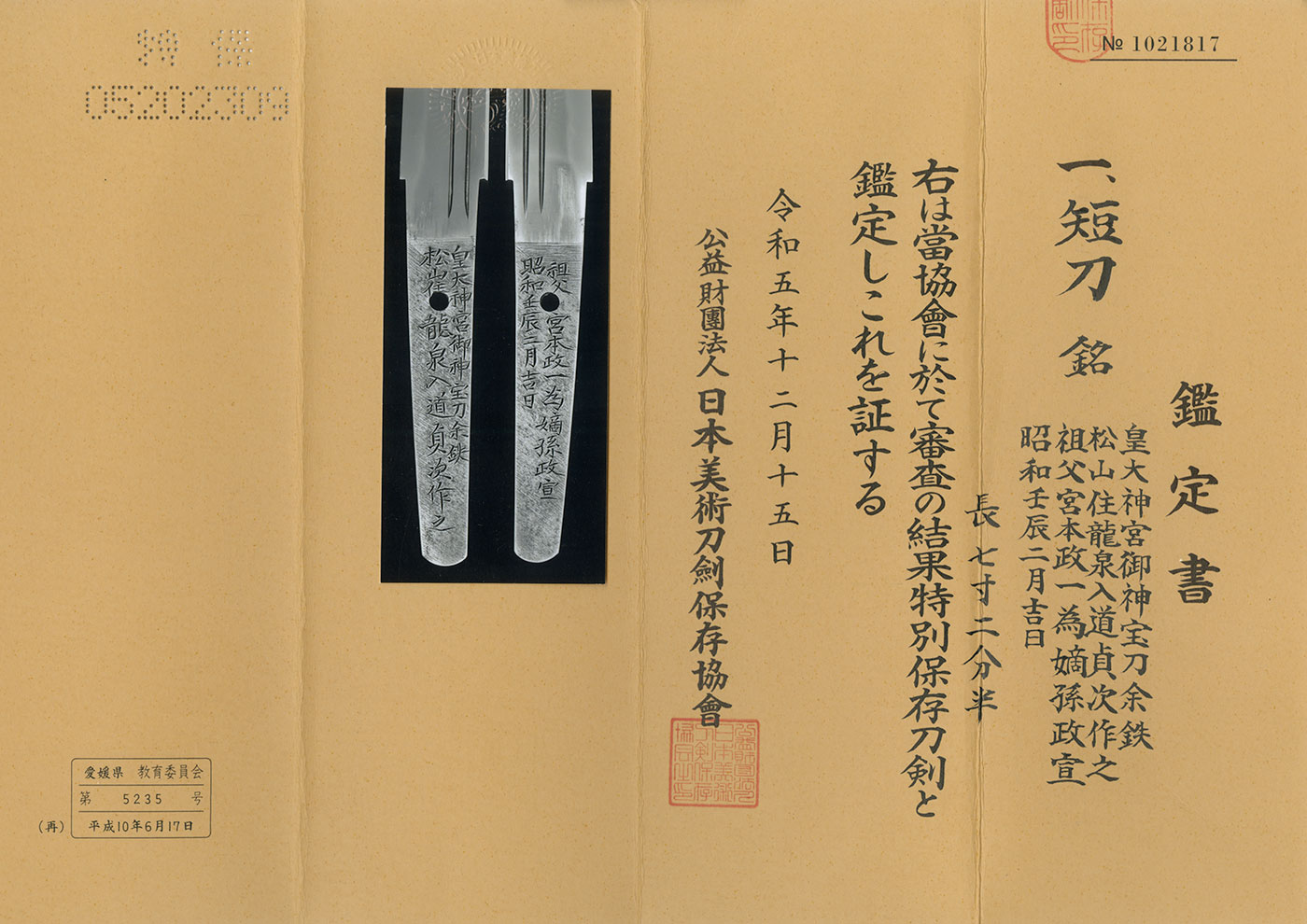
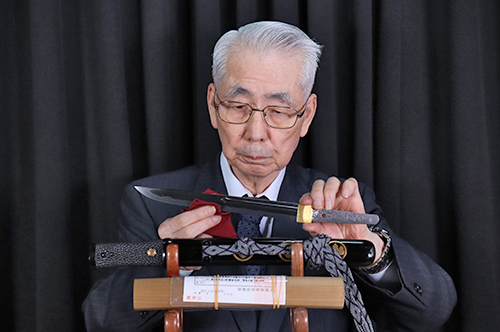
(We divide 4 sections for each sword as Saijyo Saku, Jyojyo Saku, Jyo Saku and Regular Saku). This work is ranked as Saijyo Saku for Matsuyama ju Ryusen Nyudo Sadatsugu. Shape: A suken (straight sword engraving) is carved on the front, and double grooves (futatsuji-hi) are carved on the reverse. Jigane: Ko-itame hada. It forms an exceptionally beautiful steel surface. Hamon: Nie-deki, gunome-midare, with gunome activity within the hamon, and the boshi turns back in a rounded form. Features: Matsuyama ju Ryusen Nyudo Sadatsugu was the first swordsmith from Ehime Prefecture to be designated as an Important Intangible Cultural Property of Japan (Living National Treasure). His production volume is small, and he made swords for shrines, votive offerings, and protective daggers for the Imperial family. In 1938, he received the Prime Minister’s Award at the 1st Sword Exhibition. After that, he continued forging many works as protective daggers, including one for Crown Princess Michiko on the occasion of her marriage to Crown Prince Akihito. His polishing also produces works of remarkable strength and presence. Aoi Art’s Comment: I once owned a tanto by Ryusen Nyudo Sadatsugu. It was a work with a floral motif, delivered from Japan to Lieutenant General Uokawa in North Korea via South Korea. The name of Lieutenant General Uokawa was inscribed in English, and it was a work from around 1949. At that time, sword production was not permitted, so I believe it was made under special authorization. Later, after Lieutenant General Uokawa passed away, I acquired the sword in the United States as part of my collection. As time has passed, I have now obtained this work as well. NBTHK Tokubetsu Hozon Token.
Offered by Aoi Art


As written by the shop
Ehime · around 1926-1989
3 pieces on the market now
Shōwa to the present: destruction and revival
The twentieth century nearly killed the craft twice: wartime distortion, then the occupation ban. The NBTHK’s founding in 1948 and licensed forging from 1953 rebuilt the sword as an art, crowned by Living National Treasures and the mukansa rank.
A Hozon-certified blade judged to show notably superior workmanship and a better state of preservation. The bar is higher: re-tempered blades and most unsigned Muromachi/Edo works are excluded.
The NBTHK (Nihon Bijutsu Tōken Hozon Kyōkai, the Society for the Preservation of Japanese Art Swords) is a public-interest incorporated foundation founded in 1948 and supervised by Japan’s Agency for Cultural Affairs (Bunkachō); it is based at the Japanese Sword Museum in Tokyo. Its expert panels physically examine each submitted work (shinsa) and issue a certificate (kanteishō) ranking it by artistic and historical merit. NBTHK papers are the most widely recognized standard of authentication for Japanese swords and fittings.
NBTHK official siteIf you wish to return an item, please notify us within 3 days of receipt. After this period we cannot accept cancellations. Please ship the return to us within 5 business days. Cancellation is conditional on the item being kept in the same condition as at the time of sale, so please handle it with care.
¥2,000,000
Certificate reading — 銘 皇大神宮御神宝刀余鉄 松山住龍泉入道貞次作之 / 祖父宮本政一為嫡孫政宣 昭和壬辰二月吉日