NihontoWatch Mon

NihontoWatch

MarketAuctions
Encyclopedia
NihontoWatch Mon

NihontoWatch

MarketAuctions
Encyclopedia

Description

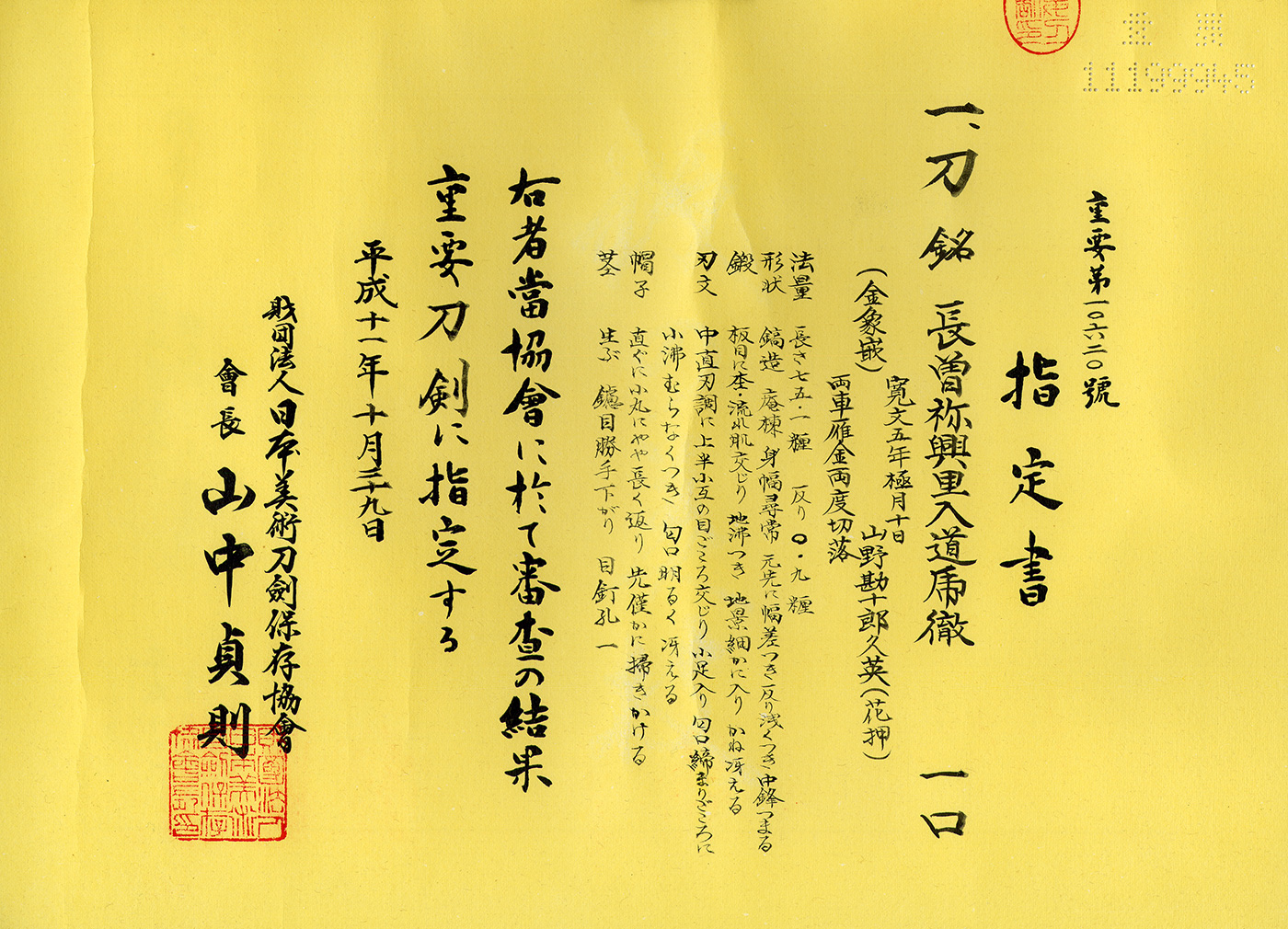
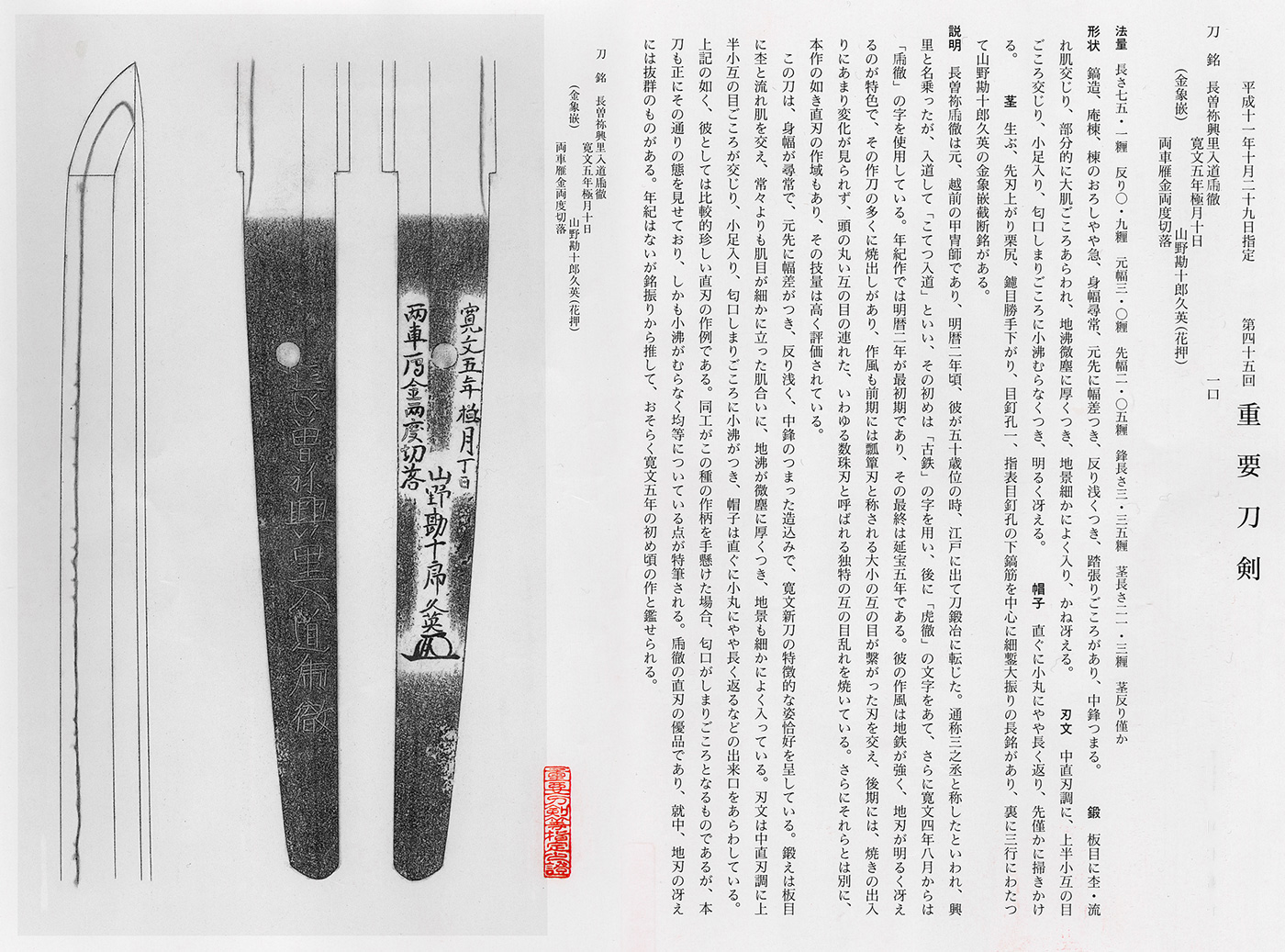
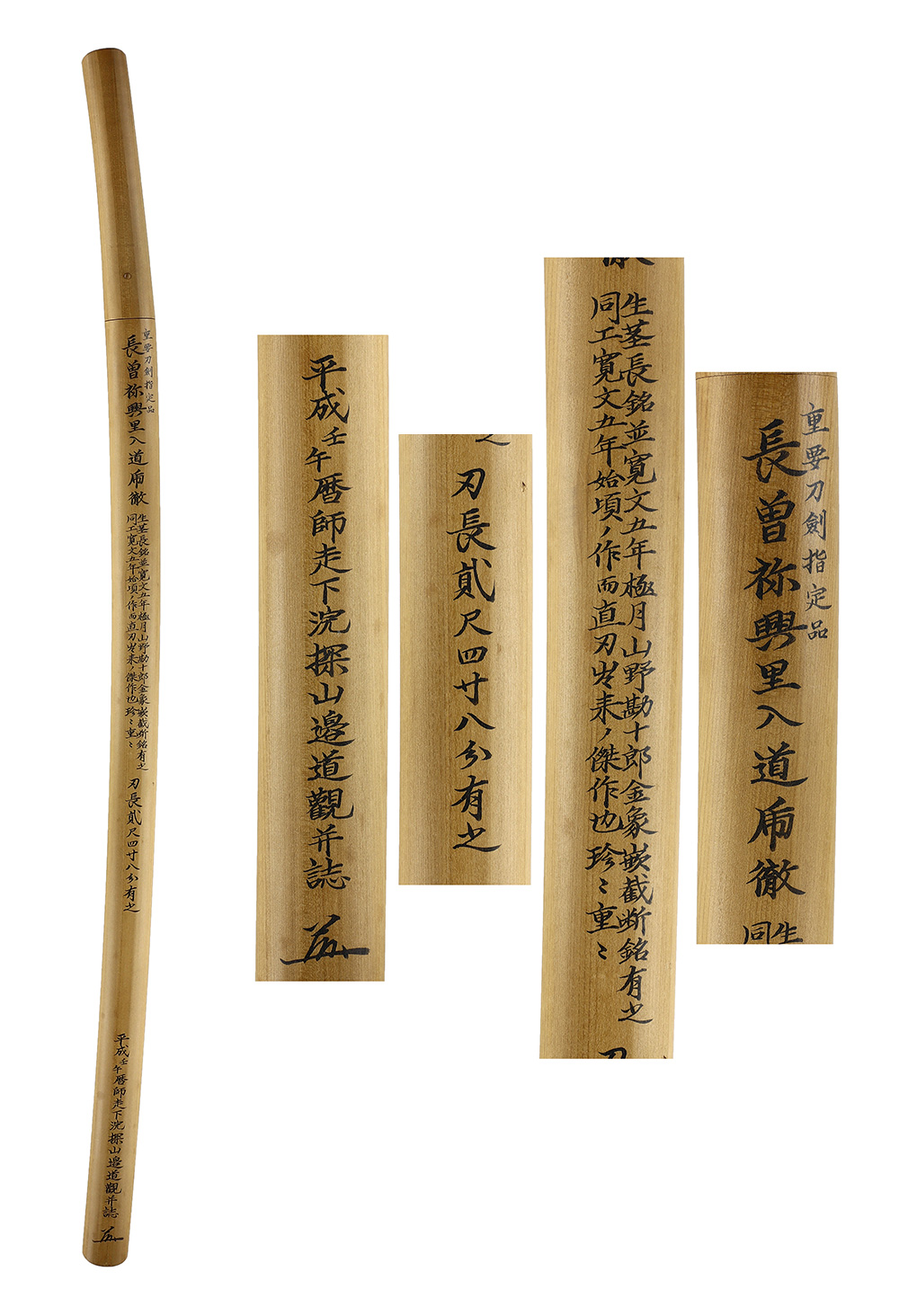
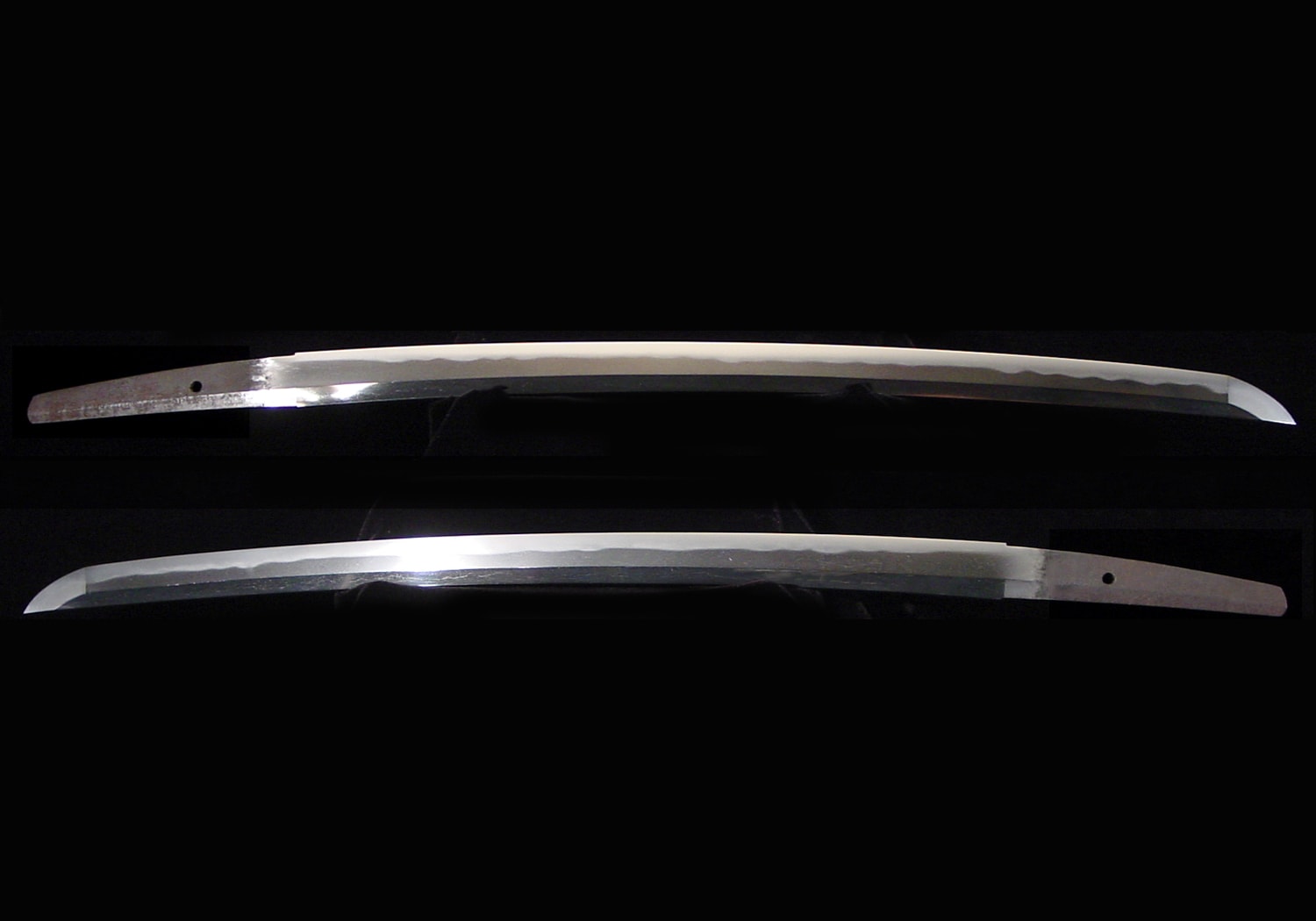
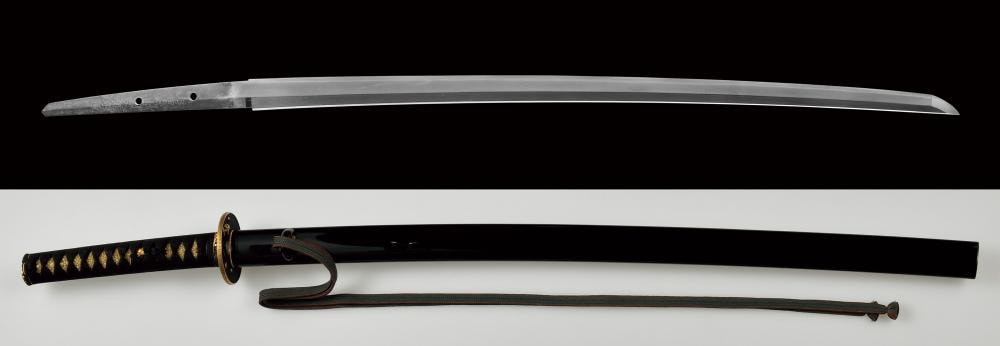
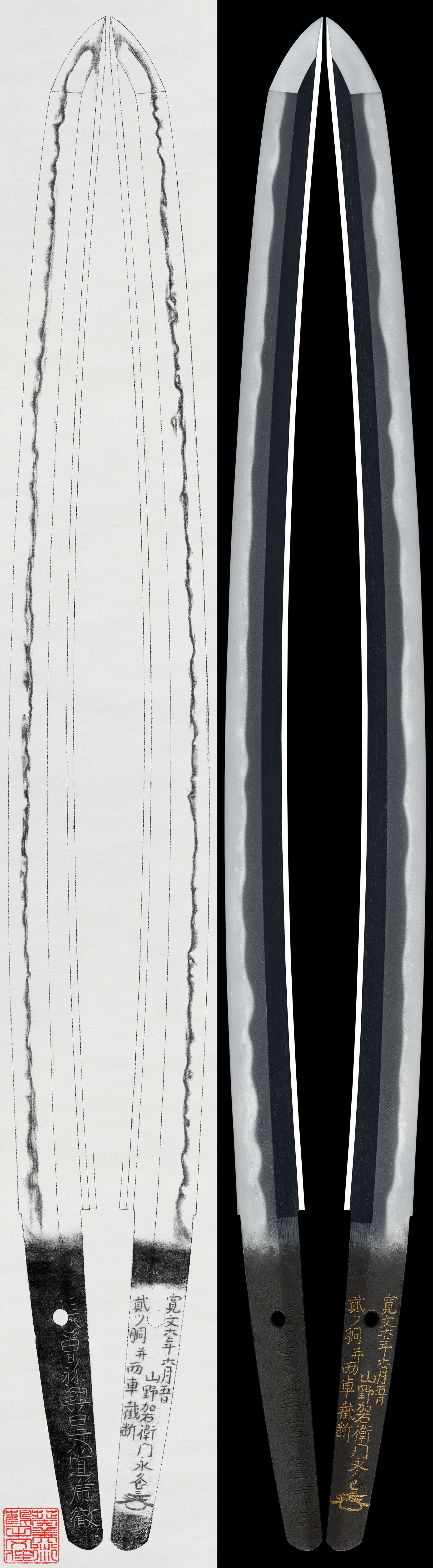
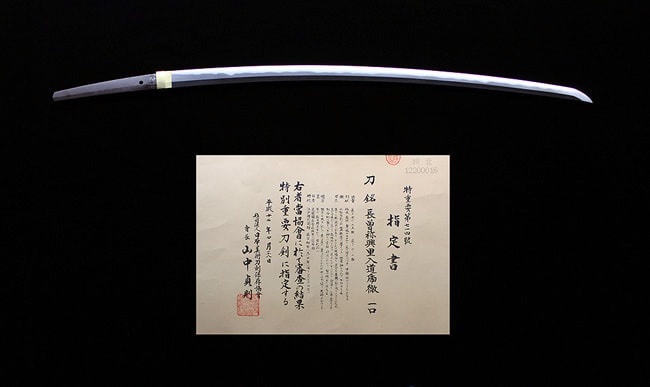
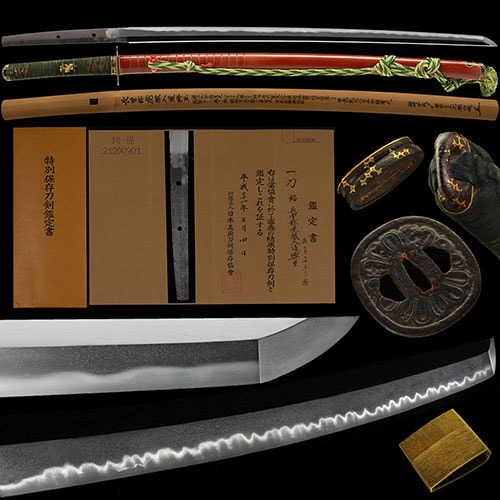
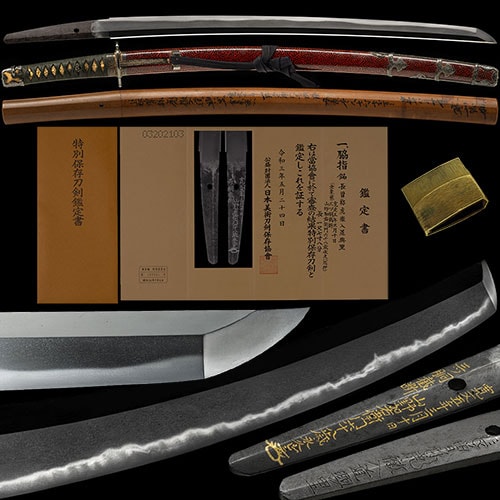
This is a long katana by Nagasone Okisato Nyudo Kotetsu, a renowned swordsmith from the early Edo period (around 1665). The blade features a rare golden cutting test inscription (Saidan-mei) from Kanbun 5, attesting to its exceptional sharpness. It is accompanied by a 45th NBTHK Juyo Token certificate, recognizing its high quality and historical significance.

NBTHK Setsumei

Jūyō-Tōken, 45th Session — Designated October 29, 1999 Katana, mei: Nagasone Okisato Nyūdō Kotetsu (長曽祢興里入道后徹) Measurements Nagasa 75.1 cm, sori 0.9 cm, motohaba 3.0 cm, sakihaba 2.05 cm, kissaki-nagasa 3.35 cm, nakago-nagasa 22.3 cm, nakago-sori slight Description Keijō: Shinogi-zukuri, iori-mune; the mune bevel drops rather steeply; standard mihaba with noticeable taper from base to tip; shallow sori with a suggestion of funbari; compact chū-kissaki. Kitae: Itame-hada mixed with mokume and nagare-hada; in places showing a tendency toward ō-hada; fine ji-nie densely and thickly applied; fine chikei well entered; the steel is clear. Hamon: Based on chū-suguha, with the upper half mixed with a suggestion of ko-gunome; ko-ashi enter; the nioiguchi tends toward being tight, with ko-nie attaching evenly without irregularity; bright and clear. Bōshi: Straight, forming ko-maru with a somewhat long kaeri; the tip shows slight hakikake. Horimono: None. Nakago: Ubu; tip ha-agari kurijiri; yasurime katte-sagari; one mekugi-ana; on the omote, beneath the mekugi-ana and centered on the shinogi-suji, there is a long signature cut with fine chiselwork in large strokes; on the ura there is, over three lines, a gold-inlaid cutting-test inscription (kinzōgan setsudan-mei) by Yamano Kanjūrō Hisahide. Artisan Nagasone Okisato Nyūdō Kotetsu (長曽祢興里入道后徹) Era Early Edo period, Kanbun era (mid-17th century) Explanation Nagasone Kotetsu was originally a maker of armor in Echizen. Around Meireki 2 (1656), when he was about fifty years of age, he went to Edo and changed his profession to that of swordsmith. It is said that his common name was Sannojō. He used the name Okisato, and after taking the tonsure he was called “Kotetsu Nyūdō.” At first he employed the characters 古鉄 for “Kotetsu,” later adopting the characters 虎徹, and from Kanbun 4 (1664), eighth month onward, he used the characters 馬徹. Among his dated works, the earliest are from Meireki 2, and the latest extend to Enpō 5 (1677). A hallmark of his style is the strong jigane and the bright, clear quality of both ji and ha. Many of his blades show yakidashi. In his earlier period he produced hamon that incorporate connected large and small gunome—the so-called “hyōtan-ba” (“gourd hamon”). In his later period the amount of variation in the yakiba tends to decrease, and he often tempered a distinctive gunome-midare with round-headed gunome linked in succession, commonly called “juzu-ba” (“rosary-bead hamon”). Apart from these, he also produced works in suguha as seen in the present blade, and his skill in that domain is held in high regard. This katana has standard width with clear taper from base to tip, shallow sori, and a compact chū-kissaki, presenting the characteristic sugata of Kanbun-shintō. The forging is itame mixed with mokume and nagare, with a somewhat more finely standing texture than is usual; fine ji-nie attaches densely and thickly, and fine chikei enter well. The hamon is based on chū-suguha with a suggestion of ko-gunome in the upper portion; ko-ashi appear; the nioiguchi shows a tendency to tighten, with ko-nie attaching evenly. The bōshi is straight and turns back in ko-maru with a somewhat long return. As stated above, this is a comparatively uncommon suguha example for this smith. When Kotetsu undertakes works of this kind, the nioiguchi characteristically becomes tight, and this blade precisely exhibits that tendency; moreover, it is especially noteworthy that the ko-nie is uniform and even throughout. It is a superior suguha work by Kotetsu, and, above all, the clarity of the ji and ha is outstanding. Although there is no date inscription, judging from the manner of the signature, it is appraised as probably a work from around the beginning of Kanbun 5 (1665).

NihontoWatch MonNihontoWatch
MarketAuctionsEncyclopedia
Swords›Kotetsu›Katana: Nagasone Okisato Nyudo Kotetsu with Saidan-mei (45th NBTHK Juyo Token)
katanaJūyō
Kotetsu

Katana: Nagasone Okisato Nyudo Kotetsu with Saidan-mei (45th NBTHK Juyo Token)

mei · Joo (1652-1655) · nagasa 74.9cm · sori 1.1cm

¥60,000,000
Visit seller website →
Kotetsu — 1 of 6
Kotetsu — 2 of 6
Kotetsu — 3 of 6
Kotetsu — 4 of 6
Kotetsu — 5 of 6
Kotetsu — 6 of 6
1 / 6
1 / 6
Kotetsu — 1 of 6Kotetsu — 2 of 6Kotetsu — 3 of 6Kotetsu — 4 of 6Kotetsu — 5 of 6Kotetsu — 6 of 6
Measurements & details
Smith
Kotetsu
Type
Katana
School
Kotetsu
Period
Around 1644–1677(Joo)
Signature
Signed(100% of this smith's designated works are signed)
Measurements
Nagasa 74.9cmSori 1.1cmMotohaba 2.14cmSakihaba 0.54cmKasane 0.64cmWeight 790g
Description

This is a long katana by Nagasone Okisato Nyudo Kotetsu, a renowned swordsmith from the early Edo period (around 1665). The blade features a rare golden cutting test inscription (Saidan-mei) from Kanbun 5, attesting to its exceptional sharpness. It is accompanied by a 45th NBTHK Juyo Token certificate, recognizing its high quality and historical significance.

Official Catalog Translation

Juyo

-, 45th Session — Designated October 29, 1999

, : Nagasone Okisato Nyūdō Kotetsu (長曽祢興里入道后徹)

Measurements 75.1 cm, 0.9 cm, 3.0 cm, 2.05 cm, 3.35 cm, 22.3 cm, slight

Description Keijō: , ; the bevel drops rather steeply; standard with noticeable taper from base to tip; shallow with a suggestion of ; compact . : mixed with and ; in places showing a tendency toward ō-hada; fine densely and thickly applied; fine well entered; the steel is clear. : Based on , with the upper half mixed with a suggestion of ; enter; the tends toward being tight, with attaching evenly without irregularity; bright and clear. : Straight, forming with a somewhat long ; the tip shows slight . : None. : ; tip ; ; one ; on the , beneath the and centered on the , there is a long signature cut with fine chiselwork in large strokes; on the there is, over three lines, a gold-inlaid cutting-test inscription ( ) by Yamano Kanjūrō Hisahide.

Artisan Nagasone Okisato Nyūdō Kotetsu (長曽祢興里入道后徹)

Era Early period, era (mid-17th century)

Explanation Nagasone Kotetsu was originally a maker of armor in . Around Meireki 2 (1656), when he was about fifty years of age, he went to and changed his profession to that of swordsmith. It is said that his common name was Sannojō. He used the name Okisato, and after taking the tonsure he was called “Kotetsu Nyūdō.” At first he employed the characters 古鉄 for “Kotetsu,” later adopting the characters 虎徹, and from 4 (1664), eighth month onward, he used the characters 馬徹.

Among his dated works, the earliest are from Meireki 2, and the latest extend to Enpō 5 (1677). A hallmark of his style is the strong and the bright, clear quality of both and . Many of his blades show . In his earlier period he produced that incorporate connected large and small —the so-called “hyōtan-ba” (“gourd ”). In his later period the amount of variation in the tends to decrease, and he often tempered a distinctive with round-headed linked in succession, commonly called “” (“rosary-bead ”). Apart from these, he also produced works in as seen in the present blade, and his skill in that domain is held in high regard.

This has standard width with clear taper from base to tip, shallow , and a compact , presenting the characteristic of -. The forging is mixed with and , with a somewhat more finely standing texture than is usual; fine attaches densely and thickly, and fine enter well. The is based on with a suggestion of in the upper portion; appear; the shows a tendency to tighten, with attaching evenly. The is straight and turns back in with a somewhat long return.

As stated above, this is a comparatively uncommon example for this smith. When Kotetsu undertakes works of this kind, the characteristically becomes tight, and this blade precisely exhibits that tendency; moreover, it is especially noteworthy that the is uniform and even throughout. It is a superior work by Kotetsu, and, above all, the clarity of the and is outstanding. Although there is no date inscription, judging from the manner of the signature, it is appraised as probably a work from around the beginning of 5 (1665).

Source: Yuhinkai Catalog
About the maker

Kotetsu

虎徹

Kotetsu school (Edo Shinto) · Musashi · around 1644-1677

Fujishiro Sai-jo saku · Tōken Taikan top 3%

3 pieces on the market now

›

On a wakizashi of his debut years Kotetsu cut his own biography into the nakago: a native of Echizen who, past half a hundred years (半百), came to live in Edo of Musashi and gave himself to the smith's craft. Nagasone Okisato, called Sannojo, who after taking lay orders signed Kotetsu Nyudo, was originally an armorer (katchu-shi) of Echizen; around Meireki 2 (1656), when he was about fifty years old, he moved to Edo and turned swordsmith, a conversion the published commentary restates on blade after blade. Dated work runs from that same Meireki 2 to Enpo 5 (1677), the year before his death: one of the most celebrated careers in the Japanese sword fits inside two decades. The sources explain the sudden fame concretely: he brought from the armorer's forge a rare skill in treating iron, he excelled at carving, and he won his name by devising a strikingly novel hamon, the juzu-ba[[c:1]], the proven sharpness of the edge and the beauty of the carving[[c:2]] doing the rest. The modern commentary calls him the most popular smith of the entire Shinto age[[c:3]].

The standing formula of the published sources gives his work in one sentence: the jigane is strong, and the ji and ha are bright and clear[[c:4]]; most of his blades open with a yakidashi[[c:5]], the short straight start of the temper above the machi. Above it, in the mature work, runs the hamon that made the name: the juzu-ba, the peculiar gunome-midare[[c:6]] whose round-headed gunome[[c:7]] link so evenly that the crests stand almost in one line, like a string of prayer beads. Thick ashi enter frequently, the nioi is deep, ko-nie lies thick, fine kinsuji and sunagashi run through the ha, and the nioiguchi is bright and clear. The boshi is typically sugu with a small round return, and in his later years he often burned a gunome across the yokote itself, a habit one text calls the idiosyncratic gesture of Kotetsu[[c:8]].

The jigane is the armorer's legacy, and the sources say so directly. Of a kanmuri-otoshi wakizashi of Meireki 2 or 3, his first manner, the commentary writes that the forging of the jigane is good even among his own works, well kneaded and extremely strong[[c:9]]; in those early blades a large open hada (大肌) surfaces toward the middle, and the so-called tekogane (テコ鉄), the armorer's billet iron, appears in the ji. In the prime the forging tightens to a ko-itame knit to the utmost, ji-nie thick and dust-fine, chikei fine, the steel clear and bright, while flecks of jifu (地斑) still surface here and there. The horimono are his own hand: the early kurikara in splendid openwork (欄間透) is read straight from the Echizen carving of the Kinai school (記内彫), the add-mei moves from dosaku horinokore (同作彫之) to horimono dosaku (彫物同作), the shinkitae-saku addendum (真鍛作) marks selected forgings, and even unsigned carvings are given to him outright on the fineness of the chisel.

The NBTHK dates his blades almost by the signature alone. He signed first with the old-iron characters (古鉄), a form with almost no parallel; then in the hane-tora manner; and from the eighth month of Kanbun 4 (1664) in the hako-tora form, both occurring within that single month. The early period belongs to the hyotan-ba, shallow gunome paired in twos[[c:10]] whose fused silhouettes suggest the double gourd, which one Juyo text dates as the hamon often seen from the end of Manji into the first years of Kanbun[[c:11]]. The later period carries the juzu-ba over the typical Kanbun-shinto sugata[[c:12]]: mihaba tapering markedly from base to tip, shallow sori, a compact chu-kissaki. The texts set the summit late, from Kanbun 10 to about Enpo 2 or 3[[c:13]], call the sober blades of about Kanbun 8 mostly tight in the nioiguchi, short of flamboyance but solid[[c:14]], and praise a wakizashi of Enpo 3 or 4 as a work of complete ripeness[[c:15]]. Two registers stand aside. Suguha is comparatively rare for him, and when he took it up the nioiguchi as a rule tightens[[c:16]]. Tanto are rarer still, probably not reaching ten extant pieces[[c:17]]; in them the jifu stands out, the nioi runs deep with coarse nie, sunagashi and kinsuji mingle, and the feeling of Soshu is strong, one text reading the aim as lying in the direction of Go (江辺).

The cutting tests are nearly a second signature. Many of his designated blades carry gold-inlaid attestations by Yamano Kaemon no Jo Nagahisa and Yamano Kanjuro Hisahide, the leading authorities on test-cutting of the day[[c:18]], recording two-body and three-body cuts[[c:19]] dated to the day. These kinzogan inscriptions sit on the nakago beside his own mei as certifications of the edge, never as signatures. That wakizashi outnumber katana, with frequent masterpieces among them, one text lays to commissions from wealthy merchants more than from the warrior class[[c:20]]. Honma Junji's verdict stands in the Juyo Bijutsuhin records: among the Kanbun-shinto smiths, Kotetsu of the east is, with Sukehiro and Shinkai of the west, beyond question of the first rank[[c:21]]; the same note adds that a market price overtaking the old masterpieces[[c:22]] goes too far. The Nagasone forge outlived him: Okimasa, his adopted son, succeeded as the second-generation Kotetsu, with Okinao and Okihisa completing the gate, Okinao read as a daisaku hand during the master's lifetime.

Fujishiro rates him Sai-jo saku, the top grade. The official record carries 129 designated works: five Important Cultural Properties, ten Tokubetsu Juyo and 102 Juyo, 112 in those two tiers together, and ten prewar Juyo Bijutsuhin. The record is almost entirely signed, 115 signed blades against a single unsigned piece, so the mei chronology above doubles as the connoisseur's map of the work. The recorded provenance runs through the great houses: the Nabeshima of Hizen, the Shimazu, the Okubo of Odawara, the Uwajima Date, the Maeda of Kaga and the Imperial Family; one blade passed through the house of Yamada Asaemon, the prewar premier Inukai Bokudo owned the wind-and-thunder-gods wakizashi of Enpo 5, his last year, and a blade of Kanbun 1 rests in the Tsukamoto Museum of Art. The five Important Cultural Properties are patrimony, preserved beyond the market; nearly everything else stands in the Tokubetsu Juyo and Juyo registers, long held in private collections, so a genuine Kotetsu surfaces only rarely and commands the very top of the market when it does. For the connoisseur the recognition runs ahead of the nakago: a juzu-ba over a strong, bright jigane in a Kanbun-shinto sugata reads as Kotetsu before the signature is ever examined.


Historical importance

Where Kotetsu stands among comparable artisans: across all of nihontō, and within tradition, era, and period. The tiers (Foremost · Leading · Major · Notable) weigh official designations from the NBTHK and Japan's Agency for Cultural Affairs, together with historical honors of lasting repute such as the Sansaku and Meibutsu-chō.

随一
Foremost
屈指
Leading
有数
Major
著名
Notable

Select a lens to see how it's measured.

Designation record
128 designated works
Jūyō Bunkazai
5
Jūyō Bijutsuhin
10
Gyobutsu (Imperial)
2
Tokubetsu Jūyō
10
Jūyō
101
3 works by Kotetsu on the market→
Kotetsu — full profileKotetsu school (Edo Shinto) school

Dated Works

Years he was demonstrably active, proven by signed-and-dated blades

Active period
1658–1677Editorial estimate: 1644–1677
17 of 109 designated works carry a date
1650
1660
1670
1680
About the school

Kotetsu

虎徹

Shinto · Musashi

4 pieces on the market now

›

Nagasone Okisato, who took the smithing name Kotetsu (虎徹), began his career not at the forge of the swordsmith but at that of the armorer, working as a katchūshi in Echizen Province. Around Meireki 2 (1656), when he was about fifty years of age, he relocated to Edo and changed his profession to swordsmithing, settling in the area of Tōeizan and Shinobugaoka. The setsumei record that his common name was Sannojō; he first signed Okisato, and after taking Buddhist vows styled himself Kotetsu Nyūdō. Learn more →

5 recorded smiths162 designated works
Leading smiths
SmithEraDesignated
Kotetsu虎徹1644-1677128
Okimasa興正1661-169026
Nagasone Kotetsu長曽祢興里c.1597-16784
Okihisa興久1673-16812
Toranyudo虎入道1661-16732
Explore the Kotetsu school →
NBTHK Certificate
Jūyō Tōken重要刀剣
Important Sword
›

A blade of top-grade workmanship and condition, formally judged to rank with a nationally recognized Important Art Object (Jūyō Bijutsuhin). Awarded only at the NBTHK’s competitive annual examination.

Of Japan’s roughly 2.5 million registered swords, only 12,307 (about 1 in 203) have ever attained Jūyō.

About the NBTHK›

The NBTHK (Nihon Bijutsu Tōken Hozon Kyōkai, the Society for the Preservation of Japanese Art Swords) is a public-interest incorporated foundation founded in 1948 and supervised by Japan’s Agency for Cultural Affairs (Bunkachō); it is based at the Japanese Sword Museum in Tokyo. Its expert panels physically examine each submitted work (shinsa) and issue a certificate (kanteishō) ranking it by artistic and historical merit. NBTHK papers are the most widely recognized standard of authentication for Japanese swords and fittings.

NBTHK official site→
Seller
A
Aoi Art
🇯🇵Ships from Japan
›
✓Verified dealeraoijapan.com
Settles in JPY
✓Ships worldwide✓English supportWire transferPayPalCredit card
Return policy

If you wish to return an item, please notify us within 3 days of receipt. After this period we cannot accept cancellations. Please ship the return to us within 5 business days. Cancellation is conditional on the item being kept in the same condition as at the time of sale, so please handle it with care.

View all of Aoi Art’s listings→View this item on the dealer’s site→

More works by Kotetsu

View all →
Nihonto Australia
Tanto - by Kotetsu - Kotetsu with Koshirae by Miyata NobukiyoTanto - by Kotetsu - Kotetsu with Koshirae by Miyata Nobukiyo

Tantō

ByKotetsu
Ask
Nihonto.com
Jūyō
Wakizashi - Jūyō - by Kotetsu - Wakizashi by Nagasone KotetsuWakizashi - Jūyō - by Kotetsu - Wakizashi by Nagasone Kotetsu

Wakizashi

ByKotetsu
Ask

Previously sold by Kotetsu

Winners Auction
Wakizashi - by Kotetsu - Nagasone Kotetsu Nyudo OkisatoWakizashi - by Kotetsu - Nagasone Kotetsu Nyudo Okisato
Sold

Wakizashi

ByKotetsu
SOLD
Winners Auction
Wakizashi - by Kotetsu - Nagasone Kotetsu Nyudo OkisatoWakizashi - by Kotetsu - Nagasone Kotetsu Nyudo Okisato
Sold

Wakizashi

ByKotetsu
SOLD
Aoi Art
Tokuho
Wakizashi - Tokuho - by Kotetsu - Nagasone Okisato Nyudo Kotetsu with Saidan-meiWakizashi - Tokuho - by Kotetsu - Nagasone Okisato Nyudo Kotetsu with Saidan-mei
Sold

Wakizashi

ByKotetsu
SOLD
Seikeido
Tokujū
Katana - Tokuju - by Kotetsu - KotetsuKatana - Tokuju - by Kotetsu - Kotetsu
Sold

Katana

ByKotetsu
SOLD
Winners Auction
Katana - by Kotetsu - Nagasone Kotetsu Nyudo Okisato - Kanbun 9th Year, February Lucky Day, Magnificent Paulownia Crest Koshirae, Polished, KotetsuKatana - by Kotetsu - Nagasone Kotetsu Nyudo Okisato - Kanbun 9th Year, February Lucky Day, Magnificent Paulownia Crest Koshirae, Polished, Kotetsu
Sold

Katana

ByKotetsu
SOLD
Giheiya
Wakizashi - by Kotetsu - Kotetsu - 1 Shaku 5 Sun, with ShirasayaWakizashi - by Kotetsu - Kotetsu - 1 Shaku 5 Sun, with Shirasaya
Sold

Wakizashi

ByKotetsu
SOLD
Shoubudou
Katana - by Kotetsu - Nagasone Kotetsu Nyudo OkisatoKatana - by Kotetsu - Nagasone Kotetsu Nyudo Okisato
Sold

Katana

ByKotetsu
SOLD
Eirakudo
Tokuho
Katana - Tokuho - by Kotetsu - Kotetsu - Tokubetsu Hozon TokenKatana - Tokuho - by Kotetsu - Kotetsu - Tokubetsu Hozon Token
Sold

Katana

ByKotetsu
SOLD

Swords

  • Katana
  • Wakizashi
  • Tantō
  • Tachi
  • Naginata
  • Yari

Fittings

  • Tsuba
  • Fuchi-Kashira
  • Kozuka
  • Menuki

By Certification

  • Tokujū
  • Jūyō
  • Tokuho
  • Hozon

Resources

  • Dealer Directory
  • Artist Directory
  • Glossary
  • Browse All
Nihontowatch© 2026
TermsPrivacyCookiesAbout

Description

This is a long katana by Nagasone Okisato Nyudo Kotetsu, a renowned swordsmith from the early Edo period (around 1665). The blade features a rare golden cutting test inscription (Saidan-mei) from Kanbun 5, attesting to its exceptional sharpness. It is accompanied by a 45th NBTHK Juyo Token certificate, recognizing its high quality and historical significance.

NBTHK Setsumei

Jūyō-Tōken, 45th Session — Designated October 29, 1999 Katana, mei: Nagasone Okisato Nyūdō Kotetsu (長曽祢興里入道后徹) Measurements Nagasa 75.1 cm, sori 0.9 cm, motohaba 3.0 cm, sakihaba 2.05 cm, kissaki-nagasa 3.35 cm, nakago-nagasa 22.3 cm, nakago-sori slight Description Keijō: Shinogi-zukuri, iori-mune; the mune bevel drops rather steeply; standard mihaba with noticeable taper from base to tip; shallow sori with a suggestion of funbari; compact chū-kissaki. Kitae: Itame-hada mixed with mokume and nagare-hada; in places showing a tendency toward ō-hada; fine ji-nie densely and thickly applied; fine chikei well entered; the steel is clear. Hamon: Based on chū-suguha, with the upper half mixed with a suggestion of ko-gunome; ko-ashi enter; the nioiguchi tends toward being tight, with ko-nie attaching evenly without irregularity; bright and clear. Bōshi: Straight, forming ko-maru with a somewhat long kaeri; the tip shows slight hakikake. Horimono: None. Nakago: Ubu; tip ha-agari kurijiri; yasurime katte-sagari; one mekugi-ana; on the omote, beneath the mekugi-ana and centered on the shinogi-suji, there is a long signature cut with fine chiselwork in large strokes; on the ura there is, over three lines, a gold-inlaid cutting-test inscription (kinzōgan setsudan-mei) by Yamano Kanjūrō Hisahide. Artisan Nagasone Okisato Nyūdō Kotetsu (長曽祢興里入道后徹) Era Early Edo period, Kanbun era (mid-17th century) Explanation Nagasone Kotetsu was originally a maker of armor in Echizen. Around Meireki 2 (1656), when he was about fifty years of age, he went to Edo and changed his profession to that of swordsmith. It is said that his common name was Sannojō. He used the name Okisato, and after taking the tonsure he was called “Kotetsu Nyūdō.” At first he employed the characters 古鉄 for “Kotetsu,” later adopting the characters 虎徹, and from Kanbun 4 (1664), eighth month onward, he used the characters 馬徹. Among his dated works, the earliest are from Meireki 2, and the latest extend to Enpō 5 (1677). A hallmark of his style is the strong jigane and the bright, clear quality of both ji and ha. Many of his blades show yakidashi. In his earlier period he produced hamon that incorporate connected large and small gunome—the so-called “hyōtan-ba” (“gourd hamon”). In his later period the amount of variation in the yakiba tends to decrease, and he often tempered a distinctive gunome-midare with round-headed gunome linked in succession, commonly called “juzu-ba” (“rosary-bead hamon”). Apart from these, he also produced works in suguha as seen in the present blade, and his skill in that domain is held in high regard. This katana has standard width with clear taper from base to tip, shallow sori, and a compact chū-kissaki, presenting the characteristic sugata of Kanbun-shintō. The forging is itame mixed with mokume and nagare, with a somewhat more finely standing texture than is usual; fine ji-nie attaches densely and thickly, and fine chikei enter well. The hamon is based on chū-suguha with a suggestion of ko-gunome in the upper portion; ko-ashi appear; the nioiguchi shows a tendency to tighten, with ko-nie attaching evenly. The bōshi is straight and turns back in ko-maru with a somewhat long return. As stated above, this is a comparatively uncommon suguha example for this smith. When Kotetsu undertakes works of this kind, the nioiguchi characteristically becomes tight, and this blade precisely exhibits that tendency; moreover, it is especially noteworthy that the ko-nie is uniform and even throughout. It is a superior suguha work by Kotetsu, and, above all, the clarity of the ji and ha is outstanding. Although there is no date inscription, judging from the manner of the signature, it is appraised as probably a work from around the beginning of Kanbun 5 (1665).

NihontoWatch MonNihontoWatch
MarketAuctionsEncyclopedia
Swords›Kotetsu›Katana: Nagasone Okisato Nyudo Kotetsu with Saidan-mei (45th NBTHK Juyo Token)
katanaJūyō
Kotetsu

Katana: Nagasone Okisato Nyudo Kotetsu with Saidan-mei (45th NBTHK Juyo Token)

mei · Joo (1652-1655) · nagasa 74.9cm · sori 1.1cm

¥60,000,000
Visit seller website →
Kotetsu — 1 of 6
Kotetsu — 2 of 6
Kotetsu — 3 of 6
Kotetsu — 4 of 6
Kotetsu — 5 of 6
Kotetsu — 6 of 6
1 / 6
1 / 6
Kotetsu — 1 of 6Kotetsu — 2 of 6Kotetsu — 3 of 6Kotetsu — 4 of 6Kotetsu — 5 of 6Kotetsu — 6 of 6
Measurements & details
Smith
Kotetsu
Type
Katana
School
Kotetsu
Period
Around 1644–1677(Joo)
Signature
Signed(100% of this smith's designated works are signed)
Measurements
Nagasa 74.9cmSori 1.1cmMotohaba 2.14cmSakihaba 0.54cmKasane 0.64cmWeight 790g
Description

This is a long katana by Nagasone Okisato Nyudo Kotetsu, a renowned swordsmith from the early Edo period (around 1665). The blade features a rare golden cutting test inscription (Saidan-mei) from Kanbun 5, attesting to its exceptional sharpness. It is accompanied by a 45th NBTHK Juyo Token certificate, recognizing its high quality and historical significance.

Official Catalog Translation

Juyo

-, 45th Session — Designated October 29, 1999

, : Nagasone Okisato Nyūdō Kotetsu (長曽祢興里入道后徹)

Measurements 75.1 cm, 0.9 cm, 3.0 cm, 2.05 cm, 3.35 cm, 22.3 cm, slight

Description Keijō: , ; the bevel drops rather steeply; standard with noticeable taper from base to tip; shallow with a suggestion of ; compact . : mixed with and ; in places showing a tendency toward ō-hada; fine densely and thickly applied; fine well entered; the steel is clear. : Based on , with the upper half mixed with a suggestion of ; enter; the tends toward being tight, with attaching evenly without irregularity; bright and clear. : Straight, forming with a somewhat long ; the tip shows slight . : None. : ; tip ; ; one ; on the , beneath the and centered on the , there is a long signature cut with fine chiselwork in large strokes; on the there is, over three lines, a gold-inlaid cutting-test inscription ( ) by Yamano Kanjūrō Hisahide.

Artisan Nagasone Okisato Nyūdō Kotetsu (長曽祢興里入道后徹)

Era Early period, era (mid-17th century)

Explanation Nagasone Kotetsu was originally a maker of armor in . Around Meireki 2 (1656), when he was about fifty years of age, he went to and changed his profession to that of swordsmith. It is said that his common name was Sannojō. He used the name Okisato, and after taking the tonsure he was called “Kotetsu Nyūdō.” At first he employed the characters 古鉄 for “Kotetsu,” later adopting the characters 虎徹, and from 4 (1664), eighth month onward, he used the characters 馬徹.

Among his dated works, the earliest are from Meireki 2, and the latest extend to Enpō 5 (1677). A hallmark of his style is the strong and the bright, clear quality of both and . Many of his blades show . In his earlier period he produced that incorporate connected large and small —the so-called “hyōtan-ba” (“gourd ”). In his later period the amount of variation in the tends to decrease, and he often tempered a distinctive with round-headed linked in succession, commonly called “” (“rosary-bead ”). Apart from these, he also produced works in as seen in the present blade, and his skill in that domain is held in high regard.

This has standard width with clear taper from base to tip, shallow , and a compact , presenting the characteristic of -. The forging is mixed with and , with a somewhat more finely standing texture than is usual; fine attaches densely and thickly, and fine enter well. The is based on with a suggestion of in the upper portion; appear; the shows a tendency to tighten, with attaching evenly. The is straight and turns back in with a somewhat long return.

As stated above, this is a comparatively uncommon example for this smith. When Kotetsu undertakes works of this kind, the characteristically becomes tight, and this blade precisely exhibits that tendency; moreover, it is especially noteworthy that the is uniform and even throughout. It is a superior work by Kotetsu, and, above all, the clarity of the and is outstanding. Although there is no date inscription, judging from the manner of the signature, it is appraised as probably a work from around the beginning of 5 (1665).

Source: Yuhinkai Catalog
About the maker

Kotetsu

虎徹

Kotetsu school (Edo Shinto) · Musashi · around 1644-1677

Fujishiro Sai-jo saku · Tōken Taikan top 3%

3 pieces on the market now

›

On a wakizashi of his debut years Kotetsu cut his own biography into the nakago: a native of Echizen who, past half a hundred years (半百), came to live in Edo of Musashi and gave himself to the smith's craft. Nagasone Okisato, called Sannojo, who after taking lay orders signed Kotetsu Nyudo, was originally an armorer (katchu-shi) of Echizen; around Meireki 2 (1656), when he was about fifty years old, he moved to Edo and turned swordsmith, a conversion the published commentary restates on blade after blade. Dated work runs from that same Meireki 2 to Enpo 5 (1677), the year before his death: one of the most celebrated careers in the Japanese sword fits inside two decades. The sources explain the sudden fame concretely: he brought from the armorer's forge a rare skill in treating iron, he excelled at carving, and he won his name by devising a strikingly novel hamon, the juzu-ba[[c:1]], the proven sharpness of the edge and the beauty of the carving[[c:2]] doing the rest. The modern commentary calls him the most popular smith of the entire Shinto age[[c:3]].

The standing formula of the published sources gives his work in one sentence: the jigane is strong, and the ji and ha are bright and clear[[c:4]]; most of his blades open with a yakidashi[[c:5]], the short straight start of the temper above the machi. Above it, in the mature work, runs the hamon that made the name: the juzu-ba, the peculiar gunome-midare[[c:6]] whose round-headed gunome[[c:7]] link so evenly that the crests stand almost in one line, like a string of prayer beads. Thick ashi enter frequently, the nioi is deep, ko-nie lies thick, fine kinsuji and sunagashi run through the ha, and the nioiguchi is bright and clear. The boshi is typically sugu with a small round return, and in his later years he often burned a gunome across the yokote itself, a habit one text calls the idiosyncratic gesture of Kotetsu[[c:8]].

The jigane is the armorer's legacy, and the sources say so directly. Of a kanmuri-otoshi wakizashi of Meireki 2 or 3, his first manner, the commentary writes that the forging of the jigane is good even among his own works, well kneaded and extremely strong[[c:9]]; in those early blades a large open hada (大肌) surfaces toward the middle, and the so-called tekogane (テコ鉄), the armorer's billet iron, appears in the ji. In the prime the forging tightens to a ko-itame knit to the utmost, ji-nie thick and dust-fine, chikei fine, the steel clear and bright, while flecks of jifu (地斑) still surface here and there. The horimono are his own hand: the early kurikara in splendid openwork (欄間透) is read straight from the Echizen carving of the Kinai school (記内彫), the add-mei moves from dosaku horinokore (同作彫之) to horimono dosaku (彫物同作), the shinkitae-saku addendum (真鍛作) marks selected forgings, and even unsigned carvings are given to him outright on the fineness of the chisel.

The NBTHK dates his blades almost by the signature alone. He signed first with the old-iron characters (古鉄), a form with almost no parallel; then in the hane-tora manner; and from the eighth month of Kanbun 4 (1664) in the hako-tora form, both occurring within that single month. The early period belongs to the hyotan-ba, shallow gunome paired in twos[[c:10]] whose fused silhouettes suggest the double gourd, which one Juyo text dates as the hamon often seen from the end of Manji into the first years of Kanbun[[c:11]]. The later period carries the juzu-ba over the typical Kanbun-shinto sugata[[c:12]]: mihaba tapering markedly from base to tip, shallow sori, a compact chu-kissaki. The texts set the summit late, from Kanbun 10 to about Enpo 2 or 3[[c:13]], call the sober blades of about Kanbun 8 mostly tight in the nioiguchi, short of flamboyance but solid[[c:14]], and praise a wakizashi of Enpo 3 or 4 as a work of complete ripeness[[c:15]]. Two registers stand aside. Suguha is comparatively rare for him, and when he took it up the nioiguchi as a rule tightens[[c:16]]. Tanto are rarer still, probably not reaching ten extant pieces[[c:17]]; in them the jifu stands out, the nioi runs deep with coarse nie, sunagashi and kinsuji mingle, and the feeling of Soshu is strong, one text reading the aim as lying in the direction of Go (江辺).

The cutting tests are nearly a second signature. Many of his designated blades carry gold-inlaid attestations by Yamano Kaemon no Jo Nagahisa and Yamano Kanjuro Hisahide, the leading authorities on test-cutting of the day[[c:18]], recording two-body and three-body cuts[[c:19]] dated to the day. These kinzogan inscriptions sit on the nakago beside his own mei as certifications of the edge, never as signatures. That wakizashi outnumber katana, with frequent masterpieces among them, one text lays to commissions from wealthy merchants more than from the warrior class[[c:20]]. Honma Junji's verdict stands in the Juyo Bijutsuhin records: among the Kanbun-shinto smiths, Kotetsu of the east is, with Sukehiro and Shinkai of the west, beyond question of the first rank[[c:21]]; the same note adds that a market price overtaking the old masterpieces[[c:22]] goes too far. The Nagasone forge outlived him: Okimasa, his adopted son, succeeded as the second-generation Kotetsu, with Okinao and Okihisa completing the gate, Okinao read as a daisaku hand during the master's lifetime.

Fujishiro rates him Sai-jo saku, the top grade. The official record carries 129 designated works: five Important Cultural Properties, ten Tokubetsu Juyo and 102 Juyo, 112 in those two tiers together, and ten prewar Juyo Bijutsuhin. The record is almost entirely signed, 115 signed blades against a single unsigned piece, so the mei chronology above doubles as the connoisseur's map of the work. The recorded provenance runs through the great houses: the Nabeshima of Hizen, the Shimazu, the Okubo of Odawara, the Uwajima Date, the Maeda of Kaga and the Imperial Family; one blade passed through the house of Yamada Asaemon, the prewar premier Inukai Bokudo owned the wind-and-thunder-gods wakizashi of Enpo 5, his last year, and a blade of Kanbun 1 rests in the Tsukamoto Museum of Art. The five Important Cultural Properties are patrimony, preserved beyond the market; nearly everything else stands in the Tokubetsu Juyo and Juyo registers, long held in private collections, so a genuine Kotetsu surfaces only rarely and commands the very top of the market when it does. For the connoisseur the recognition runs ahead of the nakago: a juzu-ba over a strong, bright jigane in a Kanbun-shinto sugata reads as Kotetsu before the signature is ever examined.

Historical importance

Where Kotetsu stands among comparable artisans: across all of nihontō, and within tradition, era, and period. The tiers (Foremost · Leading · Major · Notable) weigh official designations from the NBTHK and Japan's Agency for Cultural Affairs, together with historical honors of lasting repute such as the Sansaku and Meibutsu-chō.

随一
Foremost
屈指
Leading
有数
Major
著名
Notable

Select a lens to see how it's measured.

Designation record
128 designated works
Jūyō Bunkazai
5
Jūyō Bijutsuhin
10
Gyobutsu (Imperial)
2
Tokubetsu Jūyō
10
Jūyō
101
3 works by Kotetsu on the market→
Kotetsu — full profileKotetsu school (Edo Shinto) school

Dated Works

Years he was demonstrably active, proven by signed-and-dated blades

Active period
1658–1677Editorial estimate: 1644–1677
17 of 109 designated works carry a date
1650
1660
1670
1680
About the school

Kotetsu

虎徹

Shinto · Musashi

4 pieces on the market now

›

Nagasone Okisato, who took the smithing name Kotetsu (虎徹), began his career not at the forge of the swordsmith but at that of the armorer, working as a katchūshi in Echizen Province. Around Meireki 2 (1656), when he was about fifty years of age, he relocated to Edo and changed his profession to swordsmithing, settling in the area of Tōeizan and Shinobugaoka. The setsumei record that his common name was Sannojō; he first signed Okisato, and after taking Buddhist vows styled himself Kotetsu Nyūdō. Learn more →

5 recorded smiths162 designated works
Leading smiths
SmithEraDesignated
Kotetsu虎徹1644-1677128
Okimasa興正1661-169026
Nagasone Kotetsu長曽祢興里c.1597-16784
Okihisa興久1673-16812
Toranyudo虎入道1661-16732
Explore the Kotetsu school →
NBTHK Certificate
Jūyō Tōken重要刀剣
Important Sword
›

A blade of top-grade workmanship and condition, formally judged to rank with a nationally recognized Important Art Object (Jūyō Bijutsuhin). Awarded only at the NBTHK’s competitive annual examination.

Of Japan’s roughly 2.5 million registered swords, only 12,307 (about 1 in 203) have ever attained Jūyō.

About the NBTHK›

The NBTHK (Nihon Bijutsu Tōken Hozon Kyōkai, the Society for the Preservation of Japanese Art Swords) is a public-interest incorporated foundation founded in 1948 and supervised by Japan’s Agency for Cultural Affairs (Bunkachō); it is based at the Japanese Sword Museum in Tokyo. Its expert panels physically examine each submitted work (shinsa) and issue a certificate (kanteishō) ranking it by artistic and historical merit. NBTHK papers are the most widely recognized standard of authentication for Japanese swords and fittings.

NBTHK official site→
Seller
A
Aoi Art
🇯🇵Ships from Japan
›
✓Verified dealeraoijapan.com
Settles in JPY
✓Ships worldwide✓English supportWire transferPayPalCredit card
Return policy

If you wish to return an item, please notify us within 3 days of receipt. After this period we cannot accept cancellations. Please ship the return to us within 5 business days. Cancellation is conditional on the item being kept in the same condition as at the time of sale, so please handle it with care.

View all of Aoi Art’s listings→View this item on the dealer’s site→

More works by Kotetsu

View all →
Nihonto Australia
Tanto - by Kotetsu - Kotetsu with Koshirae by Miyata NobukiyoTanto - by Kotetsu - Kotetsu with Koshirae by Miyata Nobukiyo

Tantō

ByKotetsu
Ask
Nihonto.com
Jūyō
Wakizashi - Jūyō - by Kotetsu - Wakizashi by Nagasone KotetsuWakizashi - Jūyō - by Kotetsu - Wakizashi by Nagasone Kotetsu

Wakizashi

ByKotetsu
Ask

Previously sold by Kotetsu

Winners Auction
Wakizashi - by Kotetsu - Nagasone Kotetsu Nyudo OkisatoWakizashi - by Kotetsu - Nagasone Kotetsu Nyudo Okisato
Sold

Wakizashi

ByKotetsu
SOLD
Winners Auction
Wakizashi - by Kotetsu - Nagasone Kotetsu Nyudo OkisatoWakizashi - by Kotetsu - Nagasone Kotetsu Nyudo Okisato
Sold

Wakizashi

ByKotetsu
SOLD
Aoi Art
Tokuho
Wakizashi - Tokuho - by Kotetsu - Nagasone Okisato Nyudo Kotetsu with Saidan-meiWakizashi - Tokuho - by Kotetsu - Nagasone Okisato Nyudo Kotetsu with Saidan-mei
Sold

Wakizashi

ByKotetsu
SOLD
Seikeido
Tokujū
Katana - Tokuju - by Kotetsu - KotetsuKatana - Tokuju - by Kotetsu - Kotetsu
Sold

Katana

ByKotetsu
SOLD
Winners Auction
Katana - by Kotetsu - Nagasone Kotetsu Nyudo Okisato - Kanbun 9th Year, February Lucky Day, Magnificent Paulownia Crest Koshirae, Polished, KotetsuKatana - by Kotetsu - Nagasone Kotetsu Nyudo Okisato - Kanbun 9th Year, February Lucky Day, Magnificent Paulownia Crest Koshirae, Polished, Kotetsu
Sold

Katana

ByKotetsu
SOLD
Giheiya
Wakizashi - by Kotetsu - Kotetsu - 1 Shaku 5 Sun, with ShirasayaWakizashi - by Kotetsu - Kotetsu - 1 Shaku 5 Sun, with Shirasaya
Sold

Wakizashi

ByKotetsu
SOLD
Shoubudou
Katana - by Kotetsu - Nagasone Kotetsu Nyudo OkisatoKatana - by Kotetsu - Nagasone Kotetsu Nyudo Okisato
Sold

Katana

ByKotetsu
SOLD
Eirakudo
Tokuho
Katana - Tokuho - by Kotetsu - Kotetsu - Tokubetsu Hozon TokenKatana - Tokuho - by Kotetsu - Kotetsu - Tokubetsu Hozon Token
Sold

Katana

ByKotetsu
SOLD

Swords

  • Katana
  • Wakizashi
  • Tantō
  • Tachi
  • Naginata
  • Yari

Fittings

  • Tsuba
  • Fuchi-Kashira
  • Kozuka
  • Menuki

By Certification

  • Tokujū
  • Jūyō
  • Tokuho
  • Hozon

Resources

  • Dealer Directory
  • Artist Directory
  • Glossary
  • Browse All
Nihontowatch© 2026
TermsPrivacyCookiesAbout
NihontoWatch Mon

NihontoWatch

MarketAuctions
Encyclopedia
NihontoWatch Mon

NihontoWatch

MarketAuctions
Encyclopedia