Among the works of Nagasone Okimasa that Honma examined, one Genroku is judged to be the foremost, and the published commentary holds that it approaches the fine work of Kotetsu himself. Okimasa is the heir of the Kotetsu school. The published sources record that he studied under Nagasone Kotetsu Okisato, was later adopted, and succeeded as the second-generation Kotetsu, his technical ability standing second only to his master. They go further: among blades signed Kotetsu there are probably pieces made as Okimasa's , substitute workmanship for the master, so that the two hands are not always separable. The dated work that can be verified runs from 13 (1673) to Genroku 3 (1690), the silhouette throughout the wide-bodied, shallow-curved, shape of the - era. He worked in , in the years when the late master's name had become the most sought in the city.
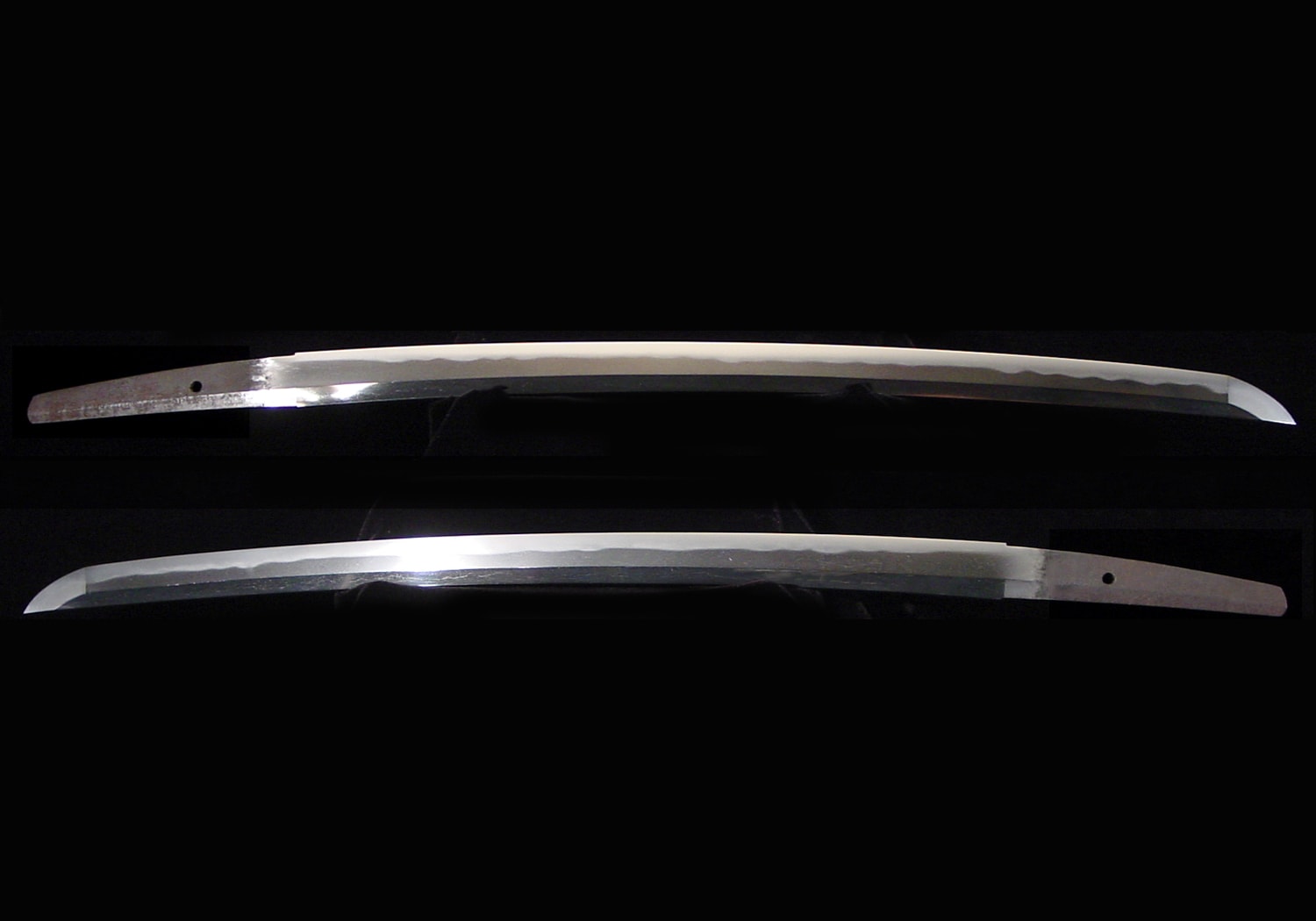
His representative hand is the inherited from Kotetsu, a chain of round-headed linked along the edge like a string of prayer beads. The published sources call this manner his forte and read it as the hand received from his master. Two things make it his own rather than a copy, and the commentary names both. The first is a habatori in which the run together in paired units, futatsu-zure, surfacing repeatedly through the temper. The second is the quality of the : it runs somewhat coarser than Kotetsu's and breaks into basake, a patchy unevenness in the hardened edge. The judges treat this not as a defect but as a point of interest, the very feature by which Okimasa is recognized. On one the published record reads, "in points such as the set somewhat coarse and the applied vigorously, Okimasa's characteristics are well displayed."
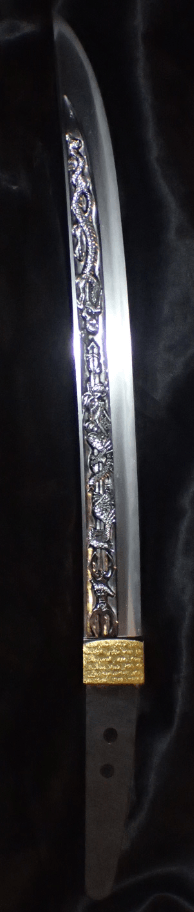
The over which this temper sits is a well-packed , often mixed with and at times standing into open , with fine laid thickly in a dust-like and entering throughout, so that the steel reads bright and clear. Over it the opens with a -toned at the base, the convention, then rises into the on a foundation. Thick and enter, the is deep, adheres, and long run through, and the stays bright. The runs straight into a with toward the point. Several blades bear carved through the body, and a number carry gold-inlaid cutting-test inscriptions on the reverse, recording the blade's proven cutting power.
The published sources are candid that Okimasa is hard to date. His signatures take many forms, dated examples are few, and the form of the character masa is noted to appear only on Enpo 4 pieces. Within his oeuvre the commentary draws two manners. One is the prime described above, brought on his best blades to what the judges call a fully satisfying result, spirited and forceful. The other stands a little apart: the widens into a shallow large , the running strong and uneven with -like patches and mixed in, on a robust wide body with thick and deep curvature. Of one such the sources speak of a manner overflowing with rustic vigor, heroic in its grandeur, while noting that the bright and the paired that still surface betray the hand. One vein of this bolder work the commentary reads as touching the style of Izumi-no-kami Kaneshige, a connection between Kaneshige and the Nagasone group.
What sets Okimasa apart is measured against his master and within his own house. The judges read his blades as truly in the Kotetsu manner, yet repeatedly point to the wider , the paired , and the coarser, basake-prone as the places where he diverges from Kotetsu's calmer, cleaner edge. He is the open, public face of the line: as second-generation Kotetsu he signed and stood at the front, while one , returned from the United States, preserves an inscription showing the smiths Okihisa and Okinao supporting him behind the scenes. Signatures reading Kotetsu Okimasa make the succession explicit on the tang itself, and one such long-signed the commentary singles out as a work in which he pursued his own individuality while inheriting the master's style.
For the collector he is a leading name whose best signed , the sources say, approach Kotetsu's own. Fujishiro grades him Jo-jo . He has no National Treasures and no Important Cultural Properties; his record runs instead through the rank, twenty-five blades in that tier, together with one certified Bijutsuhin in 1942, the piece Honma called the foremost of the maker's works he had seen. Provenance is recorded only thinly: an family and a blade once held by Wada Torao, with no museum holder on record. A signed Okimasa, then, is held more often than it is traded, and a in his manner, sound in body and bright in the edge, comes to a private collector only from time to time, a document of the Kotetsu line at the moment its second generation took it up.