Modern Nara
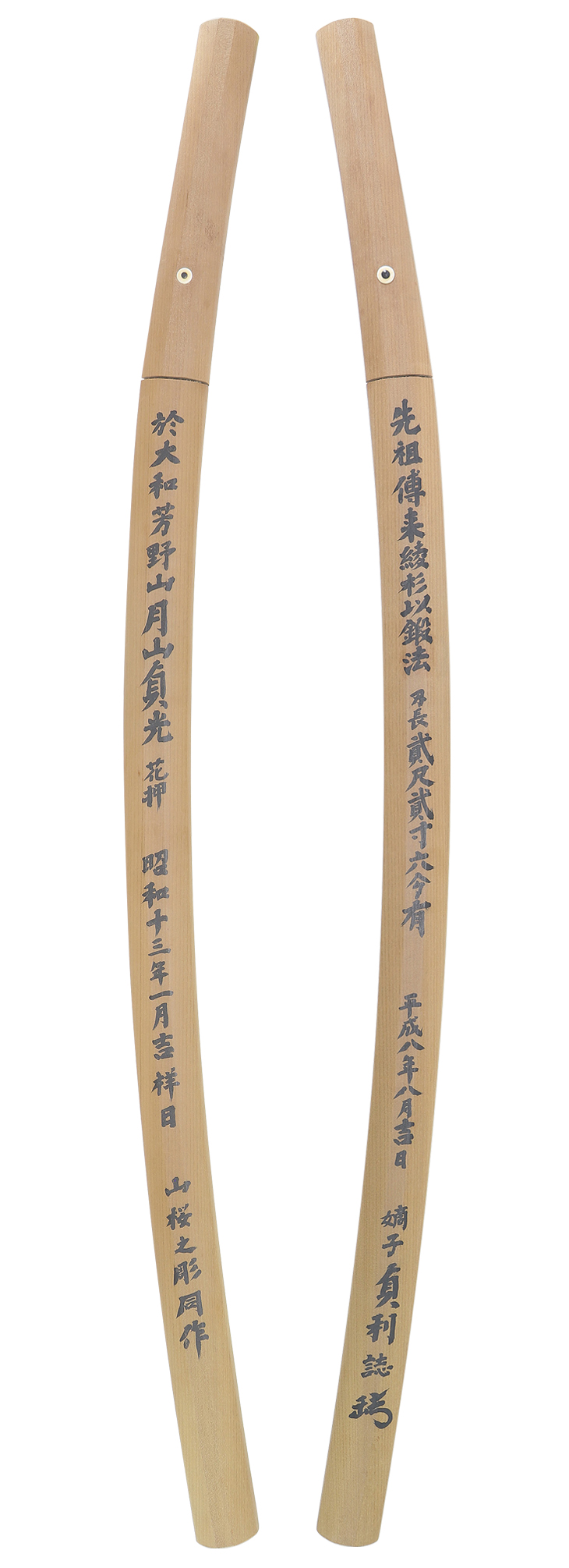
With sayagaki by legitimate son Gassan Sadatoshi (Mukansa)
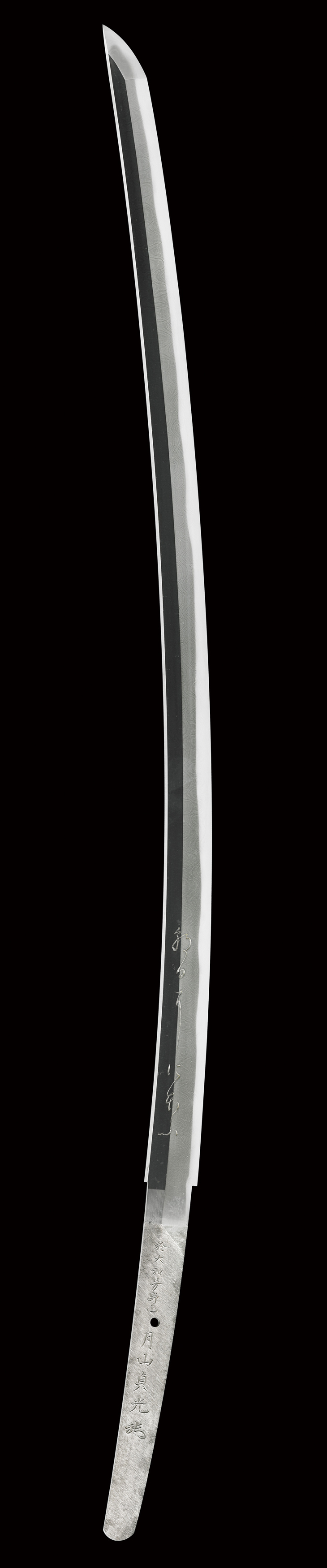
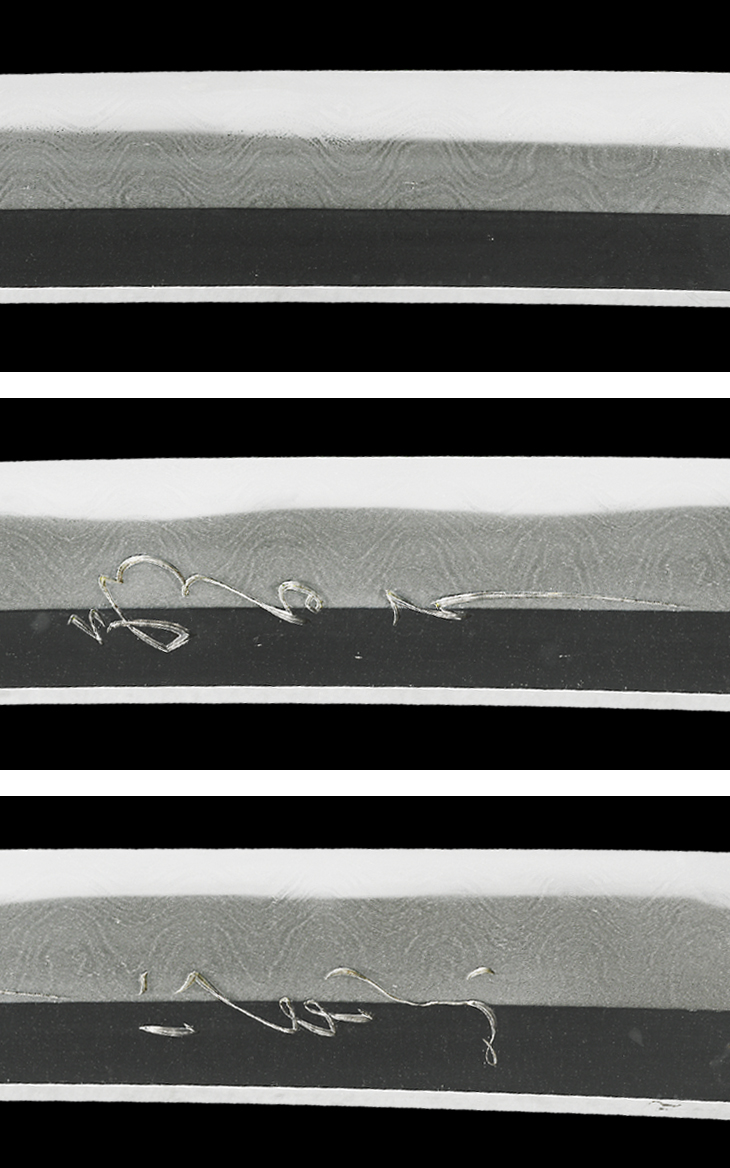
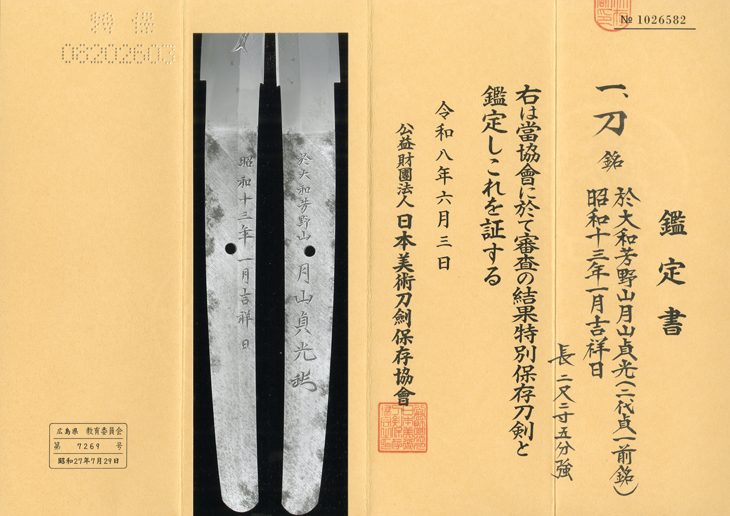
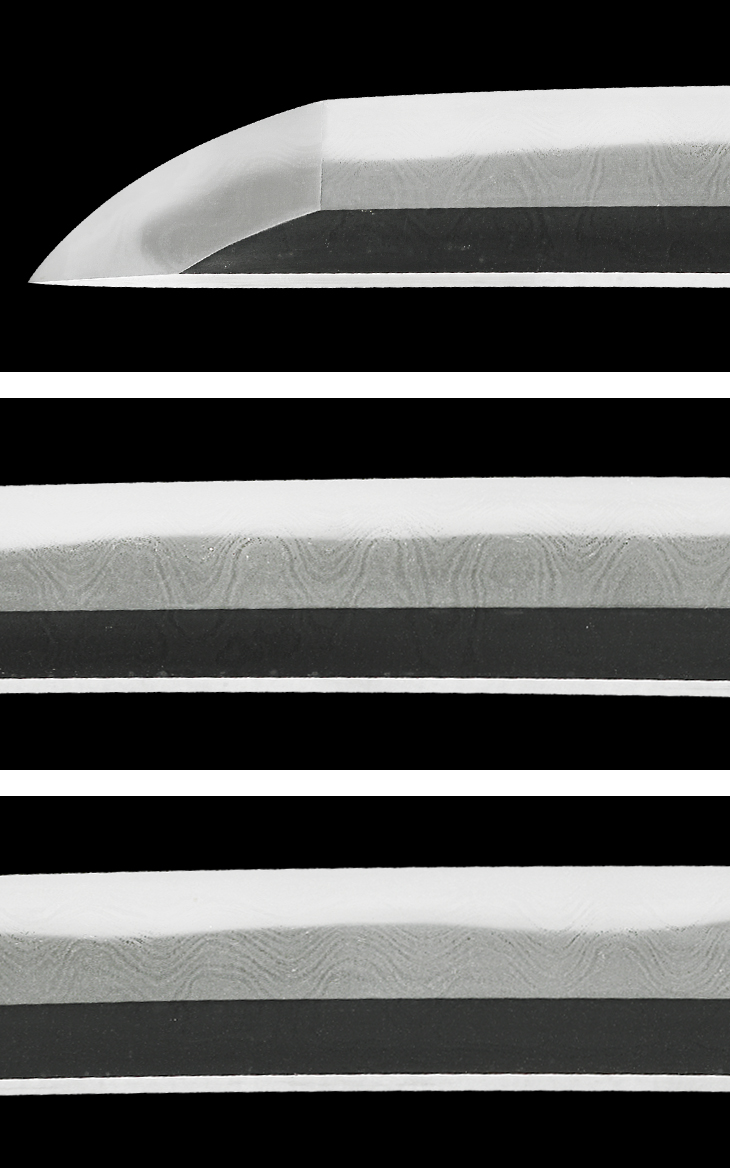
Shinogi-zukuri, high shinogi, low iori-mune, chu-kissaki. On the omote and ura at the koshimoto, there are horimono of the characters "Asahi ni niou" and mountain cherry blossoms. Kitae, the ayasugi-hada undulating in a large pattern appears clearly, ji-nie attaches thickly, chikei enters frequently, and the jigane is refined. Hamon, primarily ko-gunome-midare mixed with ko-midare and togari-style ha, the habuchi is well-covered in nie and has a slightly shizumi-kokoro quality, with ko-ashi, yo, kinsuji, and sunagashi appearing intensely within the ha. Boshi, notare style with nie and strong hakikake, the tip is yakizume style. Nakago is ubu, tip is kurijiri, yasurime is kesho o-sujikai. Silver with gold-plated habaki. Period polish. In shirasaya.
The second generation Sadakazu was named Gassan Noboru, born as the third son of Sadakatsu in Meiji 40 in Yariya-machi, Higashi-ku (now Chuo-ku), Osaka City. It is said that when his grandfather, the first generation Sadakazu, passed away in Taisho 7, he began learning swordsmithing from his father Sadakatsu at the age of only eleven. In Taisho 12, at the age of sixteen, he made his first submission and received his first acceptance at the Osaka Art Association Exhibition; in his earliest period, he signed with the mei "Gassan Sadamitsu". In Showa 10, he moved his forging dojo to Mount Yoshino in Nara Prefecture, and in Showa 18, to Kashihara City, Nara Prefecture. Around this time, the mei "Sadateru" is also seen. In Showa 31, he changed his mei to "Takateru", and in Showa 40, he opened the "Gassan Sadakazu Forging Dojo" on the banks of the Sai River at the foot of Mount Miwa in Chihara, Sakurai City, Nara Prefecture. In Showa 41, he succeeded to the name "Second Generation Sadakazu", in Showa 42, he was recognized as "Mukansa", and from that same year, he won the "Masamune Sho" for two consecutive years. In Showa 45, he was recognized as a "Nara Prefecture Intangible Cultural Property Holder", and in Showa 46, he was designated a "Ningen Kokuho".
Among his students are his third son Sadatoshi (Mukansa), Mikami Sadanao (Mukansa) of Hiroshima, Kono Sadamitsu of Fukuoka, and the 25th generation Kanefusa (Sadafusa) of Gifu, among many other disciples. He passed away in Heisei 7 at the age of eighty-seven.
Regarding his style, he skillfully mastered the Ayasugi-den and the Goke-den, and was also renowned as a master of horimono alongside his senior fellow student Takahashi Sadatsugu; due to his unique carving style, it is also called "Gassan-bori".
This work was made in Showa 13 (1938) when the smith was thirty-one years old, and is an extant work with the precious Sadamitsu mei. As mentioned previously, Sadamitsu is his earliest mei, and as the sayagaki by his legitimate son Sadatoshi states "Ancestral Ayasugi forging method", it is a typical work of the Gassan Ayasugi-den, which was never allowed outside the school.
The nagasa is slightly over 2 shaku 2 sun 5 bu, in a valiant tachi style with deep sori. The refined jigane, in which the ayasugi-hada undulating in a large pattern appears clearly, has chikei working well along the hada pattern. The yakiba, primarily ko-gunome-midare mixed with ko-midare and togari-style ha, involves the ayasugi kitae, and within the ha, glittering wave-like kinsuji and sunagashi appear intensely and frequently.
Also, as the sayagaki states "Mountain cherry blossom horimono by the same maker", there is a self-carved horimono of "Asahi ni niou mountain cherry blossoms" on the omote and ura at the koshimoto.
This is a carving on the blade of only the lower phrase of the extremely famous tanka poem composed by the Kokugaku scholar Motoori Norinaga of Matsusaka, Ise, in the late Edo period: "Shikishima no Yamato-gokoro o hito towaba asahi ni niou yamazakurabana".
Incidentally, "Shikishima" is an ancient name for Japan, used as a makurakotoba for words like "Yamato" or "Nihon". Also, "niou" in this case does not mean to have a scent, but means that the cherry blossoms are reflecting the morning sun beautifully.
Once, when asked about "Yamato-gokoro", Norinaga replied, "For example, it is a heart rich in sensitivity, where an inexpressible emotion wells up when touching the beauty of fragrant mountain cherry blossoms shining in the morning sun," and he is said to have composed this poem with that meaning.
By designing only the mountain cherry blossoms, consideration has been made to make their beauty stand out even more.
A rare mei style of the Ningen Kokuho Gassan Sadakazu, a beautiful ayasugi kitae that can be called the true essence of the Gassan school, Gassan-bori, with Tokubetsu Hozon Kantei and a sayagaki by his legitimate son Sadatoshi, this is a kind of ultimate amulet sword with the Yamato spirit carved into the blade, a representative early work of the Ningen Kokuho Gassan Sadakazu.
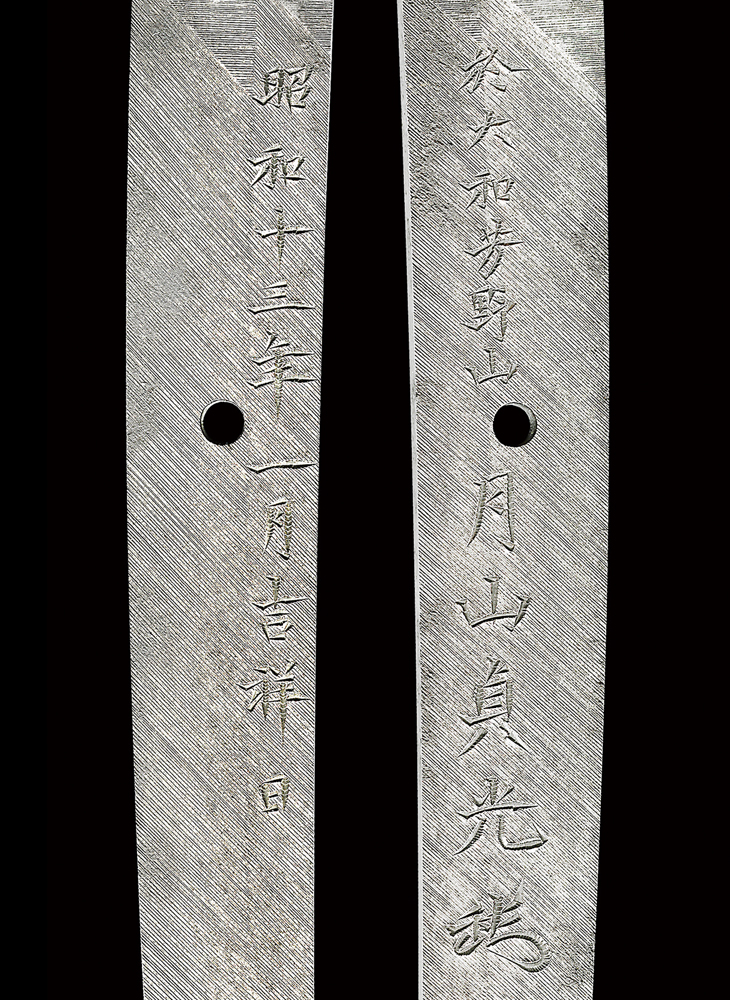
(Tachi-mei) Yamato Yoshinoyama Gassan Sadamitsu
(Kao) (Early signature of 2nd generation Living National Treasure Sadakazu)
January, a lucky day in Showa 13 (1938)
Saki-kasane
0.57
Holes
1
Machine translation of the shop's Japanese ·
Description from Samurai Nippon
Machine translation from the shop's Japanese · may contain errors ·
Modern Nara
With sayagaki by legitimate son Gassan Sadatoshi (Mukansa)
Shinogi-zukuri, high shinogi, low iori-mune, chu-kissaki. On the omote and ura at the koshimoto, there are horimono of the characters "Asahi ni niou" and mountain cherry blossoms. Kitae, the ayasugi-hada undulating in a large pattern appears clearly, ji-nie attaches thickly, chikei enters frequently, and the jigane is refined. Hamon, primarily ko-gunome-midare mixed with ko-midare and togari-style ha, the habuchi is well-covered in nie and has a slightly shizumi-kokoro quality, with ko-ashi, yo, kinsuji, and sunagashi appearing intensely within the ha. Boshi, notare style with nie and strong hakikake, the tip is yakizume style. Nakago is ubu, tip is kurijiri, yasurime is kesho o-sujikai. Silver with gold-plated habaki. Period polish. In shirasaya.
The second generation Sadakazu was named Gassan Noboru, born as the third son of Sadakatsu in Meiji 40 in Yariya-machi, Higashi-ku (now Chuo-ku), Osaka City. It is said that when his grandfather, the first generation Sadakazu, passed away in Taisho 7, he began learning swordsmithing from his father Sadakatsu at the age of only eleven. In Taisho 12, at the age of sixteen, he made his first submission and received his first acceptance at the Osaka Art Association Exhibition; in his earliest period, he signed with the mei "Gassan Sadamitsu". In Showa 10, he moved his forging dojo to Mount Yoshino in Nara Prefecture, and in Showa 18, to Kashihara City, Nara Prefecture. Around this time, the mei "Sadateru" is also seen. In Showa 31, he changed his mei to "Takateru", and in Showa 40, he opened the "Gassan Sadakazu Forging Dojo" on the banks of the Sai River at the foot of Mount Miwa in Chihara, Sakurai City, Nara Prefecture. In Showa 41, he succeeded to the name "Second Generation Sadakazu", in Showa 42, he was recognized as "Mukansa", and from that same year, he won the "Masamune Sho" for two consecutive years. In Showa 45, he was recognized as a "Nara Prefecture Intangible Cultural Property Holder", and in Showa 46, he was designated a "Ningen Kokuho".
Among his students are his third son Sadatoshi (Mukansa), Mikami Sadanao (Mukansa) of Hiroshima, Kono Sadamitsu of Fukuoka, and the 25th generation Kanefusa (Sadafusa) of Gifu, among many other disciples. He passed away in Heisei 7 at the age of eighty-seven.
Regarding his style, he skillfully mastered the Ayasugi-den and the Goke-den, and was also renowned as a master of horimono alongside his senior fellow student Takahashi Sadatsugu; due to his unique carving style, it is also called "Gassan-bori".
This work was made in Showa 13 (1938) when the smith was thirty-one years old, and is an extant work with the precious Sadamitsu mei. As mentioned previously, Sadamitsu is his earliest mei, and as the sayagaki by his legitimate son Sadatoshi states "Ancestral Ayasugi forging method", it is a typical work of the Gassan Ayasugi-den, which was never allowed outside the school.
The nagasa is slightly over 2 shaku 2 sun 5 bu, in a valiant tachi style with deep sori. The refined jigane, in which the ayasugi-hada undulating in a large pattern appears clearly, has chikei working well along the hada pattern. The yakiba, primarily ko-gunome-midare mixed with ko-midare and togari-style ha, involves the ayasugi kitae, and within the ha, glittering wave-like kinsuji and sunagashi appear intensely and frequently.
Also, as the sayagaki states "Mountain cherry blossom horimono by the same maker", there is a self-carved horimono of "Asahi ni niou mountain cherry blossoms" on the omote and ura at the koshimoto.
This is a carving on the blade of only the lower phrase of the extremely famous tanka poem composed by the Kokugaku scholar Motoori Norinaga of Matsusaka, Ise, in the late Edo period: "Shikishima no Yamato-gokoro o hito towaba asahi ni niou yamazakurabana".
Incidentally, "Shikishima" is an ancient name for Japan, used as a makurakotoba for words like "Yamato" or "Nihon". Also, "niou" in this case does not mean to have a scent, but means that the cherry blossoms are reflecting the morning sun beautifully.
Once, when asked about "Yamato-gokoro", Norinaga replied, "For example, it is a heart rich in sensitivity, where an inexpressible emotion wells up when touching the beauty of fragrant mountain cherry blossoms shining in the morning sun," and he is said to have composed this poem with that meaning.
By designing only the mountain cherry blossoms, consideration has been made to make their beauty stand out even more.
A rare mei style of the Ningen Kokuho Gassan Sadakazu, a beautiful ayasugi kitae that can be called the true essence of the Gassan school, Gassan-bori, with Tokubetsu Hozon Kantei and a sayagaki by his legitimate son Sadatoshi, this is a kind of ultimate amulet sword with the Yamato spirit carved into the blade, a representative early work of the Ningen Kokuho Gassan Sadakazu.
About the school
Gassan
月山
Wakimono · Dewa
32 pieces on the market now
›
Mount Gassan rises among the Dewa Sanzan, the three sacred peaks of northern Japan bound to the mountain asceticism of Shugendō, and the swordsmiths who took the mountain's name worked in its shadow in Ōshū, Dewa Province. The setsumei record that smiths signing "Gassan" are noted in the Kanchiin-bon Meizukushi as early as the Heian period, and the lineage's oldest surviving signed blade is a tachi simply signed Gassan, kept at the Gassan Shrine and judged to date from the late Nanbokuchō to early Muromachi period. Around that same early Nanbokuchō moment the corpus places Gassan Nagamitsu, whose signed tachi answers to the "Ushū Gassan group, around the Ryakuō era" recorded in the Meikan, and Shōgun, a Nanbokuchō hand sometimes identified with Gunshō, dated Genchū 3 (1386). A later branch is carried by Gassan Chikanori, working into the mid and late Muromachi (an ubu wakizashi dated Eishō 9, 1512). The line was revived in Osaka in the closing Tokugawa and Meiji years by Gassan Sadayoshi and his adopted son Gassan Sadakazu, who endured the Haitōrei edict and was appointed Teishitsu Gigei-in (Artist to the Imperial Household) in Meiji 39; his own adopted son Gassan Sadaichi continued the title into Taishō. The forging is the school's signature. " Over the itame base the grain flows (nagare) and tends to stand; ji-nie adheres and chikei enter, and the northern steel takes a dark, metal-like (kana-iro) hue read as Ōshū temperament.
The temper of the old line is a suguha whose nioiguchi is shizumi (subdued), at times mixed with gunome and ko-midare and softened toward urumi, the bōshi turning back in ko-maru. Departures within the corpus mark the lineage's range: Chikanori's late work can drop the ayasugi entirely and absorb Sue-Bizen and Osafune manners, while the Osaka revival smiths command itame with thick ji-nie, flamboyant nie-laden midare, kinsuji, and sunagashi in a full Sōshū idiom, and both Sadakazu and Sadaichi added meticulous horimono, from Bishamonten kurikara to taki kaen Fudō and dragon carvings carved by the same hand that forged the blade. For recognition the setsumei point first to the wave-grain ayasugi and the subdued, often slightly urumi northern nioiguchi, and where these recede, to the dark steel and standing grain that still betray an Ōshū hand. Signed examples of the old line are described as extremely rare, which raises the documentary weight of Nagamitsu's tachi and Shōgun's dated tantō. Provenance threads through the school's own sanctuary: the founding tachi and an Important Art Object tachi both reside at the Dewa Sanzan and Gassan Shrines. The Osaka revival is anchored by Sadaichi tantō signed Teishitsu Gigeiin, recorded in Honma's inventory of the Imperial collection, alongside a Sadakazu wakizashi made on commission for Prince Kuni. Across six centuries the setsumei track a single mountain workshop, from the subdued ayasugi of the Dewa founders through a Muromachi offshoot that turned toward Bizen, to the Imperial-rank carvers of Osaka who reproduced the old wave-grain while mastering the wider traditions. Learn more →
The twentieth century nearly killed the craft twice: wartime distortion, then the occupation ban. The NBTHK’s founding in 1948 and licensed forging from 1953 rebuilt the sword as an art, crowned by Living National Treasures and the mukansa rank.
A Hozon-certified blade judged to show notably superior workmanship and a better state of preservation. The bar is higher: re-tempered blades and most unsigned Muromachi/Edo works are excluded.
About the NBTHK›
The NBTHK (Nihon Bijutsu Tōken Hozon Kyōkai, the Society for the Preservation of Japanese Art Swords) is a public-interest incorporated foundation founded in 1948 and supervised by Japan’s Agency for Cultural Affairs (Bunkachō); it is based at the Japanese Sword Museum in Tokyo. Its expert panels physically examine each submitted work (shinsa) and issue a certificate (kanteishō) ranking it by artistic and historical merit. NBTHK papers are the most widely recognized standard of authentication for Japanese swords and fittings.
For one-of-a-kind items such as swords, sword fittings and antiques, other customers may be waiting for the item, so please contact us about a return within 3 days of its arrival and ship it back within 8 days. Refunds are made on the day the returned item arrives.
(Tachi-mei) Yamato Yoshinoyama Gassan Sadamitsu
(Kao) (Early signature of 2nd generation Living National Treasure Sadakazu)
January, a lucky day in Showa 13 (1938)

 NihontoWatch