 NihontoWatchNihontoWatch
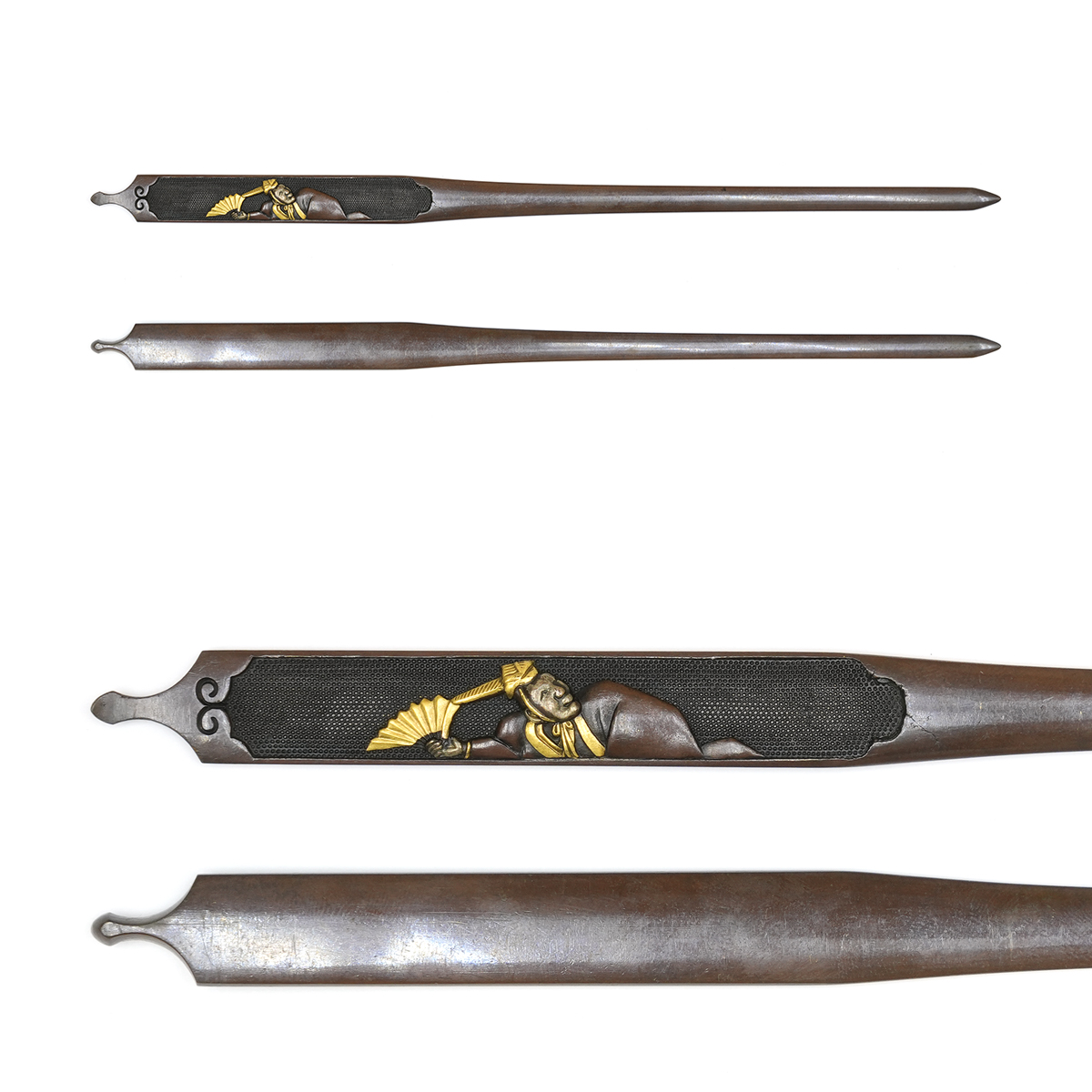
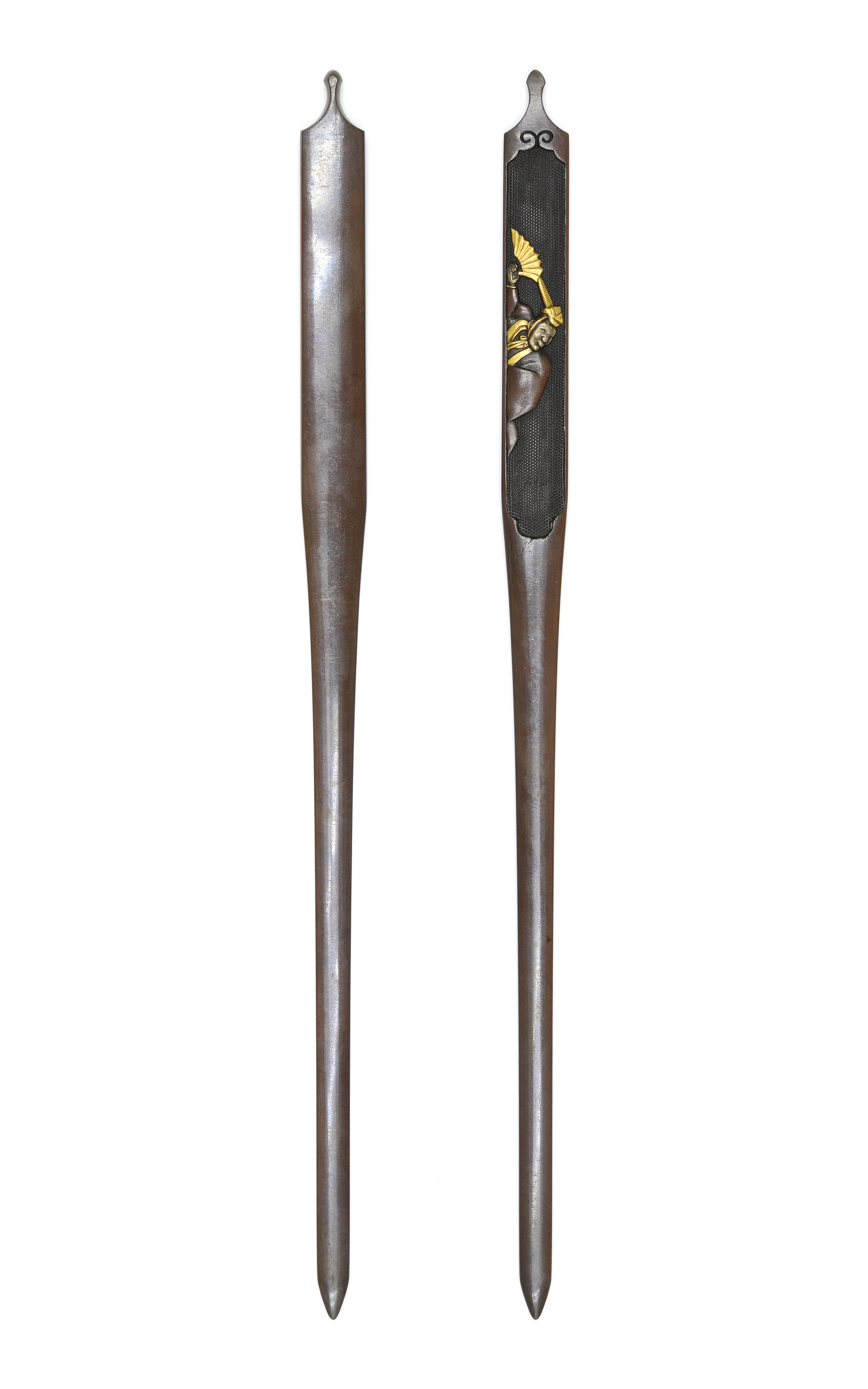
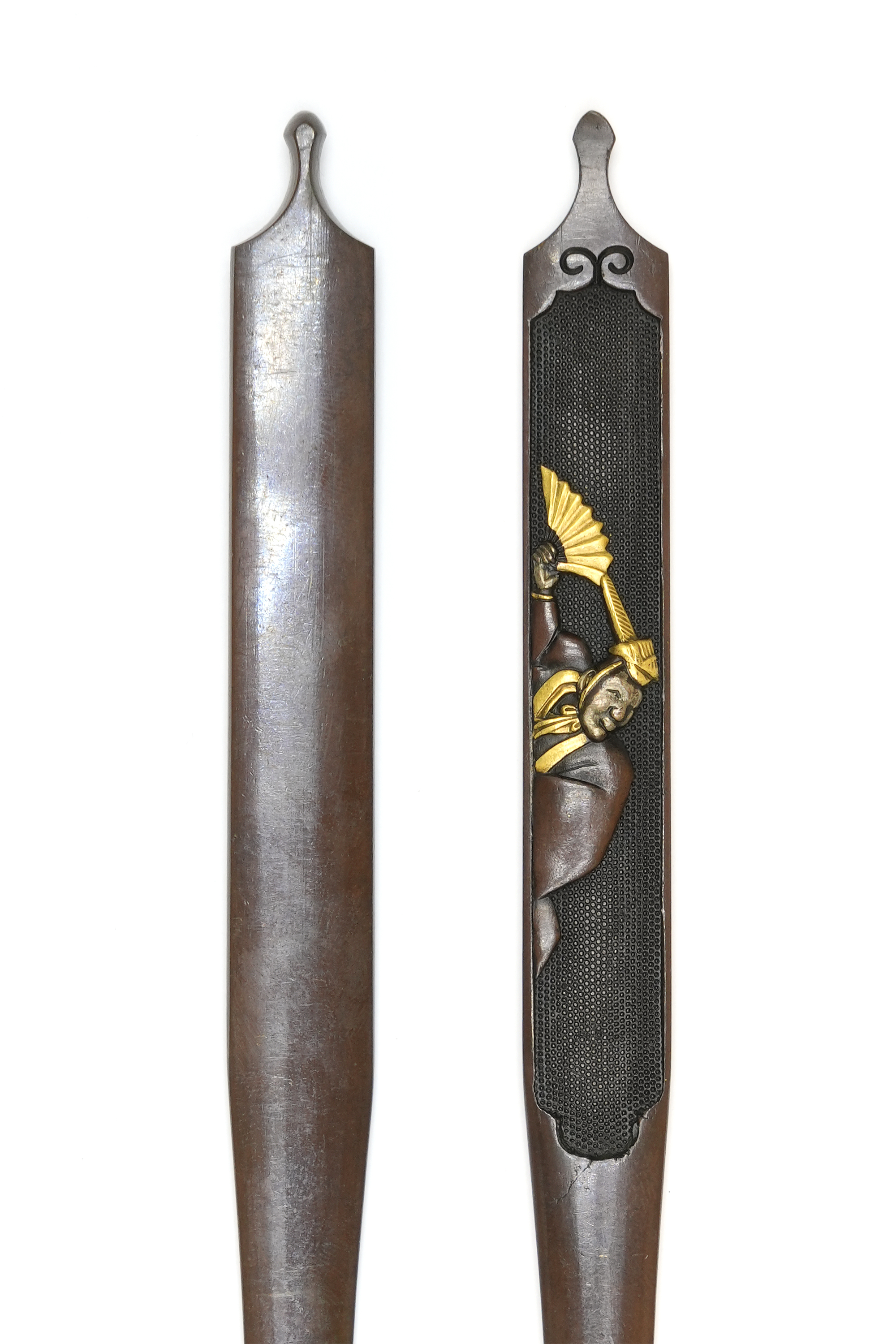
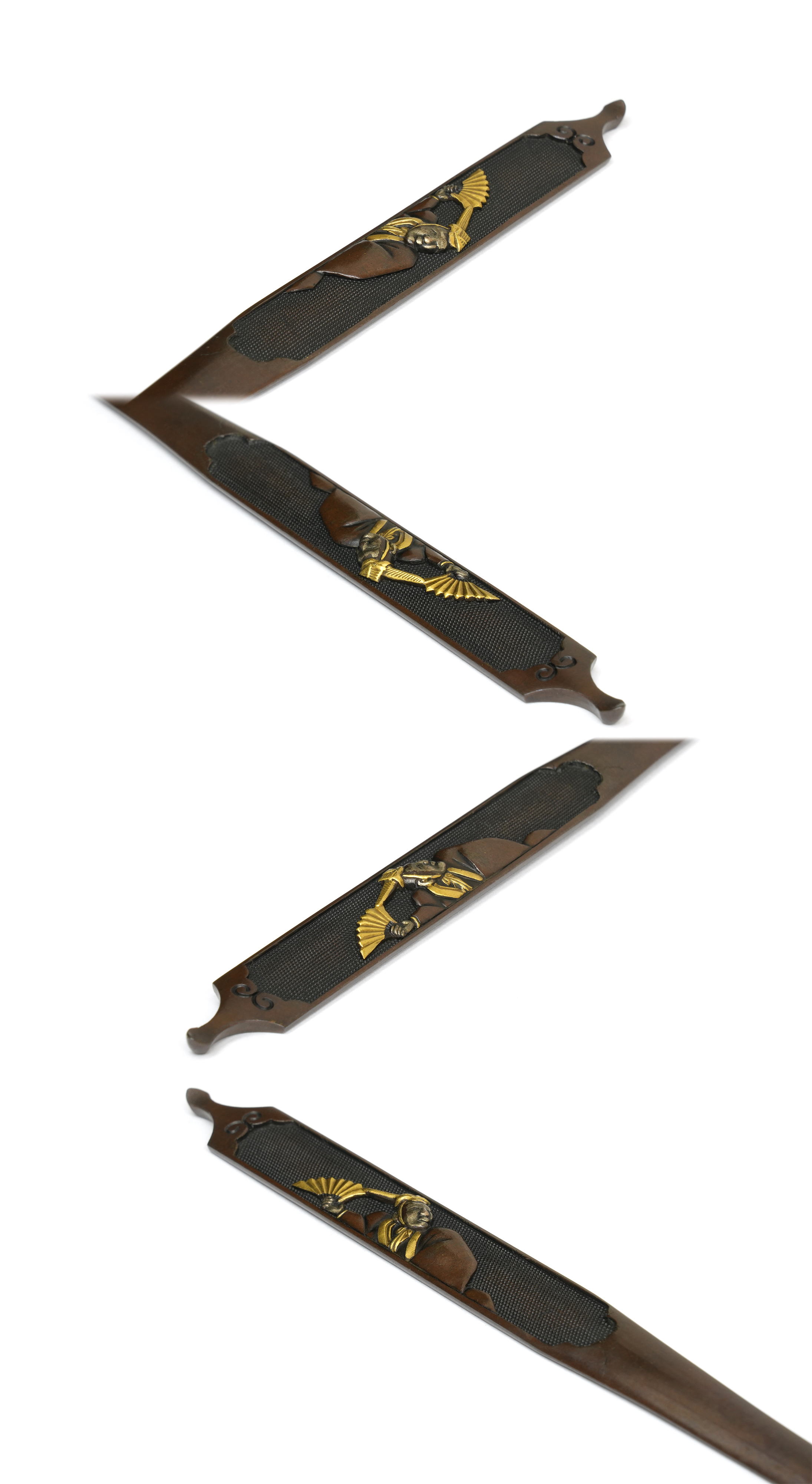
Mikawa Manzai is a traditional gate-visiting performing art originating from Mikawa no Kuni, where a Tayu and a Saizo travel from house to house during the New Year to offer celebratory words, songs, and dances, and it was widely beloved as a bright performance to celebrate longevity, prosperity, and a bountiful harvest. The sight of the Tayu wearing an eboshi and dancing with a fan in hand while the Saizo beats a tsuzumi to keep rhythm has been featured in paintings and crafts as a motif that succinctly expresses the bustle of the New Year and the wish for inviting good fortune; in this piece, by narrowing the theme to a single moment of the Tayu crouching with a fan raised to shoulder height, the dynamism of the dance and the celebratory spirit are condensed into the narrow frame of the kogai. The do of the kogai, which appears to be yamaganeji, is inlaid with a shakudo nanako-ji that exhibits a deep black color, and using the well-proportioned, fine granules as a quiet stage, the Manzai Tayu is represented plumply in takabori iroe. The brown costume rises softly from the shakudo ground, a silvery brightness is added to the face and the raised hand, and by applying rich kin-iroe to the collar, cuffs, eboshi, and fan, the movement of the figure and the festive attire emerge within a vivid contrast of black, brown, silver, and gold; in particular, the work of carefully carving each rib of the wide-open fan allows one to feel the splendor of the stage even within a small area. The figure holds the fan aloft with one hand, and combined with the modeling where the overlapping sleeves and collar are carved with thick volume, it allows one to imagine the flow of the dance as it moves toward the next beat. The composition is also skillful, not placing the figure stationary in the center of the do but shifting it to one side to utilize the widely remaining nanako-ji as the blank space of the stage; from the front, the splendor of the irogane stands out, and from an angle, the volume of the takabori and the layering of the robes become prominent, allowing one to enjoy the changes in engraving and color the more one views it from different angles. While the kogai as a whole is slender, it maintains a graceful sugata, and the smooth ridgeline continuing from the yamaganeji sao to the tip along with the calm brown koshoku composedly complement the flamboyant shakudo nanako-ji do. The uramen is given a simple finish without patterns to focus the appreciation on the representation of the figure on the omote, and a spiral design placed near the mimikaki neatly tidies the start of the do; the nanako granules, the facial features of the figure, the undulations of the costume, the fine lines of the fan, and the iroe are all well-preserved. Although it is mumei, in addition to the foundational skill of arranging the shakudo nanako-ji without gaps, the work of accurately capturing the expression and gestures of the figure within a small frame and using gold, silver, and shakudo-based tones without excess or deficiency provides a solid viewing experience, and the highly auspicious motif of Mikawa Manzai conveying New Year celebrations is also a great attraction. This is a kogai that can be enjoyed not only by matching it with a koshirae but is also recommended for those who collect figure kinko, fuzoku-zu, or celebratory designs, allowing one to fully appreciate the refined sensibilities and brilliant iroe of the middle Edo period.
Offered by Toushin

We couldn’t find current papers for this piece. Ask the dealer whether it has been, or can be, submitted to shinsa. — Hoshi

Edo
Unsigned
Machine translation of the shop's Japanese ·
Machine translation from the shop's Japanese · may contain errors ·
We could not find an authenticity certificate on the seller’s listing. Japanese swords and fittings are normally papered by the NBTHK (or the NTHK). Without one, the attribution is the seller’s own assessment and has not been independently verified — treat it with caution and ask the dealer about certification before buying.
As a rule we do not accept returns, except when we have sent a different item from the one ordered or when there is a significant discrepancy between the description and the item. If you wish to return an item, please contact us within 3 days of its arrival and then send it back.
¥132,000