The twentieth century nearly killed the craft twice: wartime distortion, then the occupation ban. The NBTHK’s founding in 1948 and licensed forging from 1953 rebuilt the sword as an art, crowned by Living National Treasures and the mukansa rank.
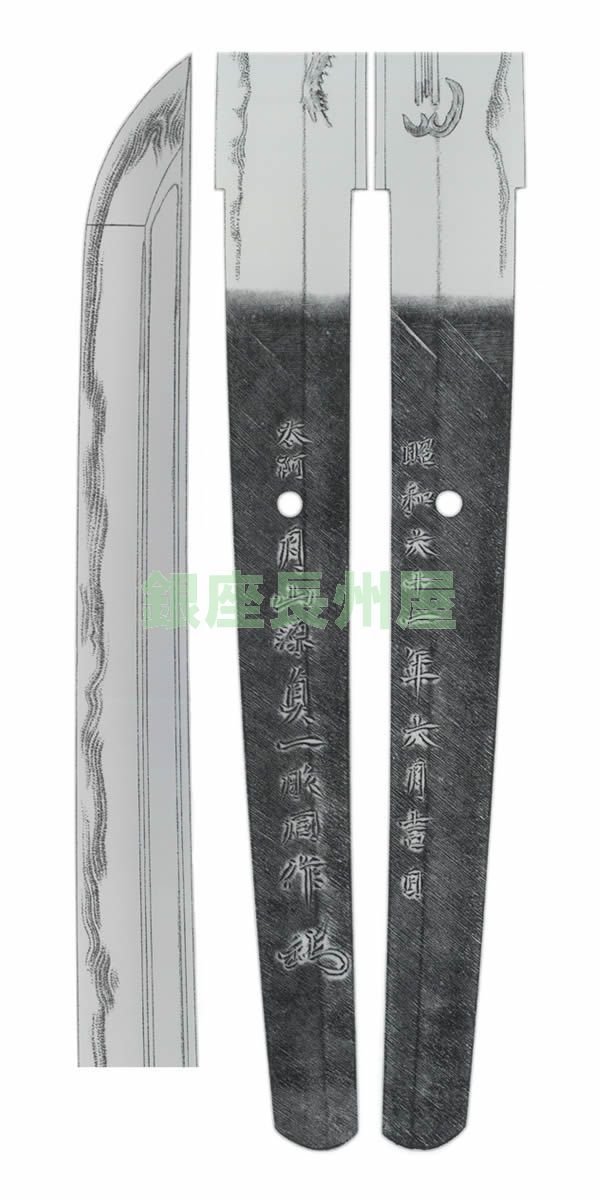
A dragon god is just about to catch up and reach out to obtain the hoju that is circling in the air accompanied by flames. Hoju is an abbreviation for nyoihoju, which was considered in ancient India to be a "treasure that grants wishes as one desires," and the dragon god was perceived as a great power of the natural world that protects it. Through China, pictorial expression advanced, and in our country's sword fittings, the Goto family produced fittings with hairyu-zu to pray for the peace and stability of the ruler. In toshin chokoku, the dragon by the shugen kaji Yukihira of Bungo-no-kuni in the early Kamakura period is known as an early example, and the dragon of Soshu-bori carved in the Nanbokucho period is also characteristic. As time went on, in the Bakumatsu period, Unryushi Sadakazu, who drew from the lineage of the Gassan kaji that flourished in Oshu, utilized novel carving techniques to carve and depict a dragon god full of spirit, and that tradition of toshin chokoku continues to the present day (Note). This sword is the work of Gassan Ta'a Sadakazu, who was designated as a "Holder of Important Intangible Cultural Property (Living National Treasure)" and is the grandson of Unryushi. Sadakazu was born in Meiji 40. Growing up watching the sword-making of his grandfather and his father Sadakatsu from a young age, by the age of 18 he had attained the skill and sensibility to exhibit his own carving at the Osaka Bijutsu Kyokai Hassoku Kinen Tenrankai and win a prize. Even after the end of the war, he was widely active, engaging in the reproduction of ancient ayasugi-hada and carving, winning consecutive awards at the Shinsaku Meito Ten and receiving the Masamune-sho, and in Showa 46 he was designated as a Living National Treasure. The scales wrapping the body of the carved dragon god stand out clearly one by one, the fierce and pointed dorsal fins pierce the surroundings, the claws of the limbs scratching the air are sharp, the luster of the rounded eyeballs is strong, and the face, horns, antennae, whiskers, and mane, which are all stippled, are all powerfully carved out within the single-level carving, as if they are about to leap out from the toshin. The hamon is the clouds of the heavens through which the dragon god flies. It is bright, with nioi blended into ko-nie, and along the hadame of the Gassan koden ayasugi-hada, it begins to hotsure, with parts of it flowing into the ha to become layered kinsen, inazuma, sunagashi, and nie-suji, while faint yubashiri swirl in the ji, creating a dynamic scene that implies the air currents that dance violently due to the movement of the dragon god, and the aesthetic beauty resulting from the fusion of jigane and carving, unique to the swordsmith Sadakazu, presses upon the viewer. The reverse side is a suken that feels tranquil in contrast to the dragon god. Note... A prestigious lineage continuing as Sadayoshi - Unryushi Sadakazu - Sadakatsu (Teishitsu Gigeiin, Kunaisho Goyo Tosho) - Ta'a Sadakazu - Sadatoshi.
Offered by Choshuya


Machine translation from the shop's Japanese · may contain errors ·
Wakimono · Dewa
32 pieces on the market now
Mount Gassan rises among the Dewa Sanzan, the three sacred peaks of northern Japan bound to the mountain asceticism of Shugendō, and the swordsmiths who took the mountain's name worked in its shadow in Ōshū, Dewa Province. The setsumei record that smiths signing "Gassan" are noted in the Kanchiin-bon Meizukushi as early as the Heian period, and the lineage's oldest surviving signed blade is a tachi simply signed Gassan, kept at the Gassan Shrine and judged to date from the late Nanbokuchō to early Muromachi period. Around that same early Nanbokuchō moment the corpus places Gassan Nagamitsu, whose signed tachi answers to the "Ushū Gassan group, around the Ryakuō era" recorded in the Meikan, and Shōgun, a Nanbokuchō hand sometimes identified with Gunshō, dated Genchū 3 (1386). A later branch is carried by Gassan Chikanori, working into the mid and late Muromachi (an ubu wakizashi dated Eishō 9, 1512). The line was revived in Osaka in the closing Tokugawa and Meiji years by Gassan Sadayoshi and his adopted son Gassan Sadakazu, who endured the Haitōrei edict and was appointed Teishitsu Gigei-in (Artist to the Imperial Household) in Meiji 39; his own adopted son Gassan Sadaichi continued the title into Taishō. The forging is the school's signature. " Over the itame base the grain flows (nagare) and tends to stand; ji-nie adheres and chikei enter, and the northern steel takes a dark, metal-like (kana-iro) hue read as Ōshū temperament.
The temper of the old line is a suguha whose nioiguchi is shizumi (subdued), at times mixed with gunome and ko-midare and softened toward urumi, the bōshi turning back in ko-maru. Departures within the corpus mark the lineage's range: Chikanori's late work can drop the ayasugi entirely and absorb Sue-Bizen and Osafune manners, while the Osaka revival smiths command itame with thick ji-nie, flamboyant nie-laden midare, kinsuji, and sunagashi in a full Sōshū idiom, and both Sadakazu and Sadaichi added meticulous horimono, from Bishamonten kurikara to taki kaen Fudō and dragon carvings carved by the same hand that forged the blade. For recognition the setsumei point first to the wave-grain ayasugi and the subdued, often slightly urumi northern nioiguchi, and where these recede, to the dark steel and standing grain that still betray an Ōshū hand. Signed examples of the old line are described as extremely rare, which raises the documentary weight of Nagamitsu's tachi and Shōgun's dated tantō. Provenance threads through the school's own sanctuary: the founding tachi and an Important Art Object tachi both reside at the Dewa Sanzan and Gassan Shrines. The Osaka revival is anchored by Sadaichi tantō signed Teishitsu Gigeiin, recorded in Honma's inventory of the Imperial collection, alongside a Sadakazu wakizashi made on commission for Prince Kuni. Across six centuries the setsumei track a single mountain workshop, from the subdued ayasugi of the Dewa founders through a Muromachi offshoot that turned toward Bizen, to the Imperial-rank carvers of Osaka who reproduced the old wave-grain while mastering the wider traditions. Learn more →

| Smith | Era | Designated |
|---|---|---|
| Tomosada友定 | 1532-1555 | 0 |
| Naonori直則 | 1830-1844 | 0 |
| Toshiyasu俊安 | 1504-1521 | 0 |
| Nagahisa長久 | 1334-1338 | 0 |
| Hisatoshi久利 | 1392-1573 | 0 |
Shōwa to the present: destruction and revival
The twentieth century nearly killed the craft twice: wartime distortion, then the occupation ban. The NBTHK’s founding in 1948 and licensed forging from 1953 rebuilt the sword as an art, crowned by Living National Treasures and the mukansa rank.
A Hozon-certified blade judged to show notably superior workmanship and a better state of preservation. The bar is higher: re-tempered blades and most unsigned Muromachi/Edo works are excluded.
The NBTHK (Nihon Bijutsu Tōken Hozon Kyōkai, the Society for the Preservation of Japanese Art Swords) is a public-interest incorporated foundation founded in 1948 and supervised by Japan’s Agency for Cultural Affairs (Bunkachō); it is based at the Japanese Sword Museum in Tokyo. Its expert panels physically examine each submitted work (shinsa) and issue a certificate (kanteishō) ranking it by artistic and historical merit. NBTHK papers are the most widely recognized standard of authentication for Japanese swords and fittings.
NBTHK official siteIf, due to our fault, the item differs significantly from its proper condition, the item may be returned. Cooling-off is within one week of the item's arrival.