After the Ōnin War broke the Ashikaga order, a century of Sengoku warfare armed nearly every province in Japan. The era rewards a discriminating eye: routine work exists in quantity, and beside it stand custom blades of the first rank.
 NihontoWatchNihontoWatch
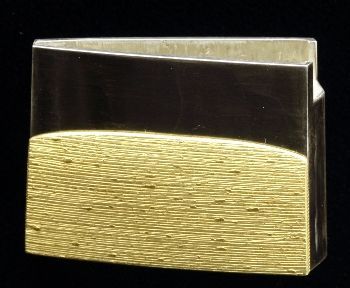
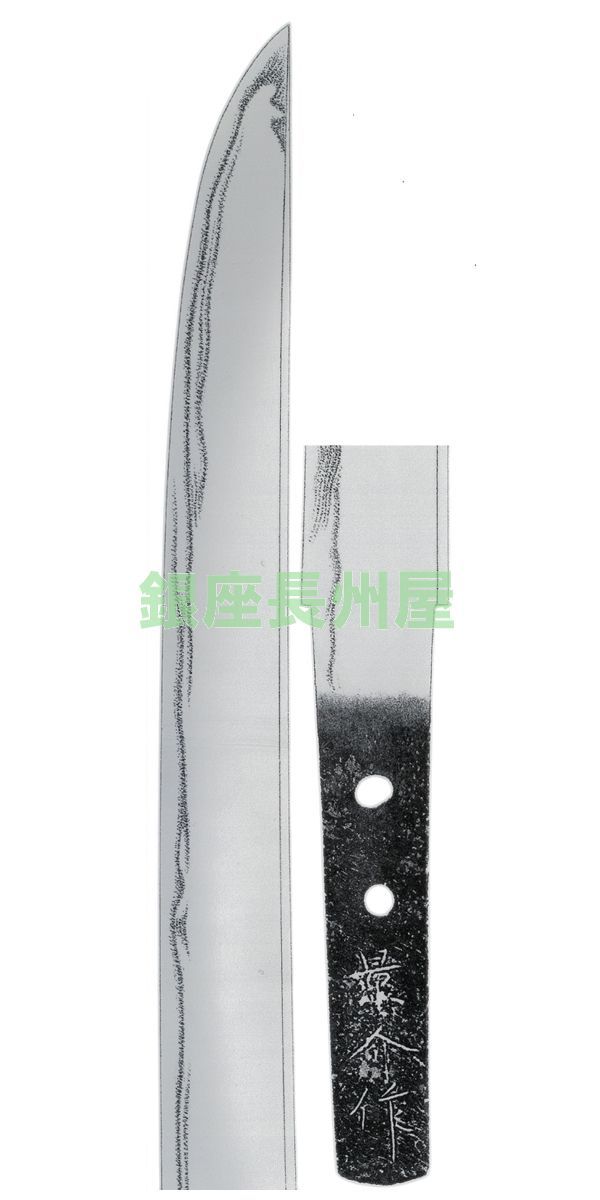
Ishinuki Kagesuke, who drew from the lineage of Enju Kunimura, the grandson of Rai Kuniyuki (Note 1), was a swordsmith of the Bunmei era (Note 2) based in Ishinuki, Tamana-no-sho, the territory of the Higo Kikuchi clan. The Kikuchi clan, who achieved military distinction as part of the Southern Court, maintained their power even after the unification of the Northern and Southern Courts to become the Shugo of Higo Province, building wealth through trade with Ming China and Korea. Kikuchi Shigetomo, whom Kagesuke served, belonged to the Eastern Army during the Onin War and is said to have boasted the preeminent military might and refinement in the country, hosting renga gatherings at his residence, Waifu Castle. This hira-zukuri wakizashi has a modest size and a slight sori, a sugata reminiscent of the early Muromachi period. The itame-kitae jigane is filled with vitality with dense chikei, and the thickly applied ji-nie reflects light strongly, with a white and powerful utsuri appearing that recalls the nie-utsuri of the ancestral Yamashiro no Kuni Rai school; near the ha it is deep and clear, and with jifu-like hada mixed in, it has a sticky softness, showing the distinct characteristics of Kyushu-mono rich in variations of light and shade in the jiso. The hamon is suguha with large kuichigai in places, yubashiri at the habuchi, and nie-sunagashi flowing within the ha to become nijuba-style, with fine kinsen and sunagashi appearing actively; the nie particles concentrated at the habuchi are bright, filled with nie and nioi with high luminosity, and the wild, powerful changes are reminiscent of Rai Kunimitsu and Kunitsugu. The boshi is well-covered in nie, with nie-sunagashi working on the omote and yubashiri on the ura, becoming nijuba and returning shallowly in komaru. The nakago is in excellent state of preservation, with the mei characters carved with magnificent chisel work. Although there are some kitae-ware, it is a work of superior deki that demonstrates the ability of Ishinuki Kagesuke, whose extant works are rare (Note 3). Note 1... Dr. Honma Kunzan states in Nihon Koto Shi, "One rarely sees swords with nenkio of the Oei and Entoku eras," and "They are recognized as the Sue-Enju school." Note 2... In Fujishiro Yoshio's Nihon Toko Jiten Koto-hen, a wakizashi by Hishu Tamana-ju Ishinuki Kagesuke saku with a date of Bunmei 8 Hinoe-Saru February is listed. Note 3... Besides Kagesuke, there are Ishinuki Koreyoshi, who has a tanto (62nd Juyo Token) dated Oei 23 August, and Ishinuki Masakuni, who has nenkio of the Bunmei, Entoku, and Meio eras, but surviving works of the Ishinuki smiths are extremely few.
NihontoWatchOffered by Choshuya






Machine translation from the shop's Japanese · may contain errors ·
Higo · around 1469-1487
Fujishiro Chu-jo saku · Tōken Taikan top 60%
1 piece on the market now
The Muromachi period (1392 to 1573)
After the Ōnin War broke the Ashikaga order, a century of Sengoku warfare armed nearly every province in Japan. The era rewards a discriminating eye: routine work exists in quantity, and beside it stand custom blades of the first rank.
A Hozon-certified blade judged to show notably superior workmanship and a better state of preservation. The bar is higher: re-tempered blades and most unsigned Muromachi/Edo works are excluded.
The NBTHK (Nihon Bijutsu Tōken Hozon Kyōkai, the Society for the Preservation of Japanese Art Swords) is a public-interest incorporated foundation founded in 1948 and supervised by Japan’s Agency for Cultural Affairs (Bunkachō); it is based at the Japanese Sword Museum in Tokyo. Its expert panels physically examine each submitted work (shinsa) and issue a certificate (kanteishō) ranking it by artistic and historical merit. NBTHK papers are the most widely recognized standard of authentication for Japanese swords and fittings.
NBTHK official siteIf, due to our fault, the item differs significantly from its proper condition, the item may be returned. Cooling-off is within one week of the item's arrival.
¥700,000