 NihontoWatchNihontoWatch
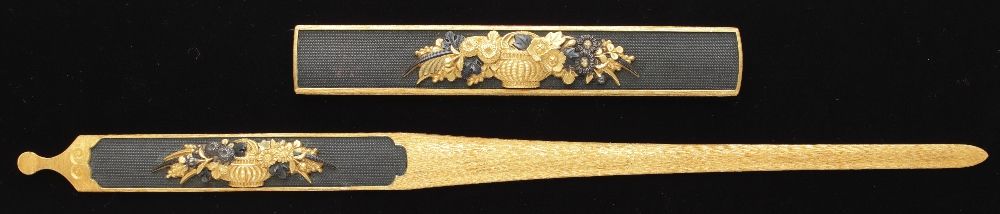
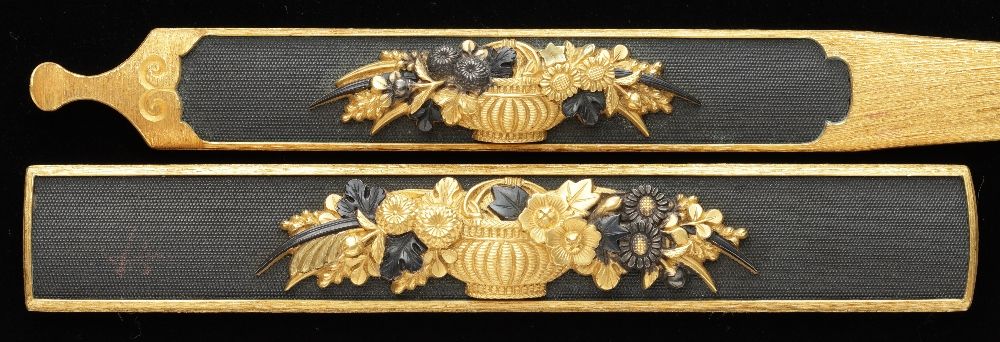
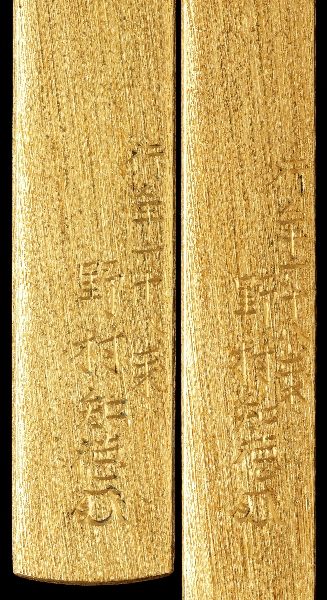
Sig. Nomura Tomonori (Kao), Ko-nen 68 sai Tokushima city, Awa province-Edo city, Musashi province 花籠に活けられた秋草を題とし、紋の高さを四ミリと極めて肉高く華やかに彫り出した、阿波金工野村知徳の二所。 粒の小さく綺麗に揃った赤銅魚子地を背景に、金無垢地をふっくらと打ち出してそれぞれの花が浮かび上がるように際端の腰を高く処理し、細やかな鏨を切り加えて花の特徴を鮮明に再現している。金地の上に施されている色金は赤銅、朧銀、青金で、いずれも置金の手法で焼き付けた、贅沢でしかも色金が映える表現。金哺の裏板も鑢目が鮮やかに輝くように仕立てとされている。 蜂須賀家お抱え金工野村家は、初代正時が後藤顕乗に学んで独立したことから阿波後藤と尊称されている。野村各代ともに技術が優れ、特に量感豊かに主題を彫り出す彫刻様式は後藤の技法を発展させたもので、野村家の特徴ともされている。この知徳の二所も、野村宗家の作風をそのまま写し出したように貫禄がある出来となっている(注)。
NihontoWatchOffered by Choshuya
This piece has sold
5 on the market
Get an email when new Nomura School work hits the market.



Nomura School
Edo
Awa
Signed
Hozon (NBTHK)
Kinko
5 pieces on the market now
The Nomura school (野村) is a lineage of kinko (金工) metalworkers based in Edo, active from the mid-Edo period. The school's eponymous tradition is anchored by Nomura Masahide (野村正秀), recorded in the NBTHK setsumei as "a highly skilled artist of the Edo Nomura school," and by Nomura Masamichi (野村正道), also known as Nomura Shodo, who served as the principal teacher of the school's most prolific designated member, Tsu Jinpo (津尋甫). Jinpo, whose personal name was Otsu Hachizaemon[[c:1]], is documented as having lived in the vicinity of Ginza in Edo and as having been active from Kyoho 7 (1722) until his death in Horeki 12 (1762). The teacher-pupil axis from Masamichi to Jinpo constitutes the core documented lineage of the school, situating it firmly within the broader Edo-period kinko milieu. The collective style of the Nomura school is defined by a rigorous commitment to realism and by a distinctive technical vocabulary rooted in shakudo (赤銅) nanako-ji (魚子地) grounds worked in takabori (高彫, high relief). This combination of deep-black shakudo surface with precisely punched nanako and boldly sculptural relief carving is the school's signature idiom, recurring across virtually every designated work. Motifs are drawn overwhelmingly from the natural world: raptors poised on oak trees (kashiwa, 柏), lilies (yuri, 百合), shrimp (ebi, 海老), and small birds amid branches.
" Polychrome enrichment through iroe (色絵) and kin-iroe (金色絵), as well as applied motifs in gold and suaka (素銅), lends chromatic depth to the relief compositions. Several works also demonstrate the influence of the Goto house tradition, exhibiting what the setsumei describe as "Goto-like dignity of style" alongside "a power and freshness distinctive to" the Nomura lineage. " Fuchi-kashira (縁頭) constitute the predominant format, followed by tsuba, kozuka, and mitokoromono (三所物) sets. The Nomura school occupies a distinctive position within the Edo-period kinko canon as a lineage that channeled the formal discipline of the Goto tradition into an intensely naturalistic mode of expression. While the school drew on Goto prototypes, particularly in nanako technique and in certain mitokoromono compositions modeled after "early Goto masterworks," the Nomura idiom is distinguished by a sculptural forcefulness and a commitment to observed nature that the setsumei consistently single out. Among Jinpo's fuchi-kashira, designs of raptors alighting upon oak branches are described as possessing "an extremely forceful impact," with "masterpieces" among them, while his lily subjects are noted as a particular strength. The school's legacy, as attested across the designated corpus, resides in this synthesis of technical rigor, vivid realism, and the bold relief carving that constitutes its most recognizable hallmark. Learn more →
| Smith | Era | Designated |
|---|---|---|
| Tsu Jinpo津尋甫 | — | 7 |
| Masayoshi正芳 | — | 0 |
| Masahide正英 | — | 0 |
| Masatsugu正次 | — | 0 |
| Masamichi正道 | — | 0 |
Certifies a genuine blade worth preserving: a signature confirmed correct, or, if unsigned, an era, province, and school that the NBTHK can reliably identify.
The NBTHK (Nihon Bijutsu Tōken Hozon Kyōkai, the Society for the Preservation of Japanese Art Swords) is a public-interest incorporated foundation founded in 1948 and supervised by Japan’s Agency for Cultural Affairs (Bunkachō); it is based at the Japanese Sword Museum in Tokyo. Its expert panels physically examine each submitted work (shinsa) and issue a certificate (kanteishō) ranking it by artistic and historical merit. NBTHK papers are the most widely recognized standard of authentication for Japanese swords and fittings.
NBTHK official siteIf, due to our fault, the item differs significantly from its proper condition, the item may be returned. Cooling-off is within one week of the item's arrival.