Two courts, sixty years of war, and the most dramatic silhouettes in the sword’s history: broad blades, extended points, true ōdachi later cut down into the majestic katana collectors prize. The Sōshū manner was the style of the age.
 NihontoWatchNihontoWatch
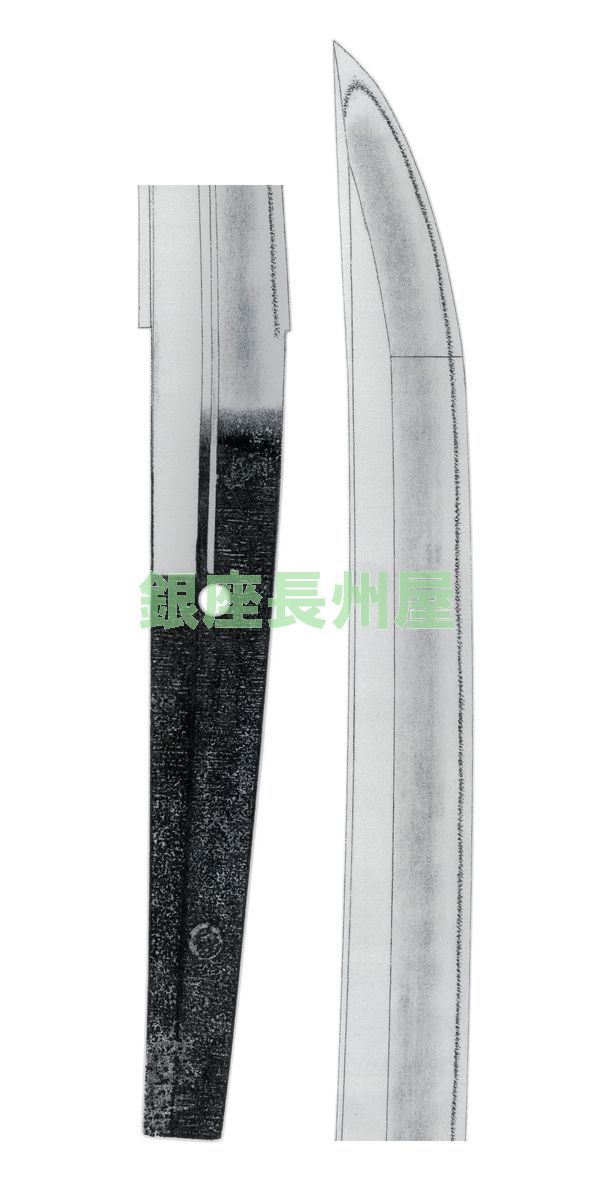
元来は二尺五寸程あったとみられる、古波平と極められた大磨上無銘の太刀。古波平とは南北朝以前の波平の刀工の作をいい、歴史は古く、平安後期に大和国から薩摩国谷山郡波平に来住した行國と、その子で猿投神社蔵の太刀(重要文化財)の作者行安に始まる。武将の信頼は厚く、源平合戦の一の谷で、源氏の武士猪俣則綱が平家の侍大将越中前司盛俊を討ち取った時、その手に「薩摩國浪平造の一物」(『源平盛衰記』)があったという。作風は鎬筋が高く、柾ごころの顕著な地肌は微細に詰んでねっとりとし、大きな焼き落しから始まる刃文は、喰い違いを交え、ほつれの掛かった細直刃を特色としている。 この太刀は、身幅が広く、元先の幅差少なく、重ね厚く刃肉も充分につき、腰反り高く鋒の延びた南北朝体配で、薙刀樋の際の線、添樋、屹然と立った鎬筋、棟の稜線、刃先の線が軌を一にし、表裏の梵字と共に、所持した武将の精神性の 高さを偲ばせている。板目鍛えの地鉄は刃寄りにうねる柾肌が顕著に現れ、肌目に沿って地景が入り、淡雪のような地沸が微塵に付いて沸映りが立つ。刃文は直刃(注2)がごく浅く揺れ、純白の小沸で刃縁きっぱりと 締まって明るく、微かに喰い違いを交え、小さな湯走りが掛かり、刃中に匂の霞が立ち込める。帽子はふくらに沿って小丸に返る。茎は細かな横鑢で入念に仕立てられている。後醍醐の皇子懐良を戴いて南朝の旗を掲げた薩摩武士の佩刀であろう。特別の材料を精鍛し、一切の不純物が叩き出されて地刃澄み、大和本国物に見紛う(注3)見事な出来栄え。同作極めの名品(注4)である。 注1...古鞘に「無銘 大和保昌貞宗極 大日本刀剣會鑒定」とある。 注2...延元四年十一月日紀の波平行安の太刀(『薩摩刀名作集』)は棒樋角止に細直刃で本作に通じる。 注3...大日本刀剣会は大和保昌貞宗と鑑定している。 注4...重要刀剣図譜では「総じて保存状態のよい古波平極めの優品」と称されている。波平極めの同作中でも匂口がきっぱりと冴えているところからであろう。
NihontoWatchOffered by Choshuya
This piece has sold
11 on the market
Get an email when new Naminohira School work hits the market.









Wakimono · Satsuma
11 pieces on the market now
The Naminohira school traces its origins to the late Heian period, when a swordsmith named Masakuni migrated from Yamato Province and established himself at Naminohira in Taniyama District, Satsuma Province. His son Yukiyasu succeeded him, and the lineage continued unbroken into the late Edo shinshintō era. The collective term Ko-Naminohira designates smiths and works dating no later than the Nanbokuchō period, distinguishing the school's formative generations from later practitioners. This geographic isolation in southern Kyushu allowed the development of a distinctive regional aesthetic that balanced mainland influences with local forging traditions. The school's technical identity reveals a pronounced Yamato character in both construction and tempering, yet the forging exhibits a characteristic density and slight tenacity (nebari) that distinguishes Naminohira work from its Yamato antecedents. The jigane typically shows strongly flowing itame-hada, often with a whitish cast and well-adhering ji-nie, while thick chikei appear throughout the ground. In the hamon, a fine hoso-suguha or narrow suguha-based temper predominates, with the nioiguchi displaying a distinctive urumi tendency—a moist, soft quality that creates a subdued, somewhat shizumi-inclined appearance.
A diagnostic feature appears at the hamachi, where slight yaki-otoshi marks the transition from untempered to tempered steel. The school's Nanbokuchō-period works often present extended ō-kissaki and deep koshizori, embodying the martial aesthetic of that turbulent age. The Naminohira tradition experienced a renaissance during the Edo period, producing masters such as Ichi Heian Yasushiro, who in Kyōhō 6 (1721) was summoned to forge for Shōgun Tokugawa Yoshimune. His exceptional skill earned him the privilege of engraving the ichiyō aoi crest on his nakago and the court appointment of Shume no Suke. His work and that of his contemporary Masakiyo represent the apex of Satsuma shintō, demonstrating how provincial schools could achieve recognition at the highest levels of Tokugawa society. The scarcity of early signed works, particularly from the Kamakura and Nanbokuchō periods, renders extant examples invaluable for understanding the school's development and its role in transmitting Yamato forging methods to Japan's southern frontier. Learn more →
| Smith | Era | Designated |
|---|---|---|
| Yukiyasu行安 | 1308-1311 | 9 |
| Yasutsuna安綱 | 1288-1333 | 0 |
| Yasutsugu安次 | 1224-1225 | 0 |
| Yasutsugu安次 | 1375-1381 | 0 |
| Haruyuki治行 | 1394-1428 | 1 |
The Nanbokuchō period (1333 to 1392)
Two courts, sixty years of war, and the most dramatic silhouettes in the sword’s history: broad blades, extended points, true ōdachi later cut down into the majestic katana collectors prize. The Sōshū manner was the style of the age.
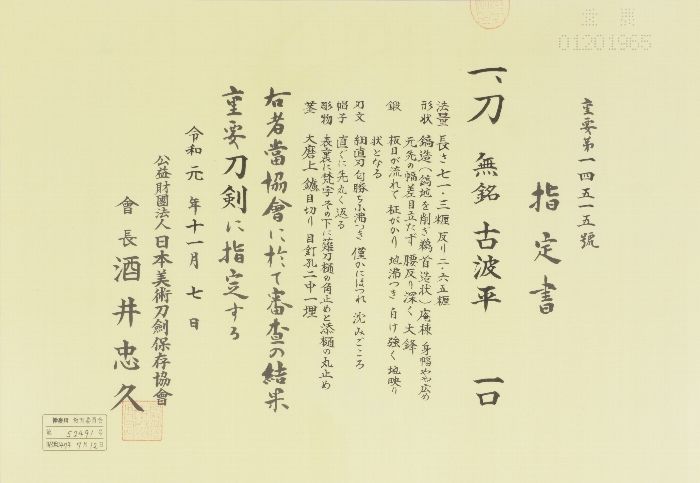
A blade of top-grade workmanship and condition, formally judged to rank with a nationally recognized Important Art Object (Jūyō Bijutsuhin). Awarded only at the NBTHK’s competitive annual examination.
Of Japan’s roughly 2.5 million registered swords, only 12,348 (about 1 in 202) have ever attained Jūyō.
The NBTHK (Nihon Bijutsu Tōken Hozon Kyōkai, the Society for the Preservation of Japanese Art Swords) is a public-interest incorporated foundation founded in 1948 and supervised by Japan’s Agency for Cultural Affairs (Bunkachō); it is based at the Japanese Sword Museum in Tokyo. Its expert panels physically examine each submitted work (shinsa) and issue a certificate (kanteishō) ranking it by artistic and historical merit. NBTHK papers are the most widely recognized standard of authentication for Japanese swords and fittings.
NBTHK official siteIf, due to our fault, the item differs significantly from its proper condition, the item may be returned. Cooling-off is within one week of the item's arrival.