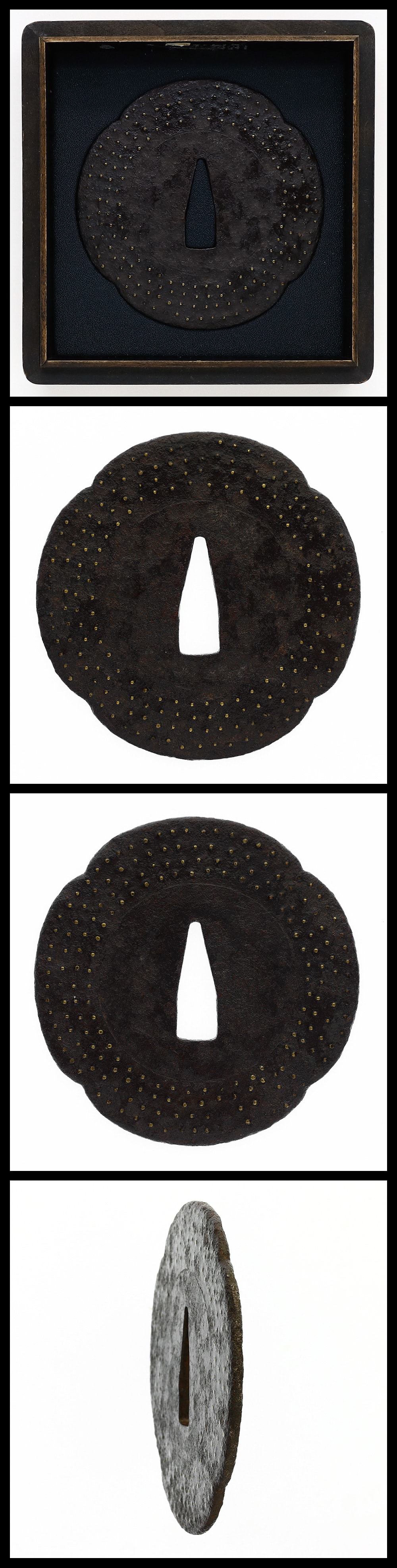
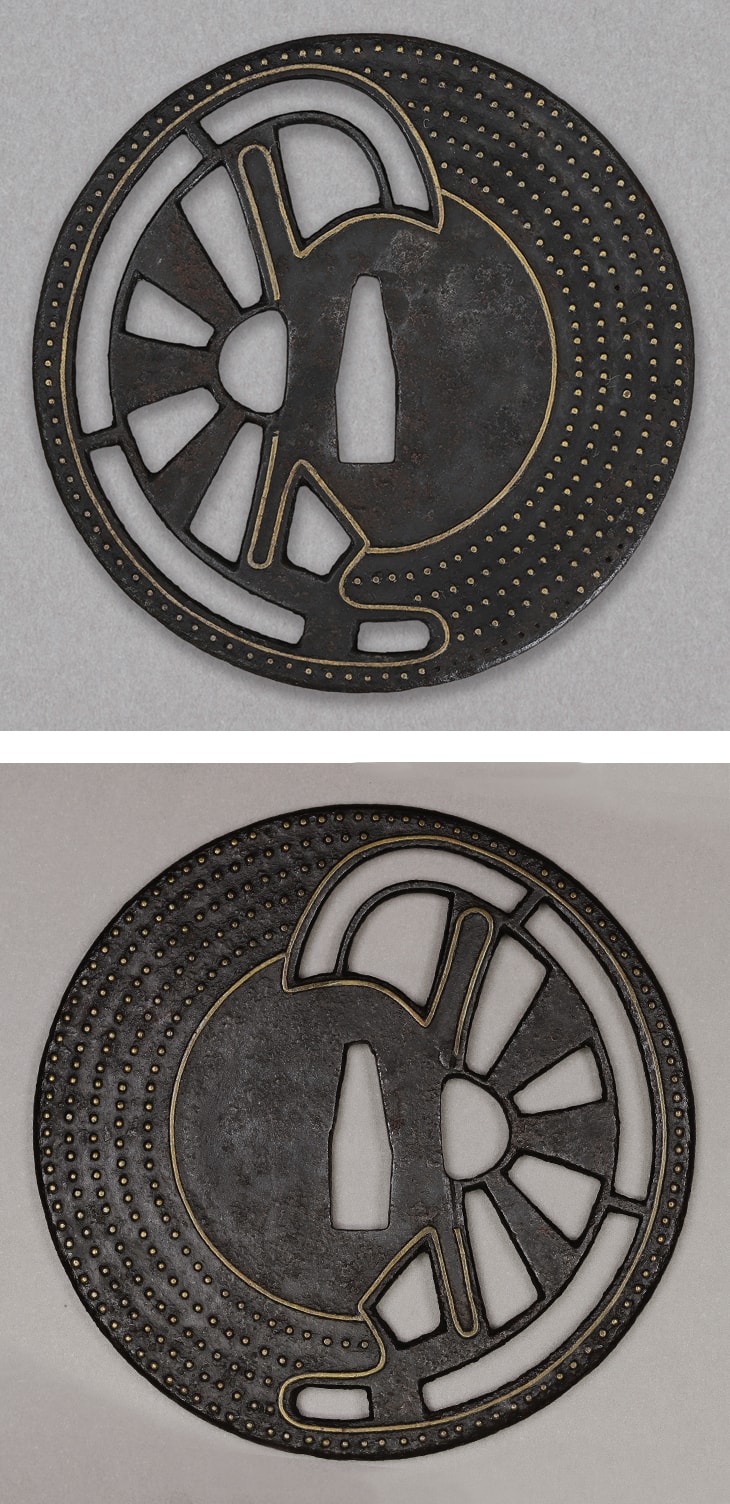
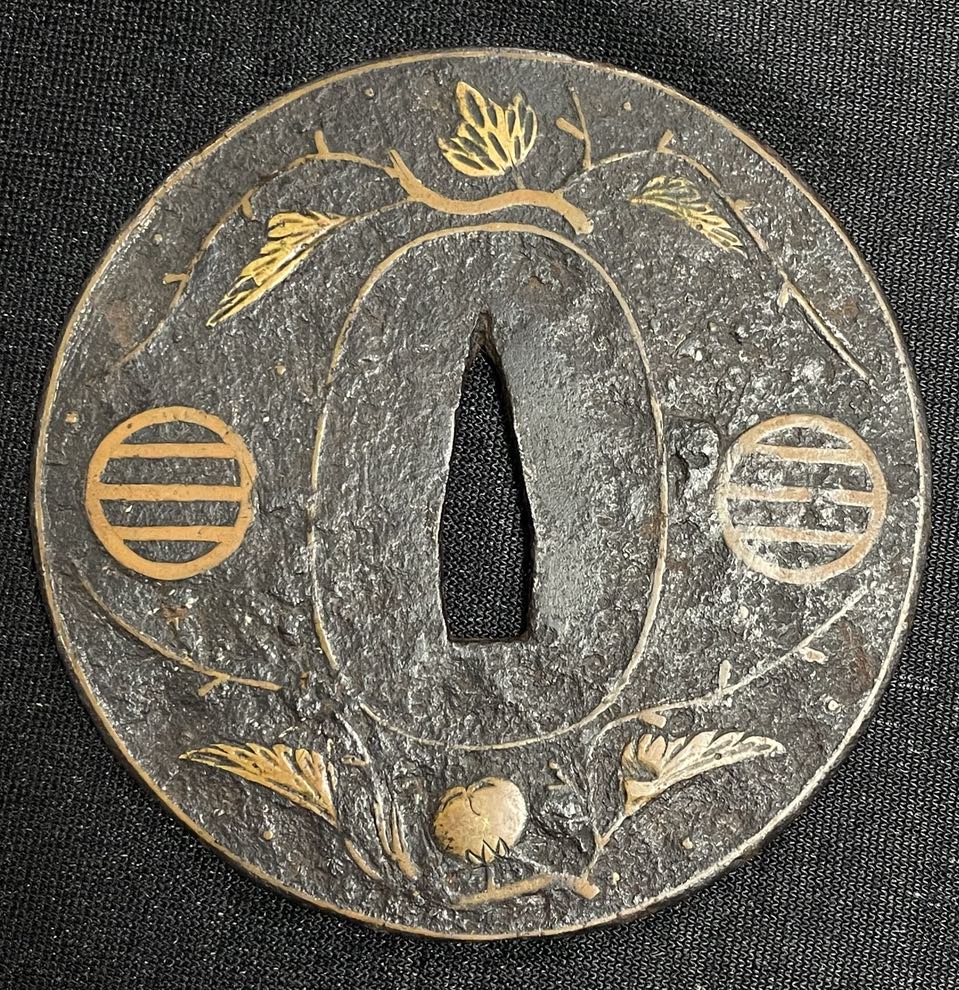
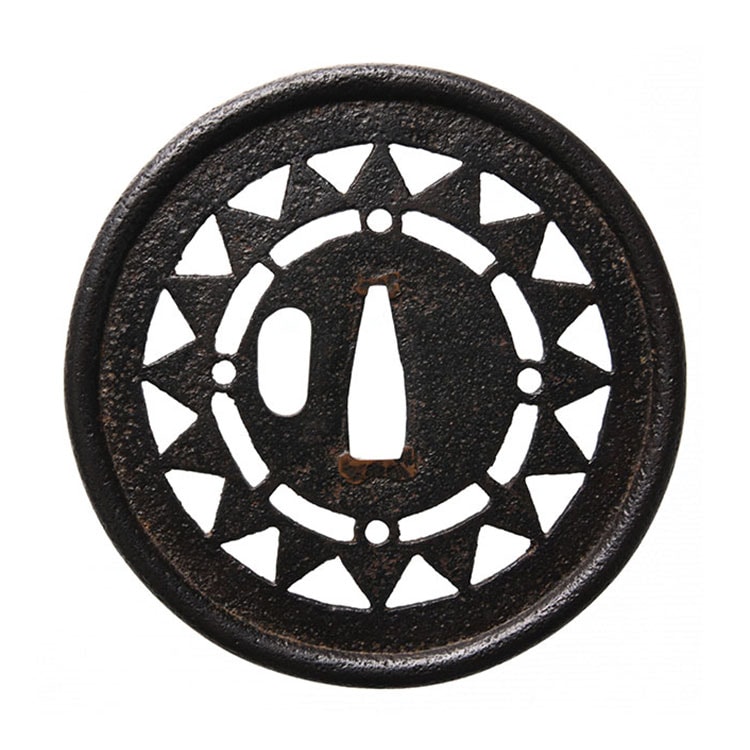
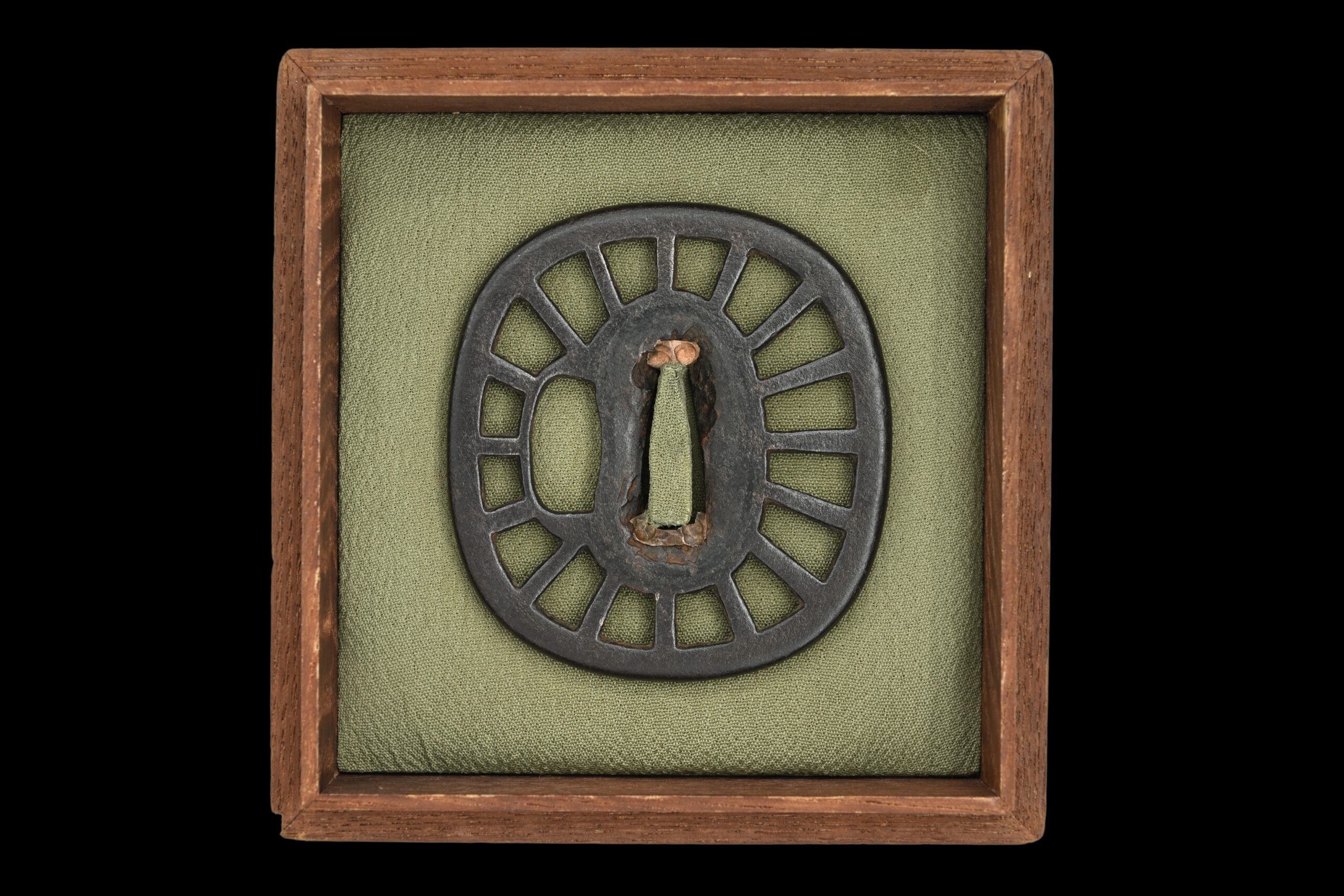
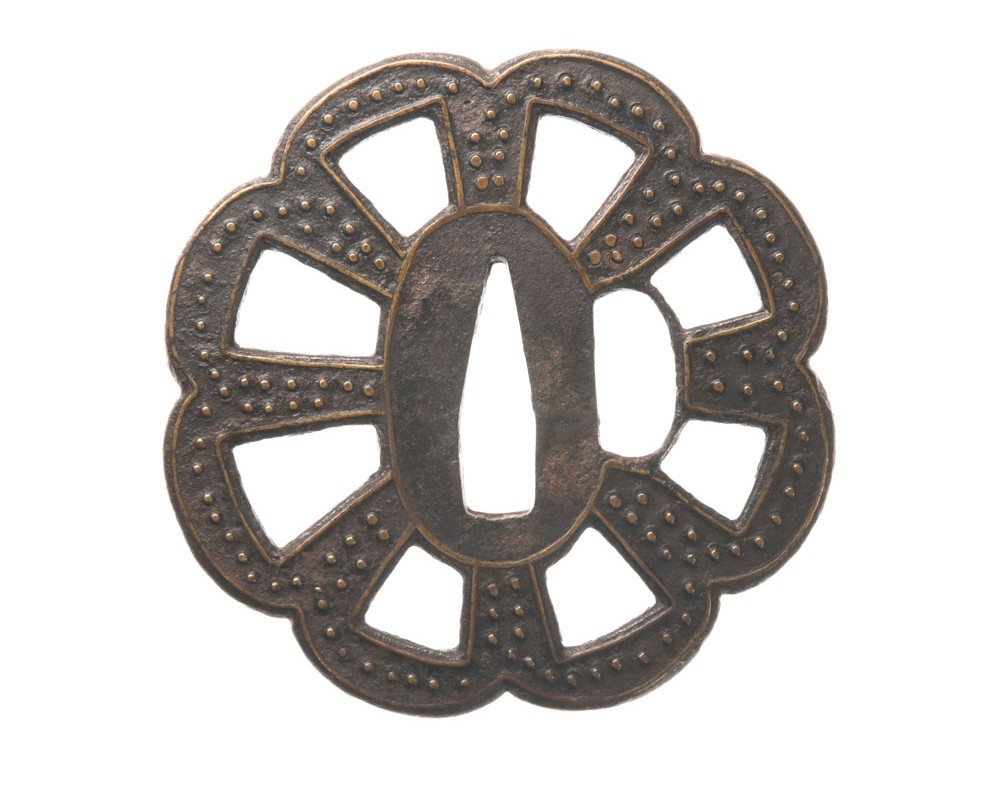
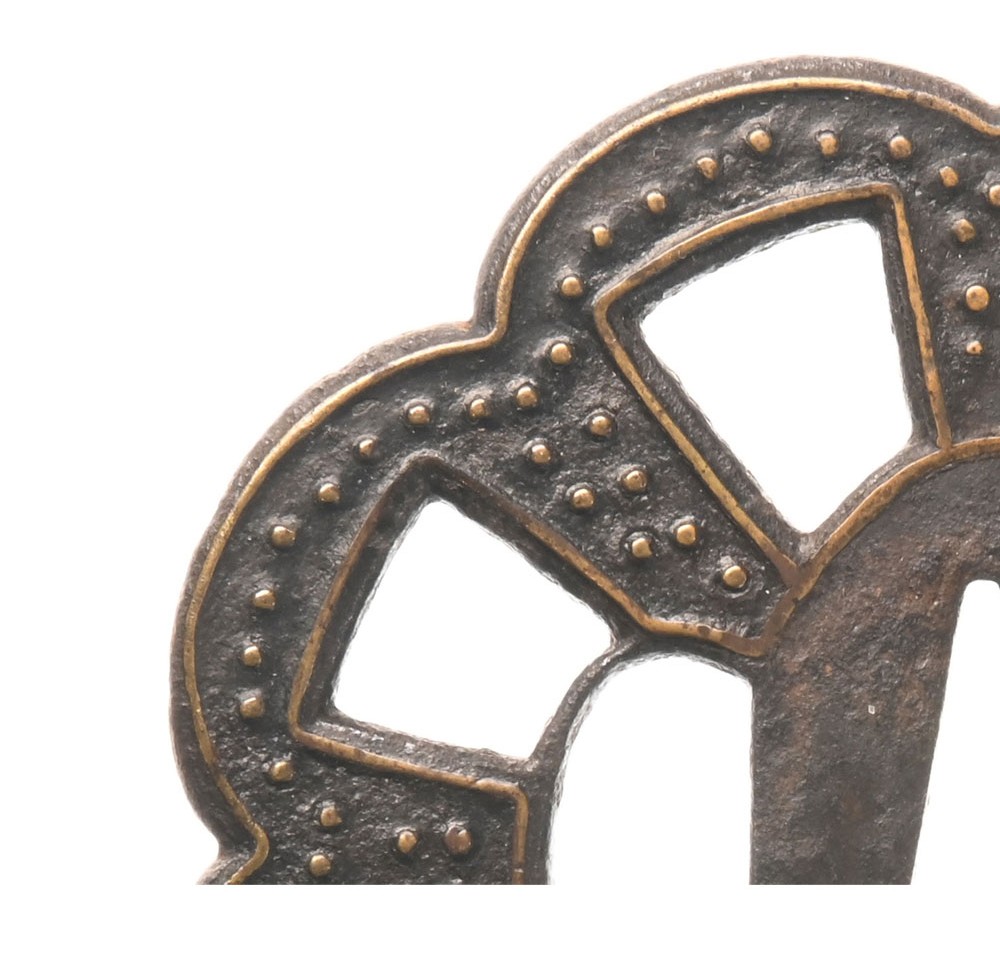
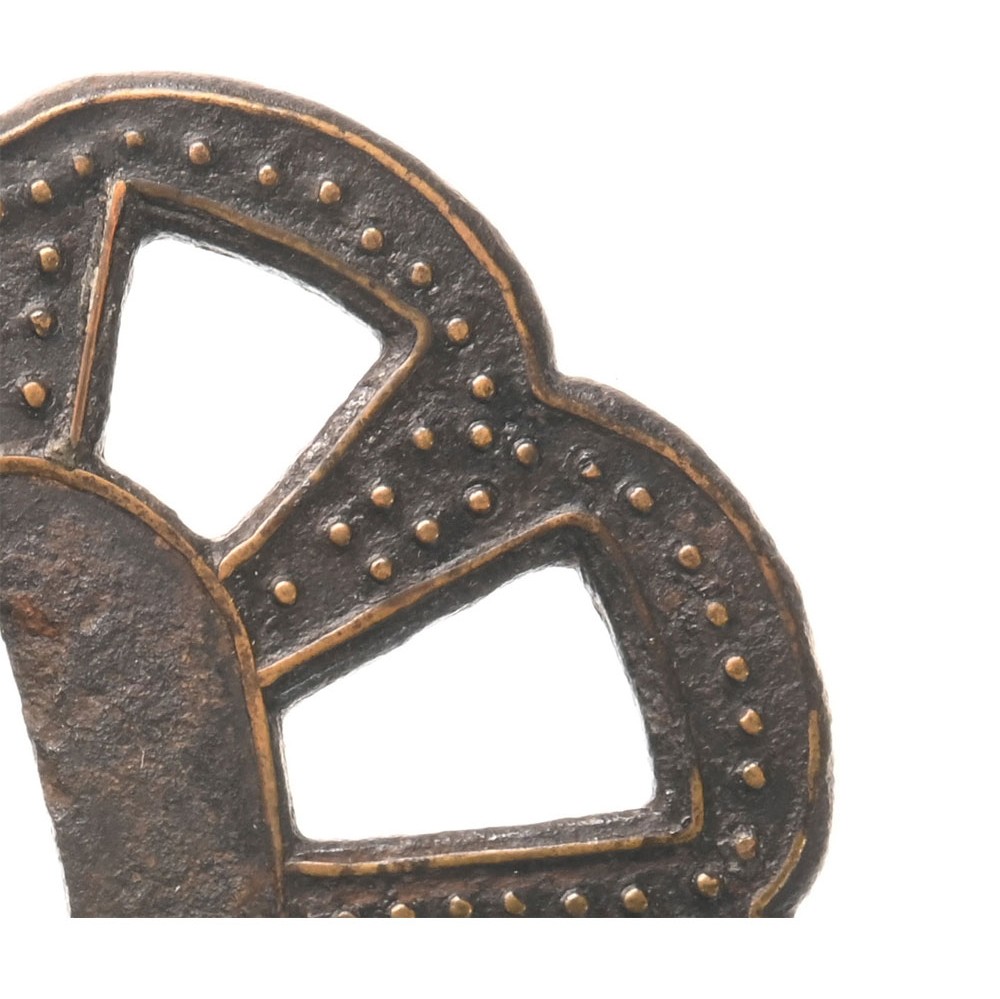
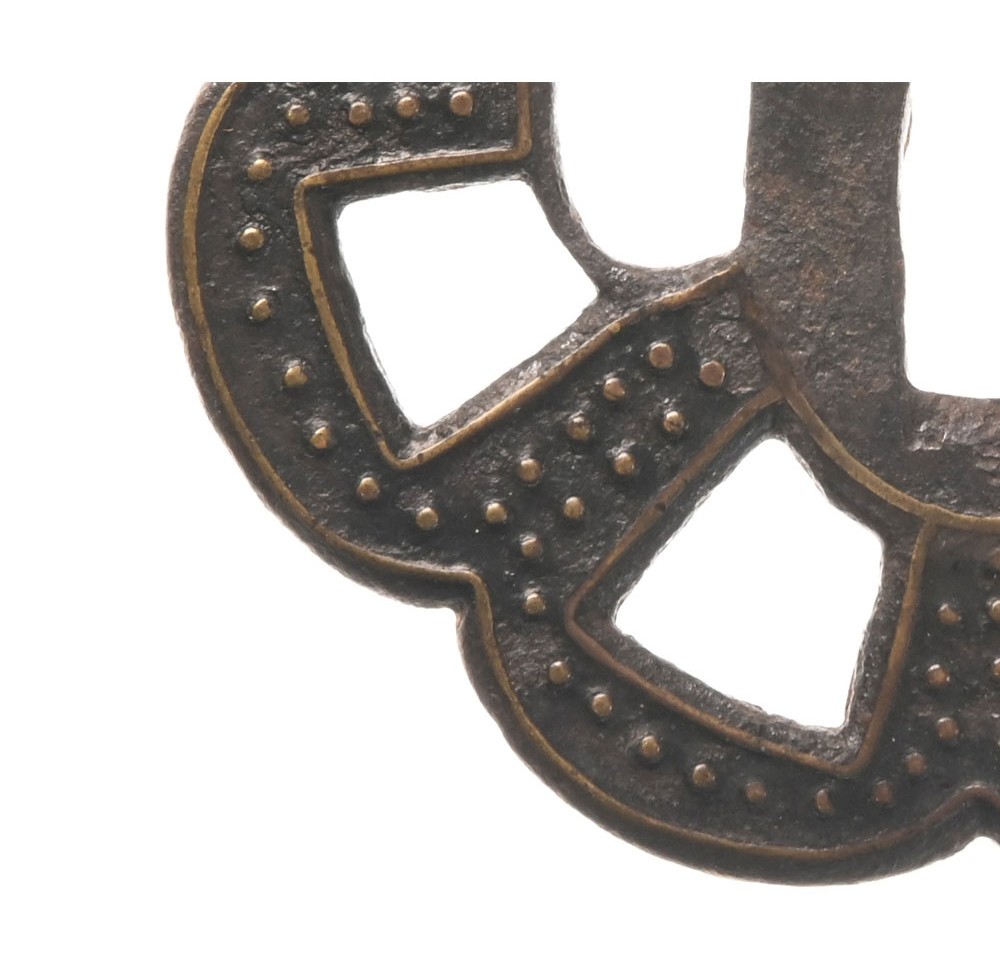
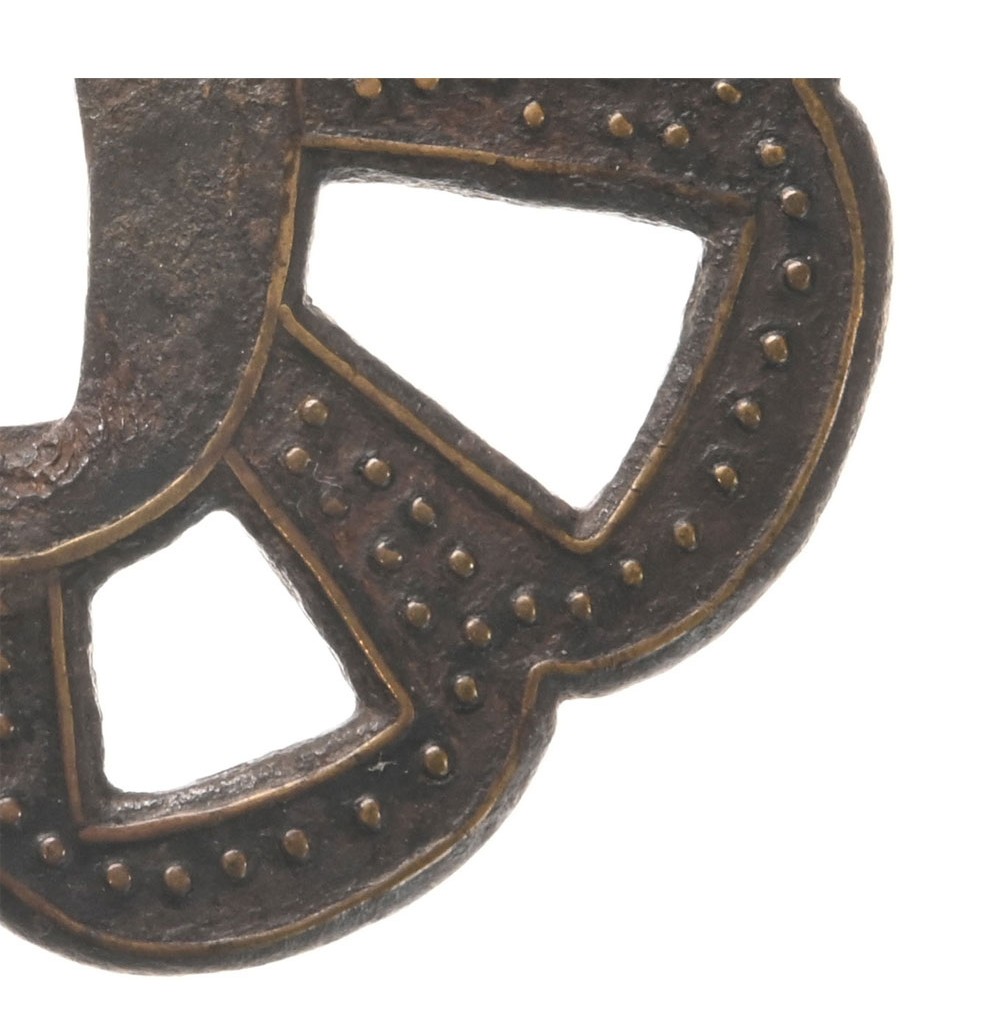
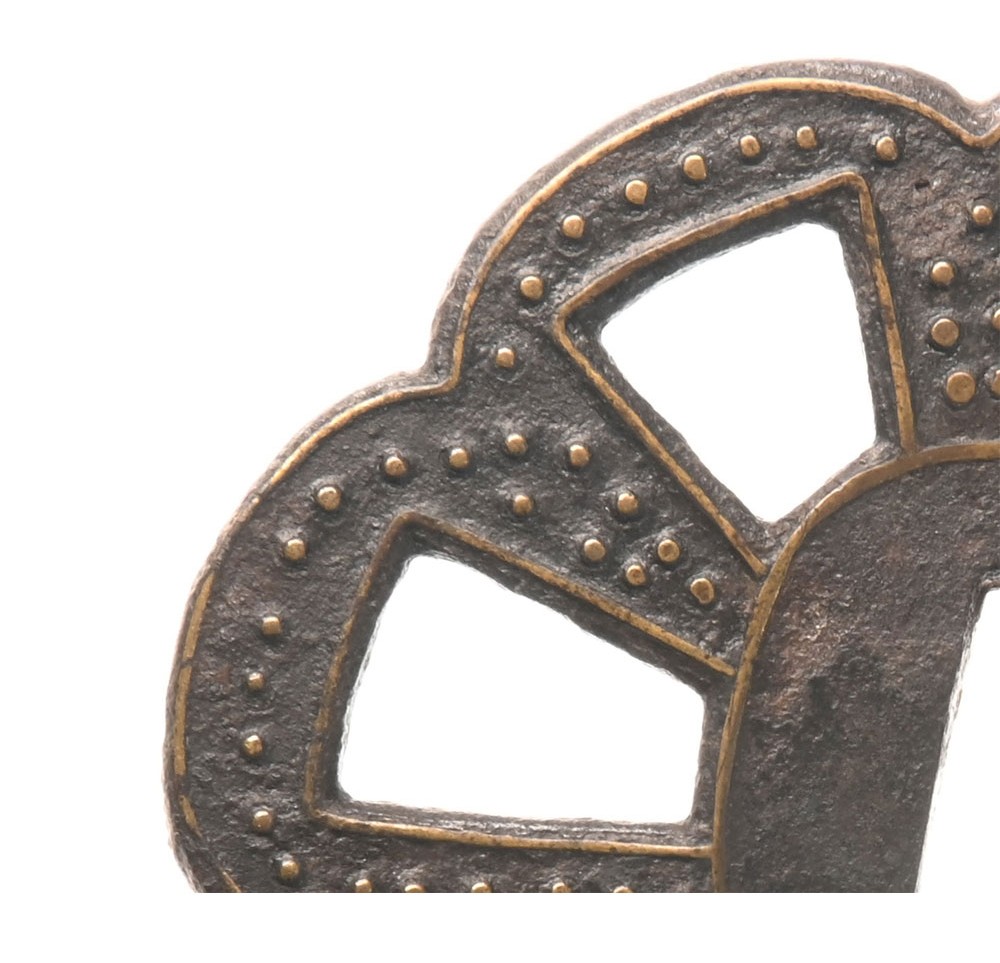
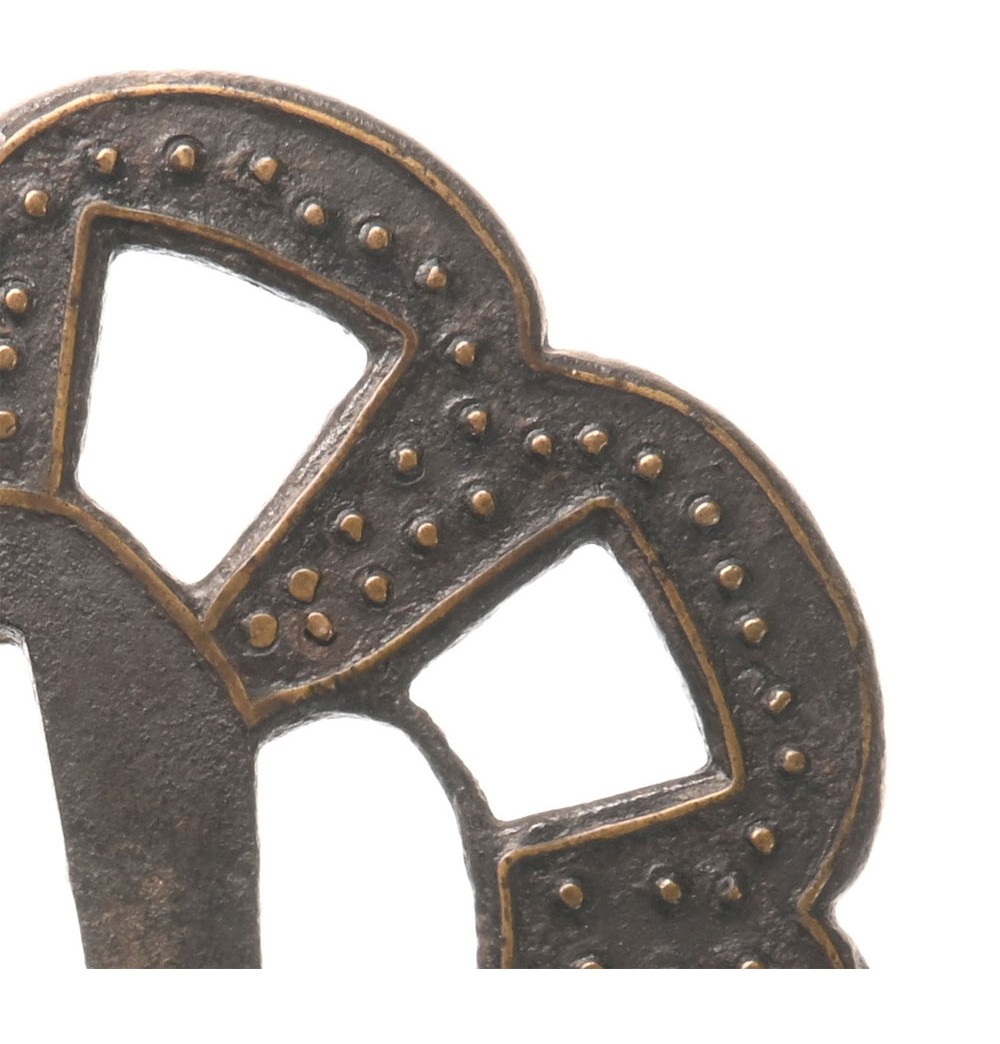
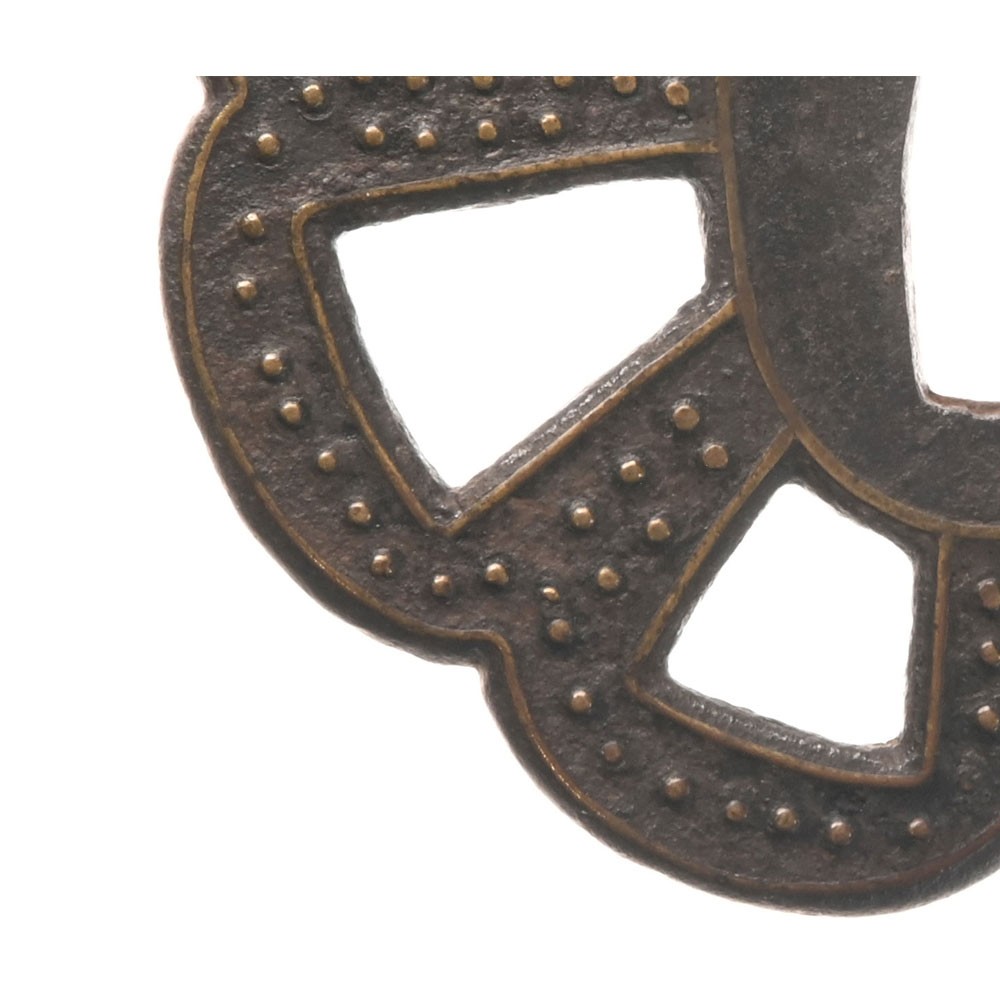
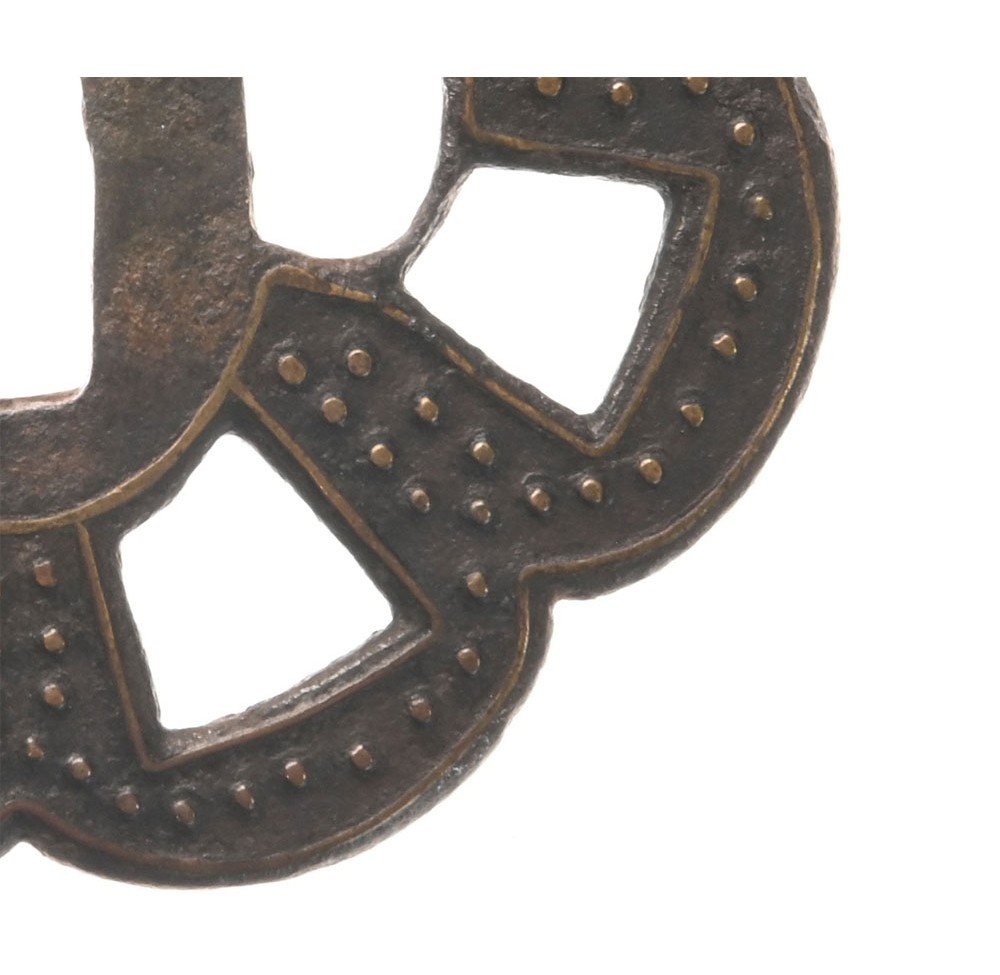
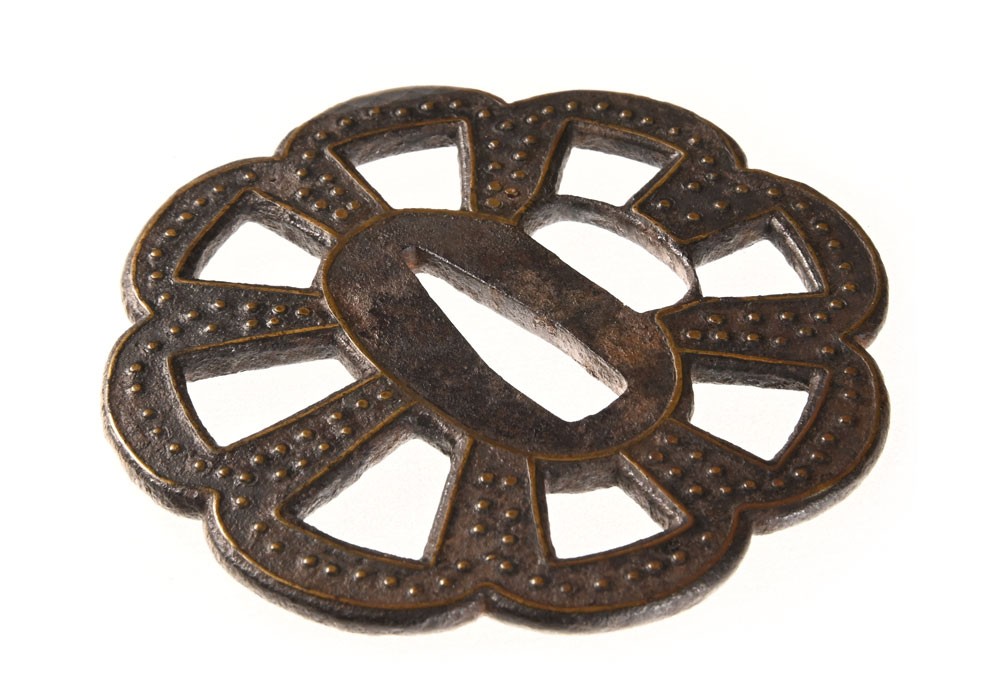
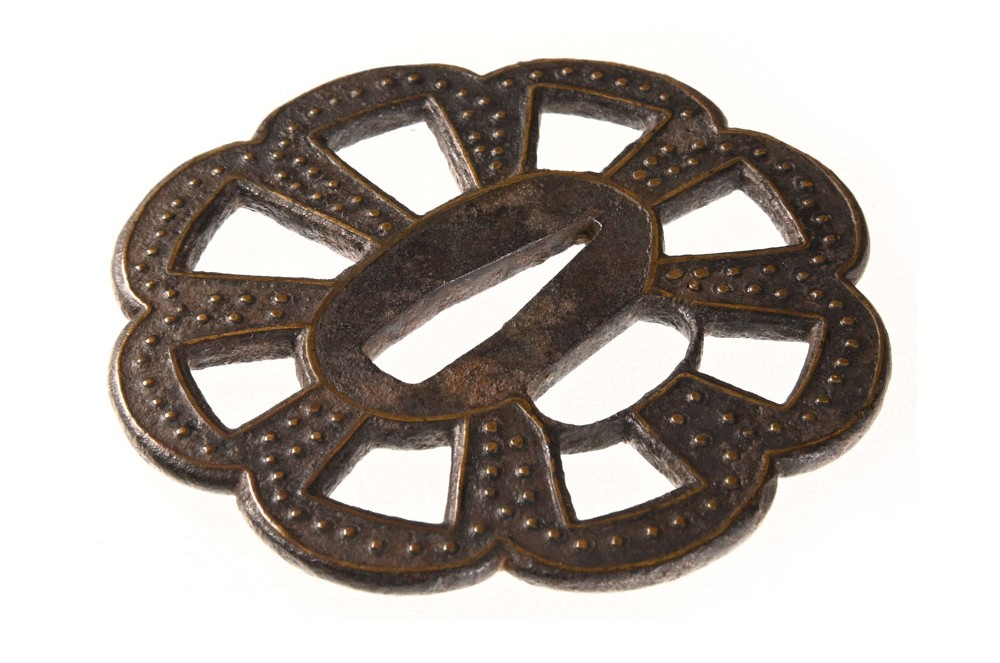
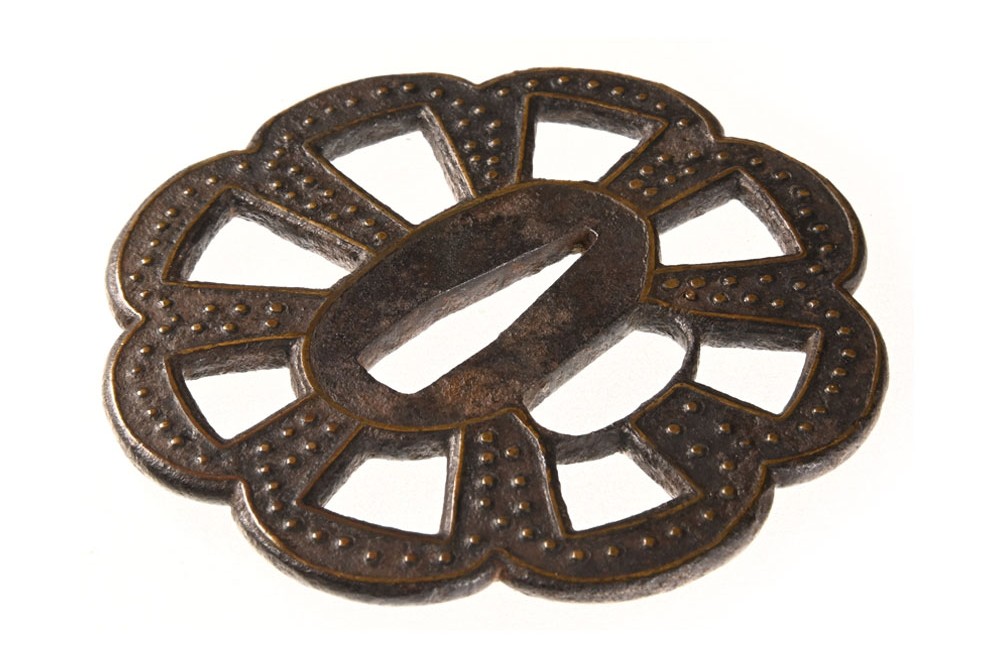
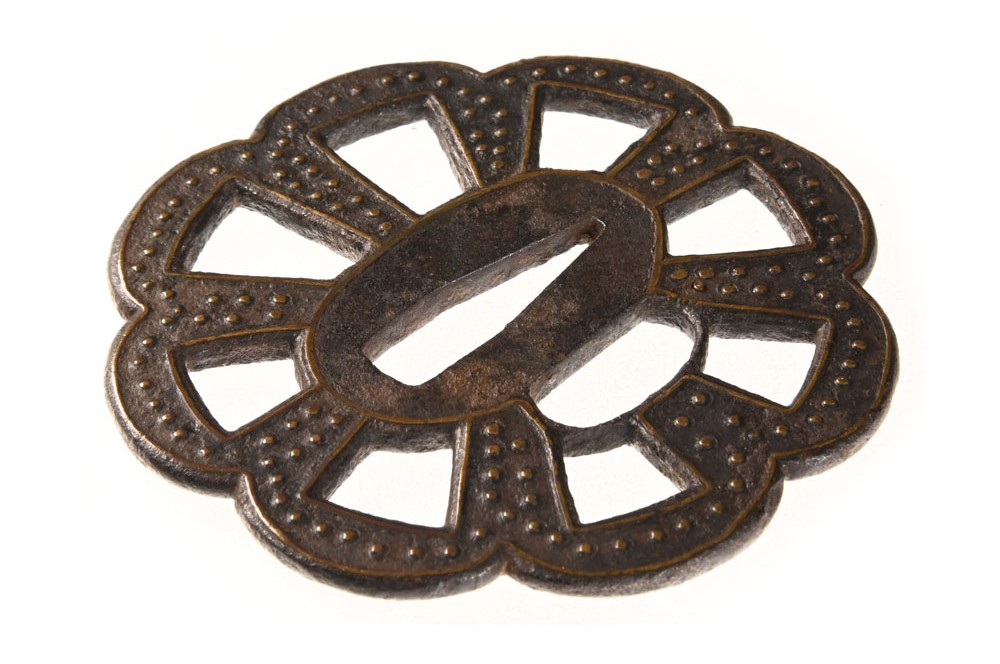
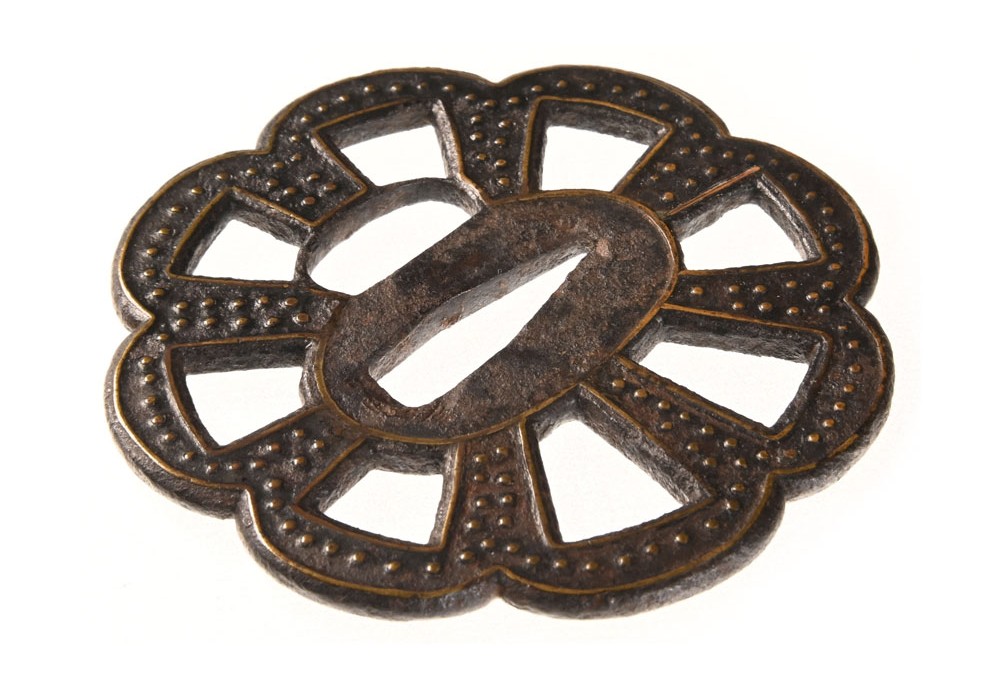
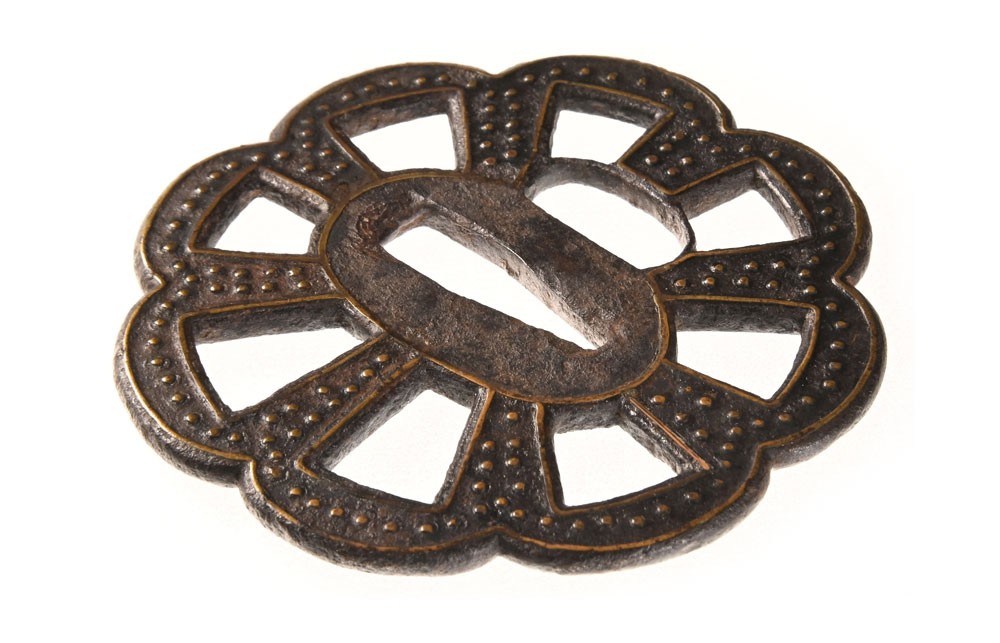
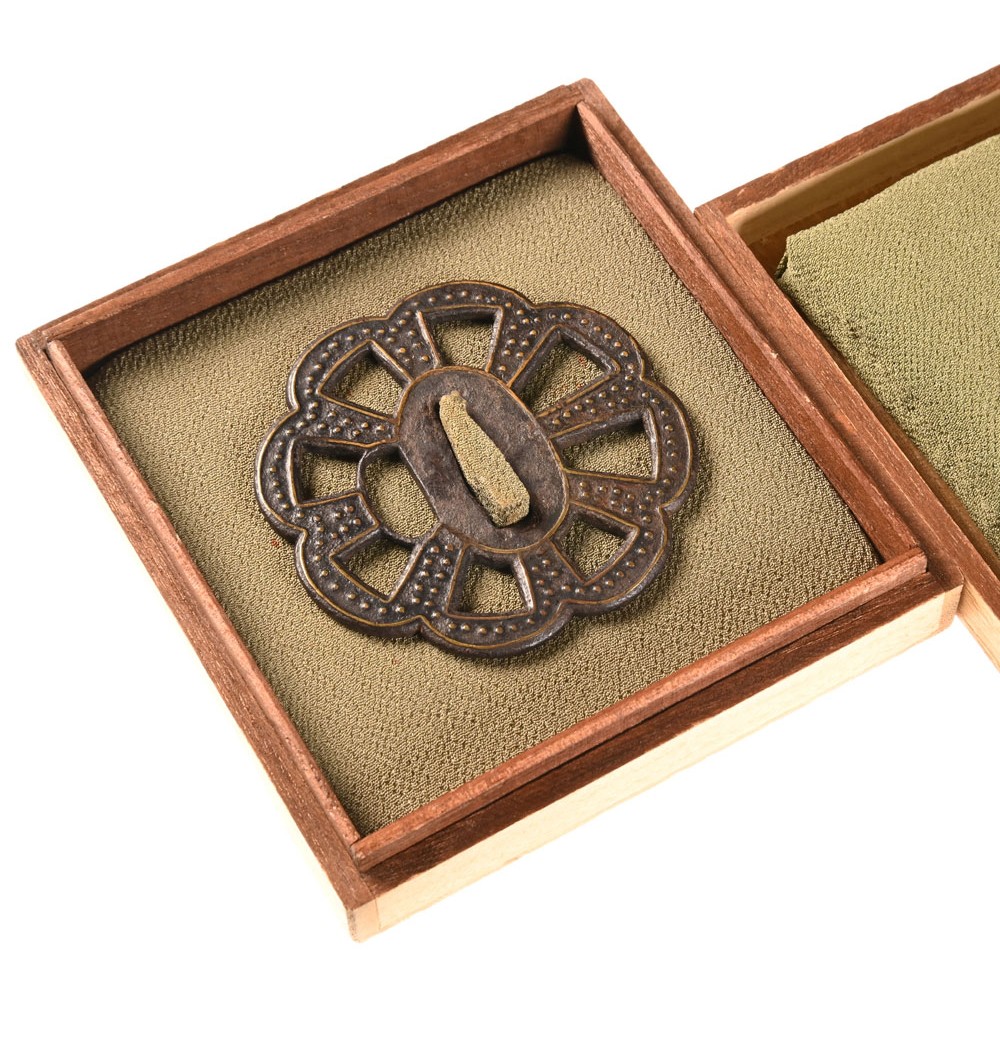
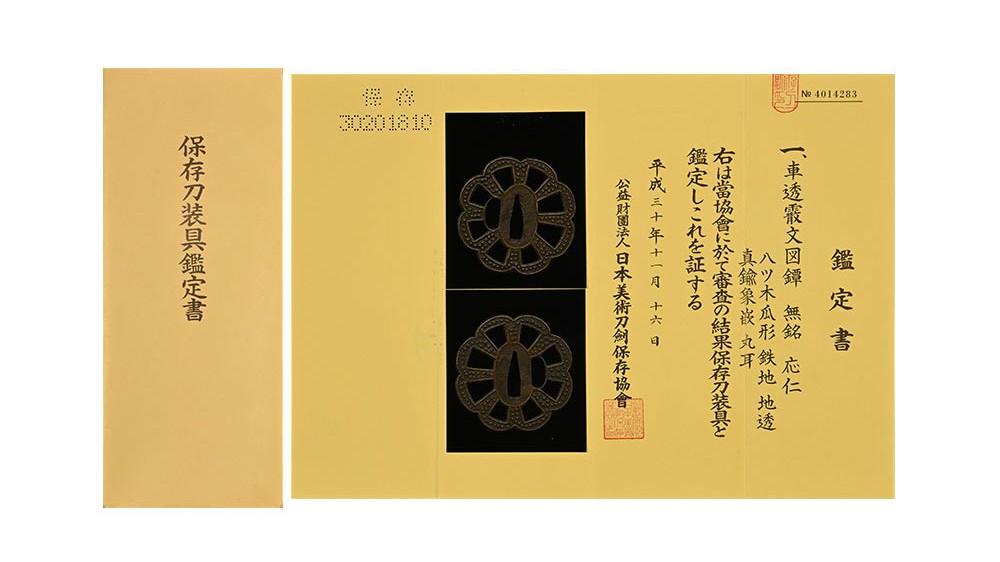
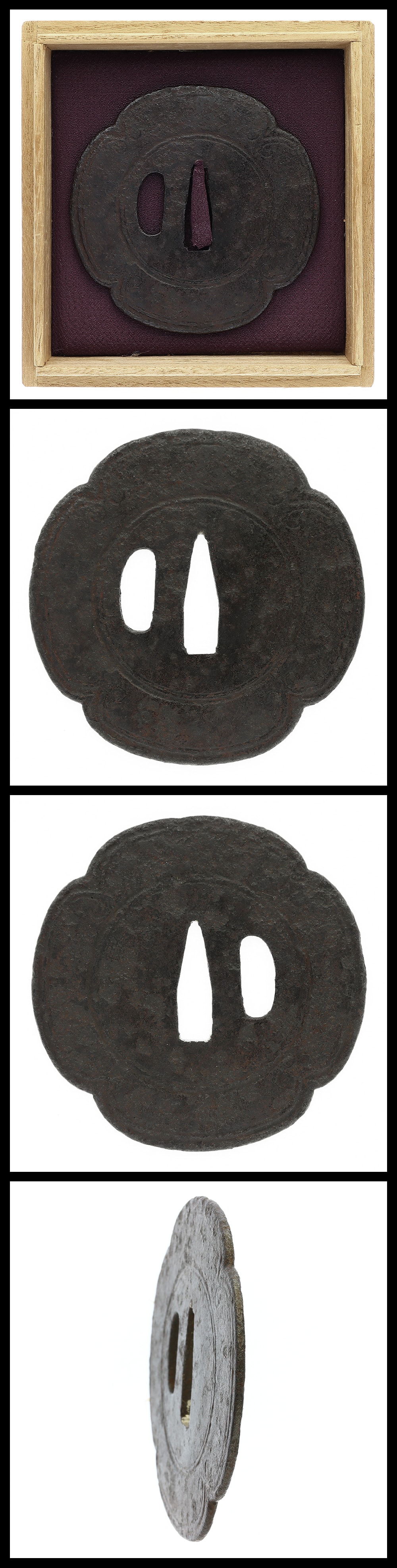
This is an Ounin tsuba featuring a kuruma sukashi (wheel openwork) and araremonzu (hailstone pattern). It is made of iron with brass inlay and has a marumimi (round rim). The Ounin school was active during the Muromachi period, known for thin iron tsuba with brass inlay and small openwork designs.
Certificate reading — 無銘(応仁)
 NihontoWatch
Ounin · mid Muromachi (c. 1400-1450)
Onin School
mid Muromachi (c. 1400-1450)
Hozon (NBTHK)
Iron-tsuba · Kyoto
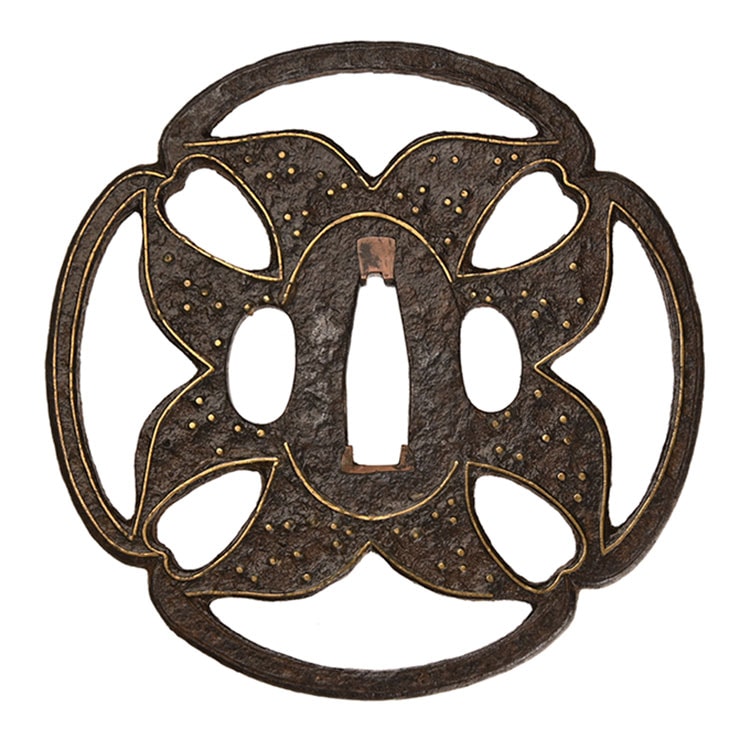
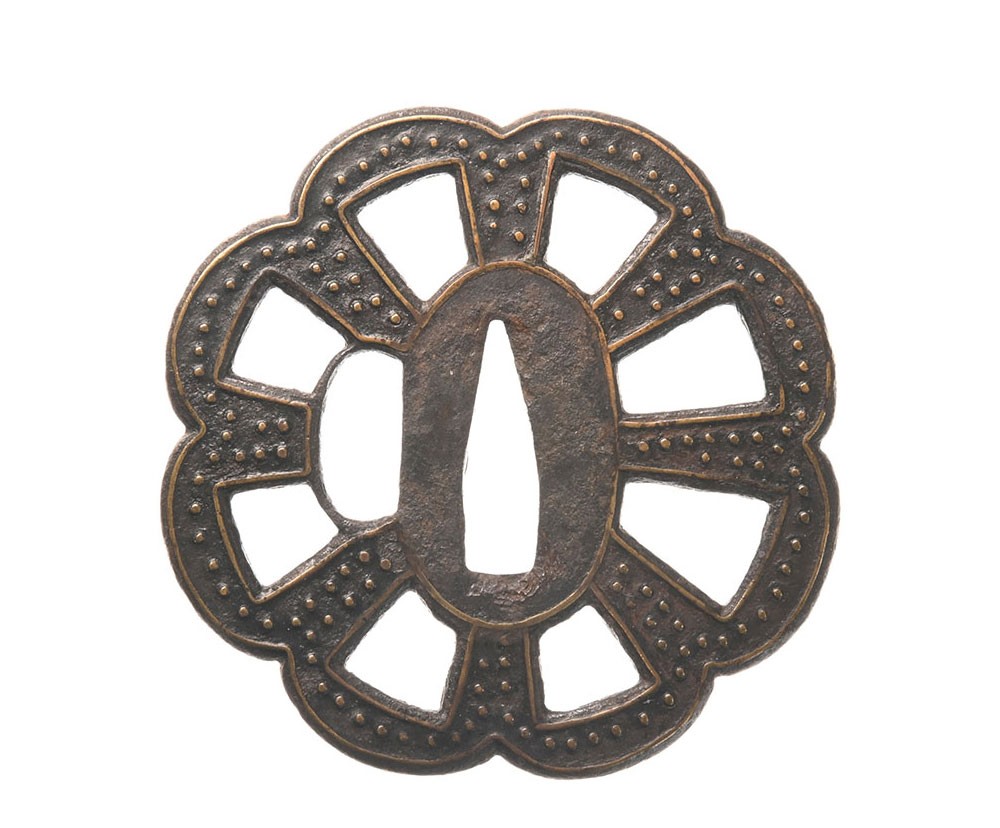
The Ōnin school represents a distinctive category of late Muromachi period tsuba characterized by their unsigned status and their integration of thin iron plate construction with brass inlay decoration. While the name suggests a connection to the Ōnin era (1467–1469), contemporary scholarship places these works more broadly within the later Muromachi period. The precise origins and geographic locus of production remain subjects of ongoing debate, though the surviving corpus demonstrates a cohesive aesthetic vocabulary and technical approach that justifies their recognition as a unified school of tsuba manufacture. The collective style of Ōnin guards centers on two principal decorative modes, both employing shinchū zōgan (brass inlay) on thin iron plate bases. The first method scatters naturalistic motifs—tachibana branches, wild geese, chrysanthemums, grasses, flowers, and scrolling karakusa arabesques—irregularly across the surface.
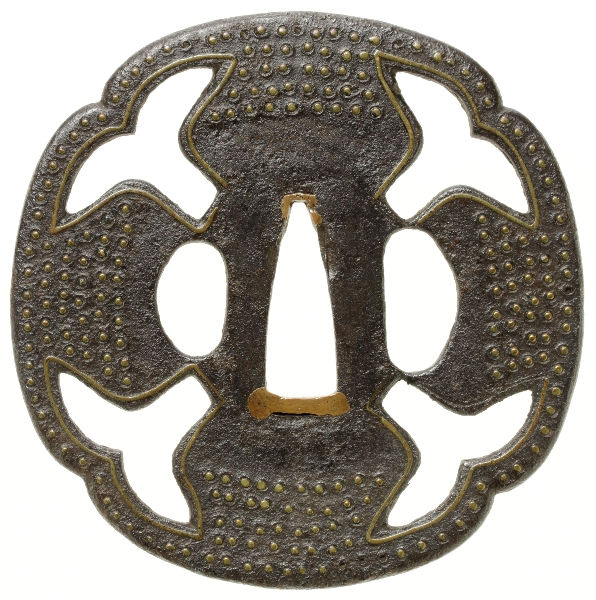
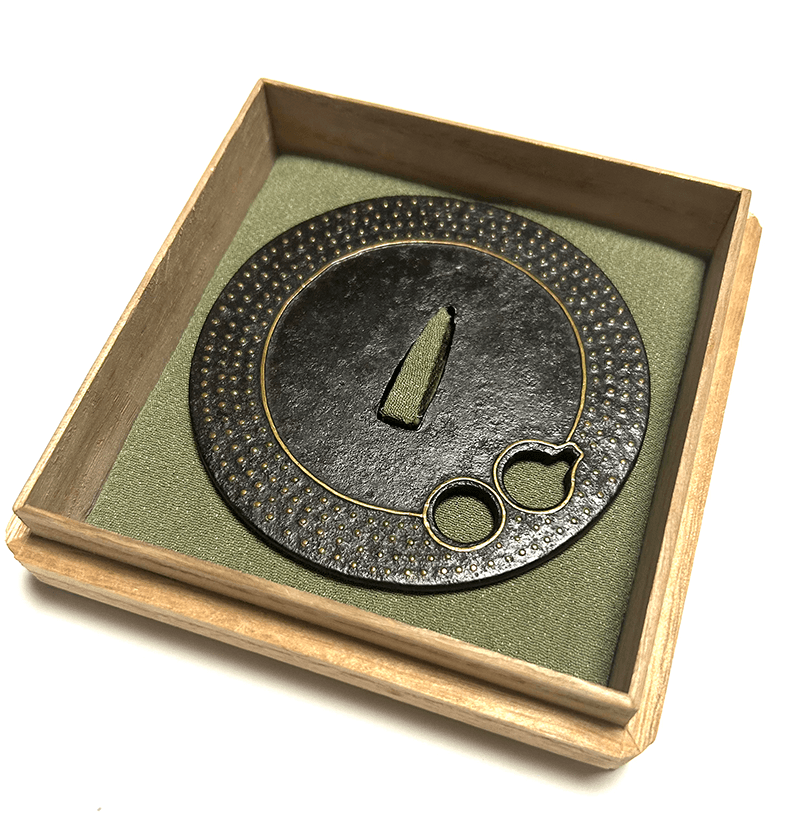
The second technique applies dotted brass inlay, termed hoshi zōgan ("star inlay") or tsuyu zōgan ("dewdrop inlay"), positioned between a brass circle centered on the nakago-ana and the rim zone, often accompanied by small openwork designs such as butterflies, clouds, sedge hats, or triple-peaked mountain forms. Many examples synthesize elements from both modes, combining scattered floral motifs with characteristic features such as brass line inlay encircling the seppa-dai perimeter and enlarged hitsu-ana surrounded by engraved inlay. The iron itself frequently exhibits a hammered tsuchime-ji ground and develops a deeply matured rust patina. Ōnin tsuba occupy a significant position within the broader continuum of Muromachi period iron guard production, representing a bridge between the austere simplicity of early smith-made guards and the more elaborate decorative programs of later periods. The forceful quality of their brass inlay work, combined with rustic iron surfaces and straightforward compositional arrangements, creates an aesthetic of unaffected dignity that has secured their enduring appreciation among collectors and scholars of Japanese sword fittings. Learn more →
Certifies a genuine fitting worth preserving: a correct signature, or, if unsigned, an identifiable era and school, with recognized artistic and craft value.
The NBTHK (Nihon Bijutsu Tōken Hozon Kyōkai, the Society for the Preservation of Japanese Art Swords) is a public-interest incorporated foundation founded in 1948 and supervised by Japan’s Agency for Cultural Affairs (Bunkachō); it is based at the Japanese Sword Museum in Tokyo. Its expert panels physically examine each submitted work (shinsa) and issue a certificate (kanteishō) ranking it by artistic and historical merit. NBTHK papers are the most widely recognized standard of authentication for Japanese swords and fittings.
NBTHK official siteReturns/exchanges/cancellations not accepted after shipment except for significant defects; if defective, return/exchange possible within 3 days of arrival (return shipping paid by customer).
¥120,000
This is an Ounin tsuba featuring a kuruma sukashi (wheel openwork) and araremonzu (hailstone pattern). It is made of iron with brass inlay and has a marumimi (round rim). The Ounin school was active during the Muromachi period, known for thin iron tsuba with brass inlay and small openwork designs.
Certificate reading — 無銘(応仁)
NihontoWatchOunin · mid Muromachi (c. 1400-1450)
Onin School
mid Muromachi (c. 1400-1450)
Hozon (NBTHK)
Iron-tsuba · Kyoto
The Ōnin school represents a distinctive category of late Muromachi period tsuba characterized by their unsigned status and their integration of thin iron plate construction with brass inlay decoration. While the name suggests a connection to the Ōnin era (1467–1469), contemporary scholarship places these works more broadly within the later Muromachi period. The precise origins and geographic locus of production remain subjects of ongoing debate, though the surviving corpus demonstrates a cohesive aesthetic vocabulary and technical approach that justifies their recognition as a unified school of tsuba manufacture. The collective style of Ōnin guards centers on two principal decorative modes, both employing shinchū zōgan (brass inlay) on thin iron plate bases. The first method scatters naturalistic motifs—tachibana branches, wild geese, chrysanthemums, grasses, flowers, and scrolling karakusa arabesques—irregularly across the surface.
The second technique applies dotted brass inlay, termed hoshi zōgan ("star inlay") or tsuyu zōgan ("dewdrop inlay"), positioned between a brass circle centered on the nakago-ana and the rim zone, often accompanied by small openwork designs such as butterflies, clouds, sedge hats, or triple-peaked mountain forms. Many examples synthesize elements from both modes, combining scattered floral motifs with characteristic features such as brass line inlay encircling the seppa-dai perimeter and enlarged hitsu-ana surrounded by engraved inlay. The iron itself frequently exhibits a hammered tsuchime-ji ground and develops a deeply matured rust patina. Ōnin tsuba occupy a significant position within the broader continuum of Muromachi period iron guard production, representing a bridge between the austere simplicity of early smith-made guards and the more elaborate decorative programs of later periods. The forceful quality of their brass inlay work, combined with rustic iron surfaces and straightforward compositional arrangements, creates an aesthetic of unaffected dignity that has secured their enduring appreciation among collectors and scholars of Japanese sword fittings. Learn more →
Certifies a genuine fitting worth preserving: a correct signature, or, if unsigned, an identifiable era and school, with recognized artistic and craft value.
The NBTHK (Nihon Bijutsu Tōken Hozon Kyōkai, the Society for the Preservation of Japanese Art Swords) is a public-interest incorporated foundation founded in 1948 and supervised by Japan’s Agency for Cultural Affairs (Bunkachō); it is based at the Japanese Sword Museum in Tokyo. Its expert panels physically examine each submitted work (shinsa) and issue a certificate (kanteishō) ranking it by artistic and historical merit. NBTHK papers are the most widely recognized standard of authentication for Japanese swords and fittings.
NBTHK official siteReturns/exchanges/cancellations not accepted after shipment except for significant defects; if defective, return/exchange possible within 3 days of arrival (return shipping paid by customer).
¥120,000