Muromachi turned sword making into an industry: the uchigatana rose with massed infantry warfare, Osafune and Seki produced bundle swords beside custom orders, and the Ming trade carried Japanese blades abroad by the tens of thousands.
 NihontoWatchNihontoWatch
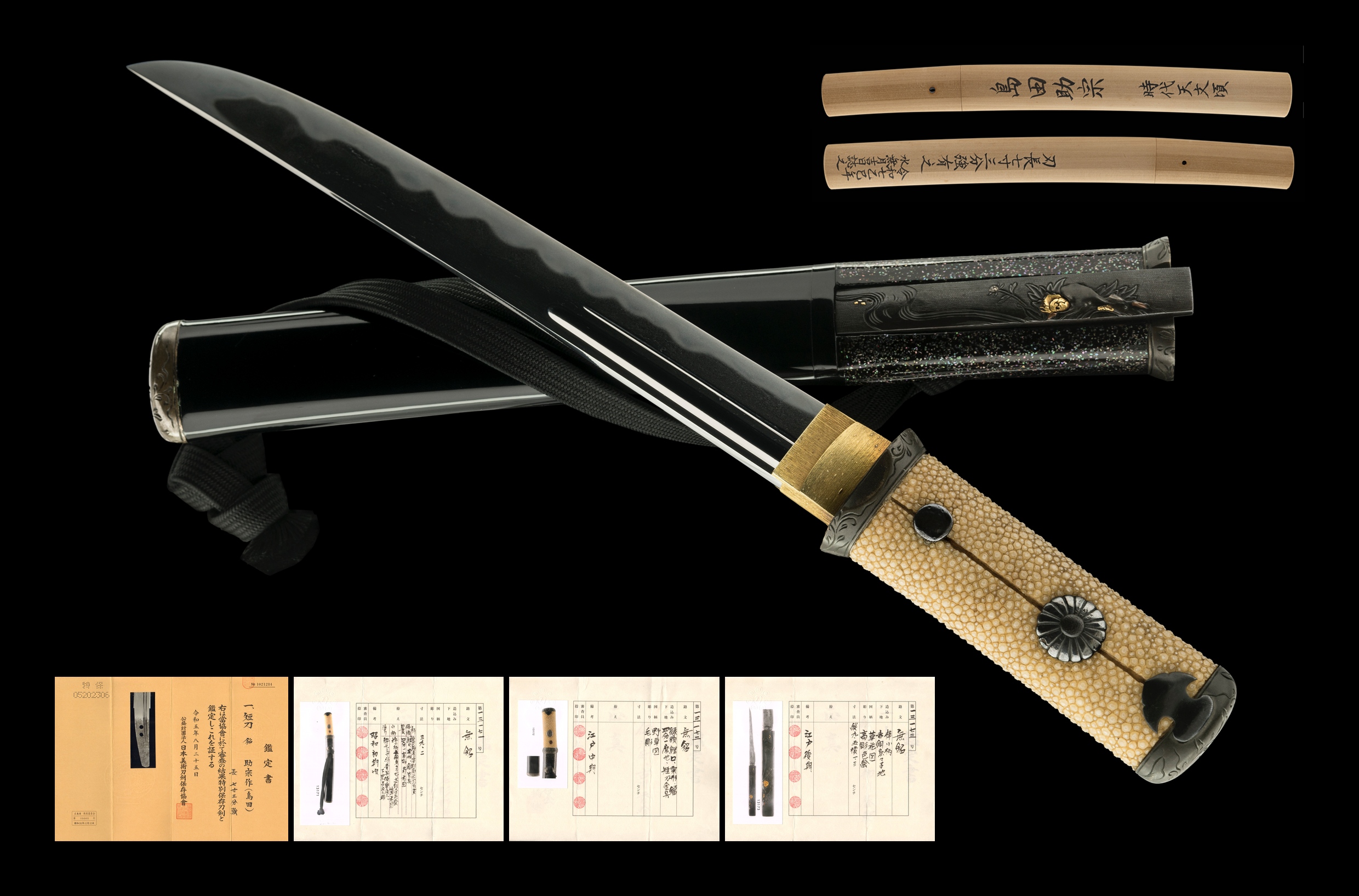
Active in the mid-16th century, during the Tenbun to Eiroku eras of the late Muromachi period, Shimada Sukemune was a wazamono-ranked swordsmith based in Shimada of Suruga province. He flourished under the Imagawa clan and contributed significantly to the development of the Shimada school. Tradition holds that he was the younger brother of the famed Shimada Yoshisuke, and there are accounts of Sukemune forging swords in Kai province under the patronage of Takeda Shingen, a sign that powerful warlords valued his work. This sharp tantô has a wide hirazukuri form with well-forged itame-hada mixed with mokume. The bright, lively hamon of gunome and chôji-midare opens into a flamboyant hitatsura, with patches of muneyaki, scattered tobiyaki in the ji and nie crystals visible to the naked eye. Suruga’s proximity to Sagami, the home of the Sôshû-den, shows in this all-over hardening, in the bold bôhi paired with a slender soebi, and in the bulging funagata (boat-shaped) nakago, a form famously seen in Masamune’s Hôchô tantô. The boshi enters with a gentle midare-komi and returns deeply along the mune with a touch of hakikake, while a light midare-utsuri adds a Bizen twist to this remarkable blade. The tantô is complemented by a regal aikuchi koshirae from the early Shôwa period (1926-1940). Matching shibuichi fittings carry hairline engravings of plants, the menuki feature the chrysanthemum crest (kikumon), and the lacquered saya is sprinkled with mother-of-pearl. A rarely seen screw-style mekugi secures the tsuka. Certification includes an NBTHK Tokubetsu Hozon paper issued in 2023 and NTHK-NPO Kanteisho for the soroi-kanagu, kozuka and koshirae. The shirasaya carries a sayagaki by Nozomi-san dating the blade to around the Tenbun era, and the gold ni-ju habaki shows crisp file marks. A vibrant, energetic tantô with plenty of nihontô character to cherish.
Offered by Unique Japan
This piece has sold
Get an email when a new Sukemune piece hits the market.
Suruga · around 1532-1555
Fujishiro Jo saku · Tōken Taikan top 37%
The Muromachi period (1392 to 1573)
Muromachi turned sword making into an industry: the uchigatana rose with massed infantry warfare, Osafune and Seki produced bundle swords beside custom orders, and the Ming trade carried Japanese blades abroad by the tens of thousands.
A Hozon-certified blade judged to show notably superior workmanship and a better state of preservation. The bar is higher: re-tempered blades and most unsigned Muromachi/Edo works are excluded.
The NBTHK (Nihon Bijutsu Tōken Hozon Kyōkai, the Society for the Preservation of Japanese Art Swords) is a public-interest incorporated foundation founded in 1948 and supervised by Japan’s Agency for Cultural Affairs (Bunkachō); it is based at the Japanese Sword Museum in Tokyo. Its expert panels physically examine each submitted work (shinsa) and issue a certificate (kanteishō) ranking it by artistic and historical merit. NBTHK papers are the most widely recognized standard of authentication for Japanese swords and fittings.
NBTHK official siteAll swords come with a three-day inspection period beginning from the date of delivery. If not satisfied, the sword may be returned within this period for a full refund of the purchase price. Outside of this period, all sales are final. Swords purchased on a layaway payment plan are not eligible for the three-day inspection period.