説明
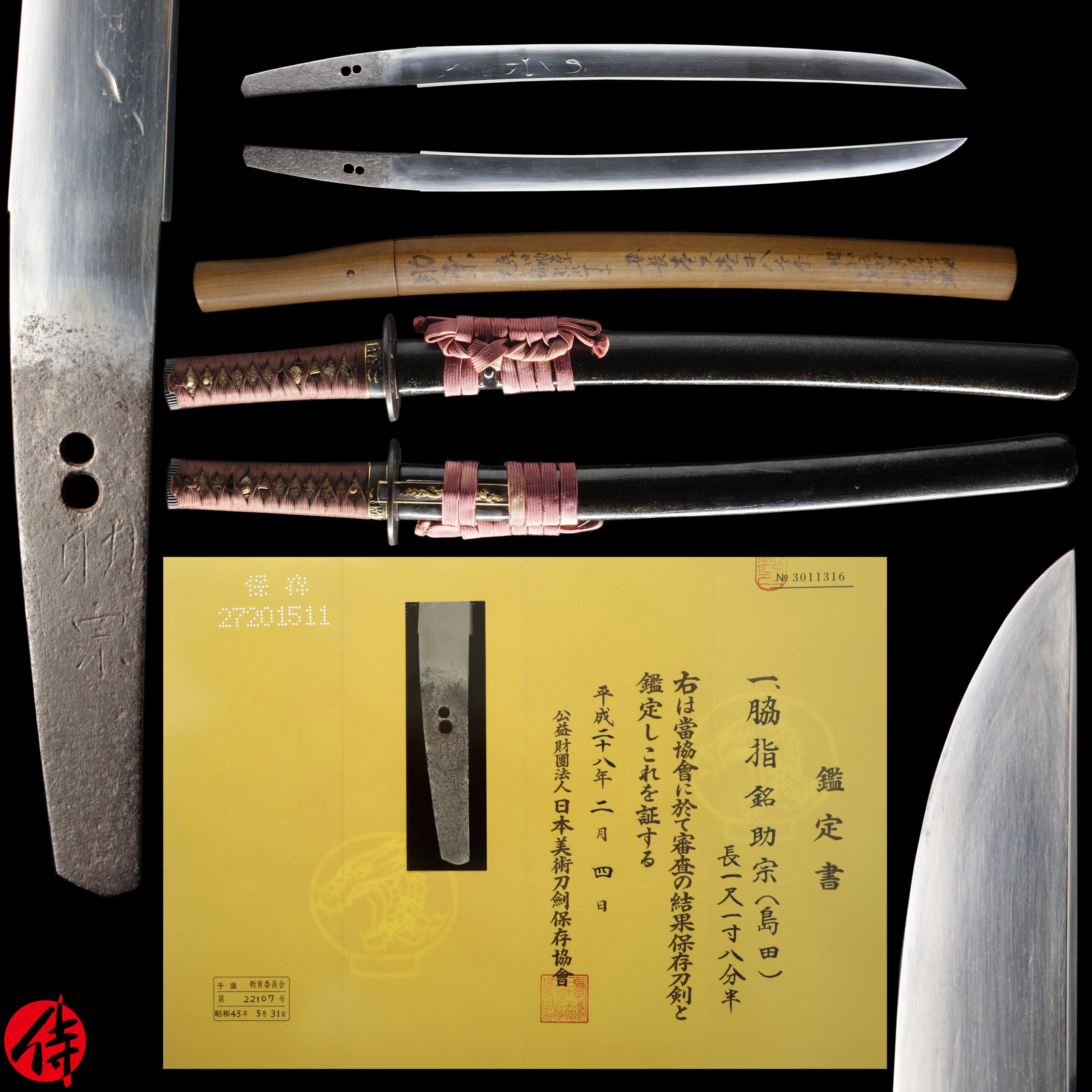
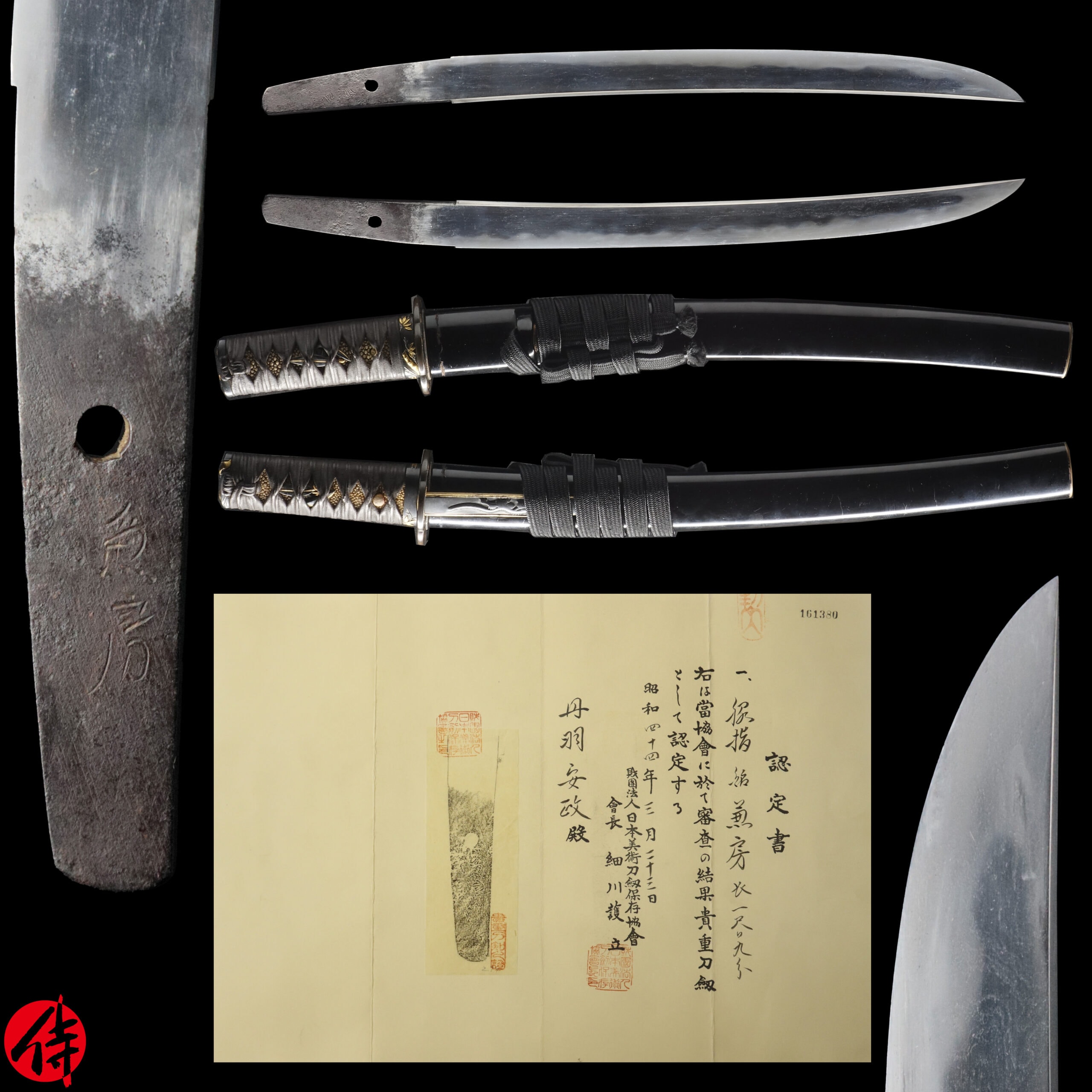
Antique Japanese Sword Wakizashi Signed by Sukemune with NBTHK
Hozon
Certificate
【Description】
Summary
This blade was signed by Sukemune (助宗). Sukemune belonged to Shimada (島田) school in the Suruga domain (today’s Shizuoka prefecture). Its foundation dates back to the mid-Muromachi period, and it was founded by Yoshisuke (義助). The first-gen Sukemune was the younger brother of Yoshisuke.
The swordsmith’s name Sukeume lasted four generations, and they were active in sword-forging during the Tenbun-Kanbun era (1532-1673). We estimate it was made by the early generation Sukemune from the Muromachi period.
The first-gen Yoshisuke served a powerful feudal family named Imagawa. It is said that he received his maker’s name 義 from Imagawa Yoshitada. Shimada school interacted with other schools in Soshu swordsmiths living near Odawara castle in Kanagawa prefecture. The Suruga domain was vital for strong feudal lords such as Takeda, Tokugawa, and Hojo clan during the Sengoku Jidai (Warring state period). The swordsmiths in Shimada school received many orders from these strong feudal families.
Soshu Den
It is said that the generations of Sukemune mastered a particular sword-forging tradition called Soshu Den. Shoshu Den was born in the middle of the Kamakura period. Back then, the Yamato and Yamashiro traditions were highly developed, and there were a few renowned swordsmiths from those regions. However, the sword-forging practice was in its infancy in the Kanto area, where the Soshu region was located.
At the beginning of the Kamakura government, which was established in 1185, the first Shogun, Minamoto Yoritomo, prioritized making a lot of rules to have its political stability. And he couldn’t afford to hire swordsmiths within the same region or train them. Therefore, the Kamakura government originally ordered weapons to the swordsmiths in the other areas, such as Yamato and Yamashiro.
But, since the government was established, the demand for weapons increased exponentially in the government, and they had to figure out how to meet those demands from Samurai who served Kamakura shogunate. Then, the 5th head of the Shogun, Hojo Tokiyori, invited two renowned swordsmiths from other parts of Japan. They were Awataguchi Kunitsuna from Yamashiro province and Bizen Saburo Kunimune from Bizen province. And the 7th-gen Shogun Koreyasu Shino also invited Fukuoka Ichimonji Sukezane from Bizen province.
It is said that those three swordsmiths played an essential role in creating the Soshu Den and making the foundation of the Soshu Den. Also another famous figure in the Soshu den is Intou Kunimitsu, an adopted son of Awataguchi Knitsuna. And Kunimitsu passed his excellent craftsmanship to Yukimitsu, his apprentice. And Masamune, one of the most famous swordsmiths in Japanese history, was an apprentice of Yukimitsu. And Masamune was the one that brought Shoshuden to nationwide fame. The tradition Masamune completed became an example of other swordsmiths who learned Soshu Den. Also, Soshu Den influenced many renowned swordsmiths during the Koto- Shinto era. One of examples is Inoue Shinkai from Osaka and Suishinshi Masahide from Edo.
Horimono (Engraving on the blade)
On this blade, you would find the Horimo of Bonjis (梵字, Sanscrit letter). Sword carvings often depict Fudo Myo-O (不動明王, acalanātha) or his incarnations, and there are also Sanskrit characters that represent this god. Among the various Buddhist Buddhas, Fudo Myo-O was deeply worshiped by Samurai warriors. According to a theory, this god is the incarnation of Dainichi Nyorai (大日如来, Mahāvairocana, the principal image of esoteric Buddhism). Perhaps the most common type of Sanskrit character carved on the blades is the character “Kahn (カーン)”, which means Fudo Myo-O. There is also a Sanskrit character called “Kanmarn (カンマーン),” which is combined with the word “Man.” There was once a trend that Samurai warriors incorporated motifs with religious meaning into their battle costumes, such as armo