説明
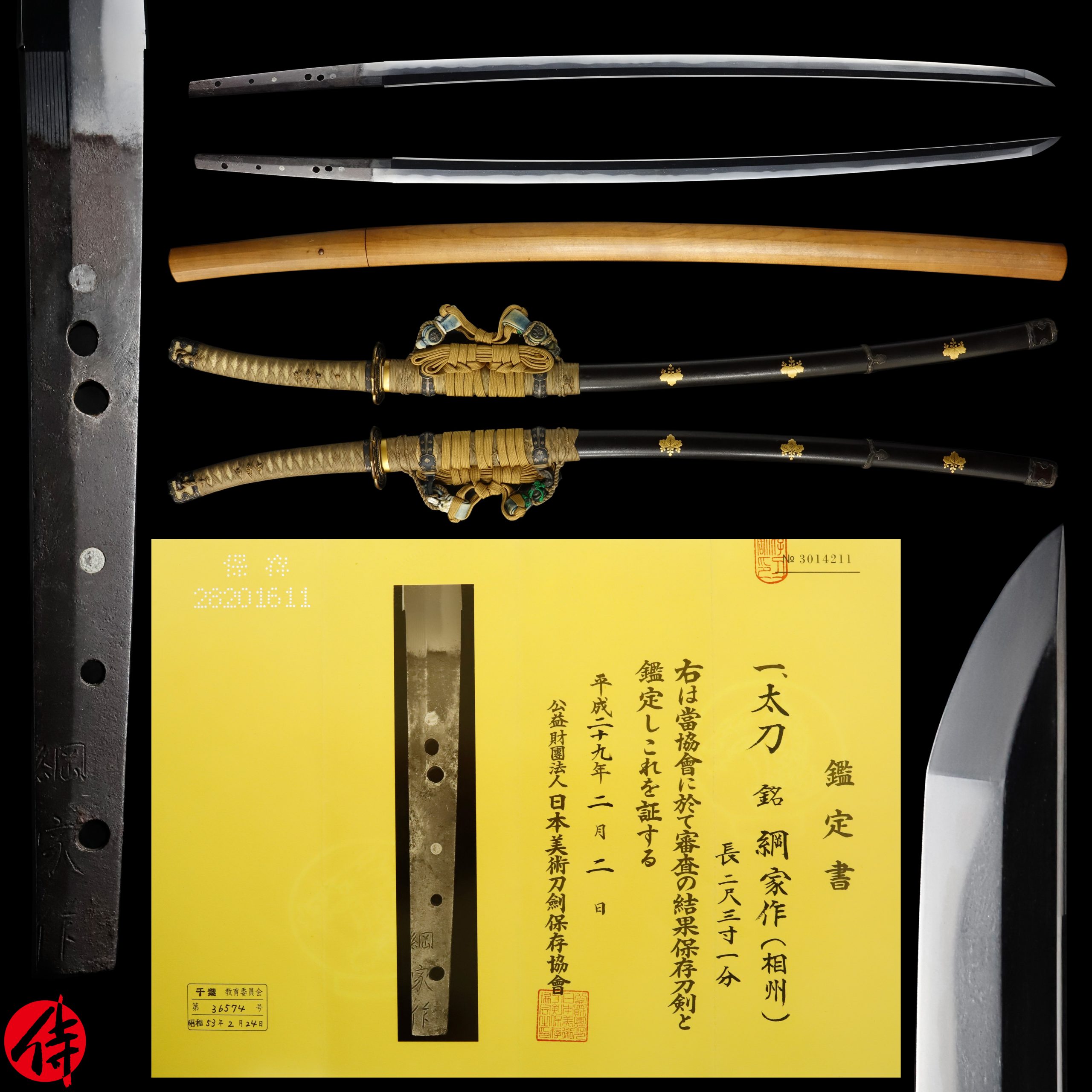
Antique Japanese Sword Tachi Signed by Soshu Tsunaie with
Hozon
Certificate
【Description】
Summary
This blade was signed by Tsunaie (綱家), who was active during the late Muromachi period (Tenbun era:
1532-1555
).
Tsunaie was originally from Suruga domain (Today’s Shizuoka prefecture) and belonged to Shimada Yoshisuke school. However, he moved to Odawara city in Kanagawa prefecture to become an Okakaekaji for Go Hojo clan, one of the most powerful clans during the late Muromachi period. Okakae Kaji means a swordsmith who exclusively served a specific clan or domain, which was considered one of the most honorable positions. To become one, a sword maker needed to be highly skilled and master the superb level of his craftsmanship.
Tsunaie was known as the older brother of the first-gen Tsunahiro (綱廣) and Yasukuni (康国), both of whom were historically significant makers. Tsunaie was also one of the most prominent figures in Soshu region (Today’s Kanagawa prefecture) during the late Muromachi period.
The maker’s name Tsuna (綱) was given by the second-gen head of the clan, Hojyo Ujitsuna (北条氏綱), who had the same letter in his name. This fact indicates that Tsunaie was highly regarded by Go Hojo clan. The second-gen Tsunahiro served Tokugawa Ieyasu.
Shimada Yoshisuke School
The first-gen Yoshisuke was active during the Kosho era (1455-57). He was an apprentice of Soshu Masahiro. He was the founder of Shimada school, located in the Suruga domain(today’s Shizuoka prefecture). It is said that the first-gen Yoshisuke was a descendant of Bizen Ichimonji Sukemune, one of the most famous swordsmiths in Japanese history.
The first-gen Yoshisuke served a powerful feudal family named Imagawa. It is said that he received his maker’s name 義 from Imagawa Yoshitada. Shimada school interacted with other schools in Soshu swordsmiths living near Odawa castle in Kanagawa prefecture. The Suruga domain was vital for strong feudal lords such as Takeda, Tokugawa, and Hojo clans during the Sengoku Jidai(Warring state period: Late Muromachi period). The swordsmiths in Shimada school received many orders from these strong feudal families.
Soshu Den
Tsunaie mastered a particular sword-forging tradition called Soshu Den. The foundation of Soshu traditions (Soshu DEN) dates back to the establishment of the Kamakura government(1185-1333). The Shogun at the time, Hojo Tokiyori, gathered swordsmiths of Yamashiro-Den and Bizen-Den to create a new tradition named Soshu-Den.
Following the Mongolian Invasion caused in 1274 and 1281, they had to improve the strength of their swords. Skilled swordsmiths such as Shintougo Kunimitsu, Yukimitsu, and Masamune pursued their craft to bring Soshu-Den to an exquisite level, achieving both beauty and practicality.
Tachi blade&Tachi Koshirae
Based on which side the signature is on and the authentication paper, this blade was created as a Tachi sword. It comes with a Tachi(太刀) Koshirae.
Tachi was mainly used by an armored Samurai with one hand on horseback from the Heian period (794-1185 A.D.) until the early Muromachi period. TACHI was suspended loosely on the left waist with its edge facing the ground so that you could draw it faster to cut down soldiers on the ground.
Because of its gorgeous looking, having a Tachi-style sword mounting became a social status among Samurai. We presume this blade was owned by a high-ranked Samurai who was wealthy enough to own a blade forged by a famous swordsmith with the Tachi-style sword mounting.
This blade is appraised as a Hozon Token(保存刀剣) issued by NBTHK(Nihon Bijutsu Touken Hozon Kyokai:日本美術刀剣保存協会). This authentication paper was only given to authentic Japanese swords, well preserved with artistic value.
【 Blade】
Cutting Edge Length(Nagasa)
:
70.1 cm (27.5 inches)
Curvature(Sori)
:
1.2 cm (0.47 inches)
Hamon
:
The crystalline structure which forms along the cutting edge of a blade as a result of the hardening process
Jimon(Jihada)
:
visible steel surface pattern created by folding and hammer