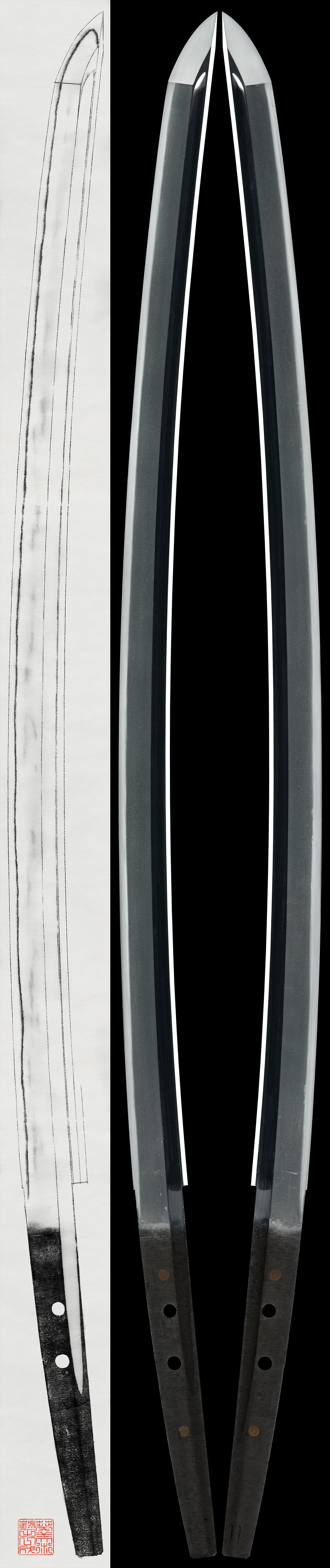
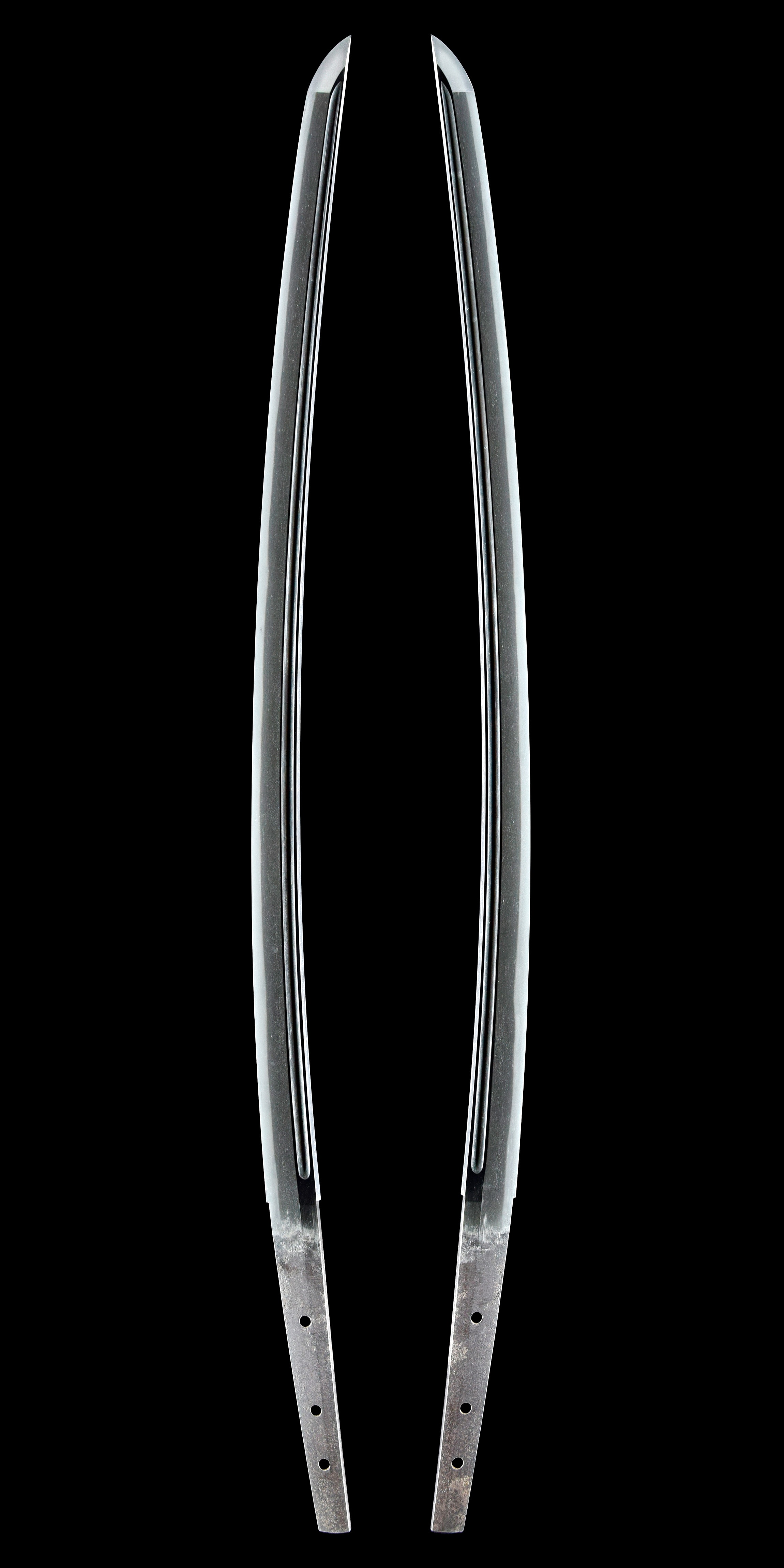
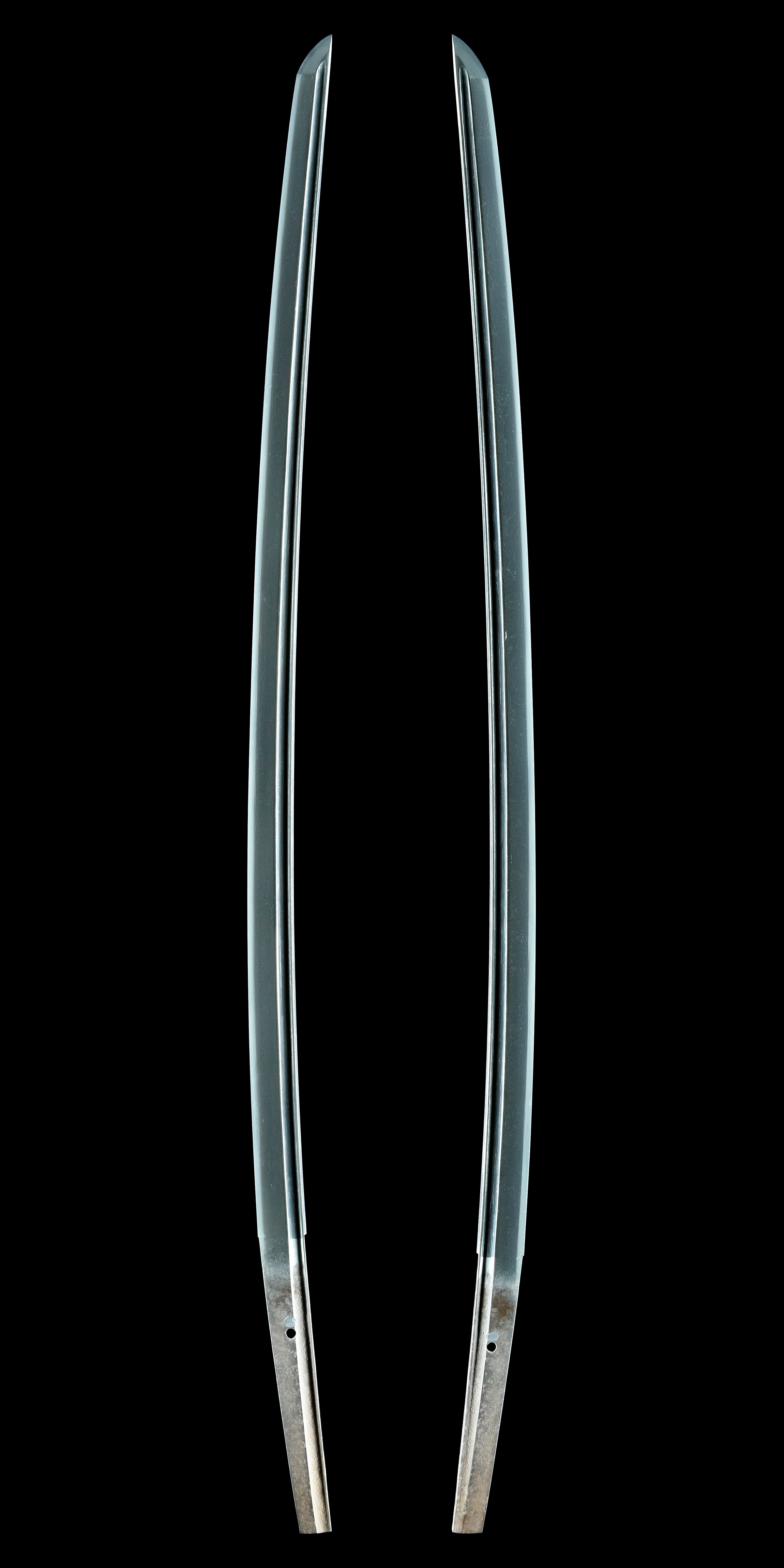
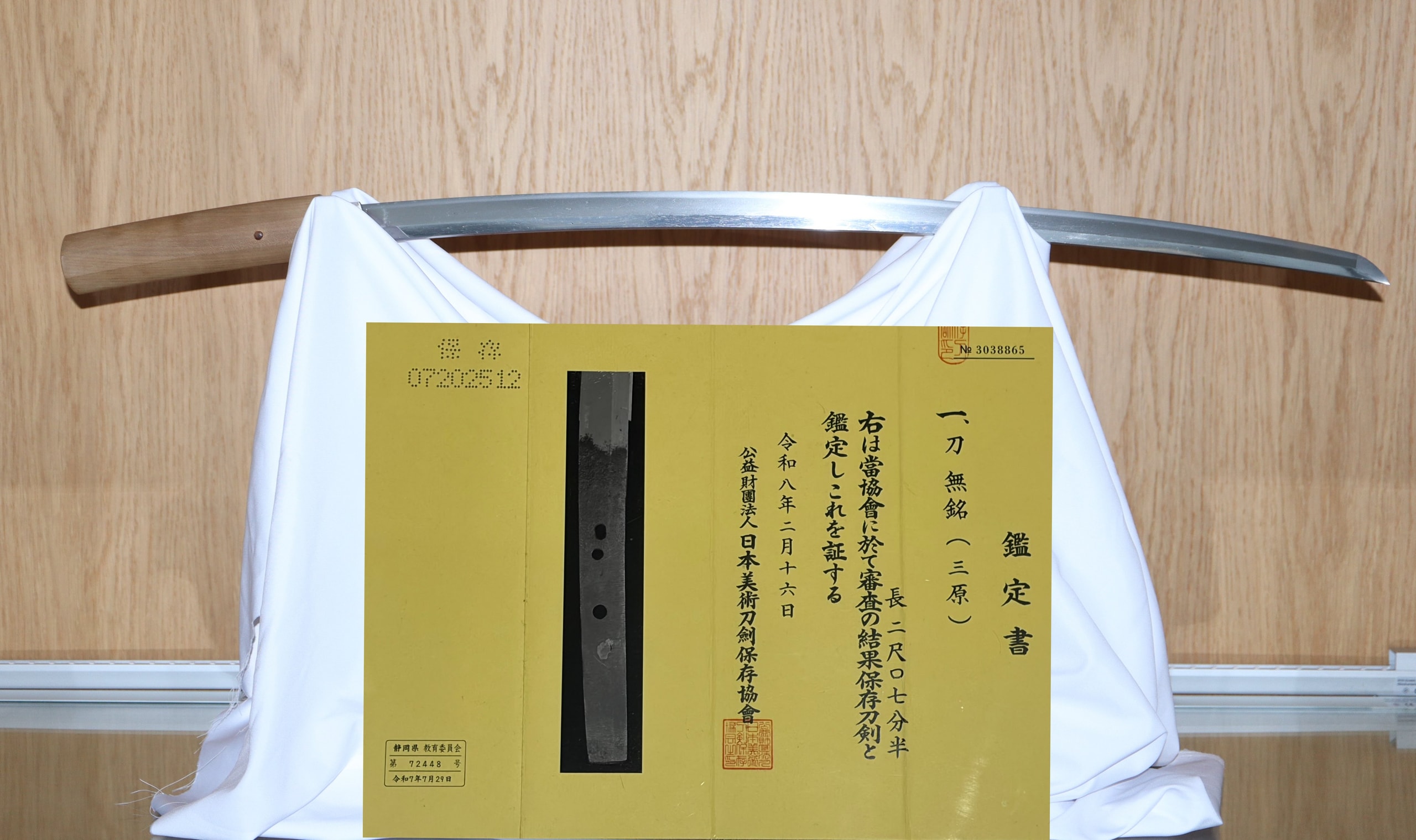
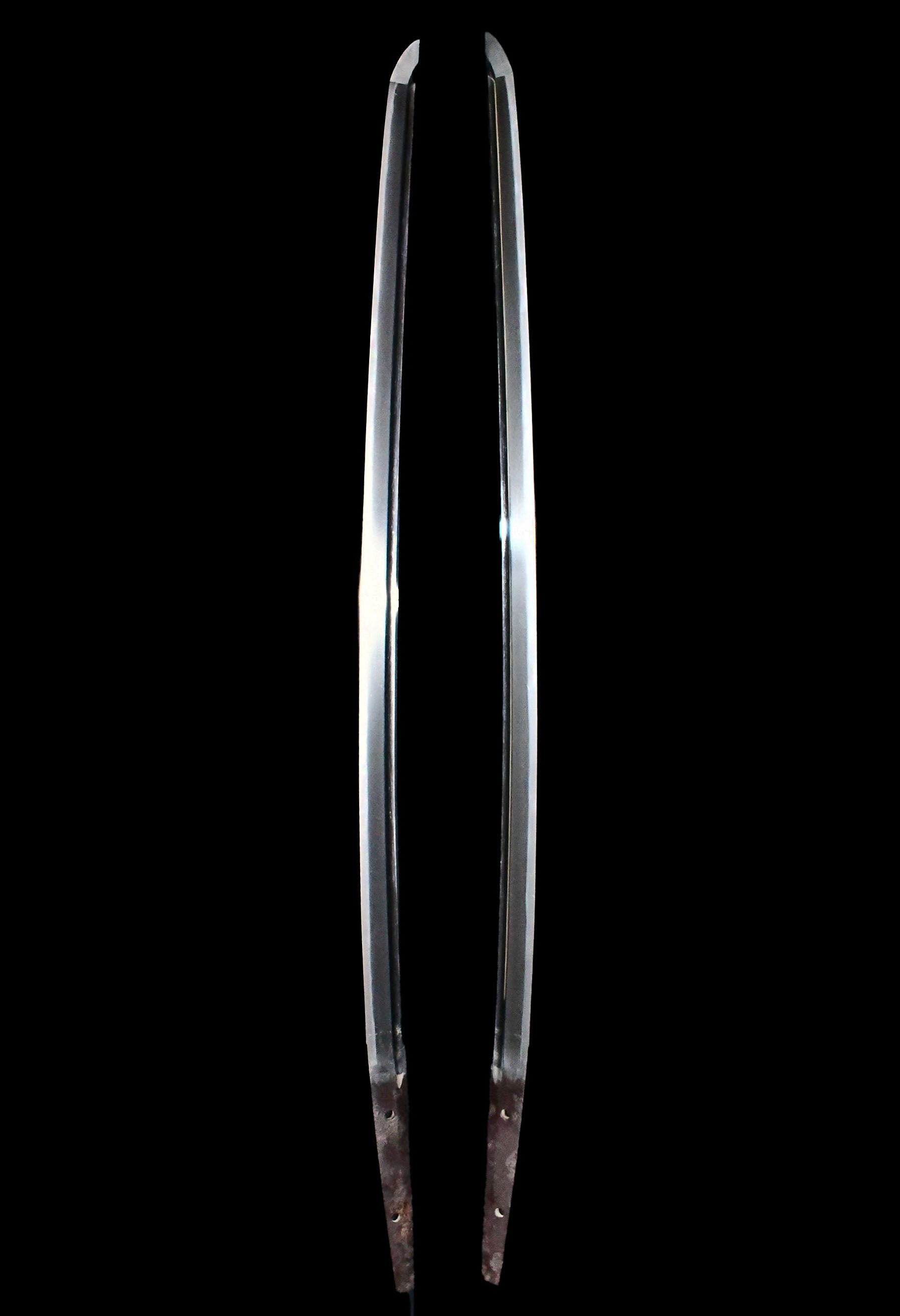
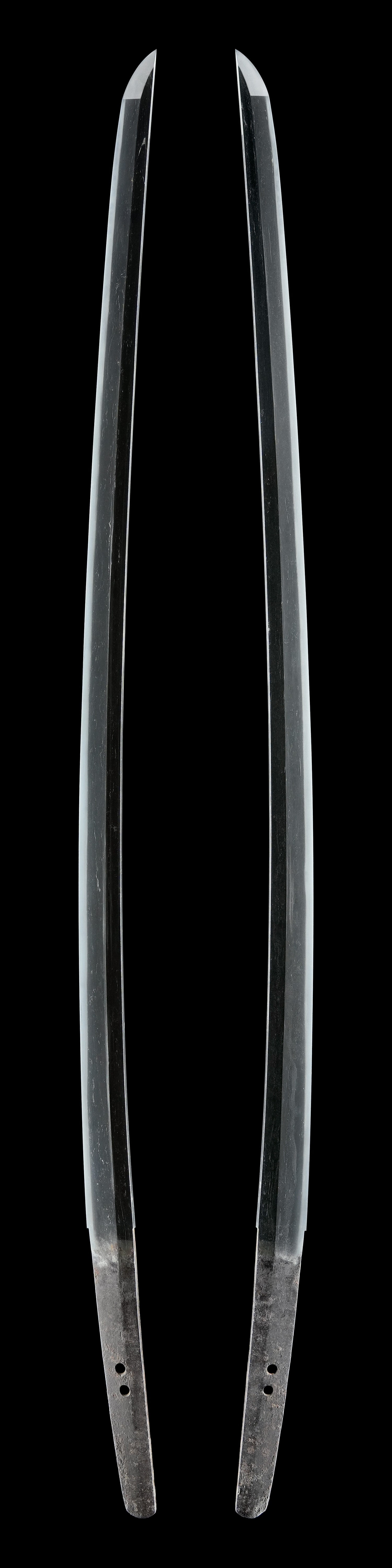
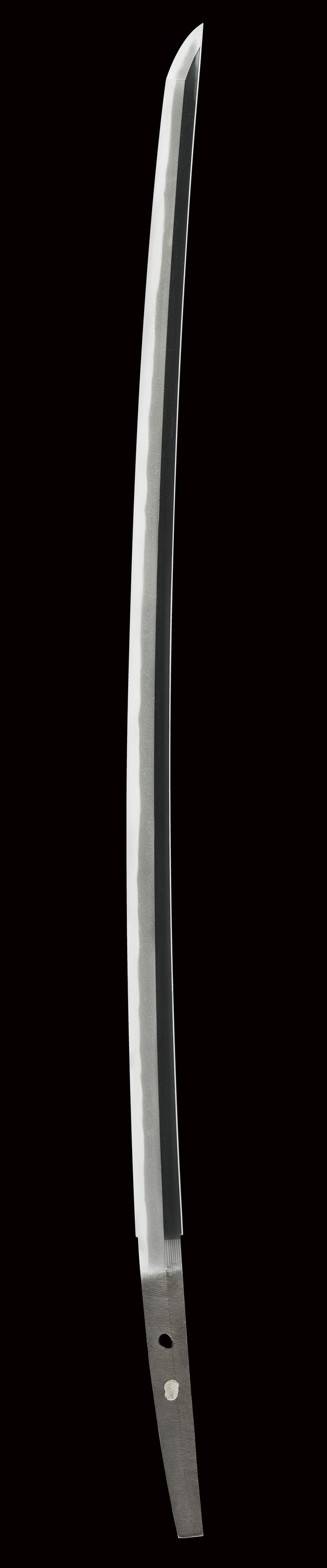
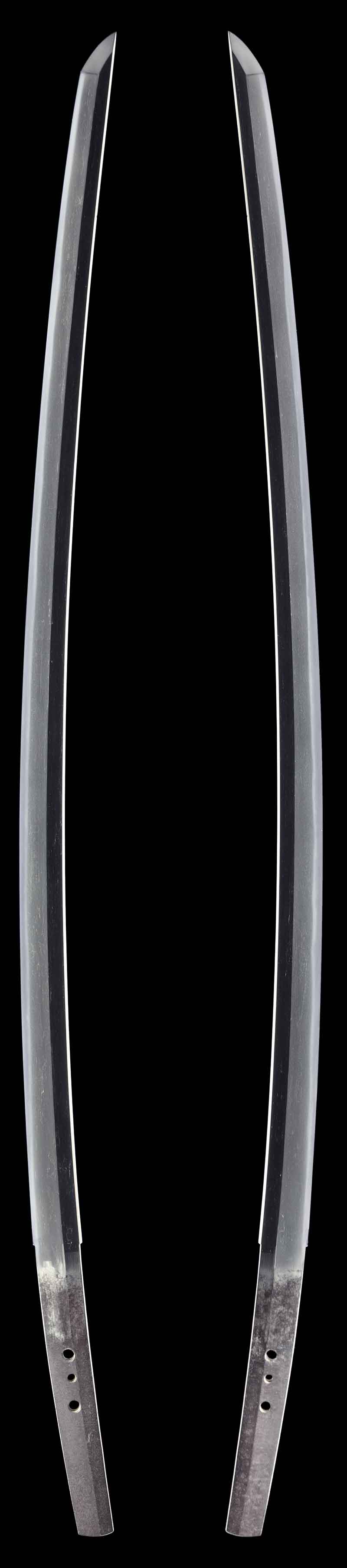
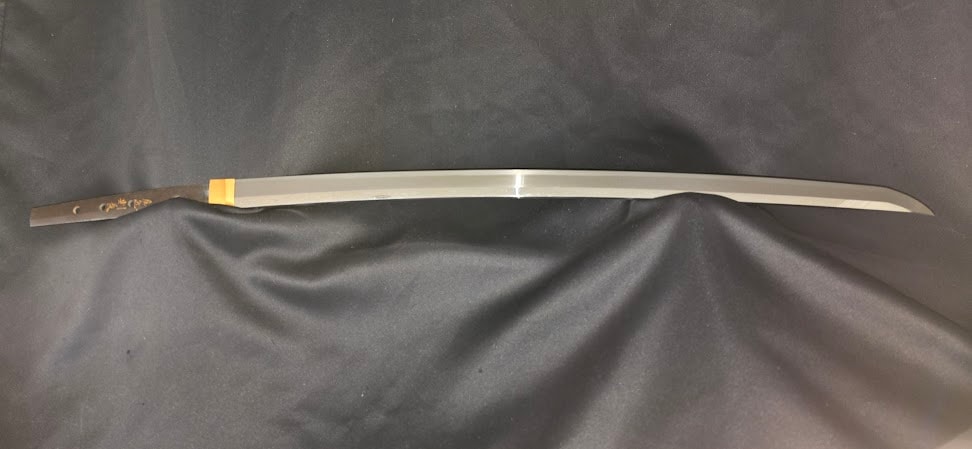
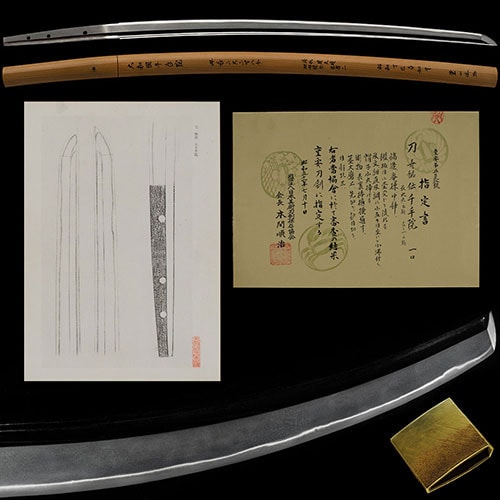
Sukekuni is the Kokubunji-group smith of Bingo Province, his career fixed by a run of dated blades that carry the eras Tokuji, Genko, Karyaku, Gentoku and Kenmu, placing him from the close of the period into the years. His is one of the standing province problems of the room. Because even his long signatures cut the province only as Bishu (備州), and the -period swordbooks read that single character as , he was transmitted for centuries as a Kokubunji smith, and the Kokon Meizukushi named him the founder of the Hokke lineage. The published sources now correct this to Bingo for three reasons: late- and Bingo work customarily cut the province as Bishu, with Bingo no appearing only from the Muromachi period; the Koto Meizukushi Taizen records his residence at Anna Tojo, and the Bingo Kokubunji stood in that Anna district; and the genealogies set this Kokubunji line apart from the Mihara group. The recognition of his hand rests not on shape but on the ji and ha, for his construction stays orthodox, without the broad shinogi-ji and high shinogi by which old Mihara announces itself.
His hand is best read as one smith working in three registers that the published sources name again and again. The first and most characteristic is a suguha or fine hoso-suguha carrying a strong Yamato temperament, and the commentary states it plainly, that 'his style, like that of Mihara works, possesses a Yamato temperament'1. Over an itame that flows and tends to masame, the grain standing, with ji-nie adhering and a whitish shirake-utsuri rising, he tempers a narrow suguha whose habuchi frequently frays into hotsure, with ko-ashi and yo entering, sunagashi and kinsuji running, and ko-nie well laid. The masame-gakari of his steel is the tell that ties him to Mihara and holds him apart from the pure itame of mainstream Bizen, and a reverse inclination, the saka-gokoro that slants his gunome and ashi toward the base, runs through the temper from his earliest dated work.
The jigane is where his two traditions meet. Across the Mihara-toned pieces the steel is an itame flowing to masame, the grain raised, with ji-nie and the whitish utsuri of Bingo; but on the Bizen-leaning blades the ji throws up a mottled, jifu-like utsuri that the published sources liken to the Unrui group, 'work in a suguha manner with a jifu reflection that calls to mind the Unrui of Bizen'2. That jifu-utsuri is the single Bizen trait that distinguishes him within the Yamato-influenced Bingo schools. The boshi runs straight to a ko-maru or finishes in a yakizume-toned sweep with hakikake, and on the ji the published sources find a steel of somewhat dark tone, with chikei entering on the better-forged examples.
The third register the commentary names is a somewhat more decorative midare, a feature it notes is scarcely seen in old Mihara. Into the suguha base he mixes ko-choji, gunome, angular and pointed elements, widening in places to a ko-midare, the whole running saka-gokoro with saka-ashi, ashi and yo frequent, ko-nie well laid and yubashiri appearing, with kinsuji and sunagashi within the ha. The dated works anchor these registers in time: the Genko 3 ubutachi of 1323 shows the Mihara-toned suguha at its clearest, while the rare Karyaku 2 tanto of 1327 carries the same hand at small scale. The published sources read the more animated tachi against the school directly, observing that this mixing of many kinds of teeth into a suguha base 'corresponds closely to the Gentoku-dated tachi' and is 'a stylistic mode showing a midare-ba scarcely encountered in Ko-Mihara'.
What sets him apart from his neighbours is exactly what the judges name. He stands within the Yamato-influenced Bingo orbit beside the old Mihara smiths, sharing their suguha and standing masame, yet held apart from them by the more decorative midare and by the jifu-like utsuri recalling Bizen Unrui. The published sources describe his working domain as one 'in which Bizen-den and Yamato-den are intermingled'3, with the characteristics of Kokubunji Sukekuni shown in both ji and ha, and for that reason they affirm his many o-suriagemumei attributions. Even where a suguha piece at first glance recalls Ko-Mihara, the commentary takes care to note that the construction differs, being orthodox rather than the broad-shinogiMihara shape; of one such katana it concludes that its appearance, which 'at first glance recalls old Mihara, expresses one facet of Sukekuni's style'4.
For the collector Sukekuni is a name encountered seldom and held with care. Fujishiro grades him Jo-jo saku. He has no National Treasures and no Important Cultural Properties; his record runs instead through the Juyo tier, where twenty of his blades are designated, and through the prewar Juyo Bijutsuhin, which holds three more, among them the Gentoku 1 tachi and a Karyaku 2 tanto. Signed works are extremely few, most of them tachi, and the published sources call surviving tanto by this smith exceedingly rare, 'examples by this maker in tanto form being exceedingly rare'5, so a dated piece is prized as research material. His blades have passed through long-held private collections rather than museums: the Juyo Bijutsuhin tachi were held by Saito Makoto and by Takashima Tatsunosuke, and the orikaeshi-meitachi by Okajima Kichiro, while one Juyo Bijutsuhin blade is recorded as having been 'presented as a memento among the belongings of Ito Hirobumi'6. Held mostly in private hands and seldom traded, a signed and dated Kokubunji Sukekuni comes to light only from time to time, a quiet but well-documented witness to the Yamato-influenced swordmaking of late-Kamakura Bingo.
Kantei
one Bingo Kokubunji hand in three registers the NBTHK names again and again: a Yamato-toned suguha akin to old Mihara, a suguha over a Bizen-Unrui-like jifu utsuri, and a somewhat more decorative chuji-gunome midare, all over an itame flowing to masame with a whitish or jifu utsuri and a saka-inclined ko-nie temper
Sukekuni is the Kokubunji-group smith of Bingo, working from the close of the Kamakura period into the Nanbokucho years, with dated blades surviving across Tokuji, Genko, Karyaku, Gentoku and Kenmu. His name is one of the standing province problems of kanting: because even his long signatures cut the province only as Bishu (備州) and the swordbooks read that as Bizen, he was transmitted from the Edo period as a Bizen Kokubunji smith, and the Kokon Meizukushi makes him the founder of the Hokke lineage. The published sources now correct this to Bingo, since for late-Kamakura and Nanbokucho Bingo work the province was customarily cut as Bishu, and Anna district, where the Bingo Kokubunji stood, is named in the genealogies. The kantei itself rests on a single coherent hand worked in three registers the NBTHK names repeatedly: a strongly Yamato-tempered suguha akin to old Mihara, full of masame-gakari, hotsure and standing grain; a suguha laid over a jifu-like utsuri that recalls the Bizen Unrui group; and a somewhat more decorative midare mixing chuji and gunome. Over an itame that flows to masame with ji-nie and a whitish or jifu-tinged utsuri he sets a suguha-based ko-nie-deki temper that runs saka-gokoro, with frequent ashi and yo, kinsuji and sunagashi, and a nioiguchi that often shizumi. The construction stays orthodox, without the broad shinogi-ji and high shinogi of old Mihara, so the attribution turns on the ji and ha rather than on shape.
Diagnostic discriminators
柾がかりmasame-gakari5
地斑映りjifu-utsuri5
unique vs old Mihara (shirake-utsuri, no jifu)
逆ごころsaka-gokoro4
Observation by phase
The Yamato-toned suguha akin to old Mihara (his core register)
His core manner is a suguha or fine hoso-suguha read by the published sources as carrying a strong Yamato temperament, like the old Mihara of Bingo. Over an itame that flows and tends to masame, with the grain standing, ji-nie adhering and a whitish utsuri rising, he tempers a narrow suguha whose habuchi frequently frays into hotsure, with ko-ashi and yo, sunagashi and kinsuji running, and ko-nie well laid; the nioiguchi tends to tighten. The boshi runs straight to a small round or finishes in a yakizume-toned sweep with hakikake. The Genko-dated ubutachi shows this manner at its clearest, a flowing itame to masame with shirake-utsuri and a fine suguha frequently hotsure, while the signed wakizashi carries the same hand at tanto scale. The published sources say outright that his style, like that of Mihara work, possesses a Yamato temperament.
The suguha over a jifu utsuri recalling Bizen Unrui
The second register the published sources name is a suguha-based work whose jihada throws up a jifu-like, mottled utsuri that calls to mind the Unrui group of Bizen. Over a well-packed ko-itame with fine ji-nie, a clear midare-utsuri or a standing irregular utsuri arises, and the temper is a chu-suguha mixed with ko-chuji and ko-gunome, ko-ashi entering, the nioiguchi tightening, bright and clear. The published sources describe his range as one in which Bizen-den and Yamato-den coexist, with the characteristics of Kokubunji Sukekuni shown in both ji and ha. The o-suriagemumeikatana attributed to him in this manner show the same well-forged ko-itame and the samemidare-utsuri, with a chu-suguha base lit by ko-chuji.
The third register named by the published sources is a somewhat more decorative midare, a feature they note is scarcely seen in old Mihara: into a suguha base he mixes ko-chuji, gunome, angular and pointed elements, with the temper widening in places to a ko-midare, running saka-gokoro with saka-ashi, ashi and yo frequent, ko-nie well laid and yubashiri appearing, kinsuji and sunagashi within the ha. The Showa-52 tachi is offered as a midareba example with a slightly florid midare scarcely encountered in Ko-Mihara, and the Heisei-16 tachi mixes gunome, ko-chuji, ko-gunome and angular forms into the suguha, the whole running saka-gokoro with saka-ashi, a treatment the published sources connect to his Gentoku-dated Juyo Bijutsuhin tachi. The boshi here runs straight with hakikake to a ko-maru.
Sugata 姿
身幅広く元先の幅差つくmihaba hiroku motosaki no habasa tsuku3
The central scholarly question around Sukekuni is the province: because even long signatures cut it only as Bishu (備州), the Edo-period swordbooks read this as Bizen and listed him as Bizen Kokubunji, while the Koto Meizukushi Taizen records a Bizen Kokubunji who resided at Anna Tojo in Bingo. The published sources resolve it for Bingo on three grounds: late-Kamakura and Nanbokucho Bingo work customarily cuts the province as Bishu (Bingo no kuni appears only from Muromachi), the Bingo Kokubunji stood in Anna district, and the genealogies set this Kokubunji line apart from the Mihara group as the Hokke lineage.3
The published sources also caution that his hand divides into the three registers, and that on the more orthodox suguha pieces he is read against old Mihara: a Showa-25 tachi is judged a midareba example showing a slightly florid midare scarcely encountered in Ko-Mihara, while several others note that although a suguha piece at first glance recalls Ko-Mihara, the construction differs, being orthodox rather than the broad-shinogi, high-shinogi Mihara shape.3
Dated Works
Years he was demonstrably active, proven by signed-and-dated blades
Active period
1323–1329Editorial estimate: 1321–1329
2 of 14 designated works carry a date
13201340
1323
元亨三年Juyo session 40, item 91
1329
元徳元年Juyo Bijutsuhin vol. 6, item 810
Historical importance
Where Sukekuni stands among comparable artisans: across all of nihontō, and within tradition, era, and period. The tiers (Foremost · Leading · Major · Notable) weigh official designations from the NBTHK and Japan's Agency for Cultural Affairs, together with historical honors of lasting repute such as the Sansaku and Meibutsu-chō.
随一
Foremost
屈指
Leading
有数
Major
YamatoKotōLate Kamakura
著名
Notable
All nihontō
Select a lens to see how it's measured.
Designations
Kokuhō—
Jūyō Bunkazai—
Jūyō Bijutsuhin3
Gyobutsu—
Tokubetsu Jūyō—
Jūyō Tōken20
Elite Standing
0.17 across 23 designated works
Top 13% among smiths
Provenance
3 documented provenances across certified works by Sukekuni
Imperial—
Shogunal—
Premier Daimyō—
Major Daimyō—
Other Daimyō—
Zaibatsu—
Institutions—
▸Named Collectors3
Provenance Standing
0 works held in elite collections across 3 documented provenances