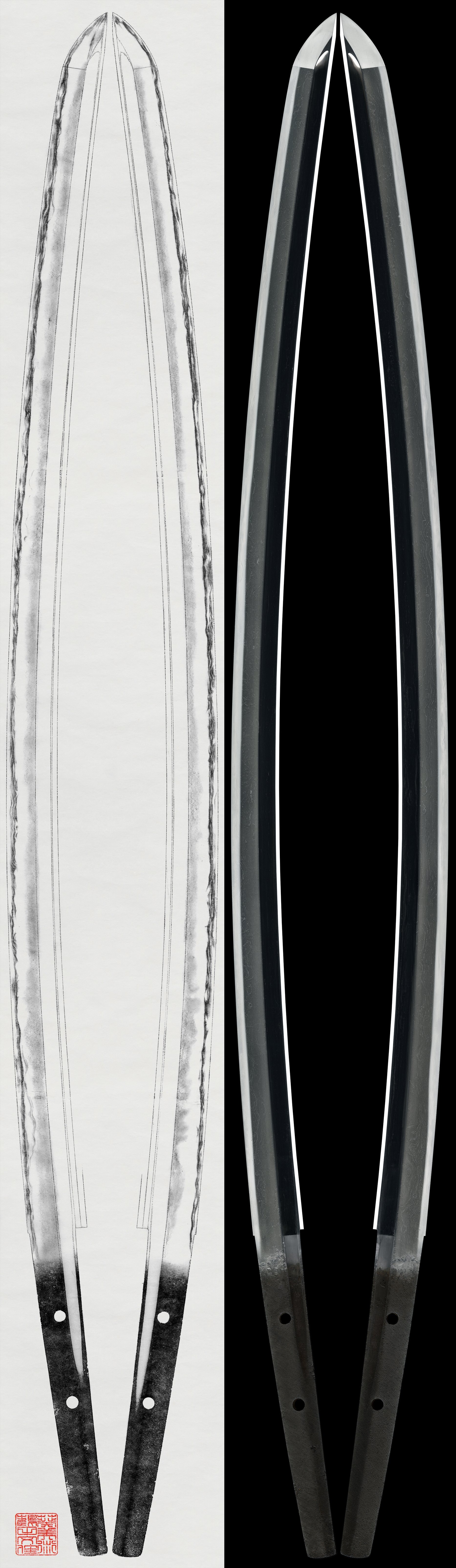
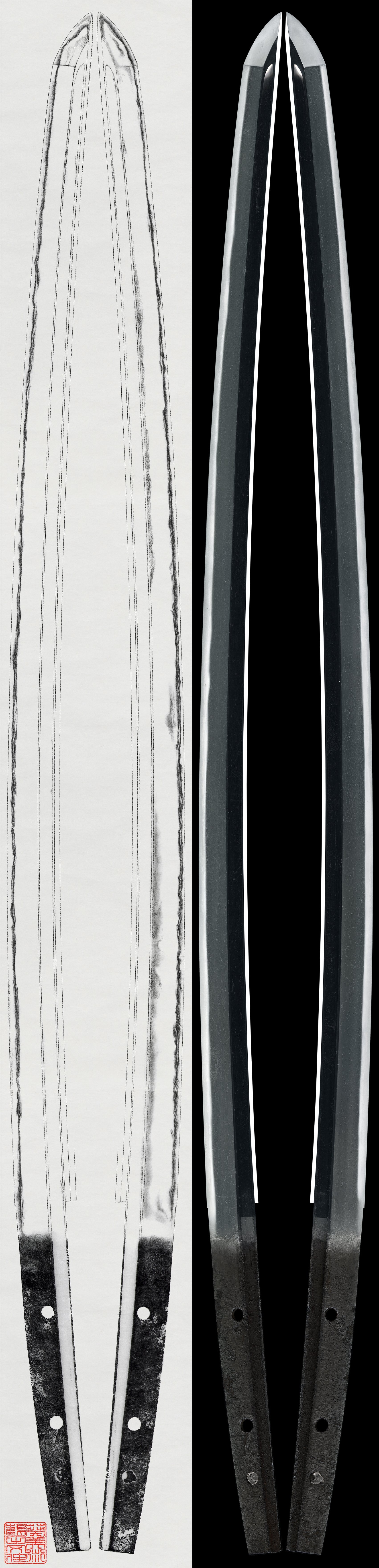
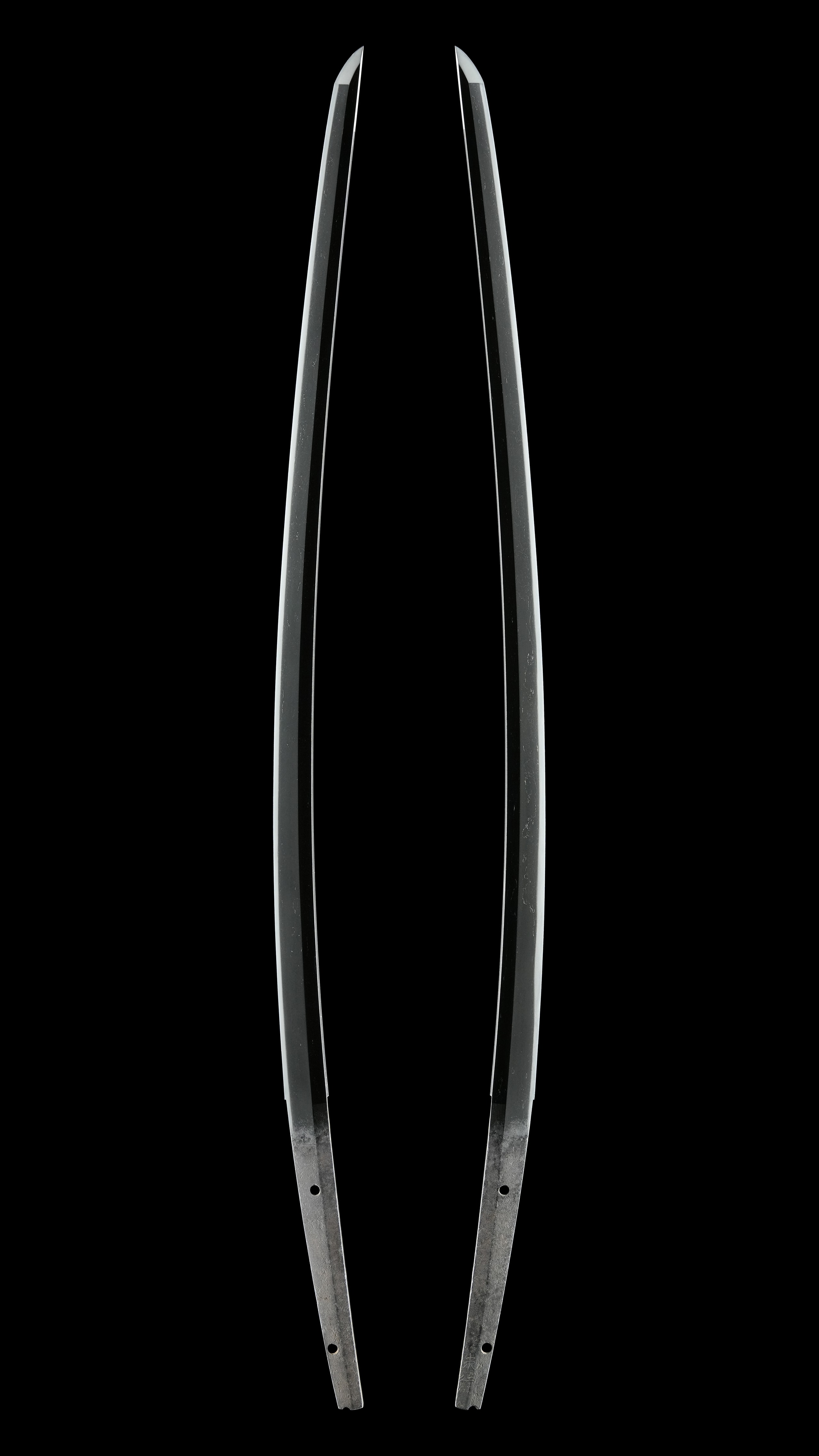
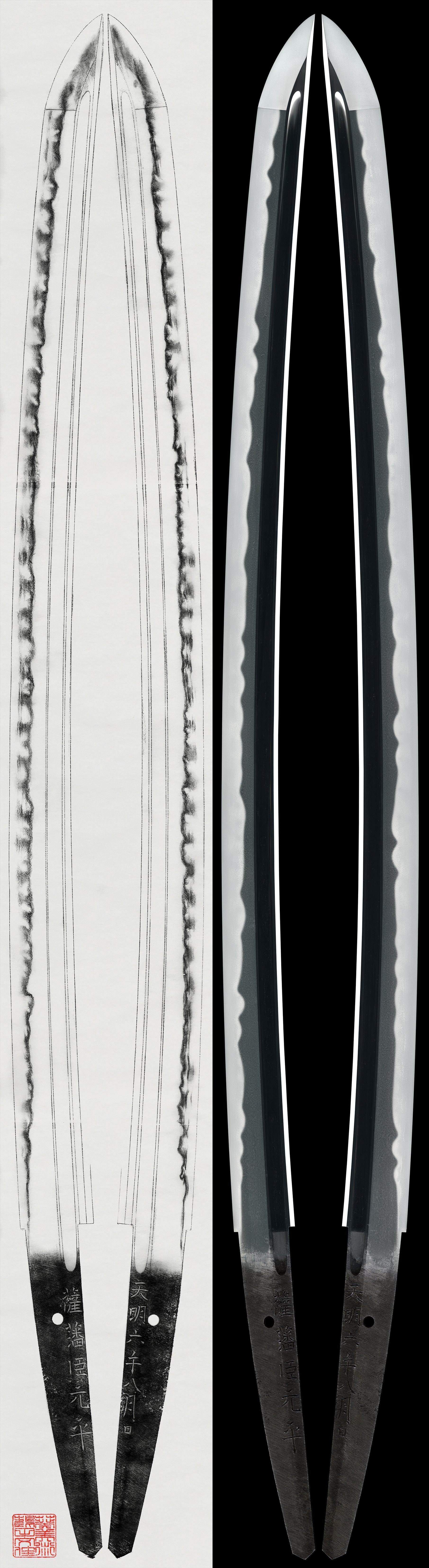
Toshinaga worked in Yamato Province across the late and periods, signing his blades Amaro Toshinaga, and the five designated works that carry his name fix him as a smith of that age. is one of the five Yamato schools, a body of swordsmiths rooted in the temple milieu of -dera, and Toshinaga belongs to its later, -period hand. He is transmitted since old times as a disciple of Takagi Sadamune, but the published sources do not let that account stand unexamined. Judging from his extant signed and , they write, the pupillage is difficult to recognize, korai Takagi Sadamune no deshi to sarete iru ga genson suru no kara sore to mitome-gataku, dojidai no mono to omowareru, and they place him instead as a smith of the general period as Sadamune. Every one of his five blades on record is a attribution, so that what is known of him is the recognized Toshinaga hand rather than a body of signed standards, and that hand is read in the Yamato coloration of his steel.
The feature that fixes his work is the that runs through the of his . The steel is forged in mixed with , gathering and threaded with , and into it runs a tendency toward , the straight grain rising through the surface and at times opening into and mottled . The published sources name this directly as the constant of his work, that the forging carries a tendency, the frays into with , and the sweeps into , ni wa -ki ga ari, wa hotsurete kakari, mo nado shite sotai ni Yamato-iro ga mirareru tokoro ni tokucho ga aru. The in the and the swept above it are the two things his blades share whatever the temper between them, and they are the Yamato evidence by which a blade is brought to his name.
That temper is worked in two registers. In the calmer of them the is a or base carrying and small , with crossing the , fraying it, and strong that runs at times to a coarser grain, and playing within the band. This restrained manner is the one that resembles Sadamune, and it is set on a wide , often shortened to . In the fuller register he takes as the principal mode, mixing in small and small , fraying repeatedly into with , threading and , and scattering , while the enters and is brushed powerfully into . This manner is carried on wide, and , several built in , and it is the one the published sources judge filled with vigor; of one worked thick in they write that the manner in which the gathers within the is splendid and the blade as a whole full of spirit, hachu atsuku sama wa migoto de ari, sotai ni ni tonda ikko de aru.
The debate over his name is in the published commentary itself, and it turns on the Sadamune resemblance. In his , the sources note, the shows prominently and the tends to , while his display a construction with high , so that a Yamato character can be discerned, ni wa ga yoku araware ga , wa ga takai wo shimeshi, Yamato- ga mitomerareru. From this the appraisal proceeds by a single logic, stated plainly on the shortened to : at a glance the blade appears in the manner of Takagi Sadamune, yet a Yamato coloration is added to it, and so it is appropriate to appraise the work as Amaro Toshinaga, ikken Takagi Sadamune- de sore ni Yamato-iro ga kami sareta to natte ori, Amaro Toshinaga to kansuru no ga dato de aru. The Sadamune comparison is therefore not a trait borrowed onto his blades but the very baseline against which they are read; what the judges look for is the Yamato evidence laid over a Sadamune-like base, and where they find the , the with , and the swept , the attribution is made.
His place in the school follows from this. Toshinaga is a smith whose hand sits close enough to Sadamune that the old tradition made him Sadamune's pupil, and the published sources, declining to confirm that descent, keep him as a contemporary working the Yamato manner of the period. His distinction within that company is grounded in his own blades, the -bearing and the swept, fraying , rather than in any single comparison; the Sadamune likeness is what his work must be told apart from, and the Yamato coloration is what tells it apart. A further register of his work is the carving, esoteric in character and varied across his blades. A with and stands on one , a relief-carved set within the on another, su- and on a , and carved kaki-nagashi on the , the Buddhist motifs according with the Yamato temple world from which the smiths came.
The connoisseurship around Toshinaga is that of a recognized Yamato hand whose surviving record is small. His designated work numbers five blades, all at the level, with no National Treasure, no Important Cultural Property, and no among them, and none carries a recorded , so that no provenance attaches to his name in this corpus and the owners on record are private holders rather than museums or shrines. His finer pieces are judged sound in both and and of good workmanship, one called a fine piece whose manner is strongly tied to his signed examples, no ni tsuyoku musubareru sakufu wo shimeshita kahin de aru, and one called splendid in the thick within the and full of vigor. For a collector this places him among the quietly attainable names rather than the celebrated ones. A Toshinaga of either manner, the calm that reads toward Sadamune or the vigorous -laden with its swept and esoteric carving, is a Yamato blade that comes to market only from time to time and rewards a patient eye, a sound and capably made work by a smith whom the published record sets beside Sadamune himself.