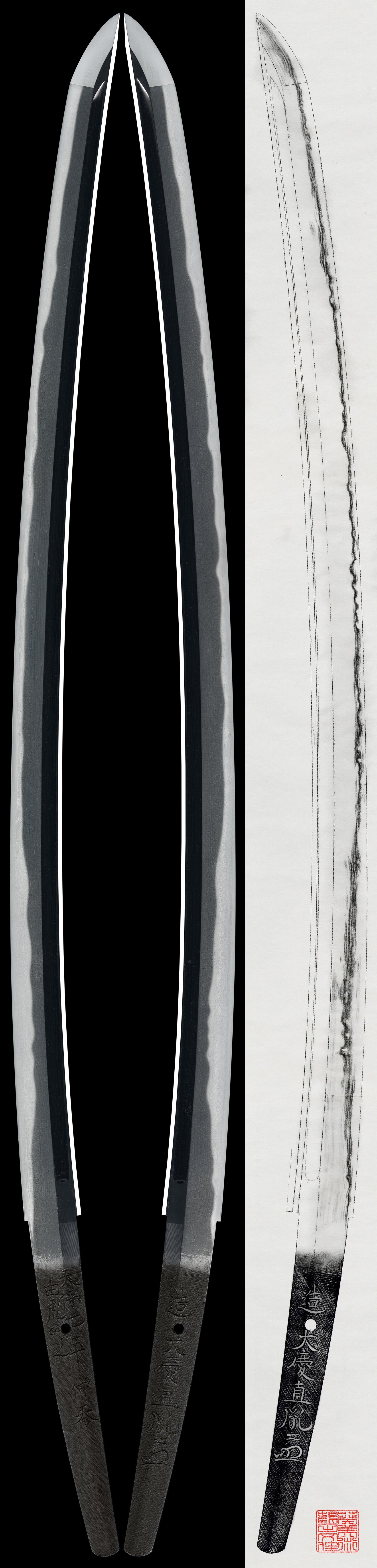
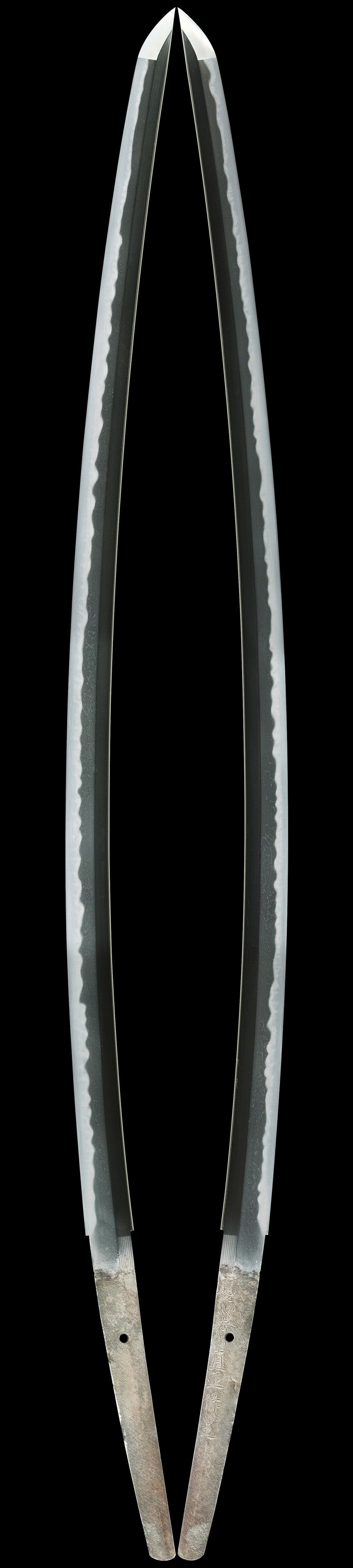
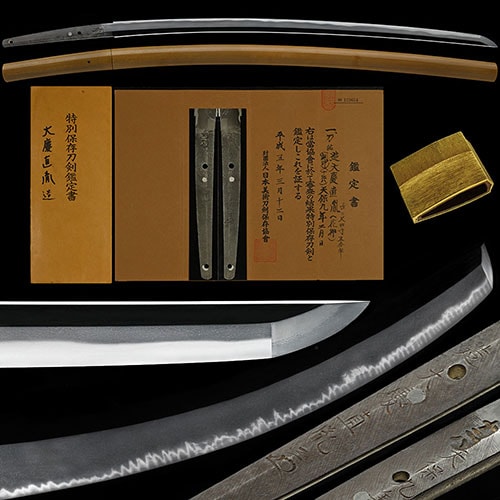
A dated Tenpō 12, mid-autumn of 1841 and signed Suishinshi Masatsugu carries, on the reverse of its tang, the name of the man who commissioned it, and the published commentary on it sets out the whole of what is known of the smith. Masatsugu, also called Kawabe Kitaji, was a late- maker of who took the art-name Suishinshi and so, in substance, succeeded as the third head of the Kawabe house. The line was that of Suishinshi Masahide, the father of , but Masatsugu's own hand came by a more particular descent: he trained under Naotane, Masahide's foremost pupil, and is recorded to have become Naotane's son-in-law, with a further tradition that he was a son of the second-generation Masahide. He lived in Okachimachi, Shitaya, pursued a life given to swordmaking, and is said to have died on the eleventh day of the third month of Man'en 1, 1860. Of his manner the published sources are emphatic and exact, holding that down even to the cut of his signature his workmanship is wholly Naotane's rather than the broader Suishinshi style, and that he excelled in the two traditions Naotane himself worked, Sōshū-den and -.
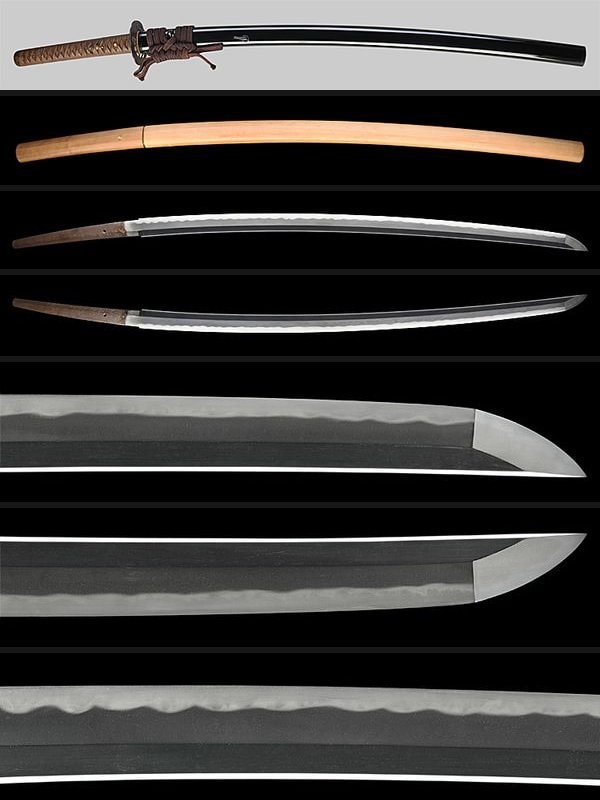
His representative manner is the Sōshū-den one, and three of his are read by the judges as exemplars of it. Over a tightly forged the runs as a broken by and small with -like heads mixed in, the deep and the thick, with patches of coarse intermingled. Along the the line frays into , and stream vigorously, a effect appears, enter and slight detaches from the temper. These activities are not occasional but constant, running through every blade in the group, so that the swept , turning round with frequent , and the and crossing the and are the connective tissue of his work rather than its highlights. The temper sits on a build that is large and robust, the wide, the thick, the rather deep and the point carried out to an extended , in one late piece to a full . The published sources call the best of these large works free of any breakdown and outstanding among his oeuvre, a in which his true strengths are fully brought to bear.
The is a closely packed , well forged, on one blade running into a moist, clinging texture with -like shining lines entering frequently, on another mixing into the lower body, and on the latest mixing in somewhat larger throughout. Over it the lies thick and fine enter, the steel on his clearest pieces notably bright, so that both and shine with a clear quality. In one work of Tenpō 8 the takes on a subdued, sinking character, but elsewhere the keynote is brightness; on the Tenpō 12 now in an American collection the published sources single out the way both and are richly covered in and brilliantly clear, calling it a piece that recalls the manner of his teacher Naotane. The Sōshū-den hand he favored is therefore read first in this combination of a thick, bright and a -worked , the activity gathered as much in the as along the edge.
The second of his two traditions, the -, leads instead with . On the in the American collection the is mixed with , the long and entering well, the deep and the thick, with small mingling in the and a that runs bright and clear; the forging beneath keeps the tightly packed with its and . The latest of the dated , of Tenpō 6, shows how close the two traditions stood in his hand: over a forging that mixes recalling Naotane's whirlpool-like uzumaki- runs a -toned centered on with and pointed elements, frequent , long and the thickly adhering. That blade carries on the , set toward the , the divine title Hachiman Daijin, a votive inscription, while the date and the smith's name with are cut at the center of the reverse. Both registers, the judges insist, descend alike from Naotane, and the difference between them is the difference between the two manners Naotane himself taught rather than two phases of Masatsugu's career.
What sets his work apart is therefore best read by his own grounded traits and by the closeness of his hand to his teacher's. The published sources describe his domain as one inherited whole from Naotane, in workmanship and in the very chisel-cut of his characters, so that the heavy-in-hand, grand and powerful of his , thickly covered in and bright, reads as the faithful continuation of his master's art rather than as an independent invention. His signature is itself part of the : a bold, slightly thick-chiseled five-character with on the of an tang finished with large kesshō , the date and frequently a commissioner's name added on the reverse, the cut following Naotane in every particular. Against the broader Suishinshi school, which after Masahide's - revival ran in many directions, Masatsugu's distinction is precisely his fidelity to the one teacher whose two traditions he reproduced with such evenness of quality.
Masatsugu's record on the books is modest in extent and consistent in level. Four of his have passed , all of them signed, dated work spanning Tenpō 6 to Tenpō 12, and the reference texts rate him Jō in skill, with a Tokō Taikan valuation in the middle range for a smith. None of his blades carries a recorded provenance of named houses, and his designations stay at the tier; his is a body of designated rather than of museum-held heritage, and the holders entered on his blades are private collectors in Tochigi, Tokyo and the United States. For a collector this places him within reach in a way the great names are not: a signed, dated Masatsugu in full Sōshū-den, large and bright and unmistakably of Naotane's school, is the kind of work that comes to the serious market from time to time rather than once in a generation, and one of his four blades appearing is a real but not unattainable opportunity. He is best had as what the published sources make him, a faithful and skilled inheritor of Naotane in whom the Sōshū-den of the revival is carried at full strength.