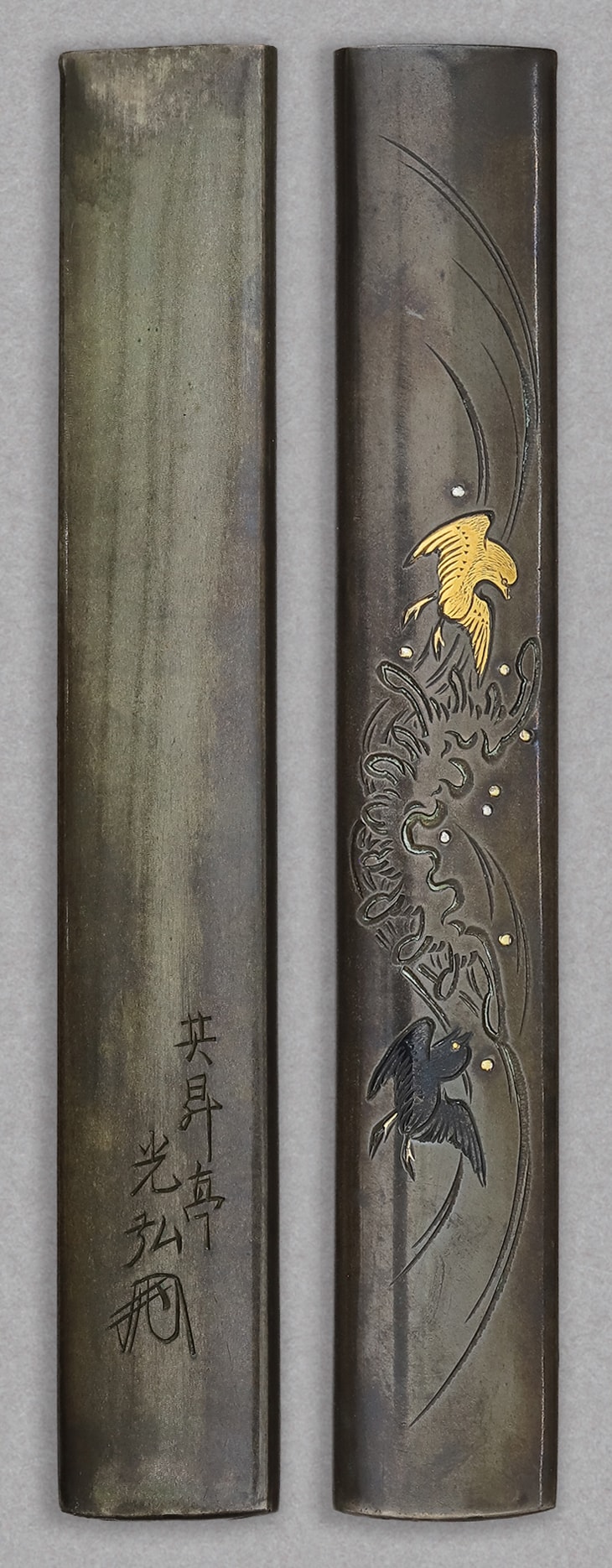
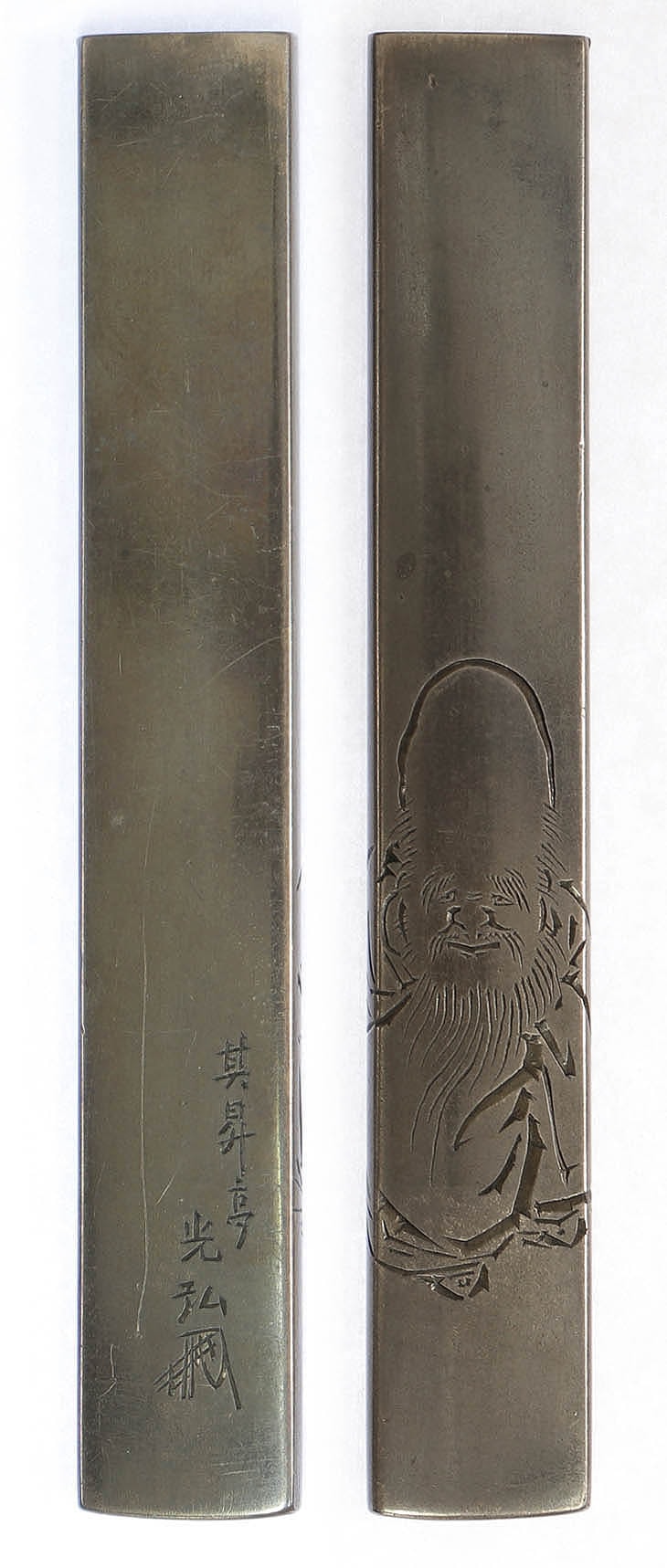
Aoki Shunkan, personal name Jinkichi, was born in Kyoto in Bunka 2 (1805). He first studied metalworking under his father Jinsuke; later traditions variously state that he apprenticed to Kawasaki Kagaharu of the Otsuki lineage, or that he received instruction from Uesugi Kazunuki and from Goto Ichijo, "though none of these accounts is definitively established." He was celebrated in his day as a specialist urashi (back-engraver) for and kogai, earning renown under the name "Yamajin-urashi." He signed his works in a distinctive reisho (clerical-script) hand, using such signatures as Shunkan, Aoshunkan, and Seiryuken Shunkan. Among his pupils was Masanuki. He died at fifty-four in Ansei 5 (1858).
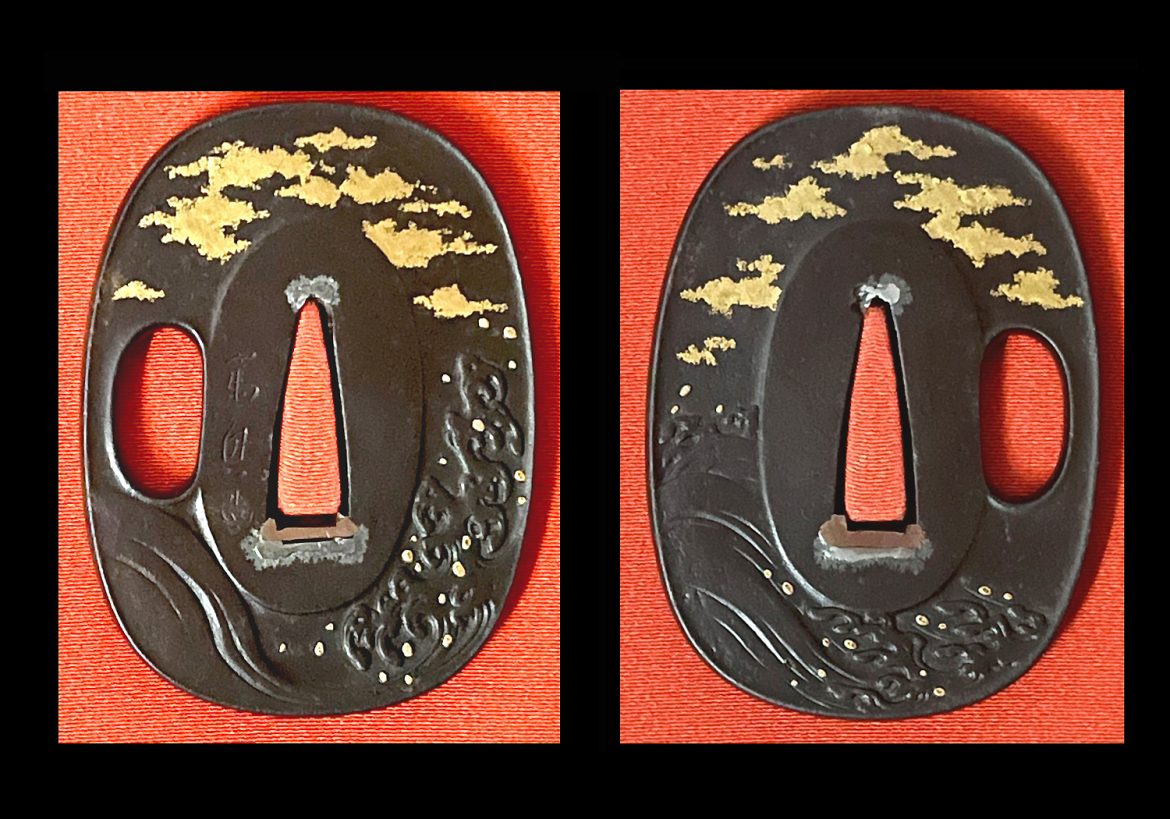
Shunkan's characteristic method employs shakudo or shibuichi grounds finished with exquisitely precise takabori high-relief carving and zoganiroe polychrome metal inlay. His nanako is "minutely and evenly executed," and his water patterns and cloud designs "show no stagnation or dullness." His figural carving is distinguished by meticulous attention to the smallest details — scales, hair, and facial expressions are rendered with "rich expression" and "an air of dignity." The NBTHK singles out his hira-zogan (flat inlay) technique as "outstanding," and notes that his use of gold iroe, though "restrained to the minimum," serves to "tighten and clarify the overall tone." His treatment of subjects drawn from Chinese and Japanese history, such as the Kanshin mata-kuguri episode and the Genpei War, demonstrates a compositional intelligence that balances narrative force with decorative refinement.
The Juyo record consistently characterizes Shunkan's works as achieving "a lofty, well-composed grandeur1" and praises his "high level of technical accomplishment." His pieces are described as possessing "elevated tone and dignity," with compositions so tightly controlled that figures appear charged with imminent motion. The NBTHK designates representative works among his oeuvre as masterpieces that convey "what is most characteristic of Shunkan's art," placing him among the foremost Kyoto metalworkers of the Bakumatsu era.
Kantei
3 descriptive axes: material (a soft-metal palette, above all shakudo, finely textured with nanako or ishime) x technique (high relief and sukidashi relief finished with colour inlay and flat inlay, his celebrated hand as a kozuka-and-kogai lining-maker) x themes (pictorial figures from the Japanese and Chinese repertoire, animals and the four numinous beasts). His surviving corpus is small (6 pieces), so the discriminators are scoped honestly: his identity as the lining-maker called Yamajin-ura, his distinctive clerical-script signature, and his standing as a refined Otsuki-school hand are what the records repeatedly set him apart by, rather than any single repeated subject.
Aoki Harutsura was a Kyoto soft-metal metalwork artist of the late Edo period, his common name Jinkichi, born in Kyoto in Bunka 2 (1805) and died in Ansei 5 (1858) at the age of 54. By trade he was a lining-maker (urashi) of kozuka and kogai, the son of the kozuka-and-kogai groundwork-maker Yamashiroya Jinsuke, and was known in the world as Yamajin-ura. He first learned from his father, mastering the metalwork largely on his own; the records then place him in the Kyoto Otsuki school as a pupil of Kawasaki Kagaharu, and add, without certainty, that he also received teaching from Uesugi Kasutsura, Ozaki Ikkan and Goto Ichijo. He signs his given name Harutsura in a distinctive clerical-script hand, cut as Aoki Harutsura, the abbreviated Sei-Harutsura, or with the go Seiryusai / Seiryuken prefixed; on menuki he splits a wari-mei. His surviving work is small in number but high in quality, treating Japanese and Chinese figures, animals and flowering plants in finely worked shakudo grounds with high relief, sukidashi relief, colour inlay and inlay, and the records count him a master of the Kyoto kinko field. His pupil was Masatsura.
Diagnostic discriminators
裏師「山甚裏」urashi, Yamajin-ura3
the records make his defining identity the lining-maker (urashi) of kozuka and kogai, son of the groundwork-maker Yamashiroya Jinsuke and known as Yamajin-ura, who rose from the back-plate trade to a signing master; an origin foreign to the ordinary signing carver of the field. Named in 3 of the 6 records. This is a biographical/trade discriminator drawn directly from the setsumei, not a workmanship feature
隷書風の特色ある銘reisho-fu no toku'aru mei3
the records say he cut his signatures, Harutsura / Sei-Harutsura / Seiryuken-Harutsura, in a distinctive clerical-script (reisho-fu) calligraphy. A signature-style tell named in the biography, present in 3 of the 6 records; it separates his cut from the ordinary signing manner of the field rather than from any one peer
Material (grounds)
His ground is the soft-metal palette, above all shakudo, finished with a fine nanako or worked into the components; the records say his work uses shakudo and shibuichi grounds. A single set adds a suaka ground for one component, and the gold colour-inlay is held to a minimum so that it tightens the whole.
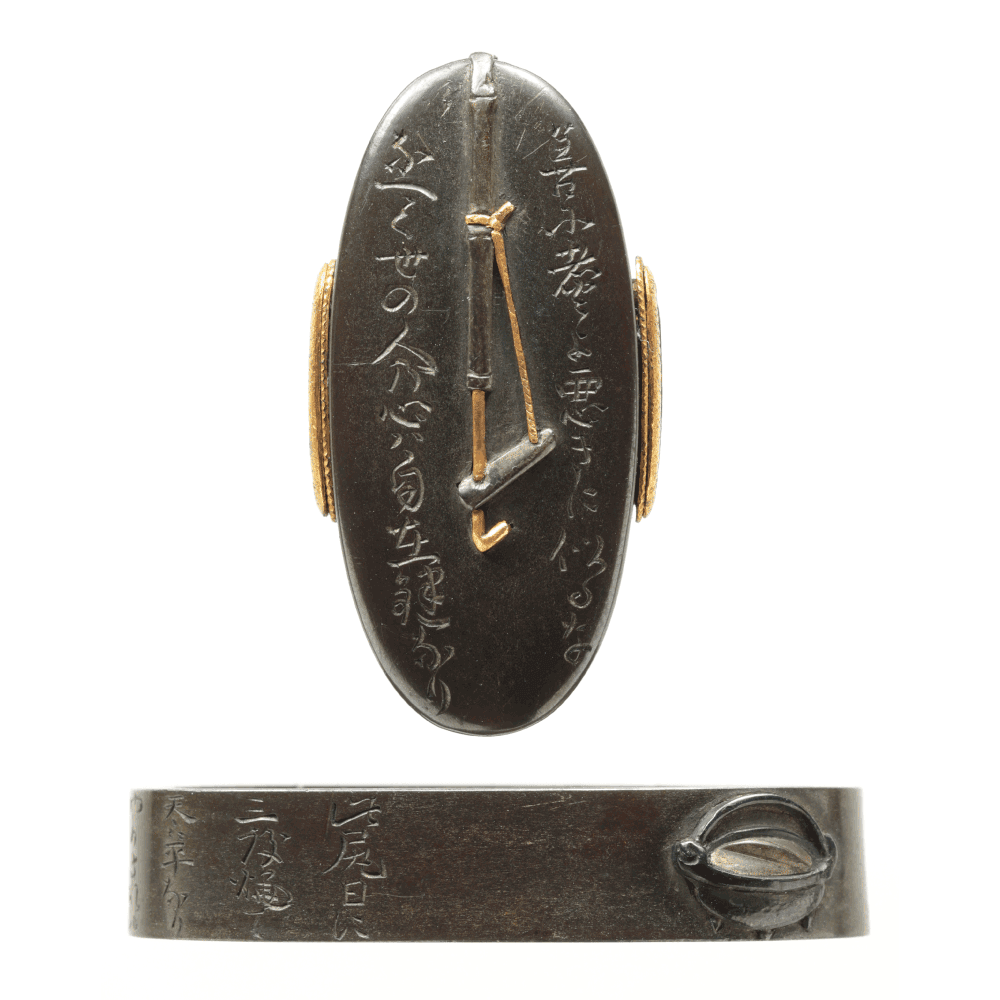
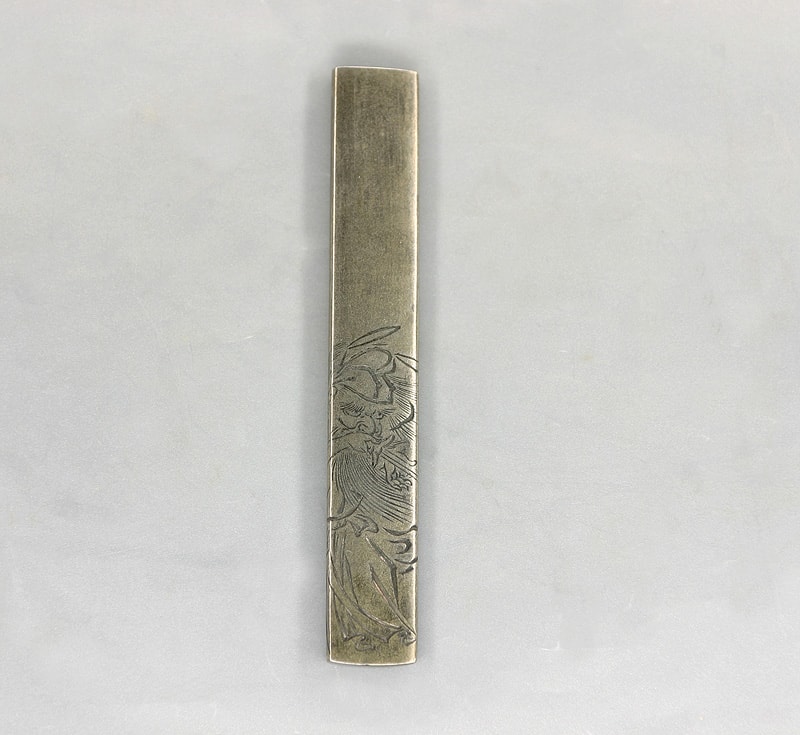
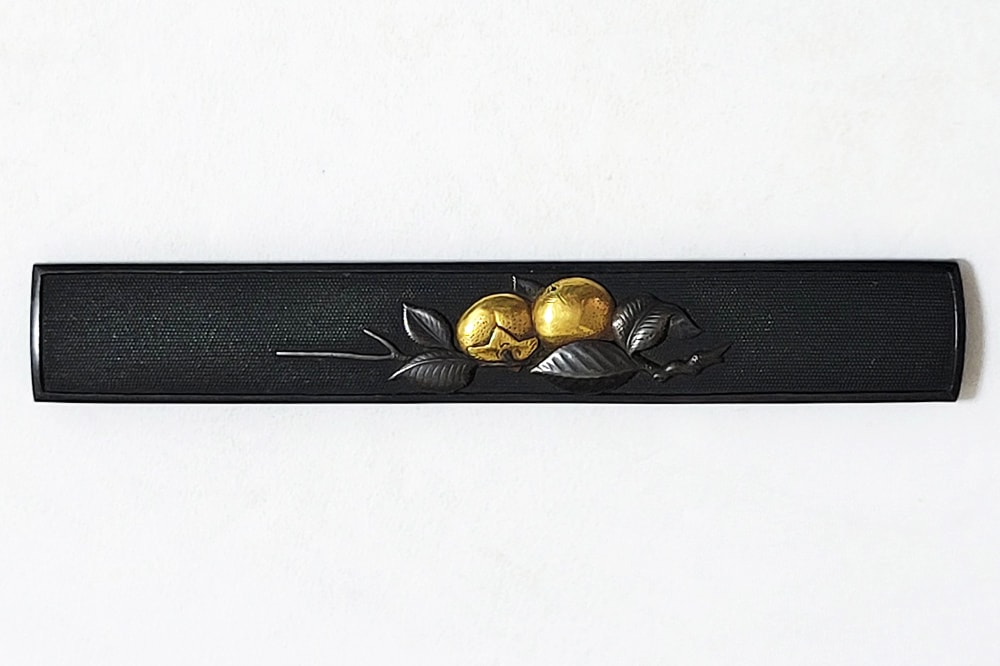
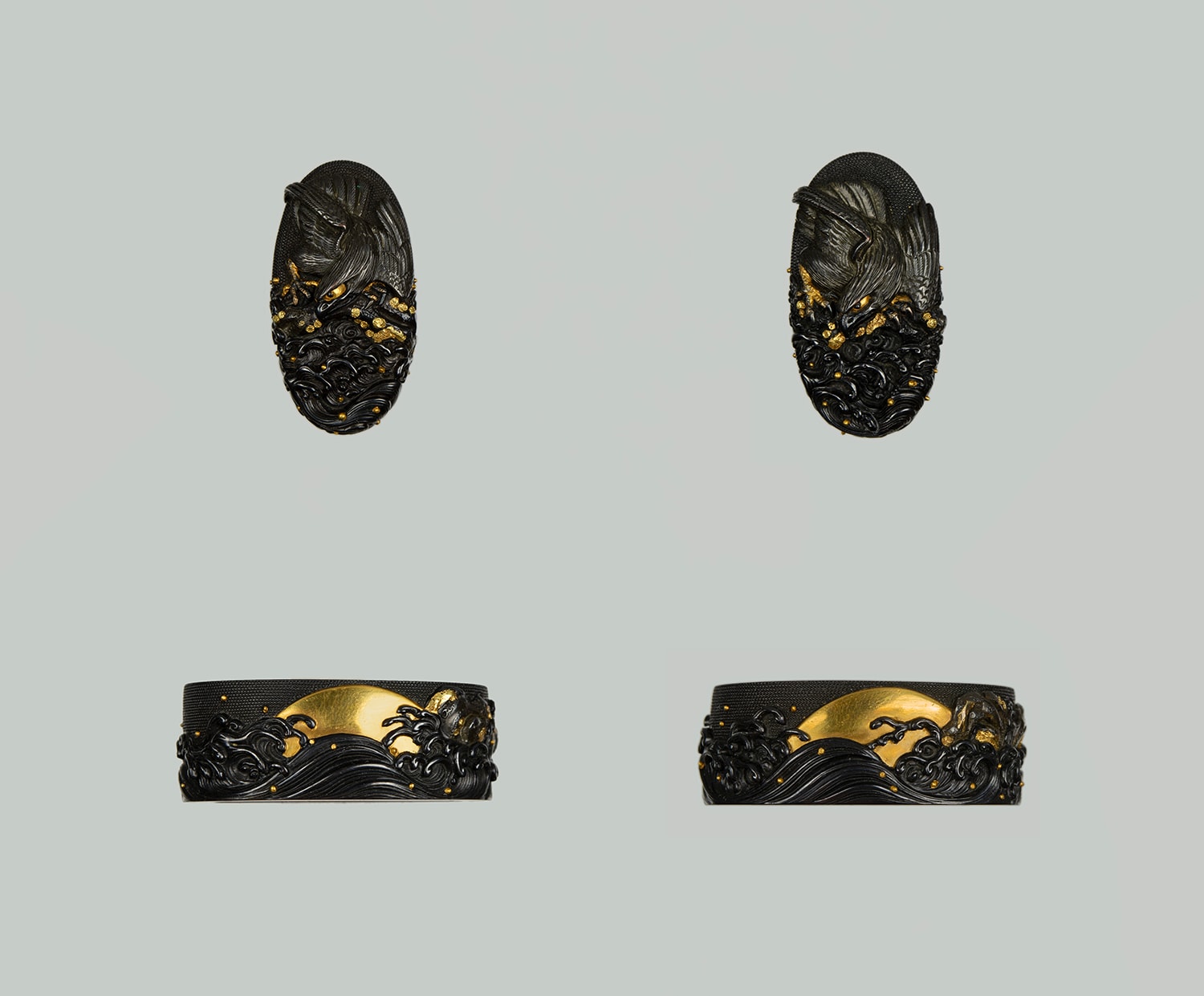
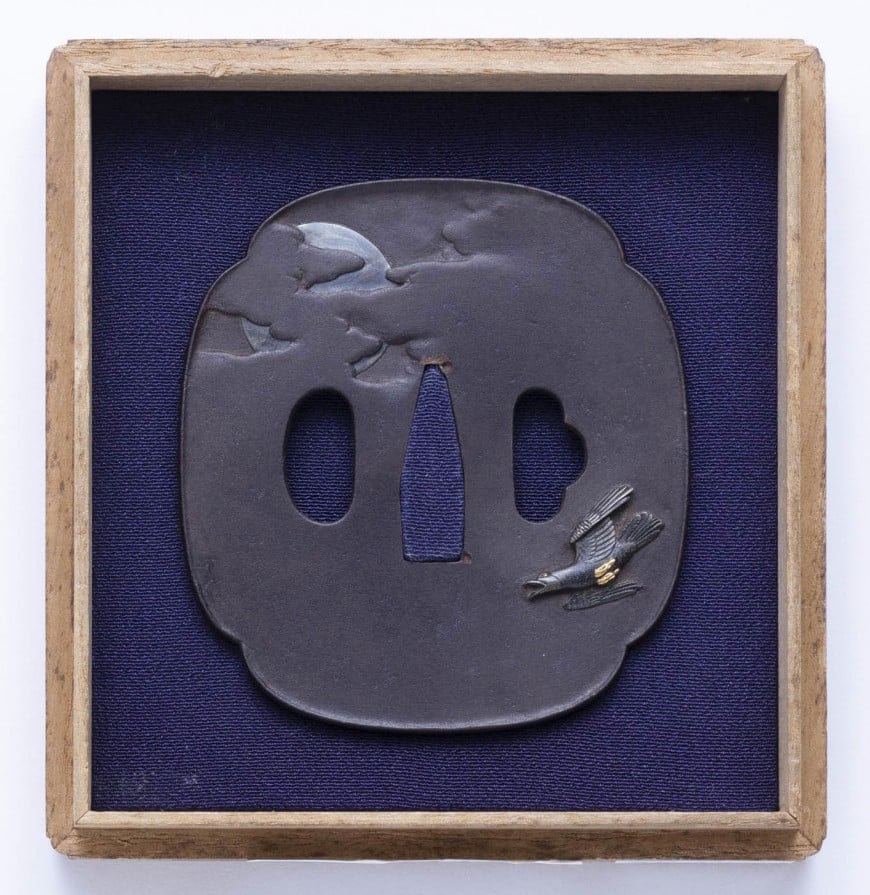
His hand is high relief and sukidashi relief carried up into the round, finished with iro-e colour inlay of gold, silver, shakudo and suaka, with flat inlay (hira-zogan) and kebori; the records single out the precision of his chiselling and the skill of his flat inlay. As a lining-maker he finishes the backs in a plate-gold or burnt-on gold ground.
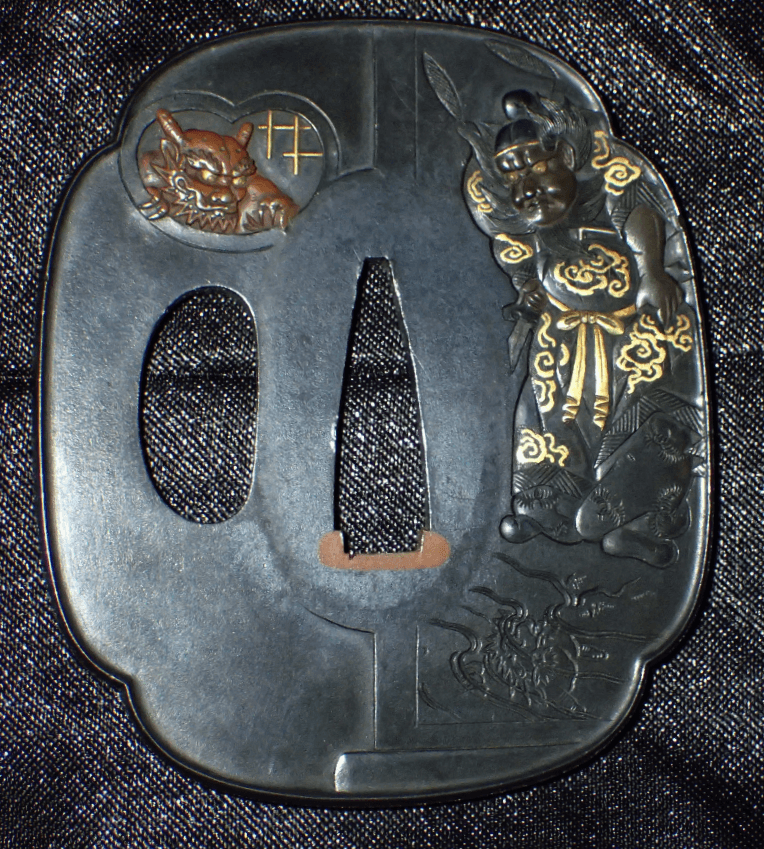
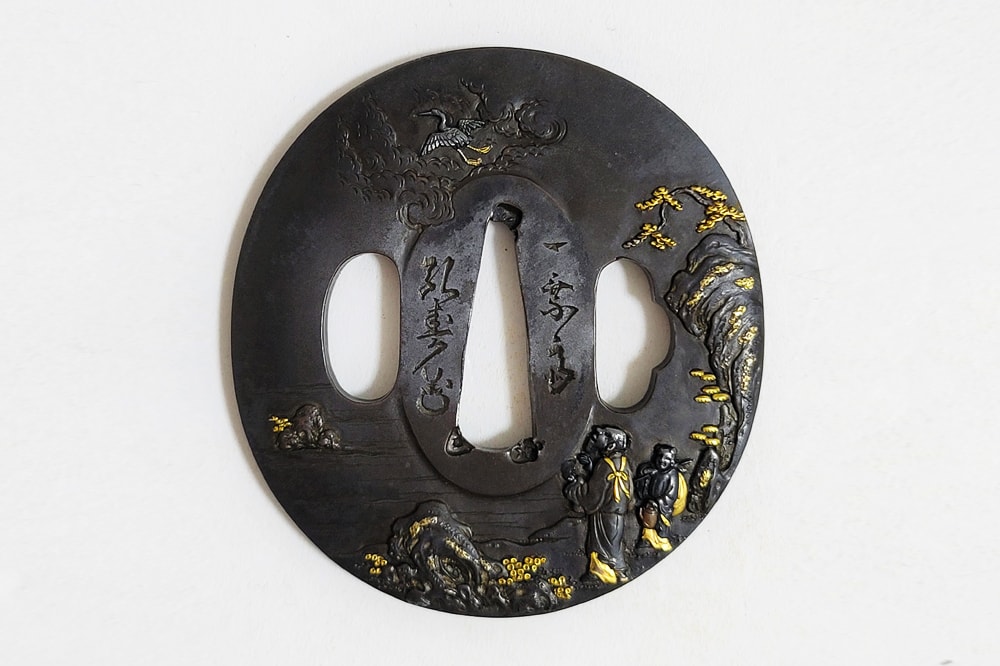
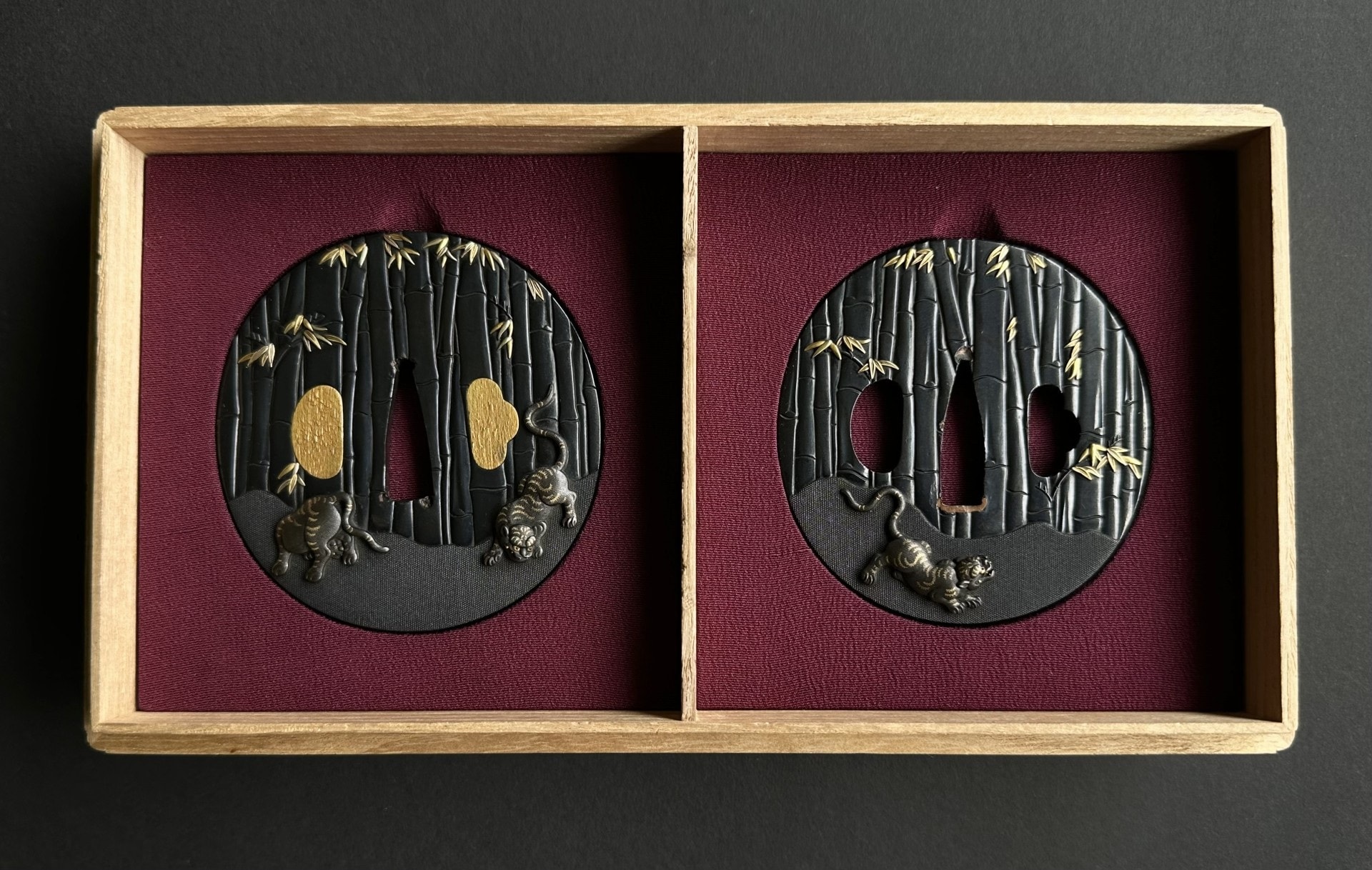
His subject matter is pictorial and drawn from the Japanese and Chinese repertoire: figures, animals and flowering plants. The surviving pieces show the Chinese endurance subject of Han Xin crawling between the bully's legs (called one of his representative works), the Genpei War scenes of Yoshitsune dropping and retrieving his bow at Yashima and his leap across eight boats, the four numinous beasts (dragon, phoenix, tortoise and qilin) assembled across a three-piece set, a cock-fight watched by a court official, and the esoteric Buddhist Dainichi Nyorai with Fudo Myoo. The records praise the rich expression of the individual figures and the precision of the carving throughout.
Japanese and Chinese figures
The figure subjects that dominate the corpus, drawn from both the Chinese histories and the Japanese war tales: the endurance of Han Xin, the Genpei War scenes of Yoshitsune at Yashima, and the esoteric Buddhist deities, each carried with rich individual expression.
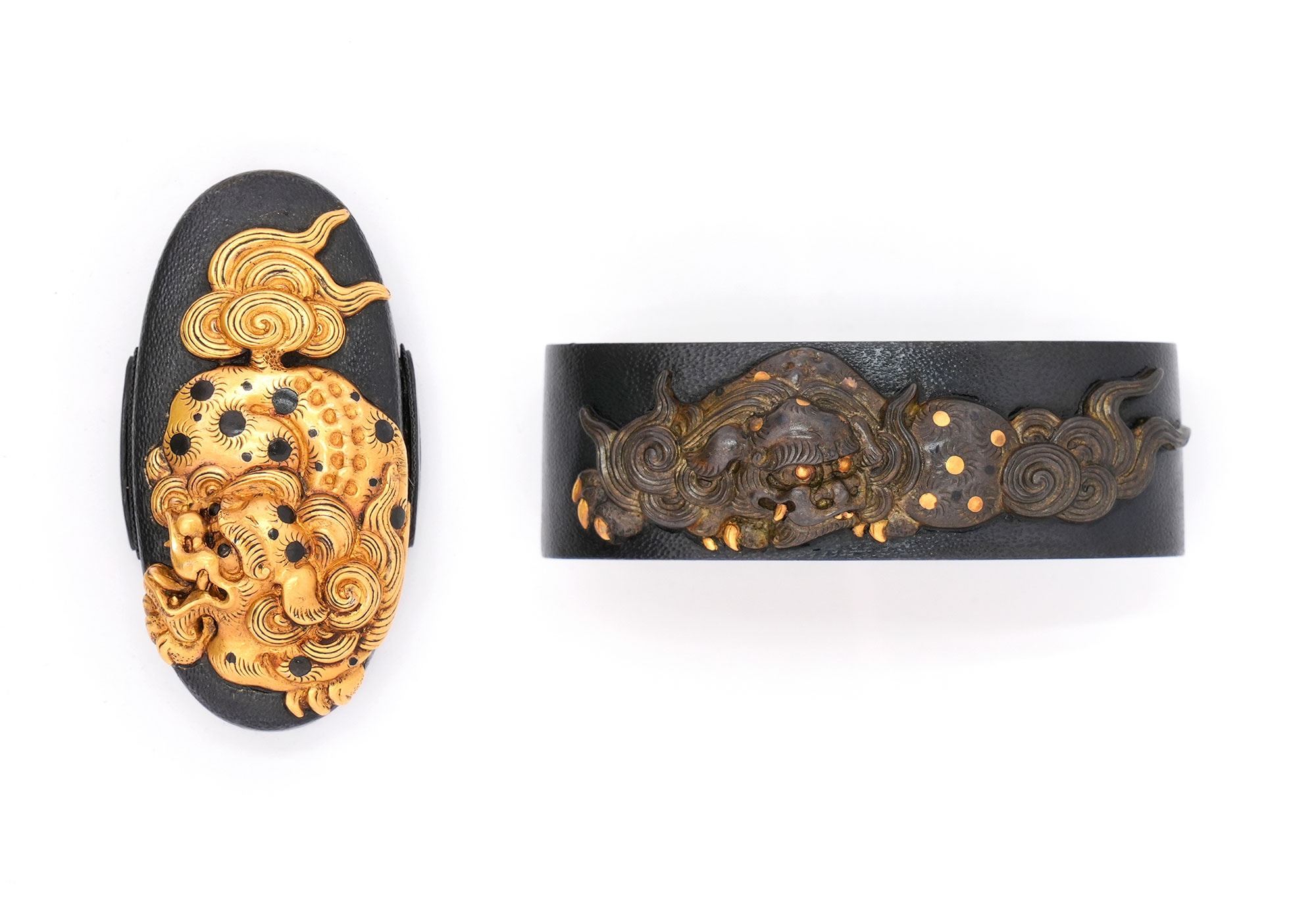
Animal subjects: the four numinous beasts (dragon, phoenix, tortoise and qilin) assembled across a single three-piece set as the shirei, the scales and feathers worked to a minute finish, and a cock-fight watched by a court official.
Harutsura (春貫), two-charthe core two-character given-name signature, split as a wari-mei 春・貫 on menuki1 pieces1
Aoki Harutsura (青木春貫 / abbreviated 青春貫)the surname-prefixed signature and its abbreviated 青春貫 form, his most characteristic2 pieces2
Seiryusai / Seiryuken Harutsura (青柳斎春貫)his art-name go prefixed to the signature1 pieces1
Placement
split signature (wari-mei) divided across the pair of menuki4 pieces4
Recorded signatures
青春貫Sei Harutsura2 pieces2
春貫Harutsura1 pieces1
青柳斎春貫Seiryusai Harutsura1 pieces1
Documentary note
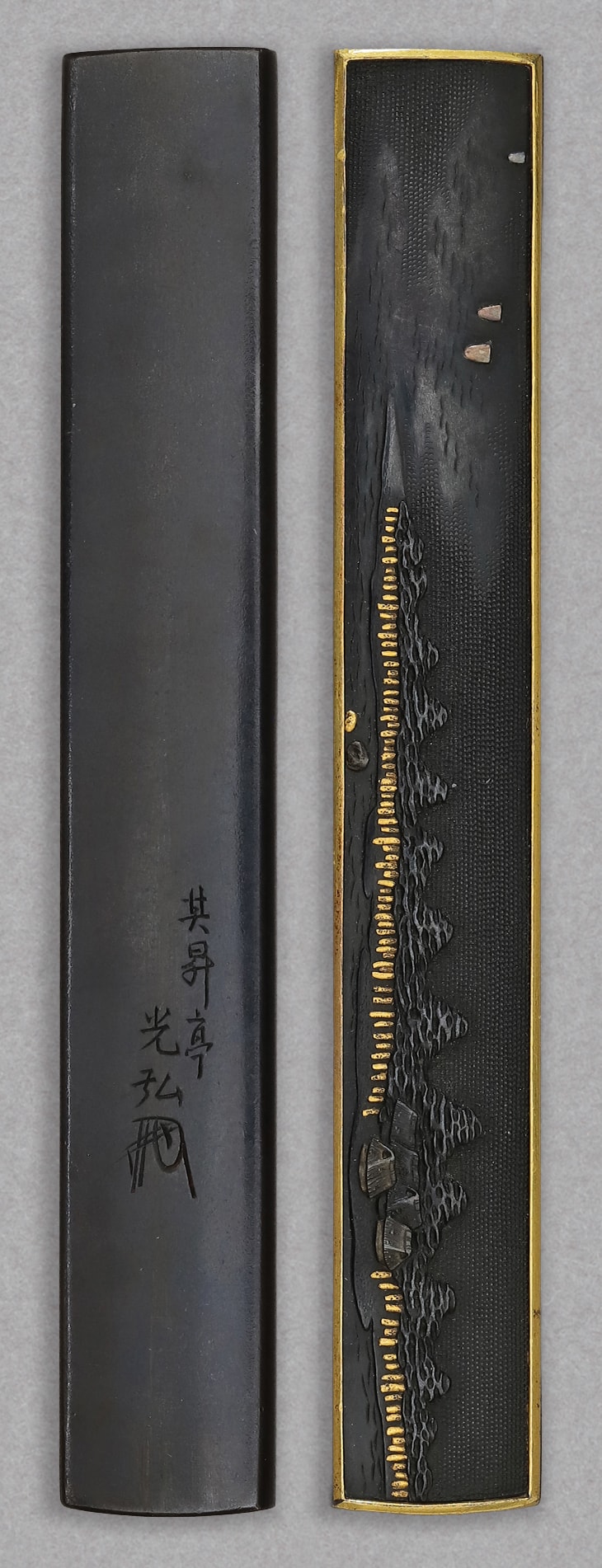
His signatures cut his given name Harutsura, in a distinctive clerical-script hand: as the full Aoki Harutsura, as the abbreviated Sei-Harutsura (the surname reduced to a single character), or with the studio-go Seiryusai / Seiryuken prefixed; on menuki he splits a wari-mei, cut as a tanzaku-mei (Haru / Tsura). The corpus signatures that the machine captures are Sei-Harutsura, Harutsura, and the go-prefixed Seiryusai Harutsura. The records pose his teaching lineage as uncertain (sadaka de nai): they place him securely in the Kyoto Otsuki school as a pupil of Kawasaki Kagaharu, but report the further teaching from Uesugi Kasutsura, Ozaki Ikkan and Goto Ichijo only as things said, not established. One record notes that his Yashima kozuka took a Goto-house work as its model, which accords with the reported Goto Ichijo connection. The corpus is small (6 pieces); his pupil is named as Masatsura.
Scholarship
His common name was Jinkichi, born in Kyoto in Bunka 2 (1805) and died in Ansei 5 (1858) aged 54; a lining-maker of kozuka and kogai called Yamajin-ura, son of Yamashiroya Jinsuke, pupil of Kawasaki Kagaharu of the Otsuki school.3
Historical importance
Where Harutsura stands among comparable artisans: across all of nihontō, and within tradition, era, and period. The tiers (Foremost · Leading · Major · Notable) weigh official designations from the NBTHK and Japan's Agency for Cultural Affairs, together with historical honors of lasting repute such as the Sansaku and Meibutsu-chō.
Harutsura(春貫) was a maker of Japanese sword fittings (tōsōgu) of the Otsuki school in Yamashiro province, active during the Bunka-Ansei (1805-1858) period.