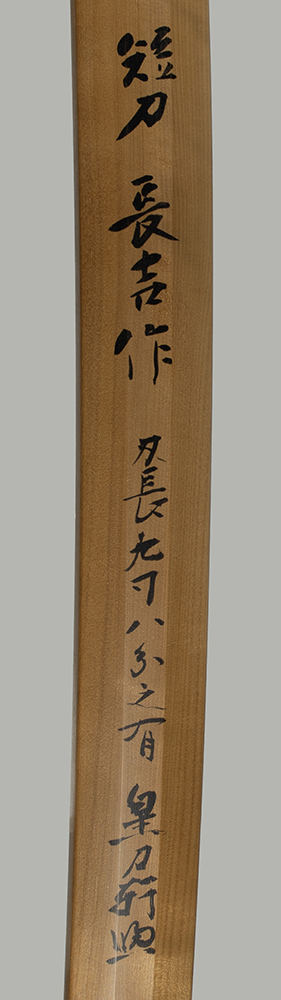
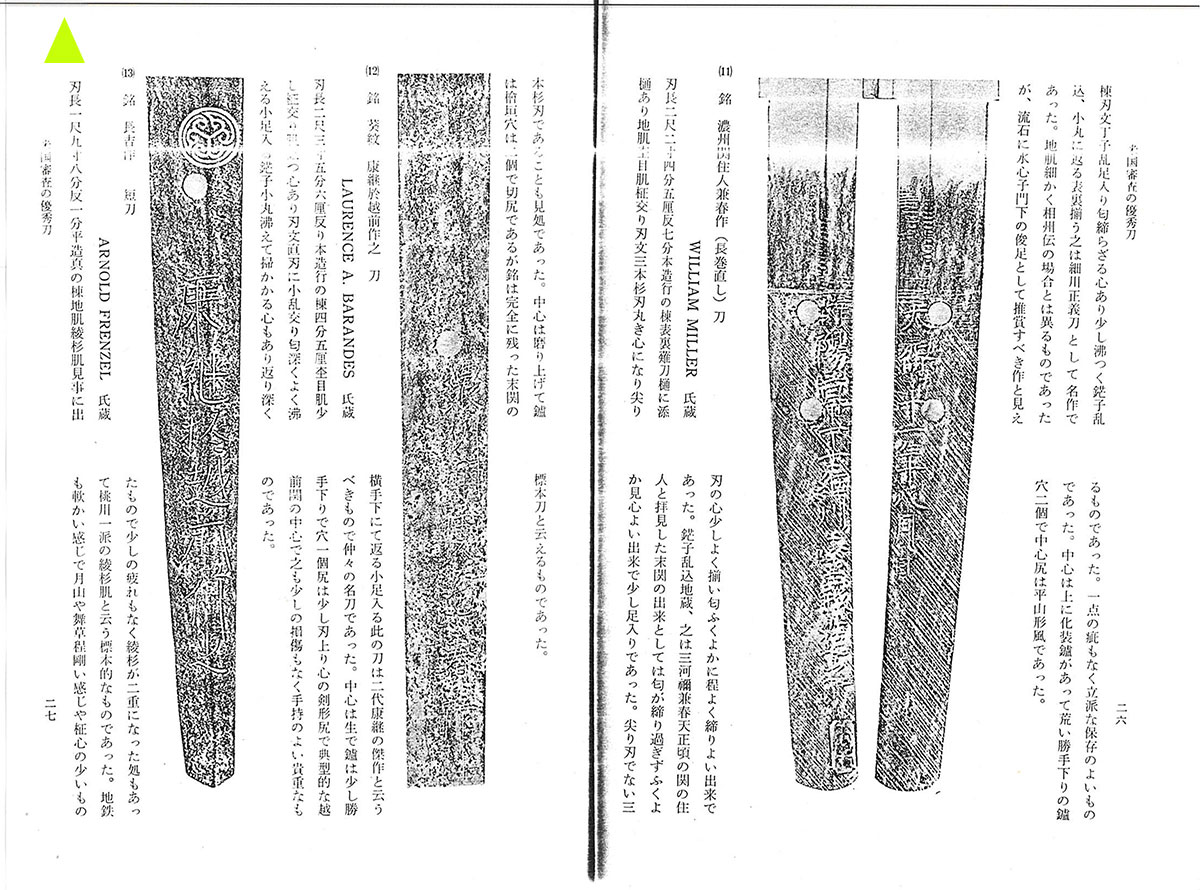
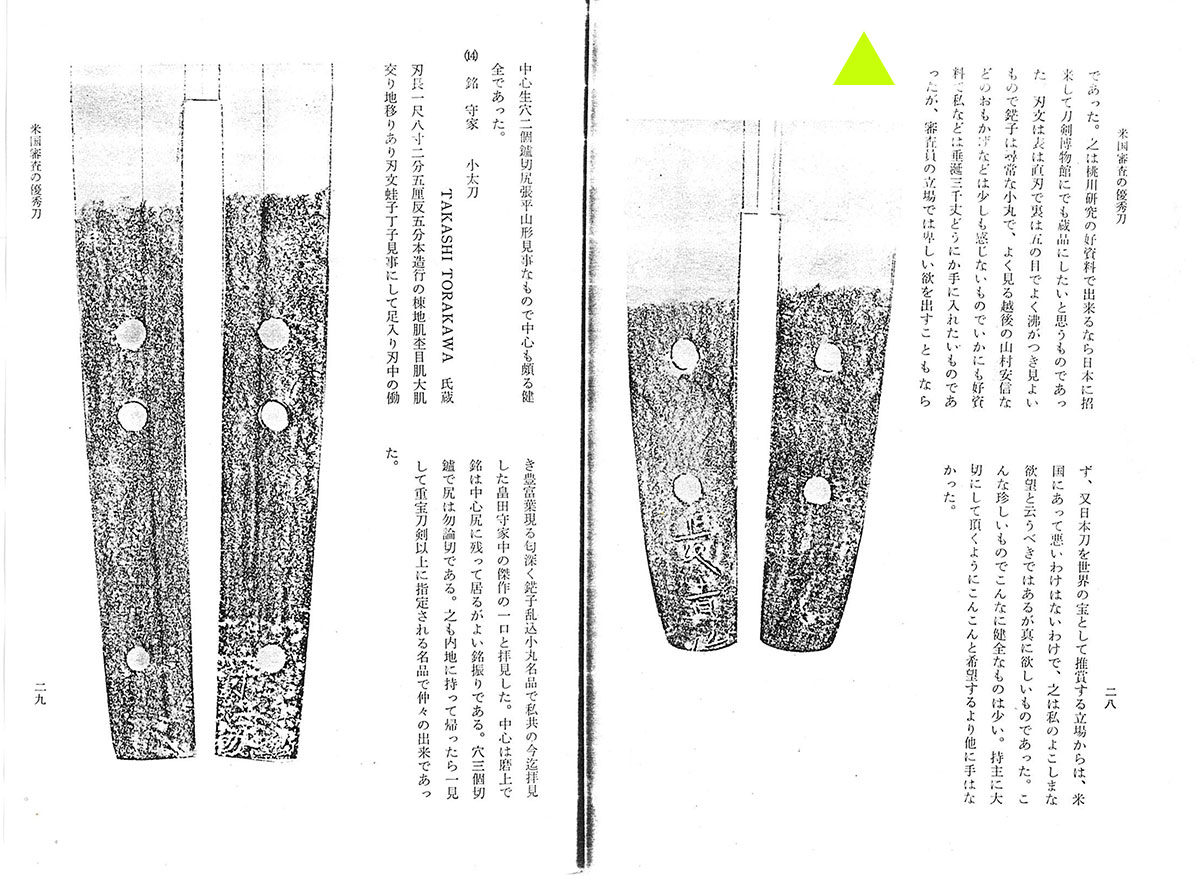
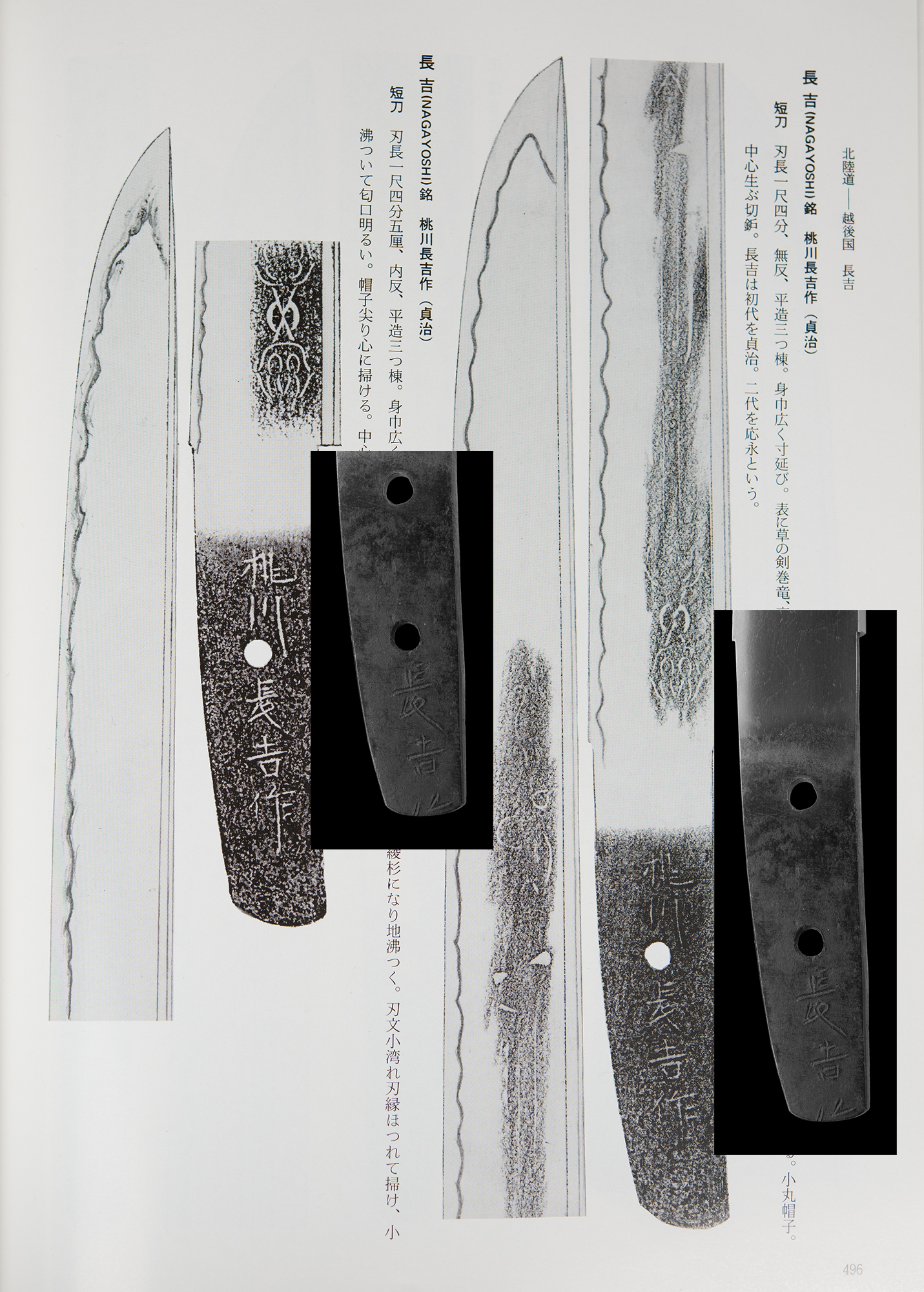
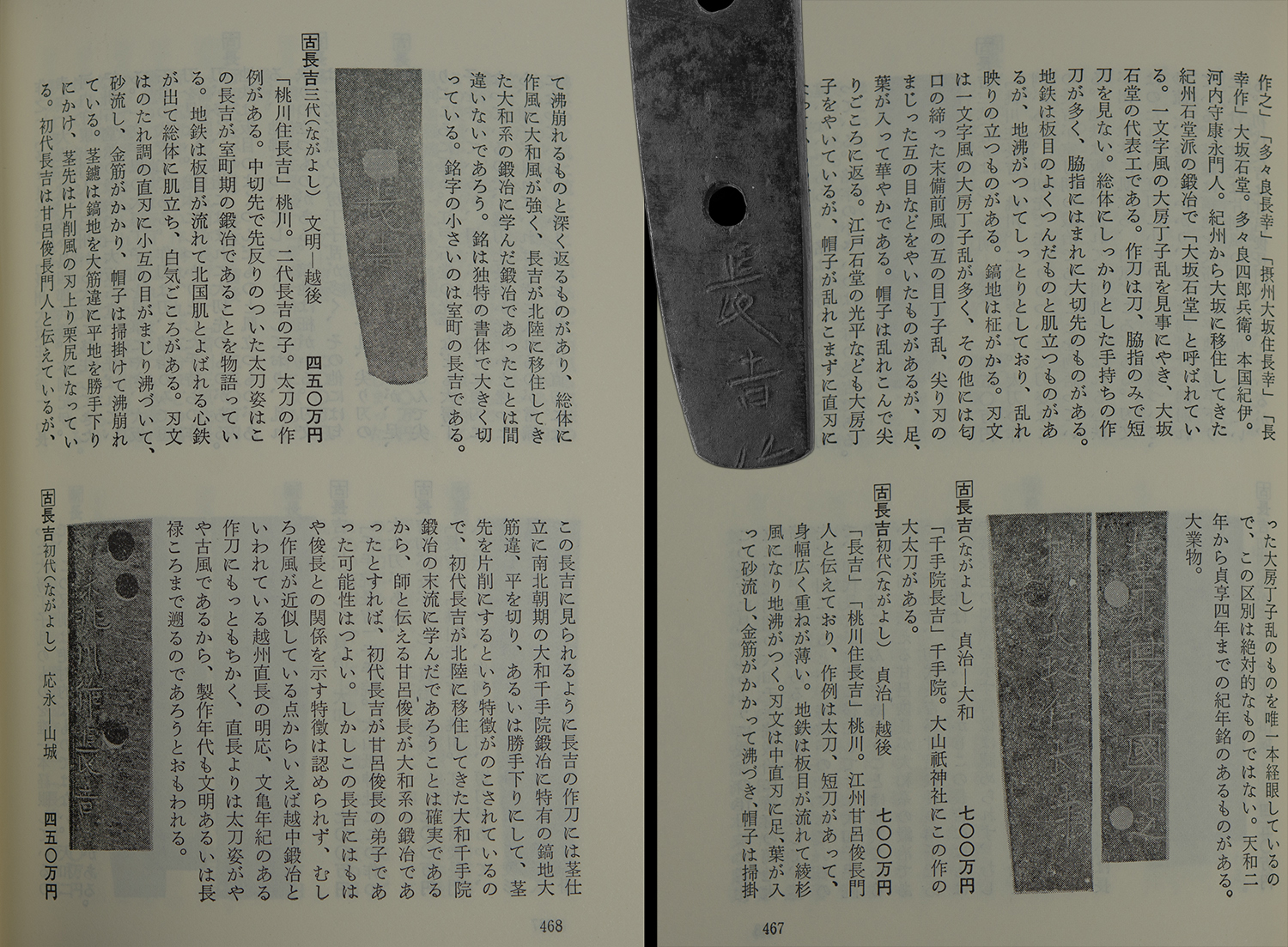
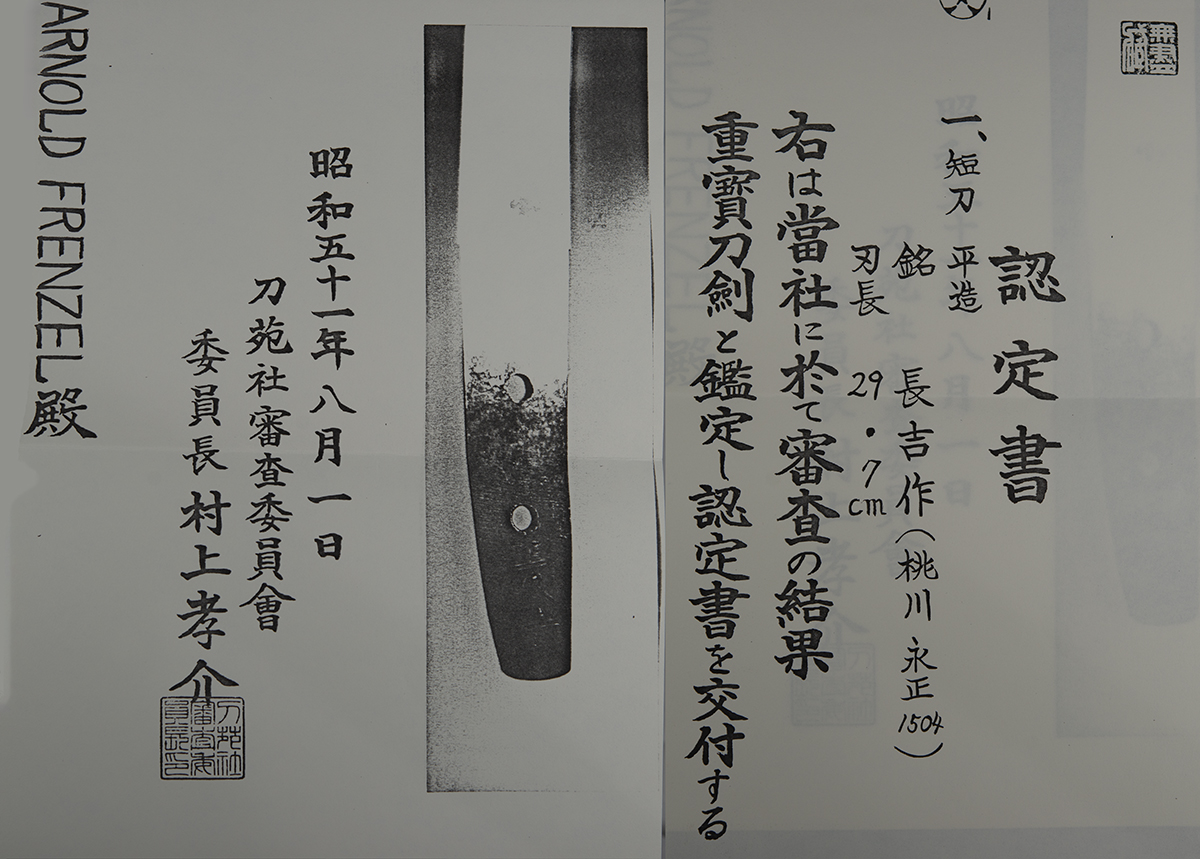
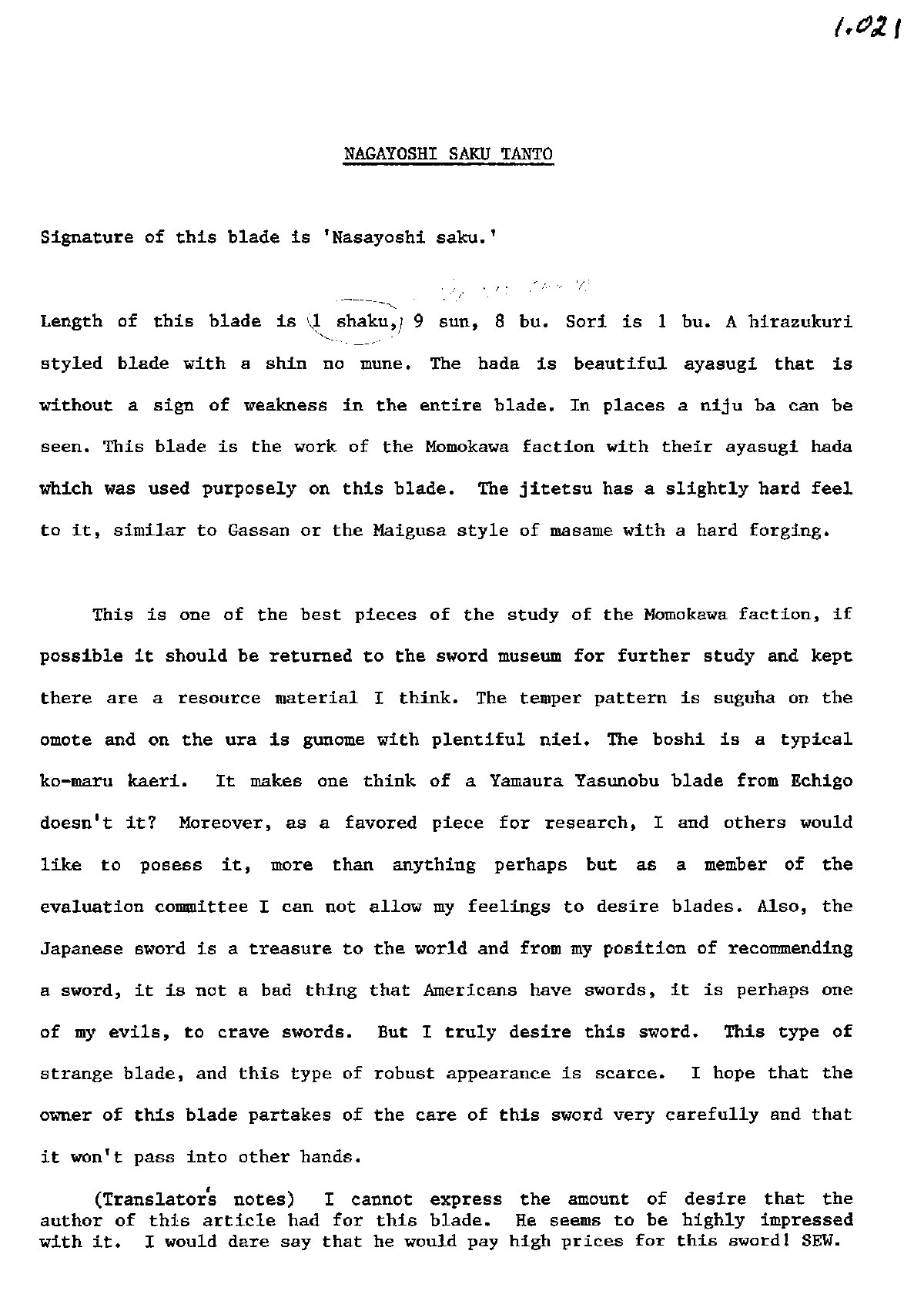
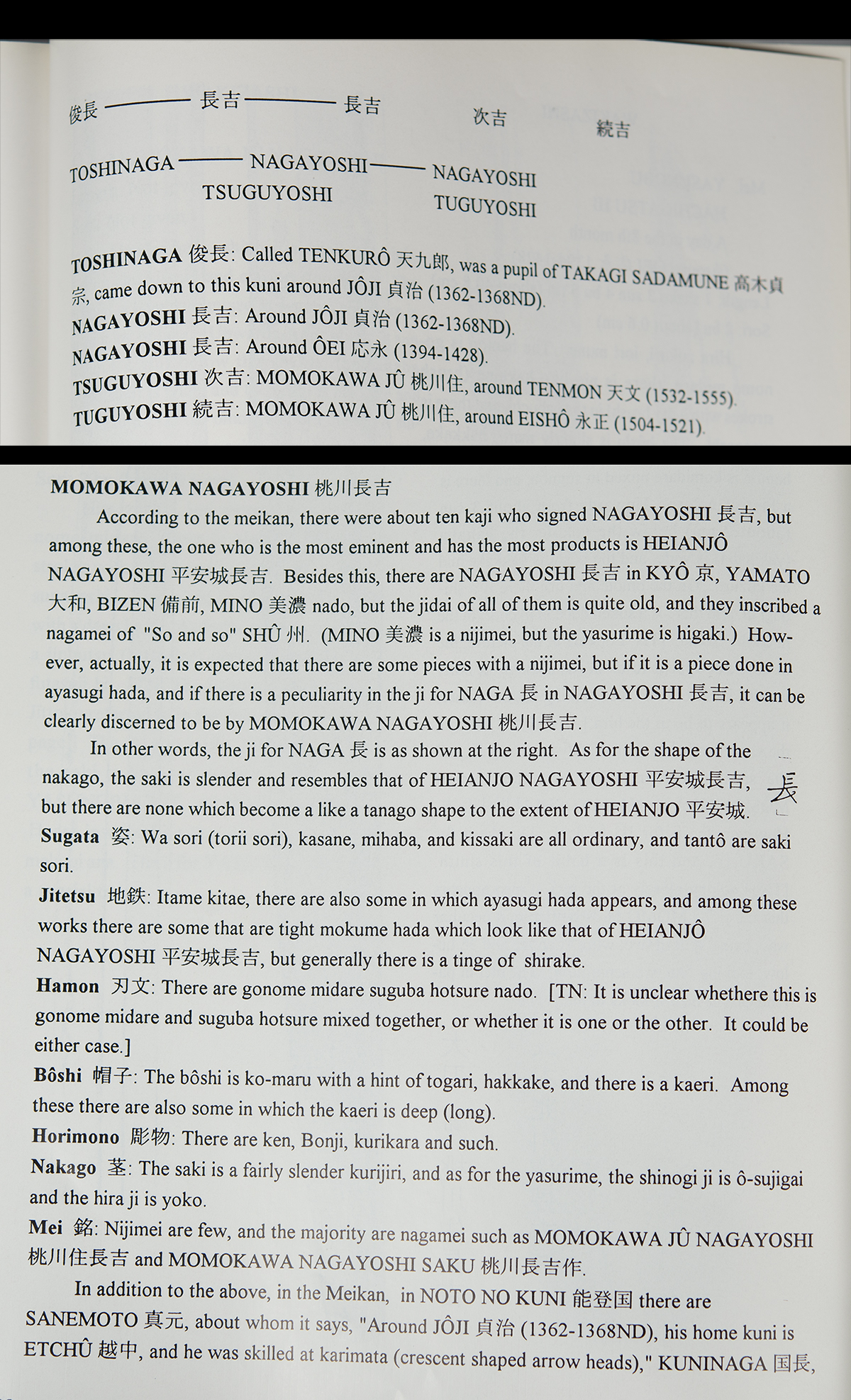
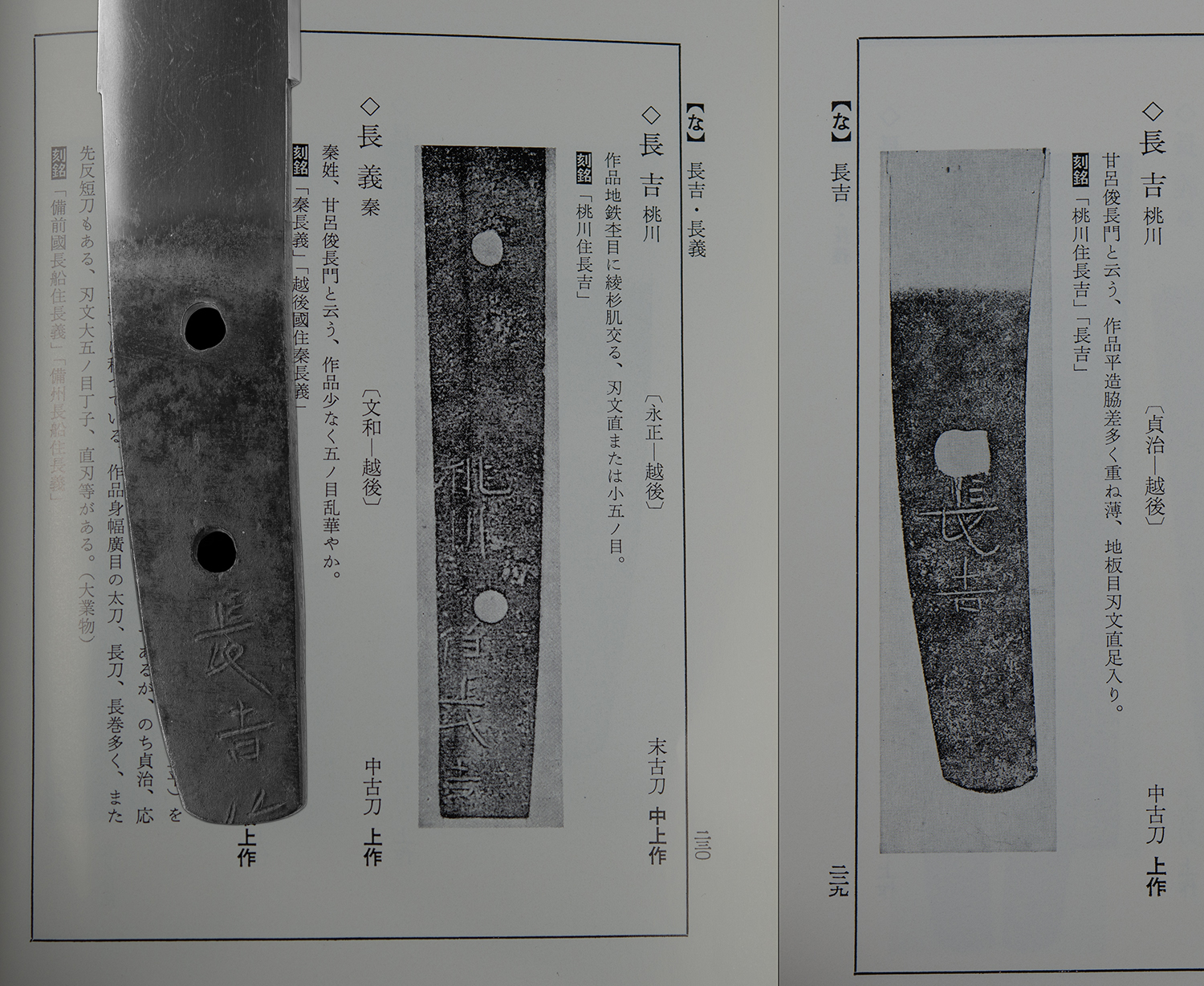
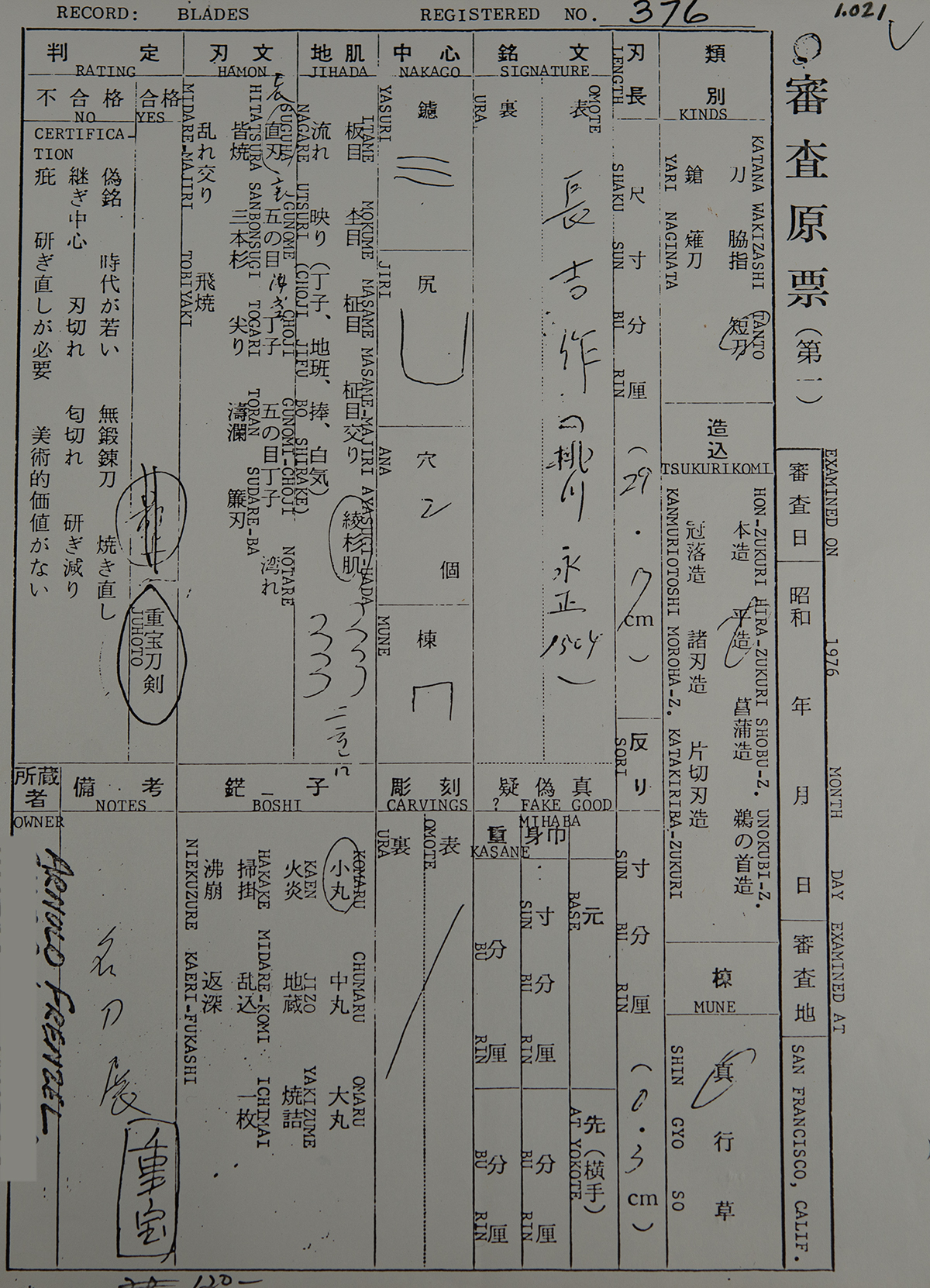
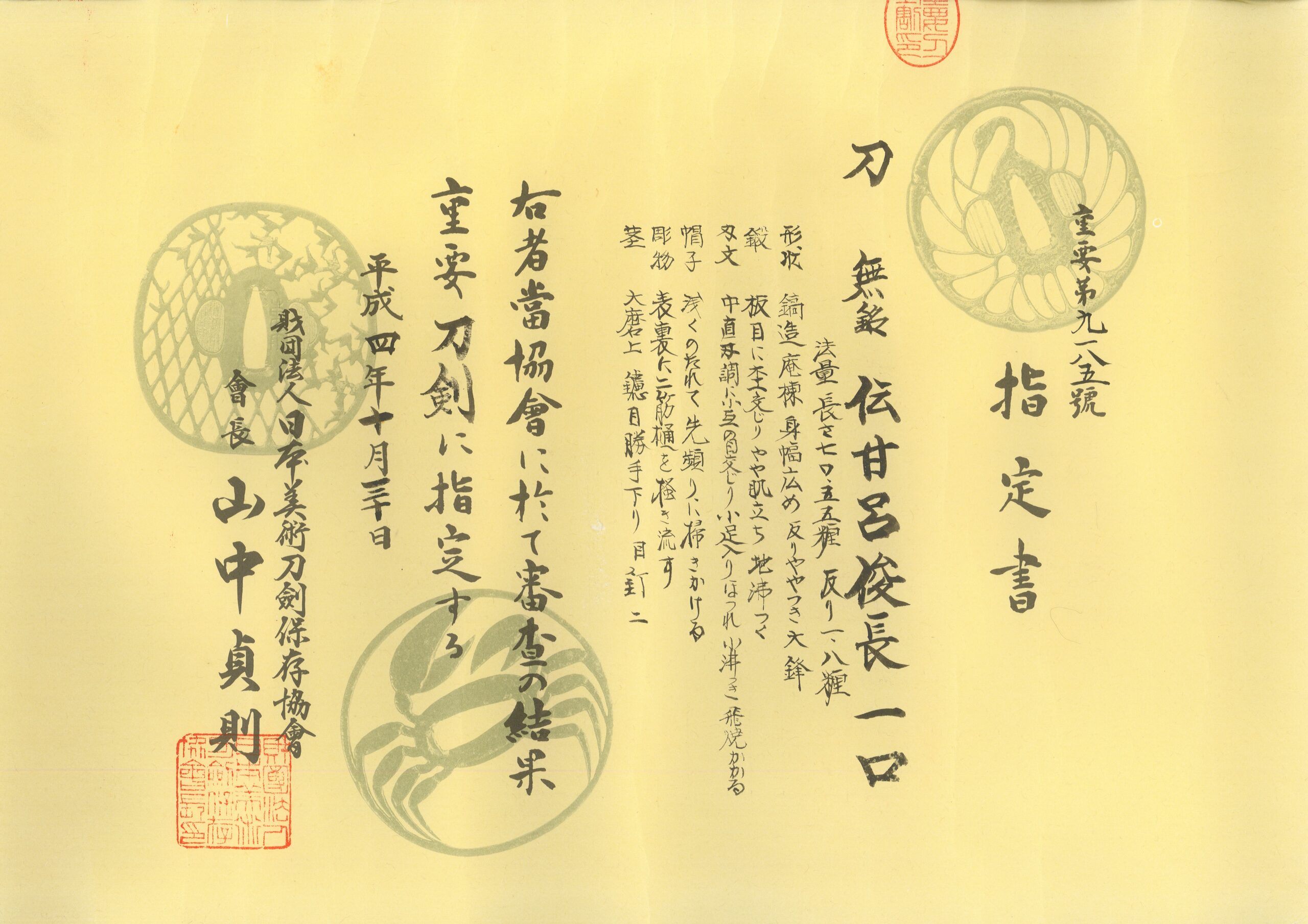
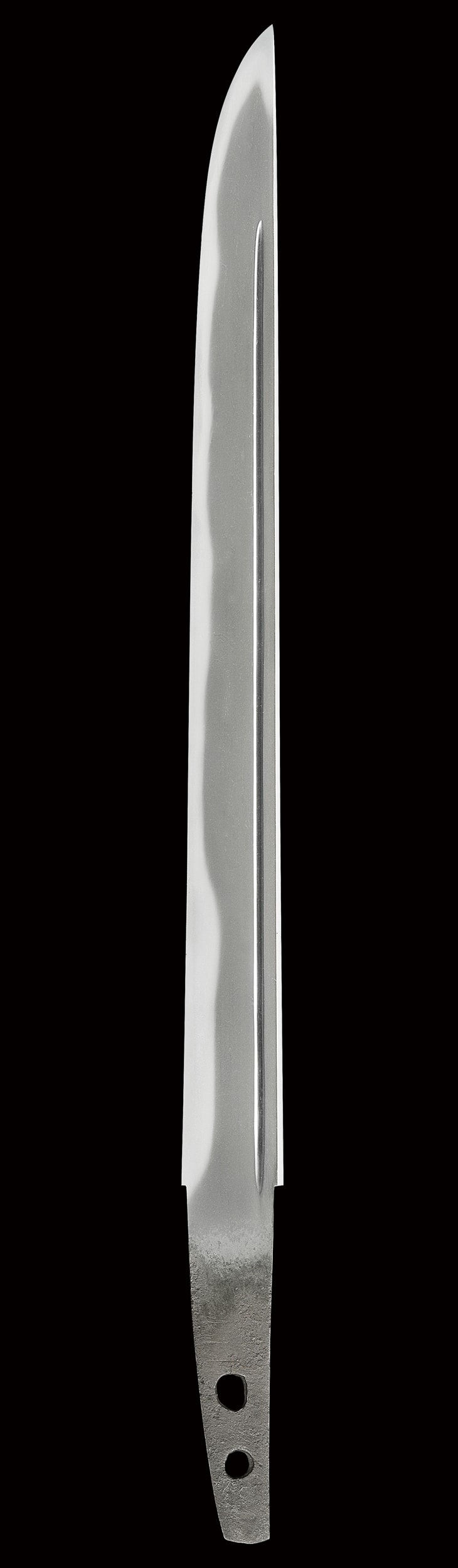
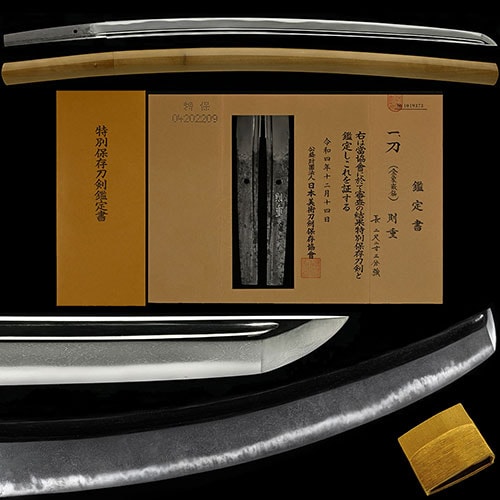
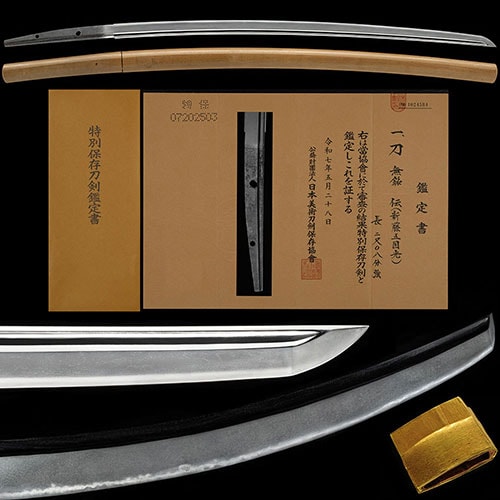
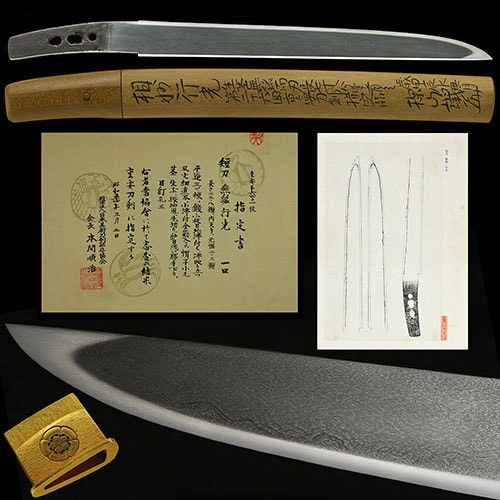
Nagayoshi is the swordsmith of the Momokawa (桃川) group of Echigo province, working in the Nanbokucho period, and he survives in only a small number of signed Juyo blades. Momokawa is a place-name in Echigo, and the published sources record that smiths styling themselves Nagayoshi (長吉) continued there for two, perhaps three generations from the Nanbokucho into the Muromachi period. Their output was scarce, and among the extant works there are no dated examples, so the several generations who bore the name cannot be told apart. One tradition makes him a pupil of Kanro Toshinaga (甘呂俊長) of Echigo, but the published sources set that tradition gently aside on the workmanship, finding little in his work that resembles Toshinaga and reading the ji and ha as Yamato (大和風) in character instead. He is therefore read not by his teacher line but by his own hand, which is consistent across the three forms in which he survives, a tanto, a wakizashi and a tachi.
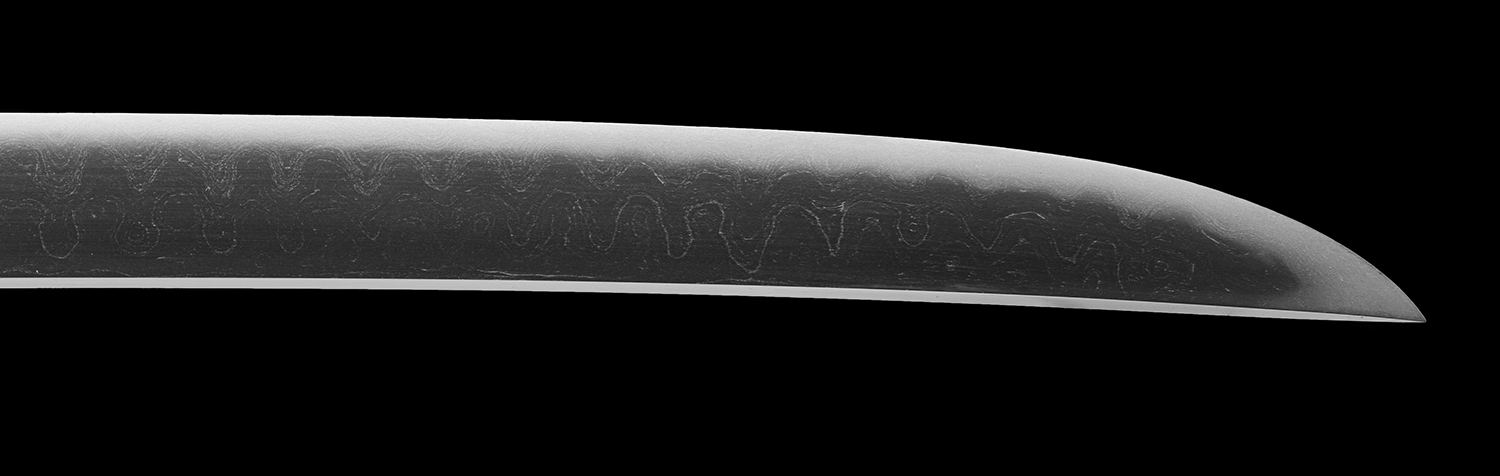
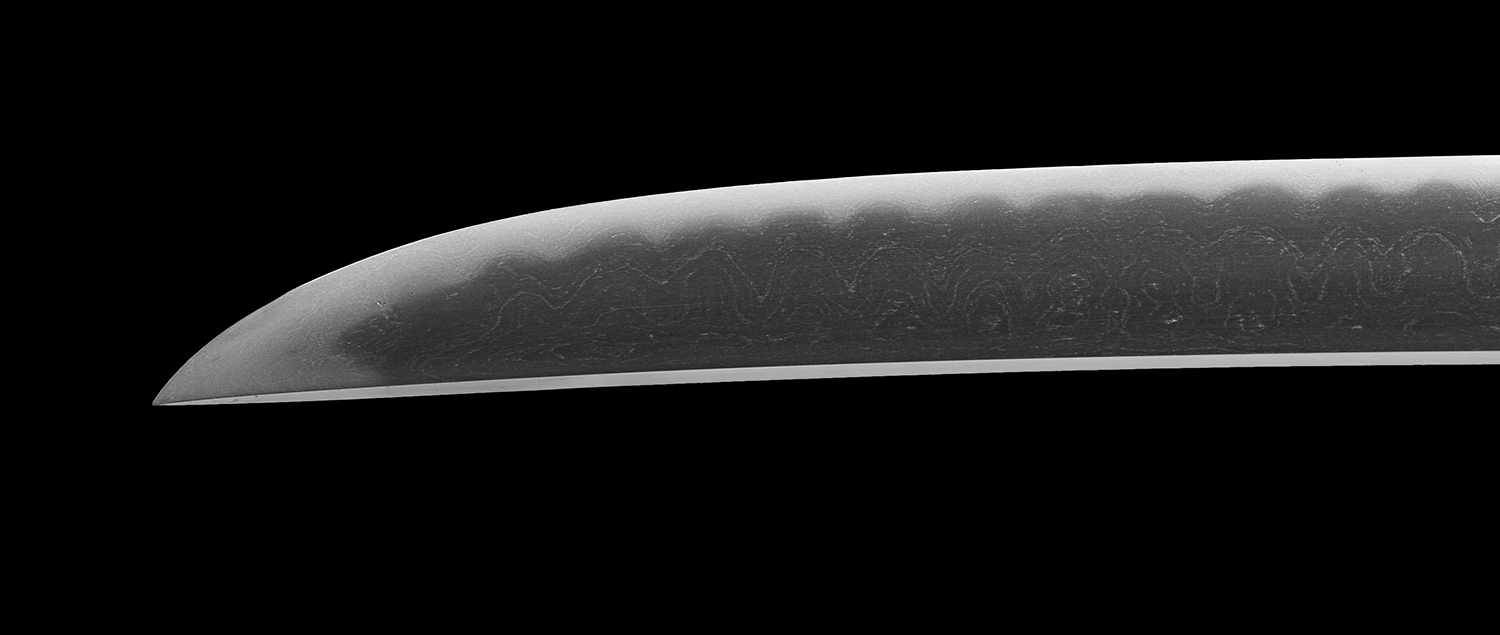
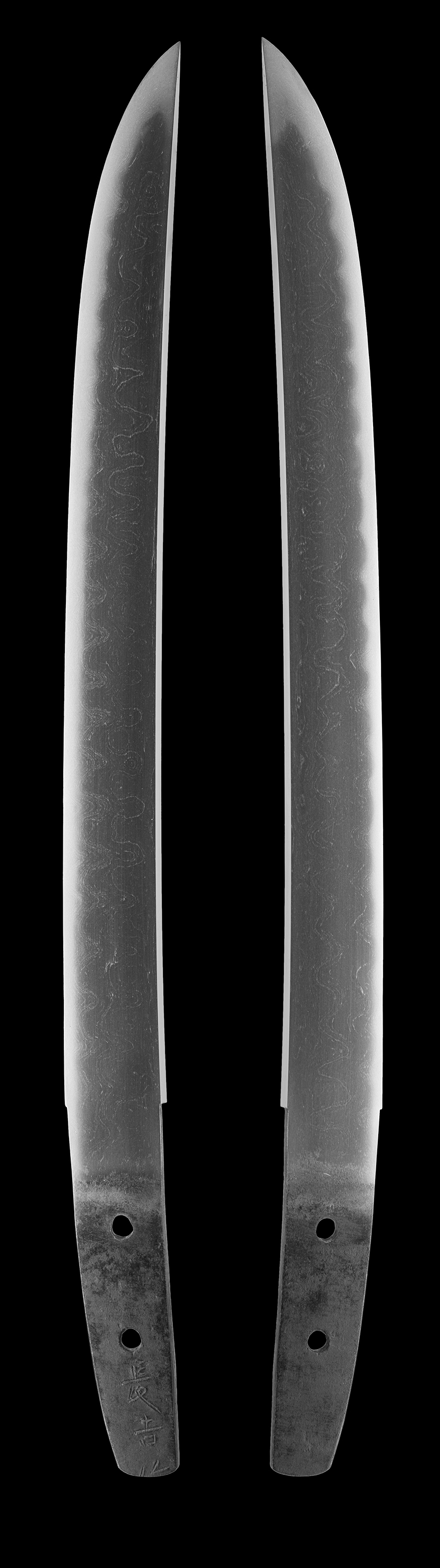
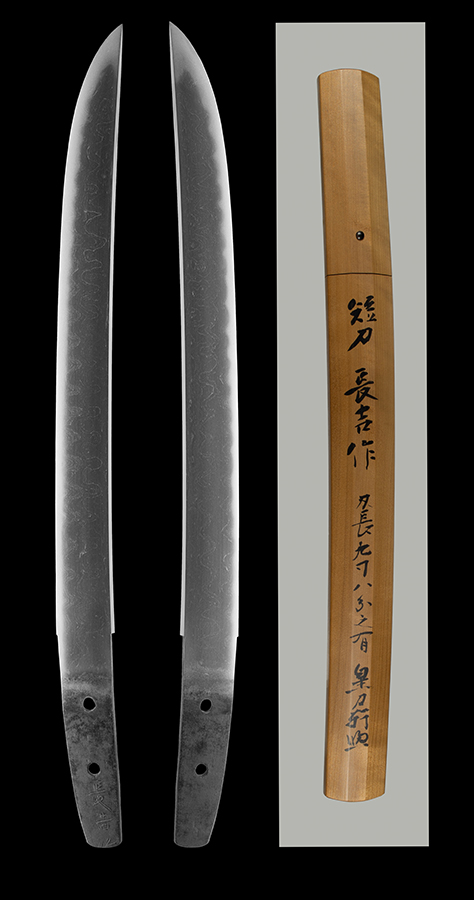
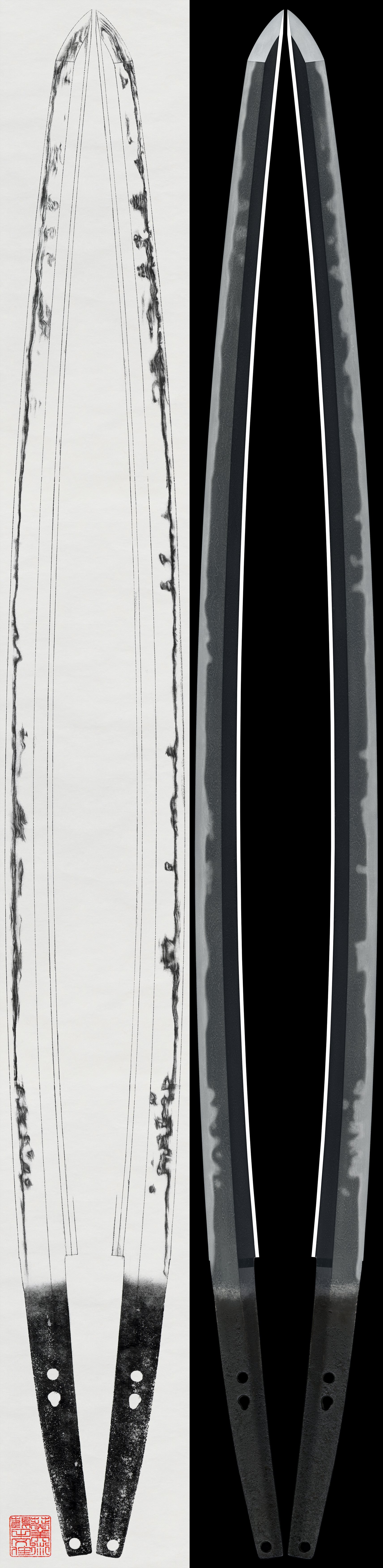
That hand is, before anything else, a Yamato hand carried into Echigo steel. Over the body the published sources describe a suguha (直刃) base, narrow on some blades and wide on others, the habuchi frequently frayed with hotsure (ほつれ), and along it sunagashi (砂流し) and kinsuji (金筋) run while the nioiguchi stays bright. It is a quiet, restrained temper, far from the showy choji of contemporary Bizen, and the persistent hotsure and the streaming sunagashi are exactly what mark the work as Yamato rather than Bizen. The boshi follows the same idiom, swept with hakikake and turning sharp at the point on the tachi and wakizashi, or finishing in a small ko-maru (小丸) with kinsuji on the tanto, tempered down long on both faces. The jigane carries the same antiquity as the temper, an itame (板目) mixed with mokume (杢) that runs and flows into a nagare grain (流れ肌), standing slightly toward hada-dachi (肌立), and on the wakizashi the flow opens into an ayasugi (綾杉) appearance, the steel tending whitish (白け). This standing, flowing, whitish ji is the constant of the work, the feature that ties the three forms together and the one that separates the Momokawa hand from the Bizen smiths of the same period.
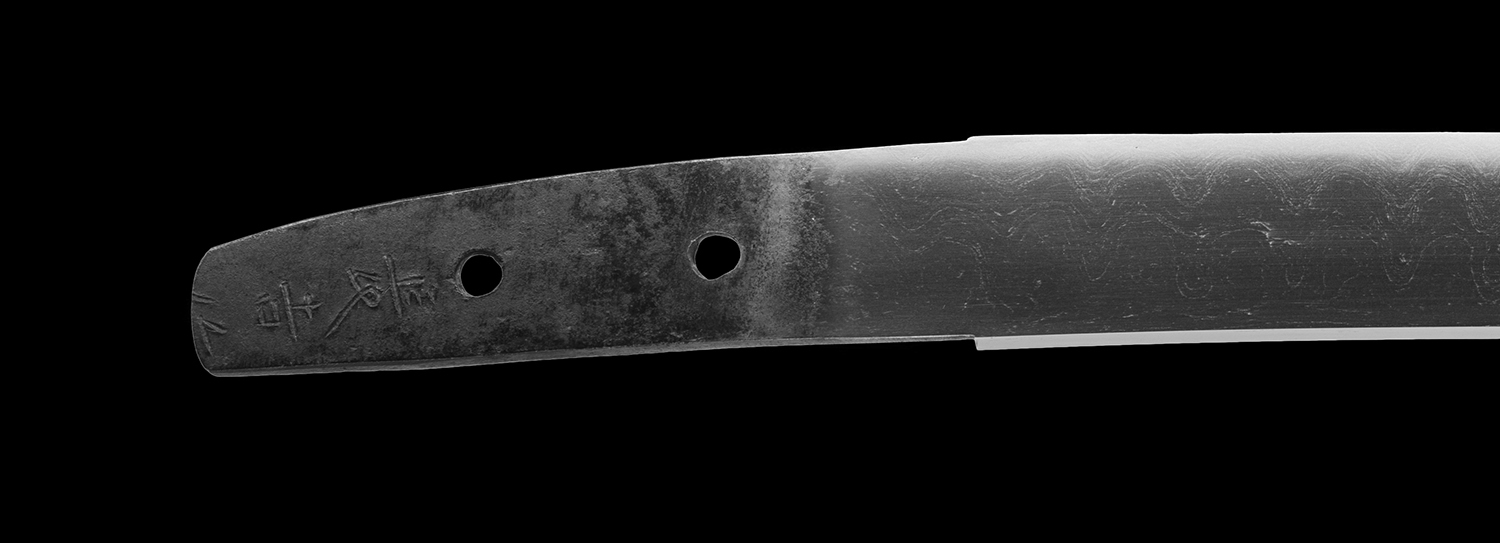
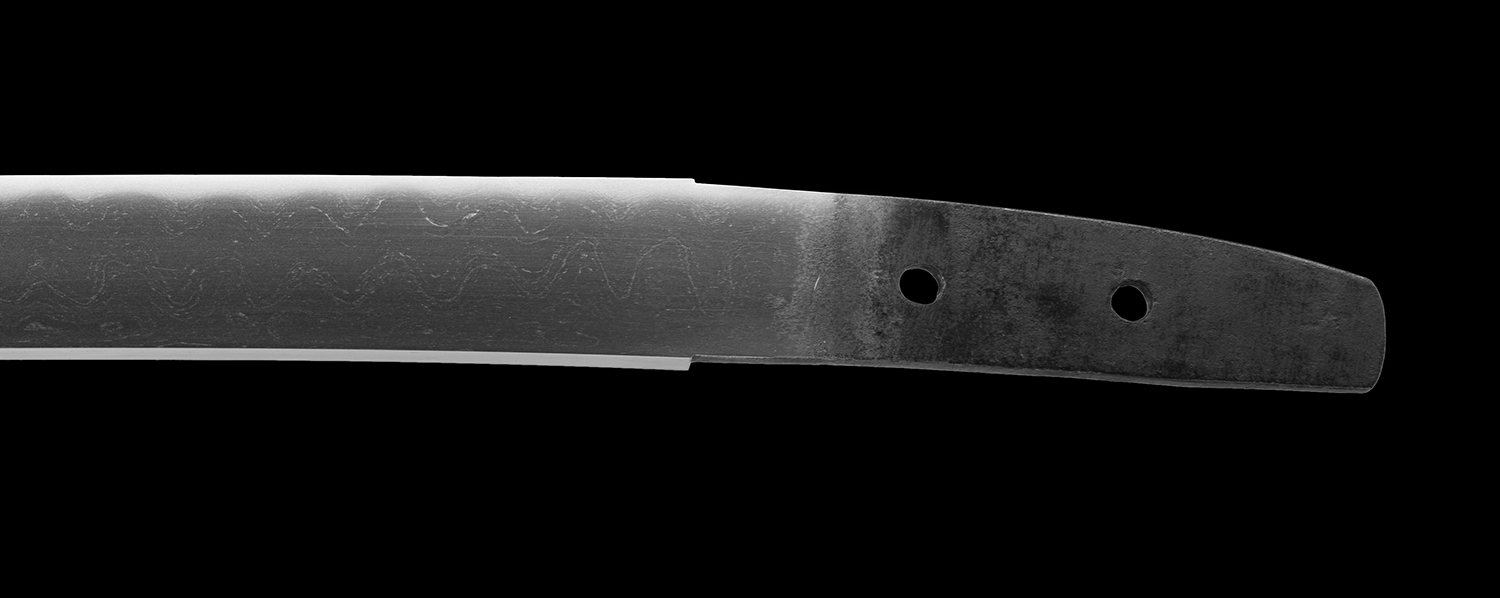
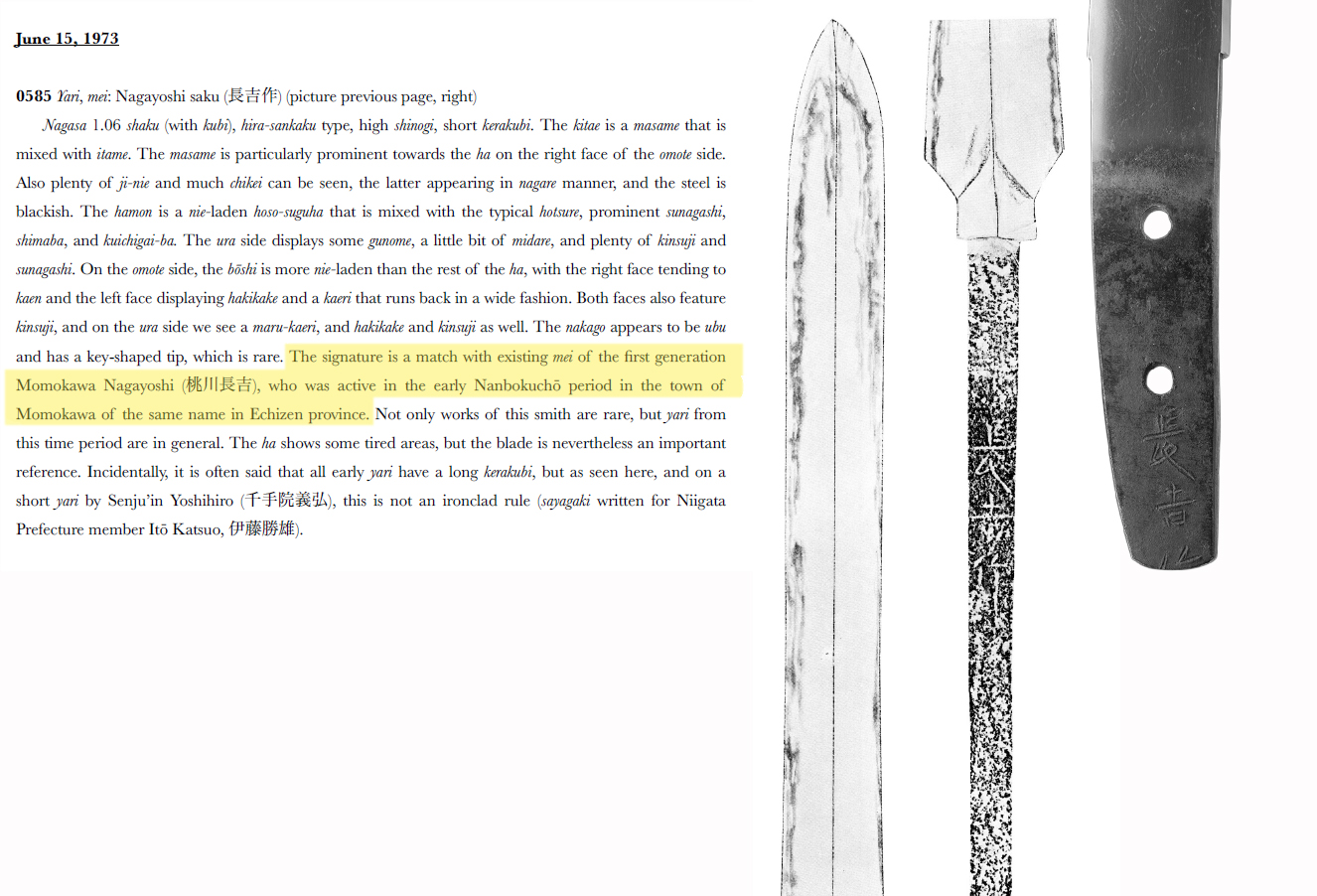
The surviving blades divide into two registers of the one manner. The rarer is the signed tachi, a shinogi-zukuri blade with koshizori and a chu-kissaki, almost ubu, that cuts the long signature toward the mune and carries narrow grooves (細樋) along the shinogi with a plain suken (素剣) in raised relief; over its tight itame the suguha mixes small gunome (小互の目), with chikei (地景) and a bright nioiguchi[[c:1]]. The more numerous register is the hira-zukuri tanto and wakizashi, broad and of slightly extended proportions (寸延び), the tanto with a finely chiseled two-character mei (二字銘) below the mekugi-ana and the wakizashi with the place-name in a five-character signature (五字銘); on the wakizashi a grass-style Kurikara (倶利迦羅) is carved on the omote and a bonji (梵字) with gomabashi (護摩箸) on the ura. Of the wakizashi the published sources judge that it well demonstrates his characteristic style, writing that the blade 「長吉の作風をよく示しており」, the suguha-cho with frequent hotsure and sunagashi taken as the very signature of his manner. The generational question is left open, the literature recording dated examples of the Joji era (貞治) while the extant tachi and tanto are exceedingly few and undated.
For the collector, Nagayoshi is a thin and quiet name rather than a celebrated one, and the honest measure of him is the small body of work on record. The reference texts place him in the Toko Taikan but record no Fujishiro grade, and there is no National Treasure, no Important Cultural Property and no Tokubetsu Juyo among the designated work; the official record runs to three Juyo blades, the tanto, the wakizashi and the tachi by which his hand is read, with no provenance to daimyo houses recorded among them. The signed pieces that survive were held privately, in Niigata and in Shizuoka, when they passed shinsa, and a Momokawa Nagayoshi is met only rarely and almost always signed. Of the tanto the published sources note that it is 「同名中でも時代が古く」, an early and rare survival of the name, while of the rare signed tachi they write 「現存数少ない長吉在銘の太刀として」 its value as reference material is extremely high. When one comes before a student of the northern provinces it is a quiet find rather than a landmark, valued for what the published sources call it, 「長吉研究の好資料の一口である」, an honest and uncommon way to hold the Yamato manner as it was practised far from Yamato, on the Echigo coast.